 Chinese Defense
Saif
Senior Member
- Joined
- Jan 24, 2024
- Messages
- 21,327
- Likes
- 9,697
- Nation

- Residence
- Axis Group

China’s bold move to bypass Western tech dominance
Washington’s continued restrictions on exporting chip technology to Beijing may soon prove futile.
China’s bold move to bypass Western tech dominance

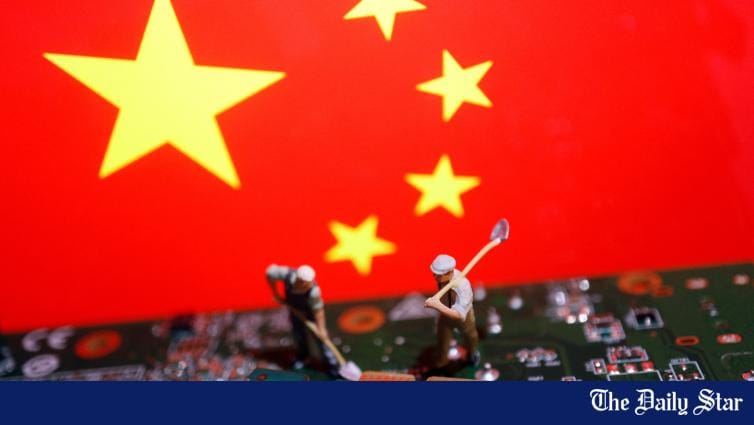
China's CNT gambit represents more than just a response to export controls—it reflects a maturing approach to innovation. PHOTO: REUTERS
Washington's continued restrictions on exporting chip technology to Beijing may soon prove futile because the silicon-based semiconductor industry faces a potent adversary taking shape in China. After decades of silicon dominance, carbon nanotubes are emerging as a promising alternative to transform computing power while dramatically reducing energy consumption. This technological shift may also fundamentally alter the global tech competition, with China charting its innovative path rather than following in Western footsteps.
Traditional silicon chips have improved steadily for decades, following Moore's Law by doubling transistor density roughly every two years. But we're approaching physical barriers that silicon cannot overcome. Modern chips leak electricity and generate excessive heat as transistors shrink to atomic scales, creating serious efficiency problems.
This limitation is particularly problematic for artificial intelligence applications. The New York Times reported that training a single advanced AI model can consume as much electricity as 100 American households use annually.
Carbon nanotubes (CNT)—microscopic cylinders of carbon atoms—offer a compelling alternative with remarkable advantages. First, they conduct electricity far better than silicon. Second, they manage heat more efficiently. Third, they can operate with up to 90 percent less energy. Fourth, they function at smaller scales than silicon can achieve.
According to a recent analysis by The Wall Street Journal, CNT represents not just an improvement in chip technology but potentially a fundamentally different approach to computing architecture.
The emergence of CNT coincides with escalating US-China technology tensions. As Foreign Policy magazine detailed, since 2018, Washington has implemented increasingly stricter controls on selling advanced semiconductors and related technologies to China. But rather than simply attempting to catch up in these areas, China appears to be charting an entirely different course—one focused on leapfrogging current technology. Researchers at Peking University demonstrated carbon nanotube transistors that rival advanced silicon chips while using significantly less power. Besides, the Chinese Academy of Sciences has achieved breakthroughs in solving critical manufacturing challenges.
This approach mirrors China's mobile technology strategy of the early 2000s. It leapfrogged to mobile networks rather than building extensive landline infrastructure as Western countries once did. This technological leap allowed China to bypass decades of development and emerge as a mobile technology leader.
Japan followed a similar path in the 1970s and 1980s. Instead of copying American manufacturing methods, its automakers pioneered lean production techniques that revolutionised the industry. The Harvard Business Review documented how this independent approach transformed Japan from a technological follower to a leader in just one generation. History shows that the most successful technological challengers didn't follow the established path—they found a new one. China's focus on CNT without replicating silicon manufacturing follows this historical pattern.
However, despite promising developments, bringing CNT chips to market presents formidable challenges. First, manufacturing consistency at the industrial scale remains difficult. Second, integration with existing computing architectures requires significant adaptation. Third, building an entirely new supply chain takes time and massive investment. Continued American investment in research and innovation also poses challenges. MIT Technology Review reports that IBM and Intel are pursuing CNT research, while venture capital firms fund several startups focusing on this area.
All these suggest that Washington's restrictions may have inadvertently accelerated Beijing's investment in alternative technologies that could eventually surpass the very technologies being withheld. Any technological divergence could reshape global computing architectures and standards. Devices and systems might develop along increasingly separate paths with different optimisation priorities and capabilities. This potential bifurcation raises important strategic questions about technology adoption, compatibility, and long-term planning for businesses and governments worldwide.
China's CNT gambit represents more than just a response to export controls—it reflects a maturing approach to innovation. Rather than following the established technological roadmap, China is increasingly willing to chart its course. One such example is the launch of DeepSeek, which shook American stock markets to the core.
As we've seen throughout industrial history, technological leapfrogging often succeeds precisely because legacy approaches don't constrain it. From Japan's manufacturing revolution to South Korea's semiconductor rise, countries that find alternative paths frequently move faster than established leaders expect. The most effective technological strategies rarely involve simply catching up—they must find a different way forward, including developing newer technologies and charting different trajectories. China's focus on post-silicon computing suggests it has internalised this lesson.
Whether CNT fulfils its promise or other alternatives emerge, one thing is clear: the future of computing will be shaped not by who can build the best chips under prevailing paradigms but who can pioneer entirely new ones. More DeepSeek moments could be just around the corner.
Dr Sayeed Ahmed is a consulting engineer and the CEO of Bayside Analytix, a technology-focused strategy and management consulting organisation.
China's CNT gambit represents more than just a response to export controls—it reflects a maturing approach to innovation. PHOTO: REUTERS
Washington's continued restrictions on exporting chip technology to Beijing may soon prove futile because the silicon-based semiconductor industry faces a potent adversary taking shape in China. After decades of silicon dominance, carbon nanotubes are emerging as a promising alternative to transform computing power while dramatically reducing energy consumption. This technological shift may also fundamentally alter the global tech competition, with China charting its innovative path rather than following in Western footsteps.
Traditional silicon chips have improved steadily for decades, following Moore's Law by doubling transistor density roughly every two years. But we're approaching physical barriers that silicon cannot overcome. Modern chips leak electricity and generate excessive heat as transistors shrink to atomic scales, creating serious efficiency problems.
This limitation is particularly problematic for artificial intelligence applications. The New York Times reported that training a single advanced AI model can consume as much electricity as 100 American households use annually.
Carbon nanotubes (CNT)—microscopic cylinders of carbon atoms—offer a compelling alternative with remarkable advantages. First, they conduct electricity far better than silicon. Second, they manage heat more efficiently. Third, they can operate with up to 90 percent less energy. Fourth, they function at smaller scales than silicon can achieve.
According to a recent analysis by The Wall Street Journal, CNT represents not just an improvement in chip technology but potentially a fundamentally different approach to computing architecture.
The emergence of CNT coincides with escalating US-China technology tensions. As Foreign Policy magazine detailed, since 2018, Washington has implemented increasingly stricter controls on selling advanced semiconductors and related technologies to China. But rather than simply attempting to catch up in these areas, China appears to be charting an entirely different course—one focused on leapfrogging current technology. Researchers at Peking University demonstrated carbon nanotube transistors that rival advanced silicon chips while using significantly less power. Besides, the Chinese Academy of Sciences has achieved breakthroughs in solving critical manufacturing challenges.
This approach mirrors China's mobile technology strategy of the early 2000s. It leapfrogged to mobile networks rather than building extensive landline infrastructure as Western countries once did. This technological leap allowed China to bypass decades of development and emerge as a mobile technology leader.
Japan followed a similar path in the 1970s and 1980s. Instead of copying American manufacturing methods, its automakers pioneered lean production techniques that revolutionised the industry. The Harvard Business Review documented how this independent approach transformed Japan from a technological follower to a leader in just one generation. History shows that the most successful technological challengers didn't follow the established path—they found a new one. China's focus on CNT without replicating silicon manufacturing follows this historical pattern.
However, despite promising developments, bringing CNT chips to market presents formidable challenges. First, manufacturing consistency at the industrial scale remains difficult. Second, integration with existing computing architectures requires significant adaptation. Third, building an entirely new supply chain takes time and massive investment. Continued American investment in research and innovation also poses challenges. MIT Technology Review reports that IBM and Intel are pursuing CNT research, while venture capital firms fund several startups focusing on this area.
All these suggest that Washington's restrictions may have inadvertently accelerated Beijing's investment in alternative technologies that could eventually surpass the very technologies being withheld. Any technological divergence could reshape global computing architectures and standards. Devices and systems might develop along increasingly separate paths with different optimisation priorities and capabilities. This potential bifurcation raises important strategic questions about technology adoption, compatibility, and long-term planning for businesses and governments worldwide.
China's CNT gambit represents more than just a response to export controls—it reflects a maturing approach to innovation. Rather than following the established technological roadmap, China is increasingly willing to chart its course. One such example is the launch of DeepSeek, which shook American stock markets to the core.
As we've seen throughout industrial history, technological leapfrogging often succeeds precisely because legacy approaches don't constrain it. From Japan's manufacturing revolution to South Korea's semiconductor rise, countries that find alternative paths frequently move faster than established leaders expect. The most effective technological strategies rarely involve simply catching up—they must find a different way forward, including developing newer technologies and charting different trajectories. China's focus on post-silicon computing suggests it has internalised this lesson.
Whether CNT fulfils its promise or other alternatives emerge, one thing is clear: the future of computing will be shaped not by who can build the best chips under prevailing paradigms but who can pioneer entirely new ones. More DeepSeek moments could be just around the corner.
Dr Sayeed Ahmed is a consulting engineer and the CEO of Bayside Analytix, a technology-focused strategy and management consulting organisation.