[🇨🇳] China-Russia Strategic Partners

[🇨🇳] China-Russia Strategic Partners
6
214
More threads by Saif

G   Chinese Defense

Saif

Senior Member
Joined
Jan 24, 2024
Messages
19,178
Likes
8,863
Nation

Residence

Axis Group

Date of Event: Jul 16, 2025
China’s Xi vows greater support for Russia in Lavrov meeting

AFP Beijing
Published: 15 Jul 2025, 13: 36

1752627048971.webp

China's President Xi Jinping. File photo

Chinese President Xi Jinping told Russia’s top diplomat on Tuesday that their countries should “strengthen mutual support”, state media said, as foreign ministers gathered in Beijing for Shanghai Cooperation Organisation talks.

Meeting Sergei Lavrov in Beijing, Xi said the two countries should “strengthen mutual support on multilateral forums”, according to state news agency Xinhua.

Beijing and Moscow should work to “unite countries of the global South and promote the development of the international order in a more just and reasonable direction”, Xi said, according to Xinhua.

Russia’s foreign ministry said in an earlier statement that “a number of issues of bilateral political contacts at the highest and high levels were discussed”.

They included preparations for President Vladimir Putin’s visit to China to join a Shanghai Cooperation Organisation (SCO) summit and World War II anniversary celebrations.

Russia’s TASS news agency reported that Xi met Lavrov after the Chinese president held a “general meeting” with SCO foreign ministers.

Lavrov met Sunday with his Chinese counterpart Wang Yi to discuss Ukraine and relations with the United States.

The Russian foreign minister arrived in China following a visit to North Korea, where he received assurances of support in its conflict with Ukraine.

Beijing, a diplomatic and economic ally of Moscow, claims to be neutral in the conflict between Russia and Ukraine.

But China has never denounced Russia’s more than three-year military campaign nor called for it to withdraw its troops, and many of Ukraine’s allies believe that Beijing has provided support to Moscow.

China regularly calls for an end to the fighting, while also accusing Western countries of prolonging the conflict by arming Ukraine.

Beijing has long sought to present the 10-member SCO as a counterweight to Western-led power blocs such as NATO.

It has pushed to strengthen collaboration between its member countries in politics, security, trade and science.

Top diplomats from the SCO are convening in Beijing this week for a meeting of the Council of Foreign Ministers, including Lavrov, India’s Subrahmanyam Jaishankar and Iran’s Abbas Araghchi.

Xi noted Tuesday that “political mutual trust among member states has deepened”, according to state broadcaster CCTV.

The SCO “has successfully explored a path of regional cooperation that aligns with the trends of the times and meets the needs of all parties, setting a model for a new type of international relations,” Xi said.​
 

Xi tells Putin China welcomes fresh US-Russia contacts as Trump seeks end to Ukraine war

REUTERS
Published :
Aug 08, 2025 18:41
Updated :
Aug 08, 2025 18:41

1754700957619.webp

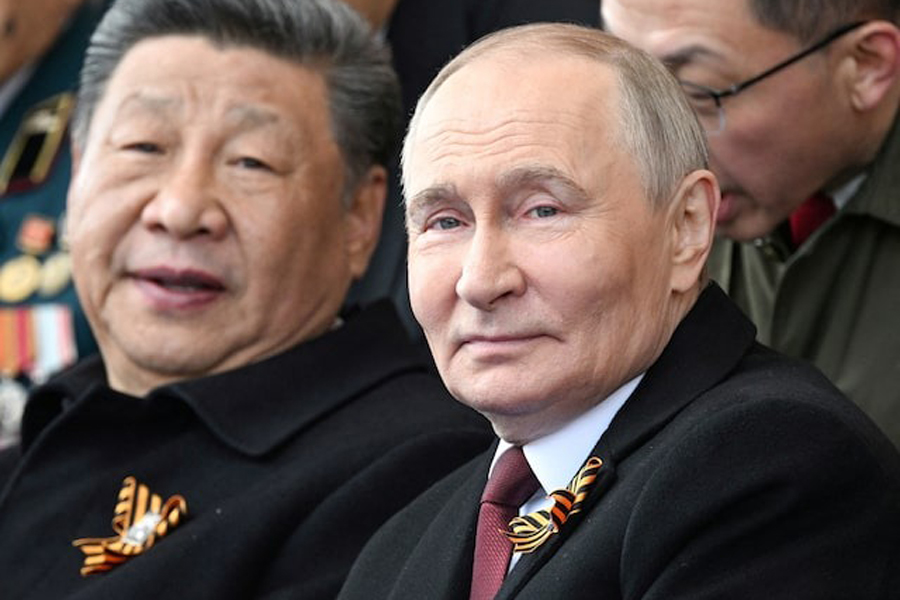
Russian President Vladimir Putin and his Chinese counterpart Xi Jinping attend a military parade on Victory Day, marking the 80th anniversary of the victory over Nazi Germany in World War Two, in Red Square in central Moscow, Russia, May 9, 2025. Photo : Sergei Bobylyov/Host agency RIA Novosti/Handout via REUTERS/Files

China is pleased to see Russia and the United States maintaining contact and improving ties to advance a political resolution of the Ukraine crisis, President Xi Jinping said in a phone call with Russian President Vladimir Putin on Friday.

Beijing will maintain its stance on the need for peace talks and a diplomatic solution to the conflict, Chinese state broadcaster CCTV quoted Xi as telling Putin.

The call was held at Putin's request, CCTV said.

The call came after the Kremlin said on Thursday that Putin would meet U.S. President Donald Trump in the coming days in the search for an end to the war, now in its fourth year.

Trump took a more conciliatory approach towards Russia after returning to the White House in January but has voiced growing frustration with Putin over the lack of progress towards peace and has threatened to impose heavy tariffs on countries including China that buy Russian oil.

Trump on Wednesday said he could announce further tariffs on China similar to the 25% duties he has already imposed on India over its purchases of Russian oil.

A Chinese foreign ministry spokesperson, in response to those remarks by Trump, said on Friday that China's trade and energy cooperation with Russia was "just and legitimate".

"We will continue to take reasonable measures to ensure energy security based on our own national interests," spokesperson Guo Jiakun said in a statement released by the Chinese Foreign Ministry.

Friday's call between Xi and Putin was their second in less than two months.

The two countries have further bolstered their economic, trade and security cooperation since Russia's full-scale invasion of Ukraine in February 2022, which triggered a sharp deterioration in Moscow's relations with the West.

Putin is expected to visit China in September for events marking the 80th anniversary of the end of World War Two.​
 

Xi, Putin hail ‘stabilising’ China-Russia alliance
Agence France-Presse . Beijing, China 04 February, 2026, 22:52

1770281322307.webp

Xi Jinping ,Vladimir Putin

China’s president Xi Jinping and Russian leader Vladimir Putin hailed their countries’ ‘stabilising’ economic, political and security alliance in the face of ‘turbulent’ times globally, as they spoke via video call on Wednesday.

Moscow and Beijing have sought to present a united front against the West, with ties deepening since Russia’s 2022 Ukraine offensive.

The call comes days after top officials from both countries agreed ties could ‘break new ground’ this year as Moscow and Beijing ramp up economic cooperation.

‘Since the beginning of the year, the international situation has become increasingly turbulent,’ Xi told Putin in a readout reported by Chinese state broadcaster CCTV.

‘Both sides should ensure that China-Russia relations continue to develop steadily along the right track, through deeper strategic coordination and a more proactive and effective commitment as major powers,’ the Chinese president said.

Addressing Xi as his ‘dear friend’, Putin expressed a similar message, saying ‘the foreign policy alliance between Moscow and Beijing remains an important stabilising factor’.

‘The Russian-Chinese comprehensive partnership and strategic cooperation is exemplary,’ Putin said in the video broadcast on Russian state TV.

Neither leader went into detail on what strategic areas they would deepen coordination on.

Putin praised trade ties, with Moscow redirecting its exports to Asia after Western countries imposed massive sanctions on Russia over the Kremlin’s Ukraine offensive.

China has never denounced Russia’s war or called for it to withdraw troops, and many of Ukraine’s allies believe that Beijing has provided support to Moscow.

The video call took place as Russian, Ukrainian and US negotiators met in Abu Dhabi for another round of talks on ending the almost four-year war.

But Putin made no mention of Ukraine during his call with Xi.

The two leaders last met in person in September, when the Russian leader attended a massive military parade in Beijing.

Xi also visited Moscow last year, in May, for Russia’s celebrations of the World War II defeat of the Nazis.

On Sunday, China’s foreign minister Wang Yi met with Russia’s security chief Sergei Shoigu in Beijing.

Wang told Shoigu that China and Russia must work together to uphold multilateralism in a time of ‘turmoil’, and ‘advocate for an equal and orderly multipolar world’, according to China’s foreign ministry.

The call with Putin follows a series of meetings between Xi and various leaders in recent months, as he consolidates diplomatic support in the face of an increasingly unpredictable United States.

During the call, Xi reiterated his commitment to the international system with the United Nations at its core.

He has stressed the importance of the United Nations—where China holds a permanent seat on the Security Council with veto rights — in recent talks with leaders from France, Canada, Britain and Brazil.

US president Donald Trump unveiled plans for a ‘Board of Peace’ in January, which has sparked concerns Washington wants to rival the United Nations.

China engages with the international body even as it has objected to what it terms internal interference.

Beijing has also sought to position itself as a stable alternative to Washington, hosting Western leaders including US allies recoiling from Trump’s bid to seize Greenland and tariff threats.

Leaders from France, Canada and Finland have flocked to Beijing in recent weeks, as well as Beijing’s traditional ally Uruguay.​
 

Putin visit to China will take place very soon, Kremlin says

REUTERS

Published :
May 14, 2026 17:31
Updated :
May 14, 2026 17:31

1778802892651.webp


Russian President Vladimir Putin will visit China very soon and preparations for the trip are already complete, Kremlin spokesman Dmitry Peskov said on Thursday.

Putin and Chinese President Xi Jinping have met more than 40 times over the years, most recently in Beijing last September.

The two men signed a "no limits" strategic partnership in February 2022, less than three weeks before Russia went to war in Ukraine.

US President Donald Trump is visiting China this week.​
 

Putin to visit China May 19-20 after Trump
Agence France-Presse . Moscow, Russia 17 May, 2026, 00:21

1778989073764.webp

Russian president Vladimir Putin.

Russian president Vladimir Putin will travel to China on May 19 for a two-day visit, hot on the heels of US President Donald Trump’s trip to Beijing, the Kremlin said on Saturday.

During the trip, the Russian leader will discuss with his Chinese counterpart Xi Jinping how to ‘further strengthen the comprehensive partnership and strategic cooperation’ between Moscow and Beijing, according to a Kremlin statement.

Putin and Xi will ‘exchange views on key international and regional issues’ and sign a joint declaration at the conclusion of their talks, it added.

As part of the visit, Putin is also scheduled to discuss economic and trade cooperation with Chinese premier Li Qiang.

The announcement of Putin’s trip comes just after Trump wrapped up on Friday the first visit to China by a US president in nearly a decade, with the grand reception belying a roster of unresolved trade and geopolitical tensions, including over the Ukraine-Russia conflict.

Although Trump and Xi discussed the more than four-year-long conflict—as well as the US leader’s stalemated war with Iran—the Republican president took off from China on Friday without appearing to secure a breakthrough on either front.

Negotiations to end the fighting in Ukraine, brokered by the United States, have appeared stalled since the beginning of the US-Israeli war with Iran which broke out on February 28.

Before Trump arrived in China, Ukraine’s president Volodymyr Zelensky asked the US leader to raise the matter of how to stop the conflict during the talks with Xi.

Moscow has ruled out a ceasefire or comprehensive negotiations with Ukraine unless Kyiv caves to the Kremlin’s maximalist demands.

While China has regularly called for talks to end the fighting, it has never condemned Russia for sending troops into Ukraine in February 2022 and presents itself as a neutral party.

Beijing also denies providing Moscow with weapons and military components for its defence industry, blaming Western countries for prolonging Europe’s deadliest conflict since World War II by arming Ukraine instead.

As the world’s top buyer of Russian fossil fuels, China has become Moscow’s key economic partner, especially since Western countries imposed economic sanctions on Russian oil and gas over the conflict.

Trump left China on Friday claiming he had negotiated ‘fantastic’ trade deals, including a commitment for Beijing to purchase 200 Boeing aeroplanes as well as US oil and soybeans.

But the details were vague or scanty, while China made no formal announcement on any trade deal.

In contrast to Trump—who described Xi as a ‘great leader’ and ‘friend’—Beijing’s response to the summit as a whole was more muted.

Russia’s top diplomat on Friday welcomed the China-US summit, but said that Moscow enjoyed warmer ties with Beijing.

‘If the agreements reached or to be reached by Beijing and Washington are in the interests of our Chinese friends, we can only be delighted,’ Sergey Lavrov told a press conference in New Delhi.Media Consulting Services

But Lavrov insisted that Russia was ‘bound to China by ties... that are deeper and stronger than traditional political and military alliances’.​
 

Putin, Xi hail 'unyielding' ties in talks after Trump visit

AFP
Beijing
Published: 20 May 2026, 15: 56

1779332332936.webp

Russia's President Vladimir Putin and China's President Xi Jinping exchange documents during a signing ceremony following their talks in Beijing on 20 May 2026. AFP

President Xi Jinping hailed China and Russia's "unyielding" ties in talks with Vladimir Putin on Wednesday, as the pair met to underscore their alliance days after Donald Trump's own visit to Beijing.

The two countries' ties have deepened since Moscow's 2022 invasion of Ukraine, as Russia has become increasingly dependent on China, its main oil customer.

Putin was received by Xi outside Beijing's opulent Great Hall of the People in much the same fashion as Trump last week, complete with chanting children and military fanfare.

But the language was much warmer, with Xi telling the Russian leader Beijing and Moscow have "continuously deepened our political mutual trust and strategic coordination with a resilience that remains unyielding", according to Chinese state media.

Opening talks, both were quick to laud their countries' special ties as they extended their treaty of "friendly cooperation".

Putin, quoting a Chinese phrase, told Xi: "A day apart feels like three autumns," adding that relations had reached an "unprecedentedly high level" despite "unfavourable external factors", Russian media footage showed.

In an apparent swipe at the United States, Xi warned of "unilateral and hegemonic countercurrents running rampant" in the world.

In contrast to Trump's visit last week, which yielded little in the way of immediate concrete announcements, Putin and Xi signed a slew of agreements on Wednesday on trade, media and energy.

The two leaders will have tea later, at which "the most important issues" such as Ukraine, Iran and relations with the US will be discussed, Kremlin foreign policy aide Yuri Ushakov told Russian state media on Monday.

"It could be a very long discussion," he added.

Fossil fuel push

Beneath the camaraderie, Putin is now perceived by many to be the junior partner in the relationship.

The Russian leader has been weakened over four years of the Ukraine conflict, with his country's economy shrinking in the first quarter of the year as factors such as wartime spending, labour shortages and sanctions take their toll.

Analysts believed Putin would use his visit to push for progress on the "Power of Siberia 2", a major natural gas pipeline running from Russia to China through Mongolia -- a land alternative to crude imported by sea from the Middle East.

But Kremlin spokesman Dmitry Peskov told Russian media Wednesday that while the two sides had reached a "basic understanding" -- including on "the route and how it will be built" -- there was no "clear timeline", and "there are still some details to be worked out".

The US-Israel war on Iran has hampered crude and gas flows from the Middle East, giving an opportunity for Putin to offer Russian energy sources as an alternative.

"Russia and China are actively cooperating in the energy sector... We are, of course, ready to continue reliably supplying all these types of fuel to the rapidly growing Chinese market," Putin said Wednesday.

His priorities may differ from China's, which wants the Middle East conflict concluded as soon as possible.

Underlining that, Xi told Putin on Wednesday that "a comprehensive ceasefire is of utmost urgency, resuming hostilities is even more inadvisable and maintaining negotiations is particularly important".

'Sovereign foreign policy'

Xi has played host to a series of world leaders as an increasingly unpredictable United States under Trump has pushed many to shore up alliances with Beijing.

Many have urged him to use his influence with Russia and Iran to help bring an end to the respective conflicts there.

Ukrainian President Volodymyr Zelensky had asked Trump to discuss ending the war with Xi during his trip last week.

The pair did talk about the issue, but the US president left China without a breakthrough.

Beijing has regularly called for talks to end the war in Ukraine, but has never condemned Russia for sending in troops -- presenting itself instead as a neutral party.

On Wednesday Putin said that Russia and China were "committed to an independent and sovereign foreign policy, are working together in close strategic cooperation and playing an important stabilising role on the global stage".​
 

China-Russia ties ‘stabilising global force’
Says Xi, slams ‘law of the jungle’ as he hosts Putin after Trump

Agencies

1779333442925.webp

Russian President Vladimir Putin and Chinese President Xi Jinping shake hands during a signing ceremony at the Great Hall of the People in Beijing, China yesterday. Photo: Reuters

Xi Jinping said the world was at risk of regressing into the “law of the jungle” and hailed the China-Russia relationship as a stabilising global force as he hosted Vladimir Putin in Beijing yesterday, just days after hosting Donald Trump.

The Chinese leader welcomed the Russian president with pomp and pageantry as the pair began talks in the Great Hall of the People.

Chinese soldiers stood in position as a military band played the Russian and Chinese national anthems for the leaders in central Beijing. Children waved Russian and Chinese flags and cheered: “Welcome, welcome!” in Chinese before the pair entered the Great Hall.

The scene was reminiscent of Trump’s high-profile meeting with Xi in Beijing last week, when the leaders of the world’s two largest economies discussed issues from trade and investment to the Iran conflict and Taiwan.

1779333472502.webp


Talks between Xi and Putin began with a shorter “narrow format meeting”, featuring fewer delegates to discuss sensitive issues. The leaders then held a “wide format meeting” with their delegations that ended at about 2:00pm local time.

Xi and Putin then attended a signing ceremony for numerous documents spanning technology, trade, scientific research, and intellectual property. Among the documents, according to Chinese state media, was an extension of the “China-Russia treaty of good neighbourliness and friendly cooperation”, first signed 25 years ago.

In comments after the signing ceremony, Xi said relations between Beijing and Moscow were at “the highest level of comprehensive strategic partnership”, as he called on both countries to oppose “all unilateral bullying” in the international arena.

Xi’s sentiments echoed his opening remarks, in which he said the world was in danger of reverting back to the “law of the jungle”. He added that further hostilities in the Middle East were “inadvisable”, and a “comprehensive ceasefire is of utmost urgency”, state media reported.

In his opening remarks, Putin hailed the countries’ relationship as being at an “unprecedentedly high level”, as he said Moscow remained a “reliable energy supplier” amid the ongoing Middle East crisis. Putin also invited Xi to visit Russia next year.

Later, Russia and China, in a joint declaration, reiterated Xi’s remarks and said that attempts by some countries to dominate global affairs in the spirit of the colonial era had failed but that the world was in danger of a return to the “law of the jungle”.

“The global situation is becoming more complex,” they said in a declaration released by the Kremlin in Russian. “The global peace and development agenda is facing new risks and challenges, and there is a danger of fragmentation of the international community and a return to the ‘law of the jungle’.”

“Attempts by a number of states to unilaterally manage global affairs, impose their interests on the entire world, and limit the sovereign development of other countries, in the spirit of the colonial era, have failed.”

The statement also criticised the Golden Dome missile defence shield plans and Washington’s “irresponsible” nuclear policy.

It said Trump’s plan for a ground- and space-based missile interceptor system threatened global strategic stability and criticised Washington over the expiry of the treaty restricting US and Russian nuclear arsenals.

The treaty lapsed in February, and Trump did not respond to Moscow’s proposal to extend it by a year, after some US politicians argued that Washington needed to grow its arsenal to counter China, which says its buildup is far smaller.

Xi later hosted Putin for tea in Zhongnanhai, the former imperial garden that now houses the Chinese Communist party’s headquarters. When the Chinese leader hosted his Russian counterpart in May 2024, the pair did the same, appearing at ease as they ditched their ties while chatting.

China’s foreign minister, Wang Yi, who greeted Putin when he landed in Beijing on Tuesday evening, is also expected to hold talks with his Russian counterpart, Sergei Lavrov.

Reciprocal trade and investment are likely to be top of the agenda for Putin as his sanctions-hit economy suffers under the growing cost of Moscow’s war in Ukraine. China, Russia’s largest trading partner, buys almost half of Moscow’s oil exports.

In contrast to the adversarial nature of Washington and Beijing’s relationship, Putin and Xi have signalled an increasingly warm bond over recent years, with the leaders labelling one another “dear” ⁠and “old” friends. The warm greetings once again flowed on Wednesday, as Putin recalled a Chinese proverb marking his eager anticipation of their reunion: “Even if we haven’t seen each other for a day, it feels like three autumns have passed.”

As Xi was preparing to welcome Putin, the Chinese commerce ministry confirmed China would buy 200 Boeing jets and seek an extension of the trade agreement with the US that was reached in Kuala Lumpur last year. The statement marked Beijing’s first confirmation of the Boeing order, which Trump alluded to last week.

The Russian news agency Interfax said Peskov did not rule out a meeting between Putin and Trump in November, when both leaders could attend the Apec summit in China.​
 

Latest Posts

Back