[🇧🇩] Corruption Watch

Quick Reply ✓ Posted!
[🇧🇩] Corruption Watch
410
20K
More threads by Saif

G Bangladesh Defense

ILLICIT FUNDS INCREASINGLY FLOWING TO FINANCIAL HUBS

Bangladesh deprived of $410m in taxes in 2022 alone: TJN data

1791156275489.webp


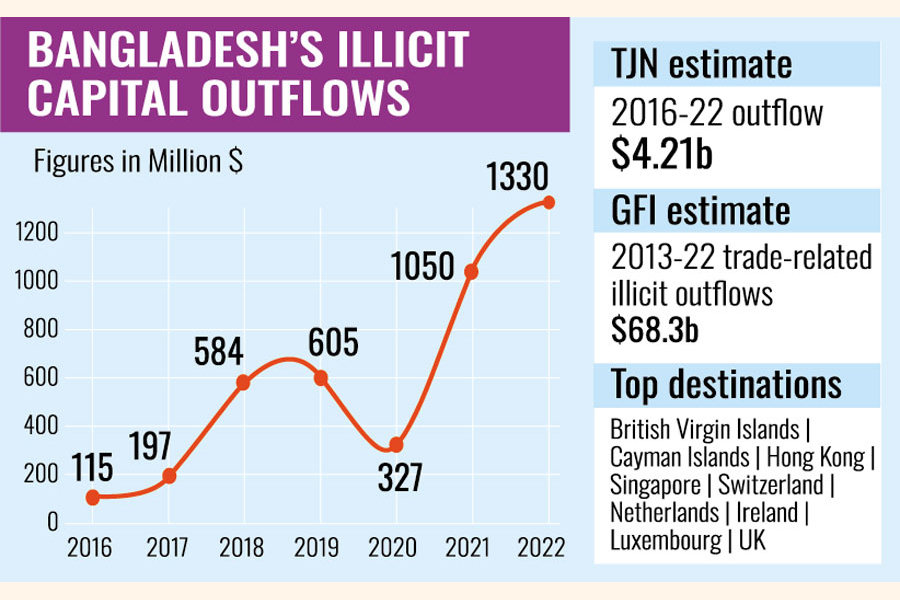
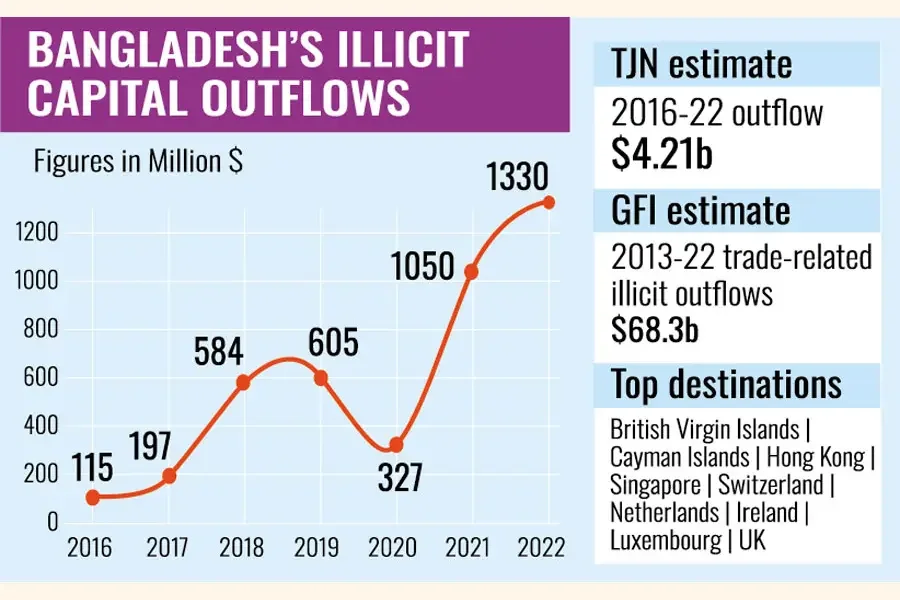
Bangladesh's illicit capital outflows reached a seven-year high of US$1.33 billion in 2022, with the associated tax loss estimated at around $410 million, according to an analysis of data compiled by the UK-based Tax Justice Network (TJN).

The data show that Bangladesh recorded a total of around $4.21 billion in estimated illicit financial outflows between 2016 and 2022, with the destinations increasingly comprising a mix of traditional offshore financial centres and major international financial hubs.

Overall, estimated illicit outflows increased more than sixfold between 2016 and 2022.

The tax loss is calculated separately from the illicit financial outflow.

It is estimated by applying Bangladesh's corporate income tax rate to the corporate component of illicit financial flows and its personal income tax rate to a standard interest rate applied to the offshore wealth component.

A review of the TJN data of illicit financial flows (IFF) by the Financial Express shows that several jurisdictions repeatedly featured among the top destinations for Bangladesh's illicit capital outflows, including the British Virgin Islands, Cayman Islands, Hong Kong, Singapore, Switzerland, the Netherlands, Ireland and Luxembourg.

These jurisdictions have also featured prominently in international assessments of financial secrecy and corporate tax-haven activity.

Professor Mustafizur Rahman, distinguished fellow of the Centre for Policy Dialogue (CPD), said the countries appearing in the data should not necessarily be considered the ultimate destinations of the funds.

"Many of those countries are used as transit points for capital outflows to shift money to other countries," he said.

Countries with flexible tax and investment regimes and strict confidentiality of banking information can become favourable destinations or intermediaries for cross-border capital movements, he added.

Dr Mustafiz also noted that the TJN estimates differ from those of Global Financial Integrity (GFI), which has focused on illicit financial flows associated with trade misinvoicing, including under- and over-invoicing.

On March 2026, a GFI finding says Bangladesh lost an estimated $68.3 billion through trade-related illicit financial flows between 2013 and 2022 (averaging about $6.8 billion annually).

The TJN methodology covers several forms of illicit financial activity. In the case of multinational companies, it estimates profits shifted to low-tax jurisdictions by comparing reported profits with the profits that would normally be expected based on a country's economic activity.

The TJN also estimates offshore wealth, covering wealth belonging to residents that is held abroad but not properly reported. Its calculations examine unusually large cross-border bank deposits and investments against what would normally be expected from the economic relationships between countries.

Because these figures are estimates based on statistical methodologies, they may vary depending on the methodology and year used, the TJN says.

Sharp rise after 2020

Bangladesh's estimated illicit financial outflows stood at $115 million in 2016, and $197 million in 2017 before rising to $584 million in 2018 and $605 million in 2019.

The outflow declined to $327 million in 2020, coinciding with the Covid-19 pandemic, but surged to $1.05 billion in 2021 and further to $1.33 billion in 2022, the highest level recorded during the seven-year period.

The 2022 figure was around 27 per cent higher than in 2021 and more than four times the 2020 level.

Shift towards financial hubs

The destination pattern indicates that Bangladesh's illicit capital movements have been routed through a combination of traditional offshore centres and mainstream international financial and corporate hubs.

Hong Kong featured among the top 10 destinations in all seven years from 2016 to 2022, while the Cayman Islands also appeared in the top 10 throughout the period.

The British Virgin Islands featured in six of the seven years and ranked first in 2022, followed by Hong Kong and the Cayman Islands.

The Cayman Islands ranked first in 2016, 2017 and 2021, while Hong Kong topped the list in 2018, 2019 and 2020.

Singapore was another recurring destination, while the Netherlands, Ireland, Switzerland, Luxembourg and the United Kingdom repeatedly appeared among the leading jurisdictions.

The composition of the top 10, however, changed from year to year. Jersey and Bermuda featured prominently in 2021, while Mauritius, Denmark and Chile entered the top 10 in 2022. Portugal appeared in 2018, while Spain featured in 2016-17.

The changing composition suggests that illicit capital movements may increasingly be routed through a combination of traditional offshore centres, financial hubs, corporate holding jurisdictions and financial intermediaries, rather than being concentrated in a single group of offshore destinations.​
 

Corruption: the hidden tax on Bangladesh's development


1791157394702.webp


Development is often measured in kilometres of highways, megaprojects, power generation, exports and gross domestic product (GDP) growth. But there is another measure that receives far less attention: how much a citizen must pay, wait or struggle to obtain a service that should be available as a right.

That is where corruption becomes more than a moral problem. It becomes an economic problem, and potentially one of the biggest hidden taxes on development.

A society does not become corrupt overnight. Corruption becomes entrenched when dishonest behaviour gradually becomes socially acceptable. The student who cheats is praised for being clever; the employee who advances through connections is described as well-connected; the businessman who accumulates wealth through questionable means is admired for his success. Meanwhile, someone who insists on following the rules may be considered impractical.

When such attitudes become normal, institutions weaken and the cost of doing business rises.

Research using World Values Survey data has found a relationship between generalised morality, trust and economic growth, suggesting that trust can be particularly important where economic institutions are weak. The implication for developing economies is significant: when people trust institutions and each other, transactions become easier; when trust collapses, the cost of doing business rises.

This matters for Bangladesh because the latest evidence suggests that corruption is not merely an occasional inconvenience. It is affecting the everyday relationship between citizens and institutions.

Transparency International Bangladesh's National Household Survey 2025 found that 81.6 per cent of households experienced corruption while accessing services, while 63.6 per cent were compelled to pay bribes. The estimated value of bribe transactions during the survey period was Tk 126.33 billion, equivalent to 1.58 per cent of the revised national budget for FY25 and 0.23 per cent of GDP. The survey covered 15,715 households, with the reference period from November 2024 to October 2025.

The numbers become even more disturbing when we look beyond the headline figure. TIB found that 81.5 per cent of households that paid bribes said services could not be obtained without paying one. More than half of households did not know how to lodge a corruption complaint, and only 10.3 per cent of households that experienced corruption actually filed complaints. Among those who did not complain, 61.3 per cent said they regarded corruption as an inherent part of the service system and saw little point in complaining.

The burden is also unequal. TIB reports that, in the five most corruption-prone sectors, households below the poverty line spent an average 5.1 per cent of annual income on corruption, compared with 3.2 per cent for households above the poverty line. Corruption therefore functions like a regressive tax: the poorer the household, the greater the relative burden.

The economic consequences extend further. Corruption can increase the cost and uncertainty of obtaining licences, approvals, land, transport, customs and other services. It can discourage entrepreneurs from expanding, distort competition and make investors more cautious. This is particularly damaging when Bangladesh needs higher private investment and more productive employment.

The connection with inflation and unemployment should also be understood carefully. Corruption is not the sole cause of either. Inflation has many drivers, including food and energy prices, exchange-rate movements, monetary conditions and supply disruptions. Yet corruption can add to cost pressures when unofficial payments, procurement irregularities and administrative delays increase the cost of producing and moving goods. Similarly, corruption does not automatically create unemployment, but an environment that discourages investment and rewards connections over efficiency can weaken the creation of productive jobs.

Bangladesh is already facing this broader economic pressure. The World Bank has identified persistent inflation, subdued private investment and weak job creation as important concerns, while stressing the need to improve the business environment and strengthen institutions.

International experience shows that corruption can be tackled more effectively when enforcement is combined with institutional design. Singapore, for example, relies on the Prevention of Corruption Act and the Corrupt Practices Investigation Bureau, while also emphasizing clear procurement procedures, conflict-of-interest declarations, audits and accessible reporting channels.

India provides another relevant example. Its Right to Information framework seeks to promote transparency and accountability, while electronic public procurement and the Government e-Marketplace have been developed to make procurement more transparent and standardised. Indonesia, meanwhile, has used electronic purchasing and procurement controls as part of its anti-corruption efforts, with its Corruption Eradication Commission identifying public procurement as a major area of corruption risk.

Bangladesh already possesses an important transparency instrument: the Right to Information Act, 2009. The problem is not simply the absence of law; it is whether citizens know how to use it and whether public institutions proactively disclose information. The Information Commission provides mechanisms for citizens to seek information and complain when access is denied. TIB's latest findings show why greater public awareness is essential.

Therefore, anti-corruption reform should move from slogans to systems.

Every public service should have a clearly published fee, process and delivery deadline. Applications should be digitally traceable. Government procurement, project costs, work orders, contract awards and implementation progress should be disclosed proactively wherever legally possible. Citizens should be able to compare what was approved, what was spent and what was delivered.

Complaint mechanisms also need credibility. TIB found that among corruption complaints filed, no action was taken in 51 per cent of cases. Such experiences inevitably weaken public confidence.

Public officials should face meaningful conflict-of-interest rules and asset-disclosure requirements. Recruitment, transfers and promotions should reward competence and integrity rather than connections. Whistleblowers and complainants should be protected from retaliation.

There is also encouraging evidence that Bangladesh can move in this direction. In 2025, the World Bank approved US$250 million to support stronger transparency, accountability and efficiency in key public institutions, including public procurement, revenue mobilisation, statistics, planning and financial oversight, with digitisation identified as a means of improving transparency and reducing corruption.

Ultimately, however, institutions alone cannot solve the problem. Businesses that offer bribes, citizens who participate in bribery when alternatives exist, and a society that celebrates unexplained wealth all contribute to the ecosystem of corruption.

Bangladesh has invested enormously in physical infrastructure and economic capacity. The next stage of development requires equal investment in institutional integrity.

A road can connect two cities, but a trustworthy institution can connect citizens to opportunity. A bridge can carry vehicles, but rule-based governance can carry an economy forward.

The real cost of corruption is not only the money paid under the table. It is the investment that never comes, the business that never grows, the job that is never created, the service that never reaches the poor and the trust that disappears from society. Fighting corruption, therefore, is not simply about protecting morality-it is about protecting Bangladesh's development itself.

The writer is former president of FICCI and AmCham Bangladesh.​
 

‘ACC must be freed from political and bureaucratic influence’

Tasneem Tayeb


1791865975863.webp

Dr Iftekharuzzaman, Photo: Star

Dr Iftekharuzzaman, executive director of Transparency International Bangladesh (TIB) and former head of the Anti-Corruption Commission (ACC) Reform Commission, speaks to Tasneem Tayeb of The Daily Star about the state of corruption in Bangladesh, the fate of reform efforts, and the changes needed to hold those in power accountable.

ACC was established in 2004 as an independent institution to combat corruption. More than two decades later, corruption remains deeply embedded in the public sector. What was the original thinking behind the commission, and where did it fail in practice?

The former Bureau of Anti-Corruption, which ACC replaced, was part of the government and directly under its control. Since government departments and those in power were themselves often accused of corruption, the bureau could not function effectively. It rather became an instrument for harassing political opponents. We wanted a specialised, independent institution free from government influence.

Fighting corruption, however, needs more than one institution. Parliament, the judiciary, law enforcement agencies, and the bureaucracy must also fulfil their responsibilities. Parliamentary committees, for example, are supposed to hold the government accountable, but whether they function properly remains a major question.

Moreover, since its beginning, appointments to the commission reflected partisan political choices. Its leadership favoured the ruling authorities while targeting political opponents, allowing the bureau’s culture to continue under a new identity. Bureaucratic influence compounded the problem as senior positions below the commissioners came to be dominated by deputed officials whose allegiance remained with the bureaucracy. This damaged ACC’s capacity and credibility. People saw minor offenders pursued while powerful figures escaped accountability.

We recommended limiting the number of deputed bureaucrats and addressing corruption within ACC itself. Officials implicated in corruption should be removed and handed over to the relevant law enforcement agencies.

Does this chequered history suggest that policymakers failed to understand how corruption operates in Bangladesh, or that their knowledge has not translated into action?

I would not say policymakers do not understand corruption. Having engaged with those in power over the years, I know there is a clear understanding of what corruption is, how it can be combated, and what their responsibilities are. These are documented in laws, policies, codes of conduct, and reform recommendations. What’s missing is execution, as those who are supposed to apply this knowledge are often beneficiaries of corruption themselves. They protect the system and thus enable further corruption.

Ironically, fighting corruption has become central to political rhetoric. Election manifestos or government statements are full of commitments. The current ruling party’s 31-point agenda, election manifesto, and the July Charter, which its leaders have pledged to implement word for word, also contain specific commitments against corruption. So political will exists on paper, but it is not reflected in practice.

TIB’s household surveys have found that 85 percent of respondents who paid bribes said they would not have received their service otherwise. This shows how deeply systemic corruption is. Catching individual offenders cannot solve the problem while the wider system remains unchanged. Expectations naturally focus on ACC as the institution specifically mandated to fight corruption, but other institutions responsible for strengthening the state’s capacity to control corruption have also failed to fulfil their roles.

To be clear, corruption does not mean just bribery. It involves the abuse of power for private gain often through collusion among political actors, public officials, and business interests. So to tackle it, we must dismantle the wider ecosystem that allows such practices to persist.

The government has recently decided to set up separate anti-corruption committees in every ministry. What gaps could these committees fill when the existing mechanisms have failed to ensure accountability?

I think this may turn out to be another example of rhetoric as the government is not approaching the problem strategically. In Bangladesh, committees are often formed to deflect attention from key issues, while their reports remain unpublished and their effectiveness is rarely evident. Their work is also likely to be hampered by conflicts of interest. As things stand, the most senior officials in each ministry already have responsibilities for ensuring accountability, integrity, and corruption-free administration. There is, moreover, no clear indication of what these new committees will actually do.

Speaking of strategic interventions, we recommended a national anti-corruption strategy assigning specific responsibilities to the institutions concerned. The government has yet to act on this proposal, even though the ruling party, like other political parties, fully endorsed it. The idea is to transform the existing National Integrity Strategy into a national anti-corruption strategy. But these committees, representing an ad hoc approach, may, at best, recommend transferring a corrupt official from one ministry or department to another. Such departmental action has already proved ineffective and could become another way of protecting corrupt officials by simply shifting them around.

Higher salaries are often presented as a way to curb corruption in the public sector. How can the new pay scale help achieve this when previous increases have failed to do so?

Public officials are a fixed-income group, so we cannot expect them to perform to the best of their ability and with integrity unless their salaries and benefits are commensurate with the cost of living. Reviewing salaries periodically is also a standard practice. That said, better pay must be linked to accountability. We recommended making annual public disclosure of assets and income a condition for receiving the revised pay scale. Officials agreeing to disclose their assets and update their statements annually would receive the increase, while those unwilling to do so would not. The purpose was to make the salary revision an effective tool for controlling corruption.

But the proposal was not accepted because of resistance from bureaucrats. Without accountability, I fear that higher salaries could simply lead to demands for higher bribes rather than help curb corruption.

The interim government established reform commissions but left many of their recommendations unimplemented. Where did it fall short, particularly in relation to the ACC reforms you proposed?

Forming the commissions was a positive step, but the interim government lacked a clear vision for what to do with their reports. It committed to implementing the recommendations that could be acted upon immediately through executive authority or by the relevant institutions, without needing to wait for a new government or constitutional changes. But most recommendations were left aside, apart from a few selected on an ad hoc basis as a token gesture. Where legal changes were made, they often reflected the government’s own ideas rather than the commissions’ recommendations. The ACC ordinance left out critical recommendations of the ACC Reform Commission.

We wanted ACC to have full independence alongside accountability. Independence cannot mean the absence of accountability. ACC must answer for protecting those in power or harassing political opponents. Our proposed reforms sought to address both political influence and bureaucratic control, but those critical changes remain unimplemented. The promise that cabinet members and public officials would disclose their wealth statements was also delayed until shortly before the interim government stepped down. What was eventually disclosed was controversial, to say the least. These examples raise questions about the seriousness of the interim government’s commitment to transparency and the foundation it left for reform.

What should the current government prioritise to give substance to its commitments against corruption?

It must abandon the mindset that “it is now our turn” and the winner-takes-all politics: the idea that we have been deprived of opportunities for so long, so winning the election entitles us to capture everything. Political positions, elected or unelected, within parties or the government, are unfortunately being treated as a licence for profiteering and personal gain. After the former regime fell on August 5, 2024, the space it had occupied through extortion and corruption was taken over by those who emerged as victors. This continued under the interim government and persists today.

This political culture, in which the abuse of power simply changes hands, must end. Political commitment must be demonstrated by enabling institutions to hold those in power to account. People must also be able to reject and report corruption without facing retaliation. Harassing those who expose corruption while protecting the corrupt only allows it to flourish.

Four elements must work in concert—political commitment, the capacity to hold offenders accountable, independent and effective institutions, and people’s ability to stand against corruption. If any of these is missing, the system cannot deliver what is promised.

If you could begin making changes now, what would be your first priority, and what results would convince people that accountability is finally possible?

There is no single magic bullet for fighting corruption. My first priority nevertheless would be to create the conditions for the governing authorities to address the two major drivers of unabated corruption: cleansing the ruling party of corruption at all levels and overhauling a bureaucracy that has become deeply entrenched in preserving systemic corruption. The first step to that end would be to require public officials to disclose their annually updated assets for public scrutiny. Equally important is a truly independent, corruption-free, efficient, and accountable ACC. The recommendations are already there on how to make it effective. Its ability to function properly depends on the government allowing it to exercise its mandate without partisan influence or bureaucratic control.

We need to see corruption, especially at higher levels, punished. The commission has hundreds of cases; it cannot, nor does it need to, handle all of them at once. Prioritising high-profile cases and securing exemplary punishments in, say, even 10 cases a year could send a powerful signal to society.

ACC cannot deliver this alone. It needs, among other things, a truly independent judicial system that upholds the highest standards of integrity. Fighting corruption needs a comprehensive strategy combining both prevention and control and involving the whole of the state and society.​
 

How interested is the BNP government in fighting corruption?

Mainul Islam


1792798837308.webp


Although eight months have passed since BNP formed the government, I have yet to see any strong measures to combat corruption. Bangladesh first ranked at the top of the corruption rankings in an index published in 2001, based on data from the final period of the Awami League government. After the BNP–Jamaat alliance came to power that year, Bangladesh continued to hold the same position from 2002 to 2005. This standing was reflected in the country rankings of Transparency International (TI), the Berlin-based anti-corruption research organisation.

In 2007, when a military-backed caretaker government took power, its strong crackdown on corruption created a stir both at home and abroad. During the caretaker government’s tenure in 2007–08, the Anti-Corruption Commission (ACC) played a highly effective role, temporarily allowing Bangladesh to escape the ignominious distinction of being the world champion in corruption for five consecutive years.

During Sheikh Hasina’s rule from 2009 to 2024, a culture of bank looting, capital plunder, and capital flight took hold in Bangladesh. She rendered the Anti-Corruption Commission completely ineffective

Sadly, after Sheikh Hasina’s government came to power in 2009, deliberate steps were taken to render the Anti-Corruption Commission ineffective, once again weakening the government’s efforts to fight corruption.
After the fall of the authoritarian Hasina government in the mass uprising of 2024, the interim government that took charge formed several reform commissions.

The task of recommending reforms to combat corruption was assigned to a committee led by Dr. Iftekharuzzaman. Since Dr. Iftekharuzzaman had demonstrated his effectiveness over many years as executive director of Transparency International Bangladesh (TIB), we were greatly reassured that the recommendations of his committee would prove highly effective and bold.

However, I was somewhat disappointed with its recommendations. In my view, the committee failed to put forward sufficiently bold proposals to address the problem. It seemed that the committee had not devoted enough time to an in-depth analysis of the problem before formulating its recommendations. Nevertheless, even though the interim government took no initiative to implement those recommendations, I had hoped that the BNP government would move forward with their implementation in a sincere and committed manner.

Corruption is primarily responsible for Bangladesh’s failure to achieve comparable levels of economic development. Bangladesh began its journey as an independent nation after winning the Liberation War in 1971, while Vietnam embarked on its path toward economic development in 1975, after defeating the United States in an extremely bloody war.
In 1974, Vietnam’s per capita GDP was just $65. According to IMF estimates, Vietnam’s per capita nominal GDP reached $4,806 in 2025, a feat being described as a “miracle.” In Bangladesh, the figure stands at $2,635.

In 2024, only 2 per cent of Vietnam’s population lived below the poverty line, compared with 21 per cent of Bangladesh’s population.
The persistence of corruption in Bangladesh is the biggest factor behind the country’s relative economic backwardness and distressing levels of poverty. In 2025, Bangladesh was again identified as the second-most corrupt country in South Asia, after Afghanistan.

During Sheikh Hasina’s rule from 2009 to 2024, a culture of bank looting, capital plunder, and capital flight took hold in Bangladesh. She rendered the Anti-Corruption Commission completely ineffective. Until she was ousted, her 15-and-a-half years of authoritarian rule gave Hasina the opportunity to engage in rampant plunder without restraint.

During Hasina’s tenure, billions and billions of taka were embezzled by inflating the estimated costs of a series of unnecessary or marginally necessary mega-projects to three or four times their actual costs. As a result, the costs of many projects reached what were described as the “highest in the world.” Through “data doctoring,” the Hasina government fabricated a narrative of commendable growth in Bangladesh’s per capita GDP while looting and ravaging the country, with the vast majority of the stolen money being siphoned abroad.

At the heart of this capital plunder were the Sheikh and Hasina families, along with their relatives and close associates. Others included predatory business oligarchs such as S Alam, Salman F Rahman, and Nazrul Islam Mazumder of Nassa Group, as well as thousands of corrupt politicians and government officials.

Following Sheikh Hasina’s fall, a white paper published by the interim government claimed that a total of $234 billion had been looted from Bangladesh and siphoned abroad during her authoritarian rule, spanning the period from 2009 to 5 August 2024.

Over the past two years since Hasina’s ouster, economists have become convinced that even if she had not lost power after being branded an authoritarian ruler, she would still have been unable to save the country’s economy from the inevitable consequences of an “economic meltdown.”
Now, if we focus solely on the scale and severity of corruption under Hasina, the question inevitably arises: What concrete steps has BNP taken and implemented over the past eight months to rid society of corruption?

The general public continues to be plagued by rampant corruption in their daily lives. With BNP leaders and activists engaging in widespread extortion after replacing Awami League, people are once again struggling to cope. Corruption remains just as pervasive as before in every area involving land-related matters. Institutional corruption in the customs, VAT, and income tax departments has not been dented at all. Complaints of corruption at every step are still heard at BRTA offices.

As before, people must pay bribes to obtain services at virtually any government office. The institutionalised system of bribery and corruption in the judiciary remains unchanged. I have not seen any reports in the newspapers indicating that action has been taken over allegations of corruption and irregularities against members of parliament or ministers. The Anti-Corruption Commission (ACC) is still not active in any meaningful sense. Reforms concerning the ACC have stalled.

Yet corruption is the country’s Number One problem. Therefore, failing to make the fight against corruption a top priority is undoubtedly a major mistake on the part of BNP.

* Dr. Moinul Islam is an economist and a retired professor in the Department of Economics at the University of Chittagong.​
 

Bank plunder since 2010 dealt heavy blow to financial sector: Wahiduddin

Staff Correspondent . Dhaka

Economist Wahiduddin Mahmud on Wednesday said bank plunder was more damaging to Bangladesh’s banking sector than loan defaulting, blaming excessive regulatory relaxation and political interference for the crisis.

Speaking at the 11th Annual Banking Conference 2026 organised by the Bangladesh Institute of Bank Management in the capital, Dhaka, the former planning and education adviser to the interim government said the sector had initially been weakened by loan defaulting but had faced a more destructive problem since 2010, when money was taken from banks without adequate scrutiny.

His remarks come as the banking sector is grappling with a huge burden of defaulted loans, capital shortages and provisioning shortfalls, undermining its ability to finance productive economic activities.

‘The banking sector was first ruined by a culture of loan defaulting. We managed to move away from that, but after 2010, a culture of bank plunder emerged. This is even more dangerous, as money is taken out of banks without following any rules,’ Wahiduddin said.

He said earlier reforms had helped some private banks meet international standards, but excessive regulatory relaxation and approval of new banks without adequate safeguards later allowed politically connected groups to gain control of banks and exploit their funds.

He said sponsor-directors of some banks had borrowed amounts equivalent to around 35 per cent of their total deposits, highlighting the risks of excessive owner influence over lending.

He also called for legislation to prevent a single group or family from controlling multiple banks.

Criticising successive governments for using state-owned banks to favour politically connected groups, he said political interference in the financial sector had caused serious economic damage.

Ending such interference required a government decision, as neither Bangladesh Bank nor bank executives could resolve the problem independently, he said.

Wahiduddin urged the authorities to ensure adequate safeguards when rescuing troubled banks, warning that relaxed rules could again be misused.

Each case, he said, should be assessed separately to ensure funds reached genuine businesses and honest entrepreneurs.

He also questioned whether new loans were being used productively and stressed that regulatory reforms must be accompanied by ethical standards among bankers, corporate leaders and industrialists.

Authorities must adapt to evolving money-laundering methods, including those involving artificial intelligence, he added.

Abdul Hai Sarker, chairman of the Bangladesh Association of Banks and of Dhaka Bank, said judicial and enforcement reforms were needed to compel defaulting borrowers to repay their loans.

Association of Bankers, Bangladesh Chairman Mashrur Arefin, also managing director of City Bank, said governance had begun to improve, but private sector credit growth was almost nil and businesses remained reluctant to invest.

Questioning reported economic growth of about 4 per cent, he said actual net growth was doubtful after excluding accrued interest and forced loans.

Banks were also seeing little demand for large letters of credit to import capital machinery for factory expansion, he added.

Bangladesh Bank Deputy Governor Md Kabir Ahmed, World Bank South Asia Regional Director for Bangladesh and Bhutan Jean Pesme, and Policy Research Institute Chairman Zaidi Sattar, who presented the keynote paper, also spoke.​
 

PKDefense Forums: Country-by-Country Military Discussions

Log In Register Forums