[🇧🇩] Corruption Watch

[🇧🇩] Corruption Watch
406
18K
More threads by Saif

G Bangladesh Defense

BB gives big defaulters 15 years to repay
Mostafizur Rahman . Dhaka 01 September, 2026, 00:46
1788308884030.webp


Bangladesh Bank has given large loan defaulters more breathing time to repay their debts, extending grace periods and total repayment periods as it struggles to contain non-performing loans now at alarming levels.

The central bank issued a circular on Monday extending the deadline for applying under its 2025 loan rescheduling and restructuring scheme to September 30, 2026.

--------------------
Under the revised rules, borrowers with a single loan account or group exposure of Tk 1,000 crore or more can now reschedule loans for up to 15 years, compared with the previous maximum of 10 years. They can also retain a grace period of up to two years.

Special restructuring for such large borrowers has also been extended, allowing up to four additional years beyond existing terms, double the two-year term permitted earlier.

If banks do not misuse the facilities like before and utilise them in good faith and efficiently, the facilities could bring good results.

— Mustafa K Mujeri Mujeri

Borrowers with exposure below Tk 1,000 crore will remain under the existing rules, including a maximum 10-year repayment period and a two per cent down payment.

Borrowers who already received support under the earlier scheme or through the central bank’s separate selection committee will also qualify for the extended terms.

Banks must complete eligible applications by December 31, 2026, after receiving the required down payment.

Local think tank Centre for Policy Dialogue distinguished fellow Mustafizur Rahman told New Age that the central bank had created the framework, but individual banks would have to decide whether borrowers deserved the relief.

‘Banks will identify borrowers and assess whether they can repay the loans if given such facilities,’ he said.

He also said that the central bank had facilitated the process so that banks could take final decisions based on borrowers’ financial conditions.

‘There is no way of recovering from the current severe stress in the banking sector. Such initiatives, I think, are logical,’ he said.

Banks are suffering from huge provisioning shortfalls, while some are also facing funding constraints because of the crisis involving non-performing loans and provisioning gaps, he said.

Mustafa K Mujeri, executive director of the Institute for Inclusive Finance and Development, another think tank, said that the banking sector was facing a severe crisis, aggravated by broader economic problems, including energy shortages.

The success of the revised facility would depend on banks’ assessment and selection of borrowers, he said.

‘If banks do not misuse the facilities like before and utilise them in good faith and efficiently, the facilities could bring good results,’ Mujeri said.

Bangladesh Bank introduced the scheme in September 2025 for businesses considered genuinely affected by disruptions following the political transition in August 2024 or exchange-rate losses on import payments.

It allowed eligible borrowers to reschedule classified loans by paying only 2 per cent upfront.

The extension comes as the banking sector’s NPL problem has deteriorated sharply.

The NPL ratio rose from 20.2 per cent in December 2024 to 32.26 per cent in March 2026, with classified loans reaching about Tk 5.89 lakh crore.

Economists have repeatedly warned that rescheduling and restructuring can postpone recognition of losses without resolving the underlying repayment problem.

A similar facility introduced in 2019 allowed generous repayment terms, but many borrowers later failed to maintain regular payments and returned to default.

The experience raised concerns that repeated concessions weaken repayment discipline.

However, they are optimistic that such misuse would not happen as banks will decide about giving the facilities to borrowers.

BB governor Mostaqur Rahman in July said that it was moving towards a tougher and comprehensive strategy to resolve bad loans.

The latest extension, however, again relies on rescheduling, creating a tension between the stated shift towards resolution and continued reliance on relief.​
 

Anti‑graft panels to be formed at ministries

Decision comes at first secretaries’ meeting

Baharam Khan


1789535017887.webp


At its first secretaries’ meeting held yesterday, the government decided to set up separate anti‑corruption committees in every ministry to curb graft in public offices.

The proposal was placed by the secretary of the Anti‑Corruption Commission (ACC) and endorsed by Cabinet Secretary Nasimul Ghani, who presided over the meeting.

Meeting sources said once a formal letter is sent from the ACC to the Cabinet Division, instructions will be issued to all ministries and divisions to take necessary steps. At least two secretaries present confirmed the decision to The Daily Star.

The nearly two‑hour session at the Secretariat was attended by 61 secretaries.

“There is no denying the negative perception regarding corruption in government services and administration. Under the new government, there is no alternative to acknowledging reality and taking steps to make public services corruption‑free. Therefore, we view the decision to form such committees in every ministry as a positive initiative,” one secretary said.

Speaking to this newspaper after the meeting, Cabinet Secretary Nasimul said, “Ensuring employment for the youth is one of the current government’s top commitments. To this end, all ministries and divisions have been asked to complete recruitment swiftly and transparently, free from controversy.”

According to the Ministry of Public Administration, 468,220 posts are currently vacant out of around 20 lakh sanctioned posts in the civil administration.

Meanwhile, special instructions were issued to install solar panels in government offices across all districts and upazilas at the earliest as part of measures to tackle the ongoing energy crisis.

Secretaries were also directed to carry out procurement transparently in line with the Public Procurement Rules (PPR) and submit procurement documents to the Cabinet Division beforehand.

Several secretaries noted the meeting came seven months after the government took office and stressed the need for such coordination sessions every few months.

In this context, the principal secretary to the prime minister said holding a secretaries’ meeting every two months could be considered. A decision in principle was also taken to organise a day‑long, full‑fledged secretaries’ meeting soon.​
 

ACC seeks domestic, foreign asset records of Asif Mahmud, wife


1789702220123.webp


The Anti-Corruption Commission (ACC) has sought information on the domestic and overseas assets, bank accounts and financial transactions of former adviser to the interim government Asif Mahmud Sajib Bhuiyan and his wife, Ayesha Akter Panna.

The ACC has sent a letter to the Bangladesh Financial Intelligence Unit (BFIU) of Bangladesh Bank seeking the information, BSS reports.

In the letter, signed by ACC Deputy Director Md Zahid Kalam on Thursday, the commission requested information on movable and immovable assets in Bangladesh and abroad belonging to Asif Mahmud, his wife, and individuals, entities or companies associated with their interests, as well as documents related to money laundering.

The ACC documents mentioned various allegations against Asif Mahmud, including the acquisition of illegal assets, formation of companies in Bangladesh, obtaining foreign citizenship and money laundering.

The letter also sought information on accounts held by Asif Mahmud, his wife, or individuals, entities or companies associated with their interests with banks and non-bank financial institutions in Bangladesh. This includes savings and current accounts, debit and credit cards, lockers, loans, savings certificates, fixed deposits (FDRs) and deposit pension schemes (DPS), along with transaction details and related records.

Besides, information has been sought regarding allegations of purchasing land, making investments, maintaining bank accounts, money laundering and forming shell companies in Portugal, Australia, Dubai in the United Arab Emirates, Singapore and Switzerland.

The BFIU has been requested to take initiatives through the financial intelligence units of the respective countries to verify whether Asif Mahmud, his wife, or individuals, entities or companies associated with their interests have any assets or investments in those countries.​
 

Devise right formula to execute special exit facility for loan defaulters
Stakeholders, experts suggest so that viable businesses not hurt, credit discipline not breached


1790466050125.webp


Devise an agreed formula through wider consultations to execute the proposed special exit facility for defaulting borrowers so that viable businesses are not hurt and credit discipline not breached.

Stakeholders and financial experts Saturday made the call at a roundtable as the government is about to launch a crash course to dispose of loads of classified loans the economy is ridden with.

They also stressed the need to distinguish between wilful defaulters and those who defaulted for genuine reasons, strengthen coordination among regulators and financial institutions, ensure reasonable rescheduling where appropriate, and assess loan -recovery cases individually.

The participants further called for stronger enforcement about non-repayment, good governance and fair treatment of borrowers, while bankers emphasised the need for institutional coordination in recovering non-performing loans (NPLs).

They were speaking at a roundtable titled "Special Exit Facility for Classified Loans: Balancing NPL Recovery, Business Sustainability, and Credit Discipline", organised by the International Business Forum of Bangladesh (IBFB) at its conference room in Dhaka.

Dr Shah Md Ahsan Habib, professor at the Bangladesh Institute of Bank Management (BIBM), presented the keynote paper, while IBFB President Lutfunnisa Saudia Khan delivered the opening remarks.

In his keynote, Dr Ahsan said Bangladesh's large stock of classified loans became a problem for both banks and businesses, as uncollected credit ties up bank capital, delays new lending and leaves viable businesses short of working capital.

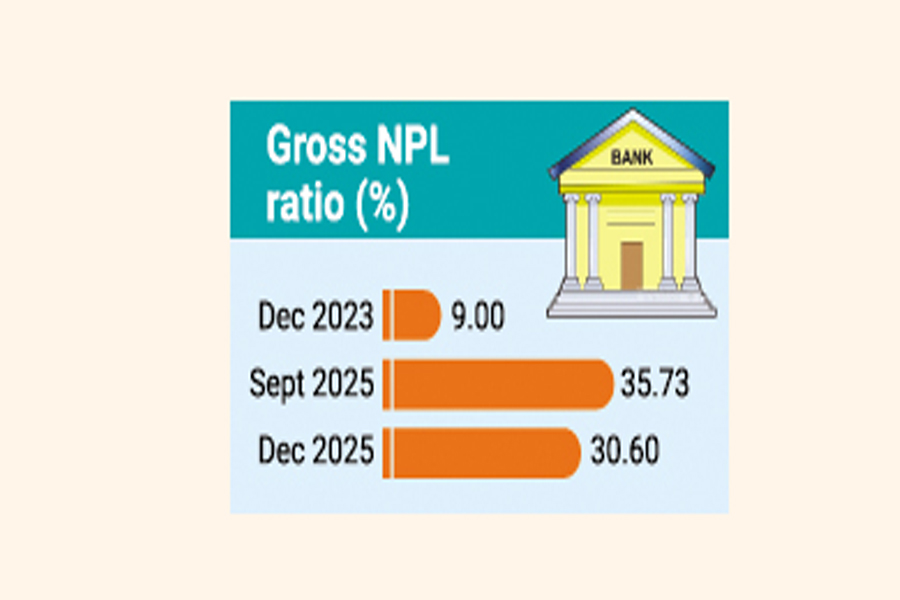
He said the gross NPL ratio had risen from 9.00 per cent at the end of 2023 to 30.60 per cent at the end of 2025, after peaking at 35.73 per cent in September 2025.

According to the March 2026 Banking-Sector Update cited in the paper, the NPL ratio stood at 32.7 per cent against total loans of about Tk17.84 trillion, implying roughly Tk5.83 trillion in classified loans.

At the end of 2025, gross NPLs stood at Tk5.57 trillion, with Bad/Loss loans accounting for roughly 94 per cent. The reported provision shortfall was Tk1.91 trillion.

Dr Ahsan said the special exit facility, introduced in June this year for Bad/Loss loans, should be assessed against realistic recovery prospects rather than being used simply to reduce the reported NPL ratio.

He has noted that the facility allows a negotiated lump-sum settlement with board approval and specified interest-waiver flexibility and will remain available until December 31, 2026.

However, most of the discussions at the event focused on how the facility should be implemented and how loan recovery could be made more effective.

Former BIBM director- general Dr Toufic Ahmad Choudhury said "political commitment from the government is necessary to recover classified loans".

He stressed the importance of distinguishing between wilful and unwilful defaulters and suggested that cases should be examined individually rather than applying a blanket approach.

His comments came amid growing concern over the size of classified loans and the effectiveness of existing recovery mechanisms.

Dr Abu Yusuf, economist and professor at the University of Dhaka's Department of Development Studies, raised the issue of enforcement against borrowers who fail to repay their loans.

He questioned how the authorities and financial institutions could ensure effective recovery "in cases where borrowers did not meet their repayment obligations".

Prof Md Mamun Habib, professor at Independent University, Bangladesh, emphasised the importance of good governance and fair practices in implementing the exit facility for the defaulters.

He stressed that any settlement mechanism should be applied "transparently and consistently so that the facility does not create unfair advantages for particular borrowers".

A representative of Pubali Bank PLC referred to the Money-lending Act 1832, and stressed the need for reasonable rescheduling of loans where borrowers have the capacity to continue their businesses and repay their obligations.

The point reflected a broader concern at the discussion that a one-time settlement may not always be the most suitable option for a viable business facing temporary liquidity constraints.

Dr Ahsan's paper also distinguishes between exit settlement and restructuring, noting that a viable business without sufficient lump-sum cash may require monitored restructuring rather than a one-time settlement.

Md Khairul Anam Mohiuddin, executive vice-president of Southeast Bank PLC, and Syed Abu Naser Bukhtear Ahmed, chairman of Agrani Bank PLC, shared their views on loan recovery and institutional coordination.

They emphasised the need for coordination among Bangladesh Bank, the Ministry of Finance and other relevant stakeholders to address the recovery of classified loans.

The discussion also highlighted the practical difficulties faced when borrowers have exposures with multiple banks and financial institutions.

Ali Reza Iftekhar, adviser of Bank Asia PLC, stressed consulting stakeholders before issuing such a major regulatory circular.

He called for engagement with banks, businesses and other concerned parties so that practical challenges can be identified before implementation.

The participants broadly agreed that wider consultation would help identify implementation difficulties and make major regulatory measures more effective.

IBFB President Lutfunnisa Saudia Khan, in her opening remarks, stressed constructive dialogue among policymakers, banks, businesses and other stakeholders.

The discussion also focused on the need to balance recovery of bad loans with the survival of businesses that remain commercially viable.

Dr Ahsan's paper notes that a lump-sum settlement could free a business from an unserviceable legacy debt but could also consume the cash required for inventory, suppliers, wages and taxes. It recommends that businesses assess their liquidity before committing to a settlement.

Business community's concerns: Business leaders at the event also highlighted the importance of maintaining access to finance for viable enterprises.

Humayun Rashid, managing director and CEO of Energypac Power Generation Ltd, Mohammad Hatem, president of the Bangladesh Knitwear Manufacturers and Exporters Association (BKMEA), Saumitra Kumar Mutsuddi, head of BSRM, Khadem Mahmud Yusuf, managing director and CEO of Bangladesh Petrochemical Company Ltd (BPCL), and Engr Utpal Kumar Das, managing director of Protec Electronics Ltd, participated in the discussion.

Banking-sector representatives included Kazi Mahmood Sattar, chairman of IDLC, Mohammad Jamal Uddin Mazumder, additional managing director of Islami Bank Bangladesh PLC, Mohammad Firoz Alam, chief risk officer of City Bank PLC, and Ali Reza Iftekhar of Bank Asia.

Dr Md Ezazul Islam, director -general of BIBM, also attended the event.​
 

Devising proper exit routes for loan defaulters

1790637208740.webp


Non-performing loans (NPLs) cause economic haemorrhage in a country. When borrowers breach agreements by using loans for purposes other than the stated ones, there is every chance for them to become loan defaulters. In a country like Bangladesh, political consideration rather than economic viability decides sanction of large amount of loans from banks and financial institutions. Bungling of banking rules and regulations facilitates misuses including siphoning off such funds abroad. Bangladesh's current economic woes owe to a large extent to the stupendous volume of NPLs. When a country's NPLs comprise as high as 35.73 per cent of the total credit amounting to Tk17.84 trillion, it highlights not only the liquidity crises of banks and financial institutions but also a business slump and slowing of the economy. At the end of 2025, the total NPL stood at Tk5.57 trillion with 94 per cent falling in the bad or loss loan categories. If the loans were properly used, the country would be able to face the fallouts of global energy crisis from a position of strength.

It is exactly against such a backdrop, the government introduced a special exit facility for borrowers. A roundtable titled "Special Exit facility for Classified Loans: Balancing NPL Recovery, Business Sustainability, and Credit Discipline" was organised by the International Business Forum of Bangladesh (IBFB) on Saturday in order to find a safe exit plan for all the stakeholders. The deliberations at the roundtable emphasised the need for a win-win solution for both creditors and debtors. Negotiation for repayment of a one-time lump sum amount and in case of viable businesses a different arrangement — perhaps rescheduling — were suggested. Financial experts and stakeholders present at the roundtable felt the need for a wider consultation in order to shape a workable formula capable of solving the enormous backlog of classified loans.

However, it is no easy to work out a one-size-fits-all formula when 94 per cent of the classified loans of some banks fall in the bad or loss categories. The government has made its intention clear about disposing of the NPLs. If repayment of a lump sum amount provides relief for wilful defaulters, it would be a disservice to defaulters in genuine distress. Additionally, it will create a bad precedence for future borrowers. Why not confiscate property and assets — both moveable and immoveable — of wilful defaulters for putting those on auction to recover loans? In case of viable businesses, rescheduling of loans can be considered but a timeline has to be fixed for repayment of those.

No political consideration should be entertained when it comes either to disbursement of loans or their recovery. Defaulters must not be rewarded for misusing funds. In this connection, impartial and reputed audit firms have to be assigned to auditing and preparing regular inventories of establishments with business potential. There is no point investing in units that have no future. To maintain credit discipline, there should be no room for political intervention and secret deals. Transparency in business is a must and the viability of establishments has to be determined by an expert team constituted for the purpose. Productivity of manufacturing units and demands for products or services should be the deciding criteria. Exit route for loan defaulters must not be at the cost of national interests.​
 

ILLICIT FUNDS INCREASINGLY FLOWING TO FINANCIAL HUBS

Bangladesh deprived of $410m in taxes in 2022 alone: TJN data


1791156275489.webp


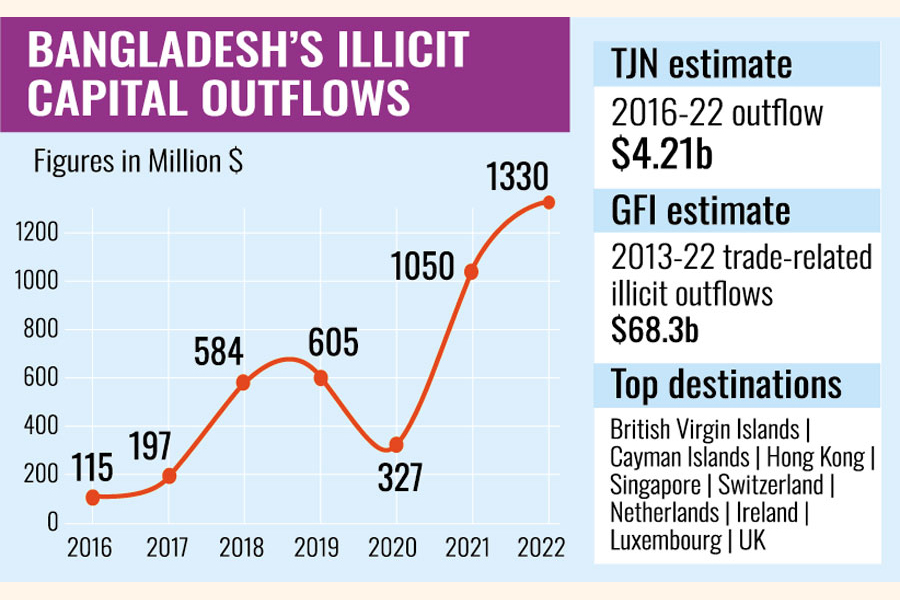
Bangladesh's illicit capital outflows reached a seven-year high of US$1.33 billion in 2022, with the associated tax loss estimated at around $410 million, according to an analysis of data compiled by the UK-based Tax Justice Network (TJN).

The data show that Bangladesh recorded a total of around $4.21 billion in estimated illicit financial outflows between 2016 and 2022, with the destinations increasingly comprising a mix of traditional offshore financial centres and major international financial hubs.

Overall, estimated illicit outflows increased more than sixfold between 2016 and 2022.

The tax loss is calculated separately from the illicit financial outflow.

It is estimated by applying Bangladesh's corporate income tax rate to the corporate component of illicit financial flows and its personal income tax rate to a standard interest rate applied to the offshore wealth component.

A review of the TJN data of illicit financial flows (IFF) by the Financial Express shows that several jurisdictions repeatedly featured among the top destinations for Bangladesh's illicit capital outflows, including the British Virgin Islands, Cayman Islands, Hong Kong, Singapore, Switzerland, the Netherlands, Ireland and Luxembourg.

These jurisdictions have also featured prominently in international assessments of financial secrecy and corporate tax-haven activity.

Professor Mustafizur Rahman, distinguished fellow of the Centre for Policy Dialogue (CPD), said the countries appearing in the data should not necessarily be considered the ultimate destinations of the funds.

"Many of those countries are used as transit points for capital outflows to shift money to other countries," he said.

Countries with flexible tax and investment regimes and strict confidentiality of banking information can become favourable destinations or intermediaries for cross-border capital movements, he added.

Dr Mustafiz also noted that the TJN estimates differ from those of Global Financial Integrity (GFI), which has focused on illicit financial flows associated with trade misinvoicing, including under- and over-invoicing.

On March 2026, a GFI finding says Bangladesh lost an estimated $68.3 billion through trade-related illicit financial flows between 2013 and 2022 (averaging about $6.8 billion annually).

The TJN methodology covers several forms of illicit financial activity. In the case of multinational companies, it estimates profits shifted to low-tax jurisdictions by comparing reported profits with the profits that would normally be expected based on a country's economic activity.

The TJN also estimates offshore wealth, covering wealth belonging to residents that is held abroad but not properly reported. Its calculations examine unusually large cross-border bank deposits and investments against what would normally be expected from the economic relationships between countries.

Because these figures are estimates based on statistical methodologies, they may vary depending on the methodology and year used, the TJN says.

Sharp rise after 2020

Bangladesh's estimated illicit financial outflows stood at $115 million in 2016, and $197 million in 2017 before rising to $584 million in 2018 and $605 million in 2019.

The outflow declined to $327 million in 2020, coinciding with the Covid-19 pandemic, but surged to $1.05 billion in 2021 and further to $1.33 billion in 2022, the highest level recorded during the seven-year period.

The 2022 figure was around 27 per cent higher than in 2021 and more than four times the 2020 level.

Shift towards financial hubs

The destination pattern indicates that Bangladesh's illicit capital movements have been routed through a combination of traditional offshore centres and mainstream international financial and corporate hubs.

Hong Kong featured among the top 10 destinations in all seven years from 2016 to 2022, while the Cayman Islands also appeared in the top 10 throughout the period.

The British Virgin Islands featured in six of the seven years and ranked first in 2022, followed by Hong Kong and the Cayman Islands.

The Cayman Islands ranked first in 2016, 2017 and 2021, while Hong Kong topped the list in 2018, 2019 and 2020.

Singapore was another recurring destination, while the Netherlands, Ireland, Switzerland, Luxembourg and the United Kingdom repeatedly appeared among the leading jurisdictions.

The composition of the top 10, however, changed from year to year. Jersey and Bermuda featured prominently in 2021, while Mauritius, Denmark and Chile entered the top 10 in 2022. Portugal appeared in 2018, while Spain featured in 2016-17.

The changing composition suggests that illicit capital movements may increasingly be routed through a combination of traditional offshore centres, financial hubs, corporate holding jurisdictions and financial intermediaries, rather than being concentrated in a single group of offshore destinations.​
 

Corruption: the hidden tax on Bangladesh's development


1791157394702.webp


Development is often measured in kilometres of highways, megaprojects, power generation, exports and gross domestic product (GDP) growth. But there is another measure that receives far less attention: how much a citizen must pay, wait or struggle to obtain a service that should be available as a right.

That is where corruption becomes more than a moral problem. It becomes an economic problem, and potentially one of the biggest hidden taxes on development.

A society does not become corrupt overnight. Corruption becomes entrenched when dishonest behaviour gradually becomes socially acceptable. The student who cheats is praised for being clever; the employee who advances through connections is described as well-connected; the businessman who accumulates wealth through questionable means is admired for his success. Meanwhile, someone who insists on following the rules may be considered impractical.

When such attitudes become normal, institutions weaken and the cost of doing business rises.

Research using World Values Survey data has found a relationship between generalised morality, trust and economic growth, suggesting that trust can be particularly important where economic institutions are weak. The implication for developing economies is significant: when people trust institutions and each other, transactions become easier; when trust collapses, the cost of doing business rises.

This matters for Bangladesh because the latest evidence suggests that corruption is not merely an occasional inconvenience. It is affecting the everyday relationship between citizens and institutions.

Transparency International Bangladesh's National Household Survey 2025 found that 81.6 per cent of households experienced corruption while accessing services, while 63.6 per cent were compelled to pay bribes. The estimated value of bribe transactions during the survey period was Tk 126.33 billion, equivalent to 1.58 per cent of the revised national budget for FY25 and 0.23 per cent of GDP. The survey covered 15,715 households, with the reference period from November 2024 to October 2025.

The numbers become even more disturbing when we look beyond the headline figure. TIB found that 81.5 per cent of households that paid bribes said services could not be obtained without paying one. More than half of households did not know how to lodge a corruption complaint, and only 10.3 per cent of households that experienced corruption actually filed complaints. Among those who did not complain, 61.3 per cent said they regarded corruption as an inherent part of the service system and saw little point in complaining.

The burden is also unequal. TIB reports that, in the five most corruption-prone sectors, households below the poverty line spent an average 5.1 per cent of annual income on corruption, compared with 3.2 per cent for households above the poverty line. Corruption therefore functions like a regressive tax: the poorer the household, the greater the relative burden.

The economic consequences extend further. Corruption can increase the cost and uncertainty of obtaining licences, approvals, land, transport, customs and other services. It can discourage entrepreneurs from expanding, distort competition and make investors more cautious. This is particularly damaging when Bangladesh needs higher private investment and more productive employment.

The connection with inflation and unemployment should also be understood carefully. Corruption is not the sole cause of either. Inflation has many drivers, including food and energy prices, exchange-rate movements, monetary conditions and supply disruptions. Yet corruption can add to cost pressures when unofficial payments, procurement irregularities and administrative delays increase the cost of producing and moving goods. Similarly, corruption does not automatically create unemployment, but an environment that discourages investment and rewards connections over efficiency can weaken the creation of productive jobs.

Bangladesh is already facing this broader economic pressure. The World Bank has identified persistent inflation, subdued private investment and weak job creation as important concerns, while stressing the need to improve the business environment and strengthen institutions.

International experience shows that corruption can be tackled more effectively when enforcement is combined with institutional design. Singapore, for example, relies on the Prevention of Corruption Act and the Corrupt Practices Investigation Bureau, while also emphasizing clear procurement procedures, conflict-of-interest declarations, audits and accessible reporting channels.

India provides another relevant example. Its Right to Information framework seeks to promote transparency and accountability, while electronic public procurement and the Government e-Marketplace have been developed to make procurement more transparent and standardised. Indonesia, meanwhile, has used electronic purchasing and procurement controls as part of its anti-corruption efforts, with its Corruption Eradication Commission identifying public procurement as a major area of corruption risk.

Bangladesh already possesses an important transparency instrument: the Right to Information Act, 2009. The problem is not simply the absence of law; it is whether citizens know how to use it and whether public institutions proactively disclose information. The Information Commission provides mechanisms for citizens to seek information and complain when access is denied. TIB's latest findings show why greater public awareness is essential.

Therefore, anti-corruption reform should move from slogans to systems.

Every public service should have a clearly published fee, process and delivery deadline. Applications should be digitally traceable. Government procurement, project costs, work orders, contract awards and implementation progress should be disclosed proactively wherever legally possible. Citizens should be able to compare what was approved, what was spent and what was delivered.

Complaint mechanisms also need credibility. TIB found that among corruption complaints filed, no action was taken in 51 per cent of cases. Such experiences inevitably weaken public confidence.

Public officials should face meaningful conflict-of-interest rules and asset-disclosure requirements. Recruitment, transfers and promotions should reward competence and integrity rather than connections. Whistleblowers and complainants should be protected from retaliation.

There is also encouraging evidence that Bangladesh can move in this direction. In 2025, the World Bank approved US$250 million to support stronger transparency, accountability and efficiency in key public institutions, including public procurement, revenue mobilisation, statistics, planning and financial oversight, with digitisation identified as a means of improving transparency and reducing corruption.

Ultimately, however, institutions alone cannot solve the problem. Businesses that offer bribes, citizens who participate in bribery when alternatives exist, and a society that celebrates unexplained wealth all contribute to the ecosystem of corruption.

Bangladesh has invested enormously in physical infrastructure and economic capacity. The next stage of development requires equal investment in institutional integrity.

A road can connect two cities, but a trustworthy institution can connect citizens to opportunity. A bridge can carry vehicles, but rule-based governance can carry an economy forward.

The real cost of corruption is not only the money paid under the table. It is the investment that never comes, the business that never grows, the job that is never created, the service that never reaches the poor and the trust that disappears from society. Fighting corruption, therefore, is not simply about protecting morality-it is about protecting Bangladesh's development itself.

The writer is former president of FICCI and AmCham Bangladesh.​
 

Latest Posts

Back