Bangladesh Defense

Saif
Senior Member
- Joined
- Jan 24, 2024
- Messages
- 22,331
- Likes
- 9,875
- Nation

- Axis Group


Bangladesh's cottage industries need more than nostalgia
Bangladesh’s traditional cottage industries require fair market access, not just nostalgic appreciation, to survive modern economic pressures.
Bangladesh's cottage industries need more than nostalgia
Saiduzzaman Pulak and Sabbir Rahman Khan
Long before Bangladesh became known for garments and remittances, it was known for making things. Not in factories. Not in industrial parks. But in homes, courtyards, village lanes, and small market towns. This was the cottage economy. It fed families, boosted local trade, and carried Bengal's reputation far beyond its rivers. The story is older than we often assume. The Roman historian Pliny wrote that textiles from this region reached the Mediterranean world as early as 73 AD. This suggests that Bengal's handmade economy was connected to global trade long before modern supply chains became the hallmark of global commerce.
Muslin became the most recognised face of this economy. It travelled through royal courts, merchant houses, and long-distance trade routes. Even after the Mughal rulers renamed Dhaka Jahangirnagar, the older name persisted because trade followed what buyers knew and trusted. Economic identity, in that sense, proved stronger than official naming. What we now call heritage was once a working system of production. Muslin was not random household work scattered across villages. It maintained an ecosystem. Specialised centres known as karkhana operated under supervision, with defined roles for spinners, weavers, washers, bleachers, supervisors, and merchants. It was not a modern factory, but it had process, discipline, and quality control.
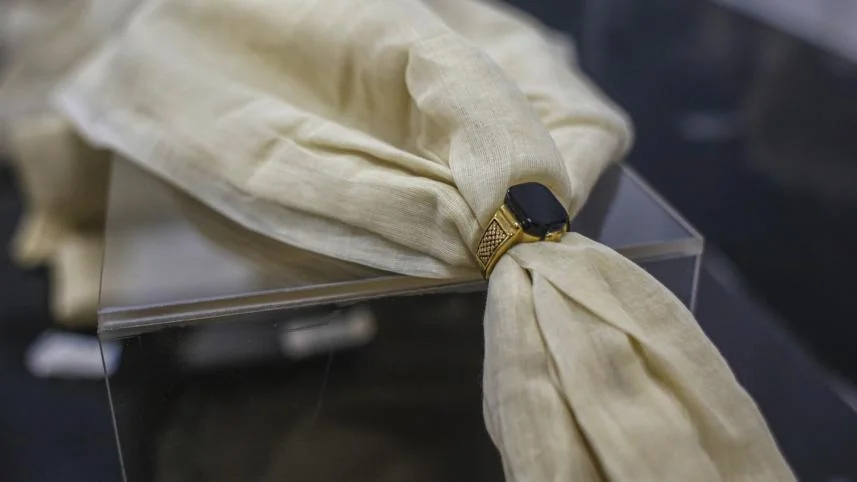
The fabric of Muslin is so fine that a six-yard sari could be passed through a ring. Photo: Rashed Shumon
Historical records from 1747 show the level of demand. The imperial household in Delhi purchased Muslin worth Rs 1,00,000; the Nawab's household in Murshidabad purchased Rs 3,00,000; the house of Jagatseth purchased Rs 1,50,000; and Turani merchants purchased another Rs 1,00,000. These figures point to a sizeable and organised market that supported not only weavers, but also cotton growers, yarn makers, washermen, dyers, bleachers, boatmen, merchants, and agents.
By the late 18th century, the textile trade had become one of the main pillars of Bengal's commercial economy. In 1787, Collector Mathew Day estimated business transactions in the region at around one crore rupees, with textiles alone accounting for 60 to 70 lakhs. The figure speaks volumes about the role of cottage production in Bengal's economic life. The challenge came when this sector was pushed into unequal competition with industrial power. The decline of cottage industries across the Indian subcontinent is often linked to the Industrial Revolution, but it cannot be attributed solely to mechanisation. Unequal trade rules, tariff protection for British manufacturers, and the growing control of imperial markets over local production systems also influenced this decline.
After 1830, Bengal's muslin production fell sharply as British industrial centres such as Glasgow and Paisley began producing imitation muslin at much lower prices. The cheaper fabric entered the market at a scale local producers could not match, while tariff barriers made Bengal muslin less competitive. The skill remained, but the market drifted away from it. The impact was felt across the wider rural economy. By 1820, major cotton centres such as Sonargaon, Dhamrai, Narainpur, Chandpur, and Bajitpur began to close. People involved in growing, spinning, dyeing, bleaching, and weaving lost their jobs, and many were forced back into agriculture, often with weaker bargaining power and lower incomes.
A similar pressure is visible today, although the source of competition has changed. It now comes less from colonial mills and more from mass production, branded consumer goods, and modern distribution networks. Fast-moving consumer goods (FMCG) have crept into every facet of daily life. Their advantage does not come from better craftsmanship. It comes from wider distribution, standardised packaging, aggressive pricing, and constant visibility.
Cottage industries do not need to be protected from the future. They need protection from a market that recognises their design but not their labour, their heritage but not their costs, their beauty but not their bargaining power.
A packaged product has a brand name, a wrapper, a fixed price, a distributor, a marketing budget, and shelf space in the nearest shop. A handmade product often depends on local demand, seasonal sales, intermediaries, and the goodwill of buyers who still recognise its value. For consumers under pressure from high prices, packaged products often feel safer. They are available, familiar, and predictable. The handmade product may be better, but it carries uncertainty. This is where Bangladesh's cottage economy has drifted off course. Cottage products carry skill, labour, memory, and local identity. FMCG carries price, reach, and certainty. In a market driven by convenience, the latter often gets the upper hand.
In Tangail, a weaver once said his loom did not rest during the wedding season. Orders came in bundles. People looked for colour, pattern, and pride. Today, buyers ask for "something like Tangail" at half the price. Sometimes they are shown machine-made copies labelled "handloom style". The weaver is not competing with another weaver. He is competing with a system that can borrow the look of his craft without carrying the labour that goes into it. In Lakshmipur, a pottery family faces a similar reality. Earthen jars and cooking pots once sold steadily in local markets. Now, plastic drums and aluminium cookware dominate shelves. Pottery still has demand, but often during festivals or for selective uses. For much of the year, the kiln remains cold. The potter's son wants to leave, not because he dislikes the craft, but because the craft does not promise a stable income.
These stories repeat across Bangladesh. Jamdani artisans in Narayanganj struggle against cheap replicas. Shital pati makers in Sylhet face weak market access. Bamboo and cane workers depend on fairs and intermediaries. In Bagerhat, talpakha making still supports seasonal income for families; a February 2025 report noted that during the February-to-mid-June production season, a palm-fan artisan family can produce 25,000 to 30,000 fans and earn Tk 200,000 to Tk 250,000. But even that income remains vulnerable when plastic and electric alternatives crowd the market.
The issue is not that Bangladeshis no longer value craft. The deeper issue is that the market increasingly rewards capital, compliance, packaging, and distribution more than skill, patience, and originality. This unfair market system is not limited to the cottage industry. Across Bangladesh's economy, three broad groups seem to operate side by side. A small group invests in process, skill, and long-term value. A larger group survives on short-term margins. Then there are smaller producers and new entrepreneurs trying to do quality work but struggling with capital, access, and protection. Cottage producers sit closest to this third group. They have skill, but little capital. They have products, but weak distribution. They have heritage, but not enough bargaining power.
The numbers speak volumes. Bangladesh has around 830,000 cottage industry units, employing more than 29 million people and producing goods worth roughly Tk 395 billion a year, with value addition of about Tk 315 billion. Nearly 97 per cent of these units reportedly operate year-round, indicating both resilience and dependence. Yet, production growth in the cottage sector fell to 6.7 per cent in FY24. This is not an outright decline, but it is a worrying sign. This concern comes at a critical time. Bangladesh is scheduled to graduate from the Least Developed Country category on 24 November 2026. The SME Policy 2019 set a target to raise the SME sector's contribution to GDP from 25 per cent to 32 per cent by 2024, while the government is now aiming for a 35 per cent SME share by 2030. These targets will lose their sheen if the smallest producers remain outside finance, markets, and public buying channels.
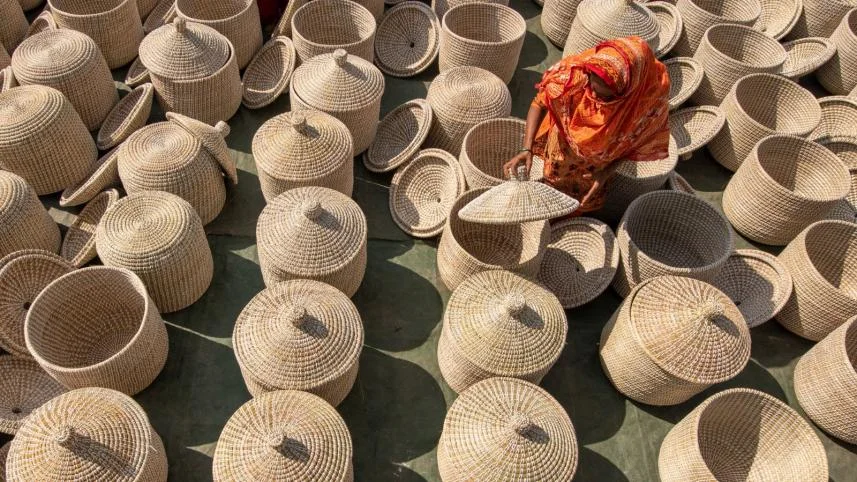
The handmade product may be better, but it carries uncertainty. Photo: Star/File
The macroeconomic situation makes the matter more urgent. Point-to-point inflation reached 9.04 per cent in April 2026, up from 8.71 per cent in March, according to BBS data. The World Bank has projected Bangladesh's FY26 growth to slow to 3.9 per cent and has called for urgent reforms to restore macroeconomic stability, sustain growth, and create jobs. The IMF has also identified low fiscal revenues, weaknesses in the banking sector, and stubbornly high inflation as major challenges.
For cottage producers, these are not distant policy concerns. Inflation raises the cost of yarn, bamboo, clay, fuel, transport, and food. Weak purchasing power reduces demand for handmade goods. Credit remains difficult. The pressure comes from both sides. Informality makes the problem worse. When producers are not registered, they struggle to access formal loans. Without accounts, they cannot easily enter institutional supply chains. Without packaging, certification, or standardisation, modern retail remains distant. Without bargaining power, intermediaries decide the terms.
The problem is not taxation itself. The problem is when compliance is designed for firms that already have accountants, office addresses, bank records, and paperwork. A home-based artisan does not operate like a medium-sized supplier. If the same rules are applied without support, formalisation becomes a wall rather than a bridge. Many small producers remain stuck in a quagmire of woes: too informal for policy support, too small for bank finance, and too invisible for large buyers. Bangladesh does have policy instruments. The Bangladesh Small and Cottage Industries Corporation Act, 2023, the SME Policy 2019, and the Geographical Indication of Goods Act, 2013, all provide entry points. But policy, by itself, does not guarantee buyers. A weaver needs orders. A potter needs buyers. A bamboo artisan needs a price that covers both labour and material. If policy does not reduce raw material risk, open buying channels, protect identity, or improve bargaining power, it remains distant from the workshop.
Mandatory jute packaging shows what aligned regulation can do. By requiring certain commodities to be packed in jute bags, the policy created demand and helped sustain the value chain. It is not a perfect model, but it offers a clear lesson: when regulation shapes demand, traditional industries can survive more firmly.
Public procurement could provide another lever. Under the Public Procurement Rules 2008, the state is one of the largest buyers in the economy. It purchases furniture, uniforms, bags, curtains, office supplies, and household items that cottage producers can make. In practice, many cannot enter the system. Tender documents are complex, compliance requirements favour established suppliers, and contracts often go to those already able to meet formal conditions.
Procurement is not only an administrative exercise. It can influence who gets access to stable demand. When the state buys only from large vendors, it tells the economy that scale matters more than inclusion. If smaller lots, simplified documentation, and reserved categories were designed with care, cottage producers could get a leg up without being forced to behave like large firms. The question of copying also warrants attention. Mass production no longer only replaces handmade goods. It borrows their look. A machine-made "handloom style" fabric carries the memory of a craft without the weaver. A plastic fan shaped like a talpakha carries the form without the artisan. Traditional cultural expressions are often copied or altered without permission, credit, or payment, and artisans rarely benefit when larger manufacturers reproduce their designs.
Legal tools such as GI, trademarks, and collective branding can help, but awareness remains low. Many small producers do not know how to protect their designs, product names, or community identity. Laws exist, but unless artisans can use them, the initiative lacks teeth. The need of the hour is not to place cottage industries in a museum. Bangladesh does not need to reverse modernisation. Factories will expand. FMCG will grow. Convenience will continue to shape consumption. The task is to build a fairer market where small producers are not punished for being small.
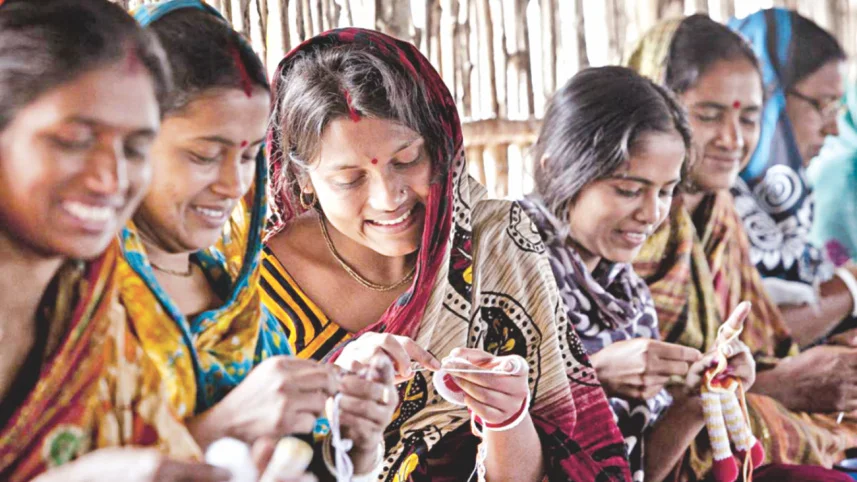
Women make toys at a factory of Hathay Bunano, one of the four Bangladeshi entities recognised by the World Fair Trade Organisation. Photo: Hathay Bunano
Cottage industries do not need to be protected from the future. They need protection from a market that recognises their design but not their labour, their heritage but not their costs, their beauty but not their bargaining power. If these industries fade, Bangladesh will lose more than products. It will lose skills that have stood the test of time. A loom can be replaced. A kiln can be rebuilt. But skill carried through hands, memory, and repetition is harder to restore once broken. When rural livelihoods weaken, migration pressure rises. Cities absorb the strain. Informality grows.
Bangladesh's LDC graduation will not only test large exporters. It will test whether the economy can broaden its base. If CMSMEs are expected to carry a larger share of GDP, cottage producers cannot be treated as decorative leftovers of the past. They must be seen as part of the country's economic architecture. The question, then, is not whether cottage industries belong to the past. It is whether Bangladesh is willing to build a future in which small producers are not forced to survive on memory alone.
Saiduzzaman Pulak and Sabbir Rahman Khan work as development practitioners at Swisscontact.
Saiduzzaman Pulak and Sabbir Rahman Khan
Long before Bangladesh became known for garments and remittances, it was known for making things. Not in factories. Not in industrial parks. But in homes, courtyards, village lanes, and small market towns. This was the cottage economy. It fed families, boosted local trade, and carried Bengal's reputation far beyond its rivers. The story is older than we often assume. The Roman historian Pliny wrote that textiles from this region reached the Mediterranean world as early as 73 AD. This suggests that Bengal's handmade economy was connected to global trade long before modern supply chains became the hallmark of global commerce.
Muslin became the most recognised face of this economy. It travelled through royal courts, merchant houses, and long-distance trade routes. Even after the Mughal rulers renamed Dhaka Jahangirnagar, the older name persisted because trade followed what buyers knew and trusted. Economic identity, in that sense, proved stronger than official naming. What we now call heritage was once a working system of production. Muslin was not random household work scattered across villages. It maintained an ecosystem. Specialised centres known as karkhana operated under supervision, with defined roles for spinners, weavers, washers, bleachers, supervisors, and merchants. It was not a modern factory, but it had process, discipline, and quality control.
The fabric of Muslin is so fine that a six-yard sari could be passed through a ring. Photo: Rashed Shumon
Historical records from 1747 show the level of demand. The imperial household in Delhi purchased Muslin worth Rs 1,00,000; the Nawab's household in Murshidabad purchased Rs 3,00,000; the house of Jagatseth purchased Rs 1,50,000; and Turani merchants purchased another Rs 1,00,000. These figures point to a sizeable and organised market that supported not only weavers, but also cotton growers, yarn makers, washermen, dyers, bleachers, boatmen, merchants, and agents.
By the late 18th century, the textile trade had become one of the main pillars of Bengal's commercial economy. In 1787, Collector Mathew Day estimated business transactions in the region at around one crore rupees, with textiles alone accounting for 60 to 70 lakhs. The figure speaks volumes about the role of cottage production in Bengal's economic life. The challenge came when this sector was pushed into unequal competition with industrial power. The decline of cottage industries across the Indian subcontinent is often linked to the Industrial Revolution, but it cannot be attributed solely to mechanisation. Unequal trade rules, tariff protection for British manufacturers, and the growing control of imperial markets over local production systems also influenced this decline.
After 1830, Bengal's muslin production fell sharply as British industrial centres such as Glasgow and Paisley began producing imitation muslin at much lower prices. The cheaper fabric entered the market at a scale local producers could not match, while tariff barriers made Bengal muslin less competitive. The skill remained, but the market drifted away from it. The impact was felt across the wider rural economy. By 1820, major cotton centres such as Sonargaon, Dhamrai, Narainpur, Chandpur, and Bajitpur began to close. People involved in growing, spinning, dyeing, bleaching, and weaving lost their jobs, and many were forced back into agriculture, often with weaker bargaining power and lower incomes.
A similar pressure is visible today, although the source of competition has changed. It now comes less from colonial mills and more from mass production, branded consumer goods, and modern distribution networks. Fast-moving consumer goods (FMCG) have crept into every facet of daily life. Their advantage does not come from better craftsmanship. It comes from wider distribution, standardised packaging, aggressive pricing, and constant visibility.
Cottage industries do not need to be protected from the future. They need protection from a market that recognises their design but not their labour, their heritage but not their costs, their beauty but not their bargaining power.
A packaged product has a brand name, a wrapper, a fixed price, a distributor, a marketing budget, and shelf space in the nearest shop. A handmade product often depends on local demand, seasonal sales, intermediaries, and the goodwill of buyers who still recognise its value. For consumers under pressure from high prices, packaged products often feel safer. They are available, familiar, and predictable. The handmade product may be better, but it carries uncertainty. This is where Bangladesh's cottage economy has drifted off course. Cottage products carry skill, labour, memory, and local identity. FMCG carries price, reach, and certainty. In a market driven by convenience, the latter often gets the upper hand.
In Tangail, a weaver once said his loom did not rest during the wedding season. Orders came in bundles. People looked for colour, pattern, and pride. Today, buyers ask for "something like Tangail" at half the price. Sometimes they are shown machine-made copies labelled "handloom style". The weaver is not competing with another weaver. He is competing with a system that can borrow the look of his craft without carrying the labour that goes into it. In Lakshmipur, a pottery family faces a similar reality. Earthen jars and cooking pots once sold steadily in local markets. Now, plastic drums and aluminium cookware dominate shelves. Pottery still has demand, but often during festivals or for selective uses. For much of the year, the kiln remains cold. The potter's son wants to leave, not because he dislikes the craft, but because the craft does not promise a stable income.
These stories repeat across Bangladesh. Jamdani artisans in Narayanganj struggle against cheap replicas. Shital pati makers in Sylhet face weak market access. Bamboo and cane workers depend on fairs and intermediaries. In Bagerhat, talpakha making still supports seasonal income for families; a February 2025 report noted that during the February-to-mid-June production season, a palm-fan artisan family can produce 25,000 to 30,000 fans and earn Tk 200,000 to Tk 250,000. But even that income remains vulnerable when plastic and electric alternatives crowd the market.
The issue is not that Bangladeshis no longer value craft. The deeper issue is that the market increasingly rewards capital, compliance, packaging, and distribution more than skill, patience, and originality. This unfair market system is not limited to the cottage industry. Across Bangladesh's economy, three broad groups seem to operate side by side. A small group invests in process, skill, and long-term value. A larger group survives on short-term margins. Then there are smaller producers and new entrepreneurs trying to do quality work but struggling with capital, access, and protection. Cottage producers sit closest to this third group. They have skill, but little capital. They have products, but weak distribution. They have heritage, but not enough bargaining power.
The numbers speak volumes. Bangladesh has around 830,000 cottage industry units, employing more than 29 million people and producing goods worth roughly Tk 395 billion a year, with value addition of about Tk 315 billion. Nearly 97 per cent of these units reportedly operate year-round, indicating both resilience and dependence. Yet, production growth in the cottage sector fell to 6.7 per cent in FY24. This is not an outright decline, but it is a worrying sign. This concern comes at a critical time. Bangladesh is scheduled to graduate from the Least Developed Country category on 24 November 2026. The SME Policy 2019 set a target to raise the SME sector's contribution to GDP from 25 per cent to 32 per cent by 2024, while the government is now aiming for a 35 per cent SME share by 2030. These targets will lose their sheen if the smallest producers remain outside finance, markets, and public buying channels.
The handmade product may be better, but it carries uncertainty. Photo: Star/File
The macroeconomic situation makes the matter more urgent. Point-to-point inflation reached 9.04 per cent in April 2026, up from 8.71 per cent in March, according to BBS data. The World Bank has projected Bangladesh's FY26 growth to slow to 3.9 per cent and has called for urgent reforms to restore macroeconomic stability, sustain growth, and create jobs. The IMF has also identified low fiscal revenues, weaknesses in the banking sector, and stubbornly high inflation as major challenges.
For cottage producers, these are not distant policy concerns. Inflation raises the cost of yarn, bamboo, clay, fuel, transport, and food. Weak purchasing power reduces demand for handmade goods. Credit remains difficult. The pressure comes from both sides. Informality makes the problem worse. When producers are not registered, they struggle to access formal loans. Without accounts, they cannot easily enter institutional supply chains. Without packaging, certification, or standardisation, modern retail remains distant. Without bargaining power, intermediaries decide the terms.
The problem is not taxation itself. The problem is when compliance is designed for firms that already have accountants, office addresses, bank records, and paperwork. A home-based artisan does not operate like a medium-sized supplier. If the same rules are applied without support, formalisation becomes a wall rather than a bridge. Many small producers remain stuck in a quagmire of woes: too informal for policy support, too small for bank finance, and too invisible for large buyers. Bangladesh does have policy instruments. The Bangladesh Small and Cottage Industries Corporation Act, 2023, the SME Policy 2019, and the Geographical Indication of Goods Act, 2013, all provide entry points. But policy, by itself, does not guarantee buyers. A weaver needs orders. A potter needs buyers. A bamboo artisan needs a price that covers both labour and material. If policy does not reduce raw material risk, open buying channels, protect identity, or improve bargaining power, it remains distant from the workshop.
Mandatory jute packaging shows what aligned regulation can do. By requiring certain commodities to be packed in jute bags, the policy created demand and helped sustain the value chain. It is not a perfect model, but it offers a clear lesson: when regulation shapes demand, traditional industries can survive more firmly.
Public procurement could provide another lever. Under the Public Procurement Rules 2008, the state is one of the largest buyers in the economy. It purchases furniture, uniforms, bags, curtains, office supplies, and household items that cottage producers can make. In practice, many cannot enter the system. Tender documents are complex, compliance requirements favour established suppliers, and contracts often go to those already able to meet formal conditions.
Procurement is not only an administrative exercise. It can influence who gets access to stable demand. When the state buys only from large vendors, it tells the economy that scale matters more than inclusion. If smaller lots, simplified documentation, and reserved categories were designed with care, cottage producers could get a leg up without being forced to behave like large firms. The question of copying also warrants attention. Mass production no longer only replaces handmade goods. It borrows their look. A machine-made "handloom style" fabric carries the memory of a craft without the weaver. A plastic fan shaped like a talpakha carries the form without the artisan. Traditional cultural expressions are often copied or altered without permission, credit, or payment, and artisans rarely benefit when larger manufacturers reproduce their designs.
Legal tools such as GI, trademarks, and collective branding can help, but awareness remains low. Many small producers do not know how to protect their designs, product names, or community identity. Laws exist, but unless artisans can use them, the initiative lacks teeth. The need of the hour is not to place cottage industries in a museum. Bangladesh does not need to reverse modernisation. Factories will expand. FMCG will grow. Convenience will continue to shape consumption. The task is to build a fairer market where small producers are not punished for being small.
Women make toys at a factory of Hathay Bunano, one of the four Bangladeshi entities recognised by the World Fair Trade Organisation. Photo: Hathay Bunano
Cottage industries do not need to be protected from the future. They need protection from a market that recognises their design but not their labour, their heritage but not their costs, their beauty but not their bargaining power. If these industries fade, Bangladesh will lose more than products. It will lose skills that have stood the test of time. A loom can be replaced. A kiln can be rebuilt. But skill carried through hands, memory, and repetition is harder to restore once broken. When rural livelihoods weaken, migration pressure rises. Cities absorb the strain. Informality grows.
Bangladesh's LDC graduation will not only test large exporters. It will test whether the economy can broaden its base. If CMSMEs are expected to carry a larger share of GDP, cottage producers cannot be treated as decorative leftovers of the past. They must be seen as part of the country's economic architecture. The question, then, is not whether cottage industries belong to the past. It is whether Bangladesh is willing to build a future in which small producers are not forced to survive on memory alone.
Saiduzzaman Pulak and Sabbir Rahman Khan work as development practitioners at Swisscontact.