Bangladesh Defense
Saif
Senior Member
- Jan 24, 2024
- 21,704
- 9,794
- Nation

- Residence
- Axis Group

Renewables’ ambitions face financing bottlenecks: experts
Staff Correspondent 03 August, 2026, 00:35
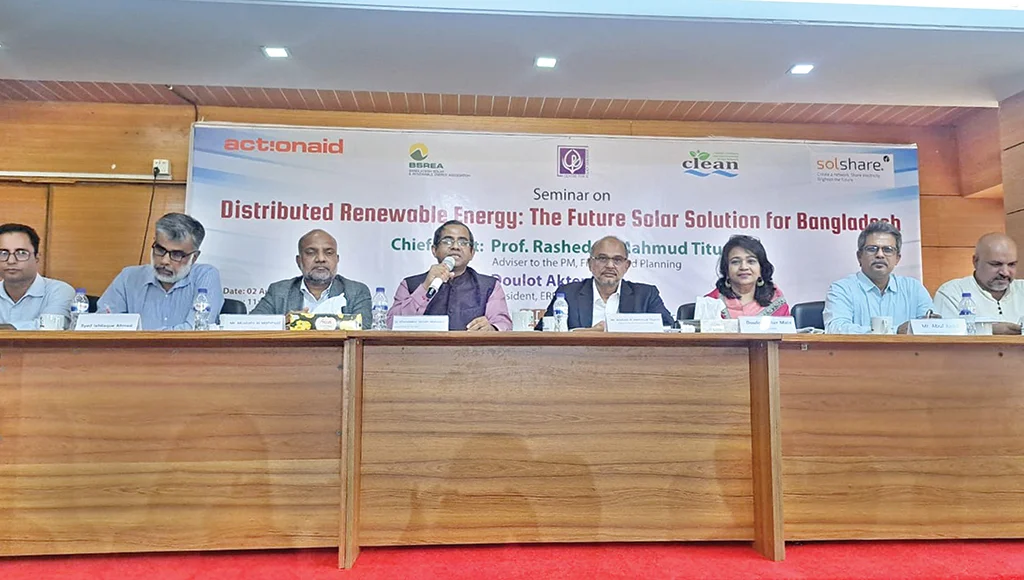
Prime minister’s finance and planning adviser Rashed Al Mahmud Titumir, among others, is present at a seminar organised by the Economic Reporters’ Forum in collaboration with the Distributed Renewable Energy Platform in the capital on Sunday. | Press release
Experts on Sunday identified inadequate access to finance as the biggest obstacle to Bangladesh’s renewable energy transition, warning that the country’s ambitious clean energy drive could fall behind unless entrepreneurs receive easier access to finance and a more supportive policy environment.
They also said that the country needed a coordinated financing framework, simplified access to credit, consistent policies and stronger institutional coordination to accelerate the transition towards distributed solar power and reduce dependence on imported fossil fuels.
The observations came at a seminar titled ‘Distributed Renewable Energy: The Future Solar Solution for Bangladesh,’ organised by the Economic Reporters’ Forum in collaboration with the Distributed Renewable Energy Platform, a forum of organisations working on renewable energy, at the ERF auditorium in the capital Dhaka.
Researchers, industry leaders and development experts said that Bangladesh’s evolving energy landscape had made distributed renewable energy increasingly important in addressing power reliability gaps, improving climate resilience and reducing costly fuel imports.
They said that many aspiring renewable energy businesses struggled to obtain affordable financing, while existing support mechanisms remained complicated and inaccessible.
Experts also identified policy inconsistency as another major obstacle, saying that although the government had adopted several supportive renewable energy policies, entrepreneurs frequently received conflicting directions from different ministries and agencies, creating uncertainty for investors and business associations.
Prime minister’s finance and planning adviser Rashed Al Mahmud Titumir said that Bangladesh’s renewable energy transition would require more than policy support, arguing that a broad-based public movement was needed to create sustained demand for clean energy.
‘If people demand renewable energy, the supply system will follow,’ he said, adding that society needed to be mobilised to recognise access to modern energy as a basic right.
Titumir said that renewable energy should be recognised as a fundamental right rather than a commodity and urged the government, civil society organisations, non-governmental organisations and financial institutions to work together to make clean energy accessible and affordable for all.
The adviser said that Bangladesh should build domestic manufacturing capacity for solar photovoltaic panels, batteries, inverters and electric vehicles to develop local industries, promote innovation and create employment.
At the event, keynote papers were presented by Centre for Policy Dialogue research associate Md Mehedi Hasan Shamim, Bangladesh Sustainable and Renewable Energy Association company secretary ASM Munir, Coastal Livelihood and Environmental Action Network chief executive officer Hasam Mehedi, SOLshare director Ishtique Ahmed and ActionAid Just Energy Transition manager Abul Azad.
They said that Bangladesh now faced a significant retention crisis, with nearly 47 per cent of the country’s six million installed solar home systems no longer functioning.
They said that these stranded assets demonstrated the need to shift towards grid-connected rooftop solar systems capable of supporting long-term electricity demand.
The keynote speakers observed that households accounted for 57.2 per cent of Bangladesh’s electricity consumption.
They estimated that if only 10 per cent of the country’s 40.3 million households installed rooftop solar systems ranging from one to five kilowatt-peak, Bangladesh could add 8,600 MWp of capacity by 2030.
They said that such a scenario alone could supply about 15 per cent of the country’s annual electricity demand while creating another 1.5 million green jobs in addition to the 1.37 million already generated by the solar industry by the end of 2021.
The keynote papers recommended accelerating battery energy storage systems and promoting virtual power plants using the country’s estimated six million electric three-wheelers.
The papers said that the vehicles collectively represented about 6 GW of potential storage capacity and that smart charging technologies could enable them to store electricity during off-peak hours and feed unused power back into the grid during evening peak demand, reducing reliance on expensive furnace oil-fired power plants.
The experts estimated that Bangladesh would require about $980 million in annual investment to achieve its distributed renewable energy targets by 2030.
They said that high upfront installation costs, ranging from Tk 80,000 to more than Tk 2,50,000 for residential systems, continued to discourage wider adoption, while commercial banks remained reluctant to finance such projects because of perceived risks and stringent collateral requirements.
To overcome these challenges, the Distributed Renewable Energy Platform proposed establishing a unified DRE coordination body under the Sustainable and Renewable Energy Development Authority to streamline licensing, planning and data management.
Titumir said that the government had already introduced major fiscal incentives, including tax benefits for solar projects and incentives for electric vehicles, to encourage investment in the sector.
He said that Bangladesh needed innovative storage technologies capable of balancing electricity supply and demand while keeping energy affordable for consumers.
Staff Correspondent 03 August, 2026, 00:35
Prime minister’s finance and planning adviser Rashed Al Mahmud Titumir, among others, is present at a seminar organised by the Economic Reporters’ Forum in collaboration with the Distributed Renewable Energy Platform in the capital on Sunday. | Press release
Experts on Sunday identified inadequate access to finance as the biggest obstacle to Bangladesh’s renewable energy transition, warning that the country’s ambitious clean energy drive could fall behind unless entrepreneurs receive easier access to finance and a more supportive policy environment.
They also said that the country needed a coordinated financing framework, simplified access to credit, consistent policies and stronger institutional coordination to accelerate the transition towards distributed solar power and reduce dependence on imported fossil fuels.
The observations came at a seminar titled ‘Distributed Renewable Energy: The Future Solar Solution for Bangladesh,’ organised by the Economic Reporters’ Forum in collaboration with the Distributed Renewable Energy Platform, a forum of organisations working on renewable energy, at the ERF auditorium in the capital Dhaka.
Researchers, industry leaders and development experts said that Bangladesh’s evolving energy landscape had made distributed renewable energy increasingly important in addressing power reliability gaps, improving climate resilience and reducing costly fuel imports.
They said that many aspiring renewable energy businesses struggled to obtain affordable financing, while existing support mechanisms remained complicated and inaccessible.
Experts also identified policy inconsistency as another major obstacle, saying that although the government had adopted several supportive renewable energy policies, entrepreneurs frequently received conflicting directions from different ministries and agencies, creating uncertainty for investors and business associations.
Prime minister’s finance and planning adviser Rashed Al Mahmud Titumir said that Bangladesh’s renewable energy transition would require more than policy support, arguing that a broad-based public movement was needed to create sustained demand for clean energy.
‘If people demand renewable energy, the supply system will follow,’ he said, adding that society needed to be mobilised to recognise access to modern energy as a basic right.
Titumir said that renewable energy should be recognised as a fundamental right rather than a commodity and urged the government, civil society organisations, non-governmental organisations and financial institutions to work together to make clean energy accessible and affordable for all.
The adviser said that Bangladesh should build domestic manufacturing capacity for solar photovoltaic panels, batteries, inverters and electric vehicles to develop local industries, promote innovation and create employment.
At the event, keynote papers were presented by Centre for Policy Dialogue research associate Md Mehedi Hasan Shamim, Bangladesh Sustainable and Renewable Energy Association company secretary ASM Munir, Coastal Livelihood and Environmental Action Network chief executive officer Hasam Mehedi, SOLshare director Ishtique Ahmed and ActionAid Just Energy Transition manager Abul Azad.
They said that Bangladesh now faced a significant retention crisis, with nearly 47 per cent of the country’s six million installed solar home systems no longer functioning.
They said that these stranded assets demonstrated the need to shift towards grid-connected rooftop solar systems capable of supporting long-term electricity demand.
The keynote speakers observed that households accounted for 57.2 per cent of Bangladesh’s electricity consumption.
They estimated that if only 10 per cent of the country’s 40.3 million households installed rooftop solar systems ranging from one to five kilowatt-peak, Bangladesh could add 8,600 MWp of capacity by 2030.
They said that such a scenario alone could supply about 15 per cent of the country’s annual electricity demand while creating another 1.5 million green jobs in addition to the 1.37 million already generated by the solar industry by the end of 2021.
The keynote papers recommended accelerating battery energy storage systems and promoting virtual power plants using the country’s estimated six million electric three-wheelers.
The papers said that the vehicles collectively represented about 6 GW of potential storage capacity and that smart charging technologies could enable them to store electricity during off-peak hours and feed unused power back into the grid during evening peak demand, reducing reliance on expensive furnace oil-fired power plants.
The experts estimated that Bangladesh would require about $980 million in annual investment to achieve its distributed renewable energy targets by 2030.
They said that high upfront installation costs, ranging from Tk 80,000 to more than Tk 2,50,000 for residential systems, continued to discourage wider adoption, while commercial banks remained reluctant to finance such projects because of perceived risks and stringent collateral requirements.
To overcome these challenges, the Distributed Renewable Energy Platform proposed establishing a unified DRE coordination body under the Sustainable and Renewable Energy Development Authority to streamline licensing, planning and data management.
Titumir said that the government had already introduced major fiscal incentives, including tax benefits for solar projects and incentives for electric vehicles, to encourage investment in the sector.
He said that Bangladesh needed innovative storage technologies capable of balancing electricity supply and demand while keeping energy affordable for consumers.