Home Watch Videos Wars Movies Login

[🇧🇩] Everything about Hasina's misrule/Laundered Money etc.

[🇧🇩] Everything about Hasina's misrule/Laundered Money etc.
261
9K
More threads by Saif

G Bangladesh Defense

S Alam issues legal action threat against Bangladesh: UK newspaper
Staff Correspondent 20 November, 2024, 06:36

Mohammed Saiful Alam, chairman and founder of S Alam Group, has claimed protection under his Singapore citizenship from what he described as a ‘campaign of intimidation’ led by Bangladesh Bank governor Ahsan H Mansur against his business conglomerate, according to a report published by the Financial Times on Monday.

In a letter issued by law firm Quinn Emanuel Urquhart & Sullivan on behalf of Saiful and his family, they warned governor Mansur of potential international arbitration proceedings against Bangladesh.

This development follows Mansur’s allegations, published in an interview with British daily Financial Times, that Saiful and associates withdrew at least Tk 1.2 trillion ($10 billion) from Bangladeshi banks during the tenure of now deposed prime minister Sheikh Hasina.

According to the Financial Times report, the letter accuses Mansur of making ‘inflammatory and unsubstantiated public comments’ amounting to a ‘campaign of intimidation against the business group’ that it said employs about 2,00,000 people directly and indirectly in Bangladesh.

The letter and Saiful’s threat to initiate international arbitration mark his most serious opposition to the Bangladesh’s interim government, led by Nobel Peace Prize laureate Muhammad Yunus, which came to power after a student-led mass uprising toppling Sheikh Hasina on August 5.

Mansur, a former International Monetary Fund official who was appointed Bangladesh Bank governor in August, told the British daily last month that Saiful and his cronies had siphoned off money out of the banking sector after taking over the top banks with the help of the members of a powerful military intelligence agency.

Mansur alleged that Saiful, his associates and other groups employed machinations, including loans issued to the banks’ new shareholders, and inflating import invoices, to carry out the ‘biggest, highest robbing of banks by any international standards’.

S Alam Group, which has interests in sectors including food, construction, garments, and banking, rejected Mansur’s allegations last month, saying in a statement through Quinn Emanuel that there was ‘no truth’ in them.

The letter to Mansur—sent on behalf of Saiful Alam, his wife Farzana Parveen and his sons Ashraful Alam and Asadul Alam Mahir, who are said to jointly own and control the ‘major part’ of the S Alam Group, described the allegations as ‘deliberately false” and slanderous’.

‘Your statements only further the aims of an apparent campaign designed to destroy the S Alam Group, and therefore also the investors’ investments,’ it said. ‘It’s remarkable that you seem to be running this campaign, if not organising it.’

The letter also mentioned that all the four investors were Singapore citizens.

A spokesperson for Quinn Emanuel did not respond to the Financial Time’s request for comment on when Saiful Alam’s family had acquired Singaporean citizenship and whether they remained Bangladeshi citizens as well. The government of Singapore did not respond to a request for comment.

Bangladesh and Singapore have a bilateral investment protection treaty dating from 2004.

The letter also cited Bangladesh’s bilateral investment treaty with Singapore and Bangladesh’s Foreign Private Investment Act of 1980 as grounds for protecting the rights of S Alam Group’s investors.

It warned Mansur that any continuation of his alleged campaign could result in legal actions, including arbitration through the International Centre for Settlement of Investment Disputes.

The letter said that if the central bank governor continued to ‘encroach on their rights’ by making ‘false statements’, they and S Alam Group would ‘have no choice but to take legal action’ against Mansur individually for the ‘damage you have inflicted’.

Mansur told the British daily that the claims he made in the interview were ‘fully substantiated’ when asked for a response to the letter.

‘They are still being documented because the range of corrupt activities is widespread across many banks and over many years. The full documentation will take some time,’ he added.​
 
Analyze

Analyze Post

Add your ideas here:
Highlight Cite Respond

What’s the point of revolution if ill-gotten wealth not reclaimed?
Debapriya asks

Noted economist Debapriya Bhattacharya has raised the question as to why the massive wealth accumulated through looting and corruption during the previous regime has not been reclaimed by the state yet.

"Where has this wealth gone? Why hasn't it been confiscated yet?" he asked at a seminar at the Economic Reporters' Forum (ERF) auditorium in Dhaka yesterday.

"If this cannot be done, what was the point of the revolution?" he told the programme jointly organised by the ERF and Research and Policy Integration for Development (RAPID).

Debapriya Bhattacharya, chair of the committee preparing the "White Paper on the State of Bangladesh Economy", also questioned why the government has not taken legal action to take back the corrupt wealth and swiftly adjust it.

At the seminar on the "Current Economic Situation and Launching of Open Budget Survey 2023 Results", the economist suggested that confiscating this wealth could have a positive impact, such as encouraging people to pay taxes.

He suggested the government set a six-month target to reduce inflation -- which has been hovering above 9 percent for around two years and hit a three-month high of 10.87 percent in October.

Besides, he called for increasing food security and strengthening the social safety net.

On the macro front, the economist advocated for prioritising the revival of private investment, resolving the tight liquidity and strengthening the energy sector.

To increase public investment, Debapriya said the government should hold a meeting with foreign development partners by December or January next year to inform them about the country's inclusive and sustainable development plan.

Debapriya, also a distinguished fellow at the Centre for Policy Dialogue (CPD), suggested that the National Board of Revenue (NBR) should be digitalised, which would help the government increase revenue collection.

He said the government's measures to lower the inflationary curve have not been effective as price pressures still remain high.

He, however, said that the current high inflation rate was inherited from the previous government.

In his keynote, titled "Fixing the Macroeconomy: A Daunting Task Inherited from the Previous Regime", Mohammad Abdur Razzaque, chairman of RAPID, told the seminar that Bangladesh has been paying the price for the previous regime's reckless macroeconomic management.

The country has faced high inflation, dwindling foreign exchange reserves and a depreciating currency, which was further complicated by poor governance and widespread corruption, Razzaque commented.

Despite the inflationary pressures, the previous government borrowed heavily from the central bank in an unprecedented manner, he said.

The RAPID chairman also credited the interim government for taking some positive steps, such as stopping fund embezzlement in the banking sector, reducing credit demand, increasing remittance inflows, improving bank deposits and expanding exports.

He also said that restoring macroeconomic stability is critical for transitioning out of least developed country (LDC) status. Uncertainty just ahead of the graduation also could deter foreign investment, he said, adding that exporters and investors need predictability.

"For LDC graduation, consider the importance of the Indian and Japanese markets as there will be an additional three-year transition period in other important markets," he added.

As a discussant, Shawkat Hossain Masum, head of national daily Prothom Alo's online edition, said journalists criticised the previous government's reckless economic policies but were rarely heard.

He said the country's economic downturn began in 2019, even before the Coronavirus pandemic, as the central bank's foreign currency reserves dwindled.

"The pandemic and the Russia-Ukraine war further worsened the situation," he commented.

Masum said containing inflation will take more time. However, the government needs to improve public confidence in its steps to counter the price pressures.

During the launching of the Open Budget Survey (OBS) 2023 Bangladesh Results at the same seminar, RAPID Executive Director M Abu Eusuf said Bangladesh has a transparency score of 37 out of 100.

It assesses the online availability, timeliness and comprehensiveness of eight key budget documents using 109 equally weighted indicators and scores each country on a scale of 0 to 100.

A transparency score of 61 or above indicates a country is likely publishing sufficient information to support informed public discourse on the budget.

ERF President Mohammad Refayet Ullah Mirdha chaired the session while ERF General Secretary Abul Kashem moderated the seminar.​
 
Analyze

Analyze Post

Add your ideas here:
Highlight Cite Respond

$14b a year lost to capital flight during AL years
Finds committee preparing white paper

1732925464709.webp


Bangladesh has lost around $14 billion a year on average to capital flight during the Awami League's 15-year tenure, according to the draft report of the committee preparing a white paper on the economy.

The actual amount of capital flight could not be determined due to time constraints, The Daily Star has learnt from members of the 12-member committee. However, a separate chapter has been prepared on the topic using scientific methodology, government documents and global reports.

The committee, which was formed on August 28, was given three months to prepare the report to inform on the true state of the economy, battered from years of mismanagement and data obfuscation.

"We have incorporated the ways money laundering takes place and how it could be stopped," said one of the committee members asking not to be named.

Earlier on November 2, Transparency International Bangladesh said $12 to $15 billion was siphoned out of the country in a year over the last 15 years.

Bangladesh lost approximately $8.27 billion on average between 2009 and 2018 only from mis-invoicing of values of import-export goods by traders to evade taxes, according to the US-based research organisation Global Financial Integrity.

The 250-page report titled "White Paper on the State of Bangladesh Economy" will have 22 chapters, including their findings on GDP growth, inflation, external balance, banking sector situation, power and energy situation, government's debt, quality of statistics, trade, revenue, expenditure, mega projects, business environment, poverty and equality, capital market, education, health, women and climate issues.

The report will be handed over to Chief Adviser Muhammad Yunus on Sunday and made available for public consumption the following day.

The committee -- led by Debapriya Bhattacharya, a distinguished fellow at the Centre for Policy Dialogue -- made its observations on mega projects like Padma bridge and the railway link, the Rooppur nuclear power plant, Matarbari power plant and Karnaphuli tunnel.

"We have incorporated our observations on the corruption charges by the World Bank in the Padma bridge project and the issue of the Canadian court. We have our observations on building the bridge with own funds," said another committee member.

The 6.15-kilometre Padma bridge cost Tk 30,193 crore, or $3.56 billion. Of the amount, $2.4 billion was paid through foreign currency provided by the Agrani Bank.

Total public debt, especially the repayment of foreign loans over the next four years for the ongoing 215 foreign-funded projects, was incorporated in the report, said another committee member.

The committee has suggested pathways to rationalise the huge subsidy expenditure, improve the bad loan situation and strengthen market management for inflation control.

The committee members include economists AK Enamul Haque, Kazi Iqbal, Mustafizur Rahman, Selim Raihan, Sharmind Neelormi, Mohammad Abu Eusuf, Ferdaus Ara Begum and Zahid Hussain; energy expert Mohammad Tamim; and manpower export expert Tasneem Arefa Siddiqui.​
 
Analyze

Analyze Post

Add your ideas here:
Highlight Cite Respond

S Alam's cunning move to shield his empire
Asjadul Kibria
Published :
Nov 30, 2024 21:01
Updated :
Nov 30, 2024 21:01

1733015944734.webp


A business conglomerate, now infamous for allegedly siphoning billion of dollars from Bangladesh, has issued a threat to the country's central bank governor, indicating its intention to initiate international arbitration procedures against Bangladesh. This development, stemming from the governor's public disclosure that the conglomerate, S Alam group, allegedly transferred a staggering Tk 1.2 trillion (approximately $10 billion) from Bangladeshi banks to other countries during the tenure of ousted former prime minister Sheikh Hasina, has notable implications for the nation's economy. The news, as reported by the Financial Times, also revealed that the group's owners were seeking to protect their investments as Singaporean under the 1980 Bangladeshi law on foreign private investment. They have further warned of their readiness to invoke the International Centre for Settlement of Investment Disputes (ICSID) to safeguard their investments.

The S Alam group's claim for investment protection is a significant development. As one of the key beneficiaries of the ousted Hasina regime, the group's chairman, along with his wife and three sons, renounced their Bangladeshi citizenship in 2022 and were immediately granted permanent residency in that country. This move, necessitated by Singapore's citizenship law that does not allow dual citizenship, raises questions about the timing of their Singaporean citizenship acquisition. Now, they are seeking investment protection as foreign investors, a move that could have far-reaching implications.

All the investments made by S Alam, chairman, and his four family members, who are also the directors of the conglomerate, before availing themselves of Singapore citizenship were Bangladesh citizens. So, those investments are not FDI from Singapore, and there is no scope to claim protection as foreign investors. It is also important to know how much investment they made after becoming Singaporean citizens.

Statistics available from Bangladesh Bank showed that the net inflow of FDI from Singapore to Bangladesh dropped to US$169.81 million in 2023 from $269.93 million in 2022. The highest amount of FDI from the island country was recorded at $573.05 million in 2016. The stock of FDI from Singapore to Bangladesh stood at $1558.23 million at the end of last year. As the investors' details are not publicly available, the central bank now needs to clarify whether S Alam made any investment as FDI from Singapore or not.

It is also possible that there was a good amount of round-tripping of FDI in the country. The round-tripping of FDI is the flow of domestic funds channelled back into the local economy through direct investment using offshore hubs. In other words, money siphoned or stashed away from Bangladesh to any other country and then brought back as FDI from tax havens is known as round-tripping. It is not easy to detect and estimate it. Nevertheless, through a rigorous exercise, it is possible to identify the round-tripping in some particular cases including S Alam's.

As S Alam wanted to drag Bangladesh into an investor-State dispute, it had to do so by invoking the Bangladesh-Singapore Bilateral Investment Treaty (BIT). The treaty, signed in 2004, outlines the legal provisions to do so in Article 7 of the treaty. It said that any dispute "shall, as far as possible, be settled amicably through negotiations between the parties to the dispute." It is the first step to resolve the dispute, where the parties must move through negotiations or consultations. If the parties fail to resolve the dispute through consultation, they can go for arbitration by the ICSID, as per Paragrah-2 of Article 7 of the treaty.

As the BIT was signed two decades ago, it clearly favoured the investor at the expense of the host state, and that was the trend at that time. Experts observed that BITs often provided for 'disproportionate protection of investors and deprived the host states of some of the fundamental rights'. These include the protection of health, the environment and national treasures. Moreover, in several dispute settlement lawsuits, big amounts of compensation for damages were imposed against developing countries. After facing such backlash by foreign investors, developing countries have recently started revising the BITs to make these balanced. India is one of the leading nations in this connection.

Bangladesh has signed 34 BITs so far. Two were terminated, and seven are still not enforced. The country signed its first BIT with the United Kingdom (UK) in 1980 and the last one with Kuwait in 2016. The country also faced eight lawsuits by foreign investors at ICSID of the World Bank Group, all of which were in the power and energy sector. Of these, three are still pending.

Investor-State Dispute Settlement (ISDS) is costly for states, especially for developing nations like Bangladesh. In many cases, foreign investors can deploy highly qualified and experienced lawyers on their behalf, which is difficult for developing nations. Lack of understanding of the significance of BITs is another problem for the states as these were designed skilfully to favour international investors. The vague and broad language of BITs put the developing nations in trouble as many of arbitration awards by the arbitration tribunals went against the host states. Some analysts also argued that in many cases, arbitration tribunals' treated sovereign regulatory measures of host states as breaches of BITs.' Moreover, some of these 'awards imposed on the host states large amounts of damages.'

The S Alam group's threat to involve Bangladesh in an Investor-State dispute serves as a warning for the country to re-evaluate its BITs. This threat could potentially pave the way for other foreign investors to follow suit, especially if the government is compelled to re-examine major foreign investment projects in the public sector. Notably, investments from China and India have seen a significant increase in the past decade, with allegations that the Hasina regime awarded contracts in violation of various laws and in exchange for bribes.​
 
Analyze

Analyze Post

Add your ideas here:
Highlight Cite Respond

Seizure of S Alam Group shares ordered
Staff Correspondent . Chattogram 02 December, 2024, 00:34

1733099072948.webp

S Alam Group chairman Saiful Alam.

The Chattogram Artha Rin Adalat has ordered the seizure of shares held by S Alam Group chairman Saiful Alam and his brother Abdus Samad with two banks, in connection with a Tk 2,000 crore loan default at Janata Bank.

The court also directed the Anti-Corruption Commission to investigate the circumstances surrounding the massive loan irregularities.

Judge Mujahidur Rahman of the Chattogram Money Loan Court issued the order on Sunday, said plaintiff’s lawyer Md Shafiqul Islam Chowdhury.

The shares in question are held at Al-Arafah Islami Bank and First Security Islami Bank, Shafiqul Islam said.

Shafiqul Islam said, ‘S Alam has shares of First Security Islami Bank, while his brother Abdus Samad Lavu owns shares of Al Arafah Islami Bank. The court has instructed the seizure of these shares based on our application. Additionally, the ACC has been tasked with probing how such a significant irregularity in the Tk 2,000 crore loan occurred.’

The case was filed earlier in the day by Satyajit Ghosh, an officer at Janata Bank’s head office and its Sadharan Bima Bhaban Corporate Branch.

According to a 2021 audit report by the Comptroller and Auditor General (CAG) of Bangladesh, Global Trading Corporation, a subsidiary of S Alam Group, has secured loans exceeding the approved limit in violation of Bangladesh Bank regulations.

Initially, in 2012, the company obtained a loan of Tk 650 crore from Janata Bank’s Chattogram Corporate Branch at Sadharan Bima Bhaban.

By 2021, the loan had reached Tk 1,070.65 crore, including interest and principal. This amount comprised Tk 61.47 crore as Payment Against Document, Tk 223.18 crore as Loan Trust Receipt, and Tk 229.99 crore as Cash Credit (Hypothecation) loan.

By September 2024, the total outstanding, including accrued interest, had surged to Tk 1,850 crore.

According to S Alam Group’s website, Global Trading Corporation, established in 2012, specializes in industrial raw materials, commercial products, and construction materials.​
 
Analyze

Analyze Post

Add your ideas here:
Highlight Cite Respond

Court for freezing foreign assets of Bashundhara chairman, family members

1733207759426.webp

Photos: Collected

A Dhaka court has ordered to freeze foreign assets of Bashundhara Group Chairman Ahmed Akbar Sobhan Shah Alam and eight family members, its MD Sayem Sobhan Anvir, in six countries and two offshore jurisdictions.

These assets include bank accounts, real estate, and business holdings.

The family members are: Shah Alam's wife Afroza Begum, his sons Sayem Sobhan Anvir, Bashundhara managing director, Sadat Sobhan, Shafiat Sobhan, vice-chairman of the conglomerate, and Safwan Sobhan and; Sadat's wife Sonia Ferdowshi Sobhan; Anvir's wife Sabrina Sobhan and Safwan's wife Yasha Sobhan.

Judge Md Zakir Hossain of Dhaka Metropolitan Senior Special Judge's Court on November 21 passed the order after Anti-Corruption Commission Deputy Director Nazmul Hussain, who is the head of the inquiry team, submitted an application in this regard.

The order, issued under the Money Laundering Prevention Act 2012, will remain in effect until further notice, the court said.

ACC Public Prosecutor Mir Ahmed Ali Salam moved the application on behalf of the anti-graft body.

It concluded that Shah Alam and his family amassed huge wealth beyond their disclosed sources of income through illicit means and subsequently, laundered to locations, including the United Arab Emirates, Slovakia, St Kitts and Nevis, Switzerland, the British Virgin Islands, the United Kingdom, Singapore and Cyprus.

Copies of the court order were sent to the State Register of Slovakia, Citizens International of St Kitts and Nevis, Chamber of Commerce and Industry of Switzerland, British Virgin Islands ministry of financial services labour and trade, UK Department for Business and Trade, Singapore Exchange of Singapore, chairman of Habib Bank in the United Arab Emirates chairman, and chief executive officer of the ministry of interior and Department of Lands and Surveys of Cyprus for necessary action as per mutual legal assistance request.

The court also ordered the ACC to publish order in the government official gazette along with widely circulated newspapers for information of the citizens.

The court also asked its office to send the order to the secretaries of the ACC, the Public Security Division of the home ministry to communicate the order with Mutual Legal Assistance Request for subsequent actions in regard to execution of the order.

The commission provided details of property acquired abroad in the name of Shah Alam and his family members to the court.

The inquiry found that they took huge amounts of loans in the name of their companies from different banks, laundered a portion of the loans outside Bangladesh and purchased assets and invested in different companies in those countries and offshore havens.

As Bangladeshi nationals, they were bound to apply to the Bangladesh Bank seeking permission to transfer any capital outside Bangladesh, but they did not do so, the commission stated in the petition.

Besides, they were bound to declare all legal incomes and assets in their income tax returns to the National Board of Revenue, but they did not do so, said the petition.

Anvir obtained citizenship by investing 3 million euros in Slovakia and Yasha Sobhan spent 2 million euros to obtain citizenship in Cyprus. Shah Alam and his wife Afroza got citizenship by investing $25 million in St Kitts and Nevis, stated the petition.

They and their sons and daughters-in-law invested in 19 companies in these countries and bought houses in Cyprus, it added.

Safwan and Sonia Ferdowsi have opened bank accounts in Habib Bank in the UAE and Eurobank in Cyprus and transacted illegal money through the accounts, it stated.

From the Habib Bank account of Safwan, 287.5 million euros were transferred to Sonia's Habib Bank account which was remitted to Cyprus. They have $3,56,970 in their accounts, the petition stated.

Sonia Ferdowshi was beneficiary or shareholders or directors in a number of companies in British Virgin Islands that included Asimina Consulting Inc, Francatina Development Inc, Soms Group SA, Akebia United SA, Norea Holdings Limited, Evelina Lordanova Ivanova, Stat Holdings Services, Francatina Development Inc and Cordyline Universal SA, according to the commission.

Besides, an investigation, conducted by The Observer in collaboration with the Transparency International, has revealed the information in a report published in the British daily Guardian on Sunday.

The report stated that family members of Akbar Sobhan owned two vast properties in the United Kingdom, acquired for a combined £13 million and owned via companies registered in the British Virgin Islands, Golden Oak Venture Limited and Kaliakra Holdings Limited.

On October 6, the Bangladesh Financial Intelligence Unit (BFIU) asked banks to freeze all personal accounts of the Bashundhara Group chairman and his family members

On October 21, the same court issued a travel ban on Akbar Sobhan and eight members of his family in connection with corruption allegations.​
 
Analyze

Analyze Post

Add your ideas here:
Highlight Cite Respond

Recover stolen funds as a top priority
$234 billion siphoned out of Bangladesh between 2009 and 2023 when Awami League was in power

1733208457924.webp

Visual: Star

According to a government-commissioned white paper on the economy, presented to Chief Adviser Prof Muhammad Yunus on Sunday, an estimated $234 billion was siphoned out of Bangladesh between 2009 and 2023 while Awami League was in power. The report reveals that these laundered funds were primarily routed through or to countries such as the UAE, UK, Canada, US, Hong Kong, Malaysia, Singapore, and India, as well as various tax havens. These findings highlight the unprecedented economic damage inflicted on Bangladesh's economy under the Sheikh Hasina-led government.

The white paper emphasises that illicit financial outflows created a complex shadow economy that "thrived on criminal activities of diverse nature, and drew sustenance from an unholy alliance involving corrupt politicians, businessmen, financial players, middlemen, government officials, influence peddlers, and wheeler-dealers." Through rampant corruption and looting, the ousted AL government severely undermined the nation's institutions, rendering many completely dysfunctional. Regulatory bodies often remained silent or were complicit in the face of such corruption.

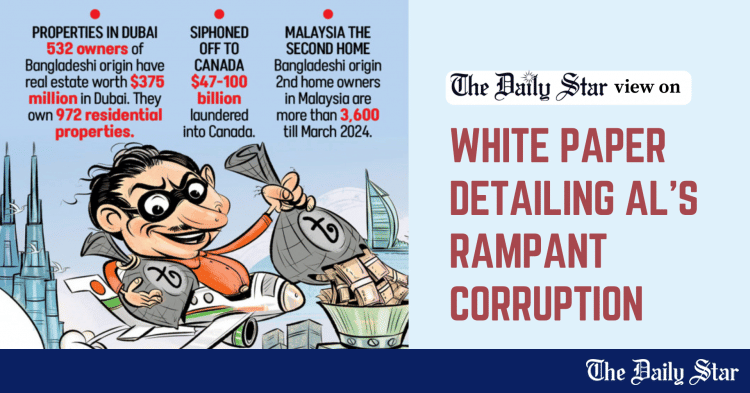
The report also outlines how individuals in this network plundered vast sums from the public treasury through fraudulent schemes before laundering them abroad, causing immense economic degradation. This massive outflow of wealth has drained the country's capital, hindering efforts to revive the economy and restore vital institutions such as the banking sector. Much of the laundered money was used to purchase real estate abroad or funnelled under the guise of business operations. The paper identifies 532 individuals of Bangladeshi origin owning real estate worth $375 million in Dubai, with 972 residential properties in the UAE valued at approximately $315 million. In Canada, between $47 billion and $100 billion was reportedly laundered, with similarly large sums transferred to other countries.

Recently, a joint investigation by the British newspaper The Observer and the Berlin-based anti-corruption organisation Transparency International revealed that close associates of Hasina, including former ministers and business owners, hold properties worth over £400 million (approximately Tk 6,000 crore) in the UK. Allegations suggest that these assets were purchased with laundered funds siphoned out of Bangladesh.

Further investigations will likely uncover additional instances of corruption and wealth laundering under the AL. It is, therefore, imperative for the interim government to thoroughly investigate these cases and begin recovering the stolen wealth as a top priority, given that financial crimes of this nature become harder to trace and recover over time.

The white paper committee has recommended establishing an independent prosecution body to pursue follow-up actions and recover these funds. The government must act promptly to implement this recommendation as well as other proposals outlined in the report. Our diplomatic channels and international connections should also be leveraged to freeze illicit funds and facilitate their return to Bangladesh. Holding accountable those responsible for plundering the nation's wealth is essential to prevent such crimes in the future.​
 
Analyze

Analyze Post

Add your ideas here:
Highlight Cite Respond

AL turned Bangladesh into kleptocratic state: Debapriya
Staff Correspondent 03 December, 2024, 00:22

1733209076361.webp

Debapriya Bhattacharya | File photo

Economist Debapriya Bhattacharya on Monday said that a kleptocracy was established from crony capitalism in the past 15 years under the Awami League regime ousted by a student-people uprising on August 5.

Politicians, businesspeople and civil and military bureaucrats established the kleptocracy, he said, highlighting the findings of the ‘White Paper on State of the Bangladesh Economy — Dissection of Development Narrative’ at a briefing at the planning commission in the capital.

Debapriya, who headed the 12–member white paper committee, blamed the successive general elections since 2014 for the origin of the kleptocracy.

To him, members of kleptocracy influenced and manipulated key facets of the economy to serve their vested interests, concealed by an illusory development narrative sustained by inflated and misleading data.

The briefing was arranged a day after submission of the ‘White Paper on State of the Bangladesh Economy’ to chief adviser Muhammad Yunus on Sunday.

Describing efforts by the members and support teams over the past three months, Debapriya, also a distinguished fellow of Centre for Policy Dialogue, said that the report would be made public in printed form in a month.

The paper stated that the country lost $16 billion annually on an average between 2009 and 2023 because of the illicit fund flow amid systemic tax evasion, misuse of exemptions, and poorly managed public finances under the AL regime.

The white paper also highlighted that $14–24 billion was lost to political extortion, bribery, and inflated budgets with the annual development programme projects worth $60 billion in the past 15 years.

Exploring the overall economy left behind by the AL regime, in 23 chapters, the 385-page white paper revealed that the banking sector was plagued by distressed assets of Tk 6.75 lakh crore as of June 2024, equivalent to the cost of constructing 14 Dhaka metro rail systems or 24 Padma Bridges.

Despite the fragile economic situation identified as the middle income country trap by committee member and economist Zahid Hussain, Debapriya said that they opposed the deferral of graduation from the least developed countries’ block from 2026.

He feared that such a decision might provide a political weapon to the ousted regime.

Indicating Sheikh Hasina who fled to India on August 5, Debapriya said that statements might be issued that the interim government ruined the LDC graduation platform laid by the AL regime.

Zahid Hussain narrated how the overstatement of the country’s gross domestic product by the AL regime had already put the country into a middle income country trap.

Besides, the loan trap due to foreign loans on high interest rates for implementing non-viable projects will cause sufferings for the next generations, said Mustafizur Rahmnan, a member of the committee.

Other committee members were also present at the briefing.

Debapriya made five recommendations, including formulation of a two-year policy by the interim government, the next six-month outlook and meetings with development and lenders.​
 
Analyze

Analyze Post

Add your ideas here:
Highlight Cite Respond

Members Online

Latest Posts

Back
 
G
O
 
H
O
M
E