Home Watch Videos Wars Movies Login

[🇧🇩] Everything about Hasina's misrule/Laundered Money etc.

[🇧🇩] Everything about Hasina's misrule/Laundered Money etc.
261
9K
More threads by Saif

G Bangladesh Defense

832 bhori gold recovered from Hasina’s Agrani Bank vaults
Say NBR officials

1764120766895.webp


The Central Intelligence Cell of the National Board of Revenue has recovered 832.51 bhori gold ornaments from two vaults registered under the name of ousted prime minister Sheikh Hasina at Agrani Bank's principal branch in Motijheel.

CIC officials said the vaults, numbered 751 and 753, were opened on Monday in line with Bangladesh Bank regulations. A joint team comprising CIC personnel and representatives from other relevant agencies opened the vaults.

"Nearly 832 bhori gold ornaments have been found along with state awards and gifts received from various countries and institutions. Gifts that should have been deposited with the State Treasury were also found in the vaults," a senior CIC official, requesting anonymity, told The Daily Star.

The Anti-Corruption Commission is expected to hold a briefing on the matter soon.

Another vault registered in Hasina's name was opened the same day at Pubali Bank, but officials said no assets were found there.

The development comes amid ongoing scrutiny of financial records linked to political figures.​
 
Analyze

Analyze Post

Add your ideas here:
Highlight Cite Respond

Phantom bank account linked to S Alam Group

Investigators unable to trace account holder, suspect money laundering

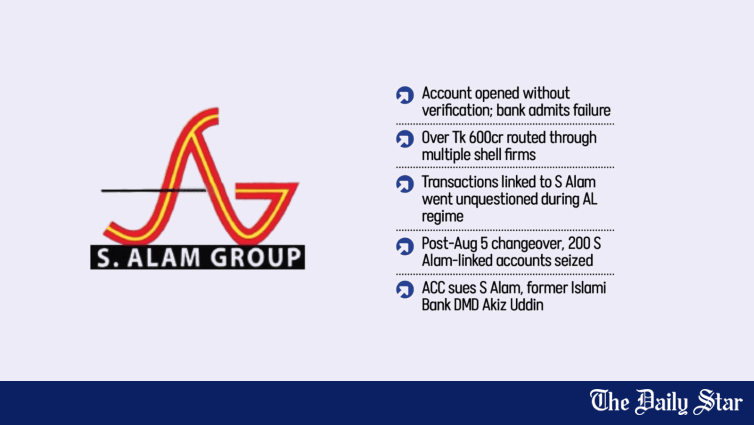
More than Tk 549 crore sit idle for over a year now in an account of a suspected shell company linked to S Alam Group, but investigators and Islami Bank officials are unable to trace the account holder.

The account named "Top Ten Trading House" was opened on April 13, 2023, at Islami Bank's Khatunganj branch in Chattogram. Bank documents show the owner is Almas Ali, and the company's registered address is listed as 23/5 Gopalbagh Residential Building, Jatrabari, Dhaka.

Over the last one year, bank officials served six formal notices on the so-called account holder to appear before the bank, but he did not show up. Bank officials also visited both his stated permanent and present addresses, but failed to verify his existence, raising questions about who actually opened the account.

"The owner of this account has never come to the bank. In fact, we could not confirm if he is a real person," Muhammad Jamal Uddin, a senior vice-president and head of Islami Bank's Khatunganj branch, told The Daily Star.

In recent months, several groups allegedly linked to S Alam Group tried to withdraw funds from the account using fake vouchers and cheques, even offering bribes to bank officials, he said but did not give any names.

"When the account was opened, I was not at this branch. But officials who were posted at the time said they were forced to open it without following proper procedures and verifying documents," Jamal added.

ACC SUES S ALAM

The Anti-Corruption Commission (ACC), which is investigating the matter, analysed Top Ten's documents and identified two more shell companies -- Alam Trading & Business House and Gold Star Trading House -- linked to S Alam Group.

Its investigation found that funds were deposited into Top Ten's account on multiple occasions directly from S Alam-linked firms, including S Alam subsidiaries such as S Alam Super Edible Oil Ltd, Sonali Traders, S Alam Edible Oil Ltd, and S Alam Sugar Refinery Ltd.

Mahmudul Hasan, an assistant commissioner at ACC's Dhaka office, filed a case over the suspicious account at the commission's Chattogram integrated office on August 18.

Suspects in the case include the nominal owners of three shell companies, along with S Alam Group Chairman Saiful Alam, its former deputy managing director Akiz Uddin, and former executive vice-president Miftah Uddin.

The ACC filed the case after Islami Bank alerted the anti-graft body about the suspicious account.

In a letter to the National Board of Revenue, the bank admitted that it did not follow proper procedures at the time of opening the account.

"A substantial sum was transferred into the account from investments made in the names of various S Alam Group concerns. While the transactions appeared on paper as payments to suppliers of the bank's investment clients, the ultimate beneficiaries were S Alam Group and some former bank officials who facilitated them," reads the letter dated October 18.

"Former Islami Bank deputy managing director Akiz Uddin, along with senior executives of S Alam Group, had opened fake accounts under the names of Top Ten Trading House and other shell firms to siphon off large sums of money and hide illicit financial dealings," the letter added.

FAKE VOUCHERS, PAY ORDERS

Bank and ACC documents show that on January 17, 2024, Tk 20 crore was transferred from Top Ten's account to Rabeya Enterprise at Southeast Bank. The company is owned by Nasir Uddin, who is married to Akiz Uddin's sister Sharmin Akter.

Bank officials say Akiz exerted significant control over Islami Bank and other banks under S Alam Group's ownership until August 5 last year. He reportedly left for Dubai after the political changeover.

The Daily Star called and texted him on WhatsApp, and the app's notification status indicates he has seen the message, but did not respond.

ACC investigators estimate that at least Tk 600 crore was deposited into Top Ten's account over 18 months since the opening of the account in April 2023 using a network of different bank accounts, fake vouchers, and pay orders.

Direct transfers from S Alam subsidiaries were avoided to mask the origin of the funds. Instead, the money was routed through shell companies before depositing in Top Ten's account.

On July 2, 2024, for example, Tk 523.10 crore was withdrawn in cash from Alam Trading's account at Islami Bank's Agrabad branch. The same amount was then deposited through three pay orders into the account of Gold Star Trading Company at the bank's same branch. Just a month later, on August 6, Tk 544 crore from Gold Star was deposited into Top Ten's account using a voucher, according to the case documents.

These transactions violated banking rules, as the pay orders should have been deposited into the issuing company's own account. Instead, they were diverted to Top Ten in a pattern the commission identified as embezzlement and money laundering.

Both Alam Trading and Gold Star Trading were found to be shell companies. Bank documents show Alam Trading is owned by Nurul Alam of Chattogram's Patiya upazila and Gold Star is owned by Bedarul Islam of Fatikchhari.

Their mobile numbers provided in bank records were found switched off.

These two accounts, having transactions worth over Tk 2,000 crore, have since been frozen on Bangladesh Bank's instructions, said Syed Mohammad Azim, senior assistant vice-president of Islami Bank's Agrabad branch.

A senior bank official said most of the money had already been withdrawn before the freeze in late August 2024, leaving only around Tk 2 crore.

Multiple Islami Bank officials said that during the 15-year rule of the Awami League, they could not question any transactions linked to S Alam. But after the August 5 changeover, more than 200 suspicious accounts linked to S Alam Group have been seized.

"S Alam-linked concerns embezzled around Tk 52,000 crore from Islami Bank through shell firms disguised as loans. Deposits in Top Ten Trading's account also came from such loans. Steps are underway to adjust the funds against outstanding liabilities," said Muhammad Jamal Uddin, senior vice president of Islami Bank's Khatunganj branch.​
 
Analyze

Analyze Post

Add your ideas here:
Highlight Cite Respond

Bangladesh ‘freezes’ Tk 661bn assets to recover laundered money, domestically and globally

bdnews24.com
Published :
Dec 17, 2025 22:16
Updated :
Dec 17, 2025 22:24

1766020523029.webp


The interim government has reported that immovable and movable assets worth Tk 661.46 million belonging to different industrial groups, both in Bangladesh and abroad, have been “attached or blocked” as part of efforts to recover laundered funds.

A media statement issued by the Finance Ministry on Wednesday said, of this, Tk 556.38 billion is held domestically, while Tk 105.08 billion is abroad. The release did not specify which countries or individuals’ assets have been frozen.

Finance Advisor Salehuddin Ahmed led the National Coordination Committee in its 30th meeting on Wednesday to formulate and implement policies and directives to prevent money laundering and terror financing.

The meeting decided to update certain provisions of the existing Money Laundering Prevention Act to make recovery of assets abroad “more efficient and effective”.

Progress on 11 priority cases, for which joint investigation teams were formed, was discussed in detail as well, according to the statement.

It said 104 cases have already been filed in these priority cases, 14 chargesheets submitted, and four cases adjudicated.

Under the act, documentation has been sent to 21 countries to facilitate recovery. Officials were instructed to expedite filing of chargesheets, forward documents to relevant countries, and take effective measures for swift case resolution.

Bangladesh Bank Governor Ahsan H Mansur said, “It normally takes four to five years to repatriate money from abroad; it is not instant. If we are lucky, the case of former land minister Saifuzzaman Chowdhury Javed in London may yield some funds. Islamic Bank and UCB have filed claims there, which could result in partial recovery.”

He, however, cautioned that the timing of any repatriation is “uncertain”, potentially arriving in February, April, June, July, or August.

Earlier, the UK’s National Crime Agency had reported freezing assets of Saifuzzaman based on information provided by the Anti-Corruption Commission.​
 
Analyze

Analyze Post

Add your ideas here:
Highlight Cite Respond

Bringing back laundered money may take 4-5 years
Says BB Governor


FE REPORT
Published :
Dec 18, 2025 09:19
Updated :
Dec 18, 2025 09:19

1766104732190.webp


The government will amend some sections of the existing Money Laundering Prevention Act, 2012 aiming to make the recovery of laundered money and assets from abroad more efficient and effective.

The decision was taken Wednesday at a meeting of the National Coordination Committee on combating money laundering and terrorist financing at Bangladesh secretariat.

Finance Adviser Dr Salehuddin Ahmed chaired the meeting, which reviewed the progress in recovery of laundered money.

The meeting discussed the progress relating to activities of the joint investigation team which was formed to investigate 11 priority cases to recover money and assets laundered abroad by influential quarters.

Apart from that, the authorities so far filed 104 cases based on priority list while charge sheets were submitted in 14 cases and the courts delivered judgments in four cases, the meeting was told.

According to a press release issued by the Ministry of Finance, immovable and movable assets worth Tk 661 billion-Tk 556 billion within the country and Tk 105 billion abroad-have been attached and frozen under the cases.

Additionally, 21 Mutual Legal Assistance Requests (MLARs) have been sent to the countries concerned for 11 priority cases.

The meeting, however, directed all concerned to submit charge sheets in priority cases as soon as possible, send MLARs to the concerned countries, and take effective initiatives for speedy disposal of the cases.

The meeting was told that the 4th round of mutual evaluation on Bangladesh's position regarding compliance with the existing international standards for prevention of money laundering and terrorist financing would be completed by the Asia Pacific Group on Money Laundering (APG) for the 2027-28 term.

The meeting considered mutual evaluation as the most important activity and instructed all relevant ministries, departments, and organisations to take necessary preparations to deal with evaluation successfully.

However, Bangladesh Bank governor Dr Ahsan H Mansur said bringing back laundered money was a lengthy process and might take four to five years.

"At least four to five years will be needed to bring back laundered money from abroad," he told newsmen after the meeting.

The governor said scores of cases had been filed against individuals and institutions so far, aiming to bring back the siphoned off money from abroad.

However, the governor is hopeful that a portion of the looted money can be brought back soon.

"We may be lucky, if the case of Saifuzzaman Chowdhury (Javed) in London is resolved, some money may come soon, (but) when it will come, whether before February or later, I don't know," he said.

Mr. Mansur said former land minister Javed did not contest the case in London, thus in one sense he accepted the defeat.

The Islami Bank and another bank already staked claims for money, if available after settlement of the case, he said.

"They may make appeal… this is a long process," he said. "But we think Saifuzzaman may not file any appeal, because he did not contest".

Regarding money laundering by the chairman of Chattogram-based S Alam Group Saiful Alam Masud, who allegedly looted billions of taka from the country's banking sector, the governor said S Alam filed for arbitration in Washington, against the Bangladesh authority.

"We will contest it on the ground that he is a Bangladeshi citizen and it is proved by Bangladeshi court and we have adequate proof of it," he said.

The governor said Saiful Alam Masud is not a Singaporean, rather he is a Bangladeshi national.

He was director and chairman of some banks in Bangladesh.

"How can he be a chairman or director of a local bank sans being a Bangladeshi?", he questioned.

Regarding the disbursement of the depositors' fund, the governor said the government was developing a computerisd system through which the money of the newly-formed Sammilito Islamic Bank will be channeled to their respective bank accounts.

He said around two weeks might be needed to develop the system.

Mr Mansur said a bank account of Sammilito Islamic Bank had been opened with the central bank with some Tk 200 billion there. The money was given from the fiscal budget of the government.

"We want a chaos-free disbursement of the depositors' money. But it will take some more time," he said.​
 
Analyze

Analyze Post

Add your ideas here:
Highlight Cite Respond
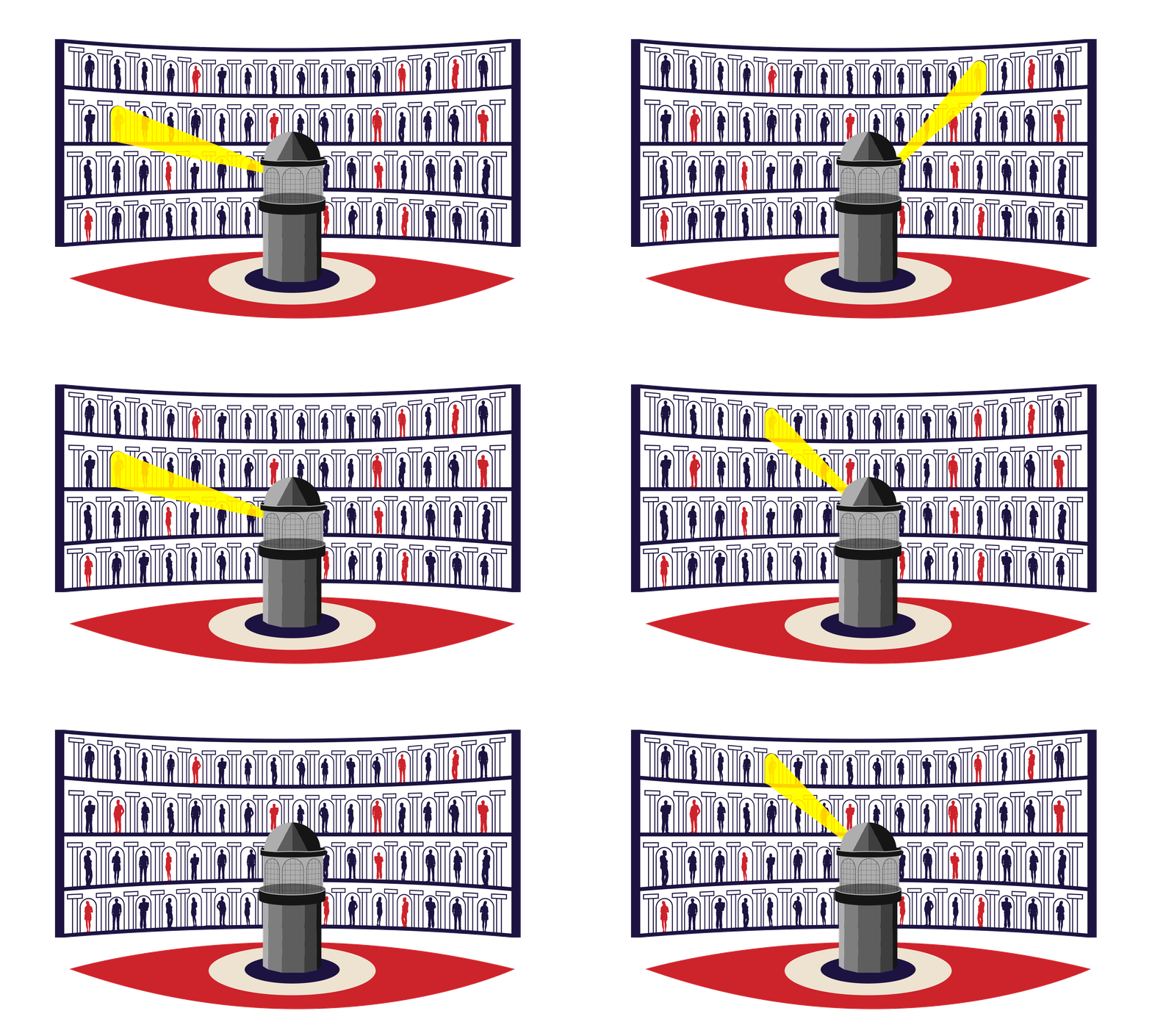
AL govt’s secret​

SURVEILLANCE​

The regime spent at least Tk 1,382cr to equip NTMC, Rab, police with surveillance infrastructure from 2016-24
Published:Monday, August 11, 2025
Reporting:Zyma Islam, Mohammad Suman and Mahmudul Hasan
Data Visualisation:Muhammad Imran
Graphics:Anwar Sohel
Editing:Martin Swapan Pandey​
 
Analyze

Analyze Post

Add your ideas here:
Highlight Cite Respond

Who will bring back laundered money?

Shah Md Ahsan Habib
Published: 24 Jan 2026, 17: 18

1769302473779.webp


After 5 August 2024, Bangladesh has faced a different reality. As the country attempts to navigate a new direction through political upheaval, administrative reorganisation, and policy reassessment, numerous sensitive economic data and complex questions have surfaced.

A white paper released by the new government attempts to highlight these issues with statistics and evidence. It officially acknowledges that a large sum of illicit funds was siphoned abroad, exploiting weaknesses in the banking sector, foreign exchange system, and weak control structures. This money laundering is not an isolated crime but rather the result of long-standing institutional failure, political patronage, weak regulation, and gaps in banking governance. The picture presented in the white paper is alarming. From under or over-invoicing in imports and exports, fake loans, shell companies, anonymous accounts, offshore banking structures, to the misuse of remittance systems—all contributed to making money laundering a systemic problem.

The most unfortunate aspect is that not only criminal groups but also various parts of the state have played a direct or indirect supportive role in this process. Consequently, questions arise about who holds responsibility in such a reality. Who will recover the vast amounts laundered over the past decade? How will it be recovered, and is it even possible? Furthermore, who will lead the recovery initiative?

The picture presented in the white paper is alarming. From under or over-invoicing in imports and exports, fake loans, shell companies, anonymous accounts, offshore banking structures, to the misuse of remittance systems—all contributed to making money laundering a systemic problem.

The interim government is discussing initiatives to recover laundered money. Identifying assets abroad, activating legal cooperation agreements with relevant countries, using Mutual Legal Assistance (MLA) pathways, and leveraging international financial intelligence structures are under consideration.

Some progress has been claimed, such as identifying suspicious accounts and initiating communication and information exchange with some foreign regulatory agencies. However, the reality is that repatriating laundered funds is a lengthy, costly, and uncertain process. Challenges include the standard of proof, timelines, political will, and international cooperation.

In this context, determining the roles, responsibilities, and leadership of involved government agencies and banks should be case-specific and incident-based. Because not all instances of money laundering prevention and recovery are the same; in some cases, negligence or compliance failures of banks are crucial, while in others, state policy laxity or administrative support has played a primary role. Therefore, it is not realistic to explain all situations within the framework of singular accountability.

Legally, banks operate customer transactions under specific laws and regulations. According to money laundering prevention laws and related rules, reporting suspicious transactions, Know Your Customer(KYC), risk-based customer classification, and regular transaction monitoring are all direct responsibilities of banks. If failures are proven in these areas, ensuring accountability of the respective banks and management will be the normal application of the law. However, it must also be acknowledged that even though effective laws exist, if their application is weak, banks alone cannot confront this risk.

The role of relevant government agencies, particularly the central bank, financial intelligence agency, revenue authorities, and law enforcement is extremely important. Their task is not only to issue directives but also to formulate realistic, timely, and effective regulations and to ensure their strict implementation.

Here, a fundamental division must be made clear. Money laundering poses a sovereign risk to a country, particularly when it occurs for a prolonged period due to institutional weaknesses. It may also represent a compliance risk for banks if it is proven that a bank deliberately or negligently violated laws. Thus, a bank's responsibility depends on whether it failed to comply with laws and regulations. Additionally, if various parts of the government were silent supporters or active enablers when money laundering occurred, how can banks protect themselves?

In many cases, it has been alleged that bank officials made decisions under political pressure, policy leniencies, or verbal directives—this is not a new allegation. If these decisions are viewed solely as bank failures today, justice becomes questionable. Thus, it is crucial to consider the timeframe, context, and decision-making framework when determining responsibility.

Many instances have shown that despite existing regulations, effective oversight did not occur due to hesitation in application, political considerations, or institutional weaknesses. This created a confusing message for banks: laws exist, but their application is uncertain.

In such a situation, anti-money laundering activities become mere formalities rather than effective measures. On the other hand, once money goes abroad, conducting complex and time-consuming processes like obtaining international legal assistance, coordinating with foreign regulators, asset freezing, and repatriation does not seem to be within the banks' capabilities. Here, the government must lead, and banks must assist with information, documents, and analysis.

In efforts to repatriate laundered funds, banks can play a supportive role by providing information, re-evaluating old transactions, and acknowledging compliance failures to take necessary corrections. However, expecting banks to lead asset freezing, litigation, or fund repatriation in international legal processes does not seem reasonable. This is primarily the domain of the state and law enforcement agencies.

However, this position is not unconditional. If an investigation proves that a bank or its top management was directly involved in money laundering, deliberately overlooked suspicious transactions, accepted fake documents, or facilitated the laundering process by violating laws, then the respective bank's liability must be financial as well as moral. In such situations, it is reasonable and justifiable to impose hefty financial penalties on banks, recover compensation, and impose the cost of legal processes for asset recovery.

For banks that build strong compliance frameworks by adhering to laws and regulations, implement effective risk-based monitoring, and maintain an uncompromising stance on suspicious transactions, it is crucial to have policy support and incentives from the central bank.

Such exemplary measures would, on one hand, ensure accountability for past irregularities, and on the other, send a strong deterrent message to the banking sector in the future. In other words, if the bank is merely a victim of negligence, then correction and collaboration are sufficient; but if proven to be a direct accomplice, financial liability should be the natural outcome of compliance and governance failures.

In this reality, clearly defining the boundaries of responsibility is crucial. Banks must be stringent in their compliance duties, government agencies must be impartial and firm in formulating and enforcing regulations, and the state must lead in repatriating laundered funds globally. This integrated and field-based distribution of responsibilities can bring desired outcomes in preventing money laundering and repatriating laundered money.

In this reality, it is clear that retrieving all funds from the past will not be easy. Yet, efforts must continue. The most pragmatic and effective strategy now is to focus on the future. The priority should now be to establish strong preventive measures to ensure that such money laundering does not occur in the future. The first requirement for this is a practical and effective compliance reform in the banking sector. Instead of policies on paper, risk-based oversight, technology-driven transaction monitoring, and a zero-tolerance policy for high-risk customers must be implemented. The bank management and board must be clearly informed that compliance failures will not be tolerated in any way.


Simultaneously, creating a proper incentive structure is now the demand of the times. Currently, in many banks, meeting income targets is considered the main indicator of success, not compliance. If this mindset and culture cannot be changed, no matter how many laws, rules, or directives are issued, their practical application will remain limited.
In this process, the role of the central bank and the Bangladesh Financial Intelligence Unit is most crucial, and they must lead from the front. This leadership should be technical, administrative, moral, and institutional. Because without impartiality, transparency, and moral firmness in policy enforcement, the desired behavioural change in the banking sector will not occur.

For banks that build strong compliance frameworks by adhering to laws and regulations, implement effective risk-based monitoring, and maintain an uncompromising stance on suspicious transactions, it is crucial to have policy support and incentives from the central bank. This could be in the form of positive recognition, prioritisation in regulatory processes, or capacity-building support. This would send a clear message to banks that compliance is not just an obligation but a valuable institutional strength.

On the other hand, for banks that consistently fail in compliance, overlook suspicious transactions, or deliberately weaken legal enforcement, visible and exemplary punishment must be ensured. Whether it's fines, administrative measures, management accountability, or business limitations—whatever measures are taken, they must be clear, timely, and nondiscriminatory.

If punishment is uncertain or selective, a compliance culture cannot develop. To implement this balance of support and punishment, the integrated, courageous, and moral leadership of the central bank and BFIU is essential. Without the effective and coordinated leadership of these two institutions, expecting desired behavioural changes from banks is unrealistic.

#Shah Md Ahsan Habib is a professor at the Bangladesh Institute of Bank Management.​
 
Analyze

Analyze Post

Add your ideas here:
Highlight Cite Respond

Members Online

Latest Posts

Back
 
G
O
 
H
O
M
E