[🇵🇰] Everything about latest Kashmir attack

[🇵🇰] Everything about latest Kashmir attack
145
4K
More threads by Saif

G Pakistan Affairs

India blows up homes of two Kashmir attack suspects
AFP Srinagar, India
Published: 25 Apr 2025, 17: 00
1745627339570.webp

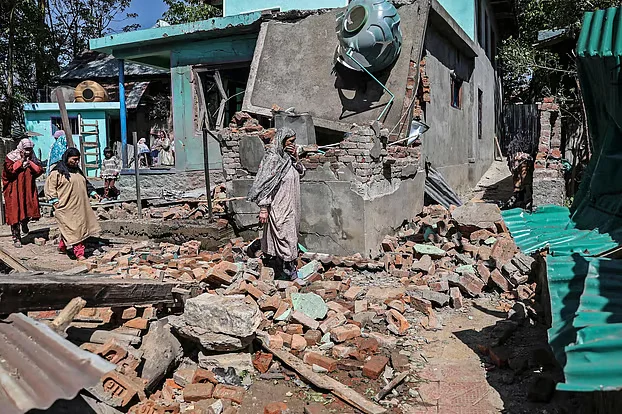
People walk through the debris of a demolished house related to the family of Ashif Sheikh, who is suspected of involvement in the Pahalgam tourist attack, in Monghama village of Tral south of Srinagar on 25 April 2025 AFP

Soldiers in Indian-administered Kashmir on Friday blew up the family homes of two men who police allege were among a gang that carried out the region’s deadliest attack against civilians for decades.

Indian security forces have launched a giant manhunt for those responsible for killing 26 men in Pahalgam on Tuesday.

Police say they are members of the Pakistani-based Lashkar-e-Taiba (LeT), designated a terrorist organisation by the United Nations.

They have issued wanted posters with sketches of three men: Indian national Adil Hussain Thoker, as well as Pakistani citizens Ali Bhai and Hashim Musa.

They are also searching for Indian citizen Ashif Sheikh.

Members of the two Indian fugitives’ immediate families were detained for questioning after the attack, the officer and their relatives said.

Sheikh’s sister Yasmeena said soldiers cordoned off the area around the house, in Kashmir’s southern Tral area, overnight from Thursday to Friday.

“One soldier climbed over the mud compound wall of our home, and climbed back after a while,” said Yasmeena, who gave only one name.

“After some time, a big frightening blast brought the house down. Everything inside is destroyed,” she said, adding that no one was inside at the time.

A police officer said soldiers also destroyed Thokar’s family home in the neighbouring Bijbehara area in the same manner early Friday.

Police said they were part of a LeT faction called The Resistance Front (TRF).

“Both have been active for three to four years, and are part of TRF which is an offshoot of LeT,” a police intelligence officer told AFP, speaking on condition of anonymity, because they were not authorised to speak to the media.

“They are wanted militants involved in earlier attacks as well on security forces,” the officer added.

Police have offered a two million rupee ($23,500) bounty for information leading to each man’s arrest.​
 

Indian and Pakistani troops exchange fire in Kashmir
AFP New Delhi
Published: 25 Apr 2025, 13: 22

1745627884321.webp

Indian Border Security Force (BSF) soldiers stand guard at the India-Pakistan Wagah border post on the outskirts of Amritsar on 24 April, 2025. At least 26 people were killed 22 April in Indian-administered Kashmir when gunmen opened fire on tourists, security sources told AFP, in the insurgency-hit region's deadliest attack on civilians since 2000. AFP

Troops from Pakistan and India exchanged fire overnight across the Line of Control in disputed Kashmir, officials said Friday, after the United Nations urged the nuclear-armed rivals to show "maximum restraint" following a deadly shooting in the region.

Relations have plunged to their lowest level in years, with India accusing Pakistan of supporting "cross-border terrorism" after gunmen carried out the worst attack on civilians in contested Muslim-majority Kashmir for a quarter of a century.

Syed Ashfaq Gilani, a government official in Pakistan-administered Kashmir, told AFP Friday that troops exchanged fire along the Line of Control (LOC) that separates the two countries.

"There was no firing on the civilian population," he added.

India's army confirmed there had been limited firing of small arms that it said had been "initiated by Pakistan", adding it had been "effectively responded to".

On Thursday, UN spokesman Stephane Dujarric told reporters in New York that issues between the countries "can be and should be resolved peacefully through meaningful mutual engagement".

1745627934535.webp

Pakistanis walk near the Pakistan-India Wagah border post on the outskirts of Lahore on 24 April, 2025. At least 26 people were killed 22 April in Indian-administered Kashmir when gunmen opened fire on tourists, security sources told AFP, in the insurgency-hit region's deadliest attack on civilians since 2000. AFP

"We very much appeal to both the governments... to exercise maximum restraint, and to ensure that the situation and the developments we've seen do not deteriorate any further," he said.

Indian Prime Minister Narendra Modi has vowed to hunt down the gunmen responsible for killing 26 civilians at the popular tourist site of Pahalgam, after Indian police identified two of the three fugitive gunmen as Pakistani.

"I say to the whole world: India will identify, track and punish every terrorist and their backer," Modi said, in his first speech since Tuesday's attack in the Himalayan region.

"We will pursue them to the ends of the Earth."

Denying any involvement, Islamabad called attempts to link Pakistan to the Pahalgam attack "frivolous" and vowed to respond to any Indian action.

"Any threat to Pakistan's sovereignty and to the security of its people will be met with firm reciprocal measures in all domains," a statement said, after Prime Minister Shehbaz Sharif held a rare National Security Committee with top military chiefs.

Water treaty suspended

Kashmir has been divided between India and Pakistan since their independence in 1947, with both claiming the territory in full but governing separate portions of it.

Rebel groups have waged an insurgency in Indian-controlled Kashmir since 1989, demanding independence or a merger with Pakistan.

India's air force and navy both carried out military exercises Thursday.

Indian police say the three gunmen are members of the Pakistan-based Lashkar-e-Taiba group, a UN-designated terrorist organisation.

They offered a two million rupee (USD 23,500) bounty for information leading to each man's arrest.

A day after the attack, New Delhi suspended a water-sharing treaty, announced the closure of the main land border crossing with Pakistan, downgraded diplomatic ties, and withdrew visas for Pakistanis.

In response, Islamabad on Thursday ordered the expulsion of Indian diplomats and military advisers, cancelling visas for Indian nationals -- with the exception of Sikh pilgrims -- and closing the main border crossing from its side.

Pakistan also warned any attempt by India to stop the supply of water from the Indus River would be an "act of war."

'Reduce it to dust'

Pahalgam marks a dramatic shift in recent Kashmiri rebel attacks, which typically target Indian security forces. Experts say that a military response may still be in the pipeline.

In 2019, a suicide attack killed 41 Indian troops in Kashmir and triggered Indian air strikes inside Pakistan, bringing the countries to the brink of all-out war.

"Whatever little land these terrorists have, it's time to reduce it to dust," Modi said on Thursday, after holding two minutes of silence in memory of those killed, all but one of whom was Indian.

India has taken its time to respond to past attacks.

The worst attack in recent years in Indian-run Kashmir was at Pulwama in 2019, when insurgents rammed a car packed with explosives into a police convoy, killing 40 and wounding 35.

Indian fighter jets carried out air strikes on Pakistan territory 12 days later.

Tuesday's assault happened as tourists enjoyed tranquil mountain views at the popular site at Pahalgam, when gunmen burst out of forests and raked crowds with automatic weapons.

Survivors told Indian media the gunmen targeted men and spared those who could give the Islamic declaration of faith.

Indian security forces have launched a vast manhunt for the attackers, with large numbers of people detained.

The attack has enraged Hindu nationalist groups, and students from Kashmir at institutions across India have reported experiencing harassment and intimidation.​
 

Trump says India, Pakistan to settle dispute one way or another
Agence France-Presse. Aboard Air Force One, Undefined 26 April, 2025, 06:24

1745628407407.webp

US President Donald Trump | AFP Photo

US President Donald Trump on Friday downplayed concerns over mounting tensions between India and Pakistan, saying the dispute between the nuclear-armed neighbours will get ‘figured out, one way or another.’

Trump was asked aboard Air Force One about crumbling relations between India and Pakistan as the fallout deepens from a deadly attack on civilians by gunmen in Indian-administered Kashmir.

‘There have been tensions on that border for 1,500 years so, you know, it's the same as it has been,’ Trump told reporters.

‘But they'll get it figured out, one way or another.’

Kashmir has been divided between India and Pakistan since their independence in 1947, with both claiming the territory in full but governing separate portions of it.

Rebel groups have waged an insurgency in Indian-controlled Kashmir since 1989, demanding independence or a merger with Pakistan.

Tensions have flared since Tuesday, when 26 male tourists were killed by gunmen in the Kashmir town of Pahalgam.

Indian police say the three gunmen are members of the Pakistan-based Lashkar-e-Taiba group, a UN-designated terrorist organization.

A day after the attack, New Delhi suspended a water-sharing treaty, announced the closure of the main land border crossing with Pakistan, downgraded diplomatic ties, and withdrew visas for Pakistanis.

Denying any involvement, Islamabad called attempts to link Pakistan to the Pahalgam attack "frivolous" and vowed to respond to any Indian action.

Officials said Friday that there was an overnight exchange of fire between Indian and Pakistani forces at the Line of Control.

‘There's great tension between Pakistan and India but there always has been,’ Trump said.​
 

Kashmir attack
India, Pakistan and threats of a water war: what we know

AFP Srinagar, India
Updated: 26 Apr 2025, 18: 18

1745715764251.webp

Pakistani citizens return to their country at the India-Pakistan Wagah border post on the outskirts of Amritsar on April 26, 2025. Pakistan and India are locked in an escalating diplomatic war of words after New Delhi said Islamabad was linked to a militant attack on tourists in Indian-administered Kashmir this week. AFP

India, furious after a deadly attack, has suspended the Indus Waters Treaty with Pakistan, with Islamabad warning any attempt to stop water flows would be considered an "act of war".

The 65-year-old pact was considered a rare diplomatic success story between bitter nuclear-armed rivals who have fought multiple conflicts.

But one thing experts on both sides of the border agree on is that while important, its suspension will have limited immediate impact on water.

What happened?

The Indus River is one of the longest in Asia, cutting through ultra-sensitive demarcation lines between India and Pakistan in contested Muslim-majority Kashmir -- a Himalayan territory both countries claim in full.

New Delhi suspended its part in the treaty after gunmen in Indian-run Kashmir targeting tourists killed 26 men on 22 April.


India accused Pakistan of supporting "cross border terrorism", claims rejected by Islamabad.

Pakistan, which argues India is flouting international law, said it would respond with "full force" to any attempt to stop the water.

What is the treaty?

The 1960 treaty, negotiated by the World Bank over several years, ensured "equitable use" of six tributaries that feed the Indus river system.

The issue of water is deeply sensitive for both nations.

For parched Pakistan, the water is critical for consumption and agriculture.

Under the deal, it was agreed that India controls three eastern Indus tributaries outright -- the Ravi, the Sutlej and the Beas.

India has the unlimited right to use them for irrigation and power generation.

While most is used, water still flows to Pakistan, especially during the rainy season when dams are full.

Three western rivers -- the Chenab, Jhelum and Indus -- are allocated to Pakistan.

India however can exploit them for non-consumptive uses, such as hydroelectric power.

Indian dams under construction on the Chenab are expected to increase its use.

What impact does suspension have?

"In the short term, there may not be any direct practical implication", said Himanshu Thakkar, coordinator of the India-based South Asia Network on Dams, Rivers and People.

"Any safe infrastructure to divert water, beyond what is happening now, takes years, mostly more than a decade".

India's existing dams do not have the capacity to block or divert water.

"India cannot immediately stop the flow of these rivers, as it is technically unfeasible and economically not viable", Pakistan water expert Hassan Abbas said.

The treaty's most important role was a dispute resolution mechanism, but Thakkar argued that it was already "more or less in limbo" for several years.

Why, then, did India suspend it?

Praveen Donthi from the International Crisis Group, said India's action was more sabre-rattling rhetoric for New Delhi to show action in a manner that "the masses will understand".

"The public was asking for retaliation, but that military retaliation takes time," Donthi said.

"It may take a week, two weeks, but there was a need for an immediate reaction".

The Indian public will view it as "a collective punishment that's being imposed on Pakistan for the act", Donthi said.

Hindu-nationalist prime minister Narendra Modi had already threatened to use water as a weapon in 2016 after an attack in Indian-run Kashmir.

"Blood and water cannot flow together," he said at the time.

Is there a longer-term impact?

India's suspension letter sent to Pakistan also said there were "fundamental changes to the circumstances" since the deal was signed, including "population dynamics" as well as a "need to accelerate the development of clean energy".

The precious resource is being sucked up by increasing populations and surging agricultural requirements, as well as hydropower projects fuelled by rising energy needs.

Building further dams that could hinder the flow more significantly is a tough task in rugged mountain terrain, but not impossible.

The growing impacts of climate change, shifting weather systems and melting glaciers in the wider Himalaya region means water is becoming more valuable than ever.

Are there other consequences?

Pakistan's The Dawn newspaper also pointed out it was "not a cost-free move" for India.

It noted that China controls the headwaters of the Brahmaputra, the vast river key to India's northeast.

"By suspending the treaty and acting unilaterally, it sets a precedent that could one day be used against it", it read.​
 

Kashmir attack
Pakistan ready to 'defend sovereignty' after India threats

AFP Islamabad
Updated: 26 Apr 2025, 18: 29

1745715994648.webp


Pakistan's former Prime Minister and leader of the Pakistan Muslim League-Nawaz (PML-N) party Shehbaz Sharif AFP file photo

Pakistan's leader announced his readiness to defend the country on Saturday, after New Delhi blamed a deadly attack in Indian-run Kashmir on Islamabad, sending already fraught relations into a tailspin with soldiers exchanging gunfire across their contested frontier.

Prime Minister Shehbaz Sharif also called for a "neutral investigation", with India accusing Pakistan of supporting "cross-border terrorism" after gunmen carried out the worst attack on civilians in Kashmir for a quarter of a century.

Islamabad denies involvement in the 22 April attack on tourists in Pahalgam, where a gang of gunmen killed 26 men.

"Our valiant armed forces remain fully capable and prepared to defend the country's sovereignty," Sharif said at a military ceremony in Abbottabad.

Both sides have imposed a slew of diplomatic measures, and exchanged gunfire in Kashmir two times in as many days.

India's army said "unprovoked" small arms firing was carried out by "multiple" Pakistan army posts overnight.

"Indian troops responded appropriately with small arms," it said in a statement, adding that no casualties were reported.

There was no immediate confirmation from Pakistan, but both sides had confirmed gunfire between their respective forces the previous night.

The United Nations has urged the neighbours, which have fought multiple wars, to show "maximum restraint".

Iran's foreign ministry said Saturday that Tehran has offered to play mediator, a day after a senior Saudi official said Riyadh was trying to "prevent an escalation".

US President Donald Trump has downplayed the tensions, saying that the dispute will get "figured out, one way or another".

'Track and punish'

Kashmir has been divided between India and Pakistan since their independence in 1947. Both claim the territory in full but govern separate portions of it.

Rebel groups have waged an insurgency in Indian-controlled Kashmir since 1989, demanding independence or a merger with Pakistan.

Indian security forces have launched a giant manhunt for those responsible for the attack in Pahalgam, with police naming two Pakistani nationals among the fugitives.

Indian police say three of the gunmen are members of the Pakistan-based Lashkar-e-Taiba group, a UN-designated terrorist organisation, and issued a bounty for their arrest.

Indian troops blew up homes in Kashmir in their search and issued wanted posters with sketches of three men.

Indian Prime Minister Narendra Modi on Thursday said his country would "track and punish every terrorist and their backer", vowing to "pursue them to the ends of the Earth".

Pakistan's Sharif said the country was "open to participating in any neutral, transparent and credible investigation" in the attack.

A day after the attack, New Delhi suspended a water-sharing treaty, announced the closure of the main land border crossing with Pakistan, downgraded diplomatic ties, and withdrew visas for Pakistanis.

Islamabad in response ordered the expulsion of Indian diplomats and military advisers, cancelling visas for Indian nationals -- with the exception of Sikh pilgrims -- and closing the main border crossing from its side.

Pakistan also warned that any attempt by India to stop water supplies from the Indus River would be an "act of war".

At the frontier, created at the end of British rule when the sub-continent was partitioned into Hindu-majority India and Muslim-majority Pakistan, distraught citizens crossed.

The measures have abruptly ended rare visits to see relatives separated for generations by the border.

Among those at the Wagah border leaving Pakistan was 39-year-old Ghaffar Musafir, who was returning to his home in Indian-administered Kashmir.

"I'm Indian. I love India, but my family is here," he said. "And it's not like I hate Pakistan. I love Pakistan too."

Pahalgam marks a dramatic shift in recent Kashmiri rebel attacks, which typically target Indian security forces.

Experts say that an Indian military response may still be in the pipeline.

In 2019, a suicide attack killed 41 Indian troops in Kashmir and triggered Indian air strikes inside Pakistan, bringing the countries to the brink of all-out war.​
 

INDIA-PAKISTAN TENSION: KSA, Iran push for peace as gunfire traded again
Trump says 1,500-yr-old crisis

Agence France-Presse . Islamabad, Pakistan 27 April, 2025, 00:12

1745716284175.webp

File photo

Iran and Saudi Arabia sought to defuse India-Pakistan’s ongoing crisis as mediators while US president Donald Trump termed the tension as 1,500-years-old problem.

Iran has offered Pakistan to act as a mediator in its conflict with India, Tehran’s foreign ministry said Saturday while Saudi Arabia is trying to defuse tensions between the neighbouring countries, after a deadly attack in the disputed Kashmir region, a senior Saudi official told AFP on Friday.

‘The Kingdom is undertaking efforts to prevent an escalation between India and Pakistan,’ the senior Saudi official said, on condition of anonymity. ‘The two countries are allies of Saudi Arabia and we do not want the situation to get out of control.’

Saudi foreign minister Faisal bin Farhan has held separate phone calls with his Indian and Pakistani counterparts, his office said on Friday.

During the discussions, he ‘reviewed developments in the situation and efforts made to ease tensions’.

Iranian foreign minister Abbas Araghchi ‘declared Iran’s readiness to extend its goodwill efforts to help reduce tensions’ in a phone call Friday with his Pakistani counterpart Ishaq Dar. Araghchi said on X that his country was ‘ready to use its good offices’ to resolve the conflict.

US president Donald Trump on Friday downplayed concerns over mounting tensions between India and Pakistan, saying the dispute between the nuclear-armed neighbours will get ‘figured out, one way or another.’

Trump was asked aboard Air Force One about crumbling relations between India and Pakistan. ‘There have been tensions on that border for 1,500 years so, you know, it’s the same as it has been,’ Trump told reporters. ‘But they’ll get it figured out, one way or another.’

‘There’s great tension between Pakistan and India but there always has been,’ Trump said.

Indian and Pakistani troops exchanged gunfire overnight along the Line of Control that separates the two countries in contested Kashmir for a second day running, the Indian army said Saturday.

India’s army said ‘unprovoked’ small arms firing was carried out by ‘multiple’ Pakistan army posts ‘all across the Line of Control in Kashmir’ overnight from Friday to Saturday.

‘Indian troops responded appropriately with small arms,’ it said in a statement. ‘No casualties reported.’

There was no immediate confirmation from Pakistan, but the two sides had confirmed gunfire between their respective forces the previous night.

Meanwhile, Pakistan’s leader said his nation was open to a neutral investigation on Saturday into a deadly attack in Indian-run Kashmir that New Delhi blames on Islamabad, and that has sent fraught relations into a tailspin with soldiers exchanging gunfire across their contested frontier.

Islamabad denies involvement in the April 22 attack on tourists in Pahalgam, where a gang of gunmen killed 26 men in the worst attack on civilians in Kashmir for a quarter of a century.

But India is adamant in it is accusation that Pakistan is supporting ‘cross-border terrorism’.

Indian police have issued wanted posters for three men—two Pakistanis and an Indian—who they say are members of the Pakistan-based Lashkar-e-Taiba group, a UN-designated terrorist organisation.

Rejecting Indian claims, Pakistan’s prime minister Shehbaz Sharif on Saturday said the country was ‘open to participating in any neutral, transparent and credible investigation’ into the attack.

Indian security forces have launched a giant manhunt for those responsible for the attack in Pahalgam, blowing up homes in Kashmir of Indian citizens suspected to be linked to the attack.

‘Our valiant armed forces remain fully capable and prepared to defend the country’s sovereignty,’ Sharif said at a military ceremony in Abbottabad.

Inda’s information ministry on Saturday warned broadcasters to ‘refrain from showing live coverage of defence operations’ in the ‘interest of national security’, and referencing the 1999 Kargil conflict with Pakistan.

The United Nations has urged the neighbours, which have fought multiple wars, to show ‘maximum restraint’.

Kashmir has been divided between India and Pakistan since their independence in 1947. Both claim the territory in full but govern separate portions of it.

Rebel groups have waged an insurgency in Indian-controlled Kashmir since 1989, demanding independence or a merger with Pakistan.​
 

A call for restraint
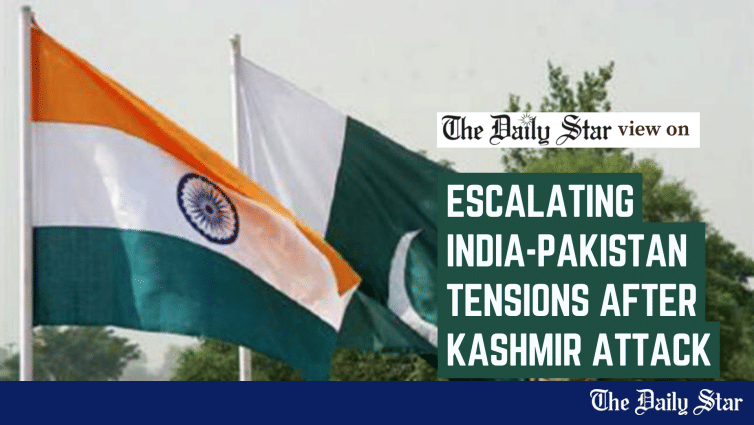
India-Pakistan tensions must not be allowed to escalate further

1745718057994.webp


We are deeply concerned by the escalating tensions between India and Pakistan, as both countries exchanged fire across the Line of Control in disputed Kashmir, following the recent terrorist attack in Kashmir's Pahalgam that resulted in the deaths of 26 tourists. As the Indian government has accused its long-standing adversary, Pakistan, of supporting "cross-border terrorism," relations between the two countries have plunged to their lowest level in years. Denying any involvement, Pakistan called the Indian attempts to link Pakistan to the Pahalgam attack "frivolous" and vowed to respond to any Indian action. Both nations have since introduced a series of retaliatory measures against each other. While we strongly condemn this heinous attack in Kashmir—the worst of its kind in a quarter of a century—and expect those responsible to be brought to justice, we also urge both countries to refrain from actions that could escalate the situation.

Reportedly, India has taken some strong measures following the attack. It has formally informed Pakistan of its decision to suspend the Indus Waters Treaty of 1961, closed the main land border crossing, downgraded diplomatic ties, and revoked visas for Pakistanis. Indian Home Minister Amit Shah also urged state chief ministers to ensure that no Pakistani remains in India beyond April 27. In response, Pakistan has closed its airspace to Indian airlines, expelled Indian diplomats and military advisers, cancelled visas for Indian nationals (except Sikh pilgrims), and shut down its side of the main border crossing.

It goes without saying that any further escalation will have far-reaching consequences for both nations. And it will be particularly disastrous for the economy of Kashmir, which is heavily dependent on tourism.

The UN has emphasised that issues between the two nations should be resolved peacefully through meaningful mutual engagement, a view we strongly support. A proper and thorough investigation is essential to identify and punish those involved in the recent terrorist attacks. However, even before such an investigation is carried out statements from India's water resources minister, pledging that "not even a drop" of water would go to Pakistan, and Pakistan's warning that halting the water supply from the Indus River would be an "act of war," are deeply concerning.

We hope both these nuclear-armed nations will renounce retaliatory actions and resolve their disputes at the negotiating table. With Pakistan reportedly proposing an international investigation and expressing willingness to cooperate, India should consider such an initiative. Finally, we urge both nations to avoid actions that could destabilise the entire region and instead focus on diplomatic solutions for the greater benefit of both sides.​
 

Kashmir attack
Pakistan ready to 'defend sovereignty' after India threats

AFP Islamabad
Updated: 26 Apr 2025, 18: 29

View attachment 16874

Pakistan's former Prime Minister and leader of the Pakistan Muslim League-Nawaz (PML-N) party Shehbaz Sharif AFP file photo

Pakistan's leader announced his readiness to defend the country on Saturday, after New Delhi blamed a deadly attack in Indian-run Kashmir on Islamabad, sending already fraught relations into a tailspin with soldiers exchanging gunfire across their contested frontier.

Prime Minister Shehbaz Sharif also called for a "neutral investigation", with India accusing Pakistan of supporting "cross-border terrorism" after gunmen carried out the worst attack on civilians in Kashmir for a quarter of a century.

Islamabad denies involvement in the 22 April attack on tourists in Pahalgam, where a gang of gunmen killed 26 men.

"Our valiant armed forces remain fully capable and prepared to defend the country's sovereignty," Sharif said at a military ceremony in Abbottabad.

Both sides have imposed a slew of diplomatic measures, and exchanged gunfire in Kashmir two times in as many days.

India's army said "unprovoked" small arms firing was carried out by "multiple" Pakistan army posts overnight.

"Indian troops responded appropriately with small arms," it said in a statement, adding that no casualties were reported.

There was no immediate confirmation from Pakistan, but both sides had confirmed gunfire between their respective forces the previous night.

The United Nations has urged the neighbours, which have fought multiple wars, to show "maximum restraint".

Iran's foreign ministry said Saturday that Tehran has offered to play mediator, a day after a senior Saudi official said Riyadh was trying to "prevent an escalation".

US President Donald Trump has downplayed the tensions, saying that the dispute will get "figured out, one way or another".

'Track and punish'

Kashmir has been divided between India and Pakistan since their independence in 1947. Both claim the territory in full but govern separate portions of it.

Rebel groups have waged an insurgency in Indian-controlled Kashmir since 1989, demanding independence or a merger with Pakistan.

Indian security forces have launched a giant manhunt for those responsible for the attack in Pahalgam, with police naming two Pakistani nationals among the fugitives.

Indian police say three of the gunmen are members of the Pakistan-based Lashkar-e-Taiba group, a UN-designated terrorist organisation, and issued a bounty for their arrest.

Indian troops blew up homes in Kashmir in their search and issued wanted posters with sketches of three men.

Indian Prime Minister Narendra Modi on Thursday said his country would "track and punish every terrorist and their backer", vowing to "pursue them to the ends of the Earth".

Pakistan's Sharif said the country was "open to participating in any neutral, transparent and credible investigation" in the attack.

A day after the attack, New Delhi suspended a water-sharing treaty, announced the closure of the main land border crossing with Pakistan, downgraded diplomatic ties, and withdrew visas for Pakistanis.

Islamabad in response ordered the expulsion of Indian diplomats and military advisers, cancelling visas for Indian nationals -- with the exception of Sikh pilgrims -- and closing the main border crossing from its side.

Pakistan also warned that any attempt by India to stop water supplies from the Indus River would be an "act of war".

At the frontier, created at the end of British rule when the sub-continent was partitioned into Hindu-majority India and Muslim-majority Pakistan, distraught citizens crossed.

The measures have abruptly ended rare visits to see relatives separated for generations by the border.

Among those at the Wagah border leaving Pakistan was 39-year-old Ghaffar Musafir, who was returning to his home in Indian-administered Kashmir.

"I'm Indian. I love India, but my family is here," he said. "And it's not like I hate Pakistan. I love Pakistan too."

Pahalgam marks a dramatic shift in recent Kashmiri rebel attacks, which typically target Indian security forces.

Experts say that an Indian military response may still be in the pipeline.

In 2019, a suicide attack killed 41 Indian troops in Kashmir and triggered Indian air strikes inside Pakistan, bringing the countries to the brink of all-out war.​

We shall know very shortly whether Pakistan is able to defend itself or not.
 

Posts you haven't read yet..

Latest Posts

Back