Donate ☕
201 Military Defense Forums
[🇧🇩] - Everything about our constitution | Page 7 | PKDefense
Home Login Forums Wars Watch Videos
Serious discussion on defense, geopolitics, and global security.

[🇧🇩] Everything about our constitution

Reply (Scroll)
Press space to scroll through posts
G Bangladesh Defense
[🇧🇩] Everything about our constitution
56
3K
More threads by Saif

HC questions 15th amendment that scrapped caretaker govt system
Staff Correspondent 19 August, 2024, 13:05


1724111853103.png


The High Court on Monday asked the government to explain in 10 days why the 15th amendment to the constitution, scrapping the caretaker government system in 2011, would not be declared illegal.

The court also asked the government to explain why all the government’s actions taken on the basis of the 15th amendment would not be declared illegal.

The court asked the secretaries of the law ministry and Jatiya Sangsad’s secretariat to explain the rule in 10 days.

The bench of Justice Naima Haider and Justice Sashanka Shekhar Sarkar issued the rule after hearing a writ petition filed on Sunday by five eminent citizens challenging the legality of the amendment made by the government of deposed prime minister Sheikh Hasina.

The citizens are Sushashoner Jonno Nagorik president M Hafizuddin Khan, its secretary Badiul Alam Majumder, local government expert Tofail Ahmed, and two individuals, Md Jobirul Hoque and Zahrah Rahman.

The court heard attorney general Md Asaduzzaman before issuing the rule.

The citizens’ lawyer, Sharif Bhuiyan, argued that the parliament scrapped the national election-time non-governmental caretaker system through the 15th amendment in violation of the Appellate Division’s May 10, 2011, short order that observed that the elections of the 10th and 11th parliaments could be held under the caretaker government system.

The lawyer argued that the caretaker government system was abolished on the recommendations of deposed prime minister Sheikh Hasina, although a 15-member special parliamentary committee and all civil citizens opined for the retention of the caretaker government system.

As the 15th amendment was unconstitutional, the incorporation of new Articles 7A and 7B into the constitution was illegal, he argued.


Article 7A. (1) says, ‘If any person, by show of force or use of force or by any other un-constitutional means-

(a) abrogates, repeals or suspends or attempts or conspires to abrogate, repeal or suspend this Constitution or any of its article ; or

(b) subverts or attempts or conspires to subvert the confidence, belief or reliance of the citizens to this Constitution or any of its article, his such act shall be sedition and such person shall be guilty of sedition.

(2) If any person,

(a) abets or instigates any act mentioned in clause (1); or (b) approves, condones, supports or ratifies such act, his such act shall also be the same offence.

(3) Any person alleged to have committed the offence mentioned in this article shall be sentenced with the highest punishment prescribed for other offences by the existing laws.

On Sunday, Supreme Court lawyer Muzahidul Islam filed a case against former chief justice ABM Khairul Haque for illegally changing the verdict on the caretaker government provision.​

The lawyer in the case alleged that Khairul, in his written verdict on September 16, 2012, after his retirement, changed the original verdict, stating that the caretaker government could only be formed with elected lawmakers.

The case said that Justice Khairul, in the changed verdict, also observed that the parliament would be dissolved 42 days before the national election and a small cabinet might be formed to carry out routine work until a new cabinet assumed office.
 
Last edited:
Analyze

Analyze Post

Add your ideas here:
Highlight Cite Fact Check Respond
  • Love (+3)
Reactions: Bilal9

Bangladesh’s eunomia problem

1736552404843.webp

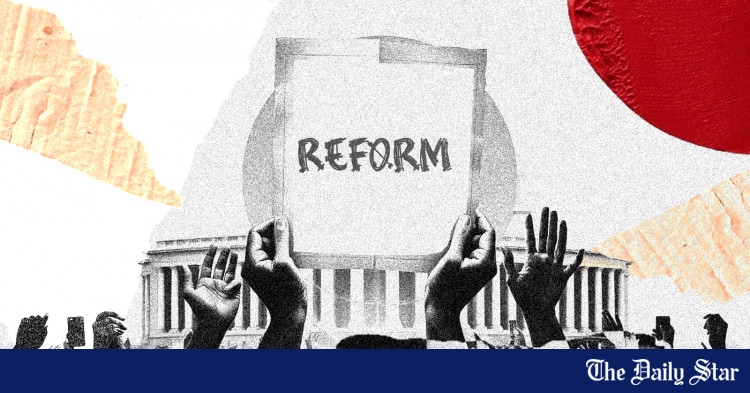
While fundamentals can be debated across historical eras, they should be neither dismissed nor desacralised in the name of renewal or with the intention of political erasure. VISUAL: SALMAN SAKIB SHAHRYAR

Let us ask an elusive question against the current political situation in Bangladesh: what creates a good nation? An ambitious constitution? Honest and accountable leaders? Effective policies? People themselves? We begin by discussing the idea of the constitution. You may not have noticed that you don't have to sign the constitution to pledge your allegiance to it or abide by it. The state assumes that you as a citizen are going to accept the constitution as a social contract and respect and follow it. In this assumption, the state imagines a nation with common beliefs and aspirations, and a shared interest in history, language, and culture. The constitution places a lot of trust in people to see, understand, and approve how it seeks to create a good nation with a common purpose. By championing a national mission, the constitution supposes that it can provide some consistency to people's public lives.

Yet, the idea of the constitution is tricky. It is a deeply idealistic instrument of the state in the sense that it is broadly based on people's collective trust and willingness to accept it as the nation's guiding principles. When that trust is not there, the constitution is fragile, becoming merely a book that catches dust on the shelf of a dimly lit office. Furthermore, as legal scholars have argued, the constitution presents a larger moral quandary. Even if it is ratified by the national assembly, it may not be just. It may only reflect the aims and machinations of an exclusive power-wielding group. When the US constitution was ratified in 1788, enslaved people in the country were considered three-fifths of a person and women didn't have the right to vote. The point is that a ratified constitution may not guarantee a fair society. To add to the complexity, there are nations—such as the UK, Canada, Saudi Arabia, and Israel—that do not have a single or full written constitution, rather various laws, conventions, principles, and judicial decisions.

Despite the inherent limitations in the ways the constitution is conceived, the image, purpose, and identity of a nation that it seeks to articulate are essential for the nation to function as a unit. But the problem is this: for people to collectively believe in the constitution as a social contract, there must be broad agreement on some "fundamentals" that take shape organically from within society over a period. In an ideal world, the constitution has already embodied these fundamentals to flesh out the details. Only when the public accepts the fundamentals wholeheartedly does the constitution begin to make sense. But what may the fundamentals be? They may include: i) that all people—irrespective of their race, gender, ethnicity, and religion—are equal before the law; ii) peaceful coexistence even while in disagreement; iii) free and fair election as the basis of democratic governance; iv) a tyranny-proof system of checks and balances in power; v) respect for the natural environment; vi) independent institutions; and vii) some historical happenings that galvanised the nation in the first place.

In the absence of public trust in the fundamentals, the constitution does not and cannot make good sense. On January 6, 2021, the US constitution became dangerously brittle until then Vice-President Mike Pence certified the 2020 US presidential election results. The constitution is not—has never been—enough to create a good nation. Let me make two crucial points here. First, what is most important in creating a good nation is a reasonable and civil historical process, powered by inclusive institutions, that produces reasonable people with the prudence to value some fundamentals as the cement of their national formation. Second, fundamentals are not God-given, and what is needed is a dynamic and quality public debate about their significance in building a good nation. In other words, a reasonable nation must know how to debate what is in their best collective interest.

A good nation is, of course, a utopian aspiration or even a myth—perhaps a necessary myth with which to articulate an acceptable national purpose. One way or the other, a nation's polity, stability, and sense of justice often depend on how maturely it deploys its ideas of fundamentals in the project of nation-building.

The Greeks first understood this political riddle. At the precipice of a civil war, circa 600 BCE, raging between a landed aristocracy and the peasants who owed it vast debts, Athenian legislator Solon came up with the idea of eunomia, an ideal political order that served the interests of all feuding parties. In addition to creating the social framework for a sound distributive justice, eunomia outlined, most importantly, how things should be in an ideal society. In other words, Solon created some fundamentals that brought people together, enabling them not only to transcend their narrow selfish interests, but also to believe in the virtues of citizenship and democracy.

With this long preamble, allow me to turn to current Bangladesh. The country's political class, unfortunately, has not been able to resolve its eunomia challenge. It did not convincingly determine what its historical fundamentals are or could be that would remain above fractious political bickering in the years to come.

The political project of what is known in Bangla as oikyomot has remained forever elusive. If oikyomot points to figuring out the nation's fundamentals, then it is, of course, not about the end product in the form of untouchable "truths," but rather about a continuous process of civil discourse with which to reason why some foundational ideas are necessary as a continuous political thread. Consider this example: by the time he was in his second term of presidency, George Washington endured vicious press attacks, questioning his integrity and his administration's "monarchical" style. But nobody ever set Mount Vernon, Washington's personal property, on fire. Today, people can write a scathing book on Washington's treatment of enslaved people in his estate, but nobody burns down the Washington Monument rising from the centre of the US capital. There is no historical dilemma in considering George Washington's pivotal role in the Constitutional Convention in 1787, a historical fundamental in the idea of the United States of America. Bangabandhu Sheikh Mujibur Rahman's March 7 speech is one such fundamental in the idea of Bangladesh. The achievement of 1971 is a foundational concept for this country. The whole point of the planned killing of the country's intellectuals by anti-liberation forces on December 14, 1971 was to defeat that concept. Ironically, the last regime's over-Mujibification of the country's political landscape spawned the wrong kind of debates on 1971.

While fundamentals can be debated across historical eras, they should be neither dismissed nor desacralised in the name of renewal or with the intention of political erasure. The problem in Bangladesh has been that political parties created their own "party fundamentals" that collapsed or were erased with their departure from the government. They weaponised history in their favour. While one party colonised 1971 as its exclusive turf, others showed a peculiar discomfort towards it (even when indulging in its sartorial celebration) or secretly denied its legitimacy. Thus, Bangladesh's political history has been a history of biased histories that created permanent political fault lines, weakening the promise of developing the nation's human capital. One cannot expect a mature nation when a misguided culture thrives, one in which people become accustomed to seeing the world from the lens of their narrow self-interests, ignoring the transcendental values of fundamentals in nation-building.

An insurmountable roadblock in Bangladesh has long diminished the possibility of establishing fundamentals as national unifiers. Since independence, the country has carried on with a peculiar birth defect, that is, the secret guilt-ridden binary of 1971 and religion. Despite the euphoria of liberation, in post-independence Bangladesh, many people, beyond the Islamist parties, secretly considered the secession from Pakistan a betrayal of Islam. Even though false—the Liberation War was fought against economic and political marginalisation—this binary continued to influence politics in Bangladesh with different artifices and under different circumstances. In many ways, August 15, 1975, the debate of Bangalee vs Bangladeshi, and partisan debates on secularism, among other examples, are different manifestations of this false binary, which seems to have become entrenched in the national psyche. It has become a culture even though its expression in recent times has become shrouded in mystical and indeterminate pronouncements.

Binaries that entrap us in a black-and-white belief system harm our social and cognitive evolution. What I propose is that some foundational concepts are necessary to anchor a good nation and its ability to live a richly hybrid life. More importantly, to be able to believe in unifying fundamentals, a nation needs maturity, courage, and a willingness to debate its purpose with civility. For that, we need to robustly invest in public education, civic programmes, and social campaigns.

Dr Adnan Zillur Morshed is an academic and a public thinker.​
 
Analyze

Analyze Post

Add your ideas here:
Highlight Cite Fact Check Respond

Constitution reform: Sweeping changes in constitution

1736981926337.webp


Expanding the fundamental rights to include food, clothing, shelter, education, internet, and vote, the Constitution Reform Commission proposes replacing nationalism, socialism, and secularism with equality, human dignity, social justice and pluralism as fundamental principles of state policy.

The only core principle retained from the 1972 constitution is democracy.

The commission also recommends an interim government to conduct elections, a bicameral parliament, two-term limits for the president and prime minister, lowering age limit of MPs to 21 from 25 and a national constitutional council to oversee appointments of constitutional bodies like the Election Commission as well as the chief adviser of the interim government.

The commission said in its recommendations that the five core principles reflect the ideals of the Liberation War of 1971 as well as the aspirations that emerged from the mass uprising of 2024. The commission recommended deletion of articles 8, 9, 10, and 12, which expanded on the key principles.

Led by Prof Ali Riaz, the commission also proposed to strike out articles 7A and 7B that barred constitutional amendments, which now have to be carried with two-thirds majority in both houses followed by a referendum.

The commission recommends calling the nation "Bangladeshis" instead of the previous "Bengalees" and further proposes recognition of mother tongues of all Bangladeshis as common or traditional languages. Bangla will remain the state language as before.

The commission advocates expanding the scope of fundamental rights and ensuring their constitutional protection through a comprehensive charter merging the second and third sections of the constitution to form a new charter on "fundamental rights and liberty". Thus, the right to food, education, healthcare or the right to vote will become enforceable in a court of law.

The commission recommends a bicameral legislature with a 400-seat lower house, or the National Assembly, and a 105-seat upper house or the Senate. The tenure of both houses are set at four years. Of the 400 assembly members elected directly, 100 will be reserved for women.

Political parties will be required to nominate at least 10 percent candidates in the lower house from among the youth. The minimum age to run in the elections will be reduced to 21 years from the existing 25.

There will be two deputy speakers with one coming from the opposition.

The recommendations stipulate that a member of parliament can only hold the post of prime minister or the leader of the house or the party chief at the same time.

Modifying, the much discussed article 70, the commission recommends that parliamentarians be allowed to vote against party line except finance bills.

To strengthen parliamentary watchdogs, the commission proposes that the standing committees be always led by members of the opposition.

The Senate will consist of 105 members, of whom 100 will be determined by the proportion of votes in the national election.

Political parties will nominate up to 100 Senate candidates of whom at least 5 will have to include representatives of marginalised communities.

The remaining 5 seats will be filled by presidential nominees who are not members of either house or affiliated with any political party.

A political party must secure at least 1 percent of the total votes in the national election to be eligible for representation in the Senate.

The Senate speaker will be elected by a simple majority from among its members.

There will be one deputy speaker elected from the opposition.

The commission recommends a National Constitutional Council (NCC) to ensure transparency and accountability in state functions and establish balance among the branches and institutions of the state.

This council will include representatives from all the three branches of the state. Council members will be the president, the prime minister, the leader of the opposition, the speakers of both houses, the chief justice, one deputy speaker of the National Assembly from the opposition, and the Senate deputy speaker, and one member elected by members of both houses, who do not belong to either the ruling party or the main opposition.

This council will remain in office even after dissolution of the parliament until the chief adviser of the interim government (charged to conduct national election) takes the oath. During the absence of the legislature, the NCC will consist of the following members: the president, the chief adviser, the chief justice, and two members of the advisory council nominated by the chief adviser.

The commission recommends the appointment of an interim government to conduct elections and remain in office until the next elected government takes oath.

The interim government's head, the chief adviser, will have to be appointed either 15 days before the expiry of the assembly or within 15 days of dissolution of the assembly.

The reform proposals lay down elaborate provisions for the appointment of a chief adviser for the interim government.

There are seven options for the appointment that the constitutional council will prioritise sequentially as laid out. The first option, requiring seven of the commission's nine votes, is to appoint any individual who is not in the commission. If that is not possible, the commission may resort to the second option, requiring six votes out of nine, to appoint any former chief justice or any former judge of the Appellate Division of the Supreme Court. If that is not possible then, the commission may, with unanimous agreement, appoint the president as the chief adviser. Failing that, the commission may then appoint the last retired chief justice as the head of interim government.

However, if the former top judge who retired last, declines, then the commission will have to approach the one who retired immediately before and work backwards. If none of the former chief justices are available or if all of them decline the appointment, then the commission will consider the last retired Appellate Division judge and failing that work backwards till they find one willing to shoulder the responsibility.

The chief adviser will carry out functions through an advisory council not exceeding 15 members.

The president will be elected by a majority vote of the electoral college, comprising each member of both houses, 64 district coordination councils and every city corporation coordination council.

The president's term will also be limited to four years with a two-term limit.

The commission also proposes the same term limit for the prime minister whether they are consecutive or not.

The commission has recommended decentralising the judiciary in an attempt to make justice more accessible. Proposals include a unitary structure of the Supreme Court while establishing permanent High Court benches in all divisional centres.

The commission emphasised the importance of a strong local government system and recommended a Local Government Commission. It also suggested coordination councils in the districts and metropolitan centres.

The commission recommends dedicating sections of the constitution elaborating on five constitutional commissions, namely the Human Rights Commission, Election Commission, Public Service Commission, Local Government Commission, and Anti-Corruption Commission.

The commission further recommends that the structure, appointment, tenure, and removal processes for all these commissions be identical. The tenure of each commission is set at four years.

The constitution commission recommends deletion of the constitutional provision that stipulates inclusion of Bangabandhu Sheikh Mujibur Rahman's speech of March 7, 1971, his declaration of independence and the proclamation of independence, which are included in the 5th, 6th and 7th schedules respectively.

The recommendations empower the president to declare a state of emergency only upon the decision of the NCC. The commission believes that during a state of emergency, no citizens' rights should be revoked or suspended, and the right to access the courts should not be suspended either.​
 
Analyze

Analyze Post

Add your ideas here:
Highlight Cite Fact Check Respond

Constitution reform commission proposes new principles for Bangladesh
Equality, human dignity, social justice, pluralism will replace nationalism, socialism, secularism

1736982591425.png

Photo: CA Press Wing

Highlights:
  • Include equality, human dignity, social justice, pluralism, and democracy in the preamble; remove nationalism, socialism, and secularism.​
  • Create a bicameral parliament with a National Assembly and Senate, each having four-year terms for better representation.​
  • Establish a National Constitutional Council to balance state powers and oversee key constitutional appointments transparently.​
  • Limit the Prime Minister to two terms, enable no-confidence motions, and amend Article 70 to reduce unilateral authority.​
  • Decentralise judiciary with permanent High Court benches in divisional cities; strengthen local governance with a Local Government Commission.​
The Constitution Reform Commission's report, submitted to the Chief Adviser Prof Muhammad Yunus, proposed including equality, human dignity, social justice, and pluralism in its preamble while removing nationalism, socialism, and secularism. Democracy, which is already a constitutional principle, will remain so.

The commission, led by Prof Ali Riaz, also proposed reinstating the provision for a referendum to amend the constitution.

The commission has recommended introducing a bicameral parliament to ensure representation for all, with a lower house (called the National Assembly) based on majority representation and an upper house (called the Senate) based on proportional representation. Both houses will have a term length of four years, meaning the government and the Prime Minister's term will also be four years.

The commission believes that one of the main reasons for the autocratic authoritarianism Bangladesh has faced over the past 16 years is the absence of an institutional power balance.

To prevent the concentration of power in the hands of an individual or institution, the commission has proposed the creation of a constitutional body named the National Constitutional Council to establish a system of checks and balances between the three branches of the state and the two executive positions — the Prime Minister and the President.

This council would include the President, the Chief Justice, the Prime Minister and Leader of the Opposition (both elected through the Parliament), the Speakers of both houses, Deputy Speakers from the opposition, and a representative of other parties.

The commission believes this institution would ensure transparency and accountability in the appointment process as a constitutional body.

The commission said, "It is evident that the unilateral powers of the Prime Minister must be reduced. To prevent the Prime Minister from unilaterally appointing heads of constitutional institutions, including the Election Commission and the armed forces, these powers should be vested in the National Constitutional Council."

The commission has recommended reforms to ensure that the Prime Minister can face a no-confidence motion in Parliament. It has also proposed amending Article 70 to prevent the Prime Minister from being entirely shielded by it.

The commission also recommended imposing a two-term limit on the Prime Minister's tenure.

The commission has provided a framework for an interim government to be formed after the dissolution of parliament and recommended that the selection of advisers to such governments should not rest with any individual or single institution. Instead, it suggested that this responsibility be given to the National Constitutional Council.

To ensure justice and accessibility for all, the commission has recommended decentralising the judiciary. It proposed maintaining the unitary structure of the Supreme Court while establishing permanent High Court benches with jurisdiction in all divisional cities.

The commission emphasised the importance of a strong local government system and recommended forming a Local Government Commission. It also suggested establishing coordination councils at the district and city corporation levels.

Additionally, the commission advocated for expanding the scope of fundamental rights and ensuring their constitutional protection through a comprehensive charter.

It proposed revising the current method of electing the President, which reflects individual preferences and suggested electing the President through an electoral college. The commission proposed that the President's term should be four years long.

While submitting the recommendations, the commission's chairman, Prof Ali Riaz, expressed hope that political parties would reach a consensus.​
 
Last edited:
Analyze

Analyze Post

Add your ideas here:
Highlight Cite Fact Check Respond

CONSTITUTION REFORM PROPOSALS: Change in state’s name recommended
Sadiqur Rahman 16 January, 2025, 00:13

The Constitution Reform Commission has recommended the substitution of ‘equality, human dignity, social justice, pluralism and democracy’ for ‘nationalism, socialism, democracy and secularism’ as the fundamental principles of the state.

The commission chief, Professor Ali Riaz, along with other members, on Wednesday handed over a report with recommendations to the chief adviser to the interim government, Professor Muhammad Yunus, at the latter’s Tejgaon office.

A summary of the report was uploaded to the commission’s website in the evening.

The report of three other reform commission –– the Electoral Reform Commission, the Anti-Corruption Commission Reform Commission and the Police Reform Commission –– were also handed over to the chief adviser at his office.

Addressing the report handover ceremony, Professor Yunus emphasised that the interim government would initiate discussions with political parties on the reform proposals made by the commissions to reach a consensus on the rebuilding of the country.
  • Bicameral legislature, 21 minimum age for contesting national polls​
  • Equality, human dignity, social justice, pluralism, democracy to replace nationalism, socialism, and secularism​
  • Bangladeshi nationalism instead of Bangalee
  • Not more than two terms in office of president, PM​
  • Decentralisation of High Court​

‘Elections will be held following a consensus among all parties. The reform proposals are the foundation for discussions to reach a consensus,’ he added.

The Constitution Reform Commission proposed a preamble of the constitution acknowledging the spirits of the War of Independence, the 2024 July-August student-people uprising and the citizens’ struggles against autocratic and fascist regimes to establish democracy and eliminate discrimination.

The commission substitution of ‘Janaganatantri Bangladesh’ for ‘Ganaprajatantri Bangladesh’ as the constitutional name of the state and the substitution of ‘nagariktantra’ for term ‘projatantra’ in the Bangla text of the constitution.

The commission recommended the establishment of a bicameral legislature –– a National Assembly with 400 directly elected members, including 10 per cent from the youth community, as a Senate with 100 members elected through a proportional representation system and five more members to be appointed by the president.

It proposed that one of the two deputy speakers must be elected from the opposition and members of the National Assembly should be free to vote against their party, except on finance bills.

It recommended lowering the minimum age-limit for National Assembly membership to 21 years from the existing 25 years.

As per the proposals, any amendment to the constitution would require the approval of two-thirds of the members from both the National Assembly and the Senate, followed by a referendum.

The commission recommended the establishment of a National Constitution Council –– comprising of the president, the prime minister, the leader of the opposition, the speakers and the opposition-nominated deputy speakers of the National Assembly and Senate, the chief justice, and an elected member –– to ensure accountability, transparency, and the balance of power among state institutions.

It recommended the recognition of food, education, medical care, shelter, access to the internet and information, voting rights, participation in the state governance, privacy, consumer rights, child development, scientific advancement, and the rights of future generations as fundamental rights.

It recommended that the election of the president by an electoral college –– 505 votes from the National Assembly and the Senate, 64 votes from district coordination councils, and single vote from each city corporation coordination council.

It proposed barring any individual from holding the office of the president and the prime minister for more than two terms.

To promote decentralisation of the judiciary, the commission suggested the establishment of permanent benches with equal authority to the High Court in every division. It also recommended forming an independent judicial appointment commission and renaming lower courts as local courts.

It recommended the establishment of a permanent attorney service.

The recommendations included the repeal of article 150(2) and the fifth, sixth, and seventh schedules of the constitution, which acknowledge Sheikh Mujibur Rahman as the father of the nation and incorporate his March 7, 1976 speech, his reported message issued early March 26, 1971 and the proclamation of the independence issued at Mujibnagar on April 10, 1971 in the constitution.

The commission recommended the repeal of articles 7(A) and 7(B), which render parts of the constitution unamendable, as well as articles 10 and 12, which endorse a socialist economic system and secularism.

At a press conference at the Foreign Service Academy, three advisers to the interim government said that six reform commissions on constitution, election, the police, the ACC, judiciary and public administration would get a one month extension to coordinate among themselves and prepare their final reports without overlapping.

‘We hope that the government, to reach a consensus, will start discussing the reform proposals with political parties by mid-February,’ said Syeda Rizwan Hassan, adviser for environment, forest, climate change and water resources adviser.

The interim government formed reform commissions on public administration, police, judiciary, election and the ACC on October 3, 2024. On October 7, the constitution reform commission was announced. The six reform commissions were primarily asked to submit their reports by the first week of January.

On January 2, the interim government extended deadlines for public administration, police and electoral reform commissions to January 15. Only the judiciary reform commission got a further extended time until January 31. The public administration reform commission failed to submit its report by January 15.​
 
Analyze

Analyze Post

Add your ideas here:
Highlight Cite Fact Check Respond

CONSTITUTION REFORM: Ambiguities in key issues remain: experts
Sadiqur Rahman 17 January, 2025, 00:14

Recommendations on the reform of Bangladesh constitution have attempted to address issues within the state’s structural and legal frameworks, but ambiguities remain, particularly concerning fundamental principles and rights, legal and political science experts said on Thursday.

They stressed further dialogue and refinement for clarity, particularly on the relationship between the state and religions, and mustering consensus among all walks of people.

The Constitution Reform Commission led by professor Ali Riaz on Wednesday submitted the recommendations to the interim government’s chief adviser Muhammad Yunus.

The reform commission recommended the substitution of ‘equality, human dignity, social justice, pluralism and democracy’ for ‘nationalism, socialism, democracy and secularism’ as the fundamental principles of the state.

Dhaka University’s political science teacher professor Tasneem Siddiqui told New Age that incorporation of pluralism in the framework of fundamental rights was appreciated.

However, expressing her concerns over the suggestion to remove secularism as fundamental principle, she said, ‘If secularism is dismissed as a Western concept, there must still be constitutional safeguards to limit the state’s involvement with religion. The constitution must provide a clear framework in this regard.’

Talking about the relationship between religion and the state, Supreme Court senior lawyer Shahdeen Malik said that in most democratic countries, the state and religion are separate entities.

‘In Pakistan, religion was used as a tool for exploitation, leading to the removal of the state religion in the 1972 constitution. Reintroducing state religion now would signify a step backward. How could we determine religion of a state if it is an institution?’ Shahdeen said.

Supreme Court lawyer Jyotirmoy Barua said that pluralism does not allow for any particular religion to dominate.

‘It is not right to eliminate secularism in the name of pluralism. If secularism is removed, the concept of a state religion must also be abandoned,’ he stated.

Regarding recommendations on democratic process, professor Tasneem found that the proposals effectively reflected public aspirations for reforms, particularly in roles of parliament, judiciary and the distribution of power between the president and the prime minister.

However, she strongly criticised the absence of provisions addressing democratisation within political parties.

‘While the electoral reform commission has addressed this issue, the constitution must provide a foundational framework for such reforms,’ she added.

As per the proposals, any amendment to the constitution would require the approval of two-thirds of the members from both the National Assembly and the Senate, followed by a referendum.

Shahdeen Malik expressed scepticism regarding the practicality of referendum for constitutional amendments, as recommended by the reform commission.

He argued that the low literacy rate in the country would make referendum challenging, especially for proposals involving multiple articles of the constitution.

‘Referendum might work for single amendment but are impractical for extensive changes,’ he said.

About the fundamental rights, professor Tasneem noted that the proposed rights to food, clothing, education, shelter and medical care should be explicitly mentioned, separating from the other rights, including access to internet and information, science education, childcare.

‘The rights to food, for instance, is fundamentally different from the rights to internet access,’ she added.

Jyotirmoy Barua demanded that the rights to energy should be in the proposed reforms. He further highlighted the need for protection against forced eviction and displacement, noting that while shelter was acknowledged as a rights in the recommendations, safeguards against land displacement were missing.

Additionally, he called for constitutional guarantees to protect citizens from harassment by law enforcers, such as unlawful detentions without warrants.

Professor Tasneem also expressed reservations about the proposed abolition of provisions related to repressive detention, saying that the elimination of such laws would also be interpreted as automatic revoking of the special power act and Section 54 of the Criminal Code.

‘What would be the alternatives if the state needs to detain a person for reasons? But still, the constitution must ensure a democratic way of such detention,’ Tasneem said.

The reform commission recommended the establishment of a bicameral legislature –– a National Assembly with 400 directly elected members, including 10 per cent from the youth community, and a Senate with 100 members elected through a proportional representation system and five more members to be appointed by the president.

Women rights activist and a senior Supreme Court lawyer Fawzia Karim Firoze said that the provisions for representation of women in the proposed National Assembly and Senate was not adequate.

She, however, welcomed efforts to limit the power of the prime minister and president, stressing the importance of a check and balance for preventing misuse of authority.

She also appreciated the decentralisation of the High Court as she said that this reform would help minimise delays and ensure access to justice amid growing lawsuits in the courts.

Fawzia endorsed the establishment of a Judicial Appointments Commission and a permanent attorney service, calling these measures crucial for strengthening the judiciary.​
 
Analyze

Analyze Post

Add your ideas here:
Highlight Cite Fact Check Respond

Members Online

⤵︎

Latest Posts

Latest Posts