We are only facilitators, not rulers, says Yunus
The interim government that took the helm of Bangladesh amid high expectations completed its 100 days in office recently. These few months have been fraught with challenges for Chief Adviser Professor Muhammad Yunus. The Daily Star Editor and Publisher Mahfuz Anam sat down with the Nobel peace laureate for an exclusive interview where he spoke about issues ranging from reforms and election to media and foreign policy. An abridged version of the interview was published on Wednesday. Following is the full interview.
The Daily Star: You gave your first interview to The Daily Star in 1992, and now, as the chief adviser, you are giving us your first interview. Thank you very much for that. You've dedicated your life to work on poverty alleviation and women's empowerment. How does it feel to suddenly step into political life?
Muhammad Yunus: I'm trying to get a grasp of it. This is an unfamiliar world for me. I'm trying to see how the work I've done all my life can be reflected in this ... how it can be and from which direction.
This is a world that is very difficult to enter, but sometimes opportunities arise. For example, at COP29, I had the chance to speak, and I shared what I've been saying all my life. Many people thought this was not coming from a government. And I made it clear that these were my own words. I speak for myself. Whether people like it or not is up to them. I will continue to say the same thing, whether I am in government or outside it. Whenever I get the opportunity, I will raise these issues.
TDS: That is your world, but politics is not. Politics, this politics of change, politics of charting new horizons, how do you feel in this realm?
Muhammad Yunus: It's a very difficult thing, but it has to keep moving forward. Politics has its own pace, and it moves that way. It's hard to fit my work into it. Not everything aligns perfectly. But where there's an opportunity to contribute, I keep trying. Take the Sustainable Development Goals, for instance. There's an opportunity there. I talk about the Three Zero Club, which is aligned with what the Sustainable Development Goals are all about. The things I've spoken about, I've said to bring them here, not leave them outside.
So, wherever possible, I speak up. If people like it, it will continue; if they don't, it will fade. But at least we have to keep saying them. We talk about building a new civilisation. I've long been saying that the civilisation we've created is self-destructive. We have to break free from this self-destructive civilisation and build something new. Where can this change happen? Where in this civilisation of ours can we make changes? I try to bring up these issues whenever there's an opportunity. Those who'll come in the future may not fully understand or may even ignore what has been said, but we will keep trying. It's not like we are forcing it.
TDS: Do you see any reflection of this among global leaderships?
Muhammad Yunus: Yes, I do, especially among the youth. Globally, young people represent a rising force with tremendous potential. There too, Bangladesh holds a significant sway, as it is a country of young people. Two-thirds of the population here is under the age of 50. You won't find such a young demographic elsewhere, especially in countries like Japan, where the population is declining. Japan is a nation with a largely ageing population, where people don't know one another. No one is aware how someone passes away. Despite accumulating vast wealth, when they die, no one is there, no children, no next of kin. An elderly person might tell another, "I'll keep the light on here. As long as the light is on, know that I'm alive." Despite their affluence, death in Japan is tragic and lonely. It's only when a smell emerges that people realise a body has been left unattended.
We don't want to go in that direction. We have the opportunity to use the power of youth. Youth means new dreams, new thoughts and creativity. We strive to inspire them and encourage them not only to dream, but to actively pursue those dreams and make them come true. I always say, if you dream, there is a chance to make it a reality. How can it be realised if you don't dream? Dreams are our greatest strength. We must not be afraid of dreams or view them as something negative. We often believe that dreaming means being detached from reality, as if becoming a poet. In truth, it is the poet who envisions the future. That's why we honour poets. They see what we cannot. Dreams come true because they are dreamt. How will they come true if they are never dreamt?
TDS: Let's get a bit more realistic from this beautiful world. Your government has crossed the 100-day milestone. What are the successes during this time, and where have you not been successful?
Muhammad Yunus: There have been some successes and some areas with no progress. Overall, it has been a mixed experience. These 100 days have been very challenging for us. This government emerged from an absolutely chaotic situation with no prior government in place. One government typically hands over responsibility to the next, but we didn't have that opportunity. We were born out of a revolution.
TDS: You had to take over state responsibilities directly after coming from the Olympics.
Muhammad Yunus: Yes. It took time to understand what is needed to be done and getting familiar with the machinery. There was an uprising and everything was in disarray. Wherever we went, we found chaos, be it restoring order, bringing back peace, re-establishing law and order, reviving business and trade, and getting the banking system functioning again. No institution was operational. Our foreign exchange reserves were depleted, and we didn't even have the capacity to repay our foreign debts. This was the situation when we took over. On one hand, the economy was in turmoil, and on the other, there was social instability. It took time to gradually restore stability from that point.
TDS: How much progress have you made in 100 days?
Muhammad Yunus: In 100 days, we have made significant strides. We've brought this chaotic economy under some semblance of order and regulation. We've managed to stabilise the collapsing banking sector, and not a single bank has closed. Even in these challenging 100 days, no bank has shut down, and we are hopeful that there will be none in future.
TDS: Is there any unfinished business?
Muhammad Yunus: The main area of incompleteness lies in law and order. There are movements being staged across the country. People come here [in front of Jamuna, the official residence of the chief adviser] with endless desires and expectations. They come here to press that they did not receive anything in the past 15/16 years, they have been deprived, and their demands must be met today. But how can we give them in one day what hasn't been given in 15/16 years? It's been difficult to make them understand these issues.
You can express yourselves; we are not telling you to stop. But don't do it by shutting everything down, because people are suffering. For example, students demanding the upgrade of Titumir College to a university had blocked the trains. We are trying to make them understand.
We can't be harsh either, because we've come through a difficult situation. We won't go back to the way things were before. We will not use the police or army as it was done in the past. So where will our strength come from? There was no police, no one else. That's the reason it took time. Meanwhile, the Ansars started a movement, demanding an extension of the retirement age. We had to make them understand. Things are happening all at once. We have to make everyone understand that these things will take place; some are already being addressed, while others are being promised. But after a few days, they return saying it's not happening. We have to explain again. Perhaps we are not good at getting our point across, which is why they come back with their demands.
Claims are being made time and again that the injured are not receiving proper care. Why wouldn't they receive treatment? We are dedicating time and resources to each individual. Yet, the newspapers are carrying reports that the injured are not being looked after. This government is giving the highest priority to those injured in the movement.
TDS: So, there is no lack of commitment?
Muhammad Yunus: There is no lack of effort or service either. But one reported to a journalist that he is not recovering. The time it takes to heal cannot be done overnight with a magic wand. I don't blame him either, because he's thinking: 'how long will I be like this'? Many have been sent abroad for treatment. After being sent to one country, they've said they need to go to another for better treatment.
TDS: Is there a possible communication gap here?
Muhammad Yunus: Yes, there is a communication gap, and we are working to address it. I wouldn't say we have been completely successful, but we are making efforts to publicise it through our communication. We have a website, but many don't even try to visit it. I asked the doctors, and they said they check regularly. If the doctors see them once a day, they [the patients] may feel it should be twice. Everyone is feeling a bit jittery.
A foundation has been set up, allocation made, and manpower deployed. The whole country's attention is focused on them, so there is no chance of neglecting them. This government was formed with their support, and we are constantly by their side.
They are being given financial support, though not everyone has received it yet. As the distribution continues, everyone will get it. We have said that we are committed to supporting them for life, not just for one or two years. Governments may change, and attitudes may shift, which is why we've set up a separate foundation, allocated funds, and arranged for future funding to ensure there is no shortage of money. Yet, they still do not find consolation.
TDS: After your interview with Al Jazeera, there has been a debate about your government's term being four years. However, your press secretary said you didn't say that. Can you clarify this?
Muhammad Yunus: It was clearly stated in that interview. I talked about the term of parliament, saying it could be four years. Then the interviewer asked if our term would also be four years, and I said it would be less. That's all I said.
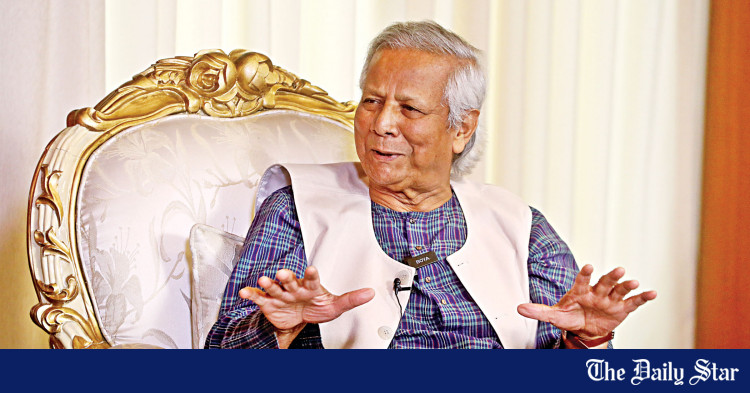
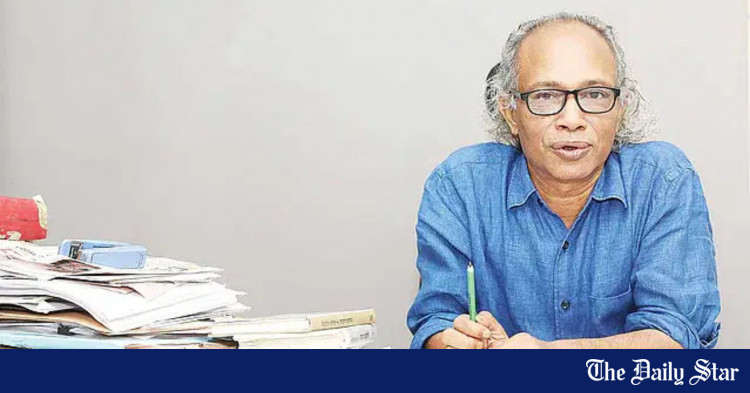
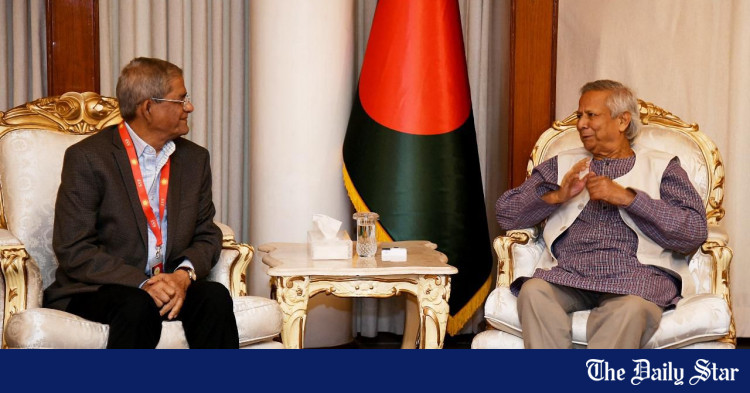
The Daily Star Editor and Publisher Mahfuz Anam interviewing Chief Adviser Muhammad Yunus at the state guest house Jamuna. Photo: Star
TDS: So, it can be assumed that it could be more than three years but less than four years?
Muhammad Yunus: I didn't mention three years either. I'm trying to keep it vague intentionally because if I state the term, people would be looking at that and try to hurry us to finish it quickly. We want the reforms to be carried out, and that's what all our efforts are directed towards.
TDS: When asked about the election roadmap, you said that let the reforms happen first. So, is it possible to provide a roadmap for the reforms?
Muhammad Yunus: We are working simultaneously on two parallel paths, with equal attention and efforts given to both. One is the path of reforms, and the other is of elections, which has nothing to do with the reforms. The Election Commission will likely be unveiled within a day or two. The commission will operate independently, and it's not under my control. Whatever is necessary will be provided.
However, the commission will have to consider what the election will be based on. It will not have that answer until the reform committee submits its report. Even after receiving the report, they can't proceed without a [political] consensus.
TDS: The reform committees have been given 90 days. Recently, four more reform committees have been formed.
Muhammad Yunus: The first six are the main ones. If those committees submit their reports, it will be sufficient. The rest can be addressed later.
TDS: So, the reports [of the commissions] are likely to be submitted by the end of December. What are the next steps?
Muhammad Yunus: Consensus. We will hold meetings with political parties. Efforts will be on to reach an agreement on what they want and what they don't. We won't impose anything. We would say that we have prepared the document, now it's up to them to tell us their views. Editorials will be written in the media, and their opinions will be considered. We will also take the views of the civil society.
TDS: How much time will you allow for this process?
Muhammad Yunus: The quicker the consensus, the quicker the process. If there's no consensus, the election train will come to a halt. Different issues are being discussed. For instance, the number of women's reserved seats and how they will be elected. These will have to be resolved. If political parties tell us there's no need for reforms, and instead they want elections, we will do that too. How long it will take to complete the reforms depends on the parties. If no one gets ready for the election and yet insists on holding the election before the reforms, we will do that. Who are we to stand in the way? Everyone wanted reforms, but if that's to be done, time must be given. If they give us time, it will happen. If not, we will hold the election.
How long does it take to hold an election? 90 days.
TDS: Yes, as stated in the constitution.
Muhammad Yunus: The election will be held within 90 days.
TDS: The debate started due to the ambiguity regarding the term. If we look at the process of the reforms, you'll get all the reports by the end of December or January, or possibly even February. After that, discussions will take place with all political parties, which could take three or four months. By July, you will have a clearer picture. Even then, there will still be about six months left in 2025. This creates some ambiguity among people ...
Muhammad Yunus: There is no ambiguity. As far as the time you mentioned, if the political parties want the election at that time, we will do that. We are not making any decisions on our own.
TDS: The responsibility for reforms lies with you.
Muhammad Yunus: I'm urging them for reforms. I'm saying that we have got an opportunity, please use it. If all political parties decide today that reforms are not necessary and want elections, then who am I to carry out these reforms?
TDS: The reality is that the major party is the BNP, then there are Jamaat and a few smaller parties. If these parties tell you that reforms are not needed and elections should be held, what will you do?
Muhammad Yunus: I will do it.
TDS: There are many people outside these parties. How will you take their opinions into account?
Muhammad Yunus: This is a new question. In that case, a referendum may be necessary.
TDS: You've said you would act according to the people's verdict.
Muhammad Yunus: Not the people, only the political parties. I don't think we will be able to go to the people. A referendum would be needed for that, and that's cumbersome. We are only taking the opinions of political parties, and this is clear.
TDS: Do you have any thoughts about the participation of the Awami League?
Muhammad Yunus: We won't impose this. The BNP has said discussions must be held with them [Awami League]. We assumed this reflects their [BNP's] opinion.
TDS: What if other political parties say that discussions cannot be held with them [Awami League]?
Muhammad Yunus: It will depend on which party is larger, and which is smaller. If the political parties agree that the Awami League should participate in the discussions, then it will happen. We don't subscribe to any specific ideology. We're not imposing anything. We're just making the arrangements.
TDS: The country's economy is a crucial issue. The finance adviser informed that the state of the economy is very bad. In your address to the nation, you said you would leave a strong economy before handing over power. How will you make that possible, and what initiatives are you taking?
Muhammad Yunus: We are fixing the banking system, stabilising foreign exchange reserves, and improving business, trade, and exports. Through these efforts, it will be done.
TDS: Foreign investment is crucial for our economy. Recently, Moody's has downgraded our rating. This will have a significant impact. Shouldn't there be a stronger economic message? What is your government doing in this regard?
Muhammad Yunus: We are trying. As I mentioned in my speeches, everyone is supporting us. No one has said they cannot accept this government and will wait for elections instead. Everyone is supporting us and enthusiastically stepping forward to help. They are showing interest, allocating funds, but it will take time. I've urged them not just to allocate funds but to release them quickly, and they have agreed. So, in that sense, we are reassured. When we hand over responsibilities to the next administration, we can at least leave them with signed agreements and incoming funds. They won't inherit a complete pandemonium.
TDS: Coming back to elections, you are saying that the sooner the reforms ...
Muhammad Yunus: … the sooner the elections. And if the political parties decide that reforms are unnecessary, elections can happen even sooner. We are not acting like rulers. We are merely acting as facilitators here.
TDS: The police were harsh in subduing protests during the previous government's tenure. Now, there seems to be some uncertainty among them about who might eventually retain their jobs and who might not.
Muhammad Yunus: That issue has been resolved. Those culprits have been identified. Those reinstated have resumed work, while those excluded remain out. Those who are to be punished are now going through that process. The current officers have been assured that they will face no further issues. However, on the ground, they still feel insecure. There's a fear of attacks.
How long it will take for the public to trust the police again remains to be seen. The people might forget gradually. At one point, there was a demand for changing the police uniforms, but that hasn't happened.
TDS: Can there be clear measures taken to alleviate the police's unease?
Muhammad Yunus: We are trying. We are making adjustments, offering encouragement, and training them. We can't immediately recruit new police officers, as that will take time. However, the process of new recruitment has also started.
TDS: A criticism of your government is that you often cave in under pressure from certain groups. For instance, the decision to extend the age limit [for entering government jobs] in the face of student protests. There was no study on it at all. Doesn't this make the government appear uncertain?
Muhammad Yunus: I wouldn't call it uncertainty of the government. Rather, it is a reflection of the uncertainty of the time. Everyone wants immediate results now. The campaign to extend the age limit to 35 years had a rationale, and a committee was formed to assess it. The committee recommended 35, but we decided that wasn't appropriate. After much internal debate, we settled on 32. Even then, there was some uproar, but we explained our position.
There are multiple demands all at once. We must address some. We can't simply ignore them. Sometimes, a decision is made, but later, we realise it doesn't resolve the issue, so we must revisit it to find an amicable solution for everyone.
TDS: There's talk about a lack of transparency in appointing advisers. Questions have been made regarding the criteria used in your latest appointments.
Muhammad Yunus: These appointments were made on the basis of necessity. There are no strict policies per se. The decision is made when we perceive that a certain sector is weak and needs strengthening. That is when we appoint someone.
TDS: Why appoint someone who seemed weak in the first place?
Muhammad Yunus: We felt they could manage. Also, this is a short-term matter. No one is staying here for the long term. If it were long-term, we would have deliberated much more.
TDS: But what if the government ends up staying in power for several years, more than three years but less than four?
Muhammad Yunus: That is exactly the signal we are giving, that we are not here for long. This is a very short-term government.
TDS: What is the government's position on Sheikh Hasina? You have mentioned that efforts will be made to bring her back after her trial.
Muhammad Yunus: A trial will take place. Once concluded, any legal processes for her return will follow accordingly. Until the trial is over, we cannot proceed on that matter.
TDS: Will Sheikh Hasina have the opportunity to defend herself?
Muhammad Yunus: This government's central focus is justice. If we handle her trial differently, it would undermine that principle. This entire movement and the change have been about establishing justice. If we deviate, the movement would lose its purpose.
TDS: And the trial will conform to international standards?
Muhammad Yunus: Whether we follow domestic standards or international, justice is justice.
TDS: There's a perception that you are closer to the Democrats than Republicans in the US. What is your view on this?
Muhammad Yunus: During my time in the US, when I lived there, Democrats were in power. So, naturally, I was closer to them. However, I never faced issues with the Republicans either. I built connections with them, and they worked with me. For example, president Clinton and Hillary Clinton supported microcredit initiatives, and we collaborated. That created a bond with them and many others, including members of the Congress and Senate. I haven't had such connections with the current Republicans, but that doesn't mean they oppose me.
I was awarded the Congressional Gold Medal, which was a unanimous decision. Everyone voted in favour, including Republicans. If anyone disliked me, they would have said so then. No one did.
TDS: What steps are being taken to establish relations with the Trump administration?
Muhammad Yunus: Let him assume office first. We have our embassy, which might already be working on this. The Bangladeshi diaspora is active as well. From here, we haven't initiated anything yet.
TDS: Indian-American groups are reportedly trying to influence the Trump administration against Bangladesh, including imposition of sanctions.
Muhammad Yunus: Bangladeshi-Americans are there too. We are encouraging them to speak out for the Bangladesh government.
TDS: But the Indian-Americans seem to be a lot better organised.
Muhammad Yunus: There's not much we can do. They've been there for much longer. We've only recently started going there. One cannot quite compare one with the other. They're well-established in business, politics, and other fields.
During the Liberation War, when I was there, finding Bangladeshis was a struggle. We had difficulty finding addresses even for sending newsletters about Bangladesh. I remember we managed to locate only 342 addresses across all of North America. Perhaps we missed another 350. But that gives you an idea of our numbers at the time.
TDS: Could you share more of your experiences from 1971?
Muhammad Yunus: At that time, we formed Citizens' Committees and the Bangladesh Defence League in America. We visited embassies, urging them to recognise our new country. Their response was, "Where is your government?" This was immediately after the declaration of independence when there was no formal government. Without a government, we couldn't effectively pursue diplomatic efforts.
So, we decided to send someone to Kolkata to work on this matter. The person reported back after a few days that preparations were under way to form a government. This reassured us. Once the government was formed, we could approach the embassies with more credibility.
TDS: Did you have contact with Tajuddin Ahmad's team back then?
Muhammad Yunus: Yes, the person we sent to Kolkata had connections. Through him, we established communications with the government. Policies were set, including procedures for people wanting to return home. Many of us had torn up our Pakistani passports. We were no longer Pakistani citizens. The new government provided us with travel documents.
I myself travelled back with one such document. I was detained at Paris airport for three to four hours. They simply would not accept the paperwork as an authentic travel document. After extensive explanations, they finally allowed me to proceed. Many others faced similar challenges.
TDS: Our younger generation knows little about the Liberation War. They don't seem to share the same emotional connection to it. Is this a cause for concern?
Muhammad Yunus: Perhaps we've failed to communicate with them effectively. Or, we've turned the history of the Liberation War into such a mess that no one knows what to believe. It's unfortunate that we couldn't provide people with accurate information.
TDS: The Indian government recognises Sheikh Hasina as a former prime minister, implying that they've acknowledged this government.
Muhammad Yunus: Their high commissioner met us. There was also a phone call with Modi. So put together, they have already recognised this government.
TDS: However, Indian media seems to distort our evolving situation. Reports include allegations of attacks on minorities. Have you expressed concern about this?
Muhammad Yunus: We've consistently said that these claims are mere propaganda. When Modi mentioned attacks on minorities during our conversation, I told him outright that these allegations are baseless. I even invited Indian journalists to visit Bangladesh to see for themselves. Our country is open, journalists can go wherever they want without restrictions.
Although some journalists did come after that, the narrative didn't change, which is disappointing.
TDS: Some Indian media have gone as far as to use terms like genocide against the Hindus.
Muhammad Yunus: They even had Trump make similar statements. This deeply saddened us. We've repeatedly emphasised that Bangladesh and India share a deep friendship. Such tactics won't sustain in the long term. Our shared history and geographic realities mean there's no scope for distance between us.
Some temporary friction may arise, but it won't define our bond. The sooner we move past these narratives, the better.
From the beginning, I've advocated revitalising SAARC. Everyone was enthusiastic about SAARC initially, but now it's practically a dead organisation. When I asked, they said it was because of Pakistan. So, I suggested that we could leave that aside for the time being and proceed. We were all there at the UN General Assembly, a photo-op would have been a matter of half an hour at most.
India says it's focusing on BIMSTEC. My response is, "Fine, pursue BIMSTEC, but SAARC is still here." We have expressed interest in joining ASEAN as well. These aren't conflicting endeavours. Every country has the right to build alliances. SAARC, with its established secretariat in Nepal, is just sitting idle. This is disheartening.
The youth are being deprived. SAARC had the potential to be like the European Union, facilitating free movement, trade, and education across member states. While this wasn't achievable immediately, it would have been possible step by step. Instead, it has regressed.
TDS: Considering US-China tensions and competition in the Indo-Pacific, Bangladesh may find itself caught in the middle. What's your perspective?
Muhammad Yunus: I don't see this as a tug-of-war. We have the opportunity to act as influencers. If misunderstandings arise between our two neighbours, we can mediate. We're friends with both and can work to defuse tensions. We may be a small nation, but we have a big role to play.
We're not seeking conflict; we want peace. And because of our size, neither side would feel threatened by us. They might even laugh at our attempts, but we'll continue advocating for peace.
TDS: The worsening US-China relations are troubling.
Muhammad Yunus: No country benefits from deteriorating relations with another. Many years ago, I wrote an article in The Daily Star titled "Growing Up with Two Giants".
TDS: It was for The Daily Star's 15th anniversary issue.
Muhammad Yunus: Yes. We're not denying their significance. This is an opportunity for us, and it remains so.
We still have the chance to make the most of it. Why would we want to create enemies? We don't wish harm upon anyone.
TDS: Is our relationship with China the same as before?
Muhammad Yunus: They are very enthusiastic about working with us. During my visit to the United Nations, the Chinese head of state didn't attend. According to protocol, I cannot hold formal meetings with anyone other than a head of state. However, the China's foreign minister was present, and he wanted to meet. We didn't have an official meeting, but we sat down informally.
For two evenings, we discussed various issues with his entire team. He outlined, point by point, the extent of China's relationship with us. He gave a lengthy statement, and I reciprocated with one of my own.
He had detailed records of my personal connections with Chinese universities that have centres named after me, places where Grameen microcredit operates, when I visited China, and whom I met.
China's largest bank, the China Construction Bank, once sought my advice on microcredit. Today, they operate microcredit programmes there. They even introduced new banking laws for the poor because of my influence. Establishing a new banking law is no small feat. It couldn't be done in our country, except for the Grameen Bank law. But in China, the law applies to all banks.
TDS: Could the distance between China and India impact us?
Muhammad Yunus: We are friends with everyone. We want to maintain close friendship with both India and China. We are excluding no one.
TDS: Murder cases have been filed against journalists without concrete evidence. Recently, the accreditation cards of 150 journalists were revoked. This has had a negative impact on press freedom.
Muhammad Yunus: This is what happens when things are done hastily. We have stopped such actions.
A committee has been formed to review the cases filed against journalists. The committee will examine whether these cases have any basis. The government will take appropriate steps based on its recommendations.
TDS: Has a timeline been set for this process?
Muhammad Yunus: No, not yet.
TDS: What about the accreditation cards?
Muhammad Yunus: I've been informed that these cards are for entry into the Secretariat, not for practising journalism. The revocation affects only access to the Secretariat. Journalists can continue their work otherwise. Legally, the government has the authority to regulate Secretariat access.
TDS: Do you have a message for journalists?
Muhammad Yunus: We now have a significant opportunity to move past everything from the past. Let us not make the same mistakes again. We need to rebuild based on truth and learnings from past errors. If we make mistakes during this process, point them out to us. That's why we value independent journalism. Your feedback helps us notice what we might otherwise miss.
TDS: We are optimistic, too. We see new opportunities and potential and want to advance along this path.
Muhammad Yunus: This is the aspiration of the entire country. We are talking about reforms to establish a proper framework to make it sustainable. Otherwise, we might return to the old ways after a single election. We must ensure that we break free from this cycle.
TDS: Thank you so much for your time.
Muhammad Yunus: Thank you for giving me this opportunity to speak.


 Bangladesh Defense


 www.newagebd.net