New Tweets

[🇧🇩] Everything about the interim government and its actions

G Bangladesh Defense
[🇧🇩] Everything about the interim government and its actions
213
7K
More threads by Saif

Bangabandhu’s photo removed from Darbar Hall at Bangabhaban​


View attachment 10521

A photo of Bangabandhu Sheikh Mujibur Rahman has been removed from the Darbar Hall in Bangabhaban, the official residence of Bangladesh's president.

Adviser Mahfuj Alam, in a Facebook post today, said, "The photo of Sheikh Mujibur Rahman - Post '71 fascist, is removed from Darbar Hall. It is a shame for us that we couldn't remove his pictures from Bangabhaban after the 5th of August. Apologies. But, he won't be seen anywhere till people's July spirit lives on."

Alam further wrote, "Awami League must acknowledge and apologize for what Sheikh Mujib and his daughter have done to the people of Bangladesh, starting from the non- democratic '72 constitution to famine, laundering of billions [of takas] and extrajudicial killings of thousands of dissidents and opponents (1972-75, 2009-2024). Then, we can talk about pre '71 Sheikh Mujib. Without apologies and trials of fascists, there won't be any kind of reconciliation."

When contacted, the president's press secretary, Joynal Abedin, did not respond.

However, a press wing official said that the photo of Bangabandhu was present last night when three new advisers took their oath in Darbar Hall.

"They went home after the oath programme; I have no knowledge about the incident," he added.

According to Article 4A of Bangladesh's Constitution, "The Portrait of the Father of the Nation, Bangabandhu Sheikh Mujibur Rahman shall be preserved and displayed" in key government offices, including those of the president, prime minister, speaker and chief justice, as well as in government and semi-government offices, educational institutions, and embassies.

In 2000, the Awami League government passed a law making it obligatory for all government offices to display Bangabandhu's portrait. However, this law was repealed in 2001 when the BNP-led government took office.
sahi hai bhai ! (good stuff bro !)

we also need to run a few people the hell out of our country

destroying them electorally, being all meek and Gandhian, and "democratic" is one thing

to the get the pitchforks, or the long swords out and walk em off a plank.. now that some next level xhit

2BPPHWM-5cf579c.jpg


wouldn't it be fun to see a saffron warrior triumphantly waving around a Sonja or Bianca ladis chest-chaddis ? :ROFLMAO:

dear lawrd !
 
Analyze

Analyze Post

Add your ideas here:
Highlight Cite Respond

Fulfilling sky-high expectations Yunus govt’s key challenge
Says ICG report on completion of interim govt’s 100 days in office

1731629208007.webp


The interim government should be unstinting in seeking consensus among political parties and other key groups, such as the army and students, as it faces key challenges in carrying out political, economic, administrative, and electoral reforms, said Brussels-based International Crisis Group in a report yesterday.

The report also stressed the need for foreign governments and multilateral institutions' support for carrying out the reforms.

ICG in its report titled "A New Era in Bangladesh? The First Hundred Days of Reform" said the Bangladesh government led by Professor Muhammad Yunus should balance demands for justice with the need for reconciliation, staying within the bounds of the constitution to mitigate the danger of its decisions being invalidated later.

The ICG report came as the interim government completed its 100 days in office following the ouster of Sheikh Hasina-led Awami League government on August 5. The Yunus-led government took charge on August 8.

The report said the government, which is expected to remain in office for another year or longer, should seek to hold fresh elections under a reformed polling system within a realistic timeframe, which should not extend beyond eighteen months.

According to the report, after fifteen years of Hasina's rule, Bangladesh has a once-in-a-generation opportunity to improve governance and put checks in place that would stop another autocratic regime from emerging. If the interim government falters, however, the country could revert to the status quo ante or even enter a period of military rule.

The interim government should aim to produce quick results to maintain public support for more ambitious reforms. It should avoid staying in power too long and build consensus on new measures among political parties. External actors should offer aid; India should work to repair its image with the Bangladeshi people, it added.

Experience suggests that the longer an interim government is in power, the louder calls for early elections gets and the larger doubts about its legitimacy grows.

Managing, let alone meeting, sky-high public expectations will be extremely challenging, reads the report.

The report mentioned that Yunus and his colleagues for now are enjoying widespread support, but popular expectations are "double-edged". If the interim administration falters in making reforms, the outcome is likely to be an early election with little progress; in the worst-case scenario, the military could assume power.

Over the past fifteen years, hundreds of billions of dollars have likely been funnelled illegally out of Bangladesh. Much of the money appears to have ended up in the United Kingdom, the US, the EU, Singapore and the Middle East, the report stated.

Already in bad shape, Bangladesh's economy is limping along, having taken a further hit from more than a month of protests and the uncertainty of the transition. Yunus's team has struggled to restore law and order, dependent largely on a police force that was heavily implicated in the anti-protest repression, it reads.

It said rebuilding the country's institutions will also be no mean feat, and while the interim administration is the most inclusive Bangladesh has ever seen, many of its members have little experience in government or management.

The interim government should look to keep its social support base strong as it builds consensus around key reforms and prepares the country for credible elections. International actors should back Yunus's administration and bolster the Bangladeshi economy to help inaugurate a new era in national politics, reads the report.​
 
Analyze

Analyze Post

Add your ideas here:
Highlight Cite Respond

Chief adviser returns home after joining COP29 in Baku

1731629873050.webp

Chief Adviser Professor Muhammad Yunus returned home this evening. Photo: CA's press wing

Chief Adviser Professor Muhammad Yunus returned home this evening wrapping up his Baku tour to attend the global climate meet Conference of Parties-29 (COP29).

"A flight of Biman Bangladesh Airlines carrying the chief adviser and his entourage reached the Hazrat Shahjalal International Airport in Dhaka at 8:00pm," CA's Deputy Press Secretary Abul Kalam Azad Majumder said.

On the first day of his tour to Azerbaijan on November 12, the chief adviser joined the opening session of COP29 in Baku, the capital of Azerbaijan, and met at least 20 top leaders of countries across the globe and heads of international agencies.

He met Turkish President Recep Tayyip Erdogan and the Turkish First Lady at the summit of the world leaders at the COP29 venue.

Yunus also met UAE President Sheikh Mohamed bin Zayed Al Nahyan; Pakistan PM Shehbaz Sharif; President of the Maldives Mohamed Muizzu; Bhutan PM Tshering Tobgay; and Nepal President Ramchandra Paudel.

Prof Yunus also met the PMs of Belgium, Bosnia Herzegovina, Albania, Barbados, presidents of Ghana, Rwanda, Montenegro, vice presidents of Brazil and Iran, president of FIFA, the and director general of IOM.

On the second day of the summit, the chief adviser addressed the Opening Session of the World Leaders Climate Action Summit in COP29, calling for creating a new life-style based on zero waste and zero carbon aiming to protect the planet from climatic catastrophes.

He joined a LDC high-level meeting with UN Secretary General Antonio Guterres.

On Wednesday, Prof Yunus also joined a number of events on the sidelines of COP29.

Today, the CA met Azerbaijan President Ilham Aliyev at the COP29 climate summit venue.

Besides, he held a meeting with former British PM Theresa May on the sidelines.

Lu Alckmin, wife of vice president of Brazil Geraldo Alckmin, called on the chief adviser at the venue of the COP29 global climate summit today.​
 
Analyze

Analyze Post

Add your ideas here:
Highlight Cite Respond
  • Like (+1)
Reactions: Bilal9

Interim govt needs to secure ‘quick wins’: ICG
United News of Bangladesh . Dhaka 16 November, 2024, 00:35

1731719192256.webp


With international support, professor Muhammad Yunus-led interim government should look to score some ‘quick wins’ to keep the public on side, said the International Crisis Group in its report released on Friday.

To hold on to power, Sheikh Hasina’s government ‘systematically undermined’ the independence of Bangladesh’s institutions, it observed.

Holding elections without reforms to put checks and balances on a future government could let another autocratic regime emerge, while a military takeover would be an even bigger setback, it added.

An early election would likely bring the Bangladesh Nationalist Party to office with few restraints on its power; given its record, many suspect it would prove little better than the Awami League, the Crisis Group observed.

If political and economic conditions were to deteriorate significantly, the army might intervene, beginning a period of military rule, the report claimed.

‘Quick wins’ could include steps to address petty corruption in public services, improve electricity supply and reduce high prices.

International actors should work with the interim government to support its ambitious goals and help move Bangladeshi politics into a new era, said the report titled ‘A New Era in Bangladesh: The First Hundred Days of Reform’.

Crisis Group’s senior consultant on Myanmar and Bangladesh Thomas Kean said that to maintain the widespread public support it enjoyed, the interim government also needed to improve its handling of day-to-day governance.

‘If Yunus and his team falter, the country could revert back to having elected governments with few checks on power, or even enter a period of military rule,’ he said, commenting on the report.

‘But if they can succeed in steering reforms, Bangladeshis could stand to benefit for decades to come.’

He mentioned that one hundred days after professor Yunus was sworn in to lead Bangladesh’s new interim government, the country stood at a crucial juncture.

The interim government had a once-in-a-generation opportunity to improve governance and put checks in place that would prevent another autocratic regime from emerging, Kean said.

‘But the scale of the task is monumental,’ he said, adding that in particular, the interim government would need to maintain a degree of political consensus with key political players, including student leaders, the Bangladesh Nationalist Party, Islamist forces, the military, and civil society.

The interim government has a strong public backing for reform and the support of key players, including student leaders and the army, the group observed.

The interim government has identified its priorities, outlined a process and laid out an initial timeline.

Sheikh Hasina’s flight from Bangladesh on 5 August has created a once-in-a generation opportunity for political renewal that can move the country beyond the bitter divisions and violence that has characterised much of the past five decades, according to the report.

‘The interim government will need to build political consensus while maintaining economic stability and delivering steady results to ensure that the Bangladeshi public remains firmly behind it,’ said the Crisis Group.

The alternatives would be unappealing for both Bangladesh and its partners, it observed.

The interim government should aim to produce quick results to maintain public support for more ambitious reforms. It should avoid staying in power too long and build consensus on new measures among political parties, said the report.

External actors should offer aid; India should work to repair its image with the Bangladeshi people, it mentioned.

After fifteen years in office, Sheikh Hasina’s administration had grown ‘deeply unpopular’. To hold on to power, the report said that her government ‘systematically undermined’ the independence of Bangladesh’s institutions, particularly the police, judiciary and bureaucracy.

Even if it is unclear how successful the Yunus team can be in reaching the goal, the alternatives look unappealing, said the report.

Foreign governments and multilateral institutions should provide the interim government with technical and financial assistance, including on security, judicial, electoral and economic reform.

Foreign governments should also help recover the proceeds of corruption and state-sanctioned theft that are sitting in banks and property markets outside Bangladesh.

India, which ‘staunchly supported’ Hasina throughout her rule, should take steps to repair the resulting damage to its image, said the report.

Support at home and abroad will be crucial to ensure that Bangladesh does not lose this chance at the political and economic change that many of its people long for, read the report.​
 
Analyze

Analyze Post

Add your ideas here:
Highlight Cite Respond
  • Like (+1)
Reactions: Bilal9

People won’t tolerate govt’s incompetence
Says Tarique

1731802936743.webp

Photo: Courtesy/UNB

BNP acting chairman Tarique Rahman yesterday urged the interim government to manifest its commitment to ensuring people's voting rights through a credible election in a bid to strengthen ties with people and build their trust.

Speaking at a council, he also warned that people will not tolerate the government's incompetency in running the country.

"The interim government has already taken an initiative to restructure the Election Commission. People expect to cast their votes freely, without fear, in a neutral and transparent environment and to elect their representatives," the BNP leader said.

He said the relationship between the government and people will grow stronger if the public can maintain their confidence in it.

"When people will see that the government is genuinely working to uphold their voting and other fundamental rights, their trust in the government will naturally deepen."

Tarique virtually addressed the concluding session of the third National Council of the Jatiyatabadi Textile Engineers Association of Bangladesh as the chief guest at the Institution of Engineers, Bangladesh.

"If the political and economic empowerment of the people is not ensured, then no matter what we call democracy, development, or reform, none of it will be sustainable," Tarique said.

He also said the main tool of a citizen's political power is the right to vote. "If people are not given the opportunity to exercise their right to vote, their relationship and partnership with the state will not be established."

Tarique said the deposed autocrats and their associates, both within the country and abroad, as well as elements within the administration, are actively working to fail the interim government. "If they succeed in undermining this government, they will also fail democracy and the millions of Bangladeshis who cherish democratic values," the BNP leader said.

In such a situation, he said, some decisions of the interim government appear to ignore the people's aspirations, instead imposing what they believe is best for the public.

Tarique also said if priorities are set incorrectly during the reform process, it will be seen by the people as a sign of the government's inefficiency.

Speaking at the programme, BNP Secretary General Mirza Fakhrul Islam Alamgir said the country is facing a very critical time. "We must navigate this period with great caution."

He urged the interim government to quickly complete the necessary electoral reforms to ensure credible and acceptable elections, in line with the people's wishes.

Tarique also called on BNP leaders and activists to preserve the party's image by refraining from any wrongdoings and standing firm against any form of injustice.

BNP Standing Committee members Dr Abdul Moyeen Khan and Dr AZM Zahid Hossain, among others, addressed the programme, with Jatiyatabadi Textile Engineers Association of Bangladesh President Fakhrul Alam in the chair.​
 
Analyze

Analyze Post

Add your ideas here:
Highlight Cite Respond

Interim govt is working to fulfil people's aspiration: Farida

1731890558829.webp

Photo: Courtesy/BSS

Fisheries and Livestock Adviser Farida Akthar yesterday said the interim government is working to fulfill the people's aspiration.

"The interim government is working to create a good atmosphere to handover the charges to the people's representatives. For this, some reforms will be needed," she told reporters after inaugurating the inter-school science fair at Shaheed Dhirendranath Datta Bhasha Chattar in Brahmanbaria town.

Bangladesh Freedom Foundation and ARD jointly organised the daylong fair.

The adviser said the interim government is also working to rehabilitate the families of martyrs and people injured during the July-August uprising.

Brahmanbaria DC Mohammad Didarul Alam, SP Mohammad Jabedur Rahman, and Professor Towfiqul Islam, among others, addressed the function with ARD Chief Advisor Siddiqur Rahman Rezvi in the chair.​
 
Analyze

Analyze Post

Add your ideas here:
Highlight Cite Respond

Holding polls not govt’s only responsibility
Says Nahid Islam

1731975082395.webp


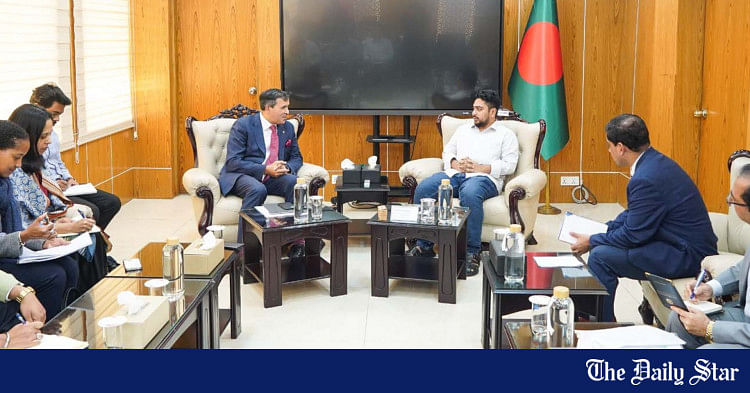
ICT Adviser Nahid Islam holds a meeting with Commonwealth Assistant Secretary-General Professor Luis Franceschi at the office of the Ministry of Posts, Telecommunications, and Information Technology at the Secretariat on Monday, November 18, 2024. Photo: PID

Just holding elections is not the sole responsibility of the current interim administration, since it is a revolutionary government, not a caretaker, Nahid Islam, adviser to the posts, telecommunications, and information technology ministry, said yesterday.

"Various commissions have already been formed for institutional reforms, and polls will be held after the reforms are completed," he said.

The adviser made the remarks during a meeting with Commonwealth Assistant Secretary-General Prof Luis Franceschi at the ministry's office, said a press release of the ministry.

Mentioning that the judicial process to ensure justice for the victims of mass killings during the July-August uprising is ongoing, he said the government requires assistance from the Commonwealth to ensure an impartial trial.

He also sought support from the Commonwealth nations in building a new Bangladesh.

Nahid mentioned that the interim government has received support from all over the world, which is still pouring in.

Prof Franceschi praised the current government's efforts towards democratic reforms and assured that the Commonwealth would support the ongoing reform initiatives, including electoral process reforms, in every possible way.

He stated that it is the Commonwealth's commitment to work with the interim government to build an inclusive, prosperous, and discrimination-free Bangladesh, said the release.

"The Commonwealth is always with Bangladesh, and it is keen to work with the country in areas such as education, information technology, media, cyber security, and artificial intelligence," added Franceschi.

Nahid reiterated that the interim government is working for the country's transition from an autocratic or non-democratic regime to a democratic one.

He stressed the importance of support from the Commonwealth countries in this regard, saying that the interim government is ready to take any action that serves the national interest.

Posts and Telecommunications Secretary Mushfiqur Rahman, acting ICT secretary Muhammad Mehedi Hasan, Commonwealth Adviser and Head of Asia Dinusha Nihara, along with other senior officials, were present at the meeting.​
 
Analyze

Analyze Post

Add your ideas here:
Highlight Cite Respond

A lot remains to be done by the government
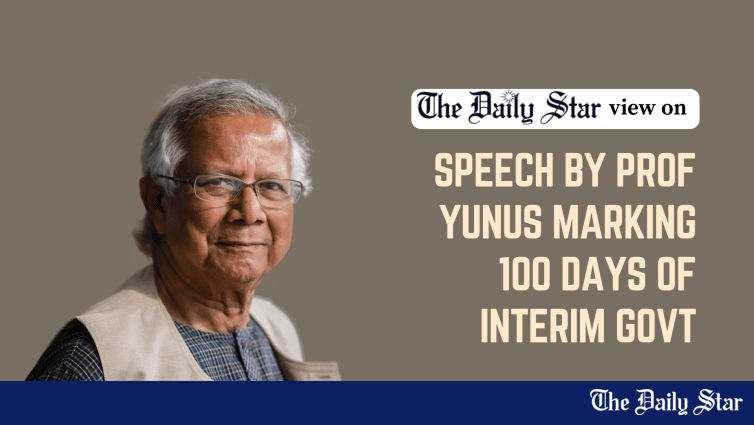
Prof Yunus’s speech marks 100 days of the interim government

1731975890243.webp

VISUAL: STAR

Amid myriad issues jostling for public attention, it was refreshing to see Chief Adviser Prof Muhammad Yunus deliver a speech conveying focused purpose and optimism at a time when deep-seated sociopolitical divisions threaten to overshadow the aspirations that led to the mass uprising over three months ago. His 34-minute address, marking the 100 days of the interim government, also reflected a sense of accountability that we hope will resonate across his administration. However, while he was quite forthcoming and persuasive on certain aspects—such as the ongoing reform drive and measures taken for the victims of the July-August uprising—he was less so on certain other aspects such as the economy, law and order, and, of course, the election timeline.

Prof Yunus has assured that an Election Commission would be formed "within a few days", and that the roadmap for the election would be issued as soon as decisions on electoral reforms are made. So far, the government has set up six commissions, including on electoral and constitutional reforms, which are expected to submit their reports between December and January. Prof Yunus said some essential reforms would be implemented during the election process which may delay the election "by a few months". This, along with his recent comment in an Al Jazeera interview about the government's tenure not extending beyond four years, has created an ambiguity that will test the patience of political parties, with BNP already expressing disappointment over the lack of a roadmap. The sooner the government comes clear on this issue, the better.

On other pressing issues, Prof Yunus's speech reflected some candour as he made no secret of the challenges we face with inflation. He said the economy is "getting stronger" after the disaster left by the ousted Awami League government, but the administration's performance in this regard, especially the persistently high commodity prices, has left a lot to be desired. On the state of law enforcement, he said the government is trying to boost the morale of the police, and that there has been "visible progress". This may be the case, but progress on this front has been much slower than expected, with media reports still painting a worrying scenario of crimes. As regards the government's initiatives for the victims of the uprising—which Prof Yunus highlighted in his address—there are areas that need to be expedited and streamlined, as recent protests by a group of injured protesters show.

These areas demonstrate the urgency to balance long-sought state reforms with immediate needs while navigating the prevailing political complexities. This is no easy task but the government must accomplish it anyway. That said, it cannot do all this on its own; political parties and citizen groups must also help with their patience, constructive criticism, and continuous feedback, keeping in mind the interests of the nation.​
 
Analyze

Analyze Post

Add your ideas here:
Highlight Cite Respond

Posts you haven't read yet..

Members Online

No members online now.

Latest Posts

Back
PKDefense - Recommended Toggle