New Tweets

[🇧🇩] Evolving partnership between Bangladesh and Malaysia

G Bangladesh Defense
[🇧🇩] Evolving partnership between Bangladesh and Malaysia
46
2K
More threads by Saif


Eight instruments of cooperation signed
Dhaka, KL ink MoUs on defence and energy


FE REPORT
Published :
Aug 13, 2025 00:35
Updated :
Aug 13, 2025 00:35

1755043194859.webp

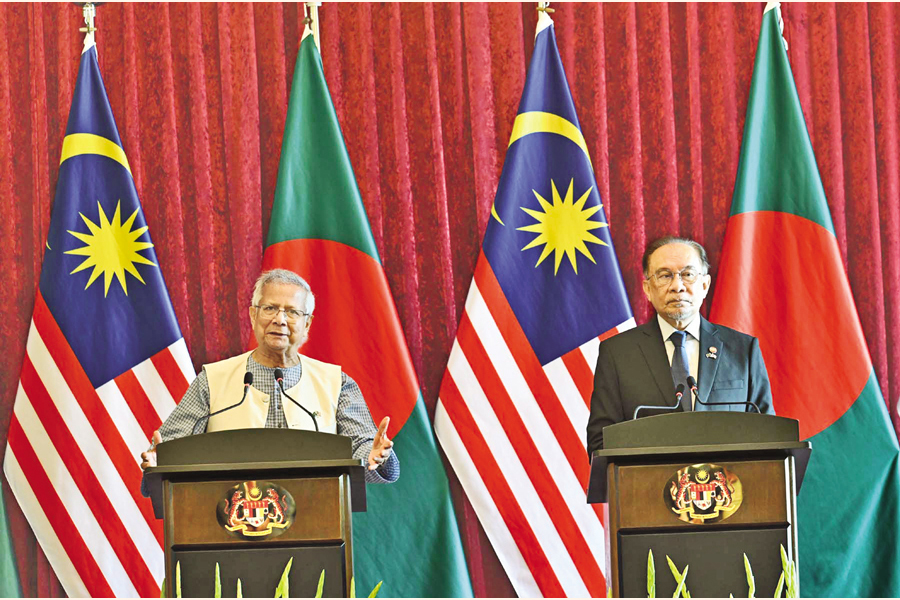
Chief Adviser Prof Muhammad Yunus and Malaysian Prime Minister Anwar Ibrahim speak at a joint press meet at the latter's office in Putrajaya on Tuesday. — PID

Bangladesh and Malaysia Tuesday agreed to deepen ties at summit talks capped with the adoption of eight instruments of cooperation with thrust on economy, investment, free trade, and labour recruitment.

The signing of five memorandums of understanding (MoUs) and exchange of three notes on cooperation followed talks between visiting Bangladesh Chief Adviser Prof Muhammad Yunus and Malaysian Prime Minister Dato' Seri Anwar bin Ibrahim at Perdana Putra in Putrajaya, where the leaders reaffirmed their commitment to transforming the Bangladesh-Malaysia relations into a deeper, future-orientated strategic partnership.

The two leaders first had a one-on-one conclave, preceded by a restricted session with select senior officials. Later, they led delegation-level talks covering a wide range of bilateral issues, including trade, investment, labour migration, energy cooperation, blue economy, education, and cultural exchanges, said a spokesperson for the CA Office.

"Our two countries share a deep bond rooted in history, religion, and cultural empathy. Malaysia is a unique partner of Bangladesh, particularly in human resources, trade, and people-to-people contacts," the head of interim government of Bangladesh said at the outset of the delegation-level talks.

Prime Minister Anwar described Professor Yunus as "a friend of Malaysia" and commended his leadership of Bangladesh's Interim Government over the past year. He emphasised the need to boost trade and expand cooperation in migrant-worker welfare and education, and efforts to resolve the nagging Rohingya crisis.

During the one-on-one meeting, Professor Yunus thanked Malaysia for facilitating the entry of nearly 8,000 stranded Bangladeshi workers under a simplified protocol and for introducing multiple-entry visas, and allowing workers to return home during emergencies without risking their jobs.

Both sides underscored the importance of transparent and fair recruitment processes to reduce costs and safeguard worker welfare.

At the delegation-level talks, Adviser on Law, Justice and Overseas Employment Prof Asif Nazrul urged Malaysia to recruit more skilled Bangladeshi professionals, including doctors and engineers, through a government-to-government framework.

He noted that Bangladesh's state-run BOESL agency is now capable of handling recruitment for Malaysian companies and called for opportunities for Bangladeshi security guards and caregivers. He also requested steps to be taken for the regularisation of undocumented Bangladeshi workers.

Malaysian officials confirmed that Bangladeshi workers would now be entitled to the same social security benefits as Malaysian workers and be able to lodge complaints in the Bangla language.

Bangladesh also requested "Graduate Pass" visas for thousands of its students in Malaysian universities. Currently, up to 10,000 Bangladeshi students are studying in Malaysia.

The leaders discussed Bangladesh's aspiration to deepen engagement with the economic bloc ASEAN, including its bid for Sectoral Dialogue Partner status, and sought Malaysia's support during its chairmanship of the association.

Professor Yunus also invited Malaysia to participate in the upcoming Conference on the Rohingya Crisis in Cox's Bazar and the UN-led international conference on the Rohingya issue in New York in September. He thanked Malaysia for its consistent support to the Rohingya people.

On economic matters, the two sides agreed to accelerate negotiations on a Bangladesh-Malaysia Free-Trade Agreement, strengthen investment cooperation through Special Economic Zones, and operationalise the Malaysia-Bangladesh Joint Business Council.

Highlighting the growing trade imbalance between the two friendly countries, Dhaka sought greater market access for Bangladeshi products such as medicines, batteries, footwear, ceramics and jute to the Malaysian market.

Bangladesh sought Malaysia's support in developing its Blue Economy and Halal industry, including establishing a Halal Economic Zone outside Dhaka, and expressed interest in joining the Regional Comprehensive Economic Partnership (RCEP).

Both countries welcomed the signing of a new MoU on LNG supply and energy cooperation and agreed to explore renewable energy partnerships. They also discussed collaboration in defence, culture, and tourism. Prime Minister Anwar expressed his admiration for Rabindranath Tagore and proposed a cultural conference on prominent Asian writers and thinkers.

After the bilateral meeting, Bangladesh and Malaysia signed five Memorandums of Understanding and exchanged three notes in different areas of cooperation.

Chief Adviser Prof Yunus and Malaysian Prime Minister Anwar Ibrahim witnessed the signing of the eight cooperation documents-five MoUs and three Exchange of Notes.

The first note of exchange provides for cooperation in the field of higher education. Malaysian foreign minister Dato' Seri Utama Haji Mohamad bin Haji Hasan and Bangladesh's foreign adviser Md Touhid Hossain exchanged the note.

The second note, on Training for Diplomats, was also exchanged by the two foreign-ministry chiefs.

The third exchange of note is on cooperation in the field of Halal Ecosystem. Deputy Minister in Malaysian Prime Minister's Department Senator Dr Zulkifli bin Hasan and Bangladesh Investment Development Authority (BIDA) Executive Chairman Chowdhury Ashik Mahmud bin Harun exchanged.

The first MoU between the Government of Malaysia and the Government of the People's Republic of Bangladesh is on defence cooperation. Malaysian defence minister Dato' Seri Mohamed Khaled bin Nordin and Bangladesh's foreign adviser Md. Touhid Hossain signed the accord.

The second MoU between the Government of Malaysia and the Government of the People's Republic of Bangladesh is about cooperation in the field of liquefied natural gas (LNG) supply, LNG infrastructure, petroleum products and their infrastructure.

Malaysian acting economic minister Datuk Seri Amir Hamzah bin Azizan and Bangladesh's energy adviser M Fouzul Kabir Khan signed the draft deal.

The third MoU is on cooperation between the Institute of Strategic and International Studies Malaysia and the Bangladesh Institute of International and Strategic Studies.

Institute of Strategic and International Studies (ISIS) Malaysia Chairman Datuk Professor Dr Mohd FaizAbdullah and Bangladesh High Commissioner in Malaysia Md. Shameem Ahsan signed the MoU.

The fourth memo is on collaboration between MIMOS Services Sdn Bhd and the Bangladesh-Malaysia Chamber of Commerce & Industry (BMCCI). MIMOS Services Sdn. Bhd. (MSSB) Chief Executive Officer (CEO) Mohamad Fauzi Yahaya and BMCCI Shabbir Ahmed Khan signed the MoU.

The fifth MoU is signed between the National Chamber of Commerce and Industry of Malaysia (NCCIM) and the Federation of Bangladesh Chambers of Commerce and Industry (FBCCI).

NCCIM president Dato' Seri N. Gobalakrishnan and FBCCI administrator Md. Hafizur Rahman signed the MoU.

The talks over, Prime Minister Anwar hosted a luncheon in honour of the Chief Adviser at the official residence of the Malaysian prime minister.

Bangladesh's delegation includes Foreign Adviser Touhid Hossain, Energy Adviser Fouzul Kabir Khan, National Security Adviser Dr Khalilur Rahman, Special Envoy Lutfey Siddiqi, BIDA Executive Chairman Chowdhury Ashik Mahmud Bin Harun, SDG Coordinator Lamiya Morshed and Foreign Secretary Asad Alam Siam.

The Chief Adviser is on a three-day official visit to Malaysia on August 11-13.​
 

Dhaka strongly raised irregular migrant issues with KL: Shafiqul Alam

Published :
Aug 12, 2025 23:29
Updated :
Aug 12, 2025 23:37

1755043327826.webp


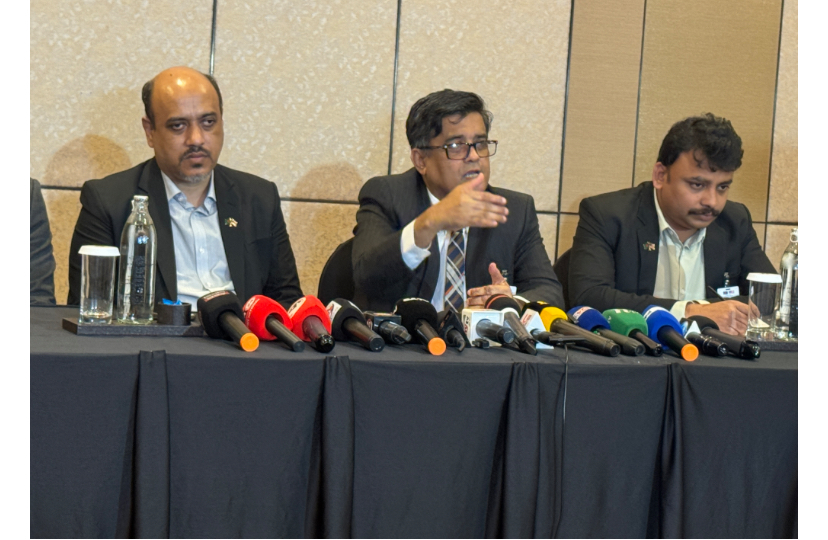
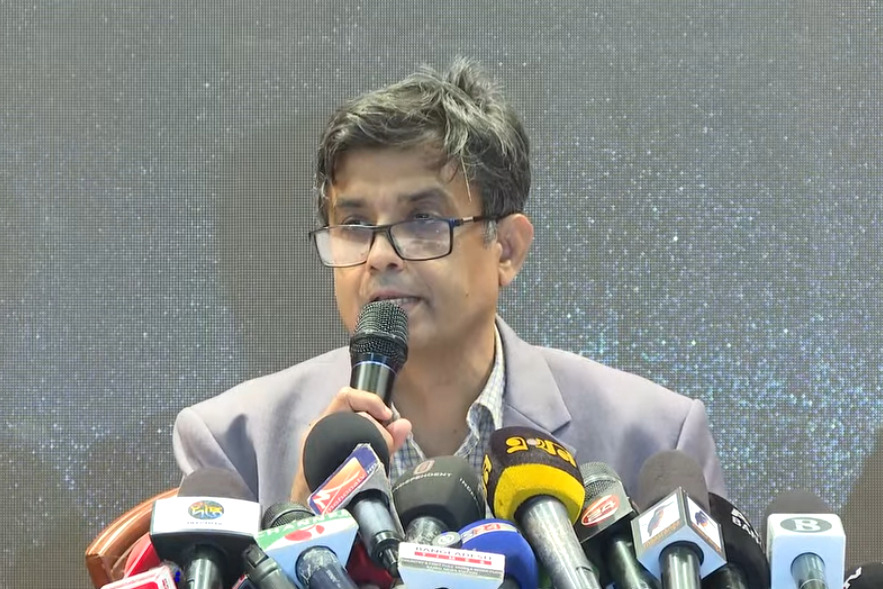
In an effort to address migrants issues effectively, Bangladesh has strongly raised the issue of 'undocumented or irregular" Bangladeshi migrants with Malaysia’s highest authorities, Chief Adviser’s Press Secretary Shafiqul Alam said on Tuesday night.

"We are coming here frequently. We are having deep and sincere discussions. They (Malaysia) have responded well and remain serious about migration welfare," Alam told reporters while briefing the media at a hotel in Kuala Lumpur.

Chief Adviser’s Deputy Press Secretary Abul Kalam Azad Majumder, First Secretary (Press) at the Bangladesh High Commission in Kuala Lumpur Sufi Abdullahhil Maruf, Senior Assistant Press Secretary Foyez Ahmmad, and Assistant Press Secretary Suchismita Tithi were also present, UNB reports.

In response to a question, Alam acknowledged that there are long-term structural issues in migration management but said efforts are underway to address all migration-related challenges.

He reiterated Bangladesh’s zero tolerance stance against human trafficking.

Describing the talks between Chief Adviser Prof Muhammad Yunus and Malaysian Prime Minister Anwar Ibrahim as “very successful and fruitful,” Alam expressed the hope that bilateral relations would reach new heights.

On trade, he said negotiations for a Free Trade Agreement (FTA) between the two countries will begin soon.

Regarding the Rohingya crisis, Alam said Malaysia will remain engaged with Bangladesh on international platforms to help find a resolution.

Earlier in the day, Prof Yunus, who is paying a three-day official visit, urged Malaysia to keep its doors open for Bangladeshi workers.

During a joint press conference following the official talks—and the signing of five Memorandums of Understanding (MoUs) and the exchange of three notes—Prime Minister Anwar Ibrahim said Malaysia considers Bangladesh an important partner, with Bangladeshi workers playing a key role in the development of both nations.

“We want to thank Malaysia for hosting so many of our people, and we hope this door will remain open and become even wider so that we can send more young people to work in Malaysia and learn valuable skills,” Prof Yunus said.

He said many Bangladeshi workers return home after gaining experience in Malaysia, starting businesses and creating economic opportunities.

“We are very grateful to Malaysia for enabling this,” he added.

Prof Yunus said Bangladesh and Malaysia are growing closer not only due to diplomatic engagement but also because of the strong people-to-people connection forged by migrant workers.

He highlighted that remittances sent home by these workers sustain their families, pay for children’s education, and improve living standards.

“It’s not simply a matter of workers coming from outside to work here. They are happy to work here, and their contributions benefit both countries,” the Chief Adviser said.​
 

Yunus's visit to Malaysia
Promoting labour migration, wooing investment


Mir Mostafizur Rahaman
Published :
Aug 11, 2025 23:39
Updated :
Aug 11, 2025 23:39

1755044994401.png


Bangladesh's relationship with Malaysia is one of the most vital partnerships in our labour migration and economic cooperation framework. Over the years, Malaysia has become a major destination for Bangladeshi workers, hosting over one million of our citizens who send home substantial amount of remittances. These workers form an essential part of Malaysia's workforce in sectors such as construction, agriculture, manufacturing, and services. However, the long-standing relationship has been punctuated by recurring crises -- the most recent being Malaysia's suspension of manpower recruitment from Bangladesh last year.

This is not the first time such recruitment has been halted. History tells us that Malaysia has, on multiple occasions, stopped hiring Bangladeshi workers due to irregularities in recruitment processes, high recruitment costs, and allegations of human trafficking. One of the most pressing reasons behind these suspensions is the influx of illegal workers, a problem perpetuated by a strong and well-connected syndicate. This syndicate, composed of both Malaysian and Bangladeshi actors, thrives on exploiting desperate job-seekers for hefty profits. The result is harassment, financial ruin, and even the loss of life for thousands of our migrant workers.

Against this troubled backdrop, Chief Adviser Dr Muhammad Yunus's ongoing visit to Kuala Lumpur carries high expectations. His trip, beginning Monday on the invitation of Malaysian Prime Minister Anwar Ibrahim, offers an opportunity to address these entrenched issues head-on, restore trust, and pave the way for reopening Malaysia's job market to Bangladeshi workers.

According to officials, the primary focus of Dr Yunus's visit is on labour migration and investment. He will hold a bilateral meeting with Prime Minister Anwar Ibrahim of Malaysia at his Office in Putrajaya. This will be followed by delegation-level talks and the signing of several memorandums of understanding (MoUs). The agenda covers a broad spectrum: recruitment of new workers in various Malaysian sectors, increased hiring of skilled professionals, and improving the benefits and facilities available to Bangladeshi workers.

Foreign Ministry officials described this visit as "very important," noting Malaysia's central role in Bangladesh's manpower sector. The hope is to "take our migration sector to a stage where Malaysia takes the maximum number of manpower from us." This requires not only an agreement to lift the current suspension but also reforms that would prevent the same issues from resurfacing.

A significant part of the talks will also focus on securing Malaysian investment in emerging sectors in Bangladesh, such as deep-sea fishing and electronic vehicle (EV) manufacturing. Malaysia's Proton already has a presence in Bangladesh, and with global demand for EVs growing, this could become an important area of cooperation. Beyond jobs for low- and semi-skilled labour, this opens up pathways for technology transfer, skilled employment, and industrial growth back home.

One least discussed aspect of the Bangladesh-Malaysia migration equation is the potential for skilled employment. Hundreds of Bangladeshi students are currently studying at Malaysian institutions, many of them in technical, engineering, and IT-related fields. Yet after graduation, many return home or seek work in other countries due to limited opportunities to work in Malaysia. If the two governments can agree on frameworks that allow these graduates to be absorbed into Malaysia's high-tech industries, the benefits would be twofold: Bangladesh would gain valuable remittance from skilled jobs, and Malaysia would address its own shortage of qualified professionals.

This would also help diversify the profile of Bangladeshi workers abroad. Currently, the bulk of our overseas workers are in low-paid, physically demanding jobs. Increasing the proportion of skilled professionals in the migration mix would not only raise overall remittance volumes but also improve the image of Bangladeshi workers globally.

Dr Yunus's itinerary includes more than just political meetings. There is a major business conference bringing together Malaysian corporate leaders and Bangladeshi entrepreneurs. This is followed by a series of high-level meetings with chief executives of Malaysia's major companies. These engagements are designed to encourage investment partnerships, facilitate joint ventures, and strengthen trade links.

The visit is also set to feature ceremonial and symbolic elements. On August 13, Universiti Kebangsaan Malaysia (UKM) will confer an honorary degree on Dr Yunus. Prime Minister Anwar Ibrahim is expected to attend the ceremony. These events will contribute to the public diplomacy aspect of the trip, showcasing mutual respect and goodwill between the two nations.

Three notes of exchange are also expected, covering the halal ecosystem, higher education, and cooperation between the diplomatic training academies of both countries. The breadth of these agreements signals a desire to deepen the bilateral relationship beyond just migration and building a more diversified and resilient partnership.

For all the promise of these agreements, the heart of the matter remains the suspension of manpower recruitment. Any breakthrough in this area will require frank discussions about the governance of migration. Both countries must confront the issues of the role that syndicates play and the political protection they enjoy. A transparent, accountable, and affordable recruitment process is essential. This includes digitalisation of recruitment systems, rigorous background checks for recruiters, and direct government-to-government hiring arrangements to bypass exploitative middlemen.

Bangladesh also needs to strengthen its pre-departure training and worker protection measures. This is to ensure that workers are fully informed about their contracts, rights, and the cost of migration before leaving the country. On the Malaysian side, stricter enforcement against illegal recruitment channels and better monitoring of employers' compliance with labour laws are necessary.

The timing of this visit is critical. The suspension has left tens of thousands of prospective workers in limbo, many of whom have already paid significant sums to recruiters. The frustration among these workers and their families is growing. For the interim government in Dhaka, securing a reopening of Malaysia's job market would be a major political and economic achievement, boosting remittance inflows and easing domestic unemployment pressures.

Moreover, the global labour market is becoming increasingly competitive. Countries such as Nepal, Indonesia, and Vietnam are aggressively expanding their labour export to Malaysia and other destinations. If Bangladesh does not move quickly to resolve its issues, it risks losing market share permanently.

While the immediate priority is resolving the suspension, the longer-term vision should be about building a sustainable migration framework with Malaysia. This means moving from a cycle of crisis and reopening to a stable, predictable flow of workers. It also means aligning migration policies with the changing needs of Malaysia's economy - for example, by increasing the supply of skilled technicians for its growing EV sector, or IT specialists for its expanding digital economy.

Equally important is expanding cooperation in education and vocational training, so that Bangladeshi workers are better prepared for higher-paying jobs. Joint training centres, mutual recognition of qualifications, and targeted scholarship programmes could be part of this approach.

If the visit can deliver concrete agreements on transparent recruitment, stronger labour protections, and expanded economic cooperation, it will go a long way towards resolving the existing problems and preventing future ones. With over a million Bangladeshis already contributing to Malaysia's economy, and countless more hoping to do so, this is a relationship that deserves careful nurturing. The stakes are high, but so is the potential for a win-win outcome.​
 

DHAKA-KL TALKS IN PUTRAJAYA
Yunus, Anwar for strategic partnership

5 MoUs signed for coop in defence, energy, business; Bangladeshis to get same social security benefits
Staff Correspondent 12 August, 2025, 10:27

1755047779774.webp

Chief adviser Professor Muhammad Yunus hugs Malaysian prime minister Anwar Ibrahim after a high-level meeting between them at the Prime Minister’s Office in Putrajaya in Malaysia on Wednesday. | CA press wing photo

Bangladesh chief adviser Professor Muhammad Yunus and Malaysian prime minister Dato’ Seri Anwar bin Ibrahim in a bilateral meeting at the Malaysian PM office complex Perdana Putra in Putrajaya city on Tuesday reaffirmed their commitment to transform Bangladesh–Malaysia relations into a ‘deeper, future-oriented strategic partnership’.

In the delegation-level talks, Bangladesh called upon the Malaysian authorities to recruit more skilled Bangladeshi professionals, including doctors and engineers, and regularise those Bangladeshi workers who became irregular or undocumented in the Southeast Asian country that has suspended hiring workers from Bangladesh since June 2024, according to officials concerned.

‘Our two countries share a deep bond rooted in history, religion, and cultural empathy. Malaysia is a unique partner of Bangladesh, particularly in human resources, trade, and people-to-people contacts,’ Professor Yunus said at the outset of the delegation-level talks.

Describing Professor Yunus as ‘a friend of Malaysia’, Anwar commended Bangladesh interim government’s leadership over the past year, said a press release of the Chief Adviser’s Office issued from Putrajaya.

The two leaders witnessed the signing of five memorandums of understanding covering defence cooperation, LNG supply and energy collaboration, cooperation between the Bangladesh Institute of International and Strategic Studies and the Institute of Strategic and International Studies of Malaysia, collaboration between the Bangladesh–Malaysia Chamber of Commerce & Industry, and the Malaysian Institute of Microelectronic Systems and cooperation between the Federation of Bangladesh Chambers of Commerce and Industry and the National Chamber of Commerce & Industry of Malaysia.

They also exchanged notes on diplomatic training, Halal industry collaboration, and higher education cooperation after the bilateral talks.

Addressing a joint press conference after the high-level talks, Yunus expressed optimism that more Bangladeshis would get job opportunities in the Malaysian labour market.

‘We hope that this door will remain open for Bangladesh and more young people from Bangladesh will get the opportunity to work here,’ the Bangladesh Sangbad Sangthsa reported quoting the chief adviser as saying.

He also urged Malaysian businessmen to invest in Bangladesh to help the country become a manufacturing hub.

The CA sought Malaysia’s cooperation for resolving the Rohingya crisis and obtaining the ASEAN membership.

Malaysian PM Anwar Ibrahim on the other hand hoped that the excellent relations between the two countries would be helpful in improving the fate of the people of both countries.

Malaysian officials confirmed that Bangladeshi workers would now be entitled to the same social security benefits as Malaysian workers and will be able to lodge complaints in the Bangla language.

Bangladesh also requested ‘Graduate Pass’ visas for its students in Malaysian universities. Currently, around 10,000 Bangladeshi students are studying in Malaysia, where around 15 lakh migrant workers from Bangladesh are staying and are mostly engaged in farms, factories and restaurants.

Both sides underscored the importance of transparent and fair recruitment processes to reduce costs and safeguard worker welfare.

The two leaders first held a one-on-one meeting, preceded by a restricted session with select senior officials.

Later, they led delegation-level talks covering a wide range of bilateral issues, including trade, investment, migration, energy cooperation, the blue economy, education, and cultural exchange, according to the release shared by the CA’s press wing.

The Malaysian prime minister underscored the need for boosting trade and expanding cooperation in migrant worker welfare, education, and efforts to resolve the Rohingya crisis as Bangladesh was hosting more than 12 lakh forcibly displaced people from Myanmar.

During the one-on-one meeting, Professor Yunus thanked Malaysia for facilitating the entry of nearly 8,000 stranded Bangladeshi workers under a simplified protocol and for introducing multiple-entry visas, allowing workers to return home during emergencies without risking their jobs.

At the delegation-level talks, adviser for law and overseas employment ministries Asif Nazrul urged Malaysia to recruit more skilled Bangladeshi professionals, including doctors and engineers, through a government-to-government framework.

He noted that state-run Bangladesh Overseas Employment and Services Limited was now capable of handling recruitment for Malaysian companies and called for opportunities for Bangladeshi security guards and carers.

He also requested steps to be taken for the regularisation of irregular or undocumented Bangladeshi workers in Malaysia.

The leaders discussed Bangladesh’s aspiration to deepen its engagement with the Association of Southeast Asian Nations, including its bid for Sectoral Dialogue Partner status, and sought Malaysia’s support during its ASEAN chairmanship.

Yunus also invited Malaysia to participate in the upcoming Conference on the Rohingya Crisis in Cox’s Bazar and the UN-led international conference on the Rohingya issue in New York in September.

On economic matters, the two sides agreed to accelerate negotiations on a Bangladesh–Malaysia Free Trade Agreement, strengthen investment cooperation through Special Economic Zones, and operationalise the Malaysia–Bangladesh Joint Business Council.

Highlighting the growing trade imbalance between the two friendly countries, Dhaka sought greater Malaysian market access for Bangladeshi products such as medicines, batteries, footwear, ceramics and jute.

Bangladesh also sought Malaysia’s support in developing its ‘blue economy’ and ‘halal industry’, including establishing a Halal Economic Zone outside Dhaka, and expressed interest in joining the Regional Comprehensive Economic Partnership.

Both countries agreed to explore renewable energy partnerships and also discussed collaboration in defence, culture, and tourism.

Prime minister Anwar expressed his admiration for poet Rabindranath Tagore and proposed a cultural conference on prominent Asian writers and thinkers.

Chief adviser Yunus is accompanied by foreign affairs adviser Md Touhid Hossain, expatriates’ welfare and overseas employment adviser Asif Nazrul, energy adviser Fouzul Kabir Khan, national security adviser Khalilur Rahman, chief adviser’s special envoy on international affairs Lutfey Siddiqi, Bangladesh Investment Development Authority executive chair Chowdhury Ashik Mahmud Bin Harun, and foreign secretary Asad Alam Siam during his three-day official visit to Malaysia to be concluded today.

In October 2024, Malaysian prime minister Anwar Ibrahim after a bilateral meeting in Dhaka announced that they had agreed to consider issuing 18,000 work visas for those Bangladeshis who got stuck and could not fly due to some recent measures by the Malaysia government.

Around 50,000 Bangladeshi aspirants failed to migrate to Malaysia after completing almost all the processes by the May 31 deadline set by the Malaysian authorities.

Of them,16,970 aspirant migrants failed to fly to Malaysia at the last moment only because they could not secure air tickets.

In September 2018, Malaysia suspended hiring workers from Bangladesh amid huge allegations of corruption.

Later, in August 2022, the market reopened for Bangladeshi workers and remained open until May 31, 2024.​
 
Malaysia’s support to establish halal industrial park sought
Bangladesh Sangbad Sangstha . Kuala Lumpur 13 August, 2025, 23:31

Bangladesh has sought Malaysia’s assistance in developing a halal industrial park, aiming to tap into the rapidly expanding global halal products market.

‘Let’s make a move on this,’ said Chief Adviser Professor Muhammad Yunus during a meeting with Malaysian halal industry officials at his hotel in Kuala Lumpur on Tuesday.

The Malaysian delegation was led by Datin Paduka Hajah Hakimah binti Mohd Yusoff, Coordinator of Halal Affairs under the Malaysian Prime Minister’s Department.

Among those present were Sirajuddin Bin Suhaimee, Director General of the Department of Islamic Development Malaysia (JAKIM), and Hairol Ariffein Sahari, Chief Executive Officer of the Halal Development Corporation (HDC).

Officials informed the Chief Adviser that the global halal products market is currently valued at USD 3 trillion and is projected to reach USD 5 trillion by 2030. Malaysia, which operates at least 14 halal industrial parks, holds a sizable market share. Other key players include Middle Eastern countries, Thailand, Australia, and New Zealand.

Bangladesh — home to the world’s third-largest Muslim population — has significant potential to join the market, provided it strengthens its infrastructure and certification systems. At present, the Islamic Foundation Bangladesh is the sole body authorised to certify halal products, with only 124 manufacturers certified so far.

Chowdhury Ashik Mahmud bin Harun, Executive Chairman of BIDA, urged the Malaysian side to help identify the requirements for establishing a halal industrial park in Bangladesh.

‘Maybe we can work together to map out what’s needed to build a halal products industry,’ he said, noting that many Bangladeshi companies are keen to export halal-certified goods.

Professor Yunus described the meeting as a valuable learning experience. ‘Thank you for the insight — it feels like a class on halal products,’ he remarked.

Earlier in the day, Bangladesh and Malaysia exchanged a note of cooperation in the field of halal ecosystems — a move officials referred to as ‘halal diplomacy.’

Sirajuddin Bin Suhaimee said Malaysia would soon send a team to Bangladesh to assess the country’s needs.

The meeting was also attended by Foreign Adviser Md Touhid Hossain, Law Adviser Asif Nazrul, Energy Adviser Fouzul Kabir Khan, Chief Adviser’s Special Envoy Lutfey Siddiqi, and Senior Secretary for SDG Affairs Lamiya Morshed.​
 

Malaysia likely to offer 'Graduate Plus' visa for Bangladeshi students

1755140806191.webp


Malaysia is likely to introduce "Graduate Plus" visas for Bangladeshi students studying in the country, enabling thousands to access high-skilled jobs in its expanding economy.

Chief Adviser Muhammad Yunus raised the issue during a meeting with Malaysian Higher Education Minister Zambry Abdul Kadir at Universiti Kebangsaan Malaysia in Kuala Lumpur.

"We had productive discussions with the minister. In principle, he has agreed to issue Graduate Pass visas to Bangladeshi students in Malaysia. However, both sides need to complete certain formalities before the policy can take effect," said Expatriates Welfare and Overseas Employment Adviser Asif Nazrul.

Foreign Adviser Md Touhid Hossain was also present.

Currently, about 10,000 Bangladeshis are enrolled in Malaysian universities, said Chief Adviser's Deputy Press Secretary Abul Kalam Azad Majumder.

While students from other countries enjoy access to Malaysia's job market, this privilege has so far been unavailable to Bangladeshi students.

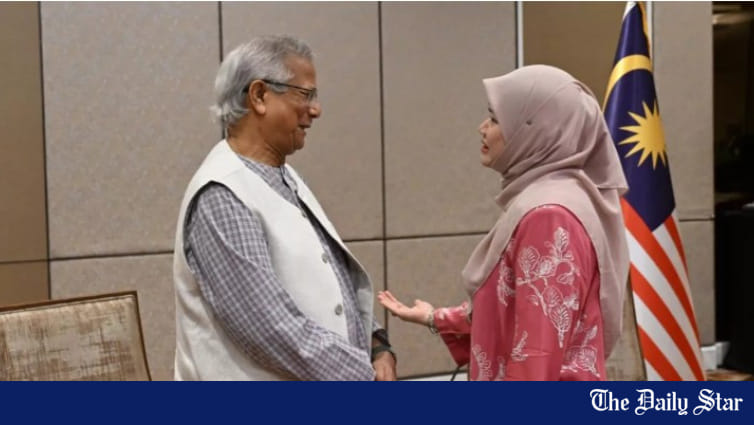
Earlier on Wednesday, Malaysian Education Minister Fadhlina binti Sidek met Yunus at a hotel in Kuala Lumpur.

The two sides discussed ways to enhance educational cooperation, including expanding scholarships for Bangladeshi students in Malaysian universities and colleges.

Yunus stressed the importance of broadening student and faculty exchange programmes.

Dhaka also sought formal recognition of Bangladeshi degrees by Malaysian authorities and higher education institutions.

The Malaysian minister expressed strong interest in Yunus's long-running "Three Zero" campaign, which aims to eliminate global poverty and unemployment and reduce carbon emissions to zero.

"Unless you imagine a world without poverty, it won't happen," Yunus said, urging global leaders to work towards building a civilisation that is not self-destructive.

Yunus invited the Malaysian education minister to visit Dhaka to further strengthen educational ties.

Energy Adviser Fouzul Kabir Khan, National Security Adviser Khalilur Rahman, Special Envoy Lutfey Siddiqi, and Senior Secretary on SDGs Affairs Lamiya Morshed were present.​
 

Malaysian PM’s Bangladesh visit gave hope in post-turmoil period: Prof Yunus

Published :
Aug 14, 2025 20:28
Updated :
Aug 14, 2025 20:28

1755216927311.webp


Chief Adviser Professor Dr Muhammad Yunus said Malaysian Prime Minister Datuk Seri Anwar Ibrahim’s official visit to Dhaka last year provided a much-needed morale boost to the nation as it was just emerging from political turmoil.

The Nobel Prize laureate reflected on Anwar’s visit in an exclusive interview with Malaysian National News Agency Bernama on Wednesday before concluding his official visit to Malaysia this week, BSS reoports.

He said Anwar’s visit also brought hope to the country during one of its most challenging times.

Yunus, who has been heading the interim government since August 8, 2024, recalled a period of uncertainty facing Bangladesh following the youth-led July mass uprising that ousted former prime minister Sheikh Hasina.

He likened the situation to being struck by a “magnitude 9 earthquake” where everything was “destroyed, in a big mess, and nothing was functioning - only anger erupted”.

“We were given the responsibility of running the country in a very difficult situation. It was an extremely difficult job,” he added.

"Not only to clean up (the mess), but you also have to rebuild everything. So we search for a way, space, and how to go about it. And while we are busy figuring out how to do that, we got the good news. The Prime Minister of Malaysia is visiting us," Yunus said.

Anwar visited Bangladesh in October 2024 and became the first foreign leader to embark on a significant visit, two months after the Yunus-led administration was formed to put the country back in order.

"He gave us hope. His visit was enormously exciting to the people. Malaysia is well known to the people in Bangladesh because so many Bangladeshis are here, and their families are here,” the Chief Adviser said.

"It is not an unknown country. So having the Prime Minister of Malaysia to say, “Yes, we're with you”, meant a lot to the people of Bangladesh. So he had a very encouraging and inspiring presence when he came," he said.

Yunus, 85, is also an economist and social entrepreneur. He founded the Grameen Bank in 1983, which provides collateral-free microcredit services for disadvantaged groups, especially women in Bangladesh.

Malaysia was the first country to adopt the Grameen Bank model through the establishment of Amanah Ikhtiar Malaysia.

Yunus undertook a three-day official visit to Malaysia from August 11 to 13, during which he held meetings with Anwar to review the progress of Malaysia-Bangladesh relations, particularly in the areas of trade and investment, labour, education, tourism and defence, as well as regional and international developments of mutual interest. He also met with local leaders and prominent business figures from various sectors to advance bilateral ties between the two countries.

“We had a wonderful and very successful visit, I must say. We are very happy with the visit. Everybody was so generous with their time. The officials that we wanted to meet, leaders that we wanted to meet, all came forward,” he said.

Yunus was confident that the visit would further strengthen bilateral relations and expand cooperation in mutually beneficial areas, building on the strong ties established since diplomatic relations began in 1972.

Bangladesh is Malaysia’s second-largest trading partner and export destination in South Asia, with key exports including petroleum products, palm oil and chemicals, while imports comprise textiles, footwear, petroleum products and manufactured goods. In 2024, Malaysia-Bangladesh trade rose 5.1 per cent to RM13.35 billion (US$2.92 billion).​
 

Bangladeshis in Malaysia to receive social protection benefits: Press Secretary

FE ONLINE REPORT
Published :
Aug 14, 2025 17:46
Updated :
Aug 14, 2025 17:47

1755217040245.webp


Chief Adviser’s Press Secretary Shafiqul Alam has said that from now on, Bangladeshi workers in Malaysia will receive the same social protection benefits as Malaysian workers.

In addition, for those going to Malaysia who have weak English skills or find it difficult to learn the Malay language, arrangements have been discussed to allow them to file complaints in Bangla, he said while briefing the press at the Foreign Service Academy in Dhaka following a meeting of the Advisory Council on Thursday.

The Press Secretary said, “The visit to Malaysia was very fruitful—we would call it a landmark tour. As a result, the already good relationship between Bangladesh and Malaysia has been further strengthened. Labour welfare issues were discussed with the Malaysian Prime Minister, and some progress has been made. The Expatriates’ Welfare Adviser informed the meeting about the process of legalising undocumented or irregular Bangladeshi workers in Malaysia.

“On our part, we also proposed recruiting Bangladeshi security guards and caregivers in Malaysia, and we expect progress on this matter soon. Additionally, the issue of allowing Bangladeshi students in Malaysia to work under the ‘Graduate Plus’ program was raised, and the Malaysian side said they would work on it.”

Shafiqul Alam added, “We will very soon conclude a Free Trade Agreement (FTA) with Malaysia. We import about USD 3 billion worth of food and other products from Malaysia. To accelerate trade between us, we will move quickly on FTA discussions. We are already in talks about FTAs with Japan and Singapore as well.”​
 

Members Online

No members online now.

Latest Posts

Back
PKDefense - Recommended Toggle