Bangladesh Defense
Saif
Senior Member
- Joined
- Jan 24, 2024
- Messages
- 21,261
- Likes
- 9,688
- Nation

- Residence
- Axis Group


Don’t let old ghosts haunt Malaysia reopening
Concerns over potential irregularities in Malaysia bid must be addressed.
Don’t let old ghosts haunt Malaysia reopening
Concerns over potential irregularities in Malaysia bid must be addressed
VISUAL: STAR
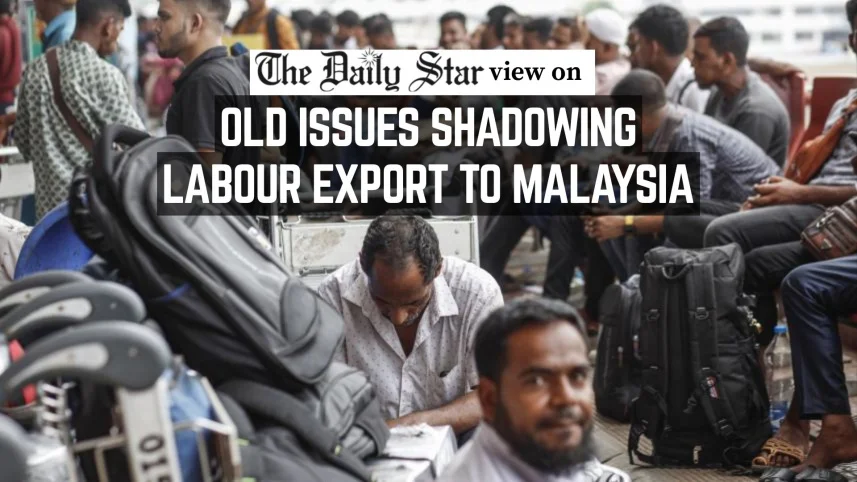
It is understandable to have cautious optimism about the prospect of the Malaysian labour market reopening to Bangladeshi migrants given the past controversies that often marred the recruitment process. One would, therefore, expect that the over-two-year recruitment freeze has given the authorities the necessary impetus to address all underlying issues before the market does reopen, which seems imminent following an announcement on Tuesday by the expatriates’ welfare and overseas employment minister. But this may not be smooth sailing, as a report by this daily suggests, amid renewed concerns over a lack of transparency and potential irregularities.
The concerns are not without basis. Even before Bangladesh and Malaysia have revised their labour migration framework through a Joint Working Group—as agreed during Prime Minister Tarique Rahman’s visit to Malaysia—questions have emerged over whether recruitment may resume under essentially the same system that previously enabled manipulation. Malaysia's recent decision to continue processing quota applications through the Foreign Workers Centralised Management System (FWCMS), a platform long associated with allegations of opaque practices, has revived fears that politically connected business interests remain entrenched. Conflicting messages from the Bangladesh government have only added to the uncertainty. While the expatriates’ welfare minister publicly announced the reopening of the labour market, the ministry subsequently instructed recruiting agencies not to begin any recruitment activities until formal procedures are announced. Such mixed signals risk creating precisely the kind of confusion that unscrupulous brokers have long exploited.
The history of Bangladesh-Malaysia labour migration offers ample reason for caution. Recruitment was last suspended in June 2024 following widespread allegations that workers often had to pay exorbitant fees only to arrive in Malaysia without the promised jobs or under exploitative conditions. The system itself proved quite flawed. For instance, only a select group of recruiting agencies was allowed to process workers, effectively creating an exclusive channel vulnerable to syndicate control. At the same time, questions were raised about the approval of inflated worker quotas by some Malaysian employers and the inadequate verification of actual labour demand, leaving many migrants stranded without work after borrowing heavily to get there. Such irregularities hurt not only workers but also the credibility of labour migration governance in both countries.
So while we welcome the ongoing reopening bid, it must not mean a return to business as usual. Any revised agreement between Bangladesh and Malaysia, likely after the expected visit of a Malaysian delegation later this month, should clearly define the accountability of both governments, as well as employers, recruiting agencies, and other stakeholders. Recruitment should remain open to all duly licensed agencies under transparent and competitive rules. Job orders and employer quotas must be properly verified before recruitment begins, and migration costs must be strictly monitored. Equally importantly, the government must ensure proper communication so that prospective migrants are not exploited by brokers. The regularisation of workers who found themselves deprived of the promised jobs in Malaysia also deserves serious consideration. These measures are vital both for restoring integrity to the recruitment process and for protecting our workers from exploitation.
Concerns over potential irregularities in Malaysia bid must be addressed
VISUAL: STAR
It is understandable to have cautious optimism about the prospect of the Malaysian labour market reopening to Bangladeshi migrants given the past controversies that often marred the recruitment process. One would, therefore, expect that the over-two-year recruitment freeze has given the authorities the necessary impetus to address all underlying issues before the market does reopen, which seems imminent following an announcement on Tuesday by the expatriates’ welfare and overseas employment minister. But this may not be smooth sailing, as a report by this daily suggests, amid renewed concerns over a lack of transparency and potential irregularities.
The concerns are not without basis. Even before Bangladesh and Malaysia have revised their labour migration framework through a Joint Working Group—as agreed during Prime Minister Tarique Rahman’s visit to Malaysia—questions have emerged over whether recruitment may resume under essentially the same system that previously enabled manipulation. Malaysia's recent decision to continue processing quota applications through the Foreign Workers Centralised Management System (FWCMS), a platform long associated with allegations of opaque practices, has revived fears that politically connected business interests remain entrenched. Conflicting messages from the Bangladesh government have only added to the uncertainty. While the expatriates’ welfare minister publicly announced the reopening of the labour market, the ministry subsequently instructed recruiting agencies not to begin any recruitment activities until formal procedures are announced. Such mixed signals risk creating precisely the kind of confusion that unscrupulous brokers have long exploited.
The history of Bangladesh-Malaysia labour migration offers ample reason for caution. Recruitment was last suspended in June 2024 following widespread allegations that workers often had to pay exorbitant fees only to arrive in Malaysia without the promised jobs or under exploitative conditions. The system itself proved quite flawed. For instance, only a select group of recruiting agencies was allowed to process workers, effectively creating an exclusive channel vulnerable to syndicate control. At the same time, questions were raised about the approval of inflated worker quotas by some Malaysian employers and the inadequate verification of actual labour demand, leaving many migrants stranded without work after borrowing heavily to get there. Such irregularities hurt not only workers but also the credibility of labour migration governance in both countries.
So while we welcome the ongoing reopening bid, it must not mean a return to business as usual. Any revised agreement between Bangladesh and Malaysia, likely after the expected visit of a Malaysian delegation later this month, should clearly define the accountability of both governments, as well as employers, recruiting agencies, and other stakeholders. Recruitment should remain open to all duly licensed agencies under transparent and competitive rules. Job orders and employer quotas must be properly verified before recruitment begins, and migration costs must be strictly monitored. Equally importantly, the government must ensure proper communication so that prospective migrants are not exploited by brokers. The regularisation of workers who found themselves deprived of the promised jobs in Malaysia also deserves serious consideration. These measures are vital both for restoring integrity to the recruitment process and for protecting our workers from exploitation.