Revisiting ‘Forces Goal 2030’: Bangladesh’s Military Modernization Plan Under the New Government
Every major step taken during the Hasina administration is now subject to change – including Bangladesh’s first formalized military modernization blueprint.
By Khandakar Tahmid Rejwan
December 06, 2024
Credit: Wikimedia Commons/ Shadman Samee
Prime Minister Sheikh Hasina in a popular mass uprising has changed the strategic, political, and social dynamics of South Asia’s second-largest economy. Given the country’s pacifist foreign policy motto, it often gets overlooked that Bangladesh has the third most powerful armed forces in the region, only behind nuclear-armed India and Pakistan. Thus, Bangladesh is militarily the most powerful non-nuclear weapons state in South Asia.
Given its policy of non-alignment and strategic balancing with international and regional powers, a military with professional manpower and modern equipment has always been a crucial ambition for enhancing Bangladesh’s deterrence. However, the emphasis given to economic development – and the resulting lack of funds in the defense budget – meant that military ambition never materialized.
This changed in 2009, when, under Hasina’s direction, Dhaka initiated its first formalized military modernization plan, Forces Goal 2030. This plan – revised in 2017 – created a historic groundwork to meet the Bangladesh Armed Forces’ demand to transform into a sophisticated 21st century military. After more than 15 years of this initiative, the Armed Forces of Bangladesh (AFB) have been substantially upgraded.
With Hasina’s 15-year reign now over, the new interim government of Muhammad Yunus has initiated plans to reform key sectors and institutions of the country, including the police, judiciary, and constitution. Every major step taken during the previous administration is now subject to change. Therefore, it is not beyond question that the successes and limitations of Forces Goal 2030 may also undergo a reassessment by the current government.
Bangladesh’s shuffled geopolitical landscape and shifting security priorities in the post-Hasina period may require revisiting the current military modernization plan. This will also require securing deeper strategic ties with Dhaka’s primary arms sellers, such as China and Turkiye.
AFB Modernization Under Forces Goal 2030
The primary objective of Forces Goal 2023 is to modernize all three arms of the AFB, namely the Army, Navy, and Air Force. The plan calls for the reconfiguration of military formations, increasing manpower, creating new units, including of modern weapons with adequate training, revising military doctrine, and increasing the defense industrial base (DIB) for indigenous production, including transfers of technology. Given these goals, it can be termed as a holistic strategy to develop the AFB into a 21st century capable force.
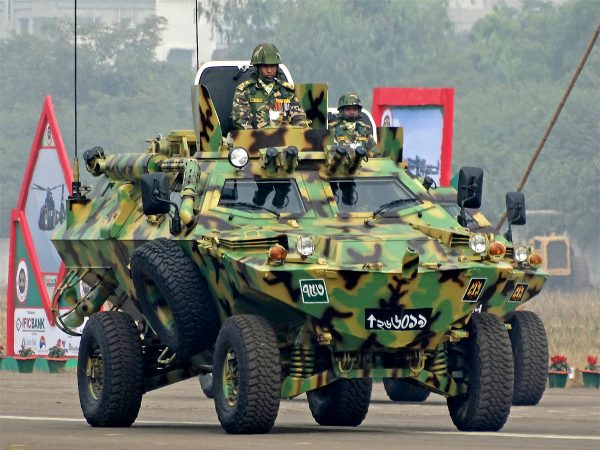
Under Forces Goal 2030, the AFB has been renovated significantly. The Bangladesh Army acquired modern Russian BTR-80 and Turkish Otokar Cobra Armed Personnel Carrier (APCs) for its newly formed mechanized infantry units. Sophisticated MBT-2000 tanks and VT-5 light tanks were introduced to the Armored Corps from China. The Artillery Corps was inducted with multiple launch rocket systems (MLRS) like the Turkish TRG-230 and TRG-300 Kasirga alongside the Chinese WS-22. Self-propelled artillery systems like the Serbian Nora B-52 were also added to the inventory. The Air Defense Artillery (ADA) Corps received FM-90 Short Range Air Defense Surface to Air Missiles (SHORAD SAMs), coming out from the legacy of operating only obsolete self-propelled guns for air defense and protection of key point installations. Turkish Bayeraktar TB-2 drones were bought for Army Aviation alongside transport aircraft and multipurpose helicopters from the West and Russia, respectively.
Due to consecutive legal victories against India and Myanmar over maritime boundaries, Bangladesh retains sovereignty over a large chunk of the Bay of Bengal (BoB). This heightened the importance of modernization for the Bangladesh Navy. Dhaka subsequently acquired two Ming-class submarines from Beijing and major ships for its surface fleet like Type 053H3 and Type 053H2 guided missile frigates, and Type 056 stealth-guided missile corvettes. Bangladesh also bought a pair of decommissioned cutters from the United States to enhance its naval presence. In 2011 Bangladesh’s Naval Aviation wing was formed with four German Dornier 228 Maritime Patrol Aircraft (MPA) and two Italian Augusta Westland maritime helicopters.
Subsequently, Dhaka’s focus on enhancing airpower also grew due to Myanmar’s repeated and aggressive breaches of Bangladeshi airspace. The Bangladesh Air Force received fourth-generation fighter trainers like the Russian Yak-130 and Chinese K-8. License-produced F-7BG and F-7BGI fighter interceptors were also introduced into the air fleet. The Air Force also acquired FM-90 SHORAD SAMs for small-area defense and Italian Selex RAT-31DL advanced 3D surveillance radar for land-based early warning systems.
Besides upgrading its inventory, Dhaka also established new formations with increased personnel. The Army raised three new divisions in 15 years, namely the 7th, 10th, and 17th Infantry Divisions, alongside the recently formed Adhoc Army Air Defense Corps. The lone Para-Commando Battalion was also strengthened to a Para-Commando Brigade in 2016. The Bangladesh Navy introduced aviation units, and the Bangladesh Air Force formed mobile SHORAD SAM units.
The AFB also focused on expanding its defense industry through its subsidiary Bangladesh Machine Tools Factory (BMTF) and Bangladesh Ordinance Factory (BOF). The BMTF now produces light vehicles like Arunima utility trucks, and the BOF provides indigenously produced small arms like BD-08 rifles, MANPADs, rockets, and grenades. This equipment is primarily produced indigenously through the technology transfer agreements with foreign partners.
Khulna Shipyard, under the Bangladesh Navy’s jurisdiction, has also successfully produced several small and lightly armed Offshore Petrol Vessels (OPVs) domestically. It intends to build larger vessels like frigates and corvettes, potentially with technical assistance from China or Turkiye, in the future, to bolster domestic manufacturing capacity.
The Rationale for Revisiting the Forces Goal 2030 and Prospective Overhauls
The interim government in Dhaka is now facing additional security challenges amid a new geopolitical reality as well as internal issues. In Rakhine and Chin states of Myanmar, rebels are gaining strongholds, and the Bangladesh-Myanmar border has turned into an active war zone. The Arakan Army (AA) has shot, abducted, and killed Bangladeshis near the Naf River. The violence across the border has also sparked new incursions of Rohingya refugees, as well as illegal border crossings by Myanmar security personnel seeking to avoid capture.
The relationship with India is also strained as anti-Bangladesh sentiment is riding high in India, culminating in a vandalism attack on Bangladesh’s Assistant High Commission in Agartala. Top Indian government officials like Amit Shah have publicly called for forces to ready for war, citing the situation in Bangladesh.
Inside Bangladesh, threats of destabilization are visible from non-state actors like the Kuki-Chin National Army (KNA), which is increasingly growing strong and receiving alleged foreign assistance, including arms, training, and safe haven.
The instability in neighboring Myanmar, war rhetoric propagating from India, and prospects of insurgency in the Chittagong Hill Tracts require the AFB to a build a strong force that is able to deter and counter any external and internal threats. For such purposes, a stronger AFB is mandatory, which will require revisiting the existing force modernization plan.
Dhaka must identify some of its contemporary shortcomings and look to improve the plan. New goals could include diversifying arms imports, acquiring critical weapons systems, prompting defense partners for a wider range of technology transfer deals, countering information warfare from adversaries, formulating an irregular warfare doctrine, and improving intelligence-based operations.
Besides, Dhaka can also integrate its second layer of territorial defense by formulating similar modernization plans for the Border Guard Bangladesh (BGB) and Bangladesh Coast Guard. Integration of these forces is vital as they will fall under the jurisdiction of the Ministry of Defense in case of a national security crisis like war or conflict.
Voluntary basic training can be introduced in tertiary education institutions similar to the country’s Cadet Colleges. Through such programs, units of the Bangladesh National Cadet Corps can also be expanded for youth participation. This will create future candidates for the AFB’s officer corps and promote youth contribution to national security.
China Dependency and Turkish Alternatives
In recent years, Turkiye has become one of the major suppliers of weapons to Bangladesh. Dhaka is among Ankara’s top four destinations of military equipment. Dhaka’s interest in acquiring Turkish weapons stems from several factors, such as the poor quality of Chinese equipment, the aim to familiarize the AFB with NATO-grade weapons, a lower price tag in comparison with other Western suppliers, and Ankara’s willingness to facilitate indigenous production through technology transfers. The Bangladesh-Turkiye strategic partnership has seen significant positive development in recent years, which brings a strong impetus for both to deepen the existing ties.
This has now raised the potential to challenge China’s status as the primary arms exporter to Bangladesh. Arguably, it is hard to replace China’s top position; Beijing accounts for more than two-thirds of total arms sales to Dhaka. The AFB’s officers are well-trained in operating Beijing’s war materiel and have a deeply embedded tradition of using Chinese equipment. Therefore, the possibility of selection bias in procurement cannot be ruled out.
Moreover, Beijing’s ambassador has already launched a charm offensive with major political parties and stakeholders in Bangladesh. A positive image of China and brewing anti-India sentiment in Bangladesh might result in the deepening of a strategic partnership between Dhaka and Beijing. Dhaka might also prefer to purchase critical systems like multi-role fighter aircraft from Beijing given the dire necessity to replenish its air power and strategic deterrence.
Turkiye and China have been Bangladesh’s major suppliers of critical systems. Both countries have also opened new areas of strategic cooperation, like joint military drills and annual defense dialogues, with Bangladesh. Both Turkiye and China promote technology transfers to help develop Bangladesh’s defense industry. Thus, a prudent step for Dhaka will be to strike a balance between both strategic partners and avoid overdependency on any single supplier. This policy will also align with Dhaka’s foreign policy of geopolitical balancing, neutrality, and peaceful coexistence.
As more complex relationships with India and Myanmar develop, the need to revise Bangladesh’s military modernization plan becomes essential. Bangladesh may also opt for cooperation from China and Turkiye in this regard. No matter the internal political outcome, the strategic relationships with Ankara and Beijing seem to be sustainable.
For now, Bangladesh, led by Muhammad Yunus’ interim government, has a spectacular opportunity to revisit Forces Goal 2030. This will bolster Dhaka’s defense capabilities, fulfill contemporary force requirements, and maintain effective deterrence against traditional and nontraditional threats. Such feats are vital for Bangladesh to maintain internal and geopolitical stability.


 Bangladesh Defense