Bangladesh Defense
Saif
Senior Member
- Jan 24, 2024
- 21,479
- 9,743
- Nation

- Residence
- Axis Group


How should we read Bangladesh’s UNGA presidency against global and domestic realities?
Bangladesh winning the presidency of the UN General Assembly (UNGA) is a moment of pride that perhaps could not have come at a more appropriate time, given the prevailing spirit of transformation in the wake of the July uprising.
How should we read Bangladesh’s UNGA presidency against global and domestic realities?
Alauddin Mohammad
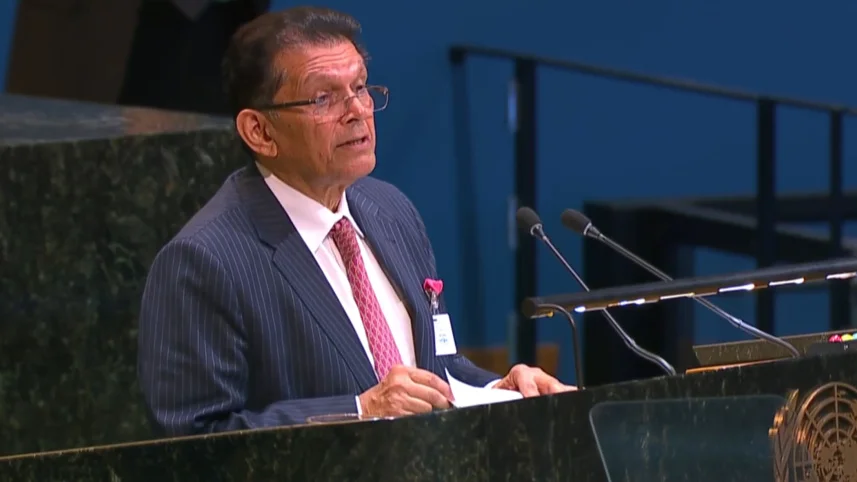
Foreign Minister Khalilur Rahman, the newly elected president of the United Nations General Assembly, addresses a plenary meeting of the body at the UN headquarters on June 2. PHOTO: UN livestream screengrab
Bangladesh winning the presidency of the UN General Assembly (UNGA) is a moment of pride that perhaps could not have come at a more appropriate time, given the prevailing spirit of transformation in the wake of the July uprising. In other words, it represents a symbolic diplomatic victory for a post-July Bangladesh. The immediate practical benefit is undeniable: greater global visibility for a developing nation standing at a critical geoeconomic crossroads.
As Dr Khalilur Rahman, the foreign minister, assumes this prestigious role, the international community will likely turn a closer eye towards Dhaka. “The role of the president of the General Assembly is no longer simply procedural,” said outgoing UNGA President Annalena Baerbock, and at a certain level, beyond internal bloc politics and calculations within the UN system, Bangladesh’s presidency reflects some confidence in its potential for being a responsible and stabilising state. If we’re being optimistic, the diplomatic elevation could also be leveraged to bring tangible benefits to Bangladesh in the form of greater foreign direct investment, stronger bilateral trade and security agreements, and more strategic partnerships.
But beneath the polished veneer of this international triumph lies a complex web of geopolitical and geoeconomic challenges that also demand scrutiny. Bangladesh is currently facing significant economic headwinds, most notably the near-certain deferment of its LDC graduation and the looming pressure of the recently imposed US tariffs. To navigate these challenges, Dhaka has already entered into a comprehensive US-Bangladesh trade agreement. While perhaps an economic necessity to maintain market access, this pact, however, was rushed through just 72 hours before the February 12 elections, bypassing the traditional avenues of democratic debate. Consequently, it has sparked considerable domestic anxiety. Various groups remain deeply concerned about the concessions made regarding our sovereign policy space. To alleviate this domestic pressure, the BNP government last month signalled its willingness to review the treaty, but to what extent it will be able or willing to revisit its more contentious provisions remains uncertain.
Regionally, the chessboard remains equally concerning. A diplomatic realignment across South Asia is palpable. Pakistan is actively manoeuvring into a strategically advantageous position while our ties with India remain in a state of flux (despite recent positive messaging) thanks to some long-unresolved issues, including New Delhi’s continuous hosting of the fallen autocrat and cronies of the Awami League regime. In this vacuum, Bangladesh must meticulously recalibrate its regional posture. We must secure our access to broader Asian markets. Revitalising a near-dormant Saarc, maximising our geopolitical footprint within BIMSTEC, and aggressively pursuing our bid to become an ASEAN sectoral dialogue partner are no longer optional strategies. They are vital for our economic future. Dr Rahman’s elevation to the UNGA presidency likely offers an avenue through which to project our soft power in the aid of these pursuits. It allows us to step confidently into new regional alignments so as to build robust, reciprocal relations with our neighbours.
Among the threats facing Bangladesh and the region, the Rohingya crisis remains a bleeding wound. The genocide in Rakhine State and the subsequent waves of mass exodus represent a most tragic and destabilising development of the modern era. For years, we have failed to secure meaningful repatriation partly because there was no prominent international advocate consistently championing the issue on the global stage. It simply did not receive the global attention it required. Dr Rahman’s presidency may offer a hope, if not a guarantee, of momentum in this regard. While neutrality is a core component of a UNGA presidency, his elevation could nonetheless help open doors for Bangladesh to recast the Rohingya crisis as a global burden rather than a regional issue.
However, one must balance this optimism with a healthy dose of critical realism. The primary architect of this UN victory, Dr Khalilur Rahman, himself remains a deeply paradoxical figure in our national political landscape. There is no denying his sharp intellect; he is an experienced and highly astute bureaucrat. Yet, his rapid ascent in recent years has been largely devoid of a popular democratic mandate. His track record during the interim period also raised some concerns.
His tenure as High Representative for Rohingya affairs and as national security adviser fell short of public expectations. The Rohingya crisis saw no tangible breakthrough under his watch. Furthermore, his tenure as security adviser was frequently marred by internal frictions. His working relationship with our defence apparatus—the army, navy, and air force—also allegedly lacked the collaborative synergy required to safeguard a volatile nation in transition. Instead of consolidating our internal and external security frameworks, he often found himself at the centre of rumours of destabilising developments, effectively operating as a security adviser on paper.
Perhaps his most defining legacy from that turbulent phrase was orchestrating the aforementioned US trade deal shortly before the BNP integrated him into its cabinet framework. While the treaty arguably secured some strategic advantages, its non-inclusive nature set a troubling and undemocratic precedent for our foreign policy framework. Some therefore perceived him as a technocrat whose manoeuvres aligned more closely with global power blocs than with the organic aspirations of the Bangladeshi people, prompting questions about who exactly was lobbying for these outcomes and what degree of our sovereignty we may be silently trading in return.
That said, we must acknowledge that Bangladesh’s global image has often been enhanced by non-political figures. Trailblazers such as Dr Zafrullah Chowdhury, Sir Fazle Hasan Abed, and Nobel laureate-turned-Chief-Adviser Muhammad Yunus have consistently elevated our international standing. Dr Rahman’s recent achievement undeniably adds to this record. It serves as a reminder that despite our deep political fractures, Bangladesh possesses the human capital required to shine on the global stage.
But exceptional individuals or achievements cannot permanently substitute for robust, accountable democratic institutions. As Dr Rahman departs to fulfil his duties in New York for one year, a vital opportunity presents itself at home. The government should appoint a strong, elected political representative to helm the ministry of foreign affairs in his absence. This is essential to operationalise the “Bangladesh First” foreign policy doctrine championed by Prime Minister Tarique Rahman. As for the UNGA presidency, it is up to Bangladesh to extract the maximum advantage possible from what could prove to be an important diplomatic instrument.
Alauddin Mohammad is joint member secretary at the National Citizen Party (NCP) and executive director of the Institute for Policy, Governance and Development (IPGAD).
Alauddin Mohammad
Foreign Minister Khalilur Rahman, the newly elected president of the United Nations General Assembly, addresses a plenary meeting of the body at the UN headquarters on June 2. PHOTO: UN livestream screengrab
Bangladesh winning the presidency of the UN General Assembly (UNGA) is a moment of pride that perhaps could not have come at a more appropriate time, given the prevailing spirit of transformation in the wake of the July uprising. In other words, it represents a symbolic diplomatic victory for a post-July Bangladesh. The immediate practical benefit is undeniable: greater global visibility for a developing nation standing at a critical geoeconomic crossroads.
As Dr Khalilur Rahman, the foreign minister, assumes this prestigious role, the international community will likely turn a closer eye towards Dhaka. “The role of the president of the General Assembly is no longer simply procedural,” said outgoing UNGA President Annalena Baerbock, and at a certain level, beyond internal bloc politics and calculations within the UN system, Bangladesh’s presidency reflects some confidence in its potential for being a responsible and stabilising state. If we’re being optimistic, the diplomatic elevation could also be leveraged to bring tangible benefits to Bangladesh in the form of greater foreign direct investment, stronger bilateral trade and security agreements, and more strategic partnerships.
But beneath the polished veneer of this international triumph lies a complex web of geopolitical and geoeconomic challenges that also demand scrutiny. Bangladesh is currently facing significant economic headwinds, most notably the near-certain deferment of its LDC graduation and the looming pressure of the recently imposed US tariffs. To navigate these challenges, Dhaka has already entered into a comprehensive US-Bangladesh trade agreement. While perhaps an economic necessity to maintain market access, this pact, however, was rushed through just 72 hours before the February 12 elections, bypassing the traditional avenues of democratic debate. Consequently, it has sparked considerable domestic anxiety. Various groups remain deeply concerned about the concessions made regarding our sovereign policy space. To alleviate this domestic pressure, the BNP government last month signalled its willingness to review the treaty, but to what extent it will be able or willing to revisit its more contentious provisions remains uncertain.
Regionally, the chessboard remains equally concerning. A diplomatic realignment across South Asia is palpable. Pakistan is actively manoeuvring into a strategically advantageous position while our ties with India remain in a state of flux (despite recent positive messaging) thanks to some long-unresolved issues, including New Delhi’s continuous hosting of the fallen autocrat and cronies of the Awami League regime. In this vacuum, Bangladesh must meticulously recalibrate its regional posture. We must secure our access to broader Asian markets. Revitalising a near-dormant Saarc, maximising our geopolitical footprint within BIMSTEC, and aggressively pursuing our bid to become an ASEAN sectoral dialogue partner are no longer optional strategies. They are vital for our economic future. Dr Rahman’s elevation to the UNGA presidency likely offers an avenue through which to project our soft power in the aid of these pursuits. It allows us to step confidently into new regional alignments so as to build robust, reciprocal relations with our neighbours.
Among the threats facing Bangladesh and the region, the Rohingya crisis remains a bleeding wound. The genocide in Rakhine State and the subsequent waves of mass exodus represent a most tragic and destabilising development of the modern era. For years, we have failed to secure meaningful repatriation partly because there was no prominent international advocate consistently championing the issue on the global stage. It simply did not receive the global attention it required. Dr Rahman’s presidency may offer a hope, if not a guarantee, of momentum in this regard. While neutrality is a core component of a UNGA presidency, his elevation could nonetheless help open doors for Bangladesh to recast the Rohingya crisis as a global burden rather than a regional issue.
However, one must balance this optimism with a healthy dose of critical realism. The primary architect of this UN victory, Dr Khalilur Rahman, himself remains a deeply paradoxical figure in our national political landscape. There is no denying his sharp intellect; he is an experienced and highly astute bureaucrat. Yet, his rapid ascent in recent years has been largely devoid of a popular democratic mandate. His track record during the interim period also raised some concerns.
His tenure as High Representative for Rohingya affairs and as national security adviser fell short of public expectations. The Rohingya crisis saw no tangible breakthrough under his watch. Furthermore, his tenure as security adviser was frequently marred by internal frictions. His working relationship with our defence apparatus—the army, navy, and air force—also allegedly lacked the collaborative synergy required to safeguard a volatile nation in transition. Instead of consolidating our internal and external security frameworks, he often found himself at the centre of rumours of destabilising developments, effectively operating as a security adviser on paper.
Perhaps his most defining legacy from that turbulent phrase was orchestrating the aforementioned US trade deal shortly before the BNP integrated him into its cabinet framework. While the treaty arguably secured some strategic advantages, its non-inclusive nature set a troubling and undemocratic precedent for our foreign policy framework. Some therefore perceived him as a technocrat whose manoeuvres aligned more closely with global power blocs than with the organic aspirations of the Bangladeshi people, prompting questions about who exactly was lobbying for these outcomes and what degree of our sovereignty we may be silently trading in return.
That said, we must acknowledge that Bangladesh’s global image has often been enhanced by non-political figures. Trailblazers such as Dr Zafrullah Chowdhury, Sir Fazle Hasan Abed, and Nobel laureate-turned-Chief-Adviser Muhammad Yunus have consistently elevated our international standing. Dr Rahman’s recent achievement undeniably adds to this record. It serves as a reminder that despite our deep political fractures, Bangladesh possesses the human capital required to shine on the global stage.
But exceptional individuals or achievements cannot permanently substitute for robust, accountable democratic institutions. As Dr Rahman departs to fulfil his duties in New York for one year, a vital opportunity presents itself at home. The government should appoint a strong, elected political representative to helm the ministry of foreign affairs in his absence. This is essential to operationalise the “Bangladesh First” foreign policy doctrine championed by Prime Minister Tarique Rahman. As for the UNGA presidency, it is up to Bangladesh to extract the maximum advantage possible from what could prove to be an important diplomatic instrument.
Alauddin Mohammad is joint member secretary at the National Citizen Party (NCP) and executive director of the Institute for Policy, Governance and Development (IPGAD).