Home Watch Videos Wars Movies Login

[🇧🇩] Cottage Industry/SME in Bangladesh

[🇧🇩] Cottage Industry/SME in Bangladesh
67
5K
More threads by Saif

G Bangladesh Defense

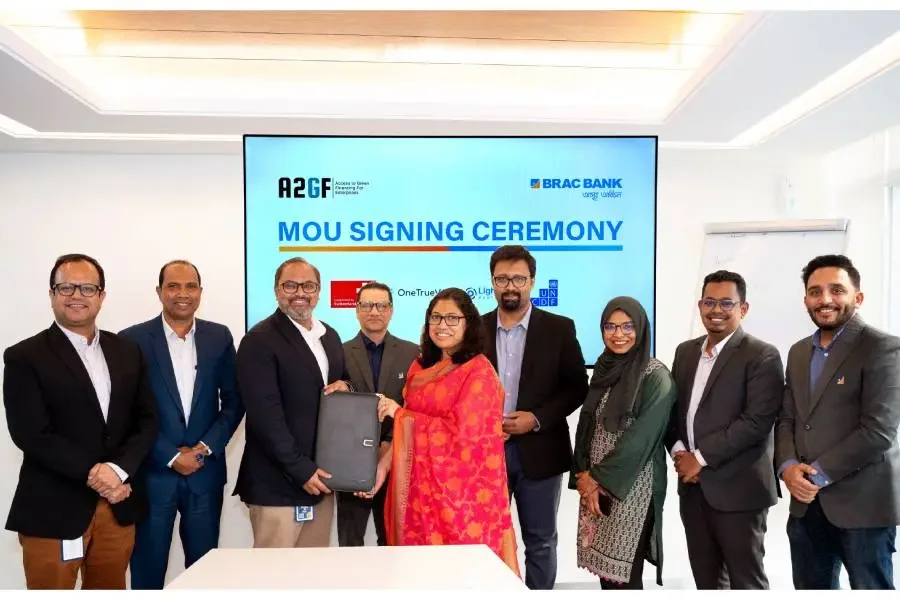
BRAC Bank, OneTrueValue partner to expand green financing for SMEs
1784168973392.webp


BRAC Bank has partnered with OneTrueValue (OTV) to expand access to green financing for small and medium enterprises (SMEs), reinforcing its commitment to sustainable business growth and Bangladesh’s transition to a low-carbon economy.

The partnership comes under the Access to Green Financing (A2GF) for Enterprises – Scale & Innovation programme, supported by the Embassy of Switzerland in Bangladesh, according to a press release.

Through the partnership, BRAC Bank will strengthen its green financing capabilities while expanding SMEs’ access to finance for renewable energy, energy-efficient technologies, waste management and circular economy initiatives.

The collaboration will also enhance the bank’s capacity to assess green investments through specialised assessment tools and technical expertise.

The initiative is expected to help SMEs improve resource efficiency, reduce environmental impact, strengthen business resilience and contribute to sustainable economic growth.

The agreement was signed by Syed Abdul Momen, Additional Managing Director and Head of SME Banking of BRAC Bank, and Sharawwat Islam, CFA, Managing Director of Truvalu Bangladesh, representing OTV.

Speaking on the occasion, Syed Abdul Momen said, “Green financing is already receiving extensive focus, particularly in our SME portfolio, and this partnership will help us expand that footprint further. As Bangladesh’s leading SME bank, we believe sustainability is becoming a key driver of business competitiveness. By making green finance more accessible, we aim to empower entrepreneurs to adopt sustainable technologies, strengthen their businesses and create lasting economic and environmental value.”

Sharawwat Islam, CFA, said, “SMEs in Bangladesh are increasingly willing to invest in green technologies, yet many continue to face challenges in accessing finance and demonstrating measurable environmental impact. Through this partnership, we aim to bridge those gaps by connecting businesses with finance while strengthening the systems that measure and verify their sustainability outcomes.”

As Bangladesh’s largest SME bank, BRAC Bank continues to advance sustainable finance through innovative solutions that help entrepreneurs grow responsibly while contributing to the country’s long-term economic and environmental aspirations.

OTV is an investment management and advisory firm accelerating green growth across emerging markets by mobilising private capital for climate solutions.

As a joint venture between One to Watch and Truvalu, OTV combines more than two decades of investment and business development experience across five countries, supporting businesses that generate financial returns alongside measurable environmental and social impact.​
 
Analyze

Analyze Post

Add your ideas here:
Highlight Cite Respond

The new era of MSME growth
Mohammad Mamdudur Rashid, Managing director & CEO, United Commercial Bank PLC (UCB)

1785282767962.webp

Mohammad Mamdudur Rashid.

Micro, Small and Medium Enterprises (MSME) have firmly established themselves as the driving force behind Bangladesh’s economic narrative. Generating a massive chunk of employment nationwide, these resilient businesses keep manufacturing, services, agriculture, exports, and local markets humming. Yet, for this sector to achieve truly sustainable growth, the demand for friction-free financing, tech-driven banking, and entrepreneur-friendly financial ecosystems is at an all-time high. History

Stepping directly into this gap is United Commercial Bank PLC (UCB). By consistently rolling out initiatives to make the SME sector more dynamic, UCB’s SME and Agricultural Banking Division now supports over 20,000 entrepreneurs. With a robust loan portfolio of approximately Tk 7,259 crore, the bank is actively funding business expansions across the country. Remarkably, nearly 83 per cent of this portfolio is self-funded—a testament to UCB’s stellar deposit management and sustainable financial strength.

At a time when stable deposits are considered the holy grail of banking, UCB’s financial position stands strong on a foundation of long-term customer trust. Over the past 18.5 months, the bank’s total deposits surged to Tk 72,300 crore.

What makes this milestone unique is that nearly 70 per cent of these deposits stem from retail and SME customers. From small-scale rural entrepreneurs to everyday individual savers, millions across Bangladesh have chosen UCB as their go-to financial partner. This diversified deposit base does more than prove UCB’s market presence; it anchors its institutional credibility and financial stability in grassroots acceptance.

Moving past traditional, slow-moving loan disbursements, UCB is undergoing a massive digital overhaul to make banking swift and transparent. The bank is systematically automating its entire lending lifecycle from initial application to approval and eventual disbursement.

By leveraging digital lead generation, platform-based lending, and data-driven analytics, UCB ensures that entrepreneurs can access funds with minimal turnaround time and zero unnecessary complexity.

UCB’s impact on the rural economy is equally profound. In the current fiscal year, the bank surpassed its agricultural loan disbursement target by over 100 per cent. UCB is intentionally channeling funds to agri-entrepreneurs, smallholders, and agro-based industries, while pioneering green agriculture, climate-resilient farming, and modern agro-ventures.

The global economic slowdown and a sluggish domestic export market have posed severe headwinds for businesses recently. Yet, UCB’s SME trade segment has managed to buck the trend.

In a striking contrast, UCB’s SME export business recorded an impressive 39 per cent growth this year, even as the country’s overall national export growth dipped to a negative 3 per cent (-3pc). On the import side, the bank maintained a remarkably stable foothold compared to national trends. Through dedicated Trade Helpdesks, specialized branch services, and alliances with trade bodies, UCB is giving local SMEs the financial firepower to compete globally.

UCB recognizes that providing money is only half the battle; nurturing entrepreneurial capability is just as crucial. To bridge the skill gap, the bank regularly hosts Relationship Manager (RM) training, entrepreneur development programs, and field-level exchange meets with local chambers of commerce.

Looking forward, the bank is executing a major digital shift in the SME sector to tackle future hurdles. UCB has already partnered with cutting-edge tech entities like ‘Sokrio Technologies’ to streamline its platform-based lending.

As part of its 2026 roadmap, UCB has taken the initiative to launch a digital supply chain alongside implementing the ‘Bangla QR Code’ system for SME deposit mobilization, which will make transactions faster and much simpler.

While technology drives efficiency, UCB is careful not to lose the human connection. The bank is blending its digital push with grassroots relational strategies, such as direct, casual ‘Cha Chakra’ with local business communities and highly active social media engagement.

As Bangladesh marches forward, the SME sector remains indispensable. By seamlessly weaving together advanced technology, strategic partnerships, and authentic human connection, UCB is not just offering financial transactions, it is cultivating a sustainable, long-term partnership that promises a brighter future for the nation’s entrepreneurs.

UCB SME Banking at a Glance

Today, UCB’s SME and Agricultural Banking Division serves more than 20,000 entrepreneurs across Bangladesh with a loan portfolio of approximately Tk 7,259 crore. Notably, around 83 per cent of this portfolio is funded through the Bank’s own deposits, reflecting UCB’s strong liquidity position and sustainable financing capability.

Customer confidence continues to strengthen the Bank. Over the past 18½ months, UCB’s total deposits have grown to Tk 72,300 crore, with nearly 70 per cent contributed by Retail and SME customers—demonstrating broad-based public trust.

1785282835577.webp


UCB has also delivered strong performance in SME trade finance. Despite challenging global conditions and a slowdown in Bangladesh’s overall export performance, UCB’s SME export business recorded nearly 39 per cent growth during the current year, significantly outperforming the country’s overall export growth of negative 3 per cent over the same period.]​
 
Analyze

Analyze Post

Add your ideas here:
Highlight Cite Respond

Govt aims to raise SMEs’ contribution to economy to 60pc
Staff Correspondent 09 August, 2026, 01:15

1786242086183.webp


The government is working to raise the contribution of micro, cottage, small and medium enterprises to Bangladesh’s economy to more than 60 per cent, industry minister Khandaker Abdul Muktadir said on Saturday.

Expanding such enterprises would increase people’s participation in economic activities, create employment and help reduce income inequality, he said.

The minister made the remarks while speaking as chief guest at a meeting with industrialists and a cheque-distribution programme for entrepreneurs at the conference room of the BanSCIC district office in Bogura.

He said micro, cottage, small and medium enterprises currently account for around 36 per cent of GDP through business activities.

‘If this share exceeds 60 per cent, the economic lifeblood will become more vibrant and the benefits of economic growth will reach more people,’ he added.

The government’s goal for the coming days is to expand the number of entrepreneurs in micro, small, medium and cottage industries, he added.

He also stressed the need to develop skilled workers for the light engineering and leather industries, saying the government had taken an initiative to establish a training centre to improve design and technical skills in the two sectors.

An international-standard organisation could be appointed to operate the centre, with the government exploring cooperation with institutions from Italy, Germany or other European countries.

Regarding Bangladesh’s industrial structure, the minister said labour-intensive industries were particularly important for an economy like Bangladesh.

Although high-tech and capital-intensive industries could generate greater investment and profits, they generally created fewer jobs, while most industries in Bangladesh were labour-intensive and required relatively less capital, he said.

‘Low-capital businesses cannot be operated at interest rates of 13–14 per cent. Considering this reality, the government is taking various measures to reduce the cost of funds,’ Muktadir said.

The government was also working to improve energy supplies for industries, he said, adding that resolving problems inherited from the past would take time and require realistic planning and effective implementation.

The minister urged entrepreneurs to come forward with projects that were less dependent on energy and assured them of government logistical support for implementing such projects.

BSCIC chairman Benzir Ahmed delivered the welcome address at the programme.

Meanwhile, at another event of the assumption of office by the newly elected board of directors of the Bogura Chamber of Commerce and Industry on the same day, he said the government is planning to establish a new industrial park on around 400 acres of land in Bogura to meet the growing demand for industrial space among small and medium-sized enterprises.

The government aims to begin preliminary development work on the proposed park during the coming winter season, he said.

Muktadir said Bogura had strong potential to emerge as an important industrial and economic hub, particularly in the light engineering sector, and the government has been working to realise it, he added.

The existing BSCIC industrial estate in Bogura had already reached full capacity, while demand for new industrial plots among SME entrepreneurs was increasing, the minister said.

‘Considering this demand, we have planned to establish a new BSCIC industrial park on around 400 acres of land. We would try to move ahead quickly and begin the initial work during the coming winter season,’ he said.

The government was also working to improve access to energy and electricity, simplify gas connections and create opportunities for industrial entrepreneurs to obtain financing at lower costs, Muktadir added.

He added that the government would place equal emphasis on developing skilled human resources and strengthening the capacity of entrepreneurs.

Road transport and bridges minister Sheikh Robiul Alam inaugurated the programme, while state minister for local government, rural development and cooperatives Mir Shahe Alam attended it as a special guest. Members of parliament from Bogura were present.

Earlier, Muktadir visited the proposed industrial park site at Fapora union in Bogura Sadar upazila.​
 
Analyze

Analyze Post

Add your ideas here:
Highlight Cite Respond

CMSMEs face existential threat amid constraints

Energy crisis, shrinking bank credit hit hard small businesses

Muhammad Ayub Ali 14 August, 2026, 00:20

1786664868954.webp


The country’s cottage, micro, small and medium enterprises are facing an existential threat as working-capital shortages, limited access to bank loans, persistent gas and electricity shortages and mounting financial distress squeeze the businesses amid a broader economic slowdown, industry insiders said.

Experts stressed that credit support alone would not be enough to safeguard CMSMEs at this critical stage, calling instead for a comprehensive approach that combines adequate energy supply, technology-based knowledge support, and sector-specific demand generation.

The struggles of two award-winning entrepreneurs illustrate how quickly fortune can turn for small businesses caught in credit and energy shortages.

Md Lutfur Rahman received the SME Prize in 2016 in the category of Producer and Exporter of Jute Products in recognition of his contribution to the jute industry. In the same year, he secured several export orders from foreign buyers, but struggled to fulfil them ‘amid unfair competition and interference from local middlemen’.

A shortage of working capital compounded his difficulties, preventing him from procuring raw materials and completing production on schedule, which in turn affected his ability to deliver goods within agreed deadlines.

In 2017, Lutfur approached several banks for loans, but his applications were rejected because he could not provide the collateral the banks required.

With working capital still scarce and institutional financing out of reach, he was eventually forced to shut his factory in 2020 — a facility that had employed more than 20 workers. He now works as a middleman in the jute trading business, without a manufacturing facility of his own.

Nazrul Islam, owner of RAJA Metal Industries and a recipient of the SME Prize in 2022, is now grappling with severe financial distress amid persistent inflation, the energy crisis and an acute working-capital shortage.

His factory, which employs around 80 workers, has not paid salaries for the past three months. Attendance has deteriorated sharply as a result — at least 10 workers stopped reporting for duty last month over the prolonged non-payment of wages.

Dhaka Chamber of Commerce and Industry president Taskeen Ahmed said on Tuesday that the CMSME sector was in a state of emergency, with its share of total bank credit eroding from 19.11 per cent in 2023 to 18.40 per cent in 2024, before hitting a critical low of 15.87 per cent in March 2025.

Weak private-sector credit growth of 4.47 per cent, combined with high interest rates of 11.92 per cent, has contributed to a sharp rise in CMSME non-performing loans, which now stand at 26.04 per cent, he said, adding that rising costs and energy shortages continue to pile further pressure on small businesses.

Restoring business confidence, Ahmed said, would require cutting bureaucratic barriers, easing access to CMSME loans, protecting funds earmarked for small firms, and reducing import duties on raw materials.

The DCCI also called for banking-sector reform and a reliable supply of gas and electricity to SME clusters, warning that the government’s Tk 60,000-crore stimulus package would fail without urgent intervention.

Khondaker Golam Moazzem, research director at the Centre for Policy Dialogue, said that the economy was grappling with high inflation, energy shortages, liquidity constraints and difficult global market conditions.

While large industries were also affected, he said, adding that CMSMEs face a far greater threat to their survival.

‘The government should secure low-cost international funds through the finance ministry to provide affordable financing for CMSMEs amid persistent economic challenges,’ he said.

The National SME Policy targets CMSME lending at a minimum of 27 per cent of total lending by 2029, with an interim target of 25.50 per cent for this year to support employment.

Actual lending, however, has continued to decline rather than rise.

Since its establishment, the SME Foundation has disbursed Tk 1,250 crore in loans, while the Bangladesh Small and Cottage Industries Corporation has disbursed Tk 341.57 crore over the past five years — a figure experts describe as grossly inadequate given the scale of demand.

Mustafa K Mujeri, a distinguished economist and executive director of the Institute for Inclusive Finance and Development, said that providing loans alone was not enough.

Businesses also needed lower production costs, easier access to raw materials, and reliable energy support, he said, adding that technology-based, sector-specific support packages were needed to foster new entrepreneurs, strengthen existing businesses, and create jobs.

According to the Bangladesh Bureau of Statistics’ 2024 Economic Survey, nearly 99 per cent of the country’s approximately 1.17 crore industrial establishments fall under the CMSME category.

The sector contributes around 30 per cent of Bangladesh’s economy and provides more than 30 million jobs, accounting for 85 per cent of total industrial employment — underscoring what economists say is at stake if the current crisis is left unaddressed.​
 
Analyze

Analyze Post

Add your ideas here:
Highlight Cite Respond

Latest Posts

Back
 
G
O
 
H
O
M
E