[🇧🇩] Foreign policy of the new government after the election

[🇧🇩] Foreign policy of the new government after the election
27
629
More threads by Saif

G Bangladesh Defense

Khalilur Rahman under spotlight as he steers 81st UNGA
Staff Correspondent 23 September, 2026, 09:08
1790135533063.webp

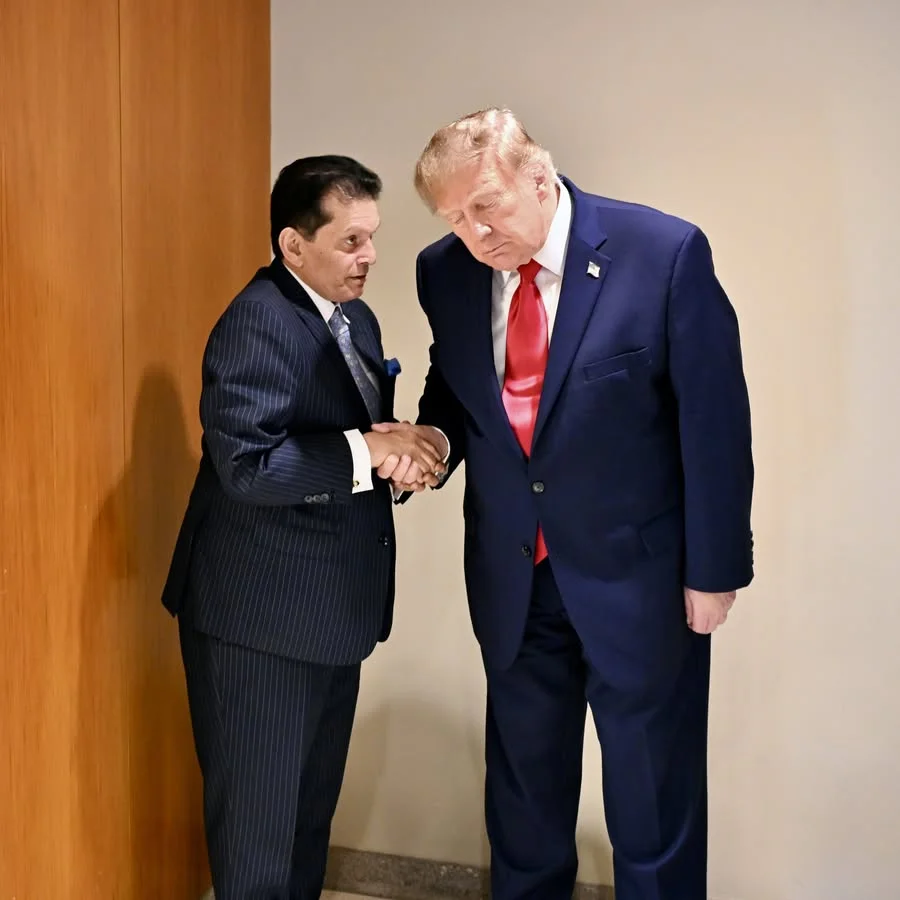
Bangladesh foreign minister and president of UNGA 81st session Khalilur Rahman in a Facebook post shared his personal exchange with US president Donald Trump. | Collected Photo

Khalilur Rahman, president of the 81st session of the UN General Assembly, is under spotlight as he presides over the 81st session of the UN General Assembly, with world leaders gathering in New York amid wars and geopolitical tensions.

The high-level general debate, which began on September 22 and will continue through September 26, is the most visible test so far for Khalilur Rahman, who was elected president of the 81st session in June.

US president Donald Trump was among the first speakers to take the stage.

Gathering of world leaders takes place against a backdrop of global conflicts, environmental crisis and massive technical disruption

The foreign minister of Bangladesh formally took the chair when the session opened on September 8 and is presiding over the general debate as presidents, prime ministers and other senior representatives address the 193-member Assembly.

US president Donald Trump delivered his address while Khalilur Rahman, as UNGA president, was seated behind him alongside UN Secretary-General António Guterres.

He later held a brief exchange with Trump.

The 81ar session of the UNGA is being held under the theme ‘Restoring Trust, Managing Transformation: A United Nations That Delivers for All.’

Khalilur Rahman has placed restoring confidence in the UN and making the organisation more responsive at the centre of his presidency.

His presidency comes as the UN faces a series of major challenges, including conflicts in the Middle East and Ukraine, humanitarian crises, climate change and the rapid development of artificial intelligence.

For him, the presidency provides Bangladesh with a prominent role at the centre of the UN’s most important annual diplomatic gathering.

A veteran diplomat with more than 30 years of UN experience, Khalilur Rahman has attended 16 sessions of the General Assembly earlier.

Opening the general debate on September 22, Rahman said, ‘Outside these walls, people are not asking whether the United Nations still exists. They are asking whether it works.’​
 

PM Tarique Rahman’s three-country tour planned for October, November

Raheed Ejaz
Dhaka


1790552303699.webp

Prime Minister Tarique Rahman BSS

Prime Minister Tarique Rahman is preparing to visit three countries in October and November. He is scheduled to visit Japan and Saudi Arabia on bilateral visits, while he will travel to Turkey to attend the 31st UN Climate Change Conference (COP31).

Bangladeshi diplomatic sources in Tokyo, Riyadh and Ankara told Prothom Alo on Saturday.

According to the sources, preliminary preparations have begun for the prime minister’s visit to Japan in October, followed by visits to Turkey and Saudi Arabia in November.

Diplomatic sources in Tokyo, Riyadh and Ankara said the prime minister is expected to visit Japan in the final week of October. He is then expected to visit Turkey in early November and Saudi Arabia in the second half of the month.

Diplomatic sources said preliminary preparations for the three upcoming visits have already begun. Senior officials are communicating with the respective countries.

Diplomatic sources in Dhaka and Tokyo said Prime Minister Tarique Rahman is expected to visit Japan at the invitation of Japanese Prime Minister Sanae Takaichi. Senior officials from the two countries recently held discussions in Dhaka on arranging the three- to four-day visit in the final week of October.

A diplomatic source in Ankara told Prothom Alo that a summit of leaders participating in COP31 will be held in Anatolia, Turkey, from 10 to 12 November. Prime Minister Tarique Rahman will travel to Turkey to attend the summit.

According to diplomatic sources in Dhaka, Prime Minister Tarique Rahman may visit Riyadh in the second half of November at the invitation of Saudi Crown Prince and Prime Minister Mohammed bin Salman. Officials from the two countries have begun discussions on arranging the visit.

Japan visit

Prime Minister Tarique Rahman’s three- to four-day visit to Tokyo in the final week of October, at the invitation of Japanese Prime Minister Sanae Takaichi, comes as the two countries continue efforts to deepen their relations.

In May 2025, Bangladesh’s then Chief Adviser Professor Muhammad Yunus visited Tokyo. During his visit, the two countries signed seven memorandums of understanding in investment, energy and technology. They set a target of sending 100,000 skilled Bangladeshi workers to Japan over five years. The two countries also reaffirmed their strategic partnership during the visit.

Japan said at the time that, under its Bay of Bengal initiative, it would step up cooperation to expand Japanese investment in Bangladesh, including infrastructure development.

Investment expansion, organising a business conference and reviewing progress in exporting manpower could receive priority during Prime Minister Tarique Rahman’s upcoming visit to Japan.

Turkey visit

COP31 will be held in Anatolia, Turkey, from 9 to 20 November. The COP31 summit of leaders will take place on 11 and 12 November. Prime Minister Tarique Rahman will visit Turkey for those two days.

Diplomatic sources indicate that holding the summit of leaders on the third and fourth days rather than the first two days of COP31 is being viewed as a strategy to maintain political attention.

Analysts say the conference is important for Bangladesh as a country vulnerable to climate change. More than a decade after the Paris climate agreement, the key question is no longer about setting new targets. Rather, it is about how previously announced targets will be implemented and how effective climate finance and compensation funds will be.

Prime Minister Tarique Rahman’s planned visit to Riyadh in the second half of November at the invitation of Saudi Crown Prince Mohammed bin Salman is also significant.

Saudi visit

Prime Minister Tarique Rahman’s planned visit to Riyadh in the second half of November at the invitation of Saudi Crown Prince Mohammed bin Salman is also significant.

In recent years, Saudi Arabia has expressed interest in taking its relations with Bangladesh beyond traditional manpower exports.

At a meeting in Dhaka last August, Saudi Deputy Foreign Minister Waleed El-Khereiji expressed interest in investing in fisheries, food, energy, renewable energy, information technology and artificial intelligence (AI).

Saudi Ambassador to Bangladesh Abdullah Jafar H. Bin Abia recently said the next five years could be a transformative period for the economic relationship between the two countries. He described Bangladesh as one of South Asia’s dynamic investment destinations.

More than 2.8 million Bangladeshis currently work in Saudi Arabia, making the country Bangladesh’s largest labour market.

Diplomatic sources said Prime Minister Tarique Rahman’s planned visit to Saudi Arabia could focus on strengthening bilateral relations, energy imports, investment agreements and exchanges of views on regional and international issues. Continued Saudi support on the Rohingya issue could also receive importance.​
 

Shama Obaed: Bangladesh wants independent foreign policy, open to global cooperation

‘People’s interests remain central to the country’s foreign policy,’ she says

1791072697945.webp

Photo: UNB

State Minister for Foreign Affairs Shama Obaed Islam on Saturday said Bangladesh wants to pursue its foreign policy independently while remaining open to cooperation with the international community.

“We don't want to be a chessboard for other players to play. We want to play on our own terms. We are ready to negotiate, collaborate and partner with the rest of the world with our head held high,” she said.

Speaking at a panel discussion titled “A World Rewritten: Power, Technology and Trust in the Age of Uncertainty” as part of the 3-day Bay of Bengal Conversation, the state minister said Bangladesh is now in a position where it is holding its head high.

Prime Minister Tarique Rahman spoke as the chief guest at the inaugural session.

Former President of the Republic of Serbia Boris Tadić, Distinguished Professor at Illinois State University, USA, Ali Riaz, Deputy Head of Mission at the Royal Norwegian Embassy in Bangladesh Alexander Falck-Bilden, Member of Parliament of Montenegro Gordan Stojović, and Editor-at-Large of TIME Magazine, Singapore, Charles Thomas Campbell took part in the first panel discussion.

“But of course, remembering that the most important thing in our foreign policy is the interest of our people,” Shama said.

Seeking broader international cooperation to resolve the Rohingya crisis, she said Bangladesh wants to cooperate with countries across South Asia, Asia and beyond as part of its economic diplomacy.

“As far as economic diplomacy goes, we believe in collaborating and working with all the nations in South Asia, Asia, and elsewhere. We want to collaborate with everyone. We want Bangladesh to become a hub because we have the demographic dividend,” she said.

“We have the people, and when we talk about power, I believe our people is our power,” Shama said.

The state minister said Bangladesh is seeking broader international cooperation to resolve the Rohingya crisis, stressing that the country cannot sustain the burden of hosting the refugees indefinitely.

“We don't know the exact number anymore, because it's 1.3 million plus Rohingya refugees, and the number is increasing every day because 30,000 children are being born every year, more or less. And every day there is influx going on,” she said.

Shama said Bangladesh is facing the challenge of a growing young Rohingya population in Cox's Bazar, with inadequate access to education, healthcare, food and security.

She also highlighted the security challenges Bangladesh faces due to the situation in Myanmar and developments along the border.

Shama described the situation inside Myanmar as complicated, saying that resolving the crisis requires engagement with multiple stakeholders - Arakan Army, Myanmar government, and the other entities.

She said Bangladesh is pursuing discussions with its neighbours and other countries to find a solution to the crisis.

Energy, economic diplomacy

Speaking about Bangladesh's broader foreign policy and economic priorities, Shama said Bangladesh, with a population of around 170 million, has significant potential as a trade, energy and investment hub between South and Southeast Asia.

“Basically, you know, Bangladesh is a nation of 170,000,000 people, and we see it where South Asia meets Southeast Asia on the shores of the Bay of Bengal, with unlimited potential of trade, energy, and investment,” she said.

Shama said Bangladesh faced challenges following the war situation in the Gulf, particularly in terms of energy security and the large Bangladeshi diaspora living and working in Gulf countries.

“So it reminds me that during that time, we have lost 14 of Bangladeshis who have been working in different countries in the Gulf,” she said.

Shama said the government is focusing on economic diplomacy and diversification of energy sources.

AI for peace and development

Responding to a question on artificial intelligence, Shama said Bangladesh wants technology to contribute to peace, security and stability rather than conflict.

“We want to live in a world where AI stops wars, not initiates. We want to live in a world where technology actually facilitates peace and security and stability, but does not start wars,” she said.

The state minister also said Bangladesh wants to use AI in ways that benefit different sections of society.

“We are living in the age of technology and AI, but we want to use AI in the social context of Bangladesh, where our farmers, our women entrepreneurs, our businessmen, our agriculture, our every sector of our population gets advantage of artificial intelligence, which is possible,” she said. “So that is what we are striving for,” she added.

AI, technology

On artificial intelligence and technology, Shama said the government is pursuing an economy based on technology and innovation, with emphasis on startups and new technologies.

“Regarding AI and technology, Bangladesh government at the present is thriving for an economy that is technology based, innovation based, and even in the new budget, in this fiscal year, our government clearly gave enough emphasis on startups and new technology and artificial intelligence-based economy,” she said.

The state minister said Bangladesh also needs to remain aware of the vulnerabilities associated with the growing use of artificial intelligence and digital technologies.

“As we embrace artificial intelligence, as we increase training in AI in Bangladesh's social context, we have to be also aware of the vulnerabilities that it creates across the board….in the cyber world, in digital world,” she said.

Shama said AI and technology are also contributing to misinformation, disinformation and digital harassment.

“Because of AI, we have misinformation, disinformation. We are seeing digital harassment against women and children, and that is created by the technology,” she said.

She called for global cooperation to address such challenges.

“It has now become a global issue. As we embrace technology, as we embrace innovation, to strengthen our economy, we also come forward and try to unite the world to combat, how we can actually address the issue of digital harassment in the cybersecurity because it's not a country-specific problem,” Shama said.​
 

Latest Posts

Back