Home Watch Videos Wars Movies Login

[🇧🇩] Healthcare Industry in Bangladesh

Latest Posts Countries Wars Q&A

[🇧🇩] Healthcare Industry in Bangladesh
61
3K
More threads by Saif

G Bangladesh Defense

Campaigners seek free healthcare
Sadiqur Rahman 09 January, 2025, 00:28

The Health Sector Reform Commission in 50 days of its formation is still gathering information and opinions on several focal areas such as service improvement while public health campaigners and medical practitioners demand free healthcare at all public health facilities.

The latters expect sharper surveillance of overall health facilities, effective corruption-control measures and rational distribution of logistics between urban and rural healthcare centres.

The interim government formed the 12-member Health Sector Reform commission on November 18, 2024 for submitting necessary reform proposals in 90 days to make the country’s healthcare services people-oriented, accessible and universal.

Commission member Muzaherul Huq, also a former senior adviser to the World Federation for Medical Education, recently told New Age that the commission identified several focal areas for reforms.

‘We are gathering information and opinions from related professionals at grassroots-level and urban healthcare centres where marginalised people often visit for medical treatment. Our mission is to propose necessary improvements of the facilities so that patients can access better healthcare,’ Muzaherul said.

The commission has been analysing the autonomy of upazila health complexes, at least for procuring crucial logistics, and strong monitoring over its expenditures, he said.

The commission has also been talking to teachers and students at institutions of public health, medical science and nursing training, and paramedics and technicians to gather suggestions on the improvement of the health and medical science education, he said.

‘Improving the facilities for continuing education or professional training would be another focal area,’ said the commission member, adding, ‘widening scopes for research on the related fields would be focused.’

About corruption in the health sector, Muzaherul said that the issue had already been identified by several local and international organisations.

He said, ‘We will definitely recommend necessary measures to check corruption. At the same time, we will recommend conflict management procedures to minimise patients’ grievances and safety for the health practitioners as well.’

Public health campaigners have, however, demanded that the commission must recommend completely free medical facilities, including diagnosis and supply of medicines, at all public hospitals.

Faizul Hakim, the convener of the Janaswastha Sangram Parishad, a platform for raising voices against irregularities in the public health sector, said, ‘The government must bear the people’s health expenditures. I won’t recommend health insurance to facilitate insurance businesses.’

Non-practicing allowance for the physicians at public hospitals, limiting fees at physicians’ private chambers, strict surveillance over the services and expenses at the private hospitals and diagnosis centres, and a functional and independent Bangladesh Medical and Dental Council are among Faizul’s recommendations.

‘Corruption has paralysed the health sector, cornering the patients and their distressed families. Recommendations should come to check corruption anyhow,’ Faizul demanded, adding that the commission must come up with a white paper investigating the alleged corruption during and after the Covid pandemic.

‘Irregularities in procuring corona vaccines must be investigated.’

Public health and preventive medicine specialist Lenin Chowdhury said that reform proposals must include a comprehensive healthcare plan combining public health and treatment, defining rights and responsibilities of private clinics and practitioners, monitoring the quality of medical colleges and training institutions, a short-mid-long-term road map for manpower recruitment in the health sector and experts-led health ministry.

‘The insolvent patients need a safety net. Moreover, there must be a guideline for bringing poverty-ridden patients under a universal healthcare system,’ Lenin said.

Commission chief Professor AK Azad Khan, also the president of Bangladesh Diabetic Society, said that the commission continued discussing with key stakeholders, including common citizens.

‘We would prepare a precise draft of reform proposals at the end of this month,’ Azad said.​
 
Analyze

Analyze Post

Add your ideas here:
Highlight Cite Respond
  • Like (+1)
Reactions: Bilal9

A public cancer hospital in crisis
Prolonged equipment failure at NICRH is unacceptable

1736724736316.webp

VISUAL: STAR

It is deeply concerning that the National Institute of Cancer Research and Hospital (NICRH)—the country's premier public facility for cancer care—is failing to provide radiotherapy treatment due to prolonged equipment failure. For over 19 days, according to a report by The Daily Star, all six radiotherapy machines at the hospital have been out of service, forcing cancer patients to delay their treatment at the risk of their conditions worsening or spreading.

NICRH is not just another healthcare facility; it is a lifeline for many patients, especially those from poor backgrounds, who rely on its subsidised services. For such a vital institution to go even a single day without functioning radiotherapy machines is thus unacceptable. That the current paralysis has dragged on for nearly three weeks only shows the gravity of the situation. In fact, the equipment failure has been a persistent problem for NICRH: one of the machines has been out of order for two years, and another for over a year. How has such a critical problem been allowed to continue unchecked for so long?

For many cancer patients, seeking treatment at private clinics is not an option due to the exorbitant costs involved. They rely on NICRH for affordable care. When that care is delayed, they face harrowing choices—some borrow or exhaust their life savings to seek private treatment, while others are left with no option but to wait, risking their lives as cancer progresses.

Reports of similar incidents paint a grim picture of recurring dysfunction at NICRH. Last year, Prothom Alo reported that all of the hospital's radiotherapy machines had malfunctioned. At that time, even the X-ray machine was out of order for two weeks. These repeated breakdowns are symptomatic of a broader systemic failure in public healthcare, at the core of which lies a disturbing culture of indifference and irregularities. Instead of prioritising urgent repairs or replacing outdated equipment, hospital authorities have shown a complacent attitude, waiting for external interventions that rarely come in time.

For many cancer patients, seeking treatment at private clinics is not an option due to the exorbitant costs involved. They rely on NICRH for affordable care. When that care is delayed, they face harrowing choices—some borrow or exhaust their life savings to seek private treatment, while others are left with no option but to wait, risking their lives as cancer progresses.

We urge the health authorities to address this crisis immediately. The radiotherapy machines at NICRH must be repaired or replaced immediately, and measures must be taken to prevent such prolonged disruptions in the future. The possibility that certain vested quarters may be deliberately sabotaging these machines to drive patients towards private facilities must also be thoroughly investigated. The health directorate's long-standing failure to properly oversee public hospitals like NICRH also must be rectified.​
 
Analyze

Analyze Post

Add your ideas here:
Highlight Cite Respond
  • Sad (0)
Reactions: Bilal9

Healthcare system needs a thorough shakeup
Published :
Feb 08, 2025 22:34
Updated :
Feb 08, 2025 22:34

1739060504318.webp


That the country's healthcare system is plagued by a lot of discrepancies and inadequacies does not require any elaboration. Volumes have been said and written on this particular issue over the years but to no avail. Speakers at a debate programme organised in the city late last week came up with a wide range of suggestions and recommendations including establishment of a regulatory body for streamlining the healthcare sector. The debate programme coincided with the government initiative to reform the sector. It may be mentioned that the interim government last November formed a Health Affairs Reform Commission to recommend reforms with the objective of making health services more accessible and universal. The core recommendation of the programme was the establishment of a regulatory body to standardise pricing, enforce quality accreditation and form a grievance mechanism for the patients.

Though there are several health-related agencies under the Ministry of Health and Family Welfare, those have hardly any control over cost of treatment, especially in private hospitals and clinics. These private healthcare outlets fix treatment charges whimsically. They do not bother to take into consideration the paying capacity of the poor and low-income people. In view of this, the speakers at the debate programme underscored the need for enacting a comprehensive health law and creating a central regulatory authority to oversee private sector engagement in health services. Patients usually do not have the scope to know beforehand how much they will have to spend for a specific treatment. For lack of effective control, pharmaceutical companies arbitrarily fix prices of medicines and increase them quite frequently. These are some of the reasons why expense for treatment is so high in Bangladesh. It is because the treatment cost remains much beyond commoners' affordability. The speakers at the programme raised concern over the high financial burden on the patients. The proposed regulatory body may devise mechanism for price control by distinguishing between actual medical cost and that charged by many healthcare outlets out of unethical commercial motive.

Healthcare services in Bangladesh are much below international standard. People do not have that much faith in the country's healthcare system. This loss of confidence prompts thousands of patients to opt for treatment outside the country at the expense of hard-earned foreign currencies from the state exchequer. Enforcement of quality accreditation is also vitally important for ensuring service quality of hospitals, laboratories and doctors. Establishment of a grievance mechanism for patients until now was an alien idea in the country. Very often patients are subjected to various forms of harassment but the victims have nowhere to go to lodge complaints for redress. The proposed grievance mechanism is expected to be a relief for the health service seekers. Similarly, public-private partnership in healthcare service is a unique idea in Bangladesh. So, serious efforts should be made to translate that idea into reality.

The Health Affairs Reform Commission has its own recommendations for streamlining the country's healthcare system. The authorities concerned are also expected to incorporate experts' suggestions if those are not already covered by the Reform Commission. Such an integration of suggestions and recommendations will hopefully free the archaic medical service system and make it accessible to common people.​
 
Analyze

Analyze Post

Add your ideas here:
Highlight Cite Respond
  • Like (+1)
Reactions: Bilal9

Bangladeshis spend $4b annually for healthcare abroad
DCCI Senior Vice President Malik Talha Ismail Bari says in a seminar on outbound healthcare tourism

View attachment 10882

Bangladeshis spend around $4 billion abroad every year for healthcare, according to Malik Talha Ismail Bari, senior vice president of the Dhaka Chamber of Commerce and Industry (DCCI).

This is due to a lack of specialised treatment, trust on doctors and advanced technology within the country alongside costs being comparatively lower abroad, he said.

Bari, also a director of United Hospital, was delivering a keynote paper through a presentation at a seminar, styled "Reversing the Outbound Healthcare Tourism", at the DCCI today.

There are 5,461 private hospitals and clinics in Bangladesh, of which 1,810 are within Dhaka division, he said.

People in rural areas are deprived of quality and adequate healthcare services while pressure is created for an influx of patients at healthcare facilities in Dhaka.

Limited infrastructure, a lack of skilled workforce, quality and safety concerns, low doctor-patient ratio and long waiting periods are some of the bottlenecks to access advanced healthcare in Bangladesh, he added.

Bari informed that Bangladesh allocated Tk 30,125 crore, or 3.78 percent of its national budget, for public healthcare in fiscal year 2024-25.

Pre-capita health expenditure, or annual government spending for healthcare per person, is $110 in Bangladesh whereas $401 in South Asia, he said.

Patients sometimes go abroad for healthcare services due to a lack of facilities, trust and comfort and reversing this trend requires formulation of a proper plan and identifying the bottlenecks, said National Professor AK Azad Khan.

"Since medical science is an ever-changing process, we need to have a proper curriculum to adopt the best technological advancements," said Khan, also president of the Diabetic Association of Bangladesh.

He also stressed on the standardisation of laboratories, adequate budgetary allocation, facilitating more research and strengthening the Bangladesh Medical and Dental Council (BM&DC), which is the regulatory authority for medical and dental education in Bangladesh.

Trust is a crucial factor when considering this sector's development, said Rezaul Karim Kazal, professor of the obstetrics and gynaecology department at Bangabandhu Sheikh Mujib Medical University.

Quality hospitals should be established in rural areas for wider coverage alongside customised services for all types of patients, he added.

Only doctors should be appointed through Bangladesh Civil Service for the public health administration to be run efficiently, said Syed Abdul Hamid, professor at the Institute of Health Economics of the University of Dhaka.

Moreover, a "health service commission" should be formed similar to the Bangladesh Judicial Service Commission, which assess the suitability of persons for entry-level appointments as assistant judges or judicial magistrates, he added.

Liaquat Hossain, registrar of the BM&DC, suggested that the national policy for registering foreign doctors to practice in Bangladesh could be simplified.

Of the 1,34,000 doctors in Bangladesh, only 33,000 are in public service, said Abul Bashar Md Jamal, a former professor of surgery at Dhaka Medical College Hospital.

However, over 10,000 foreign students are studying in different public and private medical colleges here, he added.

Members of middle-income households are increasingly seeking healthcare services abroad, mainly for a lack of confidence and satisfaction, said DCCI President Ashraf Ahmed.

Only a few types of advanced treatments, such as robotic surgery, are available locally, he said.

The trend can be reversed by outperforming regional competition, ensuring customer satisfaction and enhancing quality of medical services, reliability and branding initiatives, he added.

"We need to be more open to foreign doctors, nurses, medical technologists and other specialists," opined Ahmed.​

What needs to happen is for these talking heads stopping to "talk shop" and actually put in a "prescription" for concrete steps ( pun intended).

With mandatory temporary subsidies to set up specialized hospitals if necessary.

BS has gone on long enough while incompetent govt. idiots twiddle their thumbs with all these medical dollars go outside of the country.

If India can set up these substandard hospitals in Kolkata and Chennai area, there is no reason we cannot.

Also - we should set up some kind of necessary re-certification every year to train and certify doctors.

We need guarantees that our doctors are trained beyond a certain standard and fake doctors are weeded out.
 
Analyze

Analyze Post

Add your ideas here:
Highlight Cite Respond
What needs to happen is for these talking heads stopping to "talk shop" and actually put in a "prescription" for concrete steps ( pun intended).

With mandatory temporary subsidies to set up specialized hospitals if necessary.

BS has gone on long enough while incompetent govt. idiots twiddle their thumbs with all these medical dollars go outside of the country.

If India can set up these substandard hospitals in Kolkata and Chennai area, there is no reason we cannot.

Also - we should set up some kind of necessary re-certification every year to train and certify doctors.

We need guarantees that our doctors are trained beyond a certain standard and fake doctors are weeded out.
Our doctors are busy with their private practice and hardly have enough time to take care of their patients. The picture of all the public hospitals are the same.
 
Analyze

Analyze Post

Add your ideas here:
Highlight Cite Respond
Our doctors are busy with their private practice and hardly have enough time to take care of their patients. The picture of all the public hospitals are the same.

Agreed. Doctors are licensed. Govt. has the power to revoke those licenses.

So - if doctors do not abide by the rules (like take care of their patients in public hospitals per agreed rules), govt. has to revoke their licenses. This is exactly what they do in India. Why can't we?

Govt. has to realize that the money they spent to train doctors must have a proper return.

Becoming a doctor should not be a guarantee to print money - like it is now.
 
Analyze

Analyze Post

Add your ideas here:
Highlight Cite Respond
  • Like (+1)
Reactions: Saif

Universal health coverage: a reality or mirage?
Published :
Feb 16, 2025 23:00
Updated :
Feb 16, 2025 23:00

1739753060583.webp


The aspiration for universal health coverage (UHC), where everyone can access the necessary healthcare without facing financial hardship, remains a distant dream due to the excessive commercialisation of the health sector and a disproportionately high out-of-pocket healthcare expenditure. The UHC envisions both comprehensive service coverage for the entire population and financial protection against the high costs of medical care. While Bangladesh has made significant progress in expanding healthcare facilities, financial protection remains a major challenge. According to a World Bank study, over 73 per cent of total health expenditures in Bangladesh are borne directly by households, one of the highest in the world. This extremely high out-of-pocket spending has severe consequences. According to a study by the Bangladesh Institute of Development Studies (BIDS) soaring out-of-pocket healthcare expenses pushed 61 lakh Bangladeshis, or 3.7 per cent of the population, into poverty in 2022. Experts in a recent view exchange meeting have called for implementing a robust regulatory framework, ethical pricing mechanisms, and stronger supply chains to address the issue.

For Bangladesh to progress on the financial protection agenda, two key actions are necessary. Firstly, a significant increase in the health budget is essential. The World Health Organization suggests allocating at least 15 per cent of the total budget to the health sector, but Bangladesh allocates only around 5.0 per cent. The country's health budgetary support is one of the lowest in the South-East Asia region. The less a government spends on health, the higher out-of-pocket payment is sure to be. So, increased budgetary allocation is indispensable, particularly for ensuring access to healthcare for the poor, vulnerable, young, old, and informal workers - in essence, the majority of the population.

Secondly, the government must ensure optimum utilisation of the health budget by increasing allocation for government hospitals, health centres and healthcare professionals. However, increased allocation will not translate into enhanced facilities if corruption and some other irregularities in the health sector are not properly addressed. Absenteeism of doctors in government hospitals, particularly in rural areas has been an endemic problem. Many doctors exhaust their time and energy attending private clinics which leaves them with hardly any time for government hospitals where they are appointed to serve. It is the poor patients who mostly seek treatment at government hospitals and bear the brunt of these irregularities. Moreover, facilities in these hospitals like free medicines are scarce and those that exist do not come to the benefit of the poor due to mechanisms of vested quarters. So, to protect the poor from skyrocketing healthcare costs, public healthcare facilities must be better equipped with the necessary resources and logistics, and healthcare providers must be held accountable.

The country's high out-of-pocket healthcare expenses are not only pushing more people into the vicious cycle of poverty but also widening the gap between the rich and the poor. Globally, countries with robust government healthcare systems have achieved more equitable growth. For Bangladesh, allocating more resources to the health sector and implementing a strong strategy for enhancing financial protection for the poor and vulnerable will be crucial in ensuring access to basic healthcare for all. Otherwise, the vision of achieving universal health coverage will remain a mirage, not a reality.​
 
Analyze

Analyze Post

Add your ideas here:
Highlight Cite Respond
  • Like (+1)
Reactions: Bilal9

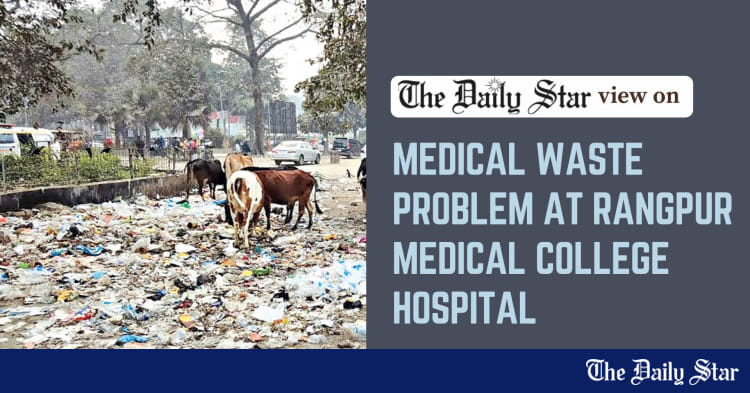
Hospitals need proper waste disposal
Resolve the crisis at Rangpur Medical College Hospital

1741046233474.webp

VISUAL: STAR

We are concerned about the medical waste problem at Rangpur Medical College Hospital where hazardous waste has been piling up inside the premises, posing health risks to both patients and visitors. According to a report by this daily, the planned construction of a waste management plant at the hospital has remained suspended for over five months due to protests from locals.

Locals are apparently worried that the plant's location, near the district's Bangladesh Medical Association building and adjacent residential areas, would cause odour pollution and pose health risks. They also allege that the plant does not have a location clearance certificate from the Department of Environment. Meanwhile, approximately 1.5 tonnes of waste, including 300 kilogrammes of hazardous waste generated daily by the hospital, are not being disposed of properly, which can have serious consequences.

Unfortunately, the situation at Rangpur Medical College Hospital is not an isolated one. Around 83 percent of hospitals in our country do not have a waste management system, according to a 2022 study by the Transparency International Bangladesh (TIB). The study also found that around 60 percent of hospitals do not have bins to store medical waste, let alone ensure basic segregation among reusable, recyclable, and non-recyclable waste—with hazardous medical waste being mixed with solid garbage in the bins that are available. In fact, at the Rangpur hospital, such waste is currently being dumped out in the open. Do the locals opposing the waste management plant not see the health risks of this uncontrolled dumping? A properly constructed waste management plant cannot pose more risks than the current situation.

Under these circumstances, hospital authorities must engage with locals, raise awareness with the help of experts if necessary, and ensure the plant's construction follows all due process. Meanwhile, all public hospitals in the country must take urgent action in line with the recommendations that came up in the TIB study. Simultaneously, the government must enforce the Medical Waste Management and Processing Rules 2008, penalising any non-compliance. The authorities also must ensure proper hygiene and cleanliness in public hospitals so that people do not fall sicker while undergoing treatment because of hospital-acquired infections.​
 
Analyze

Analyze Post

Add your ideas here:
Highlight Cite Respond
  • Sad (0)
Reactions: Bilal9

Members Online

Latest Posts

Back
 
G
O
 
H
O
M
E