Bangladesh Defense
Saif
Senior Member
- Jan 24, 2024
- 21,615
- 9,794
- Nation

- Residence
- Axis Group


BUET designs 32-bit processor using only open-source tech
A team at the Bangladesh University of Engineering and Technology (BUET) has designed a 32-bit computer processor using entirely open-source technologies.
BUET designs 32-bit processor using only open-source tech
Md. Zahidur Rabbi
Photos: Courtesy
A team at the Bangladesh University of Engineering and Technology (BUET) has designed a 32-bit computer processor using entirely open-source technologies.
The processor is based on RISC-V, an open-source instruction set architecture that has gained international attention in recent years as an alternative to proprietary chip architectures. Because anyone can use and build on the RISC-V standard without paying licensing fees, it has been adopted by universities, startups, and technology companies for research and commercial applications.
According to Professor A. B. M. Harun-Ur-Rashid of BUET's Department of Electrical and Electronic Engineering, the processor was developed by two undergraduate students, Md. Khalid Hossain and Sheikh Tariful Islam.
Professor Harun said the SoC (System on Chip), a microchip which combines all essential components to operate a computing device, was designed, verified, and prepared for manufacturing using only free and open-source Electronic Design Automation (EDA) software. Such software is used to design and test integrated circuits before they are manufactured. Commercial versions of these tools are often expensive, making them difficult for many universities and researchers to access.
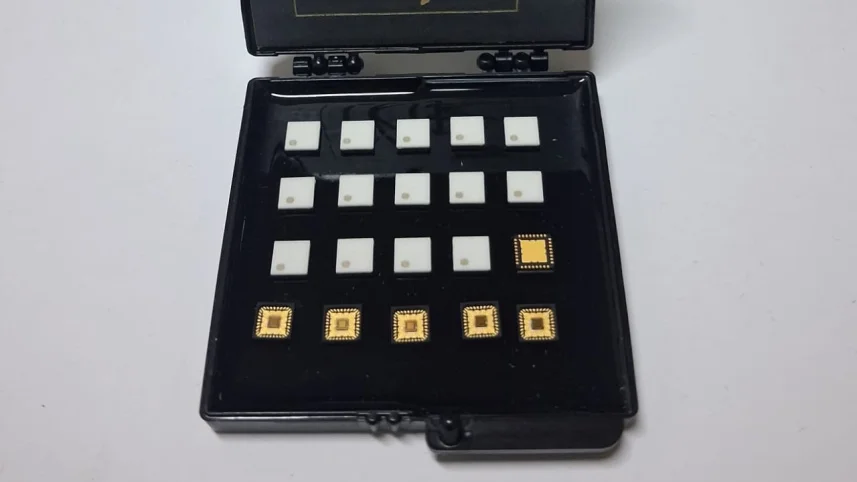
The chip was manufactured by IHP - Leibniz Institute for High Performance Microelectronics, a German government research institute, which fabricated it free of charge in support of the project's goal of creating a fully open-source hardware design. The fabricated chip has now arrived at BUET after completing customs and import procedures, Professor Harun said.
“The whole process took about a year to complete with around 4 months to complete the fabrication,” said Professor Harun.
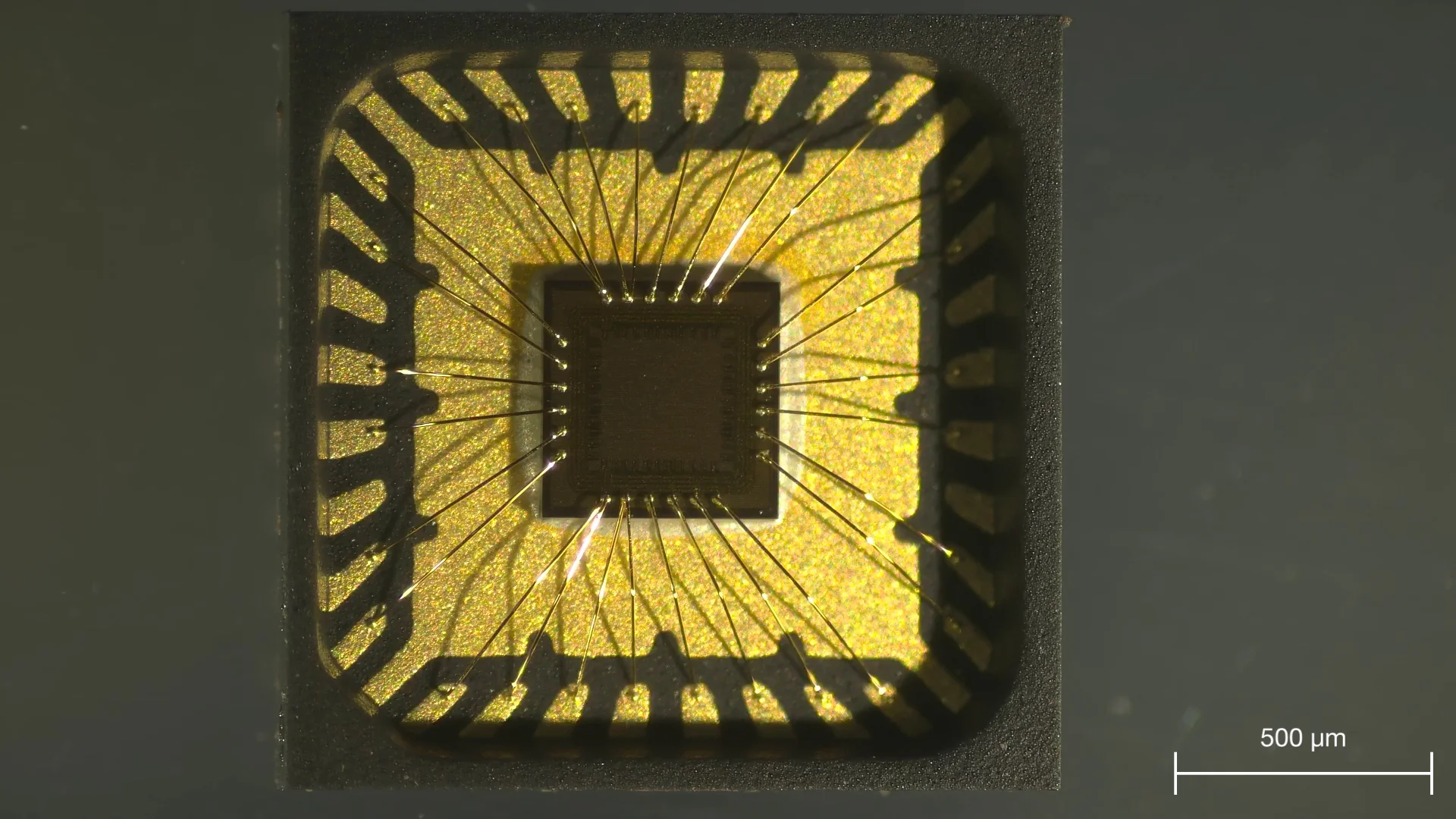
Semiconductor core connected with packaging in gold wire bond
The processor will now undergo testing with technical support from iTest Bangladesh Limited, using the facilities of iTEST, Inc. in San Jose, California. Successful testing is an important step before any chip can be considered for practical applications.
Md. Khalid Hossain, one of the students behind this project said, “We were inspired to make this chip from an air conditioner. We hope to integrate the processor into consumer electronic products manufactured by Bangladeshi companies. That remains a long-term objective, with testing and further development still ahead. Testing will take around 3 months before application.”
The project also received technical support from Neural Semiconductor Limited (NSL), a Bangladesh-based semiconductor company, which provided research fellowships for the undergraduate students involved. From NSL, AKM Uday Hasan Bhuiyan and ABM Tafsirul Islam were involved in the project.
The project comes at a time when countries around the world are investing heavily in semiconductor research amid growing demand for chips used in smartphones, computers, vehicles, and artificial intelligence systems. At the same time, open-source hardware initiatives such as RISC-V have expanded opportunities for universities and smaller research groups to participate in chip development without the high costs traditionally associated with the industry.
While Bangladesh does not have a large-scale semiconductor manufacturing industry, a few companies are working on semiconductor related designs.
Md. Zahidur Rabbi
Photos: Courtesy
A team at the Bangladesh University of Engineering and Technology (BUET) has designed a 32-bit computer processor using entirely open-source technologies.
The processor is based on RISC-V, an open-source instruction set architecture that has gained international attention in recent years as an alternative to proprietary chip architectures. Because anyone can use and build on the RISC-V standard without paying licensing fees, it has been adopted by universities, startups, and technology companies for research and commercial applications.
According to Professor A. B. M. Harun-Ur-Rashid of BUET's Department of Electrical and Electronic Engineering, the processor was developed by two undergraduate students, Md. Khalid Hossain and Sheikh Tariful Islam.
Professor Harun said the SoC (System on Chip), a microchip which combines all essential components to operate a computing device, was designed, verified, and prepared for manufacturing using only free and open-source Electronic Design Automation (EDA) software. Such software is used to design and test integrated circuits before they are manufactured. Commercial versions of these tools are often expensive, making them difficult for many universities and researchers to access.
The chip was manufactured by IHP - Leibniz Institute for High Performance Microelectronics, a German government research institute, which fabricated it free of charge in support of the project's goal of creating a fully open-source hardware design. The fabricated chip has now arrived at BUET after completing customs and import procedures, Professor Harun said.
“The whole process took about a year to complete with around 4 months to complete the fabrication,” said Professor Harun.
Semiconductor core connected with packaging in gold wire bond
The processor will now undergo testing with technical support from iTest Bangladesh Limited, using the facilities of iTEST, Inc. in San Jose, California. Successful testing is an important step before any chip can be considered for practical applications.
Md. Khalid Hossain, one of the students behind this project said, “We were inspired to make this chip from an air conditioner. We hope to integrate the processor into consumer electronic products manufactured by Bangladeshi companies. That remains a long-term objective, with testing and further development still ahead. Testing will take around 3 months before application.”
The project also received technical support from Neural Semiconductor Limited (NSL), a Bangladesh-based semiconductor company, which provided research fellowships for the undergraduate students involved. From NSL, AKM Uday Hasan Bhuiyan and ABM Tafsirul Islam were involved in the project.
The project comes at a time when countries around the world are investing heavily in semiconductor research amid growing demand for chips used in smartphones, computers, vehicles, and artificial intelligence systems. At the same time, open-source hardware initiatives such as RISC-V have expanded opportunities for universities and smaller research groups to participate in chip development without the high costs traditionally associated with the industry.
While Bangladesh does not have a large-scale semiconductor manufacturing industry, a few companies are working on semiconductor related designs.