[🇧🇩] In Bangladesh, A Violent 'Student Revolution' is on بنگلہ دیش میں انقلاب

[🇧🇩] In Bangladesh, A Violent 'Student Revolution' is on بنگلہ دیش میں انقلاب
334
14K
More threads by Bilal9

G Bangladesh Defense
Status
Not open for further replies.

3 quota protest organisers 'picked up' from hospital
Say their families, hospital staffers

View attachment 7124
Nahid Islam, Asif Mahmud and Abu Baker Majumder. Photo: Courtesy/Prothom Alo

Nahid Islam, Asif Mahmud and Abu Baker Majumder, three key organisers of the Anti-discrimination Student Movement, were picked up today from a city hospital where Nahid and Asif were undergoing treatment, their family members and hospital staffers said.

A group of people in plainclothes went to the Gonoshasthaya Nagar Hospital in the capital's Dhanmondi at 3:30pm and forcibly took the three out to an undisclosed place. The discharge process was not completed, they said.

A medical officer, requesting anonymity, told The Daily Star, "Asif's health was not stable for discharge.

"The hospital staff and doctors requested them to reconsider picking them up, but they did not pay heed."

The families and hospital staffers pointed finger at the intelligence agencies. This newspaper, however, could not verify the allegation independently.

The plainclothes men picked up Nahid from his cabin on the sixth floor of the hospital. They then went to Asif's cabin on the second floor. They also picked up Baker while he was bringing food for Asif, said the families and hospital staffers.

They took away the mobile phones of Nahid, his sister Fatima Tasnim, Asif and Baker.

"They [plainclothes men] forcibly dragged the three out of the hospital rooms. Enquired about their identity, they refused to disclose who they are. They didn't even tell me where they were taking them. Asif and Nahid were visibly shaking," Fatima told The Daily Star.

She said her brother is not involved in any anti-government activities. "They are not affiliated with any political parties. We urge all to ensure our safety."

The plainclothes men left the hospital within about eight minutes, she said.

This is the second time the trio -- all students of Dhaka University -- have been picked up in just a week.

Nahid was picked up in the early hours of July 20 allegedly by law enforcers from a house in the capital's Sabujbagh. He alleged that he was tortured physically until he was unconscious. When he gained consciousness, he found himself under a bridge in Purbachal. He went to his home by a CNG-run auto rickshaw.

Both Asif and Bakar were picked up on July 19. The two wrote on Facebook that they were blindfolded and left in Hatirjheel and Dhanmondi areas of on July 24. Neither of them mentioned who took them.

Speaking to The Daily Star around 5:30pm, Fatima said that she came to know that she and Nahid's wife could be picked up.

Ever since Nahid and Asif were admitted to the hospital, law enforcers stayed there and even disconnected the Wi-Fi to prevent them from accessing internet, she alleged.

This newspaper tried to reach Faruk Hossain, deputy commissioner (media) of Dhaka Metropolitan Police, for comments around 7:30pm, but he did not pick up the phone.​

One day there will be exemplary punishment for the so-called "iron lady" and her goons.

You cannot unleash acts of terror on a population exercising its free rights to protest govt. policy and get away scot-free.

This has been flushed across all major media outlets in Bangladesh.


How can the rulers erase so much bloodstain?
1722123461073.webp

The government tried to contain the quota reform movement with a hardline and brutal approach, which raised casualties. FILE PHOTO: AMRAN HOSSAIN
As of Thursday, at least 156 people have died in six days' of violence, per the tally recorded by this daily. The exact number of deaths is unknown; there is no certainty if it will ever come to light. One state minister said, "If law enforcement agencies come under attack, they will return fire. It is only natural that there would be some casualties."

On July 16, we saw the cold-blooded killing of Abu Sayed, student of Begum Rokeya University in Rangpur and a coordinators of the quota reform movement, at the hands of police. A viral video of his final moments showed he was quite far from law enforcement. He posed no threat, yet the police member shot him. This does not match the government's narrative.

Within such a short period of time, an unprecedented level of bloodshed took place. This exceeded even the number of deaths during the nine years' of movement against Ershad's autocratic regime, the biggest movement in independent Bangladesh. That movement was violent too; it saw arson and vandalism, too.

Now, the main question is: why did the situation escalate last week, resulting in so many deaths and injuries?

The quota system had been abolished following the quota reform movement in 2018. During a press conference on July 14 this year, Prime Minister Sheikh Hasina said she had been "utterly dismayed" and had "abolished the quotas" at that time. A circular was issued accordingly. Challenging that circular, some freedom fighters' children filed a writ, responding to which the High Court annulled it on June 5 this year, effectively reinstating the quota system. The government appealed against this decision on July 6. Not relying on the government, students of public universities began their movement again, and it was completely peaceful. On July 9, two students filed a petition, which led to the court issuing a stay order against the earlier verdict. In spite of the stay order, protests continued. The Appellate Division set the hearing date for July 21. In the meantime, several ministers made comments about the movement, such as the protesters were not following the law, they are defying the constitution, the issue must be resolved through court, the government will not bypass the court, etc. Some of those comments were condescending towards the protesters. Still, they remained peaceful.

How, then, did the protest take such a violent turn?

On July 14, the protesters submitted a memorandum to the president, saying they would launch an all-out protest if their demands were not met within the next 24 hours.

During the press conference on the same day, the PM asked, "If the freedom fighters' grandchildren won't get quotas, should the grandchildren of Razakars [Pakistani collaborators] get quotas?"

In response, DU students brought out processions that night. They chanted loudly, "Who are you, who am I? Razakar, Razakar," which naturally caused an uproar. However, the students claim that the full version of the slogan was, "Who are you, who am I? Razakar, Razakar. Says who? Says who? Shoirachar, Shoirachar (autocrat)."

On July 15, AL General Secretary and Road Transport and Bridges Minister Obaidul Quader said Bangladesh Chhatra League (BCL) would give a "fitting reply" to the student protesters who had "labelled themselves as Razakars and showed arrogance." BCL President Saddam Hussain said, "BCL is prepared to tackle this (quota reform movement) through political means."

That afternoon, BCL launched its attack on the protesters.

On July 16, the protesters and BCL both called for a rally in front of DU's Raju Memorial at 12pm and 3pm, respectively. When the unarmed general students started gathering near Raju Memorial, BCL activists attacked them with metal rods, sticks, hockey sticks and guns. Many students were injured, and eventually, the protesters were dispersed.

At night, BCL members, aided by the police, searched for and found the protesters in DU, RU and JU's residential halls and beat them up. Many were driven out of the halls.

This provoked the protesters further. On July 17, the DU coordinators of the quota reform movement asked the students to gather at Shaheed Minar with sticks.

This is the first time that the protesters took up a weapon in this movement. The same situation arose in JU and RU. Police, along with armed BCL members, conducted waves of assaults against the protesters in all three campuses.

The protesters managed to put up a strong resistance as they were bigger as a group. By that night, the members and leaders—even the female ones—of BCL, a student organisation that is disconnected from the general students, were all driven out of the residential halls and the campuses of DU, JU and RU.

A major reason why a peaceful movement became violent is the attempt to quash it using BCL's muscle power and police-BGB's mindless shooting. BCL's "Helmet Bahini" indiscriminately used sticks and hockey sticks on the protesters. Who are the armed individuals, who were photographed along with the BCL men, assaulting the students? Are they BCL members? It is assumed that they may have been outsiders, whose machete attacks injured many students, which further enraged the protesters.

Police and BGB fired lethal and non-lethal bullets at the students, as evidenced by published videos and photos in newspapers. This is not the conventional way of dispersing a protest. It seems it was not the police or BGB's goal to fire shots in order to scare the protesters and disperse them; it seemed they meant to shoot at the protesters.

Throughout the protest, the government repeatedly mentioned a "third party." Some intelligence high-ups mentioned that certain elements had "infiltrated" the movement.

The quota reform movement was led by anti-discrimination students' movement. This apolitical movement gained popular support from the entire student community. Undoubtedly, certain members of Chhatra Dal, Shibir and leftists, along with BCL members also joined the cause. More than 50 BCL leaders resigned from their posts and aligned themselves with this movement. But the leadership and majority participation came from general students. Chhatra Dal and Shibir never came close to assuming the leadership.

Yet, the government tried to contain the movement with a hardline and brutal approach, which raised casualties.

Why did AL leader Obaidul Quader, who is a former journalist and veteran politician with roots in student politics, want to use BCL to deal with such a widely supported movement? Now he can never escape the blame for what happened; his part in this mayhem will be revisited time and time again.

Even Law Minister Anisul Huq, who is an experienced lawyer, failed to show prudence. By the time he asked to sit with the students and announced intent to expedite the appeal hearing date, the situation had already spiralled out of control. Had the government sat with the students for a discussion beforehand, the situation could have unfolded differently.

This reminds me of Pablo Neruda's poem "I'm explaining a few things":

Come and see the blood in the streets.
Come and see
the blood in the streets.
Come and see the blood
in the streets!

Since independence, we have not seen so much blood being spilt during a movement. On whose hands is this blood? Can the rulers answer this question?

Translated from Bangla by Mohammed Ishtiaque Khan.

Golam Mortoza is the editor of The Daily Star Bangla.​
 

Bangladeshi students in US hold human chain in solidarity with quota reform protesters
FE ONLINE DESK
Published :
Jul 18, 2024 17:45
Updated :
Jul 18, 2024 17:45
1722126287910.webp


Bangladeshi students studying at different universities in the United States have organised a human chain to protest the attacks on the students advocating for quota reform across Bangladesh. The demonstration took place at 7:00 pm local time on Tuesday (July 16), in front of Michigan State University's Skandalaris Football Center.

The event was organised by the Bangladesh Student Association (BSU), a group of Bangladeshi students at Michigan State University, according to a press release issued by the organisation's President Mosaddek Syed.

1722126320712.webp


Bangladeshi students from various US universities joined the human chain, displaying placards with their demands and carrying the national flag.

They called for logical reform of the quota system in Bangladesh and a fair investigation and prosecution of the attacks on protesting students.​
 

They are on verge of losing their eyesight
Published: 27 Jul 2024, 16: 20

1722126538192.webp

Nafis Ahsan was shot in the body and eyes on his way to office. The photo was taken after he was treated at a hospital Collected

Nafis Ahsan, 30, was going to office in Mohakhali from his house in the capital's Rampura through Merul Badda on 18 July. He usually takes a rickshaw, but was walking to his workplace that day as there was no rickshaw available in the area due to the severe clashes between the police and the quota protesters.

Even before realising anything, Nasif was shot in the body and eyes with pellets. Although the pellets have been removed from his body, he is yet to regain his sight.

This correspondent spoke to Nafis over the phone. He told Prothom Alo, "I will probably never regain my sight."

Nafis works at the Mohakhali branch of a private bank. He lives in the Natun Rasta area in West Hazipara in Rampura. Nafis was hit with 22 pellets in his chest, forehead and hands and two in his eyes. He sustained a critical injury in his left eye.

Nafis was taken to the Lions Eye Institute and General Hospital in the capital's Agargaon after sustaining the injuries. Nafis' uncle works as a physician there. He and another specialist conducted an eye surgery on Nafis.

Speaking to Prothom Alo over the phone on Thursday, Shahidul Haque said, "He was brought to the hospital at around 12:00 pm. I checked him and consulted with two senior physicians. By that time, we had his CT scan report. There were two pellets deep inside the eyeball of his left eye."

He further said, "He (Nafis) is almost blind in his left eye. He doesn't have any vision in his left eye."

Abdur Rahim, executive official at the administrative section of Lions Eye Institute & General Hospital, told Prothom Alo that more 150 persons went there for treatment in the three days from 18 July to 20 July. In addition to eye injuries, many of them had injuries on other parts of their body.

According to the hospital authority, among the patients admitted to the hospital in those three days, around 50 had major or minor injuries in their eyes and 20 of them had to undergo surgery, including 11 major surgeries. Four of those who underwent surgery are likely to not regain their eye-sight ever. Nafis is one of them. The three other patients are Faisal Ahmed, Rafiqul Islam and Mehedi Hasan.

Faisal Ahmed has just completed his HSC from the Nirjhar Cantonment Public School and College in Mirpur. His admission to Jagannath University is underway.

Faisal was shot in his eye at around 5:30 pm on 18 July. He was demonstrating with other protesters in the area between Mirpur-10 and Mirpur-2.

Faisal told Prothom Alo over the phone, "The situation was escalating at the Mirpur-10 roundabout. The foot over bridge there was set on fire. Police were firing tear shells and rubber bullets from the Mirpur-2 end. We too were proceeding towards Mirpur-2. I didn't even realise that I was shot in my eye."

He was shot in his right eye, "I can no longer see things clearly anymore. It is almost like seeing nothing. The physicians are saying there is almost no possibility of regaining vision this eye."

Bangladesh Lion Foundation chairman AKM Rezaul Haque told Prothom Alo they had conducted surgery on nearly 20 patients. Some of them have completely lost their sight. However, the physicians are trying hard for their full recovery.

*This report appeared on the print and online versions of Prothom Alo and has been rewritten in English by Ashish Basu​
 

Cases after violence: Over 2 lakh accused in Dhaka city
1722208279620.webp

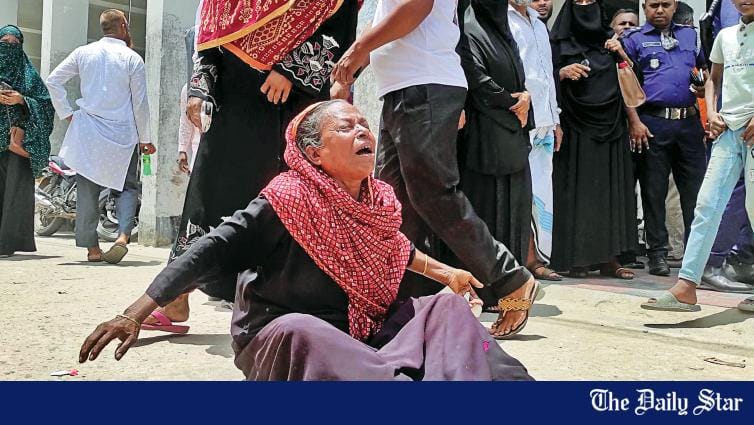
Jhunu Begum, 65, wailing in front of a Narayanganj court moments after her grandson, 19-year-old mason Arif Hossain, was taken away in a prison van. Jhunu was pleading to the police that her grandson was innocent and that he was not involved in politics. Arif was picked up from his Parameshwardi home in Narayanganj on July 23 following the recent violence. Photo: Saurav Hossain Siam

Over 2.13 lakh people, most of them unnamed, are accused in around 200 cases filed with police stations in the capital over the recent violence centring the quota reform movement.

Almost all the cases were filed by police, and in at least 16 of them, between 5,000 and 10,000 people have been accused, records show.

Law enforcers have arrested over 2,500 people, including political leaders, activists and students, in the last 12 days in different parts of the city, according to the court documents.

However, the actual numbers of cases and arrests could be much higher and are likely to rise further as law enforcers continue to raid different neighbourhoods in the capital.

The country witnessed violence on an unprecedented scale over the last week. The peaceful demonstrations turned deadly on July 15 when Chhatra League attacked the protesting students on different university campuses.

In the following days, violence escalated in Dhaka and elsewhere, leaving at least 162 dead as per The Daily Star data. However, the death toll from the violence between agitators, law enforcers, Border Guard Bangladesh members, and ruling party activists, could be much higher as this newspaper could not reach many hospitals, where dozens of critically injured patients were taken.

Also, many families reportedly took the bodies of their loved ones from the scene, and this newspaper could not contact those families.

The Daily Star's count of the victims is based solely on hospital and police sources.

According to Prothom Alo, at least 210 people were confirmed dead as of yesterday.

The government is trying to bring the situation under its control by imposing night-time curfews, deploying army across the country, and carrying out raids.

Meanwhile, rights activists, family members of those arrested or injured, and political parties are decrying law enforcers' high-handedness and misuse of power. The government maintains that the cases are based on specific evidence.

CASES FILED IN CAPITAL

Dhaka Metropolitan Police filed 229 cases with 50 police stations as of yesterday.

This newspaper has so far been able to get documents related to 178 cases filed since July 17. The number of accused in these cases is 2,13,834. Of them, only 1,310 were named.

It is not known how many people are accused in the remaining 51 cases.

The unnamed accused leaves room for the law enforcers to arrest anyone they want.

Police had not mentioned any name or number of accused in 60 cases, and in at least two, 10,000 unnamed people were accused.

One of the two cases was filed with Badda Police Station on July 18 over violence near Brac University in Merul Badda area.

The other one was filed with Lalbagh Police Station on July 21 over violence in Azimpur. The accused are unnamed BNP-Jamaat activists.

The Metro rail authorities filed a case against 9,000 unnamed people in connection with vandalism at Mirpur-10 metro station on July 19.

Another case was filed against 8,000, two cases against 7,000, seven against 6,000, and three against 5,000.

Most of the accused face charges of gathering illegally, rioting, assaulting law enforcers, and damaging properties.

ARRESTS IN DHAKA

Police produced 2,506, including 98 yesterday, before the Chief Metropolitan Magistrate's Court in at least 158 cases between July 17 and July 28.

In 15 cases filed with Jatrabari Police Station, 335 people were arrested. The area saw continuous violence for almost a week starting on July 17.

Mirpur police arrested 168 people under 10 cases while Uttara (east) arrested 164 under 10 cases, Paltan police arrested 145 under eight cases, and Badda police arrested 130 people under four cases.

Mirpur, Uttara, Badda and Paltan areas too witnessed fierce clashes.

Five cases were filed over killing policemen, a student and a police informant. One was filed under Cyber Security Act.​
 
Status
Not open for further replies.

PKDefense Forums: Country-by-Country Military Discussions

Log In Register Forums
Videos
Back