Home Login Watch Videos Wars Movies

[🇧🇩] In Bangladesh, A Violent 'Student Revolution' is on بنگلہ دیش میں انقلاب

[🇧🇩] In Bangladesh, A Violent 'Student Revolution' is on بنگلہ دیش میں انقلاب
334
10K
More threads by Bilal9

G Bangladesh Defense
Status
Not open for further replies.

Remarks of prime minister that are unbecoming, unacceptable
16 July, 2024, 00:00

THE prime minister Sheikh Hasina's remarks of July 14 at the press conference on the outcome of her visits to India and China about the ongoing movement for quota reforms in the recruitment of public servants and the movement of teachers of 35 public universities demanding the cancellation of the universal pension scheme Pratyay for them are provocative and illegal and, therefore, unacceptable. Referring to quota for the grandchildren of freedom fighters, she has asked whether the grandchildren of razakars — the term that is used to mean the people who collaborated with the killer Pakistani junta during the liberation war in 1971 — would get public service jobs instead. By implication, she has referred to the protesters and the sections in society that sympathise with or support the movement as razakars. This is unacceptable. She has said that the executive has nothing to do with reforms in the quota system and the issue would be resolved in court. But the High Court in its full verdict on July 14 said that the government could frame rules and guidelines to ensure the participation of backward sections of the citizens in public service recruitment as it did in the short verdict on July 11, stating that the government is at liberty to change, reduce or increase the ratio or percentage of quota.

The prime minister's remark about the teachers of public universities now on work abstention demanding their exclusion from the universal pension scheme also appears unbecoming. Noting that the teachers are confused about the pension scheme, which she had already notified the teachers about, the prime minister has said that she would say something after the teachers felt tired of continuing with the movement. If the demand is legitimate, why would the teachers need to wait for a decision until they felt tired of the movement? The remark is insensitive and demeaning for the teachers. This is, therefore, again unacceptable. The prime minister has also said that the criticism of her visits to India and China is reflective of 'mental illness' of the critics. This constitutes intolerance of genuine criticism. The plan to allow India to transport goods from West Bengal to Assam through Bangladesh is nothing short of granting a corridor, which many believe might create national security problems for Bangladesh, in the name of connectivity or transit. Criticism about the proposition is, rather, genuine patriotic concern on part of thinking Bangladeshis. The prime minister's terming such concern to have resulted from mental illness is, therefore, unacceptable again. The prime minister's visit to China appears to have been unsuccessful as Beijing has agreed to grant $137 million in economic aid, included in the $2 billion in grants and loans all, against government expectations of $5 billion. The criticism of the tours is, therefore, non unjustified.

Finally, talking about measures against corruption, the prime minister at the press conference has publicly admitted that an attendant at her house made a fortune of Tk 4 billion and he travelled by helicopter. She has seized his card and other documents when she came to know of the matter. While the incident is a clear example of the abuse of power in making illegal wealth, his dismissal from the job is nothing short of letting him get off scot-free. This is no example of zero tolerance for corruption. There should have, rather, been a criminal investigation against him for corruption.

While the government is, therefore, expected to resolve the legitimate issues of quota protesters and public university teachers with no further delay, it must also not give a corridor to India for goods transport through Bangladesh and show the will to end corruption with an iron fist.​
 
Analyze

Analyze Post

Add your ideas here:
Highlight Cite Fact Check
  • Love (+3)
Reactions: Bilal9

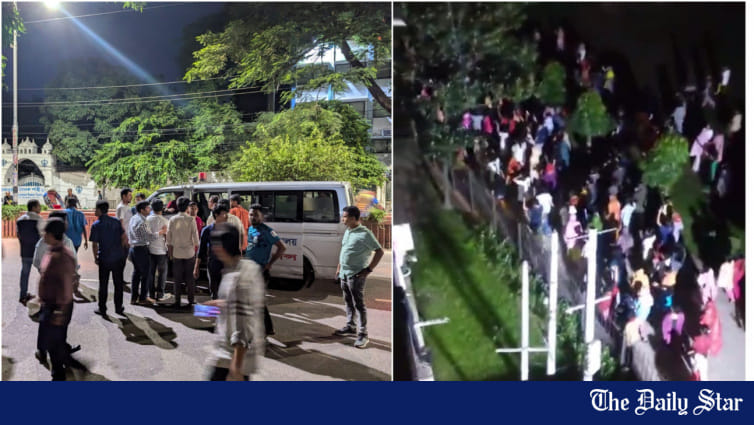
Protesters drive out female BCL leaders from DU Ruqayyah Hall

1721172144790.webp

Photos: Star
Agitating students of Begum Ruqayyah Hall of Dhaka University have surrounded the room of female leaders of Chhatra League and allegedly beat them up.

The incident took place around 11:00pm last night, reports our DU correspondent.

On the condition of anonymity, a student of Ruqayyah Hall told The Daily Star that 11 BCL leaders were chased, beaten, and driven out of the hall.

They ran and took refuge in the provost's bungalow.

Around 12:00am, an ambulance ferried them from the premises.

Dhaka University Professor Dr M Maksudur Rahman said, "Eleven students were evacuated from Ruqqayah Hall by ambulance."

However, Dhaka Medical College Hospital sources said none of the students were brought to the DMCH.

Contacted, Ruqayyah Hall Provost Nilufar Parvin said, "I won't comment at the moment." Saying this, he hung up the phone.

In a video sent by a student from Ruqayyah Hall, it was seen that the general students drove out Hall BCL President Pritha and Secretary Atika out of the halls.​
 
Analyze

Analyze Post

Add your ideas here:
Highlight Cite Fact Check
  • Like (+1)
Reactions: Bilal9

Govt is totally mishandling the quota issue
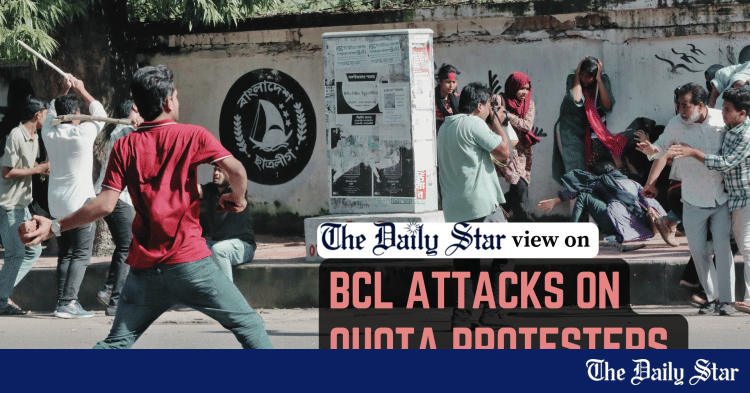
We condemn the violent attacks on students
1721172384193.webp

VISUAL: STAR

We are alarmed by the flaring up of violence in various universities, especially Dhaka University, following nationwide protests demanding quota reforms in government jobs. The prime minister, in a press conference on Sunday, had said that as long as the protesters remained peaceful, they could continue their demonstration. But then, in clear contrast to her statement and quite shockingly, if we may add, Awami League General Secretary Obaidul Quader said that Chhatra League would give the student protesters "a fitting response", which was a clear call for violence, examples of which we have seen before.

Initially, the government handled the protests with relative maturity. However, in recent days, we heard several government ministers indicating that it was preparing to handle the protests with a much heavier hand. Following the prime minister's press conference, hundreds of university students came out at night to protest what they said was a "disparaging comment" aimed at them. And as they continued their protests during the day, Chhatra League activists swooped upon them, beating the protesters indiscriminately with iron rods, sticks, and other weapons, leaving nearly 100 students injured. We strongly condemn such violence. The question naturally arises as to why the AL secretary general would want to quash citizens' grievances instead of resolving them through a constructive dialogue, or why he would call up Chhatra League to deal with a law enforcement issue, and not the police.

The quota issue is a complex matter—with quotas existing in many countries to help underprivileged groups. But what started off as that has been labelled as a matter between "pro-liberation" vs "anti-liberation" forces—which is unfortunate and completely unnecessary. It is a perfect case of an important issue being totally mishandled. Here, it is important to mention that the government could have avoided the recent developments by listening to the legitimate demands to reform the quota system back in 2018, instead of doing away with all quotas, as it did. Back then, the government failed to recognise the genuine concerns of the young people, and that is what has brought us to this debacle now. What's equally unfortunate is that similar to the time of the 2018 movement, Chhatra League has once again been used to unleash merciless beatings on students, whose concerns are being thrown out the window with disdain.

It is essential for the government to not repeat the same mistakes it had made during the 2018 quota movement. The High Court, in a portion of its judgement on the quota system, said that the government can change, reduce or increase the ratio or percentage of the quotas in public jobs if it feels it necessary to do so. As such, it should immediately sit with the protesters and, by involving experts and other stakeholders, reform the quota system in a way that is acceptable to all and in line with the purpose of giving quotas. Moreover, the ruling party must reign in BCL activists, instead of using them as a mercenary force against the students.​
 
Analyze

Analyze Post

Add your ideas here:
Highlight Cite Fact Check
  • Love (+3)
Reactions: Bilal9

A slogan lost in translation

1721173284853.webp

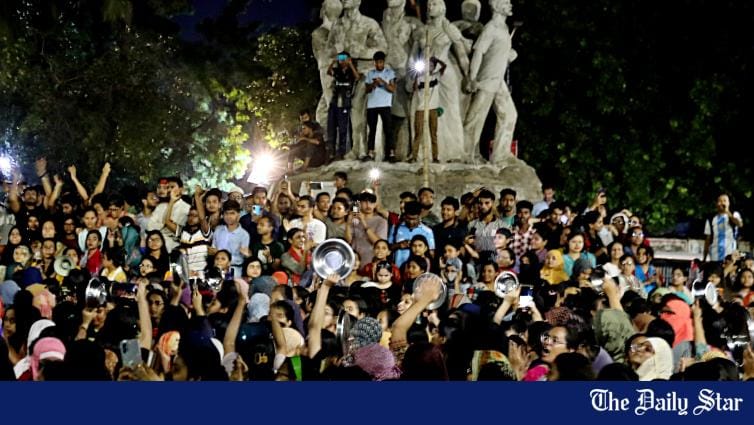
What made students flood the streets on Sunday night was a specific comment that touched a nerve. Photo: Anisur Rahman

The course of the ongoing quota reform protests has taken a drastic turn over the last two days. On Tuesday, at least six individuals, mostly students, died during clashes between protesters and members of Bangladesh Chhatra League and the police—marking a further escalation from the previous day's events. Few would have imagined this scenario when students gathered in Dhaka University and other campuses on Sunday night.

For over two weeks prior to this, they had been boycotting classes and exams, and blockading key intersections in Dhaka and major highways in different places of the country with the demand to reform the quota system in civil service recruitment. But what made them flood campus streets on that night was a specific comment that touched a nerve for the wider student community. On Sunday, in response to a journalist's question during a press conference, Prime Minister Sheikh Hasina said, "Why do they [anti-quota protesters] have so much resentment towards the freedom fighters? If the grandchildren of the freedom fighters don't get quota benefits, should the grandchildren of Razakars get the benefit?"

This questionable dichotomy is what lit the fuse, leading to students exploding in protest with renewed vigour. And among all the slogans heard across the DU campus that night, the one that seems to have had the most intense impact is the one that goes: "Tui ke? Ami ke? Razakar, Razakar!" (Who are you? Who am I? Razakar, Razakar!) There have been other, more explanatory variations of the slogan, but for whatever reason, those didn't get much coverage. The question is, what made these students—otherwise proud citizens of an independent Bangladesh, and carrying the legacy of our independence struggle—utter such incendiary slogans?

Grievances over the preferential quota system are nothing new; in fact, the way the protests have panned out this time are starkly reminiscent of what happened during the 2018 quota reform movement. Protests began at Shahbagh then as they did now, before spreading across the country. In 2018, like this time around, a senior member of the ruling party remarked in parliament, "Will the children and successors of those who risked their lives to fight for independence not get an opportunity? Will the children of Razakars get the chance? Will the quota for the freedom fighters be shrunk for them?"

Six years ago, students protested this particular line of reasoning—as they did on Sunday night. And the reaction to it on both occasions was nothing short of extraordinary. That said, it is totally unfortunate that in a movement that concerns the wellbeing of general students in modern-day Bangladesh, the word "Razakar" has occupied so much of the conversation. On principle, we must say we are against any identification—however unintended—with this term. Students, having been familiarised with the history of our nation from a young age, should have known better than to use something that only invokes the hateful memories of the atrocities committed by Razakars in 1971.

But students say the slogan was lost in translation. Their use of the term, they say, was sarcastic and heavy with context. Take away that context, and you have a totally different connotation. And this is what is happening at the moment. Unfortunately, despite the clarification from students, there has been little hint of reciprocation from those protesting the use of the word Razakar. Clearly, a mismatch exists between the protesting students and the powers that be. But what was stopping Bangladesh Chhatra League, a student party made up of students, from trying to understand the feelings of pain and anguish that led to such utterances? Why, instead of trying to impress upon them the inappropriateness of their slogan or supporting their just cause for quota reforms, did Chhatra League unleash violence on them?

After Sunday night, we have seen the ministers of road transport and bridges, education, and social welfare, and state ministers for ICT and information all come out with hardened words against the protesters. None of them seemed to have noticed that the protesters themselves offered further explanation of their mood by chanting, "Chaite gelam odhikar, hoye gelam Razakar." (Demanded rights, only to become Razakar.) Instead of trying to engage with the students and bridge any gap in communication, the Awami League general secretary has instead called on BCL to provide a "fitting reply".

We have seen the destructive nature of that reply over the past two days. Such violence and brutal attacks over a naive use of an objectionable slogan are hard to accept. We must remember that these students would never support anti-liberation ideals. Attempts could have been made to clear any confusion through amicable means. That would have been a much wiser way to deal with these realities instead of the violence that has ensued since.​
 
Analyze

Analyze Post

Add your ideas here:
Highlight Cite Fact Check
  • Love (+3)
Reactions: Bilal9
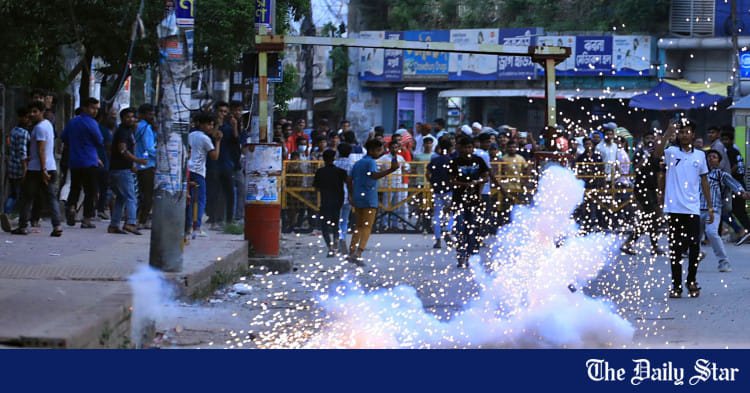
US monitoring student protests in Bangladesh; condemns violence against peaceful protesters


1721173525550.webp

The US said yesterday that it was monitoring reports of widespread student protests and attacks on students in Dhaka and across Bangladesh.

During a press briefing at the State Department in Washington, Spokesperson Matthew Miller was asked about thousands of students demanding reforms to the quota system in government job and the ensuing attack yesterday by Chhatra League that left "around 500 students" injured.

"So, we are aware of and are monitoring reports of widespread student protests in Dhaka and around Bangladesh that have killed two and attacked and injured hundreds," Miller said.

However, there have so far been no reports of anyone being killed in the violence.

"The freedom of expression and peaceful assembly are essential building blocks of any thriving democracy, and we condemn any violence against peaceful protesters. Our thoughts are with those who have been impacted by this violence."

The foreign ministry this morning released a press note informing of a briefing at the ministry at 1:00pm today to respond to the US State Department's comments on the government job quota issue.​
 
Analyze

Analyze Post

Add your ideas here:
Highlight Cite Fact Check
  • Like (+1)
Reactions: Bilal9
Status
Not open for further replies.

Members Online

No members online now.

Latest Posts

Back
PKDefense
G
O
 
H
O
M
E