New Tweets

[🇧🇩] Independence Day

G Bangladesh Defense
[🇧🇩] Independence Day
6
19
More threads by Saif

Saif

Senior Member
Messages
17,906
Likes
8,530
Nation

Residence

Axis Group

Declaration of independence by Zia united nation in 1971: president
Bangladesh Sangbad Sangstha . Dhaka 24 March, 2026, 23:53

1774401214402.webp

Mohammed Shahabuddin.

President Mohammed Shahabuddin on Tuesday said that the declaration of independence by the then Major Ziaur Rahman during the Liberation War helped unite a confused and hesitant nation, inspiring people to join the struggle for freedom.

He called upon all, irrespective of religions, caste, party or opinion to work together being imbued by patriotism to fulfil the spirit and expectations of the martyrs of the Liberation War.

‘The hope, aspiration and dream of the martyrs in the Liberation War was to build a humane, democratic and real state - where there will be no discrimination, deprivation, misrule, corruption and injustice,’ he said.

In a message on the occasion of the ‘Genocide Day’ to be observed on Wednesday, the head of the state gratefully remembered all the martyrs of the motherland, including March 25, and prayed for the eternal peace of their departed souls.Geographic Reference

The president said the March 25 is the most brutal and painful chapter in our national life as the entire nation was speechless and stunned by this genocide.

On the night of this day in 1971, he said the Pakistani occupation forces carried out indiscriminate massacres on unarmed and sleeping freedom-loving countrymen in the name of ‘Operation Search Light’.

In the middle of the night, numerous members of the Rajarbagh Police Lines and the then EPR, students, teachers, intellectuals, workers, and countless innocent people in various parts of the country, including Dhaka University, were brutally murdered, he mentioned.

Shahabuddin said during this time, on the night of March 25, the East Bengal Regiment in Chittagong formally revolted and resisted the genocide. Immediately after this, the declaration of independence by the then Major Zia from the Kalurghat radio station united the confused and hesitant entire nation, made it braver than ever, and inspired it to jump into armed struggle and sacrifice life.

‘The younger generation should clearly know about this cruel barbarity of history, on the other hand, about our glorious story and heroism as a nation,’ the head of state said.

The president said after many years, the much-desired right to vote has been re-established through a free, fair and acceptable election.

Noting that a democratic government has been established by popular vote, he said the present government has started taking various programs and steps to build a non-discriminatory, democratic, humane and self-reliant Bangladesh.​
 
Analyze

Analyze Post

Add your ideas here:
Highlight Cite Respond

Let spirit of Independence Day be guiding principle

FE
Published :
Mar 26, 2026 00:10
Updated :
Mar 26, 2026 00:10

1774484128503.webp


This year the nation observes its Independence Day against the backdrop of an insane war away from this country's shore in the Middle East. As the shockwaves of the Israeli-American war reverberates all across the world primarily because of the energy crisis made acuter by the near closure of the supply route of oil and gas, an energy import-dependent country like Bangladesh now feels the heat. Apart from this dire economic reality, the humanitarian crisis needlessly created by the US-Israel duo finds its echo in the genocide committed in Bangladesh by the Pakistani brutal army in 1971. If the Black Night of March 25, 1971 is considered the birth pang of this land, the day of deliverance allows the nation to feel empathy for nations under attacks anywhere in the world. Subjugation or capitulation of a nation in the new millennium is unthinkable and history is witness to the ultimate triumph of a people longing for its liberation.

Bangladesh and Vietnam are the best examples of how the aggressors are destined to get defeated. Both these countries made immense sacrifices before earning their liberty from foreign yoke. Bangladesh was lucky to defeat the enemy in just nine months' war, thanks to active support from India---the country that had to feed and shelter around 10 million refugees from its war-torn neighbour. Observance of the March 26 as the country's Independence Day, therefore, is more a grim reminder of savagery the Pakistani army unleashed on a peace-loving people than a joyous celebration of a red-letter day. It was the beginning of a struggle to defend an unarmed people against a brutal army dead set on following a scorched-earth policy in the occupied territory of Bangladesh. The Pakistani army was also instructed to kill students, teachers and intellectuals including eminent Bangalees under a plan of creating a vacuum of leadership and intellectual stewardship.

A nation that had such a fiery baptism 55 years ago always needs not only to relive the tragic memory but also be respectful to the sacrifice made by freedom fighters and girls and women then subjected to sexual violence. This land was sanctified by those valiant sons and daughters but the undying spirit has been undermined by people in power and the privileged in society. Coups, counter-coups and abuse of power leading to political uncertainties have not helped the country realise the dreams of the martyrs. Democracy and social and economic justice did not have a chance to flourish. Sure enough, Bangladesh achieved some sterling success but at the cost of democratic values and equality.

It is a clear case of betrayal with the ideals and principles that went into the making of this nation. Responsible for this are not the common people of this land but the leaders who have led the country and the intellectuals who have guided them. That the nation has unbounded potential is unquestionable but misuse of power has not allowed its realisation at its maximum. Had the liberation spirit been the guiding force behind all development initiatives, the country would not fall in the hands of autocrats and oligarchs. With installation of every new administrative stewardship, the people have looked for better and prosperous days only to be disillusioned by derailment of the caravan. Here is once again a fresh beginning with the Bangladesh Nationalist Party (BNP) taking over power. Several reform commissions under the interim government have made crucial recommendations. Let's hope those recommendations are approved for the country's unhindered journey towards its desired goal.​
 
Analyze

Analyze Post

Add your ideas here:
Highlight Cite Respond

Misinformation surrounding 1971 genocide

Mokerrom Hossain
Published :
Mar 26, 2026 00:07
Updated :
Mar 26, 2026 00:07

1774484563164.webp


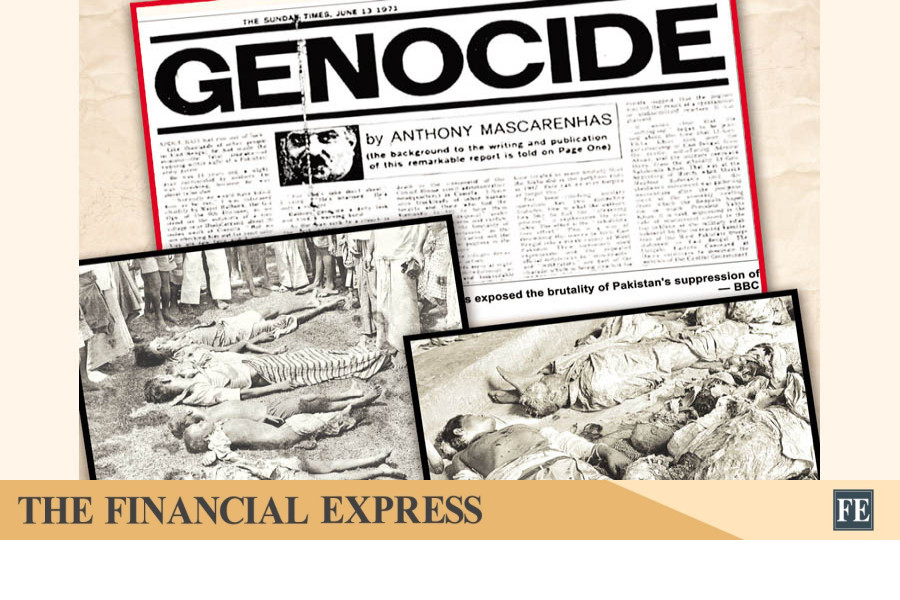
On June 13 1971, a piece by Anthony Mascarenhas in the UK's Sunday Times exposed the atrocities of Pakistani Army in Bangladesh

On March 25, 1971, the army occupation of East Pakistan turned into a genocide. On the late afternoon of March 25, the political confusion ended abruptly when the last President of united Pakistan, Yahya Khan, suddenly flew home to West Pakistan. Just prior to mid-night when the city was about to seek refuge from all the hustle and bustle of daily chores, the attack came. The Pakistani army indiscriminately attacked the Bengalis. The attack was orchestrated and carried out by the Eastern Command of Pakistan which was comprised of only one infantry division, i.e. 14 Division, with its Headquarters in Dhaka. Of the four brigades of 14 Division, the 57 Brigade was located in Dhaka, the 23 Brigade at Rangpur, the 107 Brigade at Jessore and the 53 Brigade was at Cumilla and Chttogram. This Eastern Command of Pakistan Army -- "which had brought up to strength of about 40,000 men scattered throughout East Bengal -- moved up against the 5,000 Bengali police with their headquarters at Rajarbagh in Dhaka. At the same time they attacked the detachments -- 1000 men -- of the East Pakistan Rifles at Pielkhana..." (Jackson, 1975: 33).

All over the country the attacks were carried out with precision as laid down in their "Operation Search Light." "[O]n 25 March when his green telephone rang at about 11 a.m., Lieutenant-General Tikka Khan, Chief of Eastern Command, was on the line. He said, 'Khadim [Major General Khadim Hussain Raja, the General Officer Commanding 14 Division in East Pakistan], it is tonight.' In addition, Lieutenant-General Tikka Khan and his staff were to spend the night at the Martial Law Headquarters in the Second Capital to watch the progress of action in and outside Dhaka" (Salik, 1997: 71). 'The Butcher Khan, like Nero, wanted to see how 'Rome was burnt'.

Prior to the final attack, the Pakistani command tried to either remove Bengali officers from commanding positions or disarm them and weaken the strength of the only existing Bengali regiment run by Bengali officers. During the third week of February 1971, there was a conference in Dhaka of all Brigade Commanders where decision was taken to deploy the four units of Bengali Regiments in different civil duties across the country.

Army tanks went in different directions to demolish different targets. One contingent rolled through the main street from airport to the city and attacked a newspaper office in front of the Radio Pakistan Dhaka office, and the same contingent took over the control of the radio station. Another went towards Dhaka University and attacked students' dorms. This attacked was actually video tapped by a professor of East Pakistan (Later Bangladesh) University of Engineering and Technology University, and the tape was smuggled out of the country as a first hand report of the massacre to the outside world. The area where the attacked took place in the student dorms, there were also selective break-ins at the faculty residences and a couple of professors were killed on that fearful night. Part of this attack was captured quite vividly by historian Wolpert: "US M-24 tanks led the Punjabi-Baluchi assault upon student dormitories on the campus of the University of Dacca. Iqbal and Jagnath halls were filled with sleeping students and faculty when the tanks opened fire and continued shooting at least five minutes. Soldiers crouched behind the tanks then charged into the shell-battered dorms with fixed bayonets and killed all persons still alive: students, professors, caretakers, and servants. Tikka Khan's troops were thorough."

The Pakistani military ruler had been preparing for this crack down if not for a long time, since March 1st, the day they postponed the meeting of newly elected National Assembly. Especially after March 7 when the whole population started its non-cooperation movement against the central rule following directions from Bangabandhu Sheikh Mujibur Rahman, the Pakistani ruler became very annoyed but could not blame Mujib for treason, as Mujib did not declare 'independence'. Since that date, the army was preparing the blue print to attack Bengalis.

Obviously, it was a fact that West Pakistani armies committed genocide in East Pakistan. People may try to ignore the veracity of the attack and downplay the atrocities committed by the members of Pakistani army and some of their stooges like the members of Al-Badr and Al Shamas, "two separate wings" of Razakar's organisation permitted to function by the central authority in August of 1971 at the local level by recruiting members from the disgruntled political party like Jamat-e-Islam and Muslim League. "Well- educated and properly motivated students from the schools and madrasas were put in Al-Badr Wing, where they were trained to undertake 'Specialized Operations', while the remainder were grouped together under Al-Shams, which was responsible for the protection of bridges, vital points, and other areas," Niazi wrote. However, Niazi did not elaborate on "Specialized Operations," but those who lived through the period were very much aware of the meaning of "Specialized Operations"-killing innocent Bengalis. One author writes, "Most recruits were drawn from the Urdu-speaking Bihari population. The Razakaras' state-sponsored terrorism completed the social, political and cultural divide between the Biharis and the Bengali majority." (Talbot, 1998: 209).

Currently, for political purposes, many may try to minimise the magnitude of the sufferings of ordinary people by siding with those who unlashed the atrocities, but in the core of their hearts, they knew the fateful night of March 25 in 1971, the historical day for all the Bengalis for time immemorial. One thing is certain that while the Pakistani Army targeted the Bengalis, no Urdu speaking people were attacked by the Pakistani Army. Rather, there were stories about how many Bengalis survived the initial attack by speaking Urdu loudly and gave the attacking army an impression that they were non-Bengalis by ethnicity. Pakistani army tried to diffuse the genocide issue by suggesting that the army was targeting "Bengali separatists," and was suggesting that they were not all Bengalis who favoured the creation of Bangladesh by separating from Pakistan. Even a foreigner opposed this view,"[W]e object to the use of term the "Bengali separatists" as being inaccurate and pejorative. The struggle in East Pakistan is between West Pakistan Armed Forces and non-Bengali civilians on one side and Bengalis on the other side," (Blood, 2002: 279) thus is called a "Selective Genocide."

Dr Mokerrom Hossain is a Professor at the Department of Sociology and Criminal Justice, Virginia State University, United States of America (USA). mhossain@vsu.edu. The piece is excerpted from the writer's book titled 'From Protest to Freedom: The Birth of Bangladesh.'​
 
Analyze

Analyze Post

Add your ideas here:
Highlight Cite Respond

Bangladesh celebrates 55th Independence Day with hope for ‘discrimination-free, equitable’ nation

bdnews24.com
Published :
Mar 26, 2026 00:44
Updated :
Mar 26, 2026 00:44

1774485107627.webp


Bangladesh is marking its 55th Independence and National Day, celebrating its liberation from Pakistani exploitation and oppression to hoist the red-and-green flag of sovereignty and honouring the sacrifices of 1971 martyrs.

This year’s celebrations come at a pivotal moment in the country’s political landscape.

Following 15 and a half years of Awami League rule and an 18-month tenure under an interim government, the nation is now under a new BNP-led administration.

The government has pivoted its focus toward building a "discrimination-free and equitable" society, moving slightly away from the previous trajectory of developing-nation milestones.

The anniversary is being observed amid concerns that the ongoing conflict in the Middle East could impact the domestic economy.

Despite these challenges, the country is adorned in red and green, with citizens prepared to honour the memory of the 1971 martyrs.

President Mohammed Shahabuddin, in a message to the nation, highlighted the importance of “strong national unity, compassion, and patriotism” in building a self-reliant, dynamic, and just Bangladesh.

“Long years of misrule, global economic pressures, and adverse fuel conditions have affected the nation,” he said. “The government is responding with utmost sincerity and skill to establish a fair and prosperous country.

“I urge all citizens, irrespective of party affiliation, to work together for a safe and industrious Bangladesh for present and future generations.”

Honouring those who gave their lives in the Liberation War, he added: “The extraordinary sacrifices of martyrs, including president Ziaur Rahman Bir Uttam, all freedom fighters, oppressed mothers and sisters, national leaders, organisers and citizens, inspire us to advance boldly towards an equal, justice-based, and democratic Bangladesh.”

He stressed that true independence requires ensuring equality, good governance, transparency, accountability, and empowerment for all layers of society.

Prime Minister Tarique Rahman, in his message, said Independence Day rejuvenates the spirit of courage and sacrifice.

"The main goal of independence was to establish a discrimination-free, democratic, peaceful, and prosperous Bangladesh," the head of government said.

He urged the public to draw inspiration from the significance of the day to accelerate the country's progress.

"Let us work collectively to build a developed, prosperous, and dignified Bangladesh," he added.

The Blood-Soaked Path To Freedom

The Pakistan Army launched a brutal genocide on the night of Mar 25, 1971, in a violent attempt to crush the Bengali movement for liberation.

This atrocity paved the way for a definitive resistance.

In the early hours of March 26, Bangabandhu Sheikh Mujibur Rahman declared Bangladesh an independent sovereign state.

Though Bangabandhu was subsequently arrested by Pakistani forces, the struggle for freedom commenced under his leadership.

Guided by the Mujibnagar Government, nine months of armed conflict led the Bengali nation to the shores of liberty, marking the emergence of Bangladesh on the world map.

The departure of the British in 1947 had not brought true freedom to the people of Bengal, whose lives remained shackled by Pakistani exploitation.

It was Sheikh Mujib -- affectionately titled “Bangabandhu” by his people -- who awakened the nation with the mantra of breaking those chains.

Following his historic speech on Mar 7, 1971, the Pakistan Army launched Operation Searchlight on Mar 25, turning Dhaka into a valley of death.

Despite fierce resistance at Rajarbagh Police Lines and the EPR Headquarters in Pilkhana, the defenders could not hold out long against heavy weaponry.

Machine guns, artillery fire, and arson triggered a hellish massacre across the city.

Amidst this savagery, Bangabandhu sent out a wireless message via the EPR declaring independence before his arrest.

International media quickly picked up the news of the resistance; on Mar 27, the BBC, citing reports from Kolkata, announced that Sheikh Mujibur Rahman had called upon the public to resist via a clandestine radio broadcast.

The ensuing nine-month struggle culminated in victory on Dec 16, 1971, earned at the cost of three million martyrs and the honour of countless women.

This immense sacrifice gave birth to the new state of Bangladesh.

This year, Independence Day arrives as the new BNP government, elected through the parliamentary polls, completes its first month in office.

The Awami League, which led the Liberation War but was ousted in the 2024 uprising, remains largely absent from active politics, and many of its leaders are off the ground.

In a shift from the previous administration -- which was accused of marginalising the contributions of Sector Commander Ziaur Rahman Bir Uttam -- the new political reality places him at the forefront.

Notably, the names of the independence leader Sheikh Mujibur Rahman were absent from the official messages issued by the president and the prime minister.

Parade Returns to Independence Day

The National Parade Ground is set to host a military parade this Independence Day, marking a significant return under the new BNP-led government.

The last time such a parade was held on Mar 26 was in 2008.

Throughout the Awami League's 15-and-a-half-year tenure, the traditional display of military prowess was shifted to Victory Day on Dec 16 instead.

Following the ousting of the Awami League government in the August 2024 mass uprising, the subsequent interim government oversaw one Independence Day and two Victory Days, though no parades were organised during that period.

The parade and a spectacular flypast are scheduled to begin at 9am on Thursday at the National Parade Square, located at the Old Tejgaon Airport.

Both President Shahabuddin and Tarique are expected to attend.

The Inter-Services Public Relations (ISPR) confirmed that all preparations are complete, following a final rehearsal of the parade and hardware display on Tuesday.

Nationwide Programmes

A comprehensive range of programmes has been organised across the country to observe Independence and National Day with "due solemnity".

The day will commence at dawn with a 31-gun salute in Dhaka and all district and Upazila headquarters.

The national flag will be hoisted atop all government, semi-government, autonomous, and private buildings at sunrise.

Large-scale flags will also be displayed at Bangladesh embassies abroad, city corporations, and prominent high-rise buildings in the capital.

The president and the prime minister will lead the nation in paying tribute by placing wreaths at the National Memorial in Savar.

They will be followed by families of the Bir Sreshthas, war-wounded veterans, and foreign diplomats.

Later, the president will host a reception at Bangabhaban for the families of the Bir Sreshthas and living gallantry award-winning freedom fighters.

At 8am, the national flag will be formally hoisted at all administrative levels, accompanied by the national anthem and displays by students from educational institutions.

Schools will also host essay, recitation, and art competitions focusing on the significance of the Liberation War.

In a unique display, ships from the Bangladesh Navy and Coast Guard will be open to the public from 9am until sunset at major ports and terminals, including Chattogram, Khulna, Mongla, Payra, Dhaka’s Sadarghat, Narayanganj, and Barishal.

Commemorating the occasion, Tarique inaugurated a Tk 10 commemorative postage stamp, alongside an opening cover and a special data card, on Tuesday.

Festivities will extend to the sporting arena with football matches, T20 cricket tournaments, and traditional games like Kabaddi and Ha-du-du at the local level.

State and private broadcasters will air special programmes on the history of the Liberation War, while cinemas and museums -- including children's amusement centres -- will remain open to the public free of charge.

Special prayers will be offered at mosques, temples, churches, and pagodas for the departed souls of martyrs and the nation's prosperity.

Improved diets and festive meals will be served in hospitals, jails, orphanages, and elderly care homes.

In a notable shift in the political landscape, the main opposition party, Jamaat-e-Islami, has announced a two-day programme.

This included a discussion at the National Press Club on Wednesday, with plans to hoist the national flag at their central office on Thursday.

Party Ameer Shafiqur Rahman is also scheduled to place a wreath at the National Memorial.

The day’s events will conclude with a grand cultural evening at Manik Mia Avenue at 7pm, featuring the Armed Forces orchestra and the band Warfaze.

The mountaineering group Abhijatri and the Liberation War Museum will also conduct the “Shoke Theke Shokti” (strength from grief) march, starting from the Central Shaheed Minar and ending with a formal oath at the National Memorial.​
 
Analyze

Analyze Post

Add your ideas here:
Highlight Cite Respond

March 26, 1971: emergence of a nation

Mohd Akhtaruzzaman

Published :
Mar 26, 2026 00:06
Updated :
Mar 26, 2026 00:06

1774485306841.webp

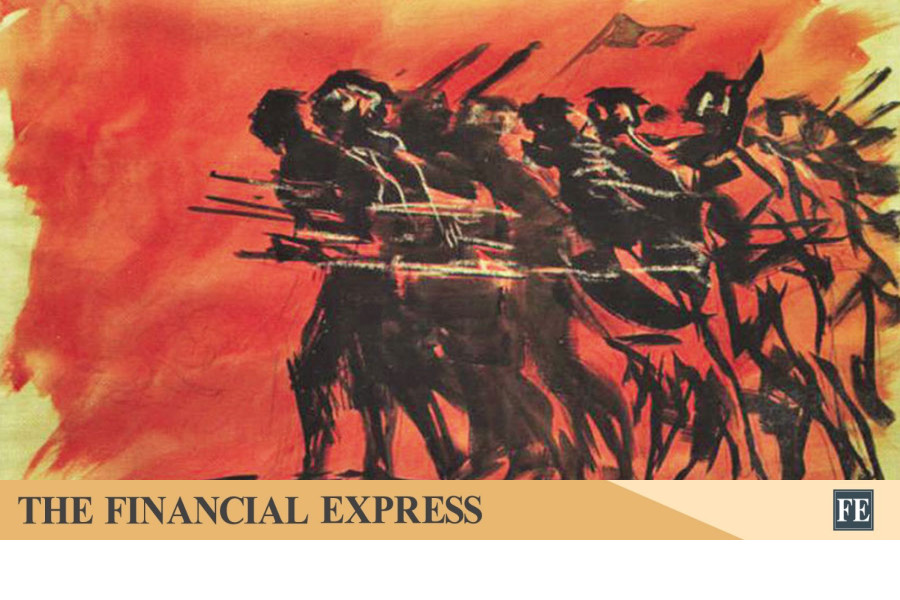
Bangladesh Liberation War, 1971: a painting by Zainul Abedin

Bangladesh did not suddenly appear in 1971. It was not created in a moment of crisis, nor born out of a single political decision. Rather, it emerged through a long and continuous historical process-shaped by geography, culture, power, resistance, and the enduring will of its people.

To understand Bangladesh, one must look beyond the immediate events of March 1971 and recognise a deeper truth: this was the culmination of a civilisational trajectory, not an accident of history.

Ancient Bengal existed as a distinct ecological and cultural space, defined by its riverine geography. The Ganges-Brahmaputra-Meghna basin provided fertile land that enabled early settlement and agricultural development. From around 4000-1500 BCE, Austroasiatic-speaking communities established the foundations of a structured society through agriculture, fishing, and river-based livelihoods. This early society, though shaped by nature, gradually evolved into an organised and adaptive human landscape.

Archaeological evidence from sites such as Wari-Bateshwar and Mahasthangarh reveals that Bengal was not an isolated agrarian region but part of an early network of urbanisation, trade, and exchange. These sites demonstrate the presence of planned settlements, commercial activity, and monetary systems-clear indicators of an integrated and outward-looking civilisation.

Placed within the broader global timeline, this development aligns with major shifts elsewhere.

Around 2000 BCE, during the era traditionally associated with Abraham (Hazrat Ibrahim in Islamic tradition), religious and social structures were taking shape in the Middle East, while agrarian civilisations were consolidating across South Asia. Bengal's early society evolved in parallel with these transformations, firmly embedded within the wider arc of human civilisation.

By the 4th century BCE, the Gangaridai state represented Bengal's first visible political consolidation. Greek historians such as Megasthenes and Diodorus described its formidable military strength, particularly its war elephants. This was not a peripheral region-it was a recognised power.

Under Chandragupta Maurya, Bengal became part of the Mauryan Empire, entering a centralised imperial structure for the first time. Emperor Ashoka (r. 268-232 BCE), following his conversion to Buddhism, advanced a model of governance rooted in ethics, tolerance, and moral responsibility. These ideas left a lasting imprint across the region.

The Gupta period (320-550 CE), often described as a "golden age," saw remarkable developments in science, literature, and the arts. Bengal participated in this intellectual flourishing while maintaining religious pluralism. Following the decline of Gupta authority, King Shashanka in the 7th century established an independent political centre in Gauda-marking the emergence of a distinct regional political identity.

The Pala Empire (750-1174 CE) elevated Bengal into a global centre of Buddhist learning. Institutions such as Nalanda University and Somapura Mahavihara at Paharpur attracted scholars from across Asia. Bengal, during this period, was not merely governed-it was intellectually influential.

This trajectory shifted under the Sena dynasty (1097-1204 CE). Ballal Sena institutionalised the kulin system, formalising rigid social hierarchies and restricting mobility. While literary culture continued to develop under Lakshman Sena, society itself became increasingly stratified and inward-looking.

It was within this convergence of social rigidity and political vulnerability that Bakhtiyar Khilji's conquest in 1204 took place-restructuring Bengal's power dynamics and linking it to a wider Islamic political world.

At the same time, Bengal remained deeply connected to global trade networks. Through riverine and maritime routes, it engaged with Southeast Asia, China, the Arab world, and even the Roman Empire. Roman coins, Chinese ceramics, and Arab merchant accounts testify to Bengal's place within the Indian Ocean trading system.

In essence, Bengal was a globally connected civilisation long before the modern idea of globalisation emerged.

MEDIEVAL BENGAL: Between the 13th and 18th centuries, Bengal became one of the most prosperous and cosmopolitan regions in the world. Islam spread gradually-through Arab traders, political expansion, and the influence of Sufi saints. Figures such as Shah Jalal (early 14th century) played a critical role in embedding Islam within society, not through coercion but through spiritual and social engagement.

The Bengal Sultanate, established under Shamsuddin Ilyas Shah in 1342, unified the region politically. Under Alauddin Hussain Shah (r. 1494-1519), Bengal witnessed a flourishing of language, administration, and culture.

In 1576, Mughal expansion under Emperor Akbar reached Bengal. His general Raja Man Singh defeated Daud Khan Karrani, ending the independent Sultanate and incorporating Bengal into a centralised imperial structure. Islam Khan later established Dhaka as the provincial capital.

Bengal's economy thrived under Mughal rule, with Dhaka muslin becoming one of the most coveted textiles in the world. Bengal was not merely surviving-it was shaping global trade and culture.

COLONIAL BENGAL: The Battle of Plashey in 1757 marked a decisive rupture. With the defeat of Nawab Siraj ud Daulah, Bengal fell under British control, and a new system of economic extraction began. Indigenous industries declined, agrarian pressure intensified, and wealth flowed outward.

Resistance emerged in multiple forms. Titu Mir (1831) led an armed peasant uprising; Haji Shariatullah mobilised agrarian society through the Faraizi movement. Even the 1857 rebellion, though limited in Bengal, reflected broader unrest.

The Bengal Famine of 1943 exposed the catastrophic consequences of colonial policy-millions perished, not solely due to nature, but due to systemic failure. Yet this period also witnessed a profound intellectual awakening. The Indigo Revolt mobilised peasants, while thinkers and writers reshaped identity. Figures such as Rabindranath Tagore and Kazi Nazrul Islam articulated a cultural consciousness that would later underpin political nationalism.

Bengal learned that rights are not granted-they are claimed.

PAKISTAN PERIOD: The creation of Pakistan in 1947 raised hopes for a just political order among many Bengali Muslims, including leaders such as A K Fazlul Huq and Huseyn Shaheed Suhrawardy. However, the state quickly became centralised around West Pakistan.

The imposition of Urdu by Muhammad Ali Jinnah triggered resistance. Economic disparity deepened as East Pakistan's resources-especially jute-were used to benefit the western wing.

Movements unfolded in sequence-from the Language Movement of 1952 for identity, to the Six-Point Movement of 1966 for autonomy, the Mass Uprising of 1969, and the elections of 1970 for a democratic mandate-together transforming a political demand into a national movement.

MARCH 1971: By March 1971, the crisis reached its peak. Despite the Awami League's electoral victory, power was not transferred. At its core, this was a conflict between democratic legitimacy and centralised authority. The suspension of the National Assembly on March 1 triggered a non-cooperation movement, effectively transferring administrative control to Bengalis. On March 7, Sheikh Mujibur Rahman's speech unified the population while maintaining strategic restraint.

March 7 was not the end-it was the decisive turn.

The balance collapsed on March 25, when the Pakistani military launched Operation Searchlight, transforming political crisis into war.

MARCH 25-26 - THE BIRTH OF A NATION: Units of the East Bengal Regiment-including the 1st, 2nd, 4th, and 8th battalions-rebelled.

Students, workers, peasants, women, and the diaspora joined the struggle.

In Chittagong, Major Ziaur Rahman -- second-in-command of the 8th East Bengal Regiment declared independence firstly on his own behalf and later on behalf of Bangabandhu Sheikh Mujibur Rahman, risking his life and career. Both the declarations were broadcast from Kalurghat Radio Station at Chittagong 26th March 1971.

The movement became a war. The people became a nation.

Bangladesh was not created in a moment. It was shaped over centuries. March 26, 1971 was not the beginning-it was the culmination. Bangladesh was not made-it was realised, through history, struggle, and the unyielding will of its people.

Maj (Retd.) Mohd Akhtaruzzaman is a Former Member of Parliament (1991-1996, 1996-2001).​
 
Analyze

Analyze Post

Add your ideas here:
Highlight Cite Respond

Freedom fighters gave the nation a map and a dignified flag: Jamaat ameer

Shafiqur Rahman says Bangladesh has changed outwardly but fallen short of the justice and good governance envisioned in 1971

Star Online Report

1774486871656.webp

File photo

Opposition Leader and Jamaat-e-Islami Ameer Shafiqur Rahman today said Bangladesh had changed only outwardly, not from within, despite the sacrifices made in the Liberation War.

Paying what he called “deep gratitude from the innermost depths of the heart” to the freedom fighters of 1971, he said they had given the nation “an independent map and a dignified flag”.

“Bangladesh was supposed to change... but in reality, only the external change has taken place, the inner change has not,” he said.

Shafiqur made the remarks as chief guest at a discussion organised by Jamaat’s Dhaka Metropolitan South unit at the National Press Club, marking Independence Day and National Day to be observed tomorrow.

On the occasion, the Jamaat chief extended greetings to Bangladeshis at home and abroad and paid tribute to those who fought and died in the Liberation War.

He said the people of this land had remained bound in the chains of subjugation for nearly 190 years and had therefore understood the true meaning of independence.

He said people had once been assured that, in the name of Pakistan, there would be no discrimination in this land, justice would be established, and people would live with dignity as citizens of an independent country.

“But that goal was not achieved; rather, it was violated at every step. As a result, the Liberation War of 1971 became inevitable,” he said.

Referring to the pre-1971 election, Shafiqur said it had been held under military rule, when the constitution was suspended, and the process was conducted under military orders.

“But the Pakistani ruling group and the military failed to respect the people’s verdict,” he said.

“Ignoring that verdict, they tried to suppress the aspirations of countless people with bullets. They killed people indiscriminately. They violated people’s honour. They destroyed property. They turned the country into a scorched land,” he added.

Shafiqur said that even after 54 years of independence, people had not received its desired fruits.

Drawing a comparison with Japan after the Second World War, he said that the East Asian country had turned around within a short time and amazed the world through industrial development.

“Today, they are established as a developed and dignified nation. Then why could we not achieve the same? The main reasons are failure of leadership, greed, shortsightedness, and limitless corruption,” he said.

He said corruption is not only embezzlement of money. Depriving people of their rights, placing the unqualified in top positions, and devaluing the qualified are also forms of corruption, he added.

Chief discussant Oli Ahmed, Bir Bikram, president of the Liberal Democratic Party, which is part of the Jamaat-led 11-party alliance, said the first reason he rebelled in 1971 as a young captain was discrimination, and the second was the absence of good governance.

He added, “Except for a short period, except during President Zia’s time, politicisation has never stopped. We have not been able to ensure good governance. We have not been able to make appointments on the basis of merit,” he said.

As a special guest, Jamaat Secretary General Mia Golam Porwar said, “Looking at the history of our independence, it seems that we won this country’s independence within nine months. But is the history of our struggle for independence really limited to these nine months? No.”

“The history of our struggle for independence is long. The people of this land have become independent three times,” he added.

The meeting was conducted by Jamaat’s Dhaka Metropolitan South Secretary Shafiqul Islam Masud. Other central and metropolitan leaders of the party also spoke.​
 
Analyze

Analyze Post

Add your ideas here:
Highlight Cite Respond

Operation Searchlight and the unrecognised genocide of 1971

25 March 2026, 00:00 AM

Tanziral Dilshad Ditan

1774487016786.webp

'The lack of a “unified” international forensic record, worsened by the systematic expulsion of foreign journalists during Operation Searchlight, has allowed revisionists to muddy the waters.' FILE VISUAL: ALIZA RAHMAN

History often remembers wars through the cold geometry of maps and the sterile ink of treaties, but for those who survived the tempest of 1971, history is a haunting sensory memory—the acrid scent of gunpowder mingling with the first rains of spring, and the terrifying, rhythmic clatter of tanks as they invaded the narrow, sleeping arteries of Dhaka.

On the fateful night of March 25, 1971, a military campaign was unleashed under the chillingly ironic title “Operation Searchlight.” While the name suggests a quest to illuminate, its reality was a brutal, systematic attempt to extinguish the torch of a burgeoning democracy and the indomitable spirit of a nation. When the West Pakistan military issued orders from a couple of thousand miles away, they were aiming at the very heart and soul of the Bangalee people, attempting to erase a culture which refused to bow.

The tragedy of that dark night lay in its cold, clinical precision. It was a calculated, murderous strike designed to break our collective will. The primary targets were not fortified military installations, but the intellectual and cultural sanctuaries of our land. At Dhaka University, the “searchlight” fell upon dormitories where our brightest students and most revered professors—the visionary architects of our future—were hunted down the corridors of learning, treated as enemy combatants in the very rooms where they dreamt of a free tomorrow. The soil of the campus, once a garden of knowledge, was soaked in the blood of those whose only weapon was their conviction.

The arrest of Bangabandhu Sheikh Mujibur Rahman shortly after midnight was intended as a decapitation strike to silence the voice of the masses. The aggressors relied on a simple logic: remove the leader and the dream of freedom dies. But the planners of Searchlight committed the ultimate error of all authoritarian regimes—they mistook a single leader for the heartbeat of an entire population.

The historical significance of that night is etched in blood and tears; a permanent scar on the conscience of the world. It was the precise moment when the fragile attempt of a unified Pakistan shattered forever, and the glorious, sovereign reality of Bangladesh was baptised in the ultimate sacrifice. Operation Searchlight was the catalyst for a humanitarian catastrophe of staggering proportions, forcing nearly one crore souls—mothers clutching infants, elderly men carrying the weight of their ancestors—to flee across the border in a desperate, heart-wrenching exodus for survival.

Despite the sheer scale of the atrocities—with a death toll that remains a scar on human history, estimated to be between 300,000 and 30 lakh—March 25 remains a national Genocide Remembrance Day in Bangladesh rather than a globally recognised UN observance. The path to international justice has been obstructed by a complex web of Cold War legacies, legal technicalities, and the cold calculations of modern realpolitik.

In 1971, the UN Security Council was paralysed by a “clash of titans.” The United States (under the Nixon-Kissinger administration) and China viewed Pakistan as a strategic bridge for their secret diplomatic opening. Consequently, they used their immense influence to frame these horrors not as a genocide, but as an “internal matter,” which would have done little to stop the violence. Vetoed by the Soviet Union, the resolution at the Security Council could not be passed. The UN was once again a stage for powerplay rather than a sanctuary for the oppressed.

A primary obstacle to early international condemnation was the unyielding stance of US leadership as then President Richard Nixon and National Security Advisor Henry Kissinger maintained a notorious “tilt” towards Pakistan, prioritising their secret intermediary, Yahya Khan, over the lives of millions. Declassified White House tapes and documents reveal a haunting truth: Kissinger famously brushed aside the moral outcries of his own diplomats, viewing the carnage through the cold lens of realpolitik by refusing to name it a genocide.

While then UN Secretary-General U Thant described the events as “one of the most tragic episodes in human history,” the UN as an institution remained a bystander. The organisation prioritised the abstract concept of state sovereignty over the lived reality of human suffering—a failure that preceded the Responsibility to Protect doctrine by decades.

The UN currently observes December 9 as the International Day of Commemoration and Dignity of the Victims of the Crime of Genocide. This date marks the 1948 signing of the Genocide Convention as the UN favours universal dates of remembrance to avoid “politicising” the calendar. To date, the UN has not officially recognised the 1971 genocide in Bangladesh.

The lack of a “unified” international forensic record, worsened by the systematic expulsion of foreign journalists during Operation Searchlight, has allowed revisionists to muddy the waters. Yet, documentation remains undeniable; the University College London (UCL) Fact Sheet estimates that up to 200,000 were slaughtered in the initial phase alone. Furthermore, the “Blood telegram” sent by US Consul General Archer Blood on April 6, 1971 remains a definitive witness which explicitly used the word “genocide” to describe the systematic erasure of the Hindu minority and Bangalee intellectuals.

Hope, however, is not lost. In 2023, the International Association of Genocide Scholars (IAGS) passed a landmark resolution formally recognising the 1971 atrocities as genocide. Most significantly, on March 20 this year, US Congressman Greg Landsman introduced House Resolution 1130 to the US House of Representatives. This historic resolution calls on the US government to formally recognise the 1971 atrocities—specifically those directed towards Bangalee Hindus, intellectuals, and students—as genocide, war crimes, and crimes against humanity. The resolution creates a framework for future US foreign policy in South Asia, and by formally using the term “genocide,” the House aligns with the UN Convention on the Prevention and Punishment of the Crime of Genocide. This strengthens the legal basis for future international tribunals or reparations discussions. Together with the 2022 House Resolution 1430 to officially label the actions of the Pakistani military as genocide, the bills call on the Pakistan government to formally apologise to the people and government of Bangladesh, acknowledge its own role in the atrocities, and prosecute any surviving perpetrators in accordance with international law.

While these resolutions are significant for historical and diplomatic recognition, they are still “simple resolutions,” meaning they express the “sense of the House” but neither carry the force of law nor mandate specific executive action unless adopted and followed by further legislative steps.

As we look back through the mist of history, we realise that March 25 was not merely a conflict of geography or “East versus West.” It was a trial of fire for our shared values—a clash between the fundamental right to exist and the cruel hand of oppression. It was the moment the river delta found its voice: a voice that sang of liberation even as it wept for its fallen.

The searchlights of 1971 were meant to blind us with fear. Instead, they ignited a fire of patriotism that guided us to liberty. We owe it to all the martyrs of the Liberation War and every nameless soul massacred during the nine months of the war to ensure their story is told with the honour it deserves. Bangladesh did not just survive; she was born of a fire that cannot be put out.

Tanziral Dilshad Ditan works in communications.​
 
Analyze

Analyze Post

Add your ideas here:
Highlight Cite Respond

Latest Posts

Back
PKDefense - Recommended Toggle