New Tweets

[🇧🇩] Iran, US- Israel War: It's Impact On Bangladesh

G Bangladesh Defense
[🇧🇩] Iran, US- Israel War: It's Impact On Bangladesh
31
367
More threads by Saif


Iran envoy says Bangladeshi oil tankers can pass safely through Strait of Hormuz

bdnews24.com
Published :
Mar 13, 2026 21:10
Updated :
Mar 13, 2026 21:10

1773447183026.webp


Iran has said it will allow Bangladeshi oil tankers to pass safely through the Strait of Hormuz despite rising tensions in the Middle East.

Iran’s Ambassador to Dhaka Jalil Rahimi Jahanabadi made the announcement on Friday, following requests from Prime Minister Tarique Rahman and Energy Minister Iqbal Hassan Mahmood.

"I have spoken with Iranian government officials and they are ready," the envoy told reporters after an event in the capital.

"If you have vessels intended to transport fuel, we will allow them to pass safely so that the people of Bangladesh do not face hardship."

The announcement comes amid a stern warning from Tehran that it may halt all vessel movement through the Strait of Hormuz, the world’s most important oil transit point, unless the United States ceases its attacks on Iranian territory.

Iran has further warned the international community to brace for oil prices as high as $200 per barrel, as it maintains its promise to block any tankers attempting passage through the waterway.

The threat has already sent shockwaves through global markets, with nearly 20 percent of the world's daily oil consumption typically passing through this maritime chokepoint.

The assurance of safe passage is a critical lifeline for Bangladesh, which faces a potential fuel shortage amid the conflict.

Long queues at filling stations have become a common sight, and the government recently declared an early closure for universities to manage the energy deficit.

Ambassador Jahanabadi defended his country’s stance, characterising the current hostilities as a defencive response to US and Israeli aggression.

"We are not seeking a regional war, but we cannot remain indifferent while being attacked from American bases in neighbouring countries," he said, specifically cautioning Arab nations against allowing their soil to be used for military strikes against Iran.

Since the conflict intensified on Feb 28, the Persian Gulf has seen heightened instability, with reports of at least 16 vessels being targeted.​
 
Analyze

Analyze Post

Add your ideas here:
Highlight Cite Respond

1773535674215.webp


Endgames and lessons for Bangladesh

14 March 2026, 10:26 AM
Ramisa Rob

Veteran diplomat, M Humayun Kabir, explains the current escalation of war in the Middle East and the ramifications for Bangladesh, in an exclusive interview with Ramisa Rob, Geopolitical Insights Editor at The Daily Star.

The Daily Star (TDS): How has the current war and the Trump administration been different to US foreign policy you witnessed firsthand?

M Humayun Kabir (MHK):
During the Bush administration, we have seen the US attacks on Iraq. Then during Obama’s time as well, we have seen Libya disintegrating thanks to the US involvement. The US establishment does have a tendency to get involved in external wars. But what makes President Trump’s administration different from his predecessors is that both the Bush and Obama administrations used multilateral facilities more. They would rally different countries and build up a coalition, then go into military action.

President Trump is more inclined to take unilateral initiatives, without as much consultations or taking Congress into as much of a consideration before going to war. We have seen what he has done in Venezuela. My sense is, that example inspired him to do something similar in Iran.

TDS: Do you think Trump is looking for an exit plan?

MHK:
After nearly two weeks, he must be looking at some exit plans. As political analysts have stated in the US press, the administration seems to have gone to war thinking it would have been a short one and lead to regime change in Iran. But Iran is an extremely resilient country. Trump said that the war will end soon, but Iran has said they are not ready to end it now.

After 8 years, in 1988, Iran agreed to a ceasefire with the Saddam Hussein regime in Iraq. Motjaba Khamenei, who has just been elected as the new supreme leader, also fought in the Iran-Iraq war. The leaders of Iran are veterans of the war. Iran wants to remove the “shadow of war,” permanently. Iranian scholars are indicating a few demands to the US: guarantee of non-aggression; withdrawal of US bases from the Gulf nations; acknowledge their right to useful use of nuclear energy; and compensation for damages caused from the war. All these elements provide a framework of what could come, as parties search for a way out.

TDS: How long can Iran last against the US — historically the most powerful nation in the world?

MHK:
For Iran, the survival of the regime is not a big deal. Iran has been under sanctions for nearly 40 years. The war is devastating for them. The US and Israel have the capacity to destroy Iran. But the regime in Iran would bet on surviving at the minimum, despite the destruction. If someone can survive at rock bottom, it is difficult to push them down even further. Iran is dexterous at asymmetric warfare. They know they cannot fight the US and Israel face-to-face. They are using other tools: the power of geography and economy by choking the Strait of Hormuz, putting a lot of pressure on the Gulf nations, the entire international community and the US as well. Iran is using whatever leverage it has, and using it intelligently.

We, in Bangladesh, are not at war but we’re facing multiple challenges. We’re seeing huge lines at the petrol pumps. A panic has caught up with the users of petrol and fuel. Our economy is in a fragile state — our inflation will go up if the war continues for another few weeks. There are millions of expatriate workers living in the Middle East, who form the remittance lifeline. Due to the disruptions to economic activities in the region, many people will also lose work if the war continues.

TDS: How can Bangladesh’s government insulate the economy from negative impact in the long-run?

MHK:
The current government is talking to different countries for oil supply, such as gasoline from China and diesel from India. In the long-term, we need to focus on renewable energy. So far, we have only been talking about it and there has been practically no contribution of renewable energy to our energy supply. This war should be a lesson to improve our energy security. We also have both onshore and offshore gas. For the last 12 years, no progress has taken place. It is time for Bangladesh to find a new strategy for energy for the long-run.

TDS: Is getting Russian oil refined through India an option for an emergency solution?

MHK:
Russian crude oil is thick, and cannot be suitably processed in our refineries. We can look at the opportunity of importing Russian oil through India, if we can do that. India has been given 30-day relief by the US, and I am sure India will be importing a lot.

TDS: There have been reports in Middle East Monitor, though it hasn’t been substantiated by the government, that Iran is granting Bangladesh safe passage through the Strait of Hormuz. Will that grant relief?

MHK:
If it happened, I would say it’s a gracious move on the part of Iran to give us the concession of safe passage. However, even if they have given us that facility, getting the vessels and insurance companies to cover that, will not be easy. Regardless, if we can get that, my position would be: let’s try it.

TDS: How would that impact the relationship with the US though?

MHK:
Well, my sense is that if the US can give relief to India to import Russian oil, we can very well approach the United States and ask to bring oil supply from the Strait of Hormuz to Bangladesh.

TDS: Is now the time to defer LDC graduation?

MHK:
I think the new Bangladesh government has already decided and applied for deferral to the United Nations. My understanding is that Bangladesh may get three years of deferral time, to graduate in 2029. Even then, we need to focus on the graduation process with the Iran war shaking us again. My personal observation is that previous processes were more of a slogan than a preparation.

LDC graduation will require massive internal reforms. We will lose our preferential access, and Bangladesh will have to renegotiate agreements with all our partners. That will be very difficult especially with the reciprocal tariff agreement that we have signed with the United States. We will have to sign similar agreements with India, China, the European Union which is already in talks with Bangladesh to sign GSP plus facilities. The moment we ask the EU to give us such facilities, we have to sign all the human rights records and so on. What this means is that we have to make ourselves more competitive on multiple fronts.

We have to reorganise our economic management, our governance structure, our skills management, among others. All of these elements need reforms, in order to be brought to a global, competitive standard. So, we need to take massive measures to prepare, and ensure that the transition will be less painful.

TDS: What should the people and government of Bangladesh focus on now?

MHK:
The war should be a reminder that the world outside is very uncertain. If we want to weather through such uncertainty, consolidation of our homefront is very important. The July uprising has given indications of which way to go. We really need to focus on reforms and build a consensus-based, inclusive political structure so that Bangladesh can go beyond both the domestic transition — characterised by the rising aspirations of people — and the economic transition that is coming up, along with the geopolitical shifts that are occurring from the war in Iran. We have to think differently. We have to do things differently. Only then, we can face the challenges ahead with dignity as a nation.​
 
Analyze

Analyze Post

Add your ideas here:
Highlight Cite Respond

Iranian envoy says Bangladeshi tankers can pass Strait of Hormuz

United News of Bangladesh . Dhaka 15 March, 2026, 00:49

1773537072519.webp


Bangladesh has received reassurance from Iran regarding the safe passage of fuel shipments amid growing concerns about global oil supply disruptions.

Iranian ambassador to Bangladesh Jalil Rahimi Jahanabadi on Friday said that Iran stood ready to ensure that Bangladeshi oil tankers could pass safely through the Strait of Hormuz, despite the ongoing tensions in the Middle East.

I have seen that there is an energy crisis in your country. Due to the energy problem, prime minister Tarique Rahman and the energy minister Iqbal Hassan Mahmood have requested the Iranian government to allow Bangladeshi oil tankers to pass through, said the ambassador.

‘I have spoken with Iranian government officials and they are ready. If you have vessels willing to transport fuel, we will allow them to pass safely so that the people of Bangladesh do not face difficulties,’ the ambassador said following an event in Dhaka.

Iran’s secretive new leader issued his first public statements on Thursday, resolving to keep fighting, promising more pain for Gulf Arab states and threatening to open ‘other fronts’ in a war that has already disrupted world energy supplies, the global economy and international travel, reports AP.

Early Friday, US president Donald Trump issued a new threat online to Iran, writing, ‘Watch what happens to these deranged scumbags today’.

Trump tallied the damage inflicted on Iran and its leaders and called it a ‘great honour’ to be responsible for it.

The remarks by supreme leader Ayatollah Mojtaba Khamenei came as Israeli prime minister Benjamin Netanyahu said that his country’s attacks were creating conditions for the Iranian population to topple the government.

‘It is in your hands,’ Netanyahu said at a news conference, addressing the Iranian people. ‘We are creating the optimal conditions for the fall of the regime.’

Iran will continue blocking the Strait of Hormuz, the world’s busiest oil shipping channel, according to a statement attributed to Iran’s new supreme leader Mojtaba Khamenei, reports the BBC.

His message was broadcast on Iranian state TV, but Khamenei did not appear in person. His message was instead read out by a newsreader.

Iran would ‘avenge the blood’ of Iranians killed in the war with the US and Israel, Khamenei said in the statement, which also warned neighbouring countries to stop hosting US bases.

He was named supreme leader on March 8 after his father, Ayatollah Ali Khamenei, was killed on the first day of the war.

Ambassador Jahanabadi defended his country’s position, and said, ‘We are not seeking a regional war, but we cannot remain indifferent while being attacked from American bases in neighbouring countries.’

The first week of war with Iran cost the United States $11.3 billion, according to the Pentagon, which provided the estimate to Congress in a briefing earlier this week, according to a person familiar with the situation who spoke on condition of anonymity to discuss the private meeting.

The US military reported spending $5 billion on munitions alone in the war’s first weekend.

The war continued to escalate on its 13th day as oil prices spiralled up again to $100 per barrel, and stocks sank worldwide over fears that the conflict could drag on longer than hoped.

To relieve the surge in prices, the US treasury department announced that it was further easing sanctions on Russian oil by granting a license that authorises the delivery and sale of some Russian crude oil and petroleum products for the next month.

Trump signalled earlier this week that he would take more action to address the squeeze on oil flows. The move follows the administration’s decision to grant temporary permission for India to buy Russian oil.

The new exemption applies only to Russian oil already at sea. Last week, analysts estimated there were about 125 million barrels loaded on tankers. To put that in perspective, about 20 million barrels of oil per day usually pass through the Strait of Hormuz, according to the International Energy Agency.​
 
Analyze

Analyze Post

Add your ideas here:
Highlight Cite Respond
  • Love (+3)
Reactions: Bilal9

From oil routes to rice fields
The hidden cost of war for Bangladesh

Ravi Nandi and Wais Kabir

Published :
Mar 16, 2026 00:15
Updated :
Mar 16, 2026 00:15

1773620308515.webp


Wars fought thousands of miles away often feel distant from Bangladesh. But in today's interconnected economy, conflict in one region can quickly affect daily life in another. Rising tensions around the Strait of Hormuz, a narrow corridor through which about 30-40 per cent of Bangladesh's fuel and LNG imports pass, show how closely food security is tied to global shipping routes. When that route becomes risky, the impact can reach Bangladesh's rice fields faster than diplomacy can react.

For Bangladesh, the impact is straightforward: when the Gulf becomes unstable, energy prices, freight charges and insurance costs rise. Fuel prices rise, and transport costs increase across the food supply chain. In an import-dependent economy like Bangladesh, the cumulative result is inflation at the market stall.

To address these challenges, the government must recognise that this is not merely an energy issue. It is a food security issue. And the most vulnerable point in that system is irrigation.

IRRIGATION-THE WEAK LINK: The most fragile point in Bangladesh's food system is not the port or warehouse; it is the irrigation pump. Bangladesh operates about 1.6 million irrigation pumps, nearly 80 per cent of them powered by diesel; much of this irrigation supports water-intensive boro cultivation. Dry-season boro rice, the backbone of national production, depends heavily on irrigation because rainfall is scarce.

Diesel is the most consumed fuel in the country, accounting for around 73 per cent of the country's total fuel consumption. When diesel prices rise sharply, the costs of irrigation, transport, and farm mechanisation services increase immediately. Farmers either pay more for water or reduce irrigation hours to manage expenses. For small farmers already operating on thin margins, this is not theoretical. Higher fuel prices mean delayed watering and lower yields. Some farmers may reduce production, leading to higher imports. The implications for the national food supply are serious. Boro rice production has been central to Bangladesh's progress toward food self-sufficiency. If irrigation becomes unreliable due to rising fuel prices or uncertain supplies, the consequences will be felt across both production and prices.

The government must therefore treat irrigation fuel as a strategic priority during this crisis.

Ensuring an uninterrupted diesel supply for agricultural regions during irrigation seasons should become an explicit policy objective. Strategic reserves and targeted distribution can help prevent supply disruptions from cascading into crop losses.

FERTILISER - THE SECOND SHOCKWAVE: Fertiliser markets are closely linked to global energy and shipping networks. When geopolitical tensions disrupt supply routes or raise freight costs, fertiliser prices can rise dramatically. Bangladesh imports large quantities of fertilisers, including urea, diammonium phosphate, triple superphosphate, and muriate of potash. Disruptions in shipping routes through the Gulf or surges in transport costs can quickly push up import prices. This not only increases the government's subsidy burden and farmers' input costs, but also has ripple effects across other sectors. Beyond rice cultivation, fertiliser price shocks also affect maize production, a key component of poultry and livestock feed. As Bangladesh's expanding poultry sector relies heavily on maize-based feed, rising feed costs soon drive up the prices of eggs and chicken, placing additional strain on household budgets.

What begins as a maritime security issue can quickly become a nutrition crisis.

WHY THE POOR SUFFER FIRST: Price shocks do not affect all households equally. Poor families suffer the most because food takes up the largest share of their household budget. Higher diesel prices raise costs throughout the supply chain from irrigation and harvesting to transport and distribution. If fertiliser prices rise simultaneously, farmers may reduce input use or take on more debt, both of which increase the risk of lower yields. At the consumer level, low-income households have little room to adapt. They cannot stockpile food or switch to premium suppliers. Instead, they reduce food consumption or substitute cheaper, less nutritious options.

This is how distant wars quietly translate into hunger at home.

WHAT THE GOVERNMENT MUST DO NOW: The government must act quickly to reduce these risks. Four priorities stand out. These recommendations are:

First, protect irrigation continuity. Fuel supply planning must prioritise agricultural irrigation during critical cropping seasons. Strategic fuel reserves and targeted distribution mechanisms can help ensure that farmers have uninterrupted access to diesel.

Second, strengthen fertiliser procurement strategies. Bangladesh should diversify import sources and secure supply contracts early, before geopolitical shocks drive prices even higher. Timely procurement can prevent panic buying during market peaks.

Third, expand targeted consumer protection. Market interventions, food assistance programs, and cash transfers can help protect vulnerable households from sudden spikes in food prices without imposing unsustainable fiscal costs.

Fourth, integrate freight and insurance risks into macroeconomic planning. Rising shipping costs directly affect import bills for fuel, food and agricultural inputs. Economic policy must anticipate these shocks rather than react after prices surge.

BUILDING RESILIENCE FOR THE FUTURE: Emergency measures alone will not protect Bangladesh from future global disruptions. Structural reforms are equally important.

The most important long-term solution is reducing dependence on diesel irrigation. Solar and grid-powered irrigation can lower farmers' exposure to volatile fuel markets while supporting climate commitments. However, these programs must be designed carefully to avoid groundwater overuse and ensure equitable access for small farmers.

Second, improving input efficiency in agriculture can reduce vulnerability to fertiliser price shocks. Conservation, precision agriculture practices and improved nutrient management can lower fertiliser use while maintaining yields. Input use efficiency is lower in Bangladesh; it must be enhanced to reduce loss.

Third, strengthening mechanisation services and agricultural extension systems can help farmers maintain productivity even when labour or input costs rise.

Finally, digital early-warning systems and better agricultural advisory services can allow farmers to respond more effectively to changing conditions, reducing crop losses and improving decision-making.

Bangladesh cannot control conflicts in the Middle East, but it can prepare for their economic consequences. Energy shocks often turn into food shocks, hitting the poorest hardest. To protect food security, the government must act early through strategic fuel planning, reliable fertiliser supply, targeted social protection, and stronger agricultural resilience.


Dr Ravi Nandi, Policy and Food Systems Economist, CGIAR CIMMYT, Bangladesh. Dr Wais Kabir, former Executive Chairman, BARC.​
 

Analyze Post

Add your ideas here:
Highlight Cite Respond

Iran war could wipe out up to 3% of Bangladesh GDP

Sanem says worst‑case modelling shows risks from falling Gulf remittances, slowing exports and rising shipping costs

Md Asaduz Zaman

1773622258184.webp


A prolonged US-Israel war on Iran could reduce Bangladesh’s gross domestic product (GDP) by as much as 3 percent over the next two years, according to a new policy analysis by the South Asian Network on Economic Modeling (Sanem).

The study says that Bangladesh’s heavy reliance on imported energy, remittances from Gulf countries, and global trade networks leaves the economy exposed to geopolitical shocks in the Middle East.

“Real wages could come under pressure and export growth would likely slow,” the report said.

The study was conducted by using the Global Trade Analysis Project (GTAP) computable general equilibrium model, a widely used analytical framework for assessing global trade and policy shocks.

Researchers modelled three scenarios to estimate the potential damage.

The first assumed a sharp rise in global energy prices, with crude oil and liquefied natural gas (LNG) prices climbing around 40 percent and 50 percent, respectively, if the conflict disrupts production or transport routes.

Higher fuel costs would push up domestic electricity generation costs, manufacturing expenses and consumer prices. Under such a situation, Bangladesh’s GDP is likely to decline by 1.2 percent, according to the paper.

“This contraction mirrors how central energy is to production and transportation throughout the economy. High fuel prices set off a chain reaction across industries, pushing production costs higher,” it said.

The second scenario examined disruptions to international trade and shipping routes, estimating a 25 percent rise in freight costs due to higher fuel prices and increased insurance premiums for vessels in high-risk maritime zones.

In this scenario, there could also be a 5 percent drop in export demand to the European and American markets. These shocks would altogether cause a 1.4 percent GDP decline, said the study.

The paper said Bangladesh’s export sectors are very sensitive to transport costs and delivery reliability.

“When exports shrink, the related backward linkages, such as textiles, logistics, and supporting services, decline. The economy, therefore, experiences a slowdown that spreads gradually through multiple layers of the production network.”

The third scenario combined several shocks at once, including a 10 percent fall in remittance inflows from Gulf countries, reflecting possible economic disruptions in the nations where millions of Bangladeshi workers are employed.

The combined shock scenario produces the largest effect, including a roughly 3 percent decline in GDP, said the paper.

Prof Selim Raihan, executive director of Sanem and author of the study, said these pressures combined could trigger moderate to significant economic stress in the short to medium term.

“This result is not surprising,” he said. “The effects reinforce each other when multiple external pressures come at the same time. Higher fuel prices raise production costs. Trade disruptions weaken export demand. At the same time, declining remittance inflows lower household income and consumption.”

“These forces work together, impacting the supply and demand sides of the economy. This is because rising costs and a weakening market mean firms cut back production. Households struggle with lower purchasing power and tighten their belts. The interaction between these changes generates a deeper slowdown than any of the shocks would create on their own.”

The paper said Bangladesh’s exports may decline by about 2 percent in the case of an energy price shock. This is because industries’ higher production costs can make Bangladeshi goods a little less competitive in international markets.

“This decline gets even larger when introducing trade disruptions. In the shipping disruption scenario, exports would shrink by about 3.4 percent. Freight costs and the uncertainty of logistics are significant here.”

In the combined scenario, however, that pressure is multiplied. Exports drop by nearly 6 percent, a sign of the cumulative effect of rising costs, reduced demand, and shipping disruptions, it added.

The report said Bangladesh’s export-oriented garments sector stands out as one of the most vulnerable sectors in both of the simulations. Its output may decline as much as 4.5 percent.

But the transport and logistics sector would be the worst hit, by as much as 5 percent, energy-intensive manufacturing 4 percent, and agriculture 1.5 percent, according to the findings.

Prof Raihan said in the case of a prolonged war, the effect could be felt in around two years. “In fact, the impact can be larger if the situation gets worse,” he said.

The paper said Bangladesh’s development model has relied on export-led manufacturing and overseas employment, but that same integration exposes it to external shocks when geopolitical crises erupt elsewhere.

The study recommends diversifying energy sources, improving trade logistics infrastructure, expanding export markets and broadening strategies for overseas employment.​
 
Analyze

Analyze Post

Add your ideas here:
Highlight Cite Respond
Analyze

Analyze Post

Add your ideas here:
Highlight Cite Respond

Economic pressure will increase if Middle East war continues: Finance Minister

Staff Correspondent
Chattogram
Updated: 22 Mar 2026, 17: 07

1774225649933.webp


Finance and Planning Minister Amir Khasru Mahmud Chowdhury exchanges views with journalists at his Mehedibag residence in Chattogram. Prothom Alo

Finance and Planning Minister Amir Khasru Mahmud Chowdhury has remarked that continued conflict in the Middle East will increase economic pressure on the country.

He stated, "We must acknowledge that the present is a difficult time. We took responsibility amid an economically fragile situation and then this Middle East war began. It has created significant economic pressure, and if the war continues, the pressure will increase further."

These statements were made by Finance and Planning Minister Amir Khasru Mahmud Chowdhury during a post-Eid exchange with media personnel at his residence in Mehedibagh, Chattogram, on Sunday morning. He is the Member of Parliament for Chattogram-11 constituency.

Amir Khasru Mahmud Chowdhury mentioned that the current government is very vigilant about energy security and continues to purchase energy.

He emphasised the importance of good management to ensure that mills, factories, and the power sector are not affected by energy shortages.

The situation is still relatively stable, and efforts are being made to maintain this stability. However, if the war persists for a more extended period, the pressure will continue to increase.

Finance Minister Amir Khasru Mahmud Chowdhury commented that this increasing pressure will ultimately fall on the people.

He noted, "As globally noted, the impact will be felt in Bangladesh too. We have not yet raised oil prices, increased commodity prices, or raised transport fares. We are attempting to manage and maintain stability. Public cooperation and support will be needed, and we must face this with restraint."

Commenting on the increased pressure on the country due to the Middle Eastern conflict, Finance and Planning Minister Amir Khasru Mahmud Chowdhury stated, "The war is not in our hands; it's happening elsewhere. However, its effects are felt across countries, including Bangladesh. The impact here is more significant because our primary source of energy comes from the Middle East."

The Finance Minister noted that efforts are being made to purchase energy from alternative sources in various countries. He mentioned that oil prices have not been raised, whereas many countries have increased them. The oil supply was normal, and during Eid, no one faced difficulties due to oil shortages, and transport fares were not increased.

Claiming that the new government inherited a sluggish economy, the Finance Minister reflected, "Poverty is rising, jobs are decreasing, and investments are declining. Overall, the economy we have inherited is slow-paced, settling at a very low level."

Finance Minister Amir Khasru Mahmud Chowdhury emphasised the need for the country to strive for self-sufficiency.

"We are attempting to keep the overall situation at a manageable level. The Prime Minister and ministers are tirelessly working. There are no holidays. Certain exemplary measures are being set, demonstrating the simplicity of the Prime Minister's movements. Some messages are being sent to the general public to curb wastage and corruption. To keep the economy running, past corruption must not be allowed, and wastage must be stopped," he added.

He further mentioned that before this Eid, wages and allowances for garment factory workers were settled.

"In previous instances, garment workers staged road blockades over wages. Factories were vandalised. However, arrangements for salaries were made in advance this time."

During this exchange, Chattogram-12 Member of Parliament Mohammad Enamul Haque, Chattogram Divisional Commissioner Md Ziauddin, and Deputy Commissioner Mohammad Zahidul Islam Miah were present.

The Minister of State for the Chittagong Hill Tracts and Land, Mir Helal, also exchanged Eid greetings with journalists.

He stated that there are allegations of corruption within the Land Ministry, and the government plans to minimise corruption within six months.

Additionally, the service of land offices will be extended to every union, making services more accessible to the public.

He made the remarks while responding to journalists’ questions during an Eid greeting exchange at his residence on Chatteswari Road in Chattogram on Sunday afternoon.

At the time, the State Minister mentioned that the government will make a six-month plan for the ministry, focusing on priority tasks.

The land office will be modernised, and all types of transactions will be moved online. This move will increase revenue and reduce corruption.​
 
Analyze

Analyze Post

Add your ideas here:
Highlight Cite Respond

The looming Persian storm
Why Bangladesh cannot afford to defy economic gravity again

Rushad Faridi
Published :
Mar 26, 2026 00:03
Updated :
Mar 26, 2026 00:39

1774485627423.webp


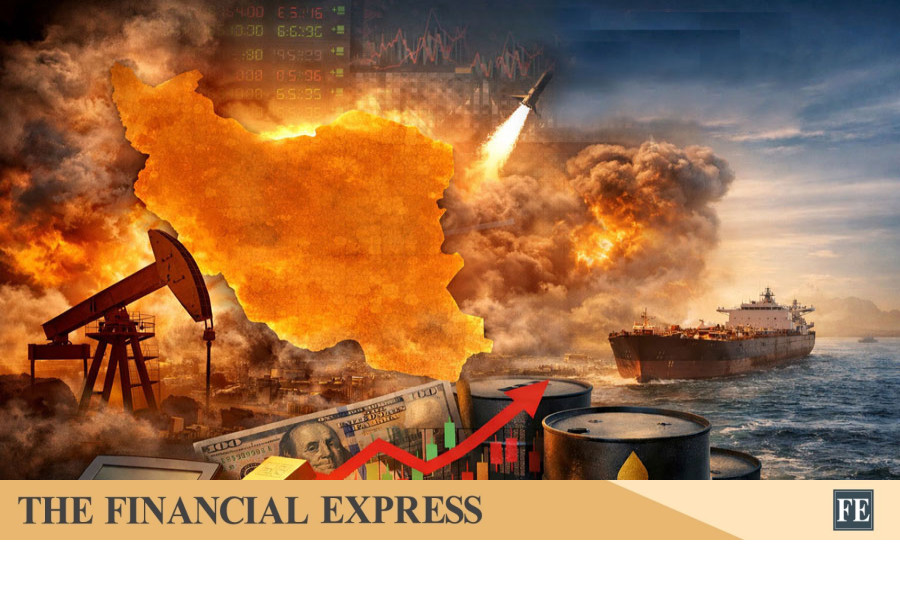
The potential for a full-scale military confrontation involving the United States (US), Israel, and Iran casts a long, dark shadow over the Bangladeshi economy, one that promises to be far more destabilising than the 2022 Ukraine crisis. This time, the threat is existential because it targets the two pillars of our economic stability: global supply chains and remittances. A conflict in the Middle East would not only skyrocket energy and freight costs but could also displace millions of our migrant workers, who are the primary contributors to our foreign exchange reserves. A global recession, exacerbated by geopolitical volatility, carries the high probability of reducing exports, a vital engine of our economy, while simultaneously burdening exporters with the additional threat of soaring shipping and freight costs. A prolonged conflict in the Middle East would likely trigger a slump in consumer demand in Western markets, leaving the RMG sector vulnerable to the dual blow of dwindling orders and the logistical nightmare of disrupted maritime routes.

As import bills for fuel and essentials explode, the country faces an inevitable and aggressive depletion of our reserves. In this high-stakes environment, the new administration cannot afford to repeat the populist economic fantasies of the past. Success depends entirely on whether the new political leadership after the recently concluded national election respects the 'Impossible Trinity,' a fundamental rule of international macroeconomics that dictates a central bank can only choose two of three specific goals: a fixed exchange rate, free capital movement, and an independent monetary policy.

The failure to understand this trilemma was the hallmark of the previous Hasina government's response to the Ukraine war. Rather than allowing the currency to adjust to market shocks, they attempted to defy economic gravity by maintaining an artificial fixed rate of around Tk 90 per USD. Simultaneously, Bangladesh Bank imposed a 9 per cent cap on lending rates, effectively trying to keep money 'cheap' even as global commodity prices and domestic inflation surged.

This infamous '9-6 rule'- capping lending rates at 9 per cent and deposit rates at 6 per cent - was not an accident of policy but a calculated manoeuvre by the previous regime to benefit its inner circle of business interests. Formally implemented in April 2020 under the guise of 'stimulating the economy' during the pandemic, the policy was the culmination of years of lobbying by the Bangladesh Association of Banks (BAB), an organisation dominated by the owners of private commercial banks who are, in many cases, the country's largest industrial borrowers.

By forcing a 9 per cent ceiling on loans, the regime essentially provided a massive, subsidized transfer of wealth from the general public to a handful of 'crony' industrialists. While the official justification was to lower the cost of doing business, the reality was that these low-cost funds were largely cornered by politically connected mega-corporations. This created a perverse incentive structure: because the 6 per cent deposit cap often sat below the actual rate of inflation, ordinary savers saw the real value of their life savings evaporate. Effectively, the struggling middle class was forced to subsidise the expansion of billionaire-owned conglomerates.

Furthermore, the 9-6 rule hollowed out the banking sector from within. It destroyed the 'interest rate spread' that banks need to remain healthy, leading to a severe liquidity crisis. Since banks could no longer price risk, charging higher rates for riskier borrowers, they naturally gravitated toward the same powerful families, leaving small and medium enterprises (SMEs) and genuine entrepreneurs completely starved of credit. This 'cheap money' era fuelled a capital flight, as the elites took advantage of the low interest rates to borrow in Taka and move assets into foreign currency.

In effect, Bangladesh Bank effectively fell victim to the constraints of the Impossible Trinity. In a futile attempt to maintain a fixed exchange rate, keeping the Taka artificially strong at a fixed rate, the authorities were forced to try and aggressively restrict capital flow to prevent a total 'dollar drain.' They imposed several stringent measures, including high LC margin requirements (often 75 per cent to 100 per cent) for non-essential and luxury imports, tighter verification of travellers' foreign currency endorsements, and strict limits on outward remittances. However, these barriers were easily bypassed as capital continued to flow through both formal and informal channels. Significant wealth was siphoned out through the Hundi system and sophisticated trade-based money laundering, particularly via the over-invoicing of imports and under-invoicing of exports. According to the Trilemma, if a country maintains a fixed exchange rate and capital continues to move, it must surrender its independent monetary policy. This is precisely what occurred: by clinging to the politically motivated 9 per cent lending rate cap even as global energy prices and inflation surged, the central bank lost its ability to raise interest rates to protect its reserves, leading to the catastrophic depletion of the nation's foreign exchange.

By trying to maintain both a fixed exchange rate and a controlled interest rate, they forfeited their ability to manage the economy effectively. The 'Trilemma' struck back and the consequence was a catastrophic 'dollar drain,' as the central bank was forced to burn through nearly $28 billion in foreign exchange reserves, dropping from $48 billion to just $20 billion, in a futile attempt to defend a fake currency value. This policy of keeping interest rates low while fiscal expenses and 'imported' inflation rose was a recipe for disaster, as it incentivised capital flight and discouraged the very savings needed to stabilise the economy.

The central bank under Ahsan Mansur's tenure finally brought a much-needed correction by respecting the constraints of the Trilemma. They made the difficult but necessary sacrifice of abandoning the fixed peg, allowing the Taka to float and find its true market value. In exchange for letting the currency fall, the central bank regained true monetary independence, which it used to hike interest rates aggressively to combat inflation. This shift stopped the bleeding of our reserves and brought a level of stability that had been absent for years. This experience serves as a clear blueprint for the current BNP government: the currency must be allowed to absorb external shocks through a managed float, and monetary policy must remain tight to fight the inflation that inevitably follows global energy spikes.

Under the stewardship of Ahsan Mansur, Bangladesh Bank finally returned to 'honouring' the Trilemma by adhering to the standard protocol of inflation targeting. Mansur correctly identified that in an economy where capital mobility is a de facto reality, driven by both global trade and persistent informal leakages, the central bank could only reclaim its monetary policy independence by sacrificing the fixed exchange rate. By abandoning the artificial peg and letting the Taka float to its market-clearing level, he freed the central bank to aggressively use interest rates as its primary weapon against surging inflation. This shift from 'defying' the Trilemma to 'managing' it within its theoretical boundaries was the catalyst that halted the reserve depletion and restored a sense of equilibrium to the financial system.

Therefore, we see that the role of the central bank governor is not merely administrative; it requires a basic understanding of fundamental macroeconomic principles to navigate global shocks effectively. This explains the widespread uproar within civil society following the appointment of Md. Mostaqur Rahman. His profile represents a radical departure from historical precedent. Unlike every previous governor, who were either career bankers, civil servants, or distinguished economists, Rahman is a garment entrepreneur and the active Managing Director of Hera Sweaters. Furthermore, he lacks a clean loan record, with reported reschedules, and holds overt political ties as a member of the BNP's national election steering committee. This creates a massive conflict of interest, particularly as the business community begins to exert immense pressure on the central bank to reduce interest rates and comes up with other demands such as export rebates.

As the former Chairman of the BGMEA Standing Committee on Bangladesh Bank and the active Managing Director of Hera Sweaters Ltd, the new governor may find it exceptionally difficult to negotiate with the very community he once led. There are legitimate fears that as a past representative of this group, one whose own company reportedly benefited from a Tk 890 million loan rescheduled shortly before his appointment. He may succumb to these sectoral pressures. It must be noted that when the currency devalues, exporters already receive a massive windfall as their earnings in local currency increase; providing additional rebates on top of this would be an unjustifiable transfer of wealth.

To insulate the governor from the singular burden of these decisions, the government should immediately form a high-powered advisory committee consisting of independent economists, seasoned financial regulators, and sectoral experts. This body would provide a diversified, data-driven shield for policy decisions, ensuring that the central bank's direction is balanced and not skewed toward any particular business interest.

Furthermore, in regard to price stabilisation policy, which becomes a major concern in any economic crisis, the government must allow market prices to take their own course. Market mechanisms are the most efficient way to ration scarce commodities to those who need them most. The social cost of these price increases should be mitigated not by market interference, but through targeted subsidies specifically for low-income earners. In the past, whenever prices rose due to genuine market forces, the narrative of 'syndicate', market collusion by sellers, was often weaponised without verification. This led to regulatory bodies imposing heavy fines and punishments, which only served to terrify sellers into reducing supply or shutting down shops entirely, causing prices to skyrocket further. We can only hope this government avoids that failed, populist route.

In the end, the task is clear: the new leadership in Bangladesh Bank must distance itself from the dishonest and plundering 'business-first' optics of the past kleptocratic regime of Sheikh Hasina. Instead they should adhere to the cold, hard principles of international macroeconomics to ensure economic stability.

Rough weather lies ahead. We need a cool and competent captain to steer us to safety, not a crew of political appointees who may inadvertently sink the ship by repeating the mistakes of the past.

Dr Rushad Faridi is Assistant Professor, Department of Economics, University of Dhaka.​
 
Analyze

Analyze Post

Add your ideas here:
Highlight Cite Respond

Latest Posts

Back
PKDefense - Recommended Toggle