New Tweets

[🇮🇳] Indian Artillery News and Discussion- Dhanush, ATAGS, Pinaka, Garuda etc.

G   Indian Defense
[🇮🇳] Indian Artillery News and Discussion- Dhanush, ATAGS, Pinaka, Garuda etc.
More threads by Krishna with Flute

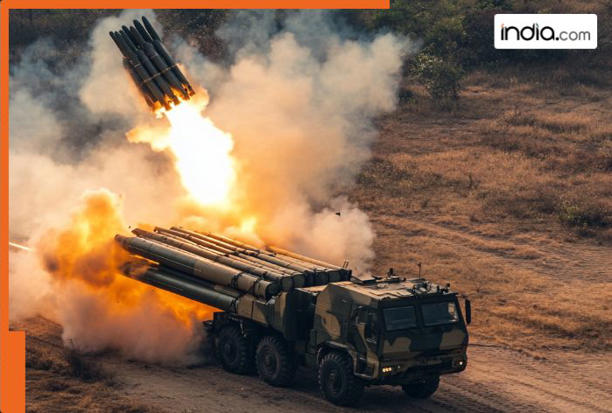
India gets new Avatar of Multi-Barrel Rocket Launcher Pinaka, Range Extended from 37 km to beyond... induction into Army by...​

Story by support@india.com (India.com News Desk)
• 1h•
2 min read

1754381704182.webp


Bad news for China and Pakistan, India developing rocket that can evade any air defense system, designed to hit targets accurately up to..., it is...

Bad news for China and Pakistan, India developing rocket that can evade any air defense system, designed to hit targets accurately up to..., it is...
New Delhi: The Indian Army is working relentlessly to enhance the range of rocket systems under the 'Atmanirbhar Bharat' (self-reliant India) initiative. It is important to note that the Indian Army relied on Russian-made multi-barrel rocket launchers like the Grad and Smerch for warfare until now, but with the induction of the indigenous multi-barrel rocket launcher Pinaka, the Army's capabilities have seen a significant boost.


Now, with the enhancement of its strike range, a new version of Pinaka has been developed. The extended-range version of Pinaka has successfully completed its user trials the final step before being inducted into the Army. It is expected to be inducted soon.

Here are some of the key features of Pinaka:​

  • Pinaka currently in service with the Indian Army's artillery
  • The original Pinaka rocket is a free-flight rocket, meaning once it is launched, it travels up to its maximum range of 37 kilometers before impact.
  • The current Pinaka rockets in the Army have a range of 37 kilometers, which has now been extended to around 75 kilometers.
  • The extended range guided Pinaka is a guided rocket equipped with GPS navigation.
  • The rocket can strike the target with precision after launch.
  • In terms of accuracy, it can hit within approximately 25 meters of the target, which is considered highly effective.
  • The rocket is pre-programmed, and once launched, it follows the set trajectory.
  • If it deviates from its path for any reason, the onboard computer, aided by GPS, corrects the trajectory to get it back on course.
  • Pinaka is equipped with an Inertial Navigation System (INS).
  • This provides a major advantage: even if an enemy attempts to breach or disrupt the GPS signal via satellite interference, the INS will still guide the rocket accurately to its target.
  • Pinaka system, when an entire battery is launched simultaneously, it can completely devastate an area measuring 1,000 by 800 meters.
  • With the induction of the guided Pinaka weapon system, the Indian Army will gain a highly destructive and precise artillery system capable of wreaking havoc on enemy forces.
The Indian Army plans to have a total of 25 Pinaka multi-barrel rocket launchers. A single battery of the Pinaka system consists of six firing units (launchers). Each launcher has 12 tubes, meaning one full battery can fire 72 rockets in total. All of these can be launched within just 44 seconds. Immediately after launching, the launchers change position and can be rearmed for another strike.

The Army procured two new types of rockets for the Pinaka Multiple Launch Rocket System (MLRS):


Attachments

  • 1754381704194.webp
    1754381704194.webp
    72 bytes · Views: 13
Analyze

Analyze Post

Add your ideas here:
Highlight Cite Respond
The Pinaka is roughly equivalent to the Turkish TRG-300K and TRG-230K GMLRS.

Bangladesh has received a total of three batteries (regiments) of the TRG-300 Kasırga GMLRS weapon system, which translates to 18 launch vehicles a few weeks ago.

The TRG-300 Guided rockets are based on the PLA Weishi WS-2 GMLRS.

SIPRI and other sources have confirmed that Bangladesh has previously so far received Six regiments (36 launch vehicles) of this TRG-300 variant and this may become standardized. Of course the launch vehicles also include requisite Command, Radar and Reload vehicles for every battery.

Which brings into total nine regiments (54 units) of these Kasirga in Bangladesh inventory.

At some point, per my information. Bangladesh may opt for the Weishi WS-3 GMLRS which uses 400mm Caliber rockets, with ranges of up to 400 KM, which it currently lacks.

Bangladesh has also acquired 74 units of the WS-22 Short Range GMLRS (122mm Kaliber) with 45 KM range, among other short range missiles. All missiles from China (and Turkey) use cascade inertial terminal guidance updated by civilian GPS/GLONASS (or are upgradable to Military Grade GPS/GLONASS).

WS-22 for Bangladesh Army
View attachment 14152

TRG-300 of Bangladesh Army
View attachment 14153

That is great.
 
Analyze

Analyze Post

Add your ideas here:
Highlight Cite Respond
  • Love (+3)
Reactions: Egyptian
The deadliest Indian gun with longest range.

 
Analyze

Analyze Post

Add your ideas here:
Highlight Cite Respond
  • Wow (+2)
Reactions: Egyptian
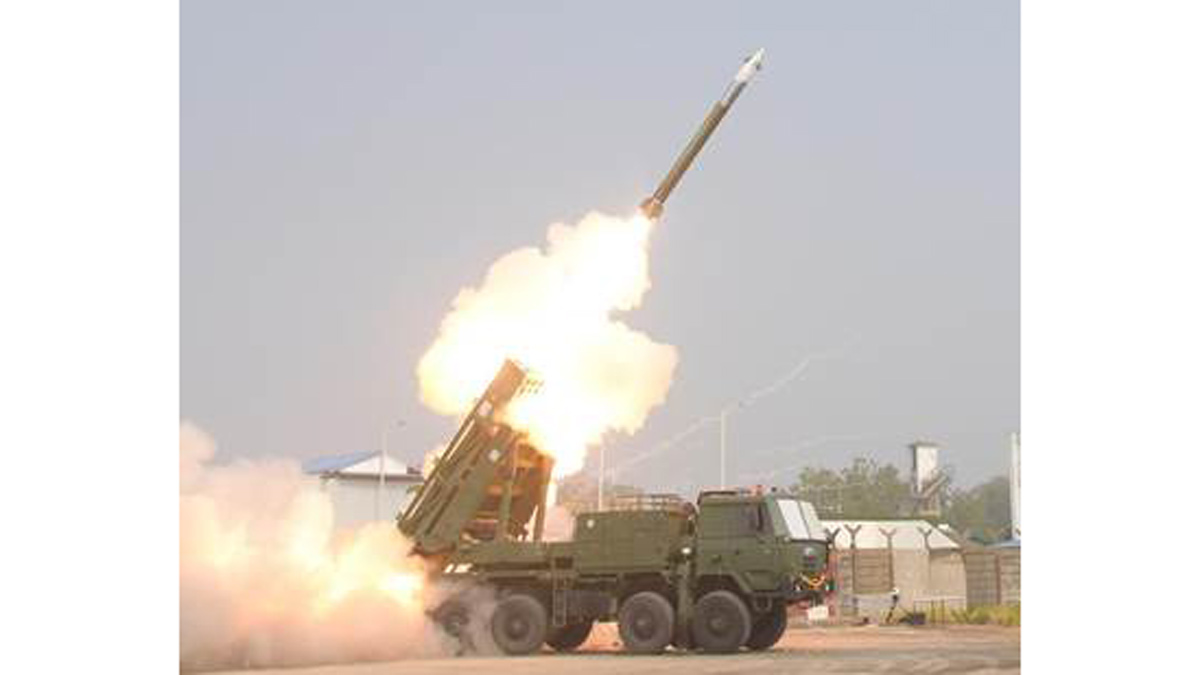
120 KM Pinaka tested. Next in line is 300 K.M. Pinaka. In flight Parameters successfully tested. Rocket followed specified path and hit target with great precision. This is a guided rocket between 5 to 20 meter CEP.

Why the newly-tested 120-km Pinaka long-range guided rocket could be a war-winner for India?​

A former DRDO scientist highlights the rocket's significance as a decisive tactical weapon that offers near-missile accuracy at a fraction of the cost

The Week News Desk By The Week News Desk Updated: December 30, 2025 15:58 IST

pinaka-120-km

As the Defence Research and Development Organisation (DRDO), on Monday, successfully conducted the maiden flight test of the Pinaka long-range guided rocket, which has a maximum range of 120 km, a former DRDO scientist observed that the 120-kilometre range can prove very decisive for a tactical weapon on the battlefield.

The rocket was tested for its maximum range of 120 km, “demonstrating all in-flight manoeuvres,” as planned at the Integrated Test Range (ITR) at Chandipur in Odisha.

For more defence news, views and updates, visit: Fortress India
Speaking about the importance of the Pinaka long-range guided rocket and the weapon system in general, former DRDO scientist Dr Ravi Gupta observed that the Pinaka multi-barrel rocket launcher system is significant in many ways.

He pointed out that this was the first defence system to be manufactured by private industry in the country.

ALSO READ: As engine delivery delay plagues LCA Tejas, will India break free of imports with indigenous AMCA engine?

“It was in 2008, under the leadership of former prime minister Atal Bihari Vajpayee, that for the first time in the history of independent India, the participation of private industry in the defence sector was approved. This proved to be a game-changer, and leveraging this, DRDO collaborated with the private sector to have it produced by private industries.”

He said that during the Kargil War, even when the Pinaka was not yet fully developed, the weapon system demonstrated its capabilities.

“Since then, it has made a very significant contribution to the Army. Moreover, the advantage of a multi-barrel rocket launcher is that it is less expensive. Compared to our guided missiles, its cost is significantly lower, although its accuracy is not as high as that of guided missiles.”

What makes Monday’s test significant?​

The defence ministry, on Monday, said the maiden flight test of the Pinaka long-range guided rocket (LRGR 120) was conducted successfully at the Integrated Test Range. The LRGR was launched from the in-service Pinaka launcher, demonstrating its versatility and providing launch capability of Pinaka variants of different ranges from the same launcher, it added.

The rocket is designed by the Armament Research and Development Establishment, a lab of the DRDO, in association with the High Energy Materials Research Laboratory, and with support from the Defence Research and Development Laboratory and Research Centre Imarat.

Speaking to news agency ANI, Gupta said the 120-kilometre-range multi-barrelled long-range rocket system has an accuracy comparable to a guided missile, but at a much lower cost. “A large area of enemy territory can be destroyed in just a few minutes. A 120-kilometre range can prove very decisive for a tactical weapon on the battlefield, and this will give our armed forces great strength and power.”

He said that although this is a tactical weapon, when it is used in large quantities by the armed forces, it can prove very decisive in a war.

Another important aspect is that since it was developed in collaboration with the private sector, it will help in expanding the defence industry.

 
Analyze

Analyze Post

Add your ideas here:
Highlight Cite Respond
@Bilal9 , @Saif
Dhaka can be hit with This version from Agartala and Shilong. i.e From Tripura and Meghalaya, 7 sisters. Your opinion gents.
 
Analyze

Analyze Post

Add your ideas here:
Highlight Cite Respond
@Bilal9 , @Saif
Dhaka can be hit with This version from Agartala and Shilong. i.e From Tripura and Meghalaya, 7 sisters. Your opinion gents.
Bangladesh also has TRG-300 MLRS with a range of 120km. Next in line is 280km MLRS.
 
Analyze

Analyze Post

Add your ideas here:
Highlight Cite Respond

Members Online

No members online now.

Latest Posts

Back
PKDefense - Recommended Toggle