[🇧🇩] Textile & RMG Industry of Bangladesh

Afghanistan Albania Algeria Andorra Angola Antigua Austria Azerbaijan Bahamas Bahrain Bangladesh Barbados Canada China Egypt Finland Germany India Iran Israel Japan Lebanon North Macedonia Pakistan Palestine Qatar Russia Syria Turkey Ukraine United Kingdom United States Yemen
[🇧🇩] Textile & RMG Industry of Bangladesh
507
23K
More threads by Saif

G Bangladesh Defense

Textile millers oppose scrapping 30% value-addition rule

Star Business Report

Textile millers have urged the government not to withdraw the 30 percent value-addition requirement on imports of garment raw materials such as yarn, warning that the move could harm the domestic primary textile sector.

The withdrawal would encourage garment exporters to import yarn instead of sourcing it locally, potentially flooding the domestic market with imported products, they said.

In its proposed budget for FY2026-27, the government has proposed scrapping the 30 percent value-addition requirement in the domestic market to facilitate business operations.

If implemented, the measure could undermine the primary textile sector, which has attracted investments of around $23 billion, said Showkat Aziz Russell, president of the Bangladesh Textile Mills Association (BTMA), at a press conference held at the Gulshan Club in Dhaka yesterday.

He said the proposal runs counter to efforts to preserve the country’s competitiveness and sustain local industry ahead of Bangladesh’s graduation from the Least Developed Country (LDC) category.

Citing various studies, Russell said Bangladesh could lose $17.5 billion in exports, mainly apparel shipments, following LDC graduation. He also said that 114 of the 234 spinning mills owned by BTMA members had shut down since 2019.

The remaining mills are operating at only 60 percent to 70 percent of capacity due to inadequate gas supplies and the growing dominance of lower-cost Indian yarn in the domestic market, he added.

According to BTMA data, imports of Indian cotton yarn rose 22.07 percent year-on-year to $1.79 billion in FY2024-25, with import volumes reaching 556.12 million kilograms.

In FY2023-24, imports of Indian cotton yarn stood at $1.48 billion, with volumes of 455.57 million kilograms, registering annual growth of 1.04 percent, the association said.

Russell said Indian suppliers are able to offer yarn at lower prices because of extensive government support.

He said the Indian government also provides a 15 percent capital investment subsidy, an 8 percent interest subsidy, infrastructure support, and 15 percent assistance for technology upgradation and modernisation.

Another concern is the risk of supply disruptions, he said, noting that Indian exporters may prioritise other markets without prior notice.

Russell cited a recent instance when India increased yarn exports to China, leaving Bangladeshi importers facing shortages and higher prices as local demand surged.

In the post-LDC era, Bangladesh may need to meet double-transformation requirements to retain trade benefits, which would require greater use of locally produced yarn, he said.

Therefore, the capacity of domestic spinning mills and the broader primary textile sector should not be reduced, particularly when the country needs to strengthen preparations for LDC graduation, he added.

Russell also urged the government to reduce the corporate tax rate for primary textile mills to 12 percent from the current 27.5 percent and maintain the rate until 2030 to attract more foreign direct investment.

He argued that the existing tax rate is discriminatory, as export-oriented non-green garment factories are taxed at 12 percent, while green garment factories enjoy a 10 percent rate.

The reduced 15 percent tax rate previously enjoyed by primary textile mills expired on June 30, 2025, after being introduced in 2015.​
 

BGMEA proposes phased ZLD implementation for apparel sector

FE ONLINE REPORT

Published :
Jun 24, 2026 20:36
Updated :
Jun 24, 2026 20:36

1782343324034.webp


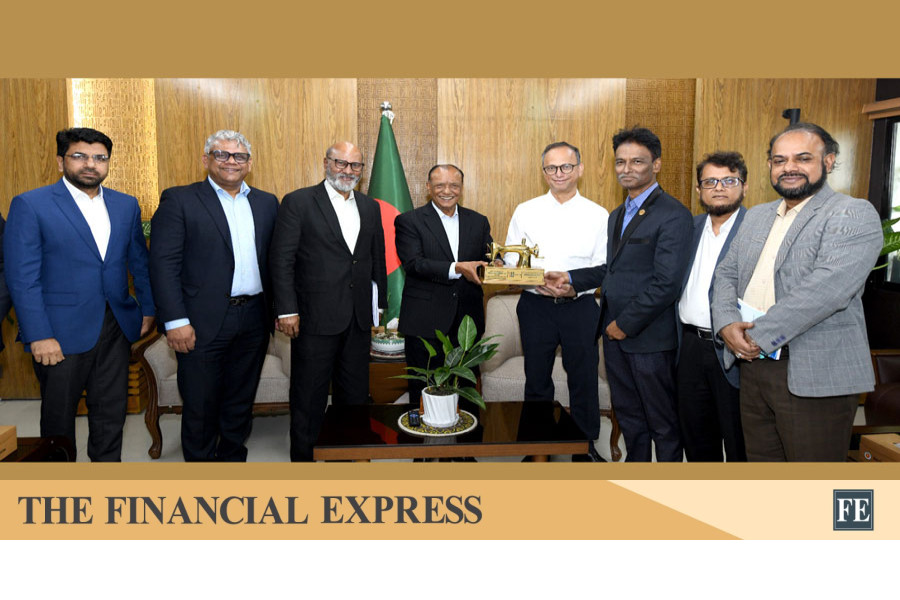
The apparel apex body BGMEA on Wednesday proposed a gradual and performance-based roadmap for implementing zero liquid discharge (ZLD) in the ready-made garment sector instead of the existing mandatory commitment.

The ZLD is an advanced water treatment process designed to eliminate liquid waste from industrial operations.

The BGMEA (Bangladesh Garment Manufacturers and Exporters Association) made the proposal when a delegation led by its President Mahmud Hasan Khan met Environment, Forest and Climate Change Minister Abdul Awal Mintoo at the latter’s secretariat office in Dhaka city.

Former Bangladesh Textile Mills Association President A Matin Chowdhury, BGMEA Director Nafis-ud-Doula and Kingsley CEO Md Ashiqur Rahman, among others, were present at the meeting.

The association also demanded the formulation of specific sustainability guidelines for water conservation and reuse, financial incentives such as VAT and duty exemptions on ZLD equipment and the launch of a specialised ‘ZLD-window’ under the Green Transformation Fund of Bangladesh Bank.

The meeting also discussed the need to align environmental compliance with the realities of the ready-made garments and sustainable textile sector.

Reiterating their commitment to ensuring a sustainable environment, the sector leaders highlighted several regulatory complexities and obstacles, including technical challenges related to the 'Environmental Protection Rules, 2023'.

The delegation noted that the current ETP colour parameters are technically very difficult to achieve with the existing infrastructure and requested that a realistic and science-based standard be set.

To enhance administrative transparency, the delegation suggested introducing a mirror testing mechanism for environmental sampling and systematically adopting a risk-based, long-term environmental clearance renewal system for compliant factories.

The BGMEA also urged the government to formulate rules under the Forest Ordinance (2026) quickly to remove uncertainty over land use in industrial areas.

The meeting also highlighted the need to set tolerance limits for fluctuations in environmental parameters due to extreme weather conditions and to ensure a balanced air quality assessment, taking external sources of pollution into account.

Acknowledging the important contribution of the readymade garment sector to the national economy, the minister assured the delegation of addressing the issues while balancing the needs of the industry with the goal of environmental conservation.​
 

Direct US cotton sourcing delivers savings for BD mills

Jasim Uddin

Published :
Jul 04, 2026 08:03
Updated :
Jul 04, 2026 08:03

1783131766732.webp

A denim producing factory in Bangladesh — Photo courtesy: hameemdenim.com

Bangladeshi spinning mills are increasingly turning to direct procurement of raw cotton from US farmers, bypassing traditional international trading houses in a move expected to lower costs for local manufacturers while ensuring better returns for American growers.Demographics

The initiative, led by a new US-based trade platform named AmeriBangla, has already facilitated direct cotton purchases by three Bangladeshi textile companies, while another 19 spinning mills are in talks to join the programme.

AmeriBangla Chief Executive Officer Aswar Rahman says the company has spent more than a year building a direct supply chain linking Bangladeshi mills with US cotton growers.

"We now have a strong network of around 900 farmers across Texas, Georgia, Arizona, and Oklahoma, while our broader network covers farmers in 17 US states," he tells The Financial Express.

According to him, Bangladeshi spinning mills can save several US cents per kilogramme of raw cotton by sourcing directly from farmers instead of relying on the conventional trading system.

At present, cotton imports typically pass through at least nine intermediaries before reaching Bangladeshi mills.

"Through AmeriBangla, we are creating a transparent supply chain connecting American farmers, ginners, and Bangladeshi spinning mills directly. This ensures fair pricing for both producers and buyers while eliminating unnecessary middlemen," he says.

Rahman says the US cotton trade is largely dominated by European multinational trading companies, leaving farmers with little bargaining power.

"It is a win-win model. American farmers receive better prices than they do from multinational traders, while Bangladeshi mills benefit from lower procurement costs by cutting out multiple intermediaries," he explains.

He notes that many US cotton farmers have been operating at a loss for the past five to six years under the existing marketing system.

"Those who have started doing business with us are returning to profitability with better margins," he adds.

Rahman believes the initiative could evolve into a strategic partnership between Bangladesh's apparel industry and American cotton growers.

"If Bangladesh significantly increases its use of US cotton, we will build stronger relationships with American farmers, who have real influence in Congress. Such a partnership could further strengthen Bangladesh's trade position in the United States while opening a new chapter in bilateral trade," he says.

He also highlights challenges in securing export finance in the United States.

"The US government is keen to promote exports through financing schemes. However, current regulations generally require exporters to have at least two years of experience and an annual turnover of around $6 million," he adds.

Rahman expresses hope that the US authorities would consider extending greater support to emerging exporters and trading platforms.

He also observes that export financing remains a relatively weak area in the US banking sector.

"Many banks, particularly in New York, do not even have dedicated export departments. During discussions, officials often realise only later that we are talking about exporting goods from the United States," he says.

He adds that AmeriBangla initially struggled because of the limited infrastructure available to support small and medium-sized agricultural exporters in the US, but eventually succeeded in establishing the required network.

Among the early adopters of the model is Envoy Textiles Ltd, one of Bangladesh's leading denim textile manufacturers.

Rahman says Envoy imported nearly 60 tonnes of cotton from US farmers through AmeriBangla last year.

Talking to The Financial Express, Kutubuddin Ahmed, founder and chairman of Envoy Textiles, says the company has already experienced the benefits of direct sourcing.

"We are importing cotton directly from US farmers through Ameri Bangla, and it has proved beneficial for both sides," he says.

He expresses optimism that Envoy would significantly increase its direct cotton purchases this year as the sourcing model expands.​
 

Non-RMG exports remain low for years
Exporters blame policy gaps, limited diversification

Saddam Hossain 08 July, 2026, 23:51

1783556141182.webp


Bangladesh’s exports continue to be heavily dependent on the readymade garment sector, with shipments of non-RMG products remaining stagnant over the years despite repeated calls for diversification.

Exporters attribute the stagnation to inadequate and inconsistent policy support, weak demand in key overseas markets amid economic challenges, and the country’s limited progress in expanding its export basket.

According to the Export Promotion Bureau, non-RMG sectors have accounted for only 17 per cent to 19 per cent of Bangladesh’s total export earnings over the past five years, with little structural change year after year.

In the financial year 2025-26, total export earnings slipped marginally to $48 billion, while RMG earnings fell further to $38.7 billion, down 1.64 per cent year-on-year, accounting for about 81 per cent of total earnings.

The non-RMG sector’s share was only around 19 per cent, which exporters and experts labelled a ‘risky economic model’.

The major non-RMG items, including leather and leather goods, jute and jute goods, agricultural products, home textiles, and engineering products, generated $1.22 billion, $884 million, $975 million, $928 million, and $652 million, respectively.

‘The government has always been working on export diversification,’ EPB vice-chairman Mohammad Hasan Arif told New Age.

However, Bangladesh’s export economy is built on a risky model, where only RMG has grown. The gap between RMG and other products is now so wide that scaling up the rest cannot happen overnight, he added.

Hasan also said several sectors have shown promise at different points but failed to sustain that momentum amid recurring crises.

‘Frozen food once showed promise, but shrimp production has fallen by nearly a third,’ he said, warning that the country›s industrialisation and economic transition remain vulnerable because they rely too heavily on a single product.

Among non-RMG items, only leather and leather goods have consistently crossed the billion-dollar mark in recent years.

The sector earned $797.7 million in FY20, $1.17 billion in FY23, $1.14 billion in FY25, and $1.23 billion in FY26, yet still short of any meaningful breakthrough beyond the billion-dollar range it has occupied, on and off, for years.

Md Nasir Khan, vice-president of the Leather Goods and Footwear Manufacturers and Exporters Association of Bangladesh, told New Age that the leather sector has remained stuck at around $1 billion in exports for decades due to inadequate government policy support.

‘Despite having domestic raw materials and producing high-quality products, the sector is falling behind because the government wants to keep it as a bonsai tree,’ he said, adding that it has the potential to earn $10 billion by adding up to 90 per cent value from locally sourced raw materials.

Khan said the government’s relocation of tanneries to Savar without proper infrastructure and a fully functional Central Effluent Treatment Plant undermined the sector.

He said leather estate factories cannot export to leading global brands because they lack Leather Working Group certification. ‘We have capable second-generation entrepreneurs. The problems lie in policy and governance failures,’ he said.

Khan also said Bangladesh lacks a unified policy and incentive framework for all export-oriented sectors.

Meanwhile, on Tuesday, commerce minister Khandakar Abdul Muktadir said in parliament that Bangladesh has the potential to earn up to $10 billion annually from leather goods exports.

The country currently utilises only 0.26 per cent of its leather potential. The relocation of tanneries from Hazaribagh to Savar remained incomplete, he said, adding that the government would make the CETP fully functional.

The jute and jute goods sector, once the country’s largest export earner, experienced negative growth for a prolonged period before showing signs of recovery in FY26.

The sector earned $882.35 million in FY20, $911.51 million in FY23, $820.16 million in FY25, and then grew 7.75 per cent to $884 million in FY26 – still below its FY23 level.

‘The global jute market has been under pressure for well over a decade. Bangladesh’s key markets, particularly Syria, Sudan and Iran, have been mired in war and internal turmoil for more than a decade, shrinking orders,’ said Aslam Babul, chairman of the Bangladesh Jute Goods Exporters Association.

Babul said the government›s 2021 decision to shut down all state-owned jute mills also sent a negative signal to global buyers.

‘Private mills alone cannot handle such large bulk orders, so support from state-run mills is essential,’ he said.

Welcoming the current government›s plan to revive closed and loss-making state enterprises through joint ventures, public-private partnerships or leasing, Babul said the mills should be reopened specifically for jute goods production.

‘Jute offers nearly full value addition, and if the mills are handed over to genuine entrepreneurs for that purpose, the sector could regain its lost glory,’ he added.

Farhad Ahmed Akand, chairman of the Bangladesh Jute Association, said farmers were losing interest in jute cultivation because it is time-consuming and costly.

He urged proper implementation of projects to enable farmers to grow jute with less time, water and land.

Agricultural product exports earned $862.06 million in FY20, $827.10 million in FY23, and $988.62 million in FY25 – the sector’s strongest showing in the period – before declining 1.34 per cent to $975 million in FY26.

Kamruzzaman Kamal, director (marketing) at Pran-RFL Group, told New Age, ‘Our entrepreneurs’ export baskets barely contain any globally competitive products, and their target buyers are not global consumers.’

He said exporters largely target the Bangladeshi diaspora with items such as chanachur, chips and mustard oil, which have no global demand, whereas biscuits, fruit drinks and juices – products with genuine global demand – deserve greater innovation and export focus.

‘We are trying to bring in innovation, and it is getting a positive response in the global market,’ he said.

Engineering products earned $529 million in FY20, $495 million in FY23, $535.56 million in FY25, and then posted the sharpest growth among major non-RMG sectors in FY26, rising 21.77 per cent to $652 million.

Abdur Razzaque, former president of the Bangladesh Engineering Industry Owners’ Association, said earlier that the sector needs a dedicated industrial park or zones to establish compliant, global-standard factory units.

He had also called for policy support through the removal of tax and VAT-related issues.

Home textile exports earned $1.13 billion in FY21, $1.09 billion in FY23, $871.57 million in FY25 and rose 6.52 per cent to $928 million in FY26.

EPB’s Hasan Arif said the government is working to support diversification, but entrepreneurs must move beyond the cheap-labour, low-innovation model.

He said policy support, including duty-free raw material imports for non-bonded factories against bank guarantees, would be provided to encourage the shift.

Bangladesh’s non-RMG export sectors have yet to realise their potential primarily because they lack the competitiveness needed to succeed in the global market, said M Masrur Reaz, chairman and chief executive officer of Policy Exchange Bangladesh.

He also said only a handful of firms in each sector are capable of competing internationally, while overall production capacity, technological capability and skills remain weak, preventing these sectors from expanding on a competitive footing.

‘Equal policy support or incentives alone would not be enough to increase non-RMG exports significantly,’ he said, adding that developing export-oriented sectors requires a comprehensive strategy backed by consistent policy support, effective implementation, technology adoption and skills development.

He identified shortcomings at two levels. At the enterprise level, many firms have failed to strengthen their competitiveness through investment in technology, skills, market intelligence and entrepreneurship.

Moreover, at the policy level, Bangladesh has not pursued a coordinated strategy to develop these sectors into globally competitive industries.

Reaz said promising sectors such as agro-processing, leather and footwear face sector-specific constraints, particularly in meeting international standards, compliance and certification requirements.

He also said that facilities such as bonded warehouse access alone would not be sufficient to drive export growth without addressing these structural bottlenecks.

The development of export sectors, he said, depends on a combination of factors, including a supportive regulatory environment, a skilled workforce, technology adoption, productivity, efficient trade policies, trade facilitation, logistics, infrastructure and market access strategies.

‘Without a comprehensive, multi-dimensional sector development plan and effective implementation, Bangladesh would struggle to build globally competitive non-RMG export industries,’ he added.​
 

Latest Posts

Back