[🇧🇩] Sea Ports/Air Ports/River Ports/Bridges/Mega Projects

Afghanistan Albania Algeria Andorra Angola Antigua Austria Azerbaijan Bahamas Bahrain Bangladesh Barbados Canada China Egypt Finland Germany India Iran Israel Japan Lebanon North Macedonia Pakistan Palestine Qatar Russia Syria Turkey Ukraine United Kingdom United States Yemen
[🇧🇩] Sea Ports/Air Ports/River Ports/Bridges/Mega Projects
221
10K
More threads by Saif

G Bangladesh Defense

Rethinking seaport financing

THE port sector is at a critical turning point. Private berth operators have demonstrated unprecedented confidence by submitting a Tk 7,650 crore proposal to renovate Chattogram Port’s ageing general cargo berth. At the same time, exporters and importers are grappling with recent tariff increases imposed by the Chattogram Port Authority, which risk raising the cost of doing business. Should Bangladesh continue relying on foreign loans and periodic tariff hikes to fund port expansion, or is it time to adopt a more modern, inclusive financing approach?Bangladeshi Culture Course

The general cargo berth illustrates this tipping point. Built in stages between 1954 and 1979, the terminal has outlived its economic life long ago. Private berth operators, who now manage roughly half of Chattogram’s container throughput and four-fifths of its bulk cargo, have operated under short-term tender contracts for years. Their long-term investment proposal demonstrates both the commercial viability of the port sector and the potential of untapped domestic and foreign capital, which has remained largely inaccessible under the current institutional structure.

Bangladesh distinguishes itself from other maritime leaders in this regard. While the Chattogram Port Authority functions as a statutory body under bureaucratic constraints, ports worldwide have modernised their governance and financing. Shanghai International Port Group raised billions through the Shanghai Stock Exchange. DP World became a global operator after listing on NASDAQ Dubai. Hutchison Port Holdings Trust in Singapore allows ordinary investors to hold units in a port-related company, generating steady returns. The Port of Rotterdam frequently taps European bond markets while India’s Adani Ports relies heavily on the stock market to fund expansion. These cases show that high-cash-flow, strategically dominant ports are naturally suited to corporate governance reforms and stock-exchange listing.

Bangladesh’s dependence on foreign loans and tariff adjustments is increasingly unsustainable. Modern ports require continuous investment in dredging, jetty construction, gantry cranes, digital systems, logistics zones and green energy transitions. Foreign loans carry long approval processes, currency risks and politically sensitive repayment obligations. Tariff hikes, by contrast, immediately raise the cost of trade. Even a modest 10 per cent increase in port fees can add more than $20 per container, undermining export competitiveness and inflating import costs. In a country with narrow trading margins, fee-based funding is inefficient.

A forward-looking alternative is to mobilise capital directly from the public via stock-exchange listing. By incorporating the port authority under the Companies Act and offering a minority share on the Dhaka Stock Exchange, Bangladesh could tap domestic savings, strengthen transparency and spread investment responsibility across a broad spectrum of shareholders. Citizens could directly own national infrastructure, while the port sector would gain a reliable, predictable source of capital. With stable cash flows and natural monopoly characteristics, ports could also anchor long-needed confidence in the DSE, attracting institutional investors and serving as a model for corporate governance in other sectors.

The Tk 7,650 crore general cargo berth proposal makes this case compelling. Significant funding is clearly available domestically, with investors recognising the commercial potential of port infrastructure. Under the current public-private partnership model, however, these benefits are restricted to a small set of operators and partners. A corporatised, partially listed CPA would enable public and institutional investors to participate, while private operators continue managing day-to-day operations, as is standard in ports such as Singapore and Shanghai.

Stock-market listing is not without challenges. Concerns about excessive foreign ownership, undervaluation of state assets, political influence and labor restructuring are genuine. Yet these issues can be managed. Foreign ownership can be limited through statutory caps and golden shares. Transparency can be ensured via independent boards, audited reports, and robust accounting standards. Labor concerns can be addressed through job security policies, retraining and structured transitions. When carefully designed, corporatisation strengthens accountability rather than diminishing it.Politics

A viable reform path could begin with incorporating CPA under the Companies Act and publishing audited financial statements and operational performance reports. Pilot listings could then be launched for strategic terminals, such as the GCB or Bay Terminal, before expanding to Mongla, Payra, and future deep-sea ports like Matarbari. This staged approach balances ambition with caution, allowing policymakers to refine the model based on early outcomes.

The impact on the capital market could be transformative. The DSE has long struggled with speculative trading, weak governance, and a shortage of large, revenue-generating listings. Ports, with predictable earnings and natural monopolies, could serve as flagship listings, attracting institutional investment, deepening market liquidity and providing benchmarks for corporate governance across industries.

Funding requirements for ports are substantial. The Bay Terminal alone requires Tk 13,525 crore in marine infrastructure. Payra Port needs extensive dredging and Matarbari deepsea port will demand long-term investment to realise its growth potential. Even routine upgrades necessitate significant annual capital. Reliance on foreign borrowing or tariff hikes alone is insufficient. Capital-market funding, coupled with carefully structured PPPs and infrastructure bonds, offers a more sustainable, inclusive route.

Bangladesh’s seaports are more than logistical facilities; they are national assets that shape competitiveness, industrial growth, and economic prosperity. The private berth operators’ Tk 7,650 crore proposal illustrates that investment-led transformation is possible. What is required now is a bold policy shift: corporatisation, transparency, and broad-based public ownership. With these reforms, Chattogram, Mongla, Payra, Matarbari and the Bay Terminal could evolve from maritime gateways into engines of shared national development. Ports should not merely move goods; they should generate wealth, opportunity and economic sovereignty for the nation.Bangladeshi Culture Course

Sayeed M Hassan, a retired navy captain, is an adjunct faculty at the Bangladesh Maritime University.​
 

Apart from NCT, race on for two other Ctg port terminals

UAE’s DP World, Saudi RSGT and two local entities enter competition

Dwaipayan Barua


1779063255642.webp

Amid negotiations over leasing Chattogram port’s New Mooring Container Terminal (NCT), attention has now turned to two other key facilities of the seaport as an increasing number of foreign and local operators are showing interest in making investments and running those terminals.

The port has four main container and cargo terminals. These are General Cargo Berth (GCB), Chittagong Container Terminal (CCT), NCT, and Patenga Container Terminal (PCT).

All of those are now operational and run by local operators, except for the PCT. Saudi Arabia’s Red Sea Gateway Terminal (RSGT) is now running the Patenga terminal.

At the fourth Dubai-Bangladesh Joint Platform meeting held in Dubai on April 8, UAE-based global operator DP World expressed interest in operating CCT. Talks have been ongoing for years to lease out NCT, the largest and busiest container terminal of the seaport, to DP World.

DP World says it wants to develop the two terminals as a single integrated facility, according to meeting minutes obtained by The Daily Star.

Within weeks of DP World’s latest approach, Saudi RSGT expressed interest in modernising and operating CCT and GCB.

Apart from the foreign firms, Bangladeshi conglomerate MGH Group, which earlier proposed operating CCT, has recently submitted a fresh proposal to operate both CCT and NCT.

Meanwhile, a group of 12 berth operators who are currently running the GCB has jointly proposed to modernise and operate the general cargo terminal.

A senior official of the Chittagong Port Authority (CPA) confirmed that several proposals have been received from local and foreign firms for investment and operation of different terminals.

Of the total four terminals at the seaport, three are dedicated to container handling. Only the GCB is used for both container vessels and bulk and break-bulk cargo.

The port handled 34.09 lakh TEUs (Twenty-foot Equivalent Unit) of containers in 2025. Of this, NCT handled 13.21 lakh TEUs, GCB 10.83 lakh, CCT 4.83 lakh, and PCT 1.53 lakh, according to CPA data.

Officials and port users say foreign firms have for several years shown interest in greenfield expansion projects such as the Bay Terminal. However, such projects require large investments and long construction timelines.

In contrast, operational terminals offer immediate revenue, which is why both local and foreign operators are focusing on existing facilities.

During the previous Awami League government, negotiations began with DP World for the operation of NCT.

The process continued under the interim government, which came close to finalising a deal before it was postponed following a strike by port workers ahead of the February parliamentary election.

The current government is still discussing DP World’s proposal for NCT.

Shipping ministry officials said CCT has also been placed under the Bangladesh-Dubai Joint Platform for discussion and may be taken up as a separate project in future meetings.

On April 22, RSGT expressed interest in modernising and operating GCB and CCT, proposing an investment of over $600 million.

Speaking on condition of anonymity, a senior RSGT official in Chattogram said the proposal was still at an early stage. “If the government allows, we are interested in modernising and efficiently operating the GCB and CCT,” he said.

In March last year, local MGH Group first proposed to upgrade and operate CCT with an investment plan of $300 million. On April 28 this year, it submitted a fresh proposal to manage and operate NCT under a public-private partnership (PPP) model.

MGH has offered the CPA $98.50 per TEU in revenue share at NCT, compared with projected earnings of $161.80 per container.

DP World earlier proposed a revenue share of $93.50 to $97.50 per container.

The group says its 15-year concession model could generate about $1.68 billion in total payments to the port authority.

Anis Ahmed, CEO of MGH Group, told The Daily Star that the company’s offer provides higher revenue to CPA than competitors.

He added that MGH’s lower financing and overhead costs, compared with foreign operators, help maintain margins despite the higher revenue share.

On November 27 last year, Berth Operators, Ship Handling Operators and Terminal Operators’ Owners’ Association (BOSTOA), a platform of 12 berth operators currently running the GCB, submitted an unsolicited proposal to finance, reconstruct, equip, operate and transfer the GCB under a PPP model.

It proposed an investment of $627 million, to be raised through a consortium of local and foreign partners, according to BOSTOA President Fazley Ekram Chowdhury.

“Since we have been operating the GCB terminal efficiently for over two decades, we have ground-level experience and have proposed a plan to reconstruct the jetties and expand yards, sheds and warehouses,” he said.​
 

CDDL gets six-month extension to run NCT
Extension approved until new operator is formally appointed

Nazimuddin Shyamol

Published :
May 25, 2026 13:44
Updated :
May 25, 2026 13:44

1779761407345.webp


CHATTOGRAM: The government has decided to extend the contract of Chittagong Dry Dock Limited (CDDL) for operating the New Mooring Container Terminal (NCT) of Chattogram port for another six months or until a new operator is appointed.

CDDL, operated by the Bangladesh Navy, which officially took over the management of the NCT at Chattogram port on July 7, 2025, will continue operating the terminal until further orders.

The decision was taken at a meeting of the Cabinet Committee on Economic Affairs and the Cabinet Committee on Government Purchase held at the Secretariat on Saturday, chaired by Finance Minister Amir Khosru Mahmud Chowdhury.

Sources said the approval was given following a proposal from the Ministry of Shipping after the expiry of the existing agreement signed with CDDL for operating the NCT, including its overflow yard.

The extension has been approved under the same rates and conditions as the previous contract to ensure uninterrupted port operations until the process of appointing a new operator is completed.

Officials of the Chittagong Port Authority (CPA) said they had heard about the decision to extend CDDL's contract but had not yet received any formal order.

The NCT is one of the key facilities of Chattogram port, with an annual container handling capacity of around 1.1 million TEUs (twenty-foot equivalent units).

However, the terminal currently handles nearly 1.3 million TEUs annually.

The terminal has four jetties capable of accommodating four container vessels simultaneously and generates nearly Tk 10 billion in annual revenue for the CPA.

Sources said earlier the CPA did not extend the contract with Saif Powertec Limited for operating the NCT after the agreement expired on July 6, 2025.

Following directives from the ministry, the CPA took over operations from Saif Powertec and handed them to CDDL on July 7, 2025.

As a result, CDDL formally assumed responsibility for operating the NCT from July 7 last year.

The formal agreement between the CPA and CDDL was finalised in accordance with the Public Procurement Rules (PPR).

Although the Bangladesh Navy cannot directly operate the terminal for technical reasons, it manages NCT activities through CDDL.

CDDL, the only dry dock in Bangladesh, is located on the bank of the River Karnaphuli on 48 acres of land within the Chattogram port area. Its 183-metre grave dock can accommodate vessels up to 22,000 DWT.

It carries out ship repair and new building activities in full compliance with national and international rules and standards.

On December 23, 2015, CDDL was handed over to the Navy and has since been operated as a state-owned limited company under its management.

CDDL is currently expanding its facilities by introducing a second dry dock and developing infrastructure for building naval and commercial vessels for both domestic and international markets.

It was created as a complementary facility to the CPA to cater to the regular and emergency repair needs of national flag carrier vessels as well as other ships calling at Chattogram port.

The project was designed and constructed with Yugoslav technical assistance and began commercial operations in July 1985.

Saif Powertec Limited, an international-standard private operator, had managed key container terminals of Chattogram port from 2007 to 2025 after being appointed under an open tender method in line with the government's privatisation policy.​
 

Global aviation giants eye Bangladesh's airport transformation

BSS

Published :
Jul 01, 2026 12:11
Updated :
Jul 01, 2026 12:11

1782949849784.webp


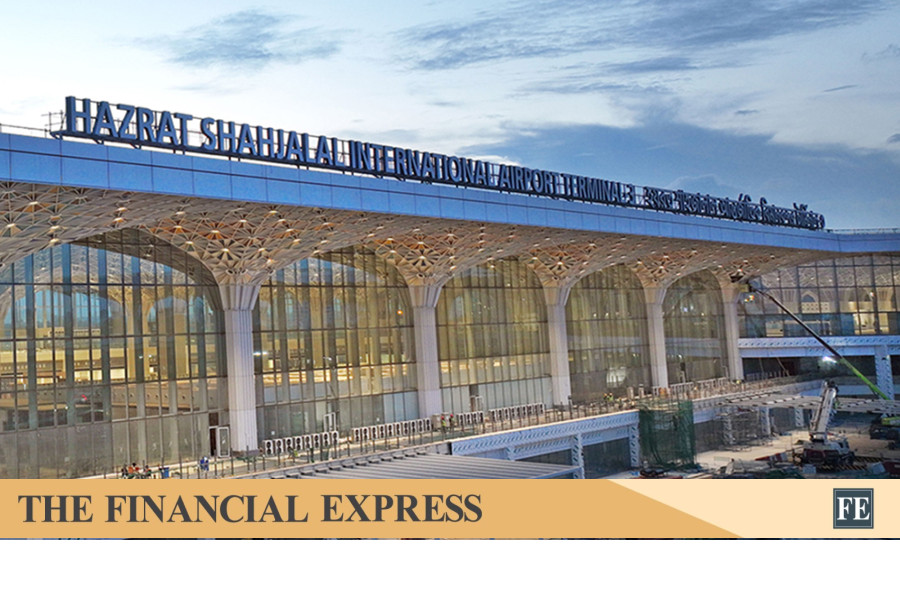
Bangladesh's aviation sector has reached a significant milestone as five of the world's leading airport service providers compete to operate at Hazrat Shahjalal International Airport's (HSIA) Third Terminal, reflecting growing global confidence in the country's ambition to emerge as a regional aviation hub.

For the first time since Bangladesh's independence, internationally renowned airport service companies are seeking entry into the country's ground handling market following the Civil Aviation Authority of Bangladesh's (CAAB) decision to appoint a second passenger ground handling operator at the Third Terminal.

A senior CAAB official involved in the negotiations confirmed to BSS here recently that a second operator would be appointed for passenger-related ground services, while cargo handling at the new terminal would remain exclusively under Biman Bangladesh Airlines.

"The second handler will be limited to passenger and ground handling activities. Cargo handling will remain solely with Biman," the official said.

Industry experts viewed the development as a strong endorsement of Bangladesh's expanding aviation industry, driven by sustained passenger growth, major infrastructure investments and increasing international connectivity.

Among the contenders are- UK-based Menzies Aviation, Switzerland's Swissport, Türkiye's Çelebi Aviation Holding, UAE-based data, part of the Emirates Group, and Singapore's SATS, all globally recognised airport service providers.

Former CAAB Chairman Air Vice-Marshal (retd.) Muhammad Mafidur Rahman said Bangladesh had rarely attracted simultaneous interest from so many international aviation companies, highlighting the country's growing strategic importance in South Asian aviation.

Diplomatic interest underscores confidence

Over recent months, ambassadors from the United Kingdom, Switzerland, Türkiye and the United Arab Emirates have separately discussed their respective companies' interests with Bangladesh's aviation leadership.

"Such diplomatic engagement reflects the commercial importance attached to Bangladesh's expanding aviation market and the confidence international investors have in the country's long-term growth prospects," Rahman said.

A landmark reform

The Third Terminal represents a major policy shift as it introduces competition in passenger ground handling after decades of Biman Bangladesh Airlines' exclusive responsibility.

Ground handling includes aircraft servicing, baggage management, passenger check-in, ramp operations and aircraft turnaround services that directly influence operational efficiency and passenger experience.

Foreign airlines have long advocated greater competition, arguing that it would improve service quality, reduce turnaround times and align Bangladesh with international standards.

Managing Director of Novoair and Secretary General of the Airline Operators Association of Bangladesh (AOAB) Mofizur Rahman welcomed the decision.

"I think the issue deserves careful consideration, even if it is addressed at a later stage. For now, however, I am happy that competition is at least being introduced in passenger handling services," he said.

Noted aviation entrepreneur and Chairman of TAS Aviation Group K M Mozibul Hoque also described the global interest as a positive sign.

"Cargo villages and ground handling operations both should be managed by internationally experienced operators," he said.

"Ownership may remain with the government, but operations should be entrusted to proven global companies. Professional operators can improve efficiency, safety, compliance and service quality while transferring knowledge to local manpower," he added.

While welcoming competition in passenger handling, industry stakeholders questioned the decision to retain Biman as the sole cargo handler at the Third Terminal's automated Cargo Village.

"There are sufficient questions about whether Biman's cargo handling is up to international standards. There are serious concerns regarding both capability and integrity," Mofizur Rahman said.

Former CAAB Chairman Mafidur Rahman also suggested that international expertise could help maximise the benefits of the terminal's advanced cargo systems.

"The equipment installed is state-of-the-art and requires experienced operators," he said.

"It would have been better if an experienced international operator had worked alongside Biman initially so that knowledge could be transferred before moving to a fully local operation."

However, he remained optimistic, saying: "There is nothing to be disappointed about it. If expert professionals are utilised properly, the aviation sector will gain new dynamism."

Biman expresses confidence

General Manager (Public Relations) Boshra Islam told BSS that Biman has already procured the required ground handling equipment and recruited more than 1,000 additional personnel for the Third Terminal.

"We are ready to conduct passenger and cargo handling operations at the Third Terminal," she said.

She added that Biman is working with the Japanese consortium on cargo handling arrangements and has not yet received any official communication regarding the appointment of a second passenger ground handler.

A Japanese consortium comprising Japan Airport Terminal Company, Sumitomo Corporation, Nippon Koei and Narita International Airport Corporation is set to assume operation and maintenance responsibilities for HSIA's Third Terminal after the signing of the final agreement.​
 

Global aviation giants eye Bangladesh's airport transformation

BSS

Published :
Jul 01, 2026 12:11
Updated :
Jul 01, 2026 12:11

View attachment 28007

Bangladesh's aviation sector has reached a significant milestone as five of the world's leading airport service providers compete to operate at Hazrat Shahjalal International Airport's (HSIA) Third Terminal, reflecting growing global confidence in the country's ambition to emerge as a regional aviation hub.

For the first time since Bangladesh's independence, internationally renowned airport service companies are seeking entry into the country's ground handling market following the Civil Aviation Authority of Bangladesh's (CAAB) decision to appoint a second passenger ground handling operator at the Third Terminal.

A senior CAAB official involved in the negotiations confirmed to BSS here recently that a second operator would be appointed for passenger-related ground services, while cargo handling at the new terminal would remain exclusively under Biman Bangladesh Airlines.

"The second handler will be limited to passenger and ground handling activities. Cargo handling will remain solely with Biman," the official said.

Industry experts viewed the development as a strong endorsement of Bangladesh's expanding aviation industry, driven by sustained passenger growth, major infrastructure investments and increasing international connectivity.

Among the contenders are- UK-based Menzies Aviation, Switzerland's Swissport, Türkiye's Çelebi Aviation Holding, UAE-based data, part of the Emirates Group, and Singapore's SATS, all globally recognised airport service providers.

Former CAAB Chairman Air Vice-Marshal (retd.) Muhammad Mafidur Rahman said Bangladesh had rarely attracted simultaneous interest from so many international aviation companies, highlighting the country's growing strategic importance in South Asian aviation.

Diplomatic interest underscores confidence

Over recent months, ambassadors from the United Kingdom, Switzerland, Türkiye and the United Arab Emirates have separately discussed their respective companies' interests with Bangladesh's aviation leadership.

"Such diplomatic engagement reflects the commercial importance attached to Bangladesh's expanding aviation market and the confidence international investors have in the country's long-term growth prospects," Rahman said.

A landmark reform

The Third Terminal represents a major policy shift as it introduces competition in passenger ground handling after decades of Biman Bangladesh Airlines' exclusive responsibility.

Ground handling includes aircraft servicing, baggage management, passenger check-in, ramp operations and aircraft turnaround services that directly influence operational efficiency and passenger experience.

Foreign airlines have long advocated greater competition, arguing that it would improve service quality, reduce turnaround times and align Bangladesh with international standards.

Managing Director of Novoair and Secretary General of the Airline Operators Association of Bangladesh (AOAB) Mofizur Rahman welcomed the decision.

"I think the issue deserves careful consideration, even if it is addressed at a later stage. For now, however, I am happy that competition is at least being introduced in passenger handling services," he said.

Noted aviation entrepreneur and Chairman of TAS Aviation Group K M Mozibul Hoque also described the global interest as a positive sign.

"Cargo villages and ground handling operations both should be managed by internationally experienced operators," he said.

"Ownership may remain with the government, but operations should be entrusted to proven global companies. Professional operators can improve efficiency, safety, compliance and service quality while transferring knowledge to local manpower," he added.

While welcoming competition in passenger handling, industry stakeholders questioned the decision to retain Biman as the sole cargo handler at the Third Terminal's automated Cargo Village.

"There are sufficient questions about whether Biman's cargo handling is up to international standards. There are serious concerns regarding both capability and integrity," Mofizur Rahman said.

Former CAAB Chairman Mafidur Rahman also suggested that international expertise could help maximise the benefits of the terminal's advanced cargo systems.

"The equipment installed is state-of-the-art and requires experienced operators," he said.

"It would have been better if an experienced international operator had worked alongside Biman initially so that knowledge could be transferred before moving to a fully local operation."

However, he remained optimistic, saying: "There is nothing to be disappointed about it. If expert professionals are utilised properly, the aviation sector will gain new dynamism."

Biman expresses confidence

General Manager (Public Relations) Boshra Islam told BSS that Biman has already procured the required ground handling equipment and recruited more than 1,000 additional personnel for the Third Terminal.

"We are ready to conduct passenger and cargo handling operations at the Third Terminal," she said.

She added that Biman is working with the Japanese consortium on cargo handling arrangements and has not yet received any official communication regarding the appointment of a second passenger ground handler.

A Japanese consortium comprising Japan Airport Terminal Company, Sumitomo Corporation, Nippon Koei and Narita International Airport Corporation is set to assume operation and maintenance responsibilities for HSIA's Third Terminal after the signing of the final agreement.​

I believe Japanese management will bring a new standard of efficiency to Dhaka Shahjalal Airport operations - and no doubt the Japanese will charge a pretty penny for this. But expensive or not - Biman needs this training to up their standards to DNATA or EU levels.

Biman even after fifty years are totally inept and clueless on running a modern airport, much less run an airline or flight kitchen. They need serious hand-holding on outsourced,
  1. 1. aircraft ground handling,
  2. 2. cargo transport (for garments exports to start with), and
  3. 3. airline meal catering standards.
I saw on the news that some passenger found a bug in Biman's catered food. This is disgusting for an International airline.

While this happens quite often in India (and even worse things I guess), Indian airlines cannot be our benchmark for anything. Japanese or DNATA benchmark is much better to aim for.
 
Last edited:

Karnaphuli Tunnel: Govt aims to offset toll deficit by leasing out luxury guesthouse

Anowar Hossain

Dhaka

1783641230358.webp


The luxury guest house built under the Bangabandhu Tunnel project in Chattogram. The facility is located on the seafront near Parki Beach in Anwara, Chattogram. Prothom Alo file photo

A luxury guest house built under the Tk 100 billion Karnaphuli Tunnel project has remained unused since its completion, while the tunnel itself is struggling to generate enough toll revenue to cover maintenance costs.

After failing twice to attract suitable bids, the Bridges Division is making another attempt to lease out the facility.

The Karnaphuli Tunnel beneath the Karnaphuli River in Chattogram was inaugurated in October 2023 during the rule of Awami League (whose activities now banned). As part of the same project, a 72-acre service area was developed beside Parki Canal in Anwara, where the guest house is located.

Despite being completed, the guest house has never been opened. Bridges Division officials attribute the delay to a shortage of manpower.

What is inside the guesthouse?

The service area, which was added to the project midway through implementation, includes a guest house, bungalows, rest houses, a replica of the tunnel, a convention centre, a health centre, a helipad, a mosque, police and fire service stations, and a museum.

The facilities are equipped with air-conditioning systems with a combined capacity of 1,182 tonnes.

The guest house features a modern, fully furnished 5,000-square-foot bungalow with six rooms and a swimming pool. The complex also includes 30 rest houses.

According to the Bridges Division sources, the guest house was built with the expectation that then-prime minister Sheikh Hasina would stay there during visits to the project.

Around Tk 450 million was spent on constructing the service area, which the government is now seeking to lease out.

Bridges Division Secretary Mohammad Abdur Rouf told Prothom Alo that the initiative to lease out the guesthouse was taken with the aim of increasing revenue from the tunnel project.

He said an income target has been set, taking into account the costs incurred for their construction. If appropriate bids are received accordingly, the facility will be leased out for a period of 29 years.

Bids fall short of expectations

Following the ouster of the Awami League in the 2024 mass uprising, the interim government took office and decided to boost revenue by leasing out the tunnel project installations, including the guesthouse.

International tenders were called twice in July and September last year to lease the guesthouse for a 29-year term. However, no foreign firms responded. While two or three local companies expressed interest, their proposed bids were lower than the Bridge Authority's estimated value and were subsequently rejected.

1783641302170.webp

Swimming pool of the luxury guesthouse built under the Karnaphuli Tunnel project in Chattogram. File photo: Prothom Alo

A third round of tendering has been initiated this year. The deadline for the submission and opening of these bids is 13 July. Only then will it become clear which institution is offering what amount to secure the lease.

Bridges Division sources revealed that 13 domestic and foreign companies have purchased tender documents in this round so far. These include JS Trade International, Chittagong Asian Apparels, LV Structure, ATN Homes, The Cox Today, Sweet Dream Management, Richmond Hotel and Suite, Khan Properties (USA), Unique Hotel and Resorts, Irving Hotel and Hospitality and Best Holding.

According to the tender conditions, the selected lessee will receive the guesthouse facilities on an ‘as-is’ basis. Under the agreement, the lessee will be responsible for the operation and maintenance of the property and must pay the rent in a minimum of four annual installments.

Maintenance costs outweigh revenue

The gap between the projected potential of the tunnel and the current reality is staggering.

The project’s initial feasibility study estimated that an average of 28,350 vehicles would use the tunnel daily by 2025. Currently, that number hovers around only 4,000, just 14 per cent of the initial forecast. The study had also indicated that the tunnel would become profitable if it handled at least 17,375 vehicles per day.

1783641350494.webp

The Karnaphuli Tunnel in Chattogram. File photo: Prothom Alo

At present, the tunnel generates around Tk 30 million in toll revenue each month, while monthly payments to the maintenance contractor amount to about Tk 115 million, leaving an average monthly deficit of roughly Tk 80 million.

A recent impact assessment report by the Implementation Monitoring and Evaluation Division (IMED) warned that increasing toll rates would not solve the crisis. To tap into the tunnel’s full potential, the report recommended integrated planning, accelerated industrialisation and improved transportation systems.

For the tunnel to become economically sustainable, the government must rapidly develop port-based industries at the Anwara end and ensure coordination among the authorities managing the Karnaphuli Dry Dock, China EPZ and Korean EPZ.

On 9 June, the Executive Committee of the National Economic Council (ECNEC), chaired by Prime Minister Tarique Rahman, approved a Tk 11.83 billion regional highway development project. Officials expect the project to improve connectivity to the tunnel.

According to the Roads and Highways Department, once implemented, the project will create a new economic corridor linking southern Chattogram with Cox's Bazar and Matarbari in Maheshkhali via the Karnaphuli Tunnel. It is expected to shorten the Chattogram–Cox's Bazar road route by about 40 kilometres and reduce travel time by around one hour.

Construction at a massive cost

The previous Awami League government undertook the Karnaphuli Tunnel project with the vision of transforming the port city into a ‘One City, Two Towns’ model, similar to China’s Shanghai. The tunnel connects Patenga with Anwara upazila in South Chattogram.

The project was implemented under a government-to-government (G2G) agreement with Chinese funding and constructed by a Chinese firm.

Although approved in November 2015, construction only began two years later due to delays in finalizing the loan agreement with China.

1783641442424.webp

Karnaphuli Tunnel. File photo: Prothom Alo

Initially, the project cost was estimated at Tk 8,446 crore. In 2020, the budget was increased to Tk 9,880 crore, citing rising land acquisition costs, higher duties and taxes and the relocation of utility lines. In 2021, authorities approved an emergency increase of another Tk 494 crore, bringing the total to Tk 10,374 crore.

According to Bridges Division sources, the second emergency cost hike was implemented specifically after the decision to build the 'Service Area' and guesthouse. A further increase of Tk 315 crore was approved in January last year.

While fluctuations in foreign exchange rates were cited as a factor, officials revealed that a primary reason for the surging costs was the procurement of high-end utensils, electronics, furniture and interior decoration for the guesthouse. Ultimately, the total cost of the tunnel project reached Tk 10,689 crore.​
 

Latest Posts

Back