


 Iranian Defense
Saif
Senior Member
- Joined
- Jan 24, 2024
- Messages
- 21,384
- Likes
- 9,715
- Nation

- Residence
- Axis Group

The US push for regime change in Iran
The question isn't whether US will be pressured to fight Israel's war on ground; it's whether any force in American politics can resist that pressure
 en.prothomalo.com
The US push for regime change in Iran
Mohammad Abdur Razzak
Published: 24 Feb 2026, 12: 55

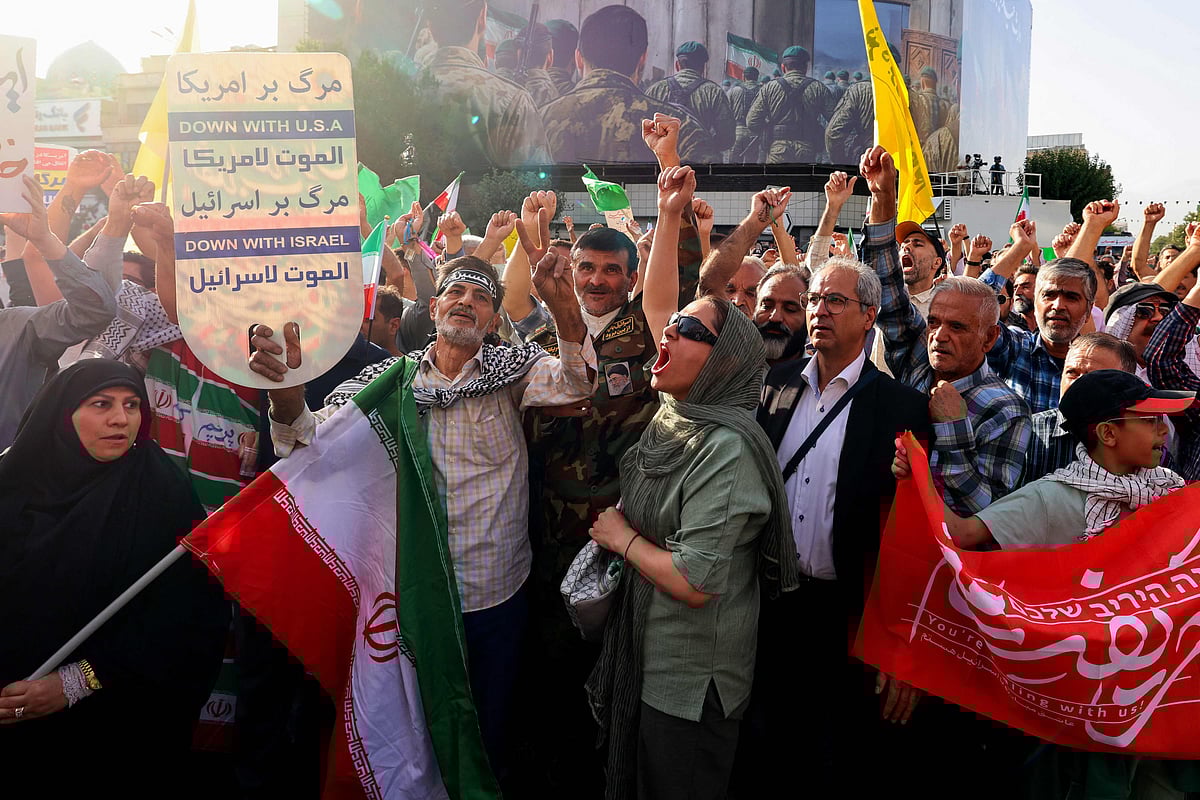
Iranians lift flags and placards during a rally protesting the US attack on Iran in Enghelab Square in Tehran on 22 June 2025. AFP
The B-2 Spirit bombers that struck Iran's nuclear facilities on 22 June 2025, delivered more than bunker-busting munitions into the fortified centrifuges of Natanz and Fordow. They delivered an answer to a question that has haunted the Middle East for two decades: Would the United States finally fight Israel's war against Iran?
The bombs that shattered not only Iran's nuclear infrastructure but also shattered the illusion that this conflict could be resolved from the air, at stand-off distance, without the return of American ground troops to a Middle Eastern quagmire. The developing situation has entered the most dangerous phase of a political crisis.
The architecture of escalation, built over years of failed diplomacy, Israeli strategic impatience, and American political captivity to pro-Israel lobbying, now stands fully revealed. Yet as the dust settles over Iran''s destroyed facilities, a more terrifying question emerges: Can the United States achieve regime change without committing ground troops, and if it does, what manner of chaos awaits?
The limits of air power
The initial American-Israeli campaign followed a familiar playbook—the playbook of shock and awe that began in Iraq in 2003, was refined in Libya in 2011. The logic is seductive: precision munitions delivered from beyond reach can decapitate command structures and degrade military capacity until the target regime collapses.
This logic did not survive with reality. Iraq''''s Saddam Hussein did not fall to bombs; he fell to 160,000 American ground troops and nine years of occupation. Libya's Muammar Gaddafi was not removed by airstrikes alone; he was dragged from a ditch by militias that NATO trained and armed.
The Islamic Republic of Iran is unlike Iraq, Libya or Syria. It is a nation of 88 million people, a civilization with 2,500 years of continuous statehood, a topography of mountains and deserts that has swallowed invaders from Alexander to Saddam. Its military doctrine is explicitly designed to survive and retaliate against precisely the kind of air campaign now underway.
Within 72 hours of the Israeli strike in June 2025, Iran launched Operation True Promise II with ballistic missiles, cruise missiles, and drones toward Israeli territory. Israel's air defence network, the most sophisticated ever assembled, performed miracles. But miracles have limits. Missiles went through. The Nevatim airbase took direct hits. Civilian casualties mounted. And the economic cost was staggering: Israel's attack cost approximately $5 billion. Iran's retaliation cost perhaps $200 million.
The ground question
This is the question now facing Washington: Can air power alone achieve what air power alone has never achieved?
The official objective is to "degrade Iran's capacity threatening regional stability." But the unspoken objective, the one whispered in Tel Aviv, is regime change. And regime change, as every strategist from Sun Tzu to Clausewitz to Petraeus has understood, requires the occupation of territory and the imposition of will through ground forces.
What would it take to conquer Iran? The 2003 invasion of Iraq, a country of 26 million divided along Shia and Sunni sect and with flat terrain, required 160,000 American troops at its peak and still resulted in eight years of counterinsurgency. Iran has over three times Iraq's population, four times its area, ten times its defensive depth. The force required to invade and occupy Iran could be measured hundreds of thousand.
Yet the military requirements, daunting as they are, may be less prohibitive than the political ones. The memory of Iraq and Afghanistan—two decades of war that cost over 7,000 American lives, 50,000 wounded, tens of thousands traumatized pushing up the rate of suicide, and $8 trillion—is not a memory to be overcome but a trauma deeply embedded in the American body politic.
President Donald Trump, who campaigned on ending wars, now confronts the irony of history: the leader who promised to end endless wars may be the one to start the most consequential war since Vietnam.
The Israeli calculus
And yet—the pressure on Washington to commit those troops grows daily. Benjamin Netanyahu, whose political survival has always depended on war, now depends on this war becoming America's war. His strategy, articulated in the 1996 "Clean Break" document and pursued relentlessly ever since, has always been to entangle the United States so deeply in Israel's conflicts that America’s withdrawal becomes impossible.
Israeli officials argue that air power alone cannot finish the job. They point to Iran's dispersed nuclear program, its underground facilities, its mobile missile launcher that cannot be destroyed from the air but must be seized on the ground. They plead for American troops to do what American air power cannot.
And the American political system, captured by pro-Israel lobbying in ways that make independent decision-making impossible, now mobilizes to demand ground intervention. The American Israel Public Affairs Committee (AIPAC) and its allied organizations, which spent over millions in the 2024 election cycle, fund the campaigns of virtually every member of Congress, now press for war.
The regional cascade
If American ground troops enter Iran, the consequences will cascade across the region. Iran's nuclear program, dispersed and hidden, would become a resistance project—decentralised, covert, seeking to produce a single device. If Iran succeeds, Saudi Arabia will immediately pursue its own weapon, then Turkey, then Egypt. The Middle East would become a nuclear-armed region, its security dilemmas intensified beyond recognition.
The global economy would shatter. The Strait of Hormuz, through which 20 per cent of the world's oil passes, would be closed. Oil prices would spike to levels not seen since the 1970s, triggering inflation, recession, and social unrest worldwide.
The reckoning
The United States that would emerge from a ground war in Iran is not the United States that entered it. Thousands of Americans dead. Trillions of dollars in war spending. A domestic consensus shattered. A global standing collapsed.
The greatest tragedy is that this catastrophe is entirely avoidable. The United States did not need to fight Israel's war. It could have pursued diplomacy, offering Iran the security guarantees that would make nuclear weapons unnecessary. It could have restrained Israel, using the leverage of military aid to prevent provocations.
Instead, it chose escalation. It chose war. It chose to fight for Israel's interests rather than its own, to bleed for a partner that has manipulated American politics for decades.
The paradox is that the United States, in fighting this war, undermines everything it claims to seek. It seeks to prevent a nuclear Iran, but its actions guarantee that Iran will pursue nuclear weapons with redoubled determination. It seeks to protect Israel, but its actions expose Israel to threats that did not exist before.
The question is no longer whether the United States will be pressured to fight Israel's war on the ground. The question is whether any force in American politics can resist that pressure?
* Mohammad Abdur Razzak, a retired Commodore of Bangladesh Navy, is a security analyst.
Mohammad Abdur Razzak
Published: 24 Feb 2026, 12: 55
Iranians lift flags and placards during a rally protesting the US attack on Iran in Enghelab Square in Tehran on 22 June 2025. AFP
The B-2 Spirit bombers that struck Iran's nuclear facilities on 22 June 2025, delivered more than bunker-busting munitions into the fortified centrifuges of Natanz and Fordow. They delivered an answer to a question that has haunted the Middle East for two decades: Would the United States finally fight Israel's war against Iran?
The bombs that shattered not only Iran's nuclear infrastructure but also shattered the illusion that this conflict could be resolved from the air, at stand-off distance, without the return of American ground troops to a Middle Eastern quagmire. The developing situation has entered the most dangerous phase of a political crisis.
The architecture of escalation, built over years of failed diplomacy, Israeli strategic impatience, and American political captivity to pro-Israel lobbying, now stands fully revealed. Yet as the dust settles over Iran''s destroyed facilities, a more terrifying question emerges: Can the United States achieve regime change without committing ground troops, and if it does, what manner of chaos awaits?
The limits of air power
The initial American-Israeli campaign followed a familiar playbook—the playbook of shock and awe that began in Iraq in 2003, was refined in Libya in 2011. The logic is seductive: precision munitions delivered from beyond reach can decapitate command structures and degrade military capacity until the target regime collapses.
This logic did not survive with reality. Iraq''''s Saddam Hussein did not fall to bombs; he fell to 160,000 American ground troops and nine years of occupation. Libya's Muammar Gaddafi was not removed by airstrikes alone; he was dragged from a ditch by militias that NATO trained and armed.
The Islamic Republic of Iran is unlike Iraq, Libya or Syria. It is a nation of 88 million people, a civilization with 2,500 years of continuous statehood, a topography of mountains and deserts that has swallowed invaders from Alexander to Saddam. Its military doctrine is explicitly designed to survive and retaliate against precisely the kind of air campaign now underway.
Within 72 hours of the Israeli strike in June 2025, Iran launched Operation True Promise II with ballistic missiles, cruise missiles, and drones toward Israeli territory. Israel's air defence network, the most sophisticated ever assembled, performed miracles. But miracles have limits. Missiles went through. The Nevatim airbase took direct hits. Civilian casualties mounted. And the economic cost was staggering: Israel's attack cost approximately $5 billion. Iran's retaliation cost perhaps $200 million.
The ground question
This is the question now facing Washington: Can air power alone achieve what air power alone has never achieved?
The official objective is to "degrade Iran's capacity threatening regional stability." But the unspoken objective, the one whispered in Tel Aviv, is regime change. And regime change, as every strategist from Sun Tzu to Clausewitz to Petraeus has understood, requires the occupation of territory and the imposition of will through ground forces.
What would it take to conquer Iran? The 2003 invasion of Iraq, a country of 26 million divided along Shia and Sunni sect and with flat terrain, required 160,000 American troops at its peak and still resulted in eight years of counterinsurgency. Iran has over three times Iraq's population, four times its area, ten times its defensive depth. The force required to invade and occupy Iran could be measured hundreds of thousand.
Yet the military requirements, daunting as they are, may be less prohibitive than the political ones. The memory of Iraq and Afghanistan—two decades of war that cost over 7,000 American lives, 50,000 wounded, tens of thousands traumatized pushing up the rate of suicide, and $8 trillion—is not a memory to be overcome but a trauma deeply embedded in the American body politic.
President Donald Trump, who campaigned on ending wars, now confronts the irony of history: the leader who promised to end endless wars may be the one to start the most consequential war since Vietnam.
The Israeli calculus
And yet—the pressure on Washington to commit those troops grows daily. Benjamin Netanyahu, whose political survival has always depended on war, now depends on this war becoming America's war. His strategy, articulated in the 1996 "Clean Break" document and pursued relentlessly ever since, has always been to entangle the United States so deeply in Israel's conflicts that America’s withdrawal becomes impossible.
Israeli officials argue that air power alone cannot finish the job. They point to Iran's dispersed nuclear program, its underground facilities, its mobile missile launcher that cannot be destroyed from the air but must be seized on the ground. They plead for American troops to do what American air power cannot.
And the American political system, captured by pro-Israel lobbying in ways that make independent decision-making impossible, now mobilizes to demand ground intervention. The American Israel Public Affairs Committee (AIPAC) and its allied organizations, which spent over millions in the 2024 election cycle, fund the campaigns of virtually every member of Congress, now press for war.
The regional cascade
If American ground troops enter Iran, the consequences will cascade across the region. Iran's nuclear program, dispersed and hidden, would become a resistance project—decentralised, covert, seeking to produce a single device. If Iran succeeds, Saudi Arabia will immediately pursue its own weapon, then Turkey, then Egypt. The Middle East would become a nuclear-armed region, its security dilemmas intensified beyond recognition.
The global economy would shatter. The Strait of Hormuz, through which 20 per cent of the world's oil passes, would be closed. Oil prices would spike to levels not seen since the 1970s, triggering inflation, recession, and social unrest worldwide.
The reckoning
The United States that would emerge from a ground war in Iran is not the United States that entered it. Thousands of Americans dead. Trillions of dollars in war spending. A domestic consensus shattered. A global standing collapsed.
The greatest tragedy is that this catastrophe is entirely avoidable. The United States did not need to fight Israel's war. It could have pursued diplomacy, offering Iran the security guarantees that would make nuclear weapons unnecessary. It could have restrained Israel, using the leverage of military aid to prevent provocations.
Instead, it chose escalation. It chose war. It chose to fight for Israel's interests rather than its own, to bleed for a partner that has manipulated American politics for decades.
The paradox is that the United States, in fighting this war, undermines everything it claims to seek. It seeks to prevent a nuclear Iran, but its actions guarantee that Iran will pursue nuclear weapons with redoubled determination. It seeks to protect Israel, but its actions expose Israel to threats that did not exist before.
The question is no longer whether the United States will be pressured to fight Israel's war on the ground. The question is whether any force in American politics can resist that pressure?
* Mohammad Abdur Razzak, a retired Commodore of Bangladesh Navy, is a security analyst.


