Donate ☕
[🇧🇩] - Israel and Hamas war in Gaza-----Can Bangladesh be a peace broker? | Page 135 | PKDefense

[🇧🇩] Israel and Hamas war in Gaza-----Can Bangladesh be a peace broker?

Reply (Scroll)
Press space to scroll through posts
G Bangladesh Defense
[🇧🇩] Israel and Hamas war in Gaza-----Can Bangladesh be a peace broker?
944
24K
More threads by Saif


Rubio says US sanctioning ICC judges for targeting Israel

REUTERS
Published :
Dec 18, 2025 23:28
Updated :
Dec 18, 2025 23:28

1766103930198.webp

US Secretary of State Marco Rubio speaks during a US-Paraguay Status of Forces agreement signing ceremony at the State Department in Washington, DC, US, Dec 15, 2025. Photo : REUTERS/Kevin Mohatt

US Secretary of State Marco Rubio said on Thursday that the US was sanctioning two judges of the International Criminal Court for targeting Israel.

"Today, I am designating two International Criminal Court (ICC) judges, Gocha Lordkipanidze of Georgia and Erdenebalsuren Damdin of Mongolia, pursuant to Executive Order 14203," Rubio said in a statement, referring to the order President Donald Trump signed in February sanctioning the ICC.

"These individuals have directly engaged in efforts by the ICC to investigate, arrest, detain, or prosecute Israeli nationals, without Israel's consent," he said.

The United States and Israel are not members of the ICC.

The US sanctions in February include freezing any US assets of those designated and barring them and their families from visiting the United States.​
 
Analyze

Analyze Post

Add your ideas here:
Cite Fact Check Highlight Respond

Gazans fear renewed displacement after Israeli strikes
AFP Khan Yunis, Palestinian Territories
Published: 23 Dec 2025, 14: 25

1766536346936.webp

Palestinian children sit by tents at a makeshift displacement camp set up amid building rubble in Gaza City on 12 May 2025 AFP

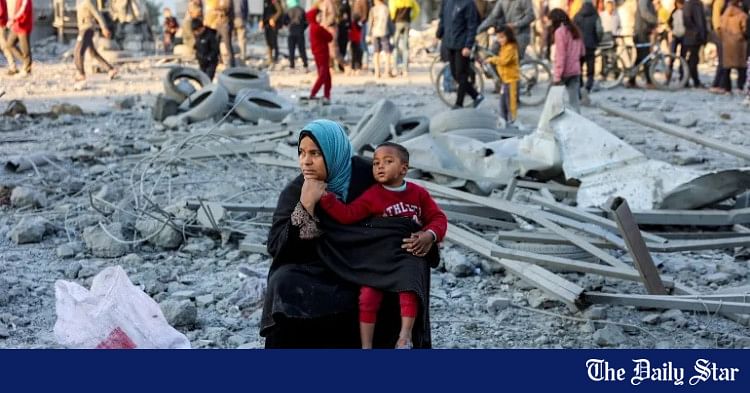
When her children, trembling with fear, ask where the family can go to escape Israel’s continued bombardment in southern Gaza’s Khan Yunis area, Umm Ahmed has no answer.

In her small, devastated village near Khan Yunis city, recent Israeli drone and artillery strikes shattered the tenuous sense of peace delivered by a ceasefire that has largely held since 10 October.

Residents say the strikes have targeted neighbourhoods east of the so-called Yellow Line—a demarcation established under the truce between Israel and Hamas.

The Israeli military says its troops are deployed in the area in accordance with the ceasefire framework, accusing Hamas militants of “crossing the Yellow Line and carrying out terrorist activities”.

More than two years after Hamas’s 7 October attack on Israel sparked a devastating war, tens of thousands of Gazans still live in tents or damaged homes in these areas, where the Israeli army maintains control and operates checkpoints.

Now, many fear being forced from their homes, compelled to move west of the Yellow Line.

“We don’t sleep at night because of fear. The bombardments in the east are relentless,” said Umm Ahmed, 40.

“My children tremble at every explosion and ask me, ‘Where can we go?’ And I have no answer.”

Her home in Bani Suheila has been completely destroyed, yet the family has stayed, pitching a tent beside the ruins.

“Staying close to our destroyed home is easier than facing the unknown,” Umm Ahmed said.

Crossing the Yellow Line to Al-Mawasi, west of Khan Yunis, is not an option for them.

There, makeshift camps stretch as far as the eye can see, housing tens of thousands of Palestinians who fled the fighting.

“There is no place left for anyone there, and not enough food or water,” Umm Ahmed said, as Gaza remains trapped in a catastrophic humanitarian crisis.

‘We will not leave’

The Israeli military blames continued threats from Hamas militants for its actions in the area.

“The IDF’s current operations in Gaza, and their deployment in the Yellow Line area in particular, are carried out to address direct threats from terrorist organisations in Gaza,” the Israeli military said in a statement to AFP.

The war in Gaza began with Hamas’s attack on Israel on 7 October, 2023 that resulted in the deaths of 1,221 people, mostly civilians, according to an AFP tally based on official Israeli figures.

Since the war began, more than 70,000 people have been killed in Gaza, according to the Hamas-run territory’s health ministry.

The vast majority of Gaza’s more than two million residents were displaced during the war, many multiple times.

A fragile ceasefire has been in place since 10 October, though both sides regularly accuse each other of violations.

Under the truce, Israeli forces withdrew to positions east of the Yellow Line.

Earlier this month, Israeli army chief Lieutenant General Eyal Zamir described the Yellow Line as the “new border line” with Israel.

“The Yellow Line is a new border line—serving as a forward defensive line for our communities and a line of operational activity,” he said to reserve soldiers in Gaza.

For Palestinian officials, the line is seen as a tool for permanent displacement.

“The objective is to frighten residents, expel them from their areas, and force them west,” said Alaa al-Batta, mayor of Khan Yunis, denouncing the bombardments as “violations of the ceasefire agreement”.

Mahmud Baraka, 45, from Khuzaa, east of Khan Yunis, described constant artillery fire and home demolitions in the area.

“It feels like we are still living in a war zone,” he said.

“Explosions happen as if they are right next to us. The objective of the occupation is clear: to intimidate us and drive us out, so the region is emptied.”

For now, residents feel trapped between bombardment and displacement, uncertain how long they can endure.

Despite the danger, Abdel Hamid, 70, refuses to leave his home located north of Khan Yunis, where he lives with his five children.

“We will not leave... this is our land,” he said.

“Moving would not be a solution, but yet another tragedy.”​
 
Analyze

Analyze Post

Add your ideas here:
Cite Fact Check Highlight Respond

The peace promise of ceasefire is but a mirage for Palestinians

1766625325191.webp

In recent weeks, heavy rains caused many damaged buildings to collapse on families inside in war-ravaged Gaza. FILE PHOTO: REUTERS

The bombs may have eased, but Palestinian children are still dying. This time, not by Israeli airstrikes, but from cold and collapsing damaged structures. Israel has violated the ceasefire agreement by obstructing the entry of vital services for children, and essential shelters to protect civilians whose homes were destroyed by two years of genocide. A war crime by other means: slower, less visible, but more excruciating death delivered through deprivation and exposure.

In recent weeks, heavy rains have inundated Gaza's tent camps, flooding makeshift shelters and causing damaged buildings to collapse on families inside. Adequate shelter is unavailable because Israel has blocked its entry at the Rafah crossing. At least 16 Palestinians, including infants, have died as a direct result of these storms. Amnesty International rightly described this as an "utterly preventable tragedy." It was not bad weather that killed these children, but Israel's violation of the ceasefire terms.

After more than two months of ceasefire noncompliance, Israel has killed and injured more than 400 Palestinians, and continues to severely restrict aid and critical supplies needed to repair the water and sewer infrastructure system. This persists despite an International Court of Justice advisory opinion affirming Israel's obligations as an occupying power, and a UN General Assembly resolution demanding compliance. The reality on the ground tells a different story: the United Nations Relief and Works Agency for Palestine Refugees in the Near East (UNRWA) alone has shelter supplies for up to 1.3 million people waiting outside Gaza, barred from entry.

After repeated displacement, the destruction or damage of at least 92 percent of Gaza's structures, and the designation of most of the territory as no-go zones, most Palestinians are now living in dilapidated tents or taking shelter under dangling concrete slabs. Israel first weaponised food to break Palestinian resistance; now its strategy has turned nature into a new weapon of war.

Amnesty investigators documented buildings collapsing in Jabalia, al-Rimal, Sheikh Radwan, and al-Shati refugee camp, crushing entire families. Mohammed Nassar lost two children, Lina and Ghazi, when their damaged five-storey building crumpled under the storm. They had fled Israeli airstrikes twice. After two years of genocide, they returned to their destroyed home, believing its sagging concrete roof would be safer than a tent flooded by rain. Instead, it collapsed, crushing them beneath it. He mourned that his children had survived the bombardment only to be killed by a storm.

UNRWA had warned over a month earlier of a harsh winter, "More shelter supplies are urgently needed for the people of Gaza. UNRWA has them outside, waiting for the green light." Those warnings fell on deaf ears, and heartless consciences.

This is what the US President Donald Trump's mediated ceasefire looks like when the blockade remains intact. Amnesty International's conclusion was unequivocal. Israel is continuing to deliberately inflict conditions of life calculated to bring about the physical destruction of Palestinians in Gaza. Israel's objectives remained unchanged, if bombs and destruction do not make Gaza unliveable, nature would be allowed to complete the job.

Amid an unfolding tragedy, and babies freezing to death, Trump speaks of bringing "peace" to the Middle East "for the first time in 3,000 years." Absurd on its face, the statement is nonetheless revealing. For Trump, and for a wider political culture that has come to accept such logic, "peace" prevails so long as the victims are not Israeli Jews.

Infants freezing to death in Gaza does not upset that false 'peace' narrative. It is only Israeli Jewish lives that appear to count as a measure of instability. Death is rendered invisible when it is asymmetrically borne, and peace is redefined as the absence of discomfort, for Israelis only.

The same Zionist savagery is at work in the occupied West Bank. As Gaza drowns, bulldozers tear through Palestinian refugee camps, and Jewish mobs set fire to homes and olive groves across the West Bank. In Nur Shams camp, near Tulkarem, the Israeli military has issued new orders to demolish 25 more Palestinian homes. Palestinian leaders and UNRWA warn that hundreds face imminent forced displacement, 77 years after their first expulsion from their original homes in historic Palestine.

The demolition of Palestinian homes coincides with the approval of new Jewish-only colonies. Where are these refugees expected to go? Their land was stolen in 1948, and they have neither the financial means nor the ability to resettle elsewhere in Palestine. Meanwhile, the Israeli government continues to expropriate what little land remains for Jewish-only use, while systematically denying building permits to non-Jews.

In Gaza, displacement is enforced by siege; in the West Bank, by demolition and land theft, both carried out by the same malevolent power. In each case, only Palestinians pay the price under the so-called "peace."

International humanitarian law is clear. Israel as an occupying power must ensure access to food, shelter, medical care, and essential infrastructure. "Peace" made on the graves of frozen infants will stand as an indictment, not of the weather, but of humanity. This is not peace; this is a genocide by other means.

Jamal Kanj is the author of Children of Catastrophe: Journey from a Palestinian Refugee Camp to America, and other books. He writes frequently on Palestine/Arab world issues for various national and international publications.​
 
Analyze

Analyze Post

Add your ideas here:
Cite Fact Check Highlight Respond

Fuel shortage forces Gaza hospital to suspend most services
Agence France-Presse . Khan Yunis, Palestinian Territories 27 December, 2025, 01:41

1766799710343.webp

AFP file photo

A major Gaza hospital has suspended several services because of a critical fuel shortage in the devastated Palestinian territory, which continues to face a severe humanitarian crisis, it said.

Devastated by more than two years of war, the Al-Awda Hospital in the central Gaza district of Nuseirat cares for around 60 in-patients and receives nearly 1,000 people seeking medical treatment each day.

‘Most services have been temporarily stopped due to a shortage of the fuel needed for the generators,’ said Ahmed Mehanna, a senior official involved in managing the hospital.

‘Only essential departments remain operational: the emergency unit, maternity ward and paediatrics.’

To keep these services running, the hospital has been forced to rent a small generator, he added.

Under normal conditions, Al-Awda Hospital consumes between 1,000 and 1,200 litres of diesel per day. At present, however, it has only 800 litres available.

‘We stress that this shutdown is temporary and linked to the availability of fuel,’ Mehanna said, warning that a prolonged fuel shortage ‘would pose a direct threat to the hospital’s ability to deliver basic services’.

He urged local and international organisations to intervene swiftly to ensure a steady supply of fuel.

Despite a fragile truce observed since October 10, the Gaza Strip remains engulfed in a severe humanitarian crisis.

While the ceasefire agreement stipulated the entry of 600 aid trucks per day into Gaza, only 100 to 300 carrying humanitarian assistance can currently enter, according to the United Nations and non-governmental organisations.

The remaining convoys largely transport commercial goods that remain inaccessible to most of Gaza’s 2.2 million people.

On a daily basis, the vast majority of Gaza’s residents rely on aid from UN agencies and international NGOs for survival.

Gaza’s health sector has been among the hardest hit by the war.

During the fighting, the Israeli military repeatedly struck hospitals and medical centres across Gaza, accusing Hamas of operating command centres there, an allegation the group denied.

International medical charity Doctors Without Borders now manages roughly one-third of Gaza’s 2,300 hospital beds, while all five stabilisation centres for children suffering from severe malnutrition are supported by international NGOs.

The war in Gaza was sparked on October 7, 2023, following an unprecedented Hamas attack on Israel that resulted in the deaths of 1,221 people, most of them civilians, according to an AFP tally based on official Israeli figures.

In Israel’s ensuing military campaign in Gaza, at least 70,942 people — also mostly civilians — have been killed, according to the health ministry in the Hamas-run territory.

These figures are considered reliable by the United Nations.​
 
Analyze

Analyze Post

Add your ideas here:
Cite Fact Check Highlight Respond
Gaza humanitarian deterioration of serious concern, say UK, Canada, France and others

REUTERS
Published :
Dec 30, 2025 22:56
Updated :
Dec 30, 2025 22:56

1767141504468.webp

A child reacts surrounded by pots as Palestinians wait to receive food from a charity kitchen in Khan Younis, southern Gaza Strip, Aug 21, 2025. REUTERS/Hatem Khaled

The humanitarian situation in Gaza has worsened again and is of serious concern, Britain, Canada, France and others said in a joint statement on Tuesday that also called on Israel to take urgent action.

The statement, published online by the British Foreign Office, said Israel should allow non-governmental organisations to work in Israel in a sustained and predictable way, and ensure the UN could continue its work in the Palestinian enclave.

"(We) express serious concerns about the renewed deterioration of the humanitarian situation in Gaza which remains catastrophic," read the statement from the foreign ministers of Canada, Denmark, Finland, France, Iceland, Japan, Norway, Sweden, Switzerland and the United Kingdom.

It also said Israel should lift what it called "unreasonable restrictions" on certain imports including medical and shelter equipment, and open border crossings to increase the flow of humanitarian aid into Gaza.

Israel and Hamas agreed to a ceasefire in October after two years of intense Israeli bombardment and military operations in Gaza that followed a deadly attack by Hamas-led fighters on Israeli communities in Oct 2023.

A global hunger monitor said on Dec 19 that there was no longer famine in Gaza after access for humanitarian and commercial food deliveries improved following the ceasefire.

But humanitarian agencies say far more aid needs to get into the small, crowded territory and that Israel is blocking needed items from entering. Israel says more than enough food gets in and that the problems are with distribution within Gaza.​
 
Analyze

Analyze Post

Add your ideas here:
Cite Fact Check Highlight Respond
10 countries warn of ‘catastrophic’ Gaza situation
Agence France-Presse . London 31 December, 2025, 21:49

1767232528298.webp

AFP file photo

The foreign ministers of 10 nations on Tuesday expressed ‘serious concerns’ about a ‘renewed deterioration of the humanitarian situation’ in Gaza, saying the situation was ‘catastrophic’.

The warning came a day after US president Donald Trump warned Palestinian group Hamas there would be ‘hell to pay’ if it fails to disarm in Gaza, as he presented a united front with Israeli prime minister Benjamin Netanyahu.

‘As winter draws in, civilians in Gaza are facing appalling conditions with heavy rainfall and temperatures dropping,’ the ministers of Britain, Canada, Denmark, Finland, France, Iceland, Japan, Norway, Sweden and Switzerland said in a joint statement released by the UK’s Foreign Office.

‘1.3 million people still require urgent shelter support. More than half of health facilities are only partially functional and face shortages of essential medical equipment and supplies. The total collapse of sanitation infrastructure has left 7,40,000 people vulnerable to toxic flooding,’ the statement added.

Trump’s comments on Monday also downplayed reports of tensions with Netanyahu over the second stage of the fragile Gaza ceasefire.

The president, speaking at a news conference with Netanyahu in Florida, said Israel had ‘lived up’ to its commitments and that the onus was on Hamas.

The foreign ministers in their statement said they welcomed the progress that had been made to end the bloodshed in Gaza and secure the release of Israeli hostages.

‘However we will not lose focus on the plight of civilians in Gaza,’ they said, calling on the government of Israel to take a string of ‘urgent and essential’ steps.

These included ensuring that international NGOs could operate in Gaza in a ‘sustained and predictable’ way.

‘As 31 December approaches, many established international NGO partners are at risk of being deregistered because of the government of Israel’s restrictive new requirements,’ the statement said.

It also called for the UN and its partners to be able to continue their work in Gaza and for the lifting of ‘unreasonable restrictions on imports considered to have a dual use’.

This included medical and shelter equipment.

The ministers also called for the opening of crossings to boost the flow of humanitarian aid into Gaza.

While welcoming the partial opening of the Allenby crossing, they said other corridors for moving goods remained closed or severely restricted for humanitarian aid, including Rafah.

‘Bureaucratic customs processes and extensive screenings are causing delays, while commercial cargo is being allowed in more freely,’ the statement said.

‘The target of 4,200 trucks per week, including an allocation of 250 UN trucks per day, should be a floor not a ceiling. These targets should be lifted so we can be sure the vital supplies are getting in at the vast scale needed,’ it added.

The Gaza ceasefire in October is considered one of the major achievements of Trump’s first year back in power, and Washington and regional mediators have hoped to keep their foot on the gas.

The Axios news site said Trump seeks to make announcements as soon as January on an interim government and an international force.

But Trump on Monday gave few details beyond saying that he hoped ‘reconstruction’ could begin soon in the Palestinian territory, devastated by Israeli attacks in response to Hamas’s October 7, 2023 attacks.

The disarmament of Hamas however continued to be a sticking point, with its armed wing again saying that it would not surrender its arms.​
 
Analyze

Analyze Post

Add your ideas here:
Cite Fact Check Highlight Respond
Thousands stage pro-Gaza rally in Istanbul
Agence France-Presse . Istanbul, Turkey 01 January, 2026, 22:01

1767318222151.webp

People hold Turkish flags and Palestinain flags as they demonstrate in solidarity with the Palestinian people amid the on-going war between Israel and the Palestinian Hamas group in the Gaza enclave, at the Galata Bridge in Istanbul on Thursday. | AFP photo

Thousands joined a New Year’s Day rally for Gaza in Istanbul Thursday, waving Palestinian and Turkish flags and calling for an end to the violence in the tiny war-torn territory.

Demonstrators gathered in freezing temperatures under cloudless blue skies to march to the city’s Galata Bridge for a rally under the slogan: ‘We won’t remain silent, we won’t forget Palestine,’ an AFP reporter at the scene said.


More than 400 civil society organisations were present at the rally, one of whose organisers was Bilal Erdogan, the youngest son of Turkish president Recep Tayyip Erdogan.

Police sources and Anadolou state news agency said some 5,00,000 people had joined the march at which there were speeches and a performance by Lebanese-born singer Maher Zain of his song ‘Free Palestine’.

‘We are praying that 2026 will bring goodness for our entire nation and for the oppressed Palestinians,’ said Erdogan, who chairs the board of the Ilim Yayma Foundation, an educational charity that was one of the organisers of the march.

Turkey has been one of the most vocal critics of the war in Gaza and helped broker a recent ceasefire that halted the deadly war waged by Israel in response to Hamas’s unprecedented attack on October 7, 2023.

But the fragile October 10 ceasefire has not stopped the violence with more than more than 400 Palestinians killed since it took hold.​
 
Analyze

Analyze Post

Add your ideas here:
Cite Fact Check Highlight Respond

Members Online

Latest Posts

Latest Posts