Home Watch Videos Wars

[🇧🇩] Israel and Hamas war in Gaza-----Can Bangladesh be a peace broker?

[🇧🇩] Israel and Hamas war in Gaza-----Can Bangladesh be a peace broker?
956
26K
More threads by Saif

G Bangladesh Defense

Eastern University stands in solidarity with Gaza
09 April, 2025, 00:38

1747701178605.webp

The students, teachers and officials of Eastern University gather in front of the main campus, showing their support for the people of Gaza, in Dhaka on Monday. | Press release

The students, teachers and officials of Eastern University on Monday gathered in front of the main campus in Dhaka to show their support for the people of Gaza.

They stood together to speak out against the ongoing violence and humanitarian crisis in Gaza, said a press release on Tuesday.

The university community gathered in front of the main campus in a peaceful assembly, holding placards, offering prayers and sharing statements that condemned the ongoing violence, systemic oppression, and human rights violations taking place in Gaza.

They also demanded an end to the attacks and the occupation of Palestine.

In alignment with this message of solidarity, Eastern University suspended all academic activities for the day. This symbolic pause served as a collective gesture of resistance against

The university also praised the students who took the lead in organising this peaceful event and raising awareness on campus.​
 
Analyze

Analyze Post

Add your ideas here:
Highlight Cite Fact Check Respond

Israel will take all of Gaza: PM
Strikes kill 52 more; WHO chief says 2 million 'starving'
1747701308932.webp

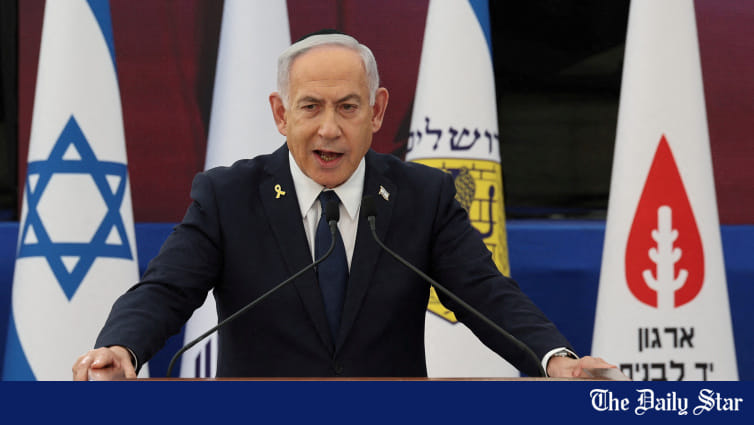
Israeli Prime Minister Benjamin Netanyahu speaks during the annual ceremony at the eve of Israel’s Remembrance Day for fallen soldiers (Yom HaZikaron) at the Yad LaBanim Memorial in Jerusalem, 29 April 2025. File photo: Reuters

Israel yesterday said it will "take control" of the whole of Gaza, where aid entered for the first time in more than two months as rescuers reported dozens killed in a newly intensified offensive.

With the Gaza Strip under a total Israeli blockade since March 2, the World Health Organization said the besieged territory's "two million people are starving".

1747701339997.webp

A wounded girl receives treatment at Al-Awda Hospital at the Nuseirat refugee camp in the central Gaza Strip, following an Israeli airstrike that hit a school in the camp yesterday. Photo: AFP

Israel, facing mounting criticism over the humanitarian crisis, has announced it would let limited aid into Gaza and said the first five trucks entered Monday, carrying supplies "including food for babies".

UN humanitarian chief Tom Fletcher said in a statement that nine trucks had been "cleared to enter... but it is a drop in the ocean of what is urgently needed."

UN spokesman Stephane Dujarric, who was unable to confirm the exact number of trucks inside Gaza, said that "none of the aid has been picked up" at a designated zone as it was "already dark" and due to "security concerns, we cannot operate in those conditions".

Prime Minister Benjamin Netanyahu cited "practical and diplomatic reasons" for the resumption of aid, saying that "images of mass starvation" could harm the legitimacy of Israel's war effort.

In southern Gaza, the Israeli military issued an evacuation call to Palestinians in and around Khan Yunis city ahead of what it described as an "unprecedented attack".

The call came after the military announced it had begun "extensive ground operations" in an expanded offensive against Hamas.

Gaza's civil defence agency said 52 people had been killed in Israeli attacks across the territory.

Netanyahu, in a video posted on Telegram, said that "the fighting is intense and we are making progress."

"We will take control of all the territory of the strip," the Israeli leader added.

The UN's OHCHR rights office decried actions that are "in defiance of international law and tantamount to ethnic cleansing", citing the latest attacks, displacement, the "methodical destruction of entire neighbourhoods" and denial of humanitarian aid.

Netanyahu yesterday said that Israel "will not give up. But in order to succeed, we must act in a way that cannot be stopped", justifying to his hardline supporters the decision to resume aid.

Israel said its blockade was aimed at forcing concessions from Hamas, while UN agencies have warned of critical shortages of food, clean water, fuel and medicines.

Last week US President Donald Trump acknowledged that "a lot of people are starving", adding "we're going to get that taken care of".

A group of 22 mostly European countries, including France and Germany, yesterday said in a joint statement that Gaza's population "faces starvation" and "must receive the aid they desperately need".

Gaza's health ministry yesterday said at least 3,340 people have been killed since Israel resumed strikes on March 18, taking the war's overall toll to 53,486.​
 
Analyze

Analyze Post

Add your ideas here:
Highlight Cite Fact Check Respond

What is the new US-backed Gaza aid plan and why doesn't the UN like it ?
REUTERS
Published :
May 20, 2025 21:20
Updated :
May 20, 2025 21:20

1747787329947.webp

A Palestinian woman and a girl carrying bags of firewood walk by the rubble of houses, in Gaza City, May 20, 2025. Photo : REUTERS/Mahmoud Issa

A US-backed organization aims to start work in the Gaza Strip by the end of May overseeing a new model of aid distribution in the Palestinian enclave, but the United Nations says the plan is not impartial or neutral, and it won't be involved.

WHAT IS THE GAZA HUMANITARIAN FOUNDATION?

Aid deliveries in Gaza will be overseen by the US-backed Gaza Humanitarian Foundation, which was established in February in Switzerland, according to the Geneva commercial registry.

The foundation intends to work with private US security and logistics firms - UG Solutions and Safe Reach Solutions - according to a source familiar with the plan. A second source familiar with the plan said the GHF has already received more than $100 million in commitments. It was not immediately clear where the money was coming from.

Senior US officials were working with Israel to enable the GHF to start work, acting US Ambassador to the UN Dorothy Shea told the Security Council earlier this month, urging the UN and aid groups to cooperate. Israel has said it will allow the foundation's work without being involved in aid deliveries.

HOW WOULD THE NEW PLAN WORK?

According to a GHF document circulating among the aid community earlier this month, the foundation would initially operate from four "secure distribution sites" that could each serve 300,000 people with food, water and hygiene kits. Israeli officials have said those hubs would be in Gaza's south.

The private US companies would transport the aid into Gaza to the hubs where it would be then distributed by aid groups - not the private companies, the first source said. Israel's UN Ambassador Danny Danon has said a few aid groups have agreed to work with the GHF. The names of those groups are not yet known.

Israel has agreed to expand the number of distribution sites and find ways for aid to get to civilians who are unable to reach a distribution site, the foundation has said.

The foundation has asked Israel's military to identify "locations in northern Gaza capable of hosting GHF operated secure distribution sites that can be made operational within 30 days." GHF has also said it would not share any personally identifiable information of aid recipients with Israel.

WHY WON'T THE UN WORK WITH THE NEW DISTRIBUTION MODEL?

The United Nations says the US-backed distribution plan does not meet its long-held principles of impartiality, neutrality and independence. UN aid chief Tom Fletcher has said time should not be wasted on the alternative proposal.

In a briefing to the Security Council, he explained what was wrong with the Israel-initiated plan: "It forces further displacement. It exposes thousands of people to harm ... It restricts aid to only one part of Gaza, while leaving other dire needs unmet. It makes aid conditional on political and military aims. It makes starvation a bargaining chip."

WHY HAS AN ALTERNATIVE AID DISTRIBUTION PLAN BEEN PROPOSED?

Israel stopped all aid deliveries to Gaza on March 2 after accusing Hamas of stealing aid, which the Palestinian militants deny, and demanding the release of all remaining hostages taken during an October 2023 attack on Israel that killed 1,200 people, according to Israeli tallies. That assault triggered the war, which Gaza authorities say has killed 53,000 people.

In early April, Israel proposed what it described as "a structured monitoring and aid entry mechanism" for Gaza. It was swiftly rejected by UN Secretary-General Antonio Guterres, who said it risked "further controlling and callously limiting aid down to the last calorie and grain of flour."

Since then pressure had been growing on Israel to allow aid deliveries to resume. A global hunger monitor last week warned that half a million people face starvation - about a quarter of the population in the enclave - and US President Donald Trump acknowledged that "a lot of people are starving in Gaza."

Amid the stalemate over Israel's plan, Washington backed the newly-created GHF to oversee aid distribution. The GHF then announced last week that it aims to start work in Gaza by the end of May.

In the meantime, Israel has allowed limited aid deliveries to resume under the existing distribution model - with five trucks entering Gaza on Monday, which Fletcher described as "a drop in the ocean." The UN said on Tuesday it has received Israeli approval for about 100 more aid trucks to enter Gaza.

WHAT WAS THE EXISTING AID DELIVERY PLAN?

Throughout the conflict, the United Nations has described its humanitarian operation in Gaza as opportunistic - facing problems with Israel's military operation, access restrictions by Israel into and throughout Gaza and looting by armed gangs.

But the UN has said its aid distribution system works and that was particularly proven during a two-month ceasefire, which was abandoned by Israel in mid-March. Israel would first inspect and approve aid. It was then dropped off on the Gaza side of the border, where it was picked up by the UN and distributed.

"We can go back to that system. We have wheels that turn. We do not need to reinvent yet another wheel," UN spokesperson Stephane Dujarric said on Monday. "We don't need a newly minted humanitarian partner to tell us how to do our work in Gaza."

Fletcher on Monday listed what the UN needs from Israel to scale up aid: at least two open crossings into Gaza - one in the north and one in the south; simplified, expedited procedures; no quotas; no access impediments in Gaza and no attacks when aid is being delivered; and being allowed to meet a range of needs, including food, water, hygiene, shelter, health, fuel and gas.​
 
Analyze

Analyze Post

Add your ideas here:
Highlight Cite Fact Check Respond

UK halts trade talks with Israel, summons envoy over Gaza
AFP London, UK
Published: 20 May 2025, 22: 00

1747788026268.webp


Britain suspended free-trade negotiations with Israel on Tuesday and summoned its ambassador to the foreign ministry in its toughest stance yet against Israel's conduct in the war in Gaza.

Foreign Secretary David Lammy accused Israeli Prime Minister Benjamin Netanyahu's government of "egregious actions and rhetoric" over its expansion of military operations in the Palestinian territory.

During an impassioned speech to Britain's parliament, Lammy also said the UK government was imposing new sanctions on individuals and organisations involved in settlements in the West Bank.

"The world is judging, history will judge them. Blocking aid, expanding the war, dismissing the concerns of your friends and partners. This is indefensible and it must stop," he said.

Lammy said Britain "cannot stand by in the face of this new deterioration" in Gaza and was pausing negotiations with Israel on a new free-trade agreement.

He said Britain would be "reviewing cooperation" with Israel under its so-called 2030 roadmap for UK-Israel relations.

"Netanyahu government's actions have made this necessary," Lammy said.

Israel's government responded by saying "external pressure will not divert Israel from its path in defending its existence and security against enemies who seek its destruction".

"If, due to anti-Israel obsession and domestic political considerations, the British government is willing to harm the British economy -- that is its own prerogative," Israeli foreign ministry spokesman Oren Marmorstein said in a statement.

Lammy said the Israeli's government's plan to displace the Gaza population and its limiting of aid to civilians "facing starvation, homelessness and trauma" meant the conflict was "entering a dark new phase".

Middle East Minister Hamish Falconer said Israeli Ambassador Tzipi Hotovely was being summoned to the Foreign and Commonwealth Development Office in protest against "the wholly disproportionate escalation of military activity in Gaza".

He added that Israel's weeks-long blockade on aid entering the strip, which was marginally lifted on Monday, had been "cruel and indefensible".

The UK government announced financial restrictions and travel bans, targeting prominent settler leader Daniella Weiss and two other individuals, as well as two illegal outposts and two organisations accused of backing violence against Palestinian communities.

Lammy said Israel suffered a "heinous attack" at the hands of Palestinian Hamas militants on October 7, 2023 and the UK government had backed Israel's right to defend itself.

He repeated calls that Hamas must release all remaining Israeli hostages seized that day "immediately and unconditionally". He also reiterated that Hamas "cannot continue to run Gaza".

Britain and Israel opened negotiations on a free-trade agreement in 2022.

According to the British government, Israel was the country's 44th-largest trading partner last year, with the two countries exchanging 5.8 billion pounds ($7.8 billion) in goods and services.​
 
Analyze

Analyze Post

Add your ideas here:
Highlight Cite Fact Check Respond

Gaza rescuers say 44 killed as Israel steps up offensive
AFP Gaza City, Palestine
Published: 20 May 2025, 20: 33

1747789353618.webp

An Israeli soldier gestures atop a military vehicle at Israel's southern border with the Gaza Strip on 20 May, 2025 amid the ongoing war with the Palestinian militant movement Hamas. AFP

Gaza's civil defence agency said Israeli strikes on Tuesday killed at least 44 people across the war-ravaged Palestinian territory, where Israel has intensified a military offensive aimed at crushing Hamas.

Aid trickled into the Gaza Strip on Monday for the first time in more than two months, following widespread condemnation of Israel's total blockade that has sparked severe shortages of food and medicine.

On Tuesday, a UN spokesman said it had received permission to send another "around 100" trucks of aid into Gaza.

The Israeli army stepped up its offensive at the weekend, vowing to defeat Gaza rulers Hamas whose 7 October, 2023 attack on Israel triggered the war.

Strikes overnight and early Tuesday left "44 dead, mostly children and women, as well as dozens of wounded", civil defence spokesman Mahmud Bassal told AFP.

1747789408223.webp


Bassal said 15 people were killed when a gas station was hit near the Nuseirat refugee camp and 12 others in a strike on a house in Deir el-Balah, both in central Gaza.

Eight people were killed in a strike on a school sheltering displaced Palestinians in Gaza City, further north, Bassal said.

The Israeli military told AFP it had "struck a Hamas terrorist who was operating from within a command and control centre" within the school compound. There was no comment on the other incidents.

In a statement Tuesday, the military announced strikes on more than "100 terror targets" in Gaza over the past day.

At the bombarded gas station, Nuseirat resident Mahmoud al-Louh carried a cloth bag of body parts to a vehicle.

"They are civilians, children who were sleeping. What was their fault?" he told AFP.

Children look at the closed UN agency for Palestinian refugees UNRWA headquarters in Gaza City, on 20 May, 2025, amid the ongoing war between Israel and the Palestinian militant movement Hamas.

Children look at the closed UN agency for Palestinian refugees UNRWA headquarters in Gaza City, on 20 May, 2025, amid the ongoing war between Israel and the Palestinian militant movement Hamas. AFP

'Egregious'

Israel's security cabinet approved earlier this month a plan to expand the military offensive, which one official said would include the "conquest" of Gaza and the displacement of its population.

On Monday Prime Minister Benjamin Netanyahu said Israel "will take control of all the territory of the strip", as the intensified military campaign prompted international alarm.

Israel resumed major operations across Gaza on 18 March amid deadlock over how to proceed with a two-month ceasefire that had largely halted the war.

Netanyahu said it was necessary for Israel to prevent famine in Gaza for "practical and diplomatic reasons", after his government announced it would allow limited aid into the besieged territory.

"Images of mass starvation" could harm the legitimacy of Israel's war effort, Netanyahu said.

On Friday, President Donald Trump of the United States, Israel's close ally and main arms supplier, said that "a lot of people are starving" in Gaza. The World Health Organization later warned that the territory's "two million people are starving".

Britain, France and Canada issued a harsh condemnation of Israel's conduct of the war, slamming its "egregious actions" in the expanded offensive and the "wholly inadequate" resumption of aid.

They warned of "concrete actions" if Israel did not ease its offensive and allow more aid in. Netanyahu called their joint statement a "huge prize" for Hamas.

1747789469966.webp

This picture taken from a position in southern Israel shows destroyed buildings in the Gaza Strip on 20 May, 2025, amid the ongoing war with the Palestinian militant movement Hamas. AFP

'Drop in the ocean'

Qatar, which has been involved in mediation efforts throughout the war, said on Tuesday that Israel's offensive had undermined chances for a ceasefire.

"This irresponsible, aggressive behaviour undermines any potential chance for peace," Qatari Prime Minister Sheikh Mohammed bin Abdulrahman bin Jassim Al-Thani said.

Ending more than two months of a complete blockade, Israel said the first five aid trucks entered Monday carrying supplies "including food for babies".

UN humanitarian chief Tom Fletcher said that the trucks allowed it on Monday were "a drop in the ocean of what is urgently needed".

AFP could not independently verify how many aid trucks had entered Gaza.

Fletcher told the BBC on Tuesday that 14,000 babies could die in the Palestinian territory in the next 48 hours if aid did not reach them in time.

The Hamas attack in October 2023 resulted in the deaths of 1,218 people on the Israeli side, mostly civilians, according to an AFP tally based on official figures.

Militants also took 251 hostages, 57 of whom remain in Gaza including 34 the military says are dead.

Gaza's health ministry said Tuesday at least 3,427 people have been killed since Israel resumed strikes on 18 March, taking the war's overall toll to 53,573.​
 
Analyze

Analyze Post

Add your ideas here:
Highlight Cite Fact Check Respond

Members Online

No members online now.

Latest Posts

Back
 
G
O
 
H
O
M
E