Donate ☕
[🇧🇩] - Israel and Hamas war in Gaza-----Can Bangladesh be a peace broker? | Page 17 | PKDefense

[🇧🇩] Israel and Hamas war in Gaza-----Can Bangladesh be a peace broker?

Reply (Scroll)
Press space to scroll through posts
G Bangladesh Defense
[🇧🇩] Israel and Hamas war in Gaza-----Can Bangladesh be a peace broker?
944
24K
More threads by Saif


Netanyahu weighs risks of Rafah assault as hostage dilemma divides Israelis
REUTERS
Published :
May 08, 2024 21:01
Updated :
May 08, 2024 21:01


1715238168730.webp

Israeli Prime Minister Benjamin Netanyahu speaks during the opening ceremony marking Israel's national Holocaust Remembrance Day at Yad Vashem, the World Holocaust Remembrance Center, in Jerusalem, May 5, 2024. Photo : Reuters/Ronen Zvulun/Files

Prime Minister Benjamin Netanyahu faces competing pressures at home and abroad when he weighs how far to push the operation to defeat Hamas in Rafah that complicates hopes of bringing Israeli hostages home.

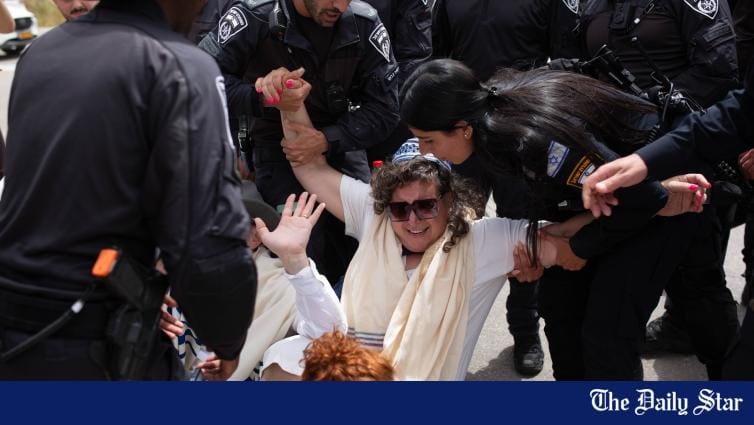
Street demonstrations against the government by families and supporters of some of the more than 130 hostages still held in Gaza have become a constant fixture, with protestors demanding a ceasefire deal with Hamas to get them back.

Others are demanding the government and the Israeli Defence Forces press ahead with the Rafah operation against the remaining Hamas formations holding out around the city which began this week with air strikes an battles on the outskirts.

"We applaud the Israeli government and the IDF for going into Rafah," said Mirit Hoffman, a spokesperson for Mothers of IDF Soldiers, a group representing families of serving military personnel, which wants an uncompromising line to pressure Hamas into surrender.

"We think that this is how negotiations are done in the Middle East."

The opposing pressures mirror divisions in Netanyahu's cabinet between centrist ministers concerned at alienating Washington, Israel's most vital ally and supplier of arms, and religious nationalist hardliners determined to clear Hamas out of the Gaza Strip.

Hamas handed Netanyahu a dilemma this week when it declared it had accepted a ceasefire proposal brokered by Egypt for a halt to fighting in return for an exchange of hostages for Palestinian prisoners. Israeli officials rejected the offer, accusing Hamas of altering the terms of the deal. But it did not break off negotiations and shuttle diplomacy continues, with CIA chief Bill Burns in Israel on Wednesday to meet Netanyahu.

Internationally, protests have spread against Israel's campaign in Gaza, which has so far killed more than 34,000 Palestinians, according to local health authorities, and spread malnutrion and disease in the enclave.

Seven months into the war, surveys show opinion in Israel has become increasingly divided since Netanyahu first vowed to crush Hamas in retaliation for the Oct. 7 attack that killed some 1,200 people, according to Israeli tallies, took more than 250 hostage, and triggered the campaign in Gaza.

"I understand that it's necessary to defeat Hamas but I think that can wait, and the hostages cannot wait," said Elisheva Leibler, 52, from Jerusalem. "Every second they're there poses immediate danger to their lives."

For the moment, Netanyahu has kept the cabinet together, rejecting the latest Hamas proposal for a ceasefire but keeping the negotiations alive by dispatching mid-ranking officials to Cairo, where Egyptian mediators are overseeing the process.

But the risks he faces by holding out against a deal, as his hard-right partners wish, were highlighted on Tuesday when Washington paused a shipment of weapons to signal its opposition to the long-promised Rafah assault.

DIVIDED OPINION

Despite his image as a security hawk, Netanyahu, Israel's longest serving prime minister, has struggled with a widespread perception that he was to blame for the security failures that allowed Hamas to overwhelm Israel's defences around Gaza.

That has fed a mood of distrust among many Israelis who otherwise support strong action against Hamas.

A survey published on Wednesday for Channel 13 suggested that 56 per cent of Israelis thought Netanyahu's chief consideration was his own political survival against only 30 per cent who thought it was freeing the hostages.

A survey by the Israel Democracy Institute found just over half the population believed a deal to rescue the hostages should be the top government priority, over the aim of destroying the remaining Hamas formations.

But a separate poll by the Jewish People's Policy Institute (JPPI) found 61 per cent thought the military must operate in Rafah no matter what. The Channel 13 poll found 41 per cent in favour of accepting the deal and 44 per cent opposed.

"I don't trust Hamas at all," said 81 year-old David Taub, from Jerusalem. "The only solution is to conquer Rafah, and then maybe, we hope, we pray, the hostages will come back to us."

For the moment, Netanyahu depends on the two hardliners from the nationalist religious bloc, Finance Minister Bezalel Smotrich and Security Minister Itamar Ben-Gvir, both of whom reject any suggestion of compromise.

Both have clashed repeatedly with Benny Gantz, the centrist former army general who joined the emergency wartime cabinet in the wake of Oct 7, and who is the leading contender to replace Netanyahu after new elections.

Gantz and his ally Gadi Eisenkot, another former army chief, are both sworn enemies of Hamas but both have been alarmed at the deterioration in relations with the United States.

For the increasingly desperate hostage families, a mood of deepening exhaustion at the endless uncertainty has settled in, with hopes of a safe return overcoming any other consideration.

Niva Wenkert, mother of 22-year-old hostage Omer Wenkert, said she had no choice but to trust Israeli leaders but that not enough had been done.

"The hostages are still in Gaza, the military actions almost stopped and the feelings are very, very bad. I want Omer back."​
 
Analyze

Analyze Post

Add your ideas here:
Cite Fact Check Highlight Respond
Gents have a look here. MIT professor has just destroyed the iron dome Hollywood fantasy narrative. This is a total disgrace and an acknowledgement that hundreds of billions of US taxpayer dollars have been wasted for propaganda. Few days ago Irans vevak intelligence has quietly announced that more than 50 Israeli soldiers have died at HQ 8200 intelligence facility on Golan after signal intercepts of IDF by Hezb revealed this info and more than 220 others injured, most of them seriously. Isra-heel is hiding a lot more deaths and losses. Evidently, Irans broken Israel’s back. How badly is this going to affect all the other US toady around the world now? People who rely on US weaponry for mental comfort? Here in Japan many are questioning the F-35’s and other weaponry after seeing the debacles in both Ukraine and Israel:
 
Analyze

Analyze Post

Add your ideas here:
Cite Fact Check Highlight Respond
  • Like (+1)
Reactions: Saif

'Our lives have completely stopped'
Say displaced Palestinians as 'fear' roils in Gaza's southern city of Rafah since Israeli incursion

1715296305074.webp


Displaced Palestinian Marwan al-Masri, sheltering in Rafah, said "Our lives have completely stopped" since Israeli tanks and troops entered the city's east, sending desperate people fleeing north in the besieged territory.

Over 1.4 million people had crammed into Rafah, a city on the Gaza Strip's southern border with Egypt, as Israeli forces pushed their way southward from coastal territory's north during months of offensive.

Many in Rafah have been displaced multiple times during the seven-month offensive, and are now heading back north after Israeli forces called for the evacuation of the city's eastern past, which hosts tens of thousands of people.

"Life has completely ceased in the downtown area of Rafah", said 35-year-old Masri, who has been displaced from northern Gaza. "The streets are empty of people, and markets are in a state of paralysis", he told AFP on Wednesday.

Many in Rafah have been displaced multiple times during the offensive, and are now heading back north.

"We all feel fear of any advancement in the invasion, as happened in the eastern areas, which are now completely empty of residents".

Masri said he and his relatives "are all tense and frightened" by the incessant shelling that they feel is getting closer to them.

Ibtihal al-Arouqi, who was displaced from Al-Bureij refugee camp in central Gaza, said she has found herself once again homeless.

"We emerged from under the rubble of our house in Al-Bureij, and now due to intense shelling in Rafah, my children and I are in the street", she said.

The 39-year-old said that only two weeks ago she gave birth by Caesarean section. "We don't know where to go. There is no safe place", Arouqi added.

She spoke from west Rafah, where many Palestinians remain.

While it is relatively calmer than the city's heavily bombarded east, the west has also been hit by shelling, an AFP journalist reported.

Both Arouqi and Masri said incessant shelling has filled the air with dust and smoke that make it hard to breathe. "The situation in Rafah is chaotic," said Mohammed Abu Mughaiseeb, a medical coordinator for Doctors Without Borders (MSF) charity in Rafah.

Himself displaced from Gaza City, he described "people carrying their things, mattresses, blankets, kitchen items on trucks" to flee east Rafah.

But "there's no space anymore in the west of Rafah," Abu Mughaiseeb told AFP.

The city's Al-Najjar hospital was "closed, evacuated by the medical team to avoid what happened in Al-Shifa or Nasser", he added.​
 
Analyze

Analyze Post

Add your ideas here:
Cite Fact Check Highlight Respond
Gents have a look here. MIT professor has just destroyed the iron dome Hollywood fantasy narrative. This is a total disgrace and an acknowledgement that hundreds of billions of US taxpayer dollars have been wasted for propaganda. Few days ago Irans vevak intelligence has quietly announced that more than 50 Israeli soldiers have died at HQ 8200 intelligence facility on Golan after signal intercepts of IDF by Hezb revealed this info and more than 220 others injured, most of them seriously. Isra-heel is hiding a lot more deaths and losses. Evidently, Irans broken Israel’s back. How badly is this going to affect all the other US toady around the world now? People who rely on US weaponry for mental comfort? Here in Japan many are questioning the F-35’s and other weaponry after seeing the debacles in both Ukraine and Israel:

Iran has amply proved that cheap Iranian weapons are enough to kill the so called high tech Israeli weapons made by US money and technology. Iron Dome and Arrow-3 suck big time. People in the know have no faith in them anymore. They are a waste. I would love to get Iranian drones but alas! The US will impose sanction on Bangladesh if we buy Iranian military products.
 
Analyze

Analyze Post

Add your ideas here:
Cite Fact Check Highlight Respond

Student protests in the US: Reclaiming the flames of human rights

1715417707505.webp

The protests in the US may not bring in ready-made solutions to the present crisis in Gaza, but they are a downstream constraint on the illegitimate use of force and exertion of power. FILE PHOTO: RUETERS

I argued a few months back that the genocidal killings of innocent civilians, particularly of children in Gaza, within the context of the Israel-Palestine war, appear not as just another passing of a period but as an episode potentially signalling the impending doom of an objectively trustworthy international human rights law scheme, particularly with five states at the helm as permanent members of the UN Security Council. Four months later, it seems a tad hopeful, particularly with students and staff in the US universities vehemently protesting the US policies that staunch support Israel, and thereby indirectly provide an impetus to the Israeli genocide.

Anti-establishment protests are generally handled with high-handed tactics by those in authoritative positions, essentially because establishment nourishes and sustains those who form part of the authority. And there has been no exception in the present context.

The protesters, with "an understanding of both worlds," stand firmly between the elite decision-makers at the top and the trampled-on Palestinians at the bottom. The protesters thus create an appropriate intermediate space to vernacularise the language of human rights, peace, and justice, upon providing for a corrective to the language of dominance, oppression, and hegemony. True that those in power are biased, that power today is defined by imbalance, and that the sham of balance is rigged, but above and beyond such top-down injustices and unfairness lies the unbending power of the people.

Indeed, the very ideas of fundamental freedom, dignity, and human rights are discursively embedded into multiple sites. Mass movements only show the site where the said ideas find flesh and blood. The protesting students chant "boycott apartheid Israel," thereby denouncing the racist policies that Israel propagates and the US sides with. They ask the university authorities to "divest from Israel," thereby warranting divergence from the deep-seated policies of extending unsighted support to Israel. Thus, the protesters unmask the aberrant intricacies and depraved symbols constructing the premise for the genocide now unfolding. However, the question is: how far can these protests take us?

In January, the International Court of Justice issued six provisional measures, ordering Israel to "take all measures within its power to prevent genocidal acts, including preventing and punishing incitement to genocide, ensuring aid and services reach Palestinians under siege in Gaza, and preserving evidence of crimes committed in Gaza." Israel, to date, continues to violate the said ruling by the world court. Moreover, the US abstained from voting in favour of the UN Security Council Resolution# 2728 on March 25 for an immediate ceasefire in Gaza, thereby not explicitly siding with the latest attempt to assuage the enormous humanitarian crisis there. Reportedly, the International Criminal Court (ICC) is considering issuing arrest warrants for Israeli top military and political figures for the commission of war crimes and crimes against humanity. However, the fact that neither Israel nor the US recognise the authority of ICC is yet another despairing reality within the international politico-legal spectrum.

Against this backdrop, perhaps it will be irrationally optimistic to imagine a system overhaul through the protests, because nothing short of such an overhaul can bring in true amends to the devastations caused. Indeed, the protests may not bring in ready-made solutions to the present crisis, precisely because racism is but an institutionalised reality in the now prevailing hegemonic-chauvinistic world order. Nonetheless, the protests are a downstream constraint on the illegitimate use of force and exertion of power. Within the illusion of sovereign equality imagining all states standing on an equal footing, the protests of people of various races, religions, sexes, genders and sexualities bring in fresh air of human equality.

In order to reclaim the transformative terrain and flames of human rights, we need to approach human rights from hitherto excluded locations and from the perspectives of hitherto excluded subjects. The task of so approaching is not quite straightforward. The task ought to involve challenging authorities, re-reading the status quos, and contesting the taken-for-granted assumptions. Through such an elaborate process only, "human rights can be remade in the vernacular" for the fringe-dwellers and the marginalised. Indeed, the protesters are an embodiment of both the excluded locations (which for them is the state of Palestine) and the excluded perspectives lying on the fringes of the international human rights paradigm.

The history of mass movements or student protests is not new in the United States. US campuses have witnessed protests during the Vietnam War, and more recently in support of Black Lives Matter movement and against the overturning of Roe v Wade (resisting the rollback of women's reproductive rights). All these movements were anti-establishment and rights-based. Such protests give us both purpose and meaning, through and in the face of adversities. Therefore, at the least, the protests tell us that it perhaps is premature to say that the end of human rights, or international law for that matter, is near. Indeed, the discourse on human rights is all the more relevant now.

Psymhe Wadud teaches International Human Rights Law at the​
 
Analyze

Analyze Post

Add your ideas here:
Cite Fact Check Highlight Respond

US says Israel's use of weapons may have violated international law
REUTERS
Published :
May 11, 2024 10:38
Updated :
May 11, 2024 10:38

1715420051318.webp


The Biden administration on Friday said Israel's use of US-supplied weapons may have violated international humanitarian law during its military operation in Gaza, in its strongest criticism to date of Israel.

But the administration stopped short of a definitive assessment, saying that due to the chaos of the war in Gaza it could not verify specific instances where use of those weapons might have been involved in alleged breaches.

The assessment came in a 46-page unclassified State Department report to Congress required under a new National Security Memorandum (NSM) that President Joe Biden issued in early February.

The findings risk further souring ties with Israel at a time when the allies are increasingly at odds over Israel's plans to strike Rafah, a move Washington has repeatedly warned against.

The Biden administration has already put a hold on one package of arms in a major policy shift and said the US was reviewing others even as it reiterated long-term support for Israel.

The State Department's report included contradictions: It listed numerous credible reports of civilian harm and said Israel did not at first cooperate with Washington to boost humanitarian assistance to the enclave. But in each instance it said it could not make a definitive assessment whether any breaches of law had occurred.

"Given Israel's significant reliance on US-made defence articles, it is reasonable to assess that defence articles covered under NSM-20 have been used by Israeli security forces since Oct 7 in instances inconsistent with its IHL obligations or with established best practices for mitigating civilian harm," the State Department said in the report.

"Israel has not shared complete information to verify whether US defence articles covered under NSM-20 were specifically used in actions that have been alleged as violations of IHL or IHRL in Gaza, or in the West Bank and East Jerusalem during the period of the report," it said.

Because of that, the administration said it still finds credible Israel's assurances that it is using US weapons in accordance with international law.

Democratic Senator Chris Van Hollen said the administration had "ducked all the hard questions" and avoided looking closely at whether Israel's conduct should mean military aid is cut off.

"This report contradicts itself because it concludes that there are reasonable grounds to believe violations to international law have occurred, but at the same time that says they're not finding non compliance," he told reporters.

More than 34,000 Palestinians have been killed in Israel's seven-month-old assault on the Gaza Strip, say health officials in the Hamas-ruled enclave. The war began when Hamas militants attacked Israel on Oct 7, killing 1,200 people and abducting

252 others, of whom 133 are believed to remain in captivity in Gaza, according to Israeli tallies.

"EXCESSIVE" CIVILIAN HARM

Israel's military conduct has come under increasing scrutiny with the soaring death toll and the level of devastation in the Gaza Strip.

US officials at the State Department have been divided over the issue. Reuters reported in late April that officials in at least four bureaus inside the agency have raised serious concerns over Israel's conduct in Gaza, laying out specific examples where the country might be in breach of the law.

Rights group Amnesty International in late April said US-supplied weapons provided to Israel have been used in "serious violations" of international humanitarian and human rights law, detailing specific cases of civilian deaths and injuries and examples of use of unlawful lethal force.

The US government reviewed numerous reports that raise questions about Israel's compliance with its legal obligations and best practices for mitigating harm to civilians, the report said.

Those included Israeli strikes on civilian infrastructure, strikes in densely populated areas and others that call into question whether "expected civilian harm may have been excessive relative to the reported military objective."

According to the report released Friday, in the period after Oct 7 Israel "did not fully cooperate" with US and other international efforts to get humanitarian aid into Gaza. But it said this did not amount to a breach of a US law that blocks the provision of arms to countries that restrict US humanitarian aid.

It said Israel had acted to improve aid delivery since Biden warned Prime Minister Benjamin Netanyahu in a call early last month that Washington would withhold some arms supplies if the humanitarian situation did not improve.

The report, Washington has decided to declassify, said individual violations do not necessarily disprove Israel's commitment to international humanitarian law, as long as it takes steps to investigate and hold violators accountable.

"Israel's own concern about such incidents is reflected in the fact it has a number of internal investigations underway," the report said. A senior State Department official confirmed that none of those investigations had yet led to prosecutions.

It also has compiled numerous instances in which humanitarian workers have been killed and military operations had taken place in protected sites but again said it was not able to reach definitive conclusions on whether US weapons were used in these occasions.​
 
Analyze

Analyze Post

Add your ideas here:
Cite Fact Check Highlight Respond

Symbolic gestures help, but the Palestine crisis needs concrete steps
The US must shed its pro-Israel bias to welcome peace

1715468330553.webp

VISUAL: STAR

As the world tries to process the continued horrors and injustices facing the Palestinians, the United Nations General Assembly (UNGA) on Friday voted overwhelmingly to grant them additional rights in the global body and backed their drive for full membership. We commend UNGA members for their effort. However, it's important to remember that this is only a symbolic gesture as the UNGA cannot enforce membership decisions. Therefore, it has suggested that the UN Security Council (UNSC), which has the authority in this regard, considers the matter "favourably".

Unfortunately, this is where the celebration ends. For as long as the United States—one of five veto-holding members on the Security Council and Israel's closest ally—resists Palestine's admittance as a state, any resolution will remain incomplete. On Friday, 143 UNGA members voted in favour of the resolution, but they remain powerless against the US, which recently vetoed another Palestinian bid for full membership. This is nothing new. The US has always turned down pro-Palestine proposals at UNSC, and this "diplomatic doom loop," as stated by an analyst, has been going on for a long time.

Against this backdrop, the latest UNGA vote should be seen more as a gesture of support for the Palestinians' quest for peace and self-determination amid a devastating war by Israel. The global outpouring of support and mass protests in favour of Palestine all point to the fact that nations are no longer buying Israel's narrative. "We want peace, we want freedom," Palestinian UN Ambassador Riyad Mansour told the General Assembly before the vote. Under the founding UN Charter, membership is open to "peace-loving states." It's ironic that a number of full members are facilitating wars, with Israel committing war crimes and genocide, and yet little is being done to make them accountable.

More than 34,000 have been killed during Israel's brutal seven-month-long war on Gaza. It has recently started its ground invasion in Rafah, in another potentially bloody campaign. Unless the US government acknowledges that it is actively facilitating this genocide, changes its stance, and stops vetoing pro-Palestine resolutions, Palestinians may see no peace. We hope that the increasing support across the globe—with several European countries planning to recognise a Palestinian state—forces the superpower to do just that, before Israel wipes out any semblance of this long-persecuted community.​
 
Analyze

Analyze Post

Add your ideas here:
Cite Fact Check Highlight Respond

Members Online

Latest Posts

Latest Posts