New Tweets

[🇧🇩] Israel and Hamas war in Gaza-----Can Bangladesh be a peace broker?

G Bangladesh Defense
[🇧🇩] Israel and Hamas war in Gaza-----Can Bangladesh be a peace broker?
966
28K
More threads by Saif


Battles in Rafah as US warns Israel over Lebanon
Agence France-Presse . Palestinian Territories 27 June, 2024, 01:00

Fighting raged on Wednesday between Israeli troops and Palestinian militants in Gaza's southern city of Rafah, witnesses said, as fears grow of a wider regional war drawing in Lebanese Hamas ally Hezbollah.

Israel's bombardment of the Gaza Strip however appeared to ease days after prime minister Benjamin Netanyahu suggested the 'intense phase' of the war was nearing its end, and as his defence minister visited Washington for crisis talks.

As the war in Gaza nears its 10th month, Israel's top ally the United States warned it of the risk of a major conflict against Iran-backed militant group Hezbollah in Lebanon following an escalation in cross-border fire.

'Another war between Israel and Hezbollah could easily become a regional war, with terrible consequences for the Middle East,' US defence secretary Lloyd Austin told his visiting Israeli counterpart Yoav Gallant.

'Diplomacy is by far the best way to prevent more escalation,' Austin said.

Top Israeli officials including Netanyahu have suggested they were open to a diplomatic resolution of the border tensions, though Gallant said Israel should be ready for 'every possible scenario'.

Israel's military said last week plans for an offensive in Lebanon were 'approved and validated', prompting fresh threats from Hezbollah chief Hassan Nasrallah.

In Beirut on Tuesday, German foreign minister Annalena Baerbock warned that any 'miscalculation' could trigger all-out war and urged 'extreme restraint'.

Canada's foreign minister Melanie Joly meanwhile told her country's citizens in Lebanon to protectively leave 'while they can'.

On the ground in Rafah, on Gaza's border with Egypt, witnesses reported clashes during the night, and the Israeli military said its air force struck a rocket launch site.

UN agencies said 10 Gazan children a day are losing one or both legs and half a million Palestinians in the besieged territory suffer 'catastrophic' hunger.

The civil defence agency in Hamas-run Gaza and hospital medics said at least four people, including three children, were killed in a strike early on Wednesday targeting a house in Beit Lahia, in the north.

Aside from that strike, agency spokesman Mahmud Basal said, 'there have been almost no attacks' and 'the rest of the areas in the Gaza Strip are calm compared to yesterday'.

An air raid on Tuesday killed Fadi al-Wadiya, an employee of medical charity Doctors Without Borders who the Israeli military said was a 'significant operative' for Islamic Jihad, a Palestinian militant group which has fought alongside Hamas.

MSF said on social media platform X that it was 'outraged' by Wadiya's killing in a strike in Gaza City.

'The attack killed Fadi, along with five other people including three children while he was cycling to work near the MSF clinic where he was providing care,' the charity said.

The military said the slain man had 'developed and advanced the terrorist organisation's rocket array'.

'He is just another case of terrorists in Gaza exploiting the civilian population as human shields,' it said in response to MSF's post.

UN and humanitarian agencies have repeatedly warned that aid workers are not safe in Gaza, impeding their desperately needed efforts delivering aid for Gaza's 2.4 million people.

Earlier in the war, Israel accused about a dozen workers of the UN agency for Palestinian refugees, UNRWA, of links to 'terrorist' activity and of involvement in Hamas's October 7 attack.

The Israeli claims have led several major donors to suspend funding for UNRWA, which has been key to humanitarian efforts, though most have since resumed it. An independent review said Israel failed to provide evidence to support its accusations.

The bloodiest ever Gaza war started with Hamas's October 7 attack on southern Israel that resulted in the deaths of 1,195 people, mostly civilians, according to an AFP tally based on Israeli figures.

The militants also seized about 250 hostages, 116 of whom remain in Gaza although the army says 42 are dead.

Israel's retaliatory offensive has killed at least 37,658 people, also mostly civilians, Gaza's health ministry said.

The deaths include 10 members of Qatar-based Hamas political chief Ismail Haniyeh's family, including his sister, who Palestinian officials said were killed in a Tuesday strike.

UNRWA chief Philippe Lazzarini warned of the war's dire impact on children.

'We have every day 10 children who are losing one leg or two legs on average,' Lazzarini told reporters, with amputations often taking place 'in quite horrible conditions' and sometimes without anaesthesia.

'Ten per day, that means around 2,000 children after the more than 260 days of this brutal war.'

Meanwhile the Integrated Food Security Phase Classification partnership said its March warning of imminent famine in north Gaza had not materialised, but around 4,95,000 people still face 'catastrophic levels of acute food insecurity'.

'The situation in Gaza remains catastrophic and there is a high and sustained risk of famine across the whole Gaza Strip,' it said in a report.

Netanyahu on Sunday said 'the war in its intense phase is about to end in Rafah', which the Israeli military sees as Hamas's last stronghold, with some troops to be redeployed to the northern border with Lebanon.

Mairav Zonszein, an analyst for the International Crisis Group, said the military would likely 'move to rolling operations' in Gaza and 'always keep some troops on the ground' in strategic areas of the territory.​
 

US health workers sound alarm on Gaza medical crisis

1719529446700.png

Palestinian families flee the Tuffah neighbourhood in the east of Gaza City following an Israeli military operation yesterday. Heavy fighting, artillery shelling and helicopter fire were also reported around northern Gaza's Shujayia market. Photo: AFP

Patients in Gaza's few standing hospitals are dying in droves from infections resulting from a lack of protective gear and soap, even when they survive their horrific blast injuries.

And health workers are facing agonising decisions, like giving up on a seven-year-old boy with extensive burns because bandages are in short supply and he'd have probably died anyway.

These are just some of the horrors witnessed by American doctors and nurses returning from the besieged Palestinian territory, who are now on a mission to spread the word about what they saw and apply pressure on Israel to allow in more life-saving supplies.

"Whether or not a ceasefire happens, we have to get humanitarian aid. And we have to get it in sufficient volumes to meet the demands," Adam Hamawy, a former US army combat surgeon, tells AFP in an interview after a medical mission to Gaza's European Hospital last month.

"You could give all you want, you can donate," says the reconstructive plastic surgeon from New Jersey. "But if these borders don't open up to allow that aid to get in, then it's just useless."

1719529511954.png


Hamawy has volunteered in war-torn and natural disaster-hit countries for the past 30 years, from the siege of Sarajevo to the Haiti earthquake.

"But the level of civilian casualties that I experienced was beyond anything I'd seen before," says the 54-year-old, who helped save the life of Senator Tammy Duckworth when she lost both of her legs to a rocket-propelled grenade (RPG) attack on the helicopter she was flying in Iraq.

"Most of our patients were children under the age of 14," he stressed. "This has nothing to do with your political views."

Hamawy and other medics told AFP they are convinced that for now their energy is better spent lobbying the halls of power to stop the offensive and require Israel to comply with international law by letting in more aid.

Israel denies allegations of international law violations during its invasion.

On a hot June afternoon in the capital Washington, Monica Johnston, a 44-year-old ICU nurse from Portland, Oregon said she conveyed specific lists of what was needed in meetings she had held with White House officials and lawmakers on Capitol Hill.​
 

Israel's stated goals are an epic lie
Susan Abulhawa 30 June, 2024, 00:00

1719704283166.webp

Twelve buildings are destroyed every hour in Gaza. | Dissident Voice/APA/Hadi Daoud

WHEN you're in Gaza and see the destruction firsthand, the clearest conclusion is that Israel's stated goals are an epic lie, on a par with 'a people without a land for a land without a people', packaged and sold to the world.

The Israelis are not targeting Hamas, nor are they interested in returning their captives, who pose tremendous liability upon their release, as they often have good things to say about their captors.

Math is useful to prove what I'm saying. So, here are some numbers to start.

Destroyed buildings

AS OF April 2024, approximately 360,000 buildings have been destroyed, of which are 405 schools and universities, 700 hospitals and health facilities, 290 mosques and three churches. Given the estimation by the United Nations monitoring group OCHA that 12 buildings are destroyed every hour in Gaza, the adjusted number to account for May and June is 377,280 buildings.

Death and injuries from direct fire

THE reported number of martyrs on Wednesday this week was 37,718. It's important to note that this number only includes martyrs who have been identified by name and civil ID number through the beleaguered health ministry in Gaza. Given the breakdown of reporting systems due to heavy destruction of infrastructure and personnel, this number, even with its limited parameters, is a gross underestimation. Based on more accurate figures of approximately 370 people killed daily, multiplied by 264 days of genocide, the actual number is closer to 97,680 martyred. (Per OCHA estimate of 15 martyrs per hour: Over the course of 264 days, which amounts to 6,336 hours, this number would roughly be 95,040).

The adjusted estimate of martyrs is 260 per cent more than the stagnant reported number. It is reasonable to adjust the number of injured (currently 86,377) by the same percentage, bringing that value to 224,580. (Per OCHA estimate of 35 injured per hour, this number comes to 221,760).

Death from lack of medications, chronic conditions

IMPORTANTLY, the number above does not include the thousands of unidentified martyrs, some of whom were uncovered from mass graves; those who arrived headless or in impossible pieces; those who were buried by their loved ones without going through the hospital system; those who have died of starvation; those who have died from lack of access to critical medications; those who have died from infections or communicable diseases.

Taking into account 1,100 dialysis patients, 2,000 cancer patients and 341,000 individuals who depend on medication to manage chronic illnesses (45,000 cardiovascular disease, 71,000 diabetes, 225,000 hypertension), the extreme shortage of life-saving medication has and will continue to lead to deaths from Israel's withholding of supplies. If a very conservative estimate of 5 per cent of these patients die as a result (if they have not already), that's an additional 17,050 people.

However, a more accurate all-cause mortality rate for unmanaged diabetes is 13.6 per cent (putting mortality at 9,869 people); 37 per cent for uncontrolled hypertension (translating to 83,250 people); untreated dialysis and cancer patients will have a high mortality rate. A conservative estimate for this group is 30 per cent or 930 patients.

Taken together, this is 94,049 people (I didn't consider cardiovascular disease alone, since patients tend to have co-morbidities and there would be natural overlap in these numbers).

Dead or dying from starvation

ACCORDING to a recent UN-backed Integrated Food Security Phase Classification report, approximately 495,000 Palestinians in Gaza are facing 'catastrophic' hunger, which means they suffer extreme lack of food leading to acute malnutrition in young children, imminent risk of starvation and death. If we make a conservative 5 per cent estimate of death from starvation among this population, that's 24,750 people dead or dying from starvation.

Data-driven mortality for acute malnutrition is approximately 20 per cent. However, the current classification has not yet reached full-blown famine levels, making the current estimate reasonable.

Missing, presumed dead or kidnapped

APPROXIMATELY 21,000 children are missing and unaccounted for. Some are trapped under the rubble, some have been kidnapped by Israeli soldiers, while others are simply lost in the chaos. Given the relative equal ratio of adults to children in Gaza, it is safe to assume the same number of adults are likewise unaccounted for, doubling this number to 42,000 people missing overall.

Death from disease

DUE to the destruction of water and sanitation infrastructure, coupled with restrictions on aid entering Gaza, Israel's assault has led to the spread of communicable and water-borne diseases such as acute jaundice (due mostly to hepatitis A), acute diarrhea (with bloody stool), scabies and lice, skin rashes, smallpox and acute respiratory infections, which totaled 1,440,805 cases as of 10 June. If only 1 per cent of these patients succumb to these serious conditions, that's 14,408 people likewise killed indirectly by Israel's bombing and siege of Gaza.

Mortality for acute jaundice or hepatitis A is low (2.5 per cent in adults and less than 1 per cent in children; thus a 1 per cent mortality estimate is appropriate for this category, or 817 people); mortality for diarrhea ranges from 4.27 per cent to 12 pe rcent (20,722-58,238 people); smallpox mortality is 1-30 per cent, depending on strain (854-2,561 people); mortality rates for acute respiratory disease range from 27 per cent to 45 per cent depending on severity (or 233,592-389,320 people). Taken together, adjusted for scientific data, the range for this category of martyrs is 255,985-450,936 people.

Estimate summaries

BASED on these estimates, both conservative and data-driven, respectively, the actual figures are likely as follows:

— 377,280 buildings destroyed completely or partially

— 95,040-97,680 martyred

— 221,760 injured

— 24,750 dead or dying from starvation

— 42,000 missing (presumed dead, kidnapped by Israel's occupying forces or possibly trafficked).

The following ranges represent conservative estimate or lower range of data-driven population estimates:

— 17,050-94,049 with chronic illnesses dead from lack of medication

— 14,408-255,985 dead from epidemics resulting from Israel's assault

This means the actual number of dead is closer to 194,768-511,824 people, with 221,760 injured. And counting.

This does not include the thousands who have been kidnapped and are being tortured in Israel's gulags, at least three dozen of whom have been tortured to death or died from harsh conditions.

Some lives matter

THE estimates here are reasonable but on-the-ground studies must be conducted immediately. International institutions must urgently assess the actual all-cause mortality resulting directly and indirectly from Israel's assault on Gaza.

Thus far, of the 240 Israeli captives in Gaza, Israel has allegedly killed 50 of their own, both directly (shooting them) and indirectly (bombing the buildings they are in) and secured the release of 112 captives, 105 through negotiated agreements with Hamas, and seven via "rescue" missions.

The most recent direct 'rescue' mission resulted in the release of four captives in Nuseirat refugee camp, central Gaza. A total of 274 Palestinians and several Israeli captives were killed in the same operation.

At least one US lawmaker believes sacrificing hundreds of Palestinians for four Israelis is worth it, because, it seems, only some lives matter.

I'll leave it to readers to do the math to see the level of death and destruction inflicted on Gaza per captive or per Hamas fighter.

There can be only one of two conclusions. Either the Israeli military is the most incompetent force to ever walk this planet — and has no reliable intelligence gathering capability — or Israel is a sadistic nation intent on genocide of the indigenous population, much as all settler colonial projects have been throughout history.

DissidentVoice.org, June 28. Susan Abulhawa is a writer and activist. Her most recent novel is Against the Loveless World.​
 

Hospital generators to run out of fuel in 48 hrs
Warns Gaza health ministry as much of electricity infrastructure decimated by Israeli attacks

1719789442610.webp

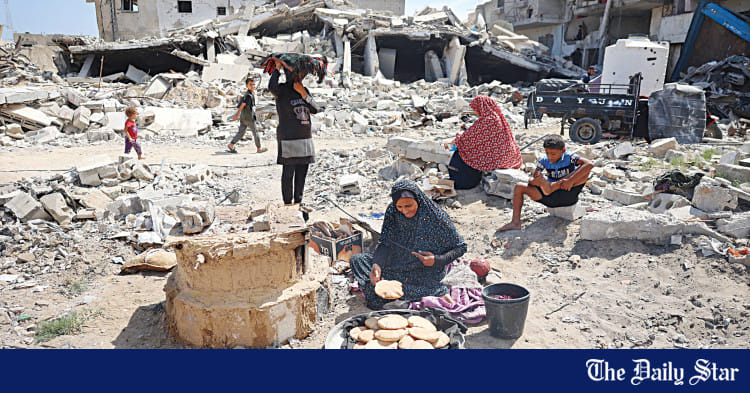
A Palestinian woman bakes unleavened bread in a makeshift oven while sitting on the rubble of buildings destroyed in the Israeli bombardment, as some residents return to the city of Khan Yunis in the southern Gaza Strip yesterday. Photo: AFP

Gaza's few functional hospitals and health facilities could lose power in 48 hours if they don't receive fuel, causing life-saving medical equipment to stop working.

"We appeal to all relevant, international and humanitarian institutions to intervene quickly to bring in the necessary fuel," the Hamas-run health ministry said in a statement.

With much of Gaza's electricity infrastructure decimated by Israeli attacks, hospitals are largely dependent on generators, powered by fuel, for life-saving operations.

Recurring fuel shortages have frequently caused hospitals to go dark, putting patients' lives at serious risk.

Meanwhile, explosions, air strikes and gunfire rattled northern and southern Gaza yesterday, the fourth day of an Israeli military operation that has uprooted tens of thousands of Palestinians.

Mohammed Harara, 30, said he and his family fled their home in Shujaiya with nothing, "due to the bombardment by Israeli planes, tanks and drones", reports AFP.

The United Nations humanitarian agency OCHA estimated that "about 60,000 to 80,000 people were displaced" from the area this week.

At least 1,15,000 Palestinians from Gaza have fled to Egypt during the Israeli bombardment.

The number includes several thousand sick and wounded Palestinians who were medically evacuated, Al Jazeera reports according to The Washington Post, who cited the Palestinian embassy in Cairo.

The rest reached Egypt with assistance from foreign embassies or through a private Egyptian travel agency, which charges large sums to coordinate their exit, The Post added.

"Most remain in limbo, with no legal status and nowhere else to go," it reports. "They are members of a new diaspora of Palestinians, a people already haunted by memories of displacement."

In a separate development, Saudi Arabia's foreign ministry has issued a statement expressing the kingdom's condemnation and denunciation of the Israeli decision to "expand blatant settlement activity in the West Bank", Al Jazeera reports.

The ministry said Saudi Arabia "firmly rejects the continuous Israeli violations of international law and resolutions of international legitimacy".

The Israeli action poses "severe consequences", given the "lack of international accountability mechanisms," the statement said, adding that "these transgressions undercut the prospects for peace and exacerbate conflicts, destabilising regional and international security and stability".

Israeli Finance Minister Bezalel Smotrich's plans to recognise five illegal settler outposts in the occupied West Bank.

In addition to recognising the outposts, Smotrich's plan removes civilian powers related to construction and zoning in one-fifth of the occupied West Bank, in what is known as "Area B".​
 

Palestinian prisoners face 'all kinds of torture'
Says Gaza hospital chief after release from Israeli detention centre

1719876936523.webp


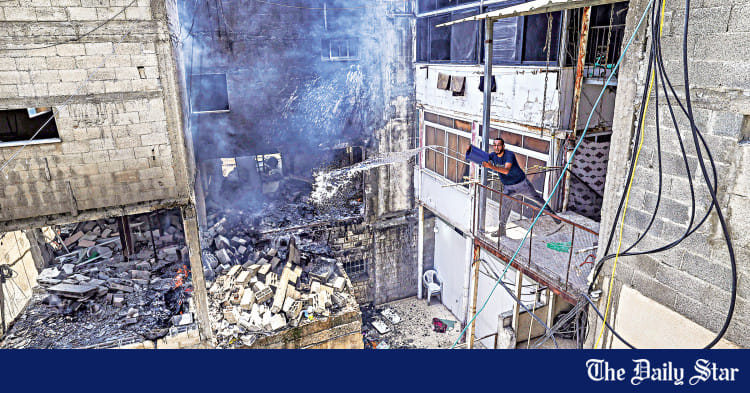
A man throws a bucket of water to dowse a fire in a building that was heavily damaged during an Israeli army raid on the Nur Shams camp for Palestinian refugees, east of Tulkarm in the occupied West Bank yesterday. Photo: AFP

The head of the Gaza Strip's biggest hospital said yesterday after being freed from more than seven months of detention that he had been "tortured" by Israel.

Al-Shifa hospital director Mohammed Abu Salmiya was among more than 50 Palestinians released and returned to Gaza for treatment, according to an Israeli minister and a medical source in the besieged territory.

Salmiya said he was put through "severe torture" during his detention, which left him with a broken thumb.

"Prisoners are subjected to all kinds of torture," he told a press conference. "Several inmates died in interrogation centres and were deprived of food and medicine."

"For two months no prisoner ate more than a loaf of bread a day," said Salmiya.

"Detainees were subjected to physical and psychological humiliation."

The medical chief said no charge had ever been made against him. Israeli forces detained Salmiya during one of a number of raids on Al-Shifa.

The hospital has largely been reduced to rubble by successive raids since Israel launched its assault on Gaza.

Salmiya and the other freed detainees crossed back into Gaza from Israel just east of Khan Yunis, a medical source at the Al-Aqsa hospital in Deir al-Balah told AFP.​
 

Israel strikes Gaza as militants claim rocket barrage
Agence France-Presse . Palestinian Territories 02 July, 2024, 00:36

1719878101982.webp

Israeli forces struck southern Gaza's main city on Monday after a rocket barrage claimed by militant group Islamic Jihad, and as shelling and fighting raged on across the besieged Palestinian territory.

A group of Palestinian detainees meanwhile returned to the Gaza Strip, including the director of its biggest hospital who recounted 'severe torture' in Israeli custody.

The Israeli military said that about '20 projectiles were identified crossing from the area of Khan Yunis' in a rare salvo after nearly nine months of devastating conflict.

The rockets were aimed at Israeli communities near the Gaza border and were fired in retaliation for Israeli 'crimes... against our Palestinian people', said Al-Quds Brigades, the armed wing of Islamic Jihad which has fought alongside Hamas. Most launches were intercepted, the Israeli military said, reporting no casualties and saying artillery was 'striking the sources of the fire'.

Elsewhere in Gaza, witnesses and the civil defence agency reported Israeli air strikes including in the southern Rafah area and the central Nuseirat refugee camp.

Witnesses reported constant Israeli tank fire in Gaza City's Shujaiya district where battles raged for a fifth day, after prime minister Benjamin Netanyahu acknowledged Israeli forces were engaged in a 'difficult fight'.

The military said troops 'eliminated numerous terrorists' in raids in Shujaiya, where air strikes also killed 'approximately 20' militants.

Israeli forces were also operating in Rafah and in central Gaza, a statement added.

Netanyahu, who recently declared that the 'intense phase' of the war was winding down, said on Sunday troops were 'operating in Rafah, Shujaiya, everywhere in the Gaza Strip'.

'This is a difficult fight that is being waged above ground and below ground' in tunnels.

The war started with Hamas's October 7 attack on southern Israel which resulted in the deaths of 1,195 people, mostly civilians, according to an AFP tally based on Israeli figures.

The militants also seized 251 hostages, 116 of whom remain in Gaza including 42 the army says are dead.

Israel's retaliatory offensive has killed at least 37,900 people, also mostly civilians, according to data from the health ministry in Hamas-run Gaza.

Months of on-and-off talks towards a truce and hostage release deal have made little progress, with Hamas saying Saturday there was 'nothing new' in a revised plan US mediators presented late last month.

Israel has released Mohammed Abu Salmiya, director of Gaza City's Al-Shifa hospital, along with dozens of other detainees returned Monday to Gaza for treatment, according to a hospital source in central Gaza's Deir al-Balah.

Successive Israeli raids have reduced parts of Al-Shifa, the territory's largest medical complex, to rubble.

Israel has accused Hamas of using Al-Shifa and other hospitals in Gaza as a cover for military operations and infrastructure, claims the militants have rejected.

Speaking after his release, Abu Salmiya said he had suffered 'severe torture' during his detention since November.

'Prisoners are subjected to all kinds of torture,' he told reporters in Khan Yunis.

'Detainees were subjected to physical and psychological humiliation' and 'several inmates died in interrogation centres and were deprived of food and medicine', he said.

Contacted by AFP, the Israeli military did not confirm the detainees' release and would not comment on the torture allegations.

According to Abu Salmiya, no charges were ever brought against him.

The European hospital in Khan Yunis said the head of its orthopaedic unit, Bassam Miqdad, was also among those freed.

The United Nations and relief agencies have voiced alarm over the dire humanitarian crisis and threat of starvation the war and Israeli siege have brought for Gaza's 2.4 million people.

Israel's ground operation in Rafah since early May has led to the closure of a key aid crossing, and a US-built temporary pier meant to facilitate humanitarian shipments was again removed from the Gaza coast over the weekend because of high seas.

The war has also led to soaring tensions on Israel's northern border with Lebanon, where the army has traded fire with the Hezbollah movement, an Iran-backed Hamas ally.

In a displacement camp in Gaza's Deir al-Balah, pharmacist Sami Hamid said skin infections were on the rise, particularly among children, 'because of the hot weather and lack of clean water'.

'The number of skin infections has increased, especially scabies and chickenpox,' as have hepatitis cases probably linked to untreated sewage flowing right beside tents, said Hamid.

Wafaa Elwan, displaced from Gaza City, said 'no clean water' or basic hygiene products were available at the tent city.

'We no longer wash our children as before' and 'treatment is not widely available', Elwan said.

'My son can't stop scratching.'​
 

Israel pounds Gaza after evacuation order
Agence France-Presse . Palestinian Territories 03 July, 2024, 00:23

1719963263882.webp

Displaced Palestinians from areas in east Khan Yunis arrive to the city as they flee after the Israeli army issued a new evacuation order for parts of the city and Rafah, in the southern Gaza Strip on Tuesday, amid the on-going conflict between Israel and the Palestinian Hamas group. | AFP photo

Israeli forces carried out deadly strikes Tuesday on southern Gaza and battled militants after issuing an evacuation order which a UN agency said would impact 2,50,000 Palestinians.

Witnesses reported intense bombing and shelling around Khan Yunis, southern Gaza's main city, from which Israeli troops withdrew in early April after a devastating months-long battle.

A hospital source in the city said shelling killed eight people and wounded more than 30 others.

The bombardment came after a rocket barrage at southern Israel on Monday morning claimed by the militant group Islamic Jihad, which has fought alongside Hamas.

This was followed by an order to evacuate most areas east of Khan Yunis and in Rafah along the borders with Israel and Egypt.

An AFP photographer saw Palestinians leave eastern Khan Yunis on foot, in cars and on horse or donkey carts, carrying their belongings with them.

Some displaced people with nowhere to go were sleeping on the streets, witnesses said.

Ahmad Najjar, a resident of the town of Bani Suhaila, said the Israeli evacuation order had caused 'a large displacement of residents' and spurred 'fear and extreme anxiety'.

The United Nations agency for Palestinian refugees estimates that 'around 2,50,000 people have been impacted by these orders', said UNRWA spokeswoman Louise Wateridge.

'We expect that almost all of these people will move from this area,' she said.

The UN humanitarian coordinator for Gaza said that 1.9 million people were now displaced in the territory, adding she was 'deeply concerned' by reports of new evacuation orders for Khan Yunis.

'Over 1 million people have been displaced once again, desperately seeking shelter and safety and 1.9 million people are now displaced across Gaza. I'm deeply concerned about reports of new evacuation orders issued in the area of Khan Yunis,' Sigrid Kaag told the UN Security Council.

Six consecutive days of intense battles followed a similar evacuation order issued last week for the Gaza City district of Shujaiya.

An AFP correspondent reported artillery shelling in the northern area on Tuesday, and witnesses said gun battles raged on.

The military said its forces were operating in Shujaiya, central Gaza and Rafah, where aircraft carried out strikes and troops 'ambushed an armed terrorist squad' in a car and killed them.

Over the past day, the Israeli air force 'struck approximately 30 terror targets' across Gaza, said a military statement.

In Shujaiya, Palestinian militants 'were eliminated and dozens of terrorist infrastructure sites above and below ground were dismantled, including tunnel shafts', it added.

In central Gaza, witnesses said strikes hit the Nuseirat refugee camp where the Palestinian Red Crescent reported at least one dead, a child.

Mohamed al-Jalees, displaced from Shujaiya to Nuseirat, helped clear the rubble and search for survivors.

'A missile struck our neighbours' house,' he said. 'We rushed to check on them, and some were rescued alive (but) we found a martyred child.'

'I have been displaced here for nine months. This is our daily routine.'

Other parts of the Gaza Strip were reeling from continued fighting nearly nine months into the war, which was sparked by Hamas's October 7 attack on Israel and has led to a dire humanitarian crisis.

Months of on-and-off talks towards a truce and hostage release deal have made little progress, even after Israeli prime minister Benjamin Netanyahu declared more than a week ago that the 'intense phase' of the war was winding down.

US secretary of state Antony Blinken said on Monday that 'we've heard the Israelis talk about a significant downshift in their operations in Gaza'.

'It remains to be seen.'

The latest order to leave parts of southern Gaza follows an evacuation of Rafah nearly two months ago which had signalled the start of a long-feared Israeli offensive that has uprooted many Palestinians and blocked a key aid route.

Hamas's October 7 attack on southern Israel that triggered the war resulted in the deaths of 1,195 people, mostly civilians, according to an AFP tally based on Israeli figures.

The militants also seized 251 hostages, 116 of whom remain in Gaza including 42 the army says are dead.

Israel's retaliatory offensive aimed at eradicating the Palestinians militants in Gaza has killed at least 37,925 people, also mostly civilians, according to data from the health ministry in the Hamas-run territory.

The military announced two soldiers were killed in central Gaza, taking to 319 its death toll since ground operations began in late October.

Israeli authorities on Monday released Mohammed Abu Salmiya, director of Gaza City's Al-Shifa hospital — the territory's largest medical complex, ravaged by Israeli raids — along with dozens of other detainees returned to Gaza for treatment.

Abu Salmiya said he had suffered 'severe torture' during his detention.

'Several inmates died in interrogation centres and were deprived of food and medicine,' he said after his release.

Israel has accused Hamas of using Al-Shifa and other hospitals as a cover for military operations, claims Gaza militants have rejected.

Netanyahu said the release had been made without his knowledge, and that Abu Salmiya belongs 'in prison' because Israeli hostages were 'murdered and held' in the hospital.

The director's return to Gaza was 'a serious mistake and a moral failure', Netanyahu said.

According to Abu Salmiya, Israel brought no charges against him during his seven-month detention.​
 

Heavy fighting rocks Gaza as thousands on move again
Agence France-Presse . Palestinian Territories 04 July, 2024, 00:30

Israeli forces bombed and battled Hamas in Gaza City on Wednesday as tens of thousands of Palestinians scrambled for a safe haven after the army issued an evacuation order for a vast swathe in the territory's south.

Apache helicopters and Israeli quadcopter drones flew above Gaza City's Shujaiya district as heavy gunfire echoed through the streets, said AFP reporters.

Prime minister Benjamin Netanyahu rejected a US media report saying his generals were urging a Gaza truce even with Hamas undefeated, stressing on Tuesday that 'this will not happen'.

Military chief Herzi Halevi meanwhile said Israel is engaged in 'a long campaign' to destroy Hamas over the October 7 attack and to bring home the hostages held by Palestinian militants.

The United Nations warned that the almost nine-months-old war had 'unleashed a maelstrom of human misery' and that the latest evacuation order had plunged yet more Palestinians into 'an abyss of suffering'.

Ten days after Netanyahu said the war's 'intense phase' was winding down, the Israeli military again rained down air strikes and artillery fire on militants in the Shujaiya district.

The air force struck 'over 50 terror infrastructure sites' across Gaza in 24 hours while ground troops 'eliminated terrorists', located tunnels and found weapons including AK-47 assault rifles, the military said.

The Israeli army — which issued an evacuation order for Shujaiya a week ago — on Sunday did the same for a larger area near Khan Yunis and Rafah in the south, raising fears of renewed heavy battles there.

Tens of thousands of Palestinians have again taken to the road there, many bundling their scant belongings on top of cars or donkey carts as they sought safety elsewhere in the bombed-out wasteland.

The UN agency supporting Palestinian refugees, UNRWA, said 2,50,000 people had been impacted by the latest evacuation order that covers southern areas bordering Israel and Egypt.

UN secretary-general Antonio Guterres's spokesman Stephane Dujarric said the order covers 117 square kilometres, or 'about a third of the Gaza Strip, making it the largest such order since October'.

The UN humanitarian coordinator for Gaza, Sigrid Kaag, told the UN Security Council in New York on Tuesday that the war had now displaced 80 per cent of Gaza's population.

She also said not enough aid was reaching the besieged territory and that crossings must be reopened, particularly to southern Gaza, to avert a humanitarian disaster.

'Palestinian civilians in Gaza have been plunged into an abyss of suffering, their home lives shattered, their lives upended,' she said. 'The war has not merely created the most profound of humanitarian crises. It has unleashed a maelstrom of human misery.'

Amid the war, siege and mass displacement, more than 1,50,000 people have contracted skin diseases in the squalid conditions, said the World Health Organization.

Wafaa Elwan, a Palestinian mother of seven who now lives in a tent city by the sea, said: 'We sleep on the ground, on sand where worms come out underneath us.'

She said her five-year-old son, much of whose body was covered in rashes and welts, 'can't sleep through the night because he can't stop scratching his body'.

The bloodiest ever Gaza war broke out after Hamas's October 7 attack on southern Israel resulted in the deaths of 1,195 people, mostly civilians, according to an AFP tally based on Israeli figures.

The militants also seized 251 hostages, 116 of whom remain in Gaza including 42 the army says are dead.

Israel's retaliatory offensive since then has killed at least 37,925 people, also mostly civilians, according to data from the health ministry in the Hamas-run territory.

The Israeli military said Wednesday that 'operational activities continue throughout the Gaza Strip'.

The Gaza civil defence agency said seven people were killed when a strike hit a family house north of Gaza City.

Another strike killed three people in a car at Al-Maghazi refugee camp in the central Deir al-Balah area, said an AFP reporter.

Air strikes also hit homes in Rafah, according to Gaza's government media office.

The New York Times has quoted Israeli security officials as saying top generals see a truce as the best way to secure the release of the remaining hostages, even if that meant not achieving all of the war goals.

Netanyahu, who heads a government including hardline right-wing parties, strongly rejected this on Tuesday and vowed Israel would not give in to the 'winds of defeatism'.

'The war will end once Israel achieves all of its objectives, including the destruction of Hamas and the release of all of our hostages,' he said.​
 

Members Online

Latest Posts

Back
PKDefense - Recommended Toggle