Home Watch Videos Wars Movies Login

[🇧🇩] Israel and Hamas war in Gaza-----Can Bangladesh be a peace broker?

Latest Posts Countries Wars Q&A

[🇧🇩] Israel and Hamas war in Gaza-----Can Bangladesh be a peace broker?
962
27K
More threads by Saif

G Bangladesh Defense

Hezbollah launches big attack on Israel
REUTERS
Published :
Jul 04, 2024 20:06
Updated :
Jul 04, 2024 20:06
1720137753674.webp

Rockets launched from Lebanon to Israel over the border are intercepted, amid the ongoing cross-border hostilities between Hezbollah and Israeli forces, in Israel, near the border with Lebanon, July 3, 2024. REUTERS
Lebanon's Hezbollah launched a big rocket and drone attack at Israel on Thursday and threatened to hit new targets in retaliation for the killing of a top commander, in the latest surge of violence in the steadily worsening conflict across the border.

Sparked by the Gaza war, the conflict between Iran-backed Hezbollah and Israel has been gradually intensifying for months, raising fears of a full-scale war, which both sides have indicated they want to avoid and diplomats are working to prevent.

As the latest violence played out in areas at or near the frontier - in keeping with the pattern of the last nine months - the sound of sonic booms rattled nerves for the second successive day in Beirut and other parts of Lebanon.

Israeli jets broke the sound barrier over several areas of the country, Lebanon's National News Agency reported.

Hezbollah said it launched more than 200 rockets and a swarm of drones at 10 Israeli military sites in retaliation for Israel's killing of Hezbollah commander Mohammed Nasser in the south on Wednesday. Nasser is one of the most senior Hezbollah commanders to be killed by Israel during the conflict.

The Israeli military said around "200 projectiles and over 20 suspicious aerial targets were identified crossing from Lebanon into Israeli territory", a number of which were intercepted by Israeli air defences and fighter jets.

Israel's ambulance service said no casualties were reported. The Israeli military said some of the drones and interceptor shrapnel set off fires.

The Israeli air force "struck Hezbollah military structures" in the areas of Ramyeh and Houla", it said, referring to two villages in south Lebanon.

Senior Hezbollah official Hashem Safieddine, speaking at an event in Beirut commemorating Nasser, indicated his group would widen its targeting.

"The series of responses continues in succession, and this series will continue to target new sites that the enemy did not imagine would be hit," Safieddine said.

DIPLOMATIC PUSH

The United States has been leading diplomatic efforts to deescalate the fighting. Hezbollah has said it will not cease fire as long as Israel continues its offensive in the Gaza Strip.

The hostilities have inflicted a heavy toll on both sides of the frontier, forcing tens of thousands of people to flee their homes.

Amos Hochstein, a senior US official at the heart of the diplomacy, discussed French and American efforts to restore calm in meetings with French officials on Wednesday, a White House official said.

"France and the United States share the goal of resolving the current conflict across the Blue Line by diplomatic means, allowing Israeli and Lebanese civilians to return home with long-term assurances of safety and security," the official said, referring to the demarcation line between the two neighbours.

Israeli Defence Minister Yoav Gallant said on Wednesday Israeli forces were hitting Hezbollah "very hard every day" and will be ready to take any action necessary against the group, though the preference is to reach a negotiated arrangement.

Hezbollah also launched rockets at Israel on Wednesday in retaliation for Nasser's killing.

Hezbollah began firing at Israeli targets along the border with Lebanon after its Palestinian ally Hams launched an attack on Israel on Oct 7, declaring its support for the Palestinians.

Israeli attacks in Lebanon have killed more than 300 Hezbollah fighters and some 90 civilians, according to Reuters tallies. Israel says fire from Lebanon has killed 18 soldiers and 10 civilians.​
 
Analyze

Analyze Post

Add your ideas here:
Highlight Cite Respond
  • Sad (0)
Reactions: Bilal9

Houthis claim multiple attacks on oil tanker, cargo ships
FE ONLINE DESK
Published :
Jun 29, 2024 10:34
Updated :
Jun 29, 2024 10:34

1720225481730.webp

File photo
Yemen's Houthi group said in a statement late Friday that they have launched multiple attacks against an oil tanker and other cargo ships, including a joint attack with the Iraqi Islamic Resistance.

"Our armed forces carried out several qualitative military operations, including a joint military operation with the Islamic Resistance in Iraq targeted the oil tanker WALER in the Mediterranean Sea with several drones while it was on its way to Haifa Port," Yahya Sarea, Houthi military spokesman, said in the televised statement aired by Houthi-run al-Masirah TV.

"Our naval forces carried out a military operation targeting the American ship DELONIX in the Red Sea with several ballistic missiles. The operation led to a direct hit on the ship," Sarea said.

He said, "We also targeted the ship JOHANNES MAERSK in the Mediterranean Sea with a winged missile, and the operation achieved its goal successfully," reports Xinhua.

"The operation was carried out simultaneously with the naval forces carrying out another military operation in the Red Sea against the ship LOANNIS. The ship was targeted by several unmanned boats," he added.

Since November last year, the Houthi group has been conducting drone and missile attacks in shipping lanes, claiming these actions are in solidarity with Palestinians amid the ongoing conflict in Gaza.

In response, the US-British naval coalition stationed in the waters has since January conducted air raids and missile strikes against Houthi targets to deter the group, but this only led to an expansion of Houthi attacks to include US and British commercial vessels and naval ships.​
 
Analyze

Analyze Post

Add your ideas here:
Highlight Cite Respond
  • Like (+1)
Reactions: Bilal9

Israel strike on UN school in Gaza kills 16
Agence France-Presse. Palestinian Territories 07 July, 2024, 05:16

1720309245038.webp

A boy inspects the rubble of a collapsed building in the aftermath of Israeli bombardment at the Jaouni school run by the UN Relief and Works Agency for Palestine Refugees (UNRWA) in Nuseirat in the central Gaza Strip on July 6, 2024 amid the ongoing conflict in the Palestinian territory between Israel and Hamas. | AFP Photo

The Hamas authorities in Gaza said an Israeli strike on Saturday on a UN-run school where thousands of displaced were sheltering killed 16 people.

Israel's military said its aircraft had targeted 'terrorists' operating around the Al-Jawni school in Nuseirat, central Gaza.

The health ministry in the Hamas-run territory, which condemned the strike as an 'odious massacre', said 50 injured were taken to hospital from the school.

Some 7,000 people were sheltering in the school at the time of the attack, the Hamas government press office said. Dozens of people scrambled through the rubble after the strike to find survivors.

The press office said the school was run by the UN agency for Palestinian refugees, UNRWA, and most of the casualties were 'children, women, and elderly'.

'This is the fourth time they have targeted the school without warning,' said one woman, Samah Abu Amsha, who told how some children were killed as they read the Koran in a class when the missile hit.

'Shrapnel flew at me inside the classroom and the children were injured,' she told AFP.

Hamas called the attack 'a new massacre and crime committed by this criminal enemy as part of its war of genocide against our Palestinian people'.

The Israeli military said in a statement it 'struck several terrorists operating in structures located in the area of UNRWA's Al-Jawni school'.

'This location served as a hideout and operational infrastructure from which attacks against IDF troops operating in the Gaza Strip were directed and carried out,' it added, insisting that 'steps were taken in order to mitigate the risk of harming civilians'.

No place is safe

Israel has agreed to meetings with mediators on a ceasefire initiative but has kept up its offensive in the territory that started on October 7 after the Hamas attack on southern Israel.

UNRWA said two of its workers were killed in a strike at Al-Bureij, also in central Gaza, early Saturday. The agency has a major food warehouse in the district.

The Al-Aqsa hospital said nine other bodies were brought to its morgue from the strike.

The UN agency said 194 of its workers have now been killed since the war started.

An UNRWA spokesperson said that since the war began, more than half of the agency's facilities have been hit and many were shelters. 'As a result at least 500 people sheltering in those facilities have been killed,' the spokesperson told AFP.

Paramedics said 10 people, including three journalists, died in another strike on a house in Nuseirat on Saturday.

'Absolutely no place in the Gaza Strip is safe,' said civil defence spokesman Mahmud Bassal.

The war began with the October 7 attack on southern Israel that resulted in the deaths of 1,195 people, mostly civilians, according to an AFP tally based on Israeli figures.

Hamas militants also seized hostages, 116 of whom remain in Gaza including 42 the military says are dead.

In response, Israel has carried out a military offensive that has killed at least 38,098 people in Gaza, also mostly civilians, according to data from the Hamas-run health ministry there.​
 
Analyze

Analyze Post

Add your ideas here:
Highlight Cite Respond
  • Like (+1)
Reactions: Bilal9

Hamas clears the way for a possible cease-fire after dropping key demand, officials say
Published :
Jul 06, 2024 19:58
Updated :
Jul 06, 2024 22:15
1720310825544.webp

Palestinians displaced by the Israeli air and ground offensive on the Gaza Strip walk next to sewage flowing into the streets of the southern town of Khan Younis, Gaza Strip, July 4, 2024. Hamas has given initial approval for a US-backed proposal for a phased cease-fire deal in Gaza, dropping a key demand that Israel gives an up-front commitment for a complete end to the war, a Hamas and an Egyptian official said Saturday July 6, 2024. Photo : AP/Jehad Alshrafi/Files

Hamas has given initial approval for a US-backed proposal for a phased cease-fire deal in Gaza, dropping a key demand that Israel give an up-front commitment for a complete end to the war, a Hamas and an Egyptian official said Saturday.

The apparent compromise by the militant group — which controlled Gaza before triggering the war with an Oct 7 attack on Israel — could help deliver the first pause in fighting since last November and set the stage for further talks on ending a devastating nine-month war. But all sides cautioned that a deal is still not guaranteed.

The two officials, who spoke on conditions of anonymity to discuss the ongoing negotiations, said Washington's phased deal will first include a "full and complete" six-week cease-fire that would see the release of a number of hostages, including women, the elderly and the wounded, in exchange for the release of hundreds of Palestinian prisoners. During these 42 days, Israeli forces would also withdraw from densely populated areas of Gaza and allow the return of displaced people to their homes in northern Gaza, the pair said.

Over that period, Hamas, Israel and the mediators would also negotiate the terms of the second phase that could see the release of the remaining male hostages, both civilians and soldiers, the officials said. In return, Israel would free additional Palestinian prisoners and detainees. The third phase would see the return of any remaining hostages, including bodies of dead captives, and the start of a yearslong reconstruction project.

Hamas still wants "written guarantees" from mediators that Israel will continue to negotiate a permanent cease-fire deal once the first phase goes into effect, the two officials said.

The Hamas representative told The Associated Press the group's approval came after it received "verbal commitments and guarantees" from the mediators that the war won't be resumed and that negotiations will continue until a permanent cease-fire is reached.

"Now we want these guarantees on paper," he said.

Months of on-again off-again cease-fire talks have stumbled over Hamas' demand that any deal include a complete end to the war. Prime Minister Benjamin Netanyahu has offered to pause the fighting, but not end it altogether until Israel reaches its goals of destroying Hamas' military and governing capabilities and returning all hostages held by the militant group.

Hamas has previously expressed concern Israel will restart the war after the hostages are released. Likewise, Israeli officials have said they are worried Hamas will draw out the talks and the initial cease-fire indefinitely, without releasing all the hostages.

Netanyahu's office did not respond to requests for comment, and there was no immediate comment from Washington.

On Friday, the Israeli prime minister confirmed that the Mossad spy agency's chief had paid a lightning visit to Qatar, one of the key mediators. But his office said "gaps between the parties" remained.

Israel launched the war in Gaza after Hamas' October attack, in which militants stormed into southern Israel, killed some 1,200 people — mostly civilians — and abducted about 250.

Since then, the Israeli air and ground offensive has killed more than 38,000 people in Gaza, according to the territory's Health Ministry, which does not distinguish between combatants and civilians in its count. The offensive has caused widespread devastation and unleashed a humanitarian crisis that has left hundreds of thousands of people on the brink of famine, according to international officials. Israel says Hamas is still holding about 120 hostages — about a third of which Israel believes to have died.

In line with previous proposals, the deal would see around 600 trucks of humanitarian aid entering Gaza daily — including 50 fuel trucks — with 300 bound for the hard-hit northern of the enclave, the officials said. Following Israel's assault on the southernmost city of Rafah, aid supplies entering Gaza have been reduced to a trickle.

Saturday's news comes as fighting and Israel's ariel bombardment in Gaza continues unabated.

In the central city of Deir al-Balah, funeral prayers were held for 12 Palestinians, including five children and two women, killed in three separate strikes in central Gaza on Friday and Saturday, according to hospital officials. The bodies of the dead were taken to al-Aqsa Martyrs Hospital, where they were counted by AP journalists.

Two of those killed in one of the strikes that hit the Mughazi Refugee camp Friday were employees with the United Nations agency for Palestinian Refugees, the organization's director of communications told the AP. Juliette Touma added that a total of 194 workers with the UN agency have been killed by the conflict since October.

Earlier this week, some 250,000 Palestinians were affected by an Israeli evacuation order in the southern city of Khan Younis and the surrounding areas. Most Palestinians seeking safety are either heading to an Israeli-declared "safe zone" centered on a coastal area called Muwasi, or the nearby city of Deir al-Balah.

Ground fighting has also raged in the Shijaiyah neighborhood of Gaza City for the past two weeks, forcing tens of thousands of people to flee their homes. Many sheltered in the Yarmouk Sports Stadium, one of the strip's largest soccer arenas.​
 
Analyze

Analyze Post

Add your ideas here:
Highlight Cite Respond
  • Like (+1)
Reactions: Bilal9

US complicity in Gaza genocide
MUHAMMAD MAHMOOD
Published :
Jul 06, 2024 21:30
Updated :
Jul 06, 2024 21:30

1720311565662.png

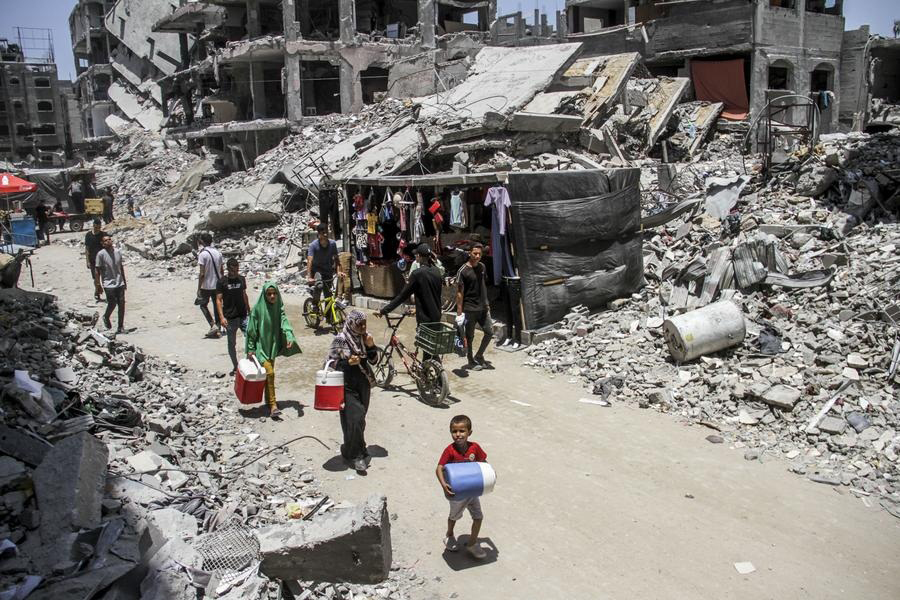
Palestinians walk in a market of the Jabalia refugee camp in the northern Gaza Strip, on June 20, 2024 — Xinhua photo

The total number of Palestinians dead now exceeds 38,000, of which more than 15,000 are children. The number of casualties is well above 120,000 with most of the 2.3 million Gaza population displaced. According to a statement issued on June 19 by the United Nations Agency for Palestinian Refugees, UNRWA, close to 70 per cent of Gaza's water, sanitation facilities and infrastructure have been totally destroyed or damaged, leading to the spreading of infectious diseases. According to the Wall Street Journal, by mid-December last year, almost 70 per cent of Gaza's 439,000 homes and half of its buildings were destroyed or damaged. Now the situation is far worse.

Even before the current war, the Gaza strip was blockaded by Israel for 17 years, turning it into an open-air prison. In fact, the Israeli blockade rendered the impoverished Gaza strip virtually "unliveable", a term used by the then UN special rapporteur Michael Lynk in 2018.

70 per cent of Gaza's population are refugees. They along with about 800,000 Palestinians were ethnically cleansed from their homeland of historical Palestine during the Nakbain 1948. The massacres, the bulldozed villages and the ethnic cleansing of about a million of Palestinians in the Nakba have been meticulously documented, despite an extraordinary propaganda campaign to persuade American and European people into believing that these never happened. These Palestinians in Gaza are survivors of massacres and ethnic cleansing.

With the blessings of the British who ruled Palestine from 1917-1948, Palestine was formally partitioned, establishing Israel, a Zionist white European colonial settler state, what was meant to be a Palestinian one, thus turning Europe's longstanding problem of anti-Semitism into Palestine's Zionist problem.

In fact, Zionism, a white European colonial movement with white supremacist and fascistic ideologies spearheaded a drive to colonise Palestine with the active support from the UK. The 1917 promise (Balfour Declaration) given by the British of a "national homeland" for European Jews was a British colonial project promising a European ethnic group land in the Arab Middle East in Palestine.

Before the Balfour declaration was made public, it had been submitted and approved by US President Woodrow Wilson, in early 1918. It was also publicly endorsed by the French and Italian governments. Finally in 1948 with the blessing of the British rulers of Palestine at that time, Zionists were successful in establishing a racist colonial settler apartheid state in Palestine and named it Israel.

The policy of ignoring the historical context by the West in general and the US in particular has given rise to the current phase of the conflict. In fact, the UN secretary general pointed out that the October 7 attacks had a historical background.

Israel began its genocidal war against Palestinians in Gaza on October 27 when the Palestinian resistance group Hamas launched a surprise attack on Israel on October 7. Before starting the ground invasion of Gaza, Israel had launched one of the most destructive bombing campaigns in modern history. It is the active US support for Israel that emboldend Israel to undertake this genocide in Gaza.

The Wall Street Journal in an article titled "The Postwar Vision That Sees Gaza Sliced into Security Zones" reported a US and Israel plan to create fenced off geographic islands in Gaza to be guarded by the Israeli army. For Israel, "the final solution of the Palestinian problem" lies in all Palestinians in Gaza, either killed or exiled.

The US backed Israeli genocide in Gaza is now aimed at complete ethnic cleansing of Gaza. A leaked Israeli Ministry of Defence intelligence document six days after the Hamas attack calls for the forced transfer of the Gaza Strip's 2.3 million Palestinians to Egypt's Sinai Peninsula.

To achieve that objective the US continues to send weapons to Israel to continue the massacre in Gaza in violation of the ceasefire order of the International Court of Justice (ICJ). Israeli prime minister Benjamin Netanyahu has been invited to address a joint session of the US Congress on July 24 even when the International Court of Justice is reviewing a request by its chief prosecutor for an arrest warrant for Netanyahu for war crimes, and crimes against humanity and murder.

According to Reuters, the US has sent 14,000, 2000-pound bombs to Israel since October for use in Gaza to enable Israel to continue with its genocide in Gaza. Thes bombs can destroy entire city blocks and can kill people up to 1,200 feet away. By sending these highly destructive bombs for use in impoverished densely populated urban areas, the US is knowingly aiding Israel to carry out planned genocide in Gaza.

Despite mounting international criticism of Israel's genocidal military campaign against Palestinians in Gaza, the US is continuing to fund, arm and politically and diplomatically supporting Israel's policy of genocide in Gaza. Recently, in a joint statement by 12 former US government officials said that the Biden administration was violating US laws through its support for Israel and finding loopholes to continue shipping weapons to its ally Israel.

These former officials further added that "America's diplomatic cover for, and continuous flow of arms to Israel ensured our undeniable complicity in the killing and forced starvation of a besieged Palestinian population in Gaza."

Strangely enough, a very poor country like India now under the leadership of a Hindu supremacist prime minister Narendra Modi is also cashing on Israeli genocide in Gaza by exporting arms and ammunitions to Israel despite India's claim that it believes in dialogue and negotiations, not war.

According to The Wire, an Indian news media outlet, the Modi government licensed a shipment in January 2024, the very month the ICJ ruled that some of the acts committed by Israel in Gaza appear to fall within the provisions of the Genocide Convention. According to Al Jazeera, in the aftermath of Israel's bombing of a UN shelter in the Nuseirat camp in Gaza, a video of the remains of a missile reveals a label that clearly read: "Made in India."

The pattern of US support for Israel goes all the way back to its founding. During and following the 1948 Palestinian war after the partition, most Palestinians were driven out of their land. In fact, for decades the US has been providing unconditional support for Israel by using its UN Security Council veto on numerous occasions to shield Israel from international accountability.

The Jewish groups such as Haganah to Irgun, and the Stern Gang actively used terrorism to create fear among the Palestinians. Terrorism carried out by these groups in the 1940s played a significant role in creating the conditions that facilitated the founding of Israel, and the consequent creation of an Arab-Palestinian diaspora. In fact, Zionist terrorism was at the core of the idea of Israel.

The US was the first country to grant Israel recognition on May 14, 1948 and played the leading role in mobilising votes in the UN to recognise the new state of Israel within its illegally seized borders. Zionist militias and the Israeli army destroyed over 500 Palestinian villages. Israel also appropriated 78 per cent of the territory of Palestine, including the larger part of Jerusalem following the 1948 war. It was a catastrophic destruction and ethnic cleansing of Palestine and her people in1948. The 1967 war provided Israel with opportunity to further expand its territory including East Jerusalem.

The US also engineered the Oslo Accord and the Abrams Accord which are attempts to further consolidate Israel as the colonial settler state in occupied Palestine with the support of major Arab states as the British did with the collaboration of Hussein bin Ali Hashimi, the Sharif of Mecca to colonise Palestine thus paving the way for the creation of the colonial settler state leading to Nakba (catastrophe) to befall the Palestinians.

Israel with the support of the US and its European allies appears to be more emboldened than ever before to escalate its genocidal campaign against Palestinians. Yet, after fighting nine months to eliminate Hamas, their fighters within Gaza still manage to inflict serious casualties on Israeli troops and destroy tanks and personnel carriers.

Not only the international community failed to end the genocide in Gaza, but it also failed to delink humanitarian aid from political and military objectives. The Palestinian people themselves alone have always remained the source of resistance against the colonisation of their land. Now chances are a united Palestinian armed resistance will continue to grow and further strengthen to liberate their land.​
 
Analyze

Analyze Post

Add your ideas here:
Highlight Cite Respond
  • Like (+1)
Reactions: Bilal9

'Bulldozed and shelled'
Gaza farming sector ravaged by Israeli offensive now in its 10th month

1720395636879.webp

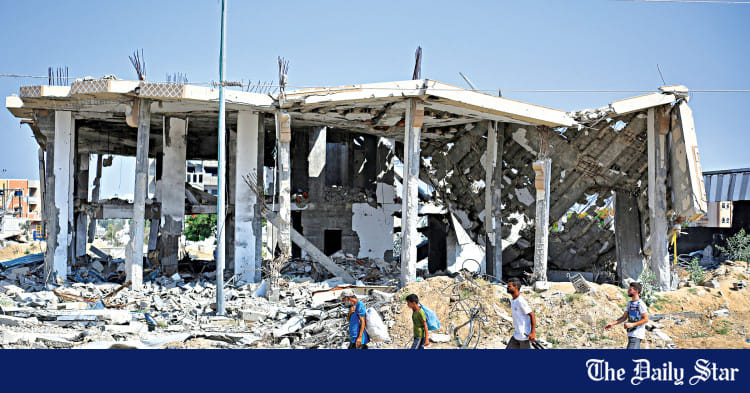
Displaced Palestinians carry belongings as they walk in front of a destroyed building in Deir el-Balah in the central Gaza Strip yesterday. An Israeli air strike on a house in the town of Zawayda, in central Gaza, killed at least six people and wounded several others. Photo: AFP

Tank tracks still fresh on his field in southern Gaza's coastal area of Al-Mawasi, Nedal Abu Jazar lamented the damage offensive has wrought on his trees and crops.

"Look at the destruction," the 39-year-old farmer told AFP, holding an uprooted tomato plant. He pointed to his greenhouse's metal frame and its white plastic sheeting strewn across the plot, inside an area designated a humanitarian zone by the Israeli army.

"People were sitting peacefully on their farmland ... and suddenly tanks arrived and fired at us, and then there were (air) strikes."

Abu Jazar said the Israeli operation in late June destroyed about 40 dunams (10 acres) of land and killed five labourers.

His is not an isolated case. Across Gaza, 57 percent of agricultural land has been damaged since the offensive began, according to a joint assessment published in June by the UN's agriculture and satellite imagery agencies, FAO and UNOSAT.

Across Gaza, 57 pc of agricultural land has been damaged since the offensive began: FAO

The damage threatens Gaza's food sovereignty, Matieu Henry of the Food and Agriculture Organization told AFP, because 30 percent of the Palestinian territory's food consumption comes from agricultural land.

"If almost 60 percent of the agricultural land has been damaged, this may have a significant impact in terms of food security and food supply."

The Gaza Strip exported $44.6 million worth of produce in 2022, mainly to the West Bank and Israel, with strawberries and tomatoes representing 60 percent of the total, according to FAO data.

The damage assessment on the agricultural land comes as the UN's hunger monitoring system estimated in June that 96 percent of Gaza faces high levels of acute food insecurity.

Contacted by AFP, the Israeli army said it "does not intentionally harm agricultural land".

In a statement, it said Hamas "often operates from within orchards, fields and agricultural land".

The impact is worse in the Palestinian territory's north, where 68 percent of agricultural land is damaged, although the southern area encompassing parts of Al-Mawasi has seen the most significant increase in recent months due to operations.

UNOSAT's Lars Bromley told AFP the damage is generally "due to the impact of activities such as heavy vehicle activity, bombing, shelling, and other conflict-related dynamics, which would be things like areas burning".

Near the southern city of Rafah, 34-year-old farmer Ibrahim Dheir feels helpless after the destruction of 20 dunams (five acres) of land he used to lease, and all his farming equipment with it.

"As soon as the Israeli bulldozers and tanks entered the area, they began bulldozing cultivated lands with various trees, including fruits, citrus, guava, as well as crops like spinach, molokhia (jute mallow), eggplant, squash, pumpkin and sunflower seedlings," he said, before listing more damage in a testimony of the area's past agricultural abundance.

Dheir, whose family exported its produce to the West Bank and Israel, now feels destitute. "We used to depend on agriculture for our livelihood day by day, but now there's no work or income."

Farmer Abu Mahmoud Za'arab also finds himself with "no source of income". The 60-year-old owns 15 dunams (3.7 acres) of land on which crops and fruit trees used to grow.​
 
Analyze

Analyze Post

Add your ideas here:
Highlight Cite Respond
  • Like (+1)
Reactions: Bilal9

Israeli protesters step up push for Gaza truce deal
Agence France-Presse . Tel Aviv 08 July, 2024, 00:51

1720397422082.webp


Women in the Israeli city of Tel Aviv take part in a demonstration for the release of hostages still held by Palestinian militants in the Gaza Strip. | AFP photo

Israeli protesters chanting 'we will not give up' marched through Tel Aviv on Sunday, the second consecutive day of demonstrations in a stepped-up push for a deal to free hostages in Gaza.

A nationwide 'disruption day' began at 6:29 am, corresponding to the start of Hamas's October 7 attack on southern Israel that set off the war.

After nine months of fighting, Israel says 116 captives are still held by militants in Gaza, including 42 the military says are dead.

'Enough is enough,' said Orly Nativ, a 57-year-old social worker from Tel Aviv who joined the hundreds of flag-wielding demonstrators.

They stopped traffic at an intersection in Tel Aviv, calling for the government to secure a deal to free the hostages still held by Palestinian militants Hamas.

'The government doesn't care what the people think, and they don't do anything to bring back our sisters and brothers from Gaza and take care of us and take care of what happened after October 7th,' Nativ said.

Another demonstrator, Yoni Peleg, called it 'a last cry out for help from the entire country to help us end the war, help us get our people.'

In Jerusalem, police stepped up security around Prime Minister Benjamin Netanyahu's residence before a planned rally there.

The night before, thousands of anti-government demonstrators blocked a highway in Tel Aviv. Some clashed with police on horseback before officers deployed water canon to force people from the road.

Protest organisers estimated around 176,000 people had by 9:00pm filled a Tel Aviv intersection which they call 'Democracy Square'. That would make it one of the biggest demonstrations since the war began.

Large protests, also demanding elections, have taken place across the Israeli city every Saturday night, with smaller ones thoughout the country to put pressure on Netanyahu's government to bring the hostages home.

The protests come as indirect truce negotiations between Israel and Hamas have regained momentum after months of failed diplomacy.

Netanyahu has consistently opposed any deal that allows Hamas to survive.

But pressure is mounting as families tire of arguing their loved ones' lives are worth more than declaring victory over Hamas.

'For the first time in many months, we feel there is a spark of hope,' Sachar Mor, a relative of hostage Ofer Kalderon, said at a separate rally held by the hostage families on Saturday night.

'This is an opportunity that cannot be missed.'

The October 7 attack resulted in the deaths of 1,195 people, mostly civilians, according to an AFP tally based on Israeli figures.

Of the 251 hostages seized by militants on that day, Israeli forces have rescued seven of them alive, and 80 Israelis were freed during the war's only truce, which lasted one week in November.

In response to the October 7 attack, Israel's military offensive has killed at least 38,153 people in Gaza, also mostly civilians, according to the health ministry in the Hamas-ruled territory.​
 
Analyze

Analyze Post

Add your ideas here:
Highlight Cite Respond
  • Like (+1)
Reactions: Bilal9

Stranded aid trucks deepen Gaza hunger crisis

Hundreds of trucks loaded with food and water have been stranded on a scorching Egyptian road, some for nearly two months, awaiting permission to deliver the much needed humanitarian supplies to Gaza.

About 50 kilometres from the Gaza border, trucks carrying flour, water and other aid line a dusty road in both directions. The drivers say they have been waiting for several weeks in the searing Egyptian summer heat.

The standstill is exacerbating Gaza's dire humanitarian crisis after nine months of offensive. Aid groups warn there is a high risk of famine across the besieged coastal territory.

The truck drivers, parked on the outskirts of the Egyptian city of al-Arish in the Sinai Peninsula, say they have been unable to deliver humanitarian supplies ever since Israel expanded its offensive on the Gaza-Egypt border in May. Some food has had to be discarded, they said.

"I swear to God, before this load, we came here and stood for more than 50 days and eventually the load was returned because it had expired," said truck driver Elsayed el-Nabawi. Israeli military started its assault on the southern Gazan city of Rafah in May.​
 
Analyze

Analyze Post

Add your ideas here:
Highlight Cite Respond
  • Like (+1)
Reactions: Bilal9

Members Online

Back
 
G
O
 
H
O
M
E