Home Watch Videos Wars Login

[🇧🇩] Israel and Hamas war in Gaza-----Can Bangladesh be a peace broker?

[🇧🇩] Israel and Hamas war in Gaza-----Can Bangladesh be a peace broker?
956
26K
More threads by Saif

G Bangladesh Defense

Iran warns against ‘ethnic cleansing’ of Palestinians
Agence France-Presse . Tehran, Iran 03 February, 2025, 22:54

1738626103398.webp


Iran on Monday condemned US president Donald Trump’s proposal to relocate Palestinians from the Gaza Strip, warning it would amount to ‘ethnic cleansing’.

Foreign ministry spokesman Esmaeil Baqaei said the international community should help Palestinians ‘secure their right to self-determination... rather than pushing for other ideas that would be tantamount to ethnic cleansing’.

The remarks from Baqaei come after Trump repeatedly floated an idea to ‘clean out’ the Gaza Strip and move its population to Egypt and Jordan.

‘Cleaning out Gaza... is part of colonial erasure of (the) Gaza Strip and the whole Palestine,’ Baqaei said, adding that ‘no third party’ can decide on the future of the Palestinian territory.

Iran, which does not recognise Israel, has made support for the Palestinian cause one of the pillars of its foreign policy since the victory of Islamic Revolution in 1979.

Iran and Israel, enemies for years, saw their first direct exchange of fire during the war in Gaza.

Iran provides financial and military backing for Hamas, but insists it and the other groups Tehran supports act independently.

Iranian vice-president Mohammad Javad Zarif recently said that Hamas’s attack on Israel on October 7, 2023 had ‘undermined’ nuclear negotiations between Iran and the United States.​
 
Analyze

Analyze Post

Add your ideas here:
Highlight Cite Fact Check Respond
  • Like (+1)
Reactions: Bilal9

Israel commits to new Gaza ceasefire talks
Netanyahu set to meet Trump; gunman kills two soldiers at West Bank checkpoint

1738710032952.webp

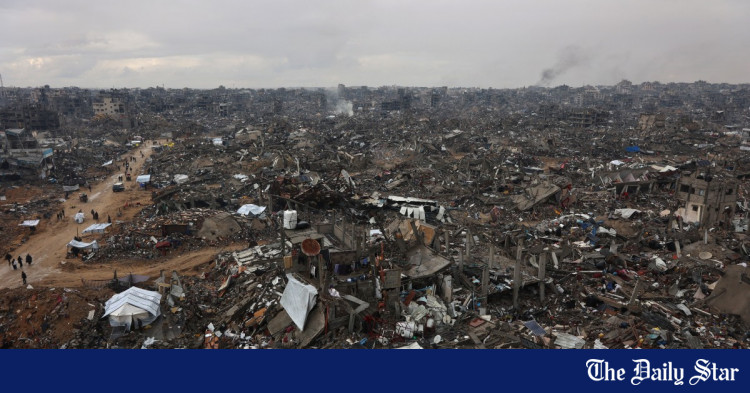
Photo: AFP This picture shows a general view of the destruction as displaced Palestinians return to the northern areas of the Gaza Strip, in Jabalia. The phot was taken recently.

Israel said it was sending a team to negotiate the next phase of a fragile ceasefire with Hamas, signalling possible progress ahead of Prime Minister Benjamin Netanyahu's meeting with US President Donald Trump on Tuesday.

Netanyahu will be the first foreign leader to meet Trump in the White House since his return to power last month, and will likely face some pressure to honour the ceasefire the US leader has claimed credit for.

Hours before their meeting, Netanyahu's office said Israel would send a delegation to the Qatari capital Doha later this week for negotiations.

Hamas has said it is ready to negotiate the second stage of the ceasefire, mediated by Qatar, the United States and Egypt, and which should focus on a more permanent end to the war.

The first phase, which took effect on January 19, halted more than 15 months of bombardment and fighting that has levelled much of the Gaza Strip.

In line with the agreement, Hamas and Israel have begun exchanging hostages held in Gaza for prisoners held in Israeli jails.

"Israel is preparing for the working-level delegation to leave for Doha at the end of this week in order to discuss technical details related to the continued implementation of the agreement," Netanyahu's office said following meetings with Trump's advisors, including Middle East envoy Steve Witkoff.

Trump has touted a plan to "clean out" Gaza, calling for Palestinians to move to Egypt or Jordan.

Both countries have flatly rejected his proposal, as have the territory's own residents.

"We are the owners of this land; we have always been here, and will always be. The future is ours," said Majed al-Zebda, a father of six whose house was destroyed in the war.

Before leaving for Washington, Netanyahu said Israel's wars with Hamas in Gaza, Hezbollah in Lebanon and its confrontations with Iran had "redrawn the map" in the Middle East.

"But I believe that working closely with President Trump we can redraw it even further, and for the better," he said.

Trump, who prides himself on his deal-making abilities, will be pushing Netanyahu to stick to the agreement, possibly offering incentives such as a normalisation deal with Saudi Arabia.

Efforts under Trump's predecessor Joe Biden for normalisation froze with the Gaza war, and Saudi Arabia has in recent months hardened its position.

Trump said Sunday that talks with Israel and other Middle Eastern countries were "progressing" -- but warned that he had "no assurances" that the truce in Gaza would hold.

"I have no assurances that it will hold, I mean I've seen people brutalised, nobody's ever seen anything like it, no I have no guarantees that the peace is going to hold," he said.

Witkoff, who met Netanyahu on Monday over terms for the second phase of the truce, said however that he was "certainly hopeful".

Since the truce took effect, Israel has turned its focus to the occupied West Bank, launching a deadly operation in the area around Jenin, a hotbed of Palestinian militancy.

UN aid agency UNRWA, which is now banned in Israel, warned the refugee camp of Jenin was "going into a catastrophic direction".

Today, the Israeli army said a gunman killed two Israeli soldiers in an attack on a military post in Tayasir in the West Bank. The assailant was also killed.

Asked about how he viewed a possible annexation of the West Bank, Trump told reporters: "It's a small country in terms of land."

"It's a pretty small piece of land. And it's amazing that they've been able to do what they've been able to do," he said.

Under the Gaza ceasefire's ongoing 42-day first phase, Hamas was to free 33 hostages in staggered releases in exchange for around 1,900 Palestinians held in Israeli jails.

Four hostage-prisoner exchanges have already taken place, with militants freeing 18 hostages in exchange for some 600 mostly Palestinian prisoners from Israeli jails.

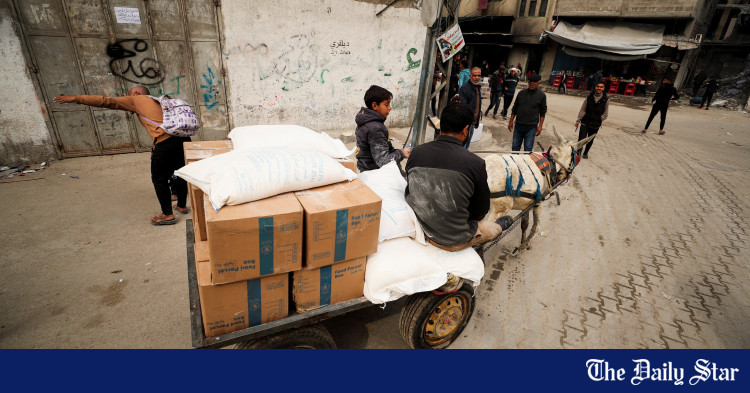
The truce has also led to a surge of food, fuel, medical and other aid into Gaza, and allowed people displaced by the war to return to their neighbourhoods in the north of the Palestinian territory.

The conflict started on October 07, 2023, with Israel killing at least 47,518 people in Gaza, the majority civilians, according to the Hamas-run territory's health ministry. The UN considers these figures as reliable.​
 
Analyze

Analyze Post

Add your ideas here:
Highlight Cite Fact Check Respond

15 freed Palestinian prisoners arrive in Turkey
Agence France-Presse . Istanbul 05 February, 2025, 00:00

1738711486858.webp

A Palestinian man sits in the sun in front of a destroyed building in Jabalia in the northern Gaza Strip on February 4, 2025. | AFP photo

Fifteen Palestinian prisoners freed by Israel under the terms of the Gaza ceasefire have arrived in Turkey, foreign minister Hakan Fidan said on Tuesday.

‘A few days ago, 15 Palestinians came to Turkey via Cairo after they were released,’ he told a joint press conference with his Egyptian counterpart Badr Abdelatty.

The former detainees were issued visas by the Turkish embassy in Cairo, he said.

The first phase of the Gaza ceasefire saw the release of 33 Israeli hostages held by Hamas in return for the freeing of around 1,900 prisoners, mostly Palestinians, being held in Israeli jails.

Upon their release, many of those prisoners were to be permanently exiled, with Fidan saying in Doha on Sunday that Turkey could take in a number of them.

In 2011, Turkey took in 11 Palestinians who were freed as part of a prisoner exchange between Israel and Hamas that saw Israeli soldier Gilad Shalit released in exchange for more than 1,000 Palestinian detainees.

Meanwhile, a gunman attacked an Israeli military checkpoint in the occupied West Bank on Tuesday, fatally wounding two soldiers before troops shot him dead, the military said.

The shooting took place in the morning at a military post in Tayasir in the northern part of the West Bank, the military said in a statement.

‘A terrorist fired at the soldiers at a military post in Tayasir,’ it said, adding the troops killed the gunman during a shootout.

Two other soldiers were ‘severely injured’ in the attack, while six were slightly wounded.

Palestinian militant group Islamic Jihad praised Tuesday’s ‘heroic’ attack on the checkpoint, saying ‘the resistance will continue until the occupation is defeated’.

Israeli forces have been engaged in what the army says is ‘an operation to thwart terrorism’ in and around the northern city of Jenin, long a hotbed of militancy.

Israeli commander Major General Avi Bluth, who is responsible for the West Bank, said Tuesday’s attack showed the ‘necessity’ of continuing with the offensive in the northern part of the territory.

‘This morning’s engagement with a despicable terrorist who emerged from the northern Samaria region is the demonstration of the necessity of the counterterrorism operation,’ Bluth told journalists when he visited the scene, vowing to ‘neutralise’ militants in the area.

On Sunday, the army said it had killed at least 50 militants since it launched the operation on January 21. The Palestinian health ministry said on Monday that Israeli forces had killed 70 people in the territory since the start of the year.​
 
Analyze

Analyze Post

Add your ideas here:
Highlight Cite Fact Check Respond

Hamas says talks start on second phase of Gaza ceasefire deal
REUTERS
Published :
Feb 04, 2025 21:24
Updated :
Feb 04, 2025 21:24

1738712466494.webp

A Palestinian man operates heavy machinery to open the road and remove the rubble, amid a ceasefire between Israel and Hamas, in the southern Gaza Strip, February 4, 2025. Photo : REUTERS/Hatem Khaled

Talks have started on the second phase of the Gaza ceasefire deal, the spokesperson for the Palestinian militant group Hamas said on Tuesday.

The first phase of the ceasefire between Israel and Hamas went into force on Jan 19 after 15 months of war and involved a halt to fighting, the release of some of the Israeli hostages held by Hamas and the freeing of some Palestinian prisoners.

Phase two of the three-phase deal is intended to focus on agreements on the release of the remaining hostages and the withdrawal of Israeli troops from Gaza.

"Contacts and negotiation on the second phase have begun," Hamas spokesperson Abdel-Latif Al-Qanoua said, without providing further details.

Israeli Prime Minister Benjamin Netanyahu's office said earlier on Tuesday that Israel was preparing to send a high-level delegation to the Qatari capital Doha to discuss continued implementation of the deal.

Netanyahu was due to hold talks with US President Donald Trump on Tuesday, with the focus likely to be on the ceasefire as well as a possible normalisation of relations with Saudi Arabia.

The initial six-week truce, agreed with Egyptian and Qatari mediators and backed by the US, has remained largely intact but prospects for a durable settlement are unclear.

The war began with the Hamas-led attack on Israel on Oct 7 in which 1,200 people were killed and more than 250 taken hostage, according to Israeli tallies. Israel's military campaign in Gaza since then has killed more than 47,000 Palestinians, Palestinian health authorities say.

Hamas and Netanyahu's government, which includes hardliners who opposed the ceasefire deal, say they are committed to reaching an agreement in the second phase although each has criticised the other over its implementation.

Israeli leaders say Hamas cannot remain in Gaza, but the movement has taken every opportunity it could to show the control it still exerts despite the loss of much of its former leadership and thousands of fighters during the war.

Qanoua said Israel had stalled in implementing the humanitarian protocol of the ongoing first phase, hindering the repair of hospitals, roads, water wells and infrastructure destroyed by Israel's 15-month offensive.

Israel did not immediately comment on Qanoua's assertion although Israeli deputy foreign minister Sharren Haskel told MSNBC's "Morning Joe" show that Hamas had broken a lot of the rules that had been set.

Despite this, she said: "We are hopeful. We want to bring back all of our family members, and we need to make sure that Israel's security can be guarded."​
 
Analyze

Analyze Post

Add your ideas here:
Highlight Cite Fact Check Respond

What to expect from Netanyahu’s visit with Trump

1738797336684.webp

Palestinians transport aid supplies on an animal-drawn cart, amid a ceasefire between Hamas and Israel, in Gaza City, on February 3, 2025. PHOTO: REUTERS

Since Donald Trump returned to the White House for a second term, global, regional and domestic changes have been accelerating at an unprecedented pace. Trump's inaugural speech and his deluge of executive orders exemplify a nationalist rhetoric, which includes barring student visas of those who participated in "pro-Palestinian" protests that shook the country last year. He heralded "a golden age," in his inaugural address, and his policies have put Washington—and the rest of the world—on notice that Trump is determined to turn his campaign promises into reality. His promises come with a liking of openly self-serving agendas. Nowhere is this more evident than in his administration's approach towards the Middle East, which is defined by a complete bias for Israeli expansionism at the expense of Palestinians.

The policy not only disregards Palestinian rights but also strengthens Israeli hegemony, offering illusions through hardline figures such as Massad Boulos and Steve Witkoff. Under Trump's first administration, the US showed no interest in supporting the establishment of an independent Palestinian state, further exacerbating Palestinian suffering and pushing towards the dissolution of the cause. This time, evidently, will be no different. Israeli Prime Minister Benjamin Netanyahu's visit and upcoming discussions with Trump raises questions, and mostly concerns, about what lies ahead. The ceasefire is currently in a fragile state, held in the Gaza Strip with the next stage of negotiations expected to enter the second phase that includes a more permanent end to the conflict.

Netanyahu, the first foreign leader to meet Trump at the White House, will undoubtedly try to preserve a dynamic between the nations where absolutely no threats for Netanyahu's position as the Prime Minister of Israel, and ensure there are no checks and balance for his government—given those members are "loyal" to him. It is the same dynamic that resulted in the Abraham Accords. In this context, it is important to remember that Netanyahu's decision in Israel has not been in the interest of the Israeli public, majority of whom do not approve of him. He dragged the war on for political gains, and got rid of anyone who objected to his decisions, in order to serve his personal interests, starting with the opposition duo Benny Gantz and Gadi Eisenkot, then Defence Minister Yoav Gallant, and finally the chief of staff who was replaced by Netanyahu's most loyal commander.

He closed the gaps that disturbed him and confused his absolute rule under the pretext of achieving absolute victory. When speaking to Trump, Netanyahu's logic that "I am Israel" will inarguably dominate. His expansionist aims will be presented, days after Trump has offered—and been rejected—to relocate Palestinians from Gaza to Egypt and Jordan.

Netanyahu's equation with Trump in his first term doubled Israel's dependency on US financial, armed and political wars, and will remain a constant threat to the Middle East, a region whose map both leaders want to change, and the region where they presume authority to throw around citizens and people across borders.

False promises and intermediary characters

Massad Boulos, a billionaire of Lebanese origin and the father-in-law of Tiffany Trump, played a role in crafting deceptive assurances to the Palestinians, suggesting there was a real opportunity for political relief under the Trump administration. These promises follow a long-standing US pattern of selling illusions to Palestinians, offering grand economic or political solutions without any substantive commitments.

Similarly, Steve Witkoff, US billionaire real estate investor and Trump's Middle East envoy, sought to position himself as a mediator, even reportedly visiting Gaza. However, these gestures will only remain as mere theatrics that fall in line with the administration's broader policies that actively reinforce Israeli occupation, settlement expansion, and annexation projects.

Israeli hegemony as a pillar of US strategy

The US-Israel alliance is deeply rooted in strategic interests, making the idea of an independent Palestinian state fundamentally at odds with Washington's long-term vision of "peace" in the Middle East. Israel serves as the linchpin of US influence in the region, and as such, Trump's policies, including his support for Israeli settlements, the relocation of the US embassy to Jerusalem, and the recognition of Jerusalem as Israel's unified capital confirm that Washington sees the continuation of Israeli hegemony as a long-term strategic goal.

In the same vein, the Trump administration brokered a truce between Hezbollah and Israel that pushed the deadline for the complete withdrawal of the Israeli occupation forces from Lebanon, further extending Israel's military presence in the country. Trump has completely sidelined Jordan from his strategic calculations, seeking to impose an economic blockade to pressure Amman into aligning with his regional agenda, most notably, by forcing Jordan to absorb Palestinians from Gaza. That is a revival of a proposal that Jordan rejected during Trump's first term, which is now being pushed again through economic coercion, including threats to cut aid.

At the same time, US officials such as Ambassador Mike Huckabee and the US ambassador to the UN have openly championed Israel's "biblical right" to the West Bank. Huckabee, a hardline Anglican, refuses to call the Israeli communities in the West Bank "settlements." The US ambassador to the UN has echoed similar sentiments, reflecting the depth of the indoctrinated anti-Palestinian beliefs in US decision-making.

Trump's policies and his supporters

Trump's support for Israel cannot be separated from his electoral base, which largely consists of Zionists and Evangelical Christians. These groups see support for Israel as a religious and ideological duty. For them, the "Greater Land of Israel" is part of their faith. The usage of religion to occupy land, unfairly, played a major role in pushing the Trump administration to adopt policies that serve the entire Israeli occupation project at the expense of Palestinian human rights.

Since assuming office, Trump has lifted sanctions on Israeli settlers, removed bans on bomb shipments to Israel, and endorsed proposals advocating for the forced transfer of Palestinians under the guise of "evacuating areas."

If we look at Trump's policies realistically, it is clear that his administration is interested in pushing for Israeli hegemony,

Trump's transactionalism

Trump approaches international issues, including the Palestinian cause, through the lens of transactionalism. Rather than addressing the political roots of conflicts or seeking justice, he perceives the region as an opportunity for economic profit. His statements referring to Gaza as a "fantastic place" exemplify his reductionist perspective, trivialising the unimaginable suffering of the Palestinians in Gaza for the past year and a half. Similar to Netanyahu, Trump has also reduced the Palestinians' struggle to a mere commercial project and their land to a profit-making machine. These policies, coated in political hypocrisy, only deepen the suffering of the Palestinian people.

Given this stark reality, it is imperative that we Palestinians, and Palestinian supporters around the world, unite according to a clear strategic vision and work to realign internal political and diplomatic priorities to confront the growing challenges. As the ceasefire in Gaza hangs in the air, the Israeli military, for its part, has shifted its focus over the past two weeks to the West Bank, carrying out airstrikes and blowing up 23 buildings in Jenin on Sunday. If Trump and Netanyahu work to foster the problematic US-Israeli equation that has underlined the conflict with Palestine, the Middle East will only plunge into further unrest. The only hope lies in Trump's economic interests with the Arab states and gulf nations overriding his penchant for far-right nationalists like Netanyahu. The coming days will reveal the future of Gaza in the short-term at least, but that itself is the issue: the future of the besieged strip lies in the hands of two men who, above all, care mostly about themselves.

Yousef SY Ramadan is the ambassador of Palestine to Bangladesh.​
 
Analyze

Analyze Post

Add your ideas here:
Highlight Cite Fact Check Respond

Members Online

No members online now.

Latest Posts

Back
 
G
O
 
H
O
M
E