[🇧🇩] Israel and Hamas war in Gaza-----Can Bangladesh be a peace broker?

[🇧🇩] Israel and Hamas war in Gaza-----Can Bangladesh be a peace broker?
1K
44K
More threads by Saif

G Bangladesh Defense

Strike on Gaza university kills 3

Agence France-Presse . Gaza City
1792975125960.webp


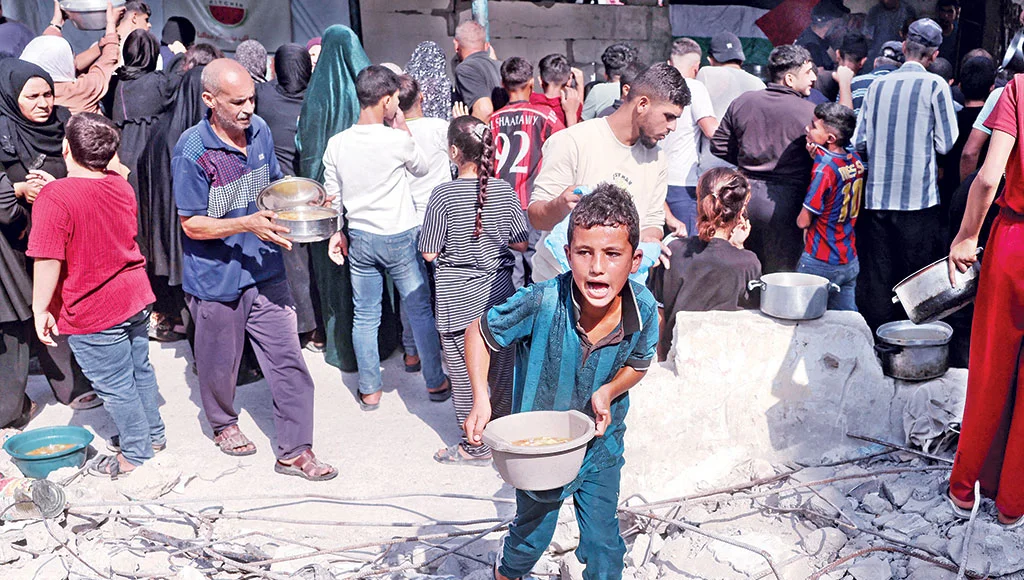
An Israeli strike on a university in Gaza City killed three people on Sunday, staff and a local hospital said, while the civil defence agency reported four others killed elsewhere in the territory.

Reached for comment, the Israeli military said it was looking into the reports.

Al Shifa hospital said it received three bodies and treated eight people who were wounded in the Gaza City drone strike, with two sources at the Islamic University saying those killed were administrative staff and the injured were students.

Gaza’s education ministry said in a statement that the students had been present for classes.

It went on to condemn the strike and said ‘the global silence regarding attacks on students and universities serves as encouragement for the continuation of these crimes’.

‘This strike occurs at a time when the higher education sector is facing total annihilation, with 95 percent of the buildings belonging to academic institutions having been damaged as a result of the war,’ it continued.

‘This heinous assault is part of a continuous series of attacks on education; over the past six days, 10 students and educators have been killed by the occupation’s fire.’

A truce has been in effect in Gaza for over a year, but has failed to completely halt the violence there.

Gaza civil defence spokesman Mahmoud Bassal said four other people were killed on Sunday, two in an airstrike in the southern city of Khan Yunis, one in central Deir al Balah and one in the north of the Strip.​
 

Netanyahu or Eisenkot: Why Israel's election may change little for Palestinians

The two rivals have contrasting backgrounds and competing visions of leadership, but their positions on Palestinian rights raise questions about whether a change of government would bring a change in policy.

Tanim Ahmed


1793146377128.webp

A combination picture shows Israeli Prime Minister Benjamin Netanyahu as he attends a memorial service held for Ran Gvili, an off-duty police officer who was killed fighting militants that had infiltrated Israel during the deadly October 7, 2023, attack by Hamas, and the last hostage recovered from Gaza, in Meitar, Israel, January 28, 2026, and Israeli opposition leader and former military chief, Gadi Eisenkot, as he launches an election campaign for Yashar, his new political party, at an event near Hod Hasharon, Israel, June 30, 2026. Photo: REUTERS/Amir Cohen

Although the two frontrunners in the Israeli elections could not be more different, neither would mean much of a difference for Palestine.

Incumbent Benjamin Netanyahu, despite his privileged upbringing in a well-to-do Jerusalem neighbourhood, has for long passed himself as the champion of the working man. Netanyahu’s American English and engaging oratory have contributed to his charm.

Netanyahu’s top challenger, Gadi Eisenkot, who served as his army chief and then in his war cabinet, grew up in the working-class township of Eilat that people of modest background actually identify with. Eisenkot joined the Golani Brigade, which could be said to be the heart of Israel’s infantry with deep roots in the land. He rose through its ranks to head the military. He is not sophisticated. Nor is he a great speaker. But he is a down to earth man who every working man can relate to.

Netanyahu is an Ashkenazi jew, meaning he is of European descent. Eisenkot is a Mizrahi -- those who are of Middle Eastern or oriental descent -- with parents from Morocco. Israel has never had a Mizrahi PM.

Netanyahu’s sons have made very little contribution to the ongoing genocide in Gaza, that Israelis appear to perceive as an existential war. In fact one of his sons has been hanging out in Miami for three years with state security at his disposal and is known for trolling political opponents of his father.

Eisenkot had driven his son to the reservists’ assembly point on October 7 when Hamas attacked Israel. A medic in the army, Eisenkot’s son died in December 2023 when he stepped on an IED. Eisenkot lost two nephews in this war too.

Both Netanyahu and Eisenkot have criticised each other for being too "soft" on Palestinians. Netanyahu, who has overseen the killing of 74,000 people in Gaza since October 2023, is "soft" on Palestine, says Eisenkot, who is credited with the "Dahiya Doctrine", which calls for disproportionate force and destruction of civilian infrastructure. The term is derived from the densely populated eponymous Beirut suburb which was a stronghold of Hezbollah. It suffered extensive bombardment in 2006.

Eisenkot has criticised Netanyahu for not caring about Israeli hostages and pulverising Gaza only to keep his far-right coalition intact. While Netanyahu continues to exempt the ultra-orthodox Jews from reserve duty and provides them government benefits, Eisenkot is of the view that everyone should share the burden of serving in the army. Although exemption for the orthodox Jews had been suspended in 2024, Netanyahu continues to overlook it, and in all likelihood, will continue to do so should he win.

Eisenkot’s alliance -- Israel has never had any single party carry the election -- is projected to take up to 54 seats in the 120-seat Knesset. Netanyahu’s coalition is projected to get about 50. It appears that Arab support could turn out to be the deciding factor. Arab parties have indicated that they might be ready to lend their support for an opposition alliance to remove Netanyahu from office.

But full results take time to come out and forming government is almost invariably a complicated affair often leading to inconclusive elections, necessitating further rounds of elections.

Since Israel’s electoral system is based on proportional representation, turn out really matters and this time there has been a record. Haaretz is reporting that Netanyahu has been railing against the Arabs for trying to "steal" the election by turning out in droves. The threshold for a party to get into the Knesset is 3.25% of the popular vote. Any party securing that percentage gets four seats.

About 15 million people live in areas under Israeli control. Just over 7 million Jewish Israelis and 1.7 million Palestinian citizens of Israel who live within what is called the green line (Israel’s pre-1967 borders) have voting rights.

Over 500,000 Israeli settlers who live in the occupied West Bank have voting rights. But the 3.1 million Palestinians do not. Similarly in occupied East Jerusalem, more than 230,000 Israelis have voting rights but about 350,000 Palestinians living there cannot.

Exit polls, due in about a few hours, may provide the first indications over who will preside over the next Israeli government but it will take a few days still for that to pan out.​
 
Back
Top