[🇮🇱] Israel News/Views

[🇮🇱] Israel News/Views
18
283
More threads by Saif

G  Israeli Defense

Saif

Senior Member
Joined
Jan 24, 2024
Messages
22,172
Likes
9,869
Nation

Axis Group

European powers urge Israel to end settlements
Agence France-Presse . Rome, Italy 23 May, 2026, 00:59

1779496619080.webp


A French activist detained and deported by Israel following the interception of their Gaza-bound flotilla hugs a relative as they arrive at Roissy Charles de Gaulle airport in Paris on Friday. | AFP photo

Italy, France, Britain and Germany urged Israel Friday to stop expanding its settlements in the West Bank, saying the government was ‘undermining stability’ and prospects for a two-state solution.

‘We call on the government of Israel to end its expansion of settlements and administrative powers, ensure accountability for settler violence and investigate allegations against Israeli forces,’ said the countries in a joint statement.

Noting that the situation in the West Bank had ‘deteriorated significantly’ in the past few months, the countries said settler violence towards Palestinians was at ‘unprecedented levels’.

‘The policies and practices of the Israeli government, including a further entrenchment of Israeli control, are undermining stability and prospects for a two-state solution,’ read the statement.

The countries condemned Israel’s E1 settlement plan—a new construction project expected to build some 3,400 housing units in the occupied West Bank over 12 square kilometres -- saying it would be a ‘serious breach of international law’.

‘Businesses should not bid for construction tenders for E1 or other settlement developments. They should be aware of legal and reputational consequences of participating in settlement construction including the risk of involving themselves in serious breaches of international law,’ the countries said.

The statement also called on Israel to lift its financial restrictions on the Palestinian Authority and the Palestinian economy.

The four countries also noted that they ‘strongly oppose those, including members of the Israeli government, who argue for annexation and forcible displacement of the Palestinian population’.

Since the war in Gaza broke out in October 2023, near-daily violence has also rocked the West Bank, which Israel has occupied since 1967.

The joint statement came after a tense week in European-Israeli relations following the publication of a video that revealed the harsh treatment of European activists from a Gaza-bound flotilla while in Israeli custody.

Israel’s far-right national security minister, Itamar Ben Gvir, published the video that showed activists forced to kneel with their foreheads to the ground and their hands tied.

Italy and Spain later called on the EU to sanction Ben Gvir, while Ireland urged the EU to take action against Israel over the activists’ treatment, according to a leaked letter seen by AFP.

The United Kingdom, meanwhile, summoned Israel’s most senior diplomat in Britain following what it called the ‘inflammatory video’.​
 

Netanyahu told Trump Israel will remain free to act against threats, Israeli source says

REUTERS

Published :
May 24, 2026 19:58
Updated :
May 24, 2026 20:03

1779681511243.webp

US President Donald Trump points his finger towards Israeli Prime Minister Benjamin Netanyahu during a press conference after meeting at Trump’s Mar-a-Lago club in Palm Beach, Florida, US, December 29, 2025. Photo : REUTERS/Jonathan Ernst/Files

Israeli Prime Minister Benjamin Netanyahu told US President Donald Trump Israel would remain free to act against threats in Lebanon during a phone call about an emerging agreement between Washington and Iran ‌on Saturday, an Israeli source said.

Trump said Washington and Iran had "largely negotiated" a memorandum of understanding on a peace deal that would reopen the Strait of Hormuz, a vital shipping passage that has been effectively closed since the US and Israel launched their war on Iran in February.

"In last night's ⁠conversation with President Trump, the Prime Minister emphasized that Israel will maintain freedom of action against threats in all arenas, including Lebanon, and President Trump reiterated and supported this principle," the Israeli political source told Reuters on Sunday, asking not to be named.

Expectations rose that a breakthrough might be imminent in the three-month-old war after Trump said an emerging agreement being brokered by Pakistan would reopen the Strait of Hormuz.

Iran's Fars news agency said the draft stipulates that the US and ‌its ⁠allies will not attack Iran or its allies, and in return Iran pledges not to launch preemptive attacks on them.

Prominent Israeli politician Benny Gantz said it would be a strategic mistake for Israel to accept a ceasefire in Lebanon, which its troops have entered ⁠to fight the Iranian-backed Hezbollah militia, as part of a deal with Iran.

According to the Israeli source, the US is updating Israel on the negotiations with Iran.

"President Trump made it ⁠clear that he will stand firm in negotiations on his consistent demand for the dismantling of the Iranian nuclear program and the removal of all enriched ⁠uranium from its territory," the source said, "and that he will not sign a final agreement without these conditions being met".

Trump wrote on Truth Social that a call with Netanyahu had gone "very well".​
 

Israel breaks all contact with UN secretary-general

1780022739630.webp

Antonio Guterres

Agence France-Presse . United Nations, United States

Israel is breaking all contact with United Nations chief Antonio Guterres, the country’s ambassador announced Thursday.

‘We are done with this secretary-general,’ said Danny Danon, Israel’s ambassador to the United Nations, in a video posted on X.

‘The decision to blacklist Israel and accuse us of using sexual violence as a weapon of war is an outrageous decision,’ he said, referring to an upcoming report from the office of Guterres.

‘The secretary-general and his team continue to spread lies against Israel. To put us and Hamas terrorists on the same list, that’s unacceptable.’

The Israeli mission to the United Nations said in a statement that it would have no contact with the secretary-general’s office as long as Guterres serves as the head of the organisation.

Guterres’s spokesperson said that they were aware of Danon’s remarks.

‘For our part, the secretary-general’s door remains open,’ Stephane Dujarric said.

The UN secretary-general’s annual report on conflict-related sexual violence is customarily presented to relevant states ahead of publication.

Last August, the report warned that Israel could be added to the list of parties suspected of, or responsible for, sexual violence in situations of armed conflict.

Militant group Hamas appears on the list.

At the time, the United Nations cited ‘credible information’ regarding sexual violence allegedly committed by Israeli security forces against Palestinian detainees in prisons and other detention centers, and saying UN inspectors had been denied access to the facilities.

‘We invited the representative of the UN to come to Israel to check those ridiculous allegations. They chose not to come,’ Danon said.

Relations between the United Nations and Israel are fraught and have reached an all-time low since the beginning of Israel’s war on Gaza.

Israeli authorities have reproached Guterres and other UN officials for criticising devastating Israeli strikes against Gaza. The UN chief was declared ‘personal non grata’ in Israel in 2024.​
 

Israeli media says Netanyahu made unannounced visit to UAE

AFP
Jerusalem
Published: 28 Sep 2026, 10: 33


1790639075044.webp

Israel's Prime Minister Benjamin Netanyahu visits the scene of a shooting at the Ramot road junction in Israeli-annexed east Jerusalem on 8 September, 2025. AFP

Israeli media reported on Sunday that Prime Minister Benjamin Netanyahu had made an unannounced visit to the United Arab Emirates to meet with the Gulf state’s leader.

TV channels 12 and KAN as well as the newspapers Haaretz and The Jerusalem Post said that Netanyahu undertook a one-day visit to the UAE to meet President Mohamed bin Zayed Al Nahyan.

The premier’s office did not immediately comment.

The reported visit comes with the Middle East still gripped by the Israel-US war launched against Iran in February.

It also comes weeks after a bombshell Israeli media report that said the Emirati president warned Netanyahu ahead of Hamas’s 7 October, 2023 attack on Israel, which the Israeli premier did not pass on to the security services.

Netanyahu has denied the story.

Israel and the UAE formally established diplomatic relations in 2020 as part of the US-negotiated Abraham Accords.​
 

Israel-bound flight diverted to Saudi Arabia after fight between pilots, Israeli official says

Reuters
Published: 30 Sep 2026, 16: 23

1790811122227.webp


A screengrab taken from Flightradar24 shows a flydubai flight to Israel which was diverted to Saudi Arabia on 30 September 2026. Reuters

A flight bound for Israel from the United Arab Emirates diverted to Saudi Arabia after transmitting emergency signals following a fight between the pilots, an Israeli official said on Wednesday.

Flydubai Flight FZ1073 from Dubai to Tel Aviv diverted over Jordanian airspace towards Saudi Arabia, transmitting a general emergency signal and then another emergency signal that indicated possible unlawful interference several minutes later, according to flight-tracking website Flightradar24.

The Boeing 737 plane, which Israeli media said had around 150 Israeli passengers on board, then again transmitted the initial general emergency signal before later landing at Tabuk airport in northwestern Saudi Arabia, the website said.

The aircraft's data appeared to show that it had suddenly and rapidly descended by nearly 14,000 feet in less than 30 seconds before the first emergency signal, Flightradar24 said.

The emergency signals triggered a major security response in Israel, which has no official diplomatic relations with Saudi Arabia, where the plane landed. The incident highlighted the potential risks on a route that has become popular among Israeli nationals since the UAE and Israel normalized ties 6 years ago.

Doron Spielman, a spokesperson for the Israeli prime minister's office, told Reuters the incident was not believed to have been a hijacking, describing it as a "different incident".

An airline spokesperson said the flydubai flight experienced an "incident" en route to Tel Aviv and diverted to Tabuk, where it landed safely. All passengers were safe and accounted for, the spokesperson said, without providing any further details.

An Israeli official, speaking on the condition of anonymity, told Reuters the pilots had transmitted the emergency signals after getting into a physical altercation with each other.

It was not immediately clear if either pilot had intentionally transmitted the signals.

Yasmin Abu Kasis said her daughter Miriam, who was among the passengers on the flight, had told her that she had heard screaming and that a man holding a knife had forced one of the pilots onto the floor, and that there was blood everywhere.

Israeli media published a photo purportedly taken from inside the plane, which appeared to show a passenger's blood-soaked shirt. Reuters could not immediately verify the image.

In a statement, the Israeli prime minister's office said the situation was "under control" and that all measures were being taken to bring the Israeli passengers back to Israel.

Flydubai operates daily return flights between Dubai and Tel Aviv, a route that is popular among Israeli nationals. The flight path normally uses airspace over Saudi Arabia and Jordan.

It is not the first time a flight between Israel and the UAE has landed in Saudi Arabia. A flydubai flight from Dubai to Tel Aviv made an emergency landing in Riyadh in September 2025 due to a medical incident, Israeli media reported at the time.​
 

Co-pilot of flydubai plane underwent radical Islamist indoctrination: Netanyahu

Plane made sudden plunge during incident. Israel's initial assessment finds Omani co-pilot likely acted alone, officials say.

Reuters
Jerusalem

1790985742828.webp

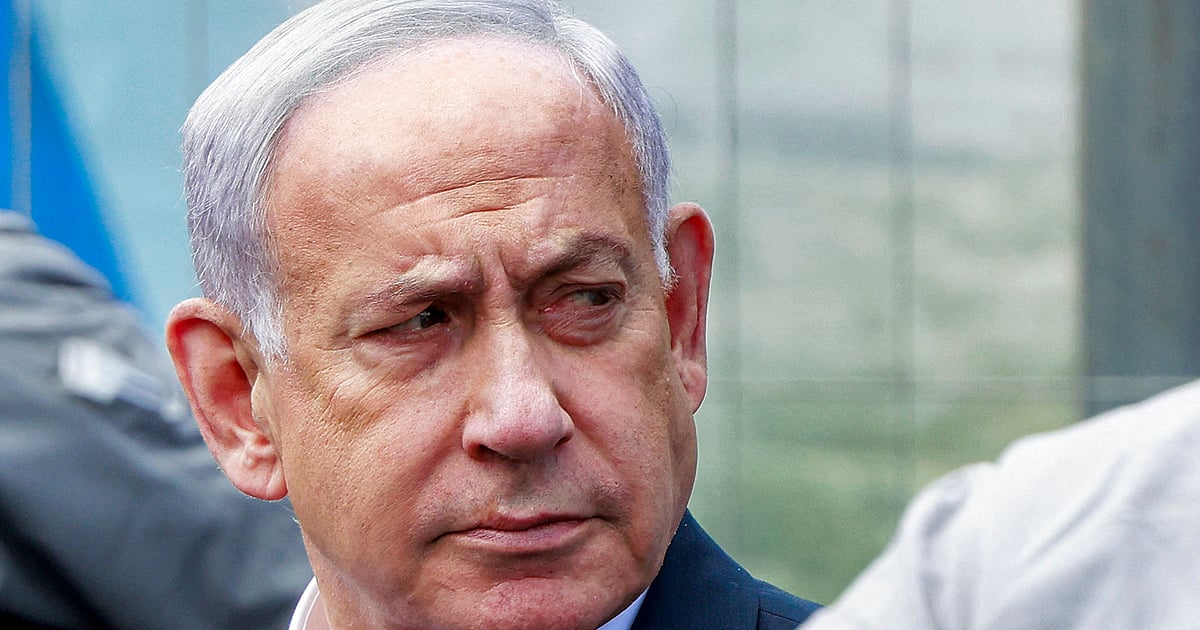
Israel's prime minister Benjamin Netanyahu File Photo: Reuters

The co-pilot of a passenger jet who stabbed the captain in an apparent attempt to crash the plane as it flew to Israel had undergone radical Islamist indoctrination and was clearly suicidal, Israel's prime minister said on Thursday.

Disaster was averted on Wednesday's flydubai flight FZ1073 from Dubai to Tel Aviv after the wounded captain managed to unlock the cockpit door, allowing passengers to subdue the attacker. A reserve crew that had been aboard landed the plane, which had more than 170 people on board, at Tabuk airport in Saudi Arabia.

"We know that he underwent Islamist radical indoctrination. That appears to be something we are gathering from his personal information," Israeli Prime Minister Benjamin Netanyahu said in an interview with Fox News.

Two Israeli security officials said Israel's initial assessment was that the co-pilot, identified by Israel as an Omani national, was likely acting alone, though the investigation was still ongoing.

The flight plunged more than 14,000 feet in less than 30 seconds during the incident as it flew over Saudi Arabia on the journey from the United Arab Emirates to Israel, according to the flight-tracking website Flightradar24.

Netanyahu said it was clear that the co-pilot was suicidal.

"It looks very likely that he was going to down the plane," Netanyahu said. Coupled with "the Islamist tendencies, that radicalization that are found in his background, I think that's ... a pretty good clue," he said, without elaborating.

"But again, I don't make final conclusions yet. But that's the indications we have now," he added.

The United Arab Emirates has started investigations seeking to establish the circumstances and motives and determine "whether the incident was linked to any terrorist activity or purpose, or involved prior planning or direction," the UAE state news agency reported on Thursday.

Attacker Identified as Omani National

Israel's envoy to the UAE, Yossi Shelley, told Reuters that it was too early to draw conclusions and no motive had been determined.

Another Israeli official said Israel was not receiving all the information it sought from the Saudis and that the Israeli intelligence services, Mossad and Shin Bet, were investigating the incident as well.

In the first comment by the Saudi government on the incident, the Interior Ministry said in a statement that the captain and co-pilot, who were both treated in a hospital for injuries, left for Abu Dhabi on Thursday morning after receiving medical clearance. Saudi Arabia said it had conducted the preliminary investigation with security teams from the United Arab Emirates.

The Saudi statement also said that the initial investigation indicated that the co-pilot assaulted the captain, forcing the plane to make the emergency landing in Tabuk.

With the co-pilot now in the United Arab Emirates, Israeli investigators "can now join the UAE's investigation team and get precisely knowledge of what his motives were, who was behind him, what his plans were," Netanyahu spokesperson David Mencer told Fox News.

Netanyahu identified the attacker as an Omani national. Omani authorities have not commented.

"We have constraints that say you can't have pilots from countries that don't have diplomatic relations with Israel. So obviously he was able to go through that," Netanyahu told Fox.

Asked if there was any indication of Iranian involvement, Netanyahu said it was too early to say. There have been no official suggestions from Israel of Iranian involvement. The two Israeli security officials said Israel had not identified any Iranian involvement so far.

Israeli Defence Minister Israel Katz said on Wednesday that Israel's preliminary information indicated that the co-pilot aimed to crash the plane, describing him as a terrorist, though Netanyahu only described it as "a serious security incident."

Iran's permanent mission in Geneva did not immediately respond to Reuters' request for comment.

Security Fears Ahead of Israeli Election

The incident heightened security fears in Israel weeks before Israelis vote in the first election since the Hamas-led attacks on 7 October, 2023, with Israel's security figuring prominently in the campaigning.

The US and Israel launched strikes against Iran in February, in a conflict that quickly spread to the Gulf and Lebanon, where Israel has been fighting Iran-backed militant group Hezbollah.

Netanyahu and Indian Prime Minister Narendra Modi have hailed the flight FZ1073 captain and Indian national Smit Machchhar as a hero.

The pilot was recovering well, the Indian embassy in the UAE said on X. Israel has also lauded passengers who subdued the attacker.

Yaniv Hayun, one of the men who incapacitated the attacker, described running to the cockpit as the plane nosedived.

"We pulled the assailant out, I pulled him out. After I pulled him out we took control of the plane, I pulled up the yoke (steering control of the plane), I straightened the plane out a bit," he said, talking to reporters upon his return to Israel on Wednesday.​
 

Thousands rally in Israel capital against Netanyahu ahead of vote


1792973050136.webp
 

What to know about Israel's electoral system

AFP
Jerusalem


1793064771055.webp

Israel's Prime Minister Benjamin Netanyahu (L) speaks to his supporters as Boaz Bismuth, chairman of the Foreign Affairs and Defence Committee in the Knesset, reacts during a Likud Party meet-and-greet held as part of the campaign ahead of Israel's legislative election, at King Solomon Hotel in Netanya on 22 October 2026. Israel heads to the polls on 27 October in its first election since 7 October 2023 Hamas-led attack, in what is seen as a referendum on the prime minister. AFP

Israel's general election on 27 October will determine whether the country's longest-serving prime minister, Benjamin Netanyahu, will remain in power.

Here are the main features of Israel's electoral system.

Single nationwide constituency

Israel's legislature consists of a single body, the Knesset, with 120 members elected for a four-year term.

The law stipulates that elections must be "general, national, direct, equal, secret, and proportional".

Parliament can be dissolved early by a simple majority vote, which is common in Israel.

In exceptional circumstances, the Knesset may extend its term beyond four years by a vote of 80 members.

The entire country of roughly 7.3 million voters forms a single constituency.

In the last elections in November 2022, turnout stood at 70.6 per cent.

Voters cast their ballots for members of parliament via party lists of candidates.

They may vote for only one list and do not provide ranked preferences.

The vote is based on proportional representation: the number of seats is allocated in proportion to the percentage of votes obtained by each list.

Any list passing an electoral threshold of 3.25 per cent of valid votes -- equivalent to four seats -- enters the Knesset.

Ineligibility threshold and redistribution

The 3.25-per cent threshold has a major impact on the final results, with votes cast for lists that fail to reach that percentage "neutralised".

Party seat allocations are then based on their proportion of the remaining votes. For example, 20 percent of the remaining votes would earn a party 20 per cent of the seats, or 24 Knesset members.

However, dividing vote proportions by the number of seats available does not deliver a neat result. Instead it produces unallocated or remainder seats and so-called "excess" votes when parties fall shy of gaining one more seat.

1793064821706.webp

Knesset Member Waleed Taha, second-placed candidate for the United Arab List (Raam), speaks during a campaign rally in the Arab-Israeli village of Abu Ghosh, 21 October 2026. Israel heads to the polls on 27 October in its first election since 7 October 2023 Hamas-led attack, in what is seen as a referendum on Israel's current prime minister who has held office for a total of nearly 17 years since first being elected in 1996. AFP

Parties can enter into agreements whereby their excess votes are combined in order to secure some of those unallocated seats.

For any remaining unallocated seats, Israel uses the "Bader-Ofer method", similar to Europe's d'Hondt method, a mathematical formula which gives each remaining seat to the party with the highest average of votes per seat. This tends to reward larger parties.

The allocation of these seats played a decisive role in the last elections, when the equivalent of 300,000 ballots (six percent of the vote) were effectively redistributed.

Despite the near-parity between the two lists in terms of votes cast, Netanyahu's camp ultimately secured a comfortable majority of 64 seats thanks to the reallocation.

Electoral mosaic

The Israeli electorate is fragmented into multiple parties, with 38 lists competing this year, according to Central Elections Committee figures, though two have announced they are dropping out.

Historic movements such as the right?wing Likud and the left?wing Labour Party, now renamed the Democrats, are flanked by lists representing, among others, ultra?Orthodox Jews, citizens from the former Soviet bloc, the religious Zionist movement, and Druze and Arab voters.

Coalitions

The large number of parties makes it virtually impossible for any single one to obtain the absolute majority of 61 seats needed to form a government.
Once the ballots are counted, negotiations begin on forming a coalition.

The president, currently Isaac Herzog, is legally responsible for appointing the list leader best placed to form a coalition, based on recommendations submitted by the parties.

In 2021, after the fourth election in less than two years, Netanyahu failed to form a government.

It was Naftali Bennett who managed to become prime minister at the head of a varied coalition, even though his party had won just six seats in parliament.​
 

Israel to give verdict on Netanyahu in pivotal election

AFP
Jerusalem


1793145666220.webp

In this file photo taken on 1 November, 2022 Israel’s ex-premier and leader of the Likud party Benjamin Netanyahu addresses supporters at campaign headquarters in Jerusalem early after the end of voting for national elections AFP

A deeply divided Israel heads to the polls on Tuesday for the first time since Hamas’s 7 October, 2023 attack, with voters delivering their verdict on veteran Prime Minister Benjamin Netanyahu and the country’s rightward drift.

Israelis are casting their ballots in the shadow of three years of multi-front regional wars triggered by 7 October, with the trauma still fresh and questions over accountability and security central to the campaign.

The close-fought vote comes as Israel looks increasingly isolated on the world stage, driven by a devastating military campaign in Gaza, soaring settlement construction and violence in the occupied West Bank, and a move towards hard-right religious nationalism.

The last polls to be published showed Netanyahu, Israel’s longest-serving prime minister, running neck and neck with his main centrist rival Gadi Eisenkot, a political novice and former military chief whose mild manner is seen as the antithesis of the incumbent.

Some 7.3 million people are eligible to vote, with more than half a million young people due to cast their ballot for the first time. Surveys show they overwhelmingly identify as centre-right or right-wing.

Tens of thousands of Israelis are estimated to have flown in from abroad to vote in an election seen as crucial to deciding the future character of their country.

“I think this is one of the most important election days in the history of the state of Israel,” Uriel Brandler, a 58-year-old real estate agent, told AFP in Jerusalem the day before the vote.

“The country definitely needs a change for the better in every aspect.”

Netanyahu, 77, has served as Israel’s prime minister on and off for more than 19 years.

The wily political operator focused heavily on his security credentials during his campaign, playing on his relationship with US President Donald Trump and insisting he is the only one who can keep Israelis safe.

In the years since 7 October, Netanyahu led multiple wars that have seen Israeli forces reduce Gaza to rubble, occupy southern Lebanon and for the first time pummel arch-foe Iran with US help.

At home, Israelis have faced bombardment from Iran, Hamas, Lebanese militant group Hezbollah, and Yemen’s Houthi rebels.

‘Not afraid to take action’

Zipporah Bennett, an 85-year-old retiree, said she was voting for Netanyahu “because he has had the experience of navigating the country through a lot of difficult seasons”.

“He has the full support of the American government,” she said, “and I believe he’s a man who’s not afraid to take action.”

Netanyahu returned to power in December 2022, bringing into his coalition far-right ultra-nationalists who have since seen their political clout skyrocket.

The opposition has scorned the premier for his backing of ultra-Orthodox parties fighting to keep exemptions for religious Jewish students from drafting into the military, which faces personnel shortages.

But one of the biggest criticisms levelled at Netanyahu is his failure to take responsibility for the 7 October attack, the deadliest day in the country’s history.

Eisenkot, 66, has pledged to establish an independent state commission of inquiry into the security failures that led to the attack, something Netanyahu’s government has resisted.

Seeking to unseat the premier is an informal bloc of parties led by Eisenkot’s Yashar and spanning from the right to the centre-left.

Eisenkot has vowed to prevent the creation of a Palestinian state and expressed support for Israeli settlements, but has promised to crack down on violent settlers.

Neither Eisenkot nor Netanyahu have publicly said they would partner with the predominantly Arab lists, which represent some 21 percent of Israel’s population and who could become kingmakers if the results are as close as expected.

Most polling stations will close at 10:00 pm (2000 GMT).

Final results could take days to trickle in and it is highly unlikely that any single party will come close to the 61 seats needed for a majority in the 120-member parliament.

Cobbling together any coalition could take weeks or months, with possible new elections on the horizon if negotiations fail.​
 

Israeli exit polls show deadlock in apparent setback for Netanyahu

Two exit polls give Eisenkot edge, third has blocs tied


1793146183726.webp

Israel's Prime Minister Benjamin Netanyahu and his wife Sara prepare to vote at a polling station in Jerusalem on October 27, 2026, on the day of Israel's legislative election. Photo: YONATAN SINDEL/Pool via REUTERS

Israel's wartime election was deadlocked on Tuesday, exit polls showed, with two major television networks giving Gadi Eisenkot's opposition bloc a narrow lead over Prime Minister Benjamin Netanyahu's camp and a third showing them tied, leaving neither side with a clear path to power.

If the projections hold, the result would mark a major setback for Netanyahu's coalition, which entered the election with 68 seats, though the deadlock could allow Israel's longest-serving prime minister to remain in power as caretaker during coalition negotiations.

Turnout was 77.7%, Israel's Central Elections Committee said, the highest in more than two decades and around 7 percentage points higher than in 2022.

Two of Israel's three major television networks gave Eisenkot's bloc a narrow edge over Netanyahu's Likud-led camp in updated exit polls, while Channel 13 put the two blocs level at 51 seats each.

None of the projections gave either camp the 61 seats needed for a majority in the 120-seat Knesset. Far-right religious parties led by Itamar Ben-Gvir and Bezalel Smotrich were projected to take a combined 13 seats within Netanyahu's bloc.

Arab parties outside the two main blocs could hold the balance of power. But Eisenkot, leader of the Yashar party and a former military chief, has all but ruled out forming a government with them, complicating his path to power even in projections where his bloc finishes ahead.

Final results could take days, and Israel's fragmented political system leaves smaller parties potential kingmakers. No single party has ever won 61 seats outright in the 120-seat Knesset, making coalitions the norm.

It was the first election since the Hamas-led attacks of October 7, 2023, and the ensuing wars in Gaza, Lebanon and Iran.

Yohanan Plesner, president of the Israel Democracy Institute, called the exit polls a major defeat for Netanyahu's coalition, which was projected far below its 68 seats in the outgoing Knesset, while cautioning that Eisenkot had not emerged as a clear winner and much could change as votes were counted.

NETANYAHU SETBACK, NO CLEAR WINNER

Opposition leader Yair Lapid said in a statement: “Don’t let anyone confuse you: the Netanyahu bloc has suffered a crushing defeat. This is a total collapse and the public has told them to go home.”

Eisenkot, 66, who lost a son and two nephews in the Gaza war, emerged as Netanyahu's strongest challenger, stressing his security credentials while positioning himself as a centrist domestically.

He entered politics only four years ago and joined Netanyahu's war cabinet after the 2023 Hamas attack, but quit eight months later, criticising the prime minister's leadership.

Eisenkot offers a break with Netanyahu's leadership and far-right allies, but not with the hardline approach to security that has become more entrenched since the 2023 Hamas attack. He opposes Palestinian statehood and says Hamas' military wing must be destroyed or dismantled.

Eisenkot says Israel's response — a war that has killed more than 74,000 Palestinians, according to Gaza health authorities — was a failure because Hamas remains in charge.

"Dear Democrats, a decision was made," Yair Golan, leader of the Democrats party and a Netanyahu rival, said at a party rally after polls closed. "The nation has given us a sacred duty: to translate the trust they have placed in us into action, to fortify democracy, to save Israel and to provide true defense for the state."

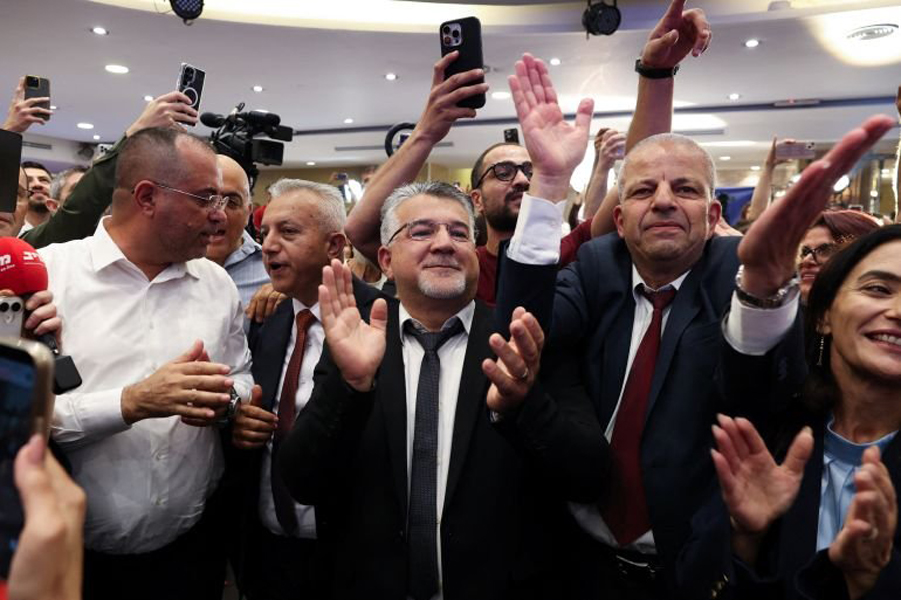
The headquarters of the Joint List, an alliance of several Arab parties, burst into whistles and applause when exit polls were released, on a historic night for turnout among Palestinian citizens of Israel.

“We refuse the occupation and racism, and we will remain here,” said Faten Gattas, a candidate in the Joint List, in a speech at the alliance’s headquarters in Nazareth. Candidates hoped that high Arab voter participation would allow them to play a decisive role in preventing Netanyahu’s coalition – the most far-right in Israel's history – from returning to power.

A WARTIME VERDICT

Voters grappled with the trauma of Israel's deadliest day, when Hamas killed 1,200 people and took 251 hostages, and the wars in Gaza and with Lebanon's Hezbollah and Iran that followed.

While Netanyahu was criticised for the country's biggest security failure, he argued that he had made Israel and the world safer by assassinating top leaders of Hamas, Hezbollah and Iran.

The policies of Netanyahu's right-wing coalition have been divisive at home and deepened Israel's international isolation, but he has portrayed himself as the leader with the mettle to face down Israel's foes.

Netanyahu, 77, has served as prime minister for nearly 19 of the past 30 years and has repeatedly survived political crises. His opponents have managed to wrest the premiership from him only once since 2009, after four inconclusive elections in two years. Eighteen months later, he was back.

He entered the election facing longstanding corruption charges, which he denies, and criticism over intelligence failures that allowed Hamas-led militants to carry out their attack.

Netanyahu campaigned on an endorsement from US President Donald Trump, his ally in the war against Iran.​
 

Arab parties on track to win record seats in Israel election, polls show


1793232660787.webp


Israel’s Arab parties are projected to win 19 seats in the Israeli parliament, exit polls indicate, after voting among Palestinian citizens of Israel surged to their highest levels in decades.

Exit polling data from Tuesday’s vote suggested that the leading Arab-led parties, the Joint List and Ra’am, could hold a record combined 19 seats in the 120-member Knesset.

With more than one-third of votes counted, the Joint List was winning over 9 per cent of votes. The opposition bloc led by former Israeli military chief of staff Gadi Eisenkot’s Yashar party was trailing the coalition led by Prime Minister Benjamin Netanyahu’s Likud party, though the votes were preliminary.

Polls estimated voter turnout among Palestinian citizens of Israel at around 80 per cent, historic numbers that break 1999 records, Israel’s Channel 12 reported on Tuesday.

The leader of Ra’am, or the United Arab List, Mansour Abbas, said he hopes the final election results will allow the anti-Netanyahu bloc, including his party, to win the 61 seats required to form a government.

“With the numbers we have now, there is no government,” Abbas told Israel’s Channel 12 before preliminary votes began trickling in.

Abbas, whose Ra’am party currently holds five seats in the Knesset and joined the coalition that governed Israel from 2021 to 2022, added that both main blocs reached out to his party before and after the election.​
 

Netanyahu and rival each claim mandate after tight Israel election

AFP

1793233328579.webp

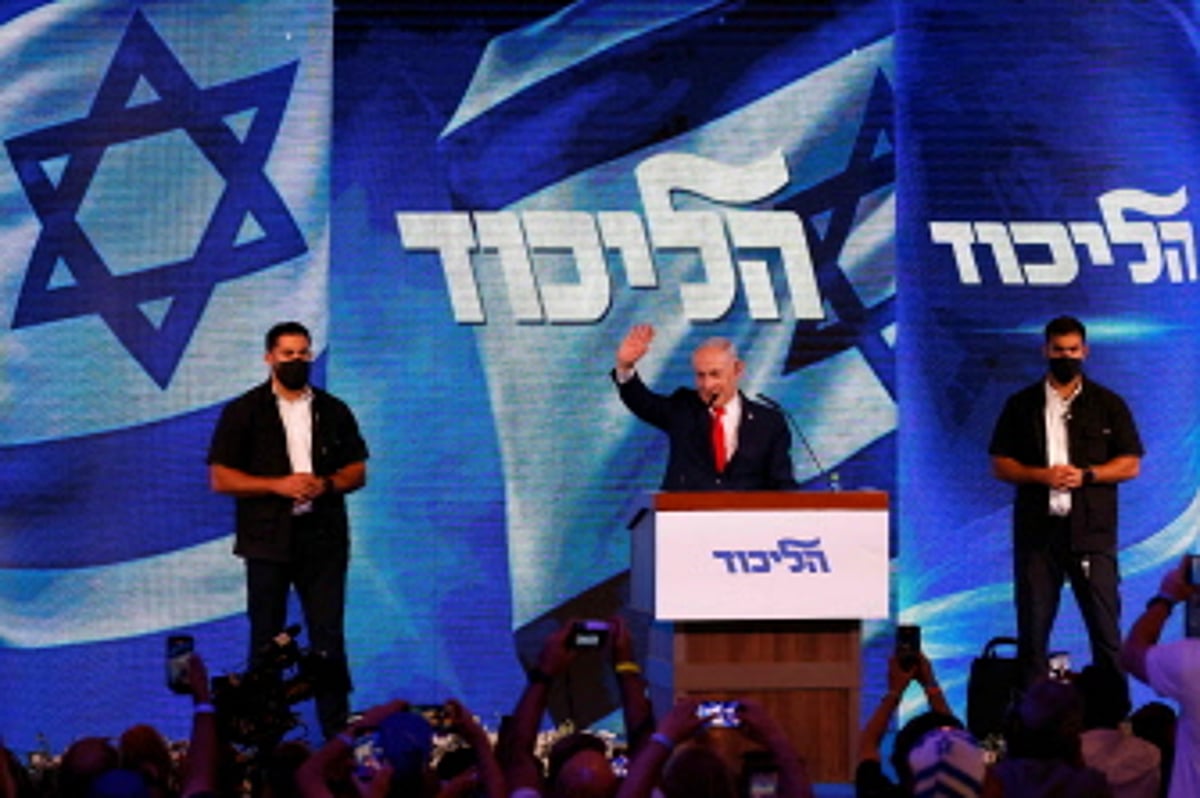
Israel's Prime Minister Benjamin Netanyahu waves to his supporters at the election night rally after the first exit polls were announced, in Jerusalem on early 28 October 2026, during Israel's legislative elections. Netanyahu vowed early on the following day to form a new government after a close election, saying no leader should rule through the backing of Israeli Arabs, whose parties posted strong gains. AFP

Israeli Prime Minister Benjamin Netanyahu and rival Gadi Eisenkot each vowed on Wednesday (28 October) to form a government after both came up short in the first election since the 7 October, 2023 attack.

Voters turned out Tuesday in the highest numbers in decades to give their verdict on the divisive rule of Netanyahu, Israel's longest-serving prime minister who has pushed the country sharply to the right and unleashed a wave of wars in response to the Hamas attack.

Exit polls showed Eisenkot, a former military chief and political novice, and his opposition bloc neck and neck with Netanyahu's hard-right camp and both well away from the threshold for a majority in parliament.

The strongest gains came from Arab Israeli parties whose voters turned out in soaring numbers against Netanyahu, who has relentlessly warned that the minority would dilute the Jewish nationalist direction in which he has taken Israel.


1793233362527.webp

Yashar party leader Gadi Eisenkot (C) arrives to address his supporters at the election night rally after the first exit polls were announced, in Tel Aviv on early 28 October 2026, during Israel's legislative elections. AFP

Netanyahu, greeting cheering supporters at a Jerusalem convention centre after 3:00 am (0100 GMT), called for a "strong government of the right" and said that the "Jewish and Zionist majority must unite".

The 77-year-old prime minister was unusually brief and did not directly claim victory.

Instead, he listed leaders Israel has killed under his orders and again hinted that he was ready for a third bombing campaign against Iran alongside US President Donald Trump, his close ally.

"Israel has a unique opportunity with our partner President Trump to forever eliminate the existential threat of Iran," Netanyahu said.

Eisenkot, speaking to his own supporters in Tel Aviv, issued a veiled warning to Netanyahu, who observers say could use a war to push for a unity government.

"Netanyahu, don't you dare use Israel's security for your political needs," Eisenkot said.

Addressing Israel's security establishment, Eisenkot said that they served the state and not Netanyahu, calling him "a caretaker prime minister, without a mandate or the people's trust".

1793233402151.webp

Supporters of Likud party leader and Israel's Prime Minister Benjamin Netanyahu celebrate at the International Convention Centre in Jerusalem early on 28 October 2026. AFP

'Public has voted for change'

Eisenkot shares many of Netanyahu's views on security and has backed the Gaza offensive following 7 October that has reduced the territory to rubble.

But Eisenkot has vowed to create a more inclusive atmosphere inside Israel and to rein in extremist settlers in the West Bank who have attacked Palestinians with virtual impunity.

After turnout of nearly 78 per cent, the highest since 1999, Eisenkot said it would be a mistake to hold a second election and vowed to work "swiftly" to form a government.

"The public has voted for change," Eisenkot said. "A worthy leader would accept the people's vote of no confidence and announce his retirement from political life today."

The three mainstream Israeli television networks in exit polls gave the two blocs each around 51 seats -- well below the 61 needed to govern -- after initially giving an edge to the opposition.

Israeli Arab lists were projected to win 17 to 18 seats, a sharp gain, with some Israeli Arab communities reporting near-universal turnout driven by outrage to often derogatory rhetoric against them by Netanyahu's far-right allies.

Key Israeli Arab leader Mansour Abbas said he believed the right had "suffered a major loss" and was open to working with Eisenkot.

But Eisenkot said during the campaign he would not govern with Israeli Arab lawmakers -- and Netanyahu again suggested that a government relying on Arab votes would lack legitimacy.

Arab lawmakers could give Eisenkot support in parliamentary votes to maintain a minority government without joining a coalition. If not, Israel could head to new elections.

Itamar Ben Gvir, a far-right firebrand who according to exit polls did not gain as much as many expected, warned Netanyahu against another option -- a unity government with Eisenkot.

"It would be a terrible mistake," said Ben Gvir, who champions the expulsion of Palestinians and would likely be excluded from any unity government.

Hebrew University of Jerusalem political scientist Gideon Rahat said Ben Gvir had succeeded in mobilising votes -- of Israeli Arabs.

But he said: "Even if Netanyahu lost, that doesn't mean Eisenkot won."

1793233466780.webp

Israel's Prime Minister Benjamin Netanyahu addresses his supporters at the election night rally after the first exit polls were announced, in Jerusalem on early 28 October 2026, during Israel's legislative elections AFP

Divisive

The election came as Israel looks increasingly isolated on the world stage, driven by the war in Iran and the military campaign in Gaza, soaring settlement construction and violence in the occupied West Bank.

Netanyahu himself faces an arrest warrant from the International Criminal Court over Gaza as well as domestic corruption charges that could land him in prison if he loses power.

Eisenkot is a political novice whose mild manner is the antithesis of the smooth-talking incumbent.

The son of working-class Moroccan Jewish immigrants, Eisenkot would be the first prime minister of Middle Eastern or North African descent.

Before voting, the 66-year-old Eisenkot paid his respects privately at the grave of his son Gal, whose death fighting in Gaza has drawn empathy from many Israelis.

Tens of thousands of Israelis are estimated to have flown in from abroad for an election seen as crucial for their country.

Eilana Zisblit, 55, told AFP she had travelled back from Canada, where she has lived for almost 30 years, to vote for a centre-right party in Eisenkot's bloc.

"The country is going in a really, really bad direction. Both for Jews and Arabs living in the country, and for Jews living abroad," she said.

The time to act is "now, or the country really won't survive anymore".​
 

Arab parties could play kingmaking role in forming new Israel govt

President urges against new vote despite inconclusive result

Agence France-Presse . Jerusalem

Israel’s president voiced hope Wednesday for avoiding a second election after a hard-fought vote produced no clear winner, leaving Prime Minister Benjamin Netanyahu and the opposition scrambling for options and making Israeli Arab parties possible kingmakers.

With more than 85 per cent of ballots counted, Netanyahu’s right-wing bloc was slightly ahead but still short of a majority in Tuesday’s election, the first since the October 7, 2023 attack that led Israel to wage war in Gaza and across the region.

Both Netanyahu, Israel’s longest-serving prime minister who is allied with far-right and ultra-Orthodox Jewish parties, and Gadi Eisenkot, a former military chief leading a broad opposition bloc, said they would seek to form the next government.

But neither looks set to reach the 61-seat threshold, with Netanyahu’s bloc projected to win 53 of the 120 seats in parliament and Eisenkot’s opposition set for 48.

The final results could still change, but one place of clear gains was among Israeli Arab lists, which were set to jump to 19 seats.

‘We must do everything we can, certainly after yesterday, to avoid another round of elections,’ said President Isaac Herzog, who is tasked with determining which candidate to tap to form a government, and who urged parties to keep ‘an open mind’.

Yousef Jabareen, head of the leftist Arab-majority Joint List, said the Israeli public had voted for new leadership and ‘anyone who wants to offer a substantive and genuine alternative to Netanyahu’s blood-soaked government will have to talk to us’.

‘It’s either the continuation of racism, the continuation of exclusion and the continuation of supremacy, or a genuine Jewish-Arab partnership,’ he said.

Voters from the Arab community, descendants of Palestinians who stayed after Israel’s creation and make up around 20 per cent of the population, have been enraged by the Netanyahu government’s ultra-nationalist Jewish vision for the country and the Palestinian territories.

Eisenkot has resisted allying with Arab parties.

Netanyahu during the campaign relentlessly attacked the opposition by saying it would put Arabs in power, running on the slogan: ‘Either the Right or Palestine.’

Yair Golan, the head of Israel’s main left-wing party and a member of Eisenkot’s camp, became its first to call for an alliance with the Arab lists.

‘We must no longer accept Netanyahu’s racist division between Jewish votes and Arab votes,’ Golan said in a social media post.

But Eisenkot’s camp also includes right-wingers who share many of Netanyahu’s hawkish views and have adamantly rejected working with Arab lawmakers.

Arab lawmakers could also give Eisenkot support in parliamentary votes on an ad hoc basis, enabling him to maintain a minority government without joining a coalition, although few observers believe such an arrangement would survive for long.

A lack of a clear majority for either camp could mean weeks spent trying to cobble together coalitions, with new elections a possibility if negotiations fail.

‘Maybe everybody lost in these elections but the Arab parties. And for the Arab parties, it’s unclear that they can make use of their huge success,’ Hebrew University of Jerusalem political scientist Gideon Rahat said.

A stalemate could in the immediate term benefit Netanyahu, who would remain caretaker prime minister until a new government is formed.

Both Netanyahu and Eisenkot appeared to indicate another factor was on the horizon — a Israeli attack alongside the United States on Iran.

Netanyahu ordered bombing campaigns against Iran both last year and earlier this year, reluctantly stopping only after President Donald Trump reached a now-moribund ceasefire.

In the days leading up to the election, Netanyahu repeatedly called for the overthrow of Iran’s government. News reports, which Netanyahu denied, said military top brass pushed back on his plans for pre-election action.

Trump has said that the United States is no longer negotiating with Iran but will not attack until after next Tuesday’s US midterm elections.

Speaking at a rally, Netanyahu said that Israel had a ‘unique opportunity’ with Trump to ‘forever eliminate the existential threat of Iran’.

Eisenkot in a post-election appearance warned Israel’s security chiefs that they must serve the national interest and not the political needs of Netanyahu, whom he called a caretaker premier ‘without a mandate’.

‘Netanyahu, don’t you dare use Israel’s security for your political needs,’ Eisenkot said.

All eyes will be on Herzog, who has reportedly supported a unity government, which could take on more urgency if Netanyahu attacks Iran, although Eisenkot has publicly ruled out serving with him.

Netanyahu, who has served as prime minister on and off for more than 19 years, has divided Israeli society.

Facing criminal charges over corruption that he denies, he has sought to revamp the judiciary.

He has also allied with far-right champions of extremist settlers who attack Palestinians in the West Bank with virtual impunity.

Netanyahu is also wanted by the International Criminal Court over Israel’s devastating war in Gaza, where residents expressed uncertainty Wednesday as to what the vote might mean for them.

‘Our fear is that these elections might result in the emergence of an even worse leader and those who are more violent and bloodthirsty,’ displaced Gazan Huda al-Houli said.​
 

Netanyahu, at risk of losing power, steps up attacks on Israel’s Arab parties

Reuters
Jerusalem

1793404815099.webp

Israel's ex-premier and leader of the Likud party Benjamin Netanyahu arrives to address supporters at campaign headquarters in Jerusalem early on November 2, 2022, after the end of voting for national elections AFP

Israeli Prime Minister Benjamin Netanyahu alleged on Thursday, without providing evidence, that Arab parties’ record gains in an election this week were driven in part by voter fraud, a charge rejected by Arab leaders who accused the premier of incitement.

The allegation represents an escalation of rhetoric against Arab parties by Netanyahu and his far-right partners after high Arab turnout in a national ballot on Tuesday effectively blocked a smooth path to power for either him or his main rivals.

Israeli officials said on Thursday that the authorities were probing fraud allegations, though the election’s integrity was not systematically compromised.

Analysts and critics say that by stepping up attacks on Arab parties, Netanyahu may be trying to ensure his main rival, Gadi Eisenkot, feels unable to even consider forming a minority government with Arab help that could oust him from power.

Netanyahu’s goal is “delegitimising any Arab-Jewish cooperation”, said Eytan Gilboa, professor of politics at Reichman University.

Tuesday’s tightly fought election has produced no clear winner and is likely to be followed by weeks of protracted negotiations over a new government.

With nearly 99% of votes counted, Netanyahu’s nationalist-religious bloc held a modest lead in seats over a bloc of right-wing and centre-left parties led by Eisenkot, with both men’s coalitions short of the 61 seats needed for a majority in parliament.

Parties representing Israel’s 21% Arab minority were projected to win an unprecedented 19 seats, leaving Eisenkot’s bloc, which has 48 seats against Netanyahu’s camp of 53, with no path to power without broad Arab backing.

Eisenkot has so far ruled out including the parties in government but his camp could try to form a minority government with Arab support from the outside.

Election Integrity Not Systematically Compromised, Officials Say

Ahmad Tibi, one of the leaders of the Arab Joint List party, said Netanyahu has launched a “toxic campaign” meant to undermine the election results.

“This entire campaign is directed against Eisenkot, to prevent him, intimidate and scare him off forming a government that relies on external support from the Joint List or Ra’am,” Tibi told Reuters.

During and after Tuesday’s election, Netanyahu and his allies warned against rising Arab turnout and his right-wing Likud party issued statements accusing the Arab parties of “stealing the vote.”

It demanded police and the Shin Bet domestic intelligence service investigate incidents of suspected election bribery and intimidation at ballot stations in Arab towns. It said it possessed evidence of such activity but has not presented it to the public.

The police say they have arrested at least seven people since Tuesday in Israel’s south, where many Arabs live, on suspicion of voter fraud.

On Thursday, the head of Israel’s Central Election Committee, Supreme Court jurist Noam Sohlberg, said he had asked the Shin Bet to investigate suspicions that unidentified foreign players had tried to intervene in the election.

Likud seized on Sohlberg’s request, alleging an attack on Israel’s democracy, “an Islamisation of Israel and the toppling of the right-wing in order to bring about IDF withdrawal and defeat on all fronts, foremost Iran.”

Likud said Qatar was behind the alleged election intervention, which Qatar denied.

Ra’am head Mansour Abbas said his party was not involved and urged a full investigation.

“We have one message in response to the campaign of incitement and delegitimization he (Netanyahu) is waging against Arab citizens: Nothing will come of it, because there is nothing there,” Abbas said in a statement.

In a letter sent to a parliamentarian and published by the Central Election Committee, the committee said that there was “no base for claims that there was systematic harm to the election’s integrity.”

Shin Bet said that its investigation was focused only on those involved and should not cast aspersions on “an entire sector that went out to vote democratically and legally.”

Israeli president: ‘we must not tarnish an entire community’

The coalition that last toppled Netanyahu, in 2021, for the first time in Israel’s history relied on an Arab party — Ra’am, which has Islamist roots. But Eisenkot’s camp would need backing from the Arab-dominated Joint List, which includes an explicitly anti-Zionist party.

Eisenkot said in a statement that the investigation into possible election meddling must be carried out without politicians intervening.

“Likud and Netanyahu have set out on an orchestrated organised campaign to delegitimise the election results,” Eisenkot said.

After vote tallying is completed, President Isaac Herzog will consult with party chairs and choose a candidate who he thinks has the best chance to form a government.

On Thursday, he said the allegations must be investigated.

“But even at a moment like this, we must not tarnish an entire community that sought to exercise its right to vote and take an active part in democracy,” Herzog said.​
 

Rallies seek Jewish-Arab govt in Israel

New Age Desk . Dhaka

01 November, 2026, 01:10

Demonstrations are scheduled in several Israeli cities Saturday night calling for the formation of a Jewish-Arab government by opposition parties following Tuesday’s election, as Arab-led parties emerge as potential kingmakers in the formation of the next government.

The Standing Together group said rallies would be held at 7:30pm local time at Habima Square in Tel Aviv, Paris Square in Jerusalem, and in Beersheba, Haifa and Tayibe.

The organisers called on opposition leaders to recognise their victory and form a government based on Jewish-Arab partnership.

‘Arab votes are worth exactly as much as Jewish votes, and Arab citizens must be full partners in shaping the country’s future,’ the organisers said.

‘The Jewish-Arab majority that voted for change must also be reflected in the next government. Now is not the time to abandon our partnership, but to turn it into a political force that changes reality,’ they said.

The opposition bloc secured 67 seats in the 120-member Knesset, compared with 53 seats for the coalition. However, the opposition’s total includes 48 seats won by Zionist parties and 19 seats secured by Arab-led parties, whose participation in a government remains contentious.

The four Zionist opposition parties are Gadi Eisenkot’s Yashar, Naftali Bennett’s B’Yachad, Yair Golan’s The Democrats and Avigdor Liberman’s Yisrael Beytenu. The Arab-led parties are Yousef Jabareen’s Joint List and Mansour Abbas’s Ra’am.

On Friday night, Golan expressed optimism that the opposition could form a government with support from the Arab-led parties, despite Liberman’s public refusal to cooperate with them.

Golan rejected the possibility of a unity government involving Prime Minister Benjamin Netanyahu’s Likud party, saying the opposition ‘can establish a government and we must establish a government.’

Golan said he had met Yashar leader Gadi Eisenkot, B’Yachad number two Yair Lapid and Ra’am chief Mansour Abbas on Thursday, ‘and I found all three deeply determined to form a government.’

Liberman reiterated on Friday that his party would not join a coalition involving either Arab-led party.

‘We will not sit with supporters of terrorism!’ he wrote on Facebook, citing statements and actions by Ra’am and Joint List lawmakers.

A surge in Arab voter turnout has strengthened the position of Arab-majority parties, putting the opposition’s reluctance to rely on their support to a decisive test.

Netanyahu, despite leading the largest party, has no clear path to securing the 61 seats needed to form a government beyond his existing far-right and ultra-Orthodox allies.

Ra’am leader Abbas said on Wednesday that his party was in contact with members of Netanyahu’s coalition, adding that ‘everyone is speaking with us, not just from the change bloc.’

The Joint List has also offered to support an alternative government from outside the coalition, with its chair Jabareen vowing to use the faction’s parliamentary strength to oust Netanyahu.​
 

Israeli president picks Gadi Eisenkot, Netanyahu rival, to try to form govt

Reuters

1794097229600.webp

Former military chief Gadi Eisenkot, leader of the Yashar party, waves an Israeli flag following the exit polls at his party headquarters, on the evening of Israel's national election, in Tel Aviv, Israel October 28, 2026. Photo: REUTERS

Israel's president on Saturday chose Gadi Eisenkot, Prime Minister Benjamin Netanyahu's strongest rival, to try to form a new government following a deadlocked election that left neither man with a clear path to power.

Netanyahu, Israel's longest-serving leader, is fighting to stay in office after his religious-nationalist coalition lost its majority in an October 27 election but still emerged as the largest bloc in parliament.

Eisenkot, a former military chief, has declined to join forces with Arab parties, with whose support he would have a majority of seats in parliament. But Arab leaders, incensed by what they view as the racist policies of Netanyahu and his far-right allies, still nominated Eisenkot to try to form a government first — giving him the most endorsements.

"President Herzog has invited Gadi Eisenkot to the President’s Residence, where he will be tasked with forming the government tomorrow," said the spokesperson of President Isaac Herzog, whose largely ceremonial role involves nominating a candidate to form a coalition after elections.

EISENKOT FACES LONG-SHOT BID TO FORM GOVERNMENT

Weeks of protracted negotiations are expected to follow Eisenkot's nomination. He has 28 days to try to forge a government, with a possible 14-day extension.

His potential pathways to power include trying to form a minority government with Arab support from the outside; forming a coalition with ultra-Orthodox parties that he and his allies have shunned in the past; or forging a unity government with Netanyahu.

Analysts say that all three options are unlikely to take shape. If Eisenkot fails, another candidate can try to form a government and if that candidate fails, parliament can nominate another. There is a deadline for the process of around 100 days. If no one succeeds, another election is held.

Likud won the most seats of any single party with 27 in the 120-seat Knesset, but Netanyahu's wider religious-nationalist coalition garnered only 53 in total, short of a 61-seat majority.

Eisenkot's Yashar party emerged as the second-largest party with 21 seats, while his coalition, spanning four centre-left to right-wing Jewish-led parties, won just 48 seats. Two parties representing Israel's Arab minority won an unprecedented 19 seats.

EISENKOT CRITICAL OF SETTLER VIOLENCE

A son of Moroccan immigrants, Eisenkot, 66, would be the country's first prime minister from Israel's Mizrahi community, Jews who trace their roots to the Middle East and North Africa.

Reserved and media-shy, Eisenkot only entered politics in 2022. He briefly served in Netanyahu's wartime cabinet following Hamas' October 7, 2023, attack on Israel before returning to the opposition.

From opposition, he publicly rebuked Netanyahu over his leadership, including his management of the military campaign in Gaza, and has sworn that he would not serve in government with him.

Eisenkot's public standing is also bound up with the personal price his family has paid since 2023: a son and two nephews were killed fighting in Gaza.

Eisenkot highlighted his security credentials on the campaign trail, citing his "Dahiyeh doctrine" of responding to attacks with disproportionate force, which he deployed as a commander during Israel's 2006 war with Iran-backed Hezbollah in Lebanon.

Eisenkot has criticised settler violence against Palestinians, which has surged since 2023, raising tensions in Israel’s ties with Western states, and he opposes Netanyahu's far-right coalition partners Itamar Ben-Gvir and Bezalel Smotrich, who have both faced sanctions by some Western countries for inciting violence against Palestinians.​
 

Israel president taps Netanyahu rival Eisenkot to form new government

AFP
Jerusalem

1794181067411.webp

Former military chief Gadi Eisenkot, leader of the Yashar party, waves an Israeli flag following the exit polls at his party headquarters, on the evening of Israel's national election, in Tel Aviv, Israel 28 October, 2026. REUTERS

Israel's president announced on Saturday he would task Gadi Eisenkot with forming the next government following last week's election, in what Netanyahu's rivals see as a first step to remove the country's longest-serving prime minister.

The opposition bloc led by Eisenkot, a former military chief and political newcomer who has tried to appeal to secular and liberal Israelis, has opened the door to a once improbable alliance with ultra-Orthodox Jews, which could give it the numbers to form a coalition.

President Isaac Herzog said that after consultations with all parties during the week, he would grant Eisenkot the first chance to form a government after the 27 October election, in which neither side secured a majority in a country deeply polarised by Netanyahu's hard-right rule and worn down by three years of war.

The formal appointment would take place in an official ceremony on Sunday at the president's residence in Jerusalem, Herzog's office said.

Eisenkot, who later pledged to "do everything" to form a new government, was recommended by parties representing 67 lawmakers as opposed to 46 for Netanyahu's bloc.

But the recommendations for Eisenkot included members of Israel's Arab minority -- whose seat haul soared in the election on the back of anger against Netanyahu -- and right-leaning segments of the opposition that are against relying on Arab votes.

Unity government
Herzog, originally from Israel's now defunct left-wing Labour Party but who has a non-partisan role and has forged a working relationship with Netanyahu, has signalled that he would like to explore a national unity government that would seek to bring together Jewish Israelis from across the political spectrum.

Pressure for a unity government could build if Netanyahu follows through on threats to resume war on Iran, although US President Donald Trump has not given the green light.

1794181115499.webp

Iranians take pictures of a burning anti-US and anti-Israel billboard depicting US special envoy Steve Witkoff, US President Donald Trump, Israel's Prime Minister Benjamin Netanyahu and US Vice President JD Vance during a rally in Tehran's Enqelab Square on 4 November, 2026. Tehran taunted the US president over his midterms defeat on 4 November as the US leader admitted the war against Iran was the key factor in his stinging electoral rebuke. AFP

Netanyahu, who has led Israel on and off for nearly two decades and guided its sharply rightward turn in recent years, faces corruption charges and potentially jail if he leaves office. He also faces an arrest warrant over the Gaza war from the International Criminal Court, whose authority he rejects.

Netanyahu has already called for a unity government but the opposition has stood firm on removing him first.

He has attacked opposition leaders for even considering working with Israeli Arabs, descendants of Palestinians who stayed after the creation of Israel in 1948.

The incumbent premier said on Saturday that a potential coalition between opposition parties and Arab lists, which he called Islamists, would "dismantle the State of Israel from within" and urged the formation of a unity government comprising "all the Zionist parties that want to safeguard our state."

In response, Eisenkot's Yashar party urged Netanyahu's allies and members of his Likud party to form a unity government led by Eisenkot and to "publicly announce the dissolution of their alliance with the extremists".

"Now is the time to form a national emergency government," Eisenkot wrote on X in his first reaction to the announcement of his designation. "I will do everything to ensure we are worthy."

Opposition bloc member Avigdor Liberman, a former Netanyahu aide turned fierce critic who nonetheless shares his hawkish views on the Palestinians, has made clear that he will not sit with Eisenkot if he relies on Israeli-Arab votes.

But on Friday, Liberman -- a staunch secularist whose support base initially was Russian-speaking immigrants -- made a U-turn on another group he had shunned and said he was open to discussions on a law that would enshrine an exemption for ultra-Orthodox Jews from mandatory military service.
​

1794181156083.webp

A combination picture shows Israeli Prime Minister Benjamin Netanyahu as he attends a memorial service held for Ran Gvili, an off-duty police officer who was killed fighting militants that had infiltrated Israel during the deadly 7 October, 2023, attack by Hamas, and the last hostage recovered from Gaza, in Meitar, Israel, 28 January, 2026, and Israeli opposition leader and former military chief, Gadi Eisenkot, as he launches an election campaign for Yashar, his new political party, at an event near Hod Hasharon, Israel, 30 June, 2026. REUTERS

Liberman and another opposition leader, Naftali Bennett, had made closing the exemption a core campaign promise and had viscerally criticised ultra-Orthodox Jews as burdens on the state, responding to wide resentment by other Israelis at a time when reservists are serving multiple tours in Gaza and Lebanon.

Eisenkot has proposed requiring national service for all Israelis but allowing citizens to choose a civilian option rather than the military, opening the door to integrating the ultra-Orthodox.

On Friday, Eisenkot said it was urgent to replace Netanyahu, calling him a threat to the "very existence of Israeli democracy".

Following his appointment, Eisenkot will have 28 days to come up with the 61 votes needed for a government. If he comes up short, Herzog can provide a 14-day extension before he has to offer the mandate to someone else.

If neither side succeeds, Israel will head to fresh elections. The country held five elections between 2019 and 2022 due to repeated deadlocks.​
 

Israeli president tasks Eisenkot to form govt

Agence France-Presse . Jerusalem

1794182679438.webp

Gadi Eisenkot. | AFP photo

Israel’s president on Sunday officially tasked opposition leader Gadi Eisenkot with forming a new government, warning that the country faces uncertainties after elections in the United States.

‘The State of Israel needs a stable government,’ President Isaac Herzog said, pointing to the ‘new political reality’ in the United States.

Eisenkot said he was open to Prime Minister Benjamin Netanyahu and one of his far-right allies joining but under him as the new leader.

‘If members of Likud and the Religious Zionist Party truly believe this is a time for unity, as they told the president, I cannot conceive of any reason why they would not support a government under my leadership and the principles I have presented,’ Eisenkot said, referring to Netanyahu’s party and that of the far-right finance minister Bezalel Smotrich.

Eisenkot, 66, born to a family of working-class Moroccan immigrants, would be the first Sephardic prime minister — a descendant of Jews from the Middle East or North Africa — in a country long dominated by an Ashkenazi elite with ties to Europe.

Netanyahu, who has been prime minister on and off for nearly two decades and has led war on Gaza, Lebanon and Iran since the October 7, 2023 attacks, lost support in last month’s election but no side claimed an outright majority.

In consultations last week with Herzog, Eisenkot received recommendations from parties accounting for 67 lawmakers, against 46 for Netanyahu.

But the vote count included Israeli Arabs, whose seat haul surged to a historic high on anger over Netanyahu’s government, which includes far-right firebrands who have openly sought to marginalise the community.

Avigdor Liberman, a former Netanyahu aide turned sharp critic who nonetheless shares his hawkish views, has been adamant against any alliance with Israeli Arabs, descendants of Palestinians who stayed after Israel’s creation in 1948.

Taking back one of his signature campaign pledges, Liberman instead voiced an openness to an alliance with ultra-Orthodox Jews, whose almost singular priority is ensuring that they remain exempt from military service.

The exemption for the ultra-Orthodox — whose two main parties had been aligned with Netanyahu but could push Eisenkot to a majority — has been a source of growing resentment for many Israelis as reservists fight on multiple tours of duty.

Liberman said Sunday he still backed conscription for all Israelis but that he had to make ‘difficult decisions’ for the higher priority of ousting Netanyahu, who faces corruption charges that could land him in jail if he loses power.

But he remained adamant that he would never ally with Israeli Arabs.

‘I will not lend a hand to the establishment of such a government, which in my view will harm security and bring Netanyahu back to power,’ Liberman wrote on X.

Liberman, whose party at seven votes is the smallest within the opposition bloc, denied speculation he was trying to engineer a deadlock that could result in him becoming prime minister.

Born in Moldova and with a party base originally from Russian-speaking immigrants, Liberman said that commentators’ views on his motives had ‘sometimes a distinctly racist tone’.

Naftali Bennett, the second strongest opposition leader after Liberman, has also been outspoken against the ultra-Orthodox community’s military exemption and has stayed quiet since Liberman’s about-face.

Eisenkot has called for a ‘national emergency’ government that would remove Netanyahu, calling him ‘a fundamental threat to the very existence of Israeli democracy’.

He has ruled out a unity government with Netanyahu, who has repeatedly called for a broad coalition with himself at the top.

Eisenkot appears to be suggesting that he is willing to start off with a minority government — relying on outside votes from Israeli-Arab parties — while still working to find a stable government with majority support.

Assaf Shapira, a political expert at the Israel Democracy Institute, said that Eisenkot would face an especially fragile government if it only has 48 lawmakers, even if others promise to keep it in power.

‘To pass laws, you need strong support from other parties,’ Shapira said, explaining that an Eisenkot minority government would be forced into extensive negotiations on every piece of legislation.

Eisenkot has vowed to repair Israel’s international reputation and put an end to rampant violence against Palestinians by extremist West Bank settlers supported by Netanyahu’s government.

He has warned Netanyahu he does not have the mandate for another attack on Iran but has also largely backed his war decisions.

Commanding the military during the 2006 war with Hezbollah, Eisenkot devised the so-called ‘Dahiya doctrine’ that calls for massive force against civilian infrastructure where enemies operate, a policy critics say amounts to a war crime.

In Tel Aviv, Neri Bar-On, who works in educational technology, said he expected Eisenkot to succeed in forming a government.

‘But the problems run deeper,’ he said.

‘The country is facing a massive internal conflict; even if he manages to form a government, it won’t solve the underlying issues.’​
 

Eisenkot’s strange bedfellow options to lead Israel
Agence France-Presse . Jerusalem

1794271320584.webp

Gadi Eisenkot.

Israel’s former army chief Gadi Eisenkot has a matter of weeks to form a government, despite not having won a clear majority in the new parliament.

Eisenkot has a number of options, although none look ideal for him, to reach the magic number of 61 in the 120-member parliament.

President Isaac Herzog on Sunday gave Eisenkot the mandate to try to form a government, setting the clock at 28 days for him to come up with the 61 votes, although Herzog could give him a 14-day extension.

Minority govt backed by Arab Israelis

Eisenkot has called for a ‘national emergency’ government that would quickly oust Netanyahu, calling him a threat to democracy.

Eisenkot has suggested it be a minority government at first — with other parties not joining immediately but still voting to install him.

One option would be to rely on Arab Israelis, whose voter turnout surged in the October 27 election on anger over racism and marginalisation by Netanyahu’s far-right government.

Arab-majority parties won a record 19 seats, easily enough to give a majority to Eisenkot, whose core opposition bloc won 48 seats. Netanyahu’s bloc won 53 seats.

But any minority government would be fragile and Arab Israelis, who are descendants of Palestinians who stayed after Israel’s 1948 creation, could bring down Eisenkot over likely policy disagreements including over Israel’s intense military pressure in Gaza.

Netanyahu has relentlessly attacked the prospect of an opposition government backed by Arab Israelis as a threat to Israel’s Jewish character and has accused them of electoral fraud, allegations that the lawmakers deny.

Alliance with ultra-Orthodox

Few campaign promises were as explicit for the opposition as ending an exemption from Israel’s mandatory military service for ultra-Orthodox Jews, who under a longstanding arrangement backed by Netanyahu are allowed to let their children study the Torah instead of joining the army.

The exemption has fuelled major resentment among other Israelis at a time when reservists are carrying out multiple tours of duty to fight in the wars in Gaza, Lebanon and Iran.

But Liberman, who had gone so far as to call the ultra-Orthodox ‘anti-Jewish’, has opened the door to allying with the community as a way to oust Netanyahu while avoiding partnering with Arab Israelis.

The two ultra-Orthodox parties, Shas and United Torah Judaism, have backed Netanyahu but could use their 13 combined seats to push Eisenkot over the top if they were promised a law to enshrine the exemption.

Yair Golan, the most left-leaning of the opposition bloc leaders and a supporter of working with Arab Israelis, quipped that Liberman should just form a government with Netanyahu if he does not want to draft the ultra-Orthodox or overturn the veteran prime minister’s sweeping, controversial judicial reforms.

National unity government

Eisenkot and Netanyahu have both offered a national-unity government — but with each one insisting he would be in charge.

Eisenkot has publicly said that Netanyahu is dangerous and unfit to lead Israel, pointing to his failure to prevent the October 7, 2023 Hamas attack, his deep divisiveness and corruption charges that could land Netanyahu in prison if he were to lose power.

Netanyahu has also shown no interest in serving under Eisenkot and he would lose his immunity if he does not remain premier.

But if Eisenkot cannot find another option, a national unity government could be an option to avoid new elections in which some observers predict the opposition would fare worse due to fading enthusiasm.

Herzog has signalled he would welcome a unity government to ease the country’s polarisation. Israel held five elections between 2019 and 2022 due to repeated deadlocks until Netanyahu formed a government with the far-right.

Netanyahu in 2020 formed a national unity government with another centrist former military chief, Benny Gantz, but the arrangement quickly collapsed, the country headed to new elections and Gantz today is a marginal political figure.​
 
Back
Top