Home Login Watch Videos Wars

[🇧🇩] July Charter

[🇧🇩] July Charter
36
833
More threads by Saif

G Bangladesh Defense

Yunus rules out referendum over July Charter
Chief adviser insists party agreement key to polls; vows justice, reform ahead of election
chief adviser yunus on july charter 2025

1749687123831.webp

Photo: CA press wing

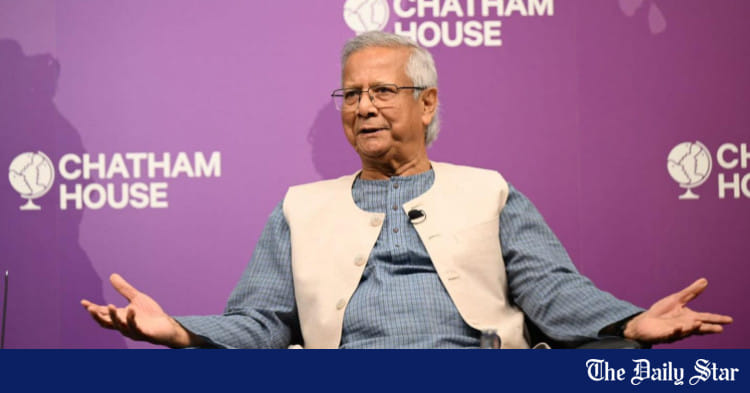
Chief Adviser Muhammad Yunus has said the upcoming "July Charter" will not be put to a public referendum.

"Referendum will be meaningless," he said, adding that people may not fully understand the complex issues.

He made the remark while speaking at Chatham House in London, UK, as part of a trip that includes meetings with King Charles, British government officials, and BNP Acting Chairman Tarique Rahman.

"If all parties are involved in all these political issues and the national issues, that they're supposed to understand and debate, then it's more real than giving it to a referendum," he said.

Yunus also reaffirmed his commitment to holding what he described as "the most beautiful election" in Bangladesh's history, expected in early April 2026.

He outlined three things shaping the transition which are reform, trial, and election.

"We don't want to go back to the institutions who created this [situation]," he said, citing the establishment of commissions to propose deep reforms in parliament, the constitution, and the civil service.

As for the elections, he said they would be held on the basis of the "July Charter" to be released next month.

Yunus denied that the Awami League AL had been banned, stating instead that their activities have been suspended for public safety until investigations are complete.

"If they can kill young people on the street just like that, make people disappear, steal money, would you still call it a political party?" he said, adding that "people were celebrating in the whole country" after the ousted Former Prime Minister Sheikh Hasina had fled on August 5 last year.

"None of that party has ever expressed remorse," he said.

Responding to concerns about press freedom, Yunus insisted the media "never had so much freedom in their life. They can say anything they want."

Asked by a UK-based correspondent about the demolition of Sheikh Mujibur Rahman's house, Yunus acknowledged that "lots of issues came at the same time."

"We couldn't handle everything right away So it's a kind of a period that we have gone through, things have calmed down," he said.

He emphasised that all political parties were contributing to the July Charter.

"That's the best unity can you can get in any country after a revolution within a year " he said.

Yunus ruled out any future political ambitions for himself or his cabinet, saying, "None of our cabinet members would like to do that. Our job is to make sure the transition is managed well and people are happy when we hand over power to the elected government."

On ousted prime minister Sheikh Hasina's presence in India, Yunus revealed that he had urged Indian Prime Minister Narendra Modi not to allow her to address the Bangladeshi public.

"He said it's social media, we cannot control it," Yunus said.

Bangladesh has since sent a diplomatic note requesting her extradition, and the International Criminal Tribunal has issued a notice.

"So we have to go to the interpol," he added.

Yunus also pledged to safeguard women's rights, noting the inclusion of women in his cabinet and the need for continued work in the sector.

On attracting foreign investment, particularly in energy, he said Bangladesh aims to become a global production hub with improved infrastructure and regional connectivity.

"Bangladesh is offering itself to be the production hub for the world, not just for Bangladesh," he said.​
 
Analyze

Analyze Post

Add your ideas here:
Highlight Cite Fact Check Respond
  • Like (+1)
Reactions: Bilal9

National Charter can be prepared within July: Ali Riaz
Staff Correspondent Dhaka
Updated: 17 Jun 2025, 14: 55

1750204892864.webp


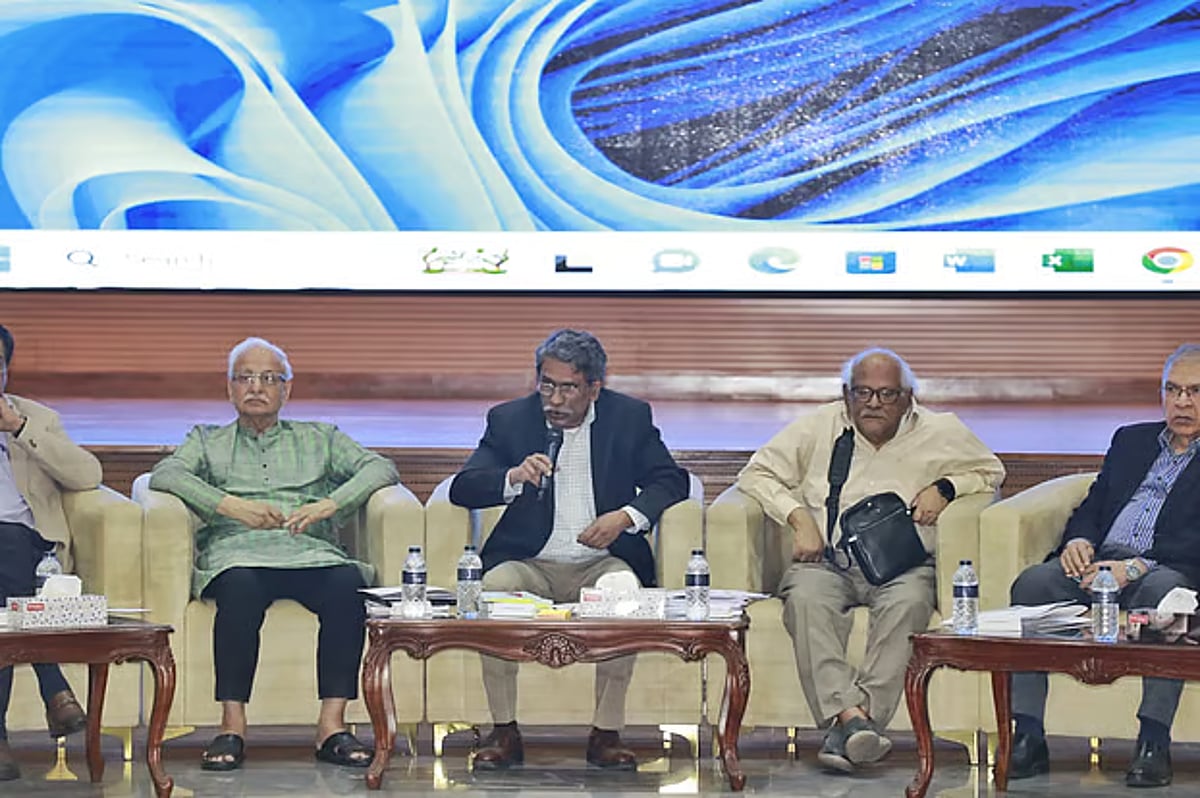
Ali Riaz speaks at the second round of talks held by the national consensus commission to complete unfinished discussion with the political parties Shuvra Kanti Das

Co-chair of the national consensus commission, Ali Riaz, has said that it will be possible to prepare the July Charter within July this year.

He said, "The national consensus commission is committed to prepare the July Charter within July."

Ali Riaz was speaking at the second round of talks held by the national consensus commission to complete unfinished discussions with the political parties.

The discussions began at around 11:45 pm today, Tuesday, at Doel Hall of the Foreign Service Academy, on Bailey Road in the capital.

The discussion was joined by representatives of BNP, NCP, Islami Andolan, Nagorik Oikya, Gono Odhikar Parishad, Ganosamhati Andolan and other political parties. No leader of Jamaat-e-Islami turned up at the meeting.

Co-chair of the national consensus committee Ali Riaz said, "The national consensus commission is committed to prepare the National Charter within July. We are sincerely grateful to the political parties and political leaders for the cooperation you all are extending in this regard."

Ali Riaz said, "We hope that if the process continues, we will be able to reach our goal. We are endeavouring to reach an overall consensus, even if we do not agree on all issues."

He further said, "We may not be able to reach a consensus on all issues, but even so, we can make certain concessions in the interests of the nation and the state so as to arrive at one point. There is no guarantee that we will be able to complete all issues."

The issues discussed at today's meeting included Article 70 of the constitution, nominating heads of the standing committees, women's representation, and more.

Talks were also held on a bicameral parliament (with an upper and lower house), the process of appointing the chief justice and several other issues. The commission is scheduled to hold discussions on 17, 18 and 19 June with the political parties.

Attending the discussion on behalf of the national consensus commission are Abdul Muyeed Chowdhury, Safar Raj Hossain, Badiul Alam Majumdar, Iftekharuzzaman and others.​
 
Analyze

Analyze Post

Add your ideas here:
Highlight Cite Fact Check Respond

July Charter, the warriors, and some random questions

1751069826023.webp


Published: 27 Jun 2025, 15: 22

One year has passed since 24 July to 25 June, a time with a difference. On 1 July last year could anyone imagine such a change in scenario? It started with the movement for reforms in quotas in government service. That morphed into a one-point movement to oust Sheikh Hasina. Then came the miracle. Sheikh Hasina fled across the border. This was a thrilling, unbelievable, breathtaking, dramatic changeover. The country had no government for a few days. Then the interim government was formed. Surely there will be a movie in the days to come of those gripping 100 hours.

And then? There are so many stakeholders in the country. Hundreds of political parties, all vocal. The smaller the party, the louder are its leaders' voices. All of them pose as guardians of the public. And now all eyes are focused on a charter. The July Charter is in the making. This is, ostensibly, to be on a basis of political consensus.

The coordinators of the anti-discrimination students' movement were at the heart of the July movement. That is as far as we know at the moment. We do not know what transpired behind the scenes. The fallen leaders of Awami League claim that there was a deep-rooted conspiracy behind this movement. This country's politics thrives on conspiracy theories. We've being swallowing conspiracy theories down the decades, down the centuries. We see conspiracies behind every change. Let's see if the conspiracy-vendors find the conspirators soon.

We were talking about the July Charter. It was D-Day on the 5 of August 2024. The charter was supposed to have been brought out around that time. We had hoped for at least a paragraph back then on what we want, where we want to go, how we will proceed, and so on. The people at that moment of time would have listened to the coordinators. They had the trust and love of the people at the time. But that did not happen. It was apparent that no one was quite prepared for D-Day.

The charter which the activists of the movement were supposed to have brought out, is now being prepared by the government. It is, in other words, a government charter and support will be sought form the political parties for this charter. It will clipped and cropped, then adopted on the basis of political consensus. Political consensus? What in the world is that? Each and every side wants some of their pet words and trademark terms to be included. It would be unrealistic to imagine that everyone will be in agreement. I do not understand how conflicting parties will come to an agreement over the wording of this charter. If they do, that will certainly be another revolution.

On one hand, you will laud the youth, and on the other, you will pitch them into the chasm of partisan politics, destroying their future. A generation will get their degree without taking their exams. Will anyone knowingly give them jobs?

Why are we so hot and bothered about the charter? Will the words of the charter change our lives? The preamble of the 1971 constitution contained the most beautiful and appealing words possible. It has democracy and socialism. It shone with secularism. Nationalism is a part and parcel of a nation state and so that could hardly be left out! The tome also had the grand words of human rights. And what was the outcome? From the very outset, these tripped up one after the other.

These words of the constitution remained confined to paper. The people of the country, the majority of whom are not educated, to whom literacy means being able to sign one's name or study up till Class 5 at the most, never got to know that this sacred book had given them ownership of the country. And since they don’t know, the self-styled syndicate of "owners" feels no responsibility toward them. If yet another charter is handed down, what difference will it make? The actual owners of the country will not know what the charter contains. The majority of the people have never even seen the constitution, let alone read it. What difference does it make to them if anything is added or removed?

In 1971, there were freedom fighters. In 2024, the country became independent a second time. Now we have “July Warriors.” These July Warriors will receive official state recognition. They will be granted various state benefits - medical care, jobs, allowances.

In ages past, mercenaries from across wide swaths of Asia took up arms, sticks, swords, and guns, for the ruling powers in pursuit of money, estates, and spoils of war. These were paid soldiers. By offering various material benefits, we have already turned a section of the freedom fighters into mercenaries. Alongside this, a large number of fake freedom fighters have sprung up. If you can somehow obtain a certificate, you can sit back and enjoy a hefty allowance.

Meanwhile, due to political rivalries, many genuine freedom fighters were never issued certificates. The same sleight of hand is now unfolding with the July Warriors. The very quotas they protested against are now being used to trap them. This will turn the rest of the public against them.

Society must take responsibility for the treatment and rehabilitation of those who gave their lives, who were permanently disabled and who were injured. That was not done properly for the 1971 fighters. But the "fattening-up scheme" that was run in the name of 1971 freedom fighters must not be replicated today, portraying them as a privileged group.

Those who fought in 1971 and in 2024 did not do so for personal gain. They fought for the freedom of all people in the country. Many attempts have been made and are still being made, to buy their loyalty with various incentives. The fighters must speak out against this. If they do not, a scramble for the spoils will begin. Pseudo-warriors will mushroom overnight like toadstools. Bribery and profiteering will ensue, just as it did under previous governments. The signs are already showing.

There is a minimum age to become a voter and to contest elections. A proposal has been made to lower that further. This idea stems from political motives. Parents are increasingly desperate to see student political wings removed from educational institutions. Even the elites of political parties don’t allow their own children to engage in student politics. But while their children will study at home or abroad, the children of others become the political thugs of these elite political leaders. That is the miracle of so-called student politics in this country. Aside from shouting slogans for the ruling party and beating up opponents, what else do they really do?

There are knives, choppers, cleavers, crude bombs and guns, everything in the educational institutions. The teachers have their political groupings. They use their political loyalty to grab positions as provosts, vice chancellors, members of various commissions and even ambassadors. Studies are of least concern. When an entire batch of students are given auto-promotion, based on certain demands and barricades, one can easily understand the level of degeneration that exists. That is where mob culture began.

On one hand, you will laud the youth, and on the other, you will pitch them into the chasm of partisan politics, destroying their future. A generation will get their degree without taking their exams. Will anyone knowingly give them jobs? Where will they turn to? Will they have to sell all their worldly possessions go the Middle East to work 18 hours a day and live in cramped quarters where 20 men huddle together in 10ft X10ft rooms? Of be lured by dubious agents to the dream world of Europe, only to drown half way there in the Mediterranean sea? Or spend their lives as a leader's henchman, living off his leftovers or making money through extortion?

  • Mohiuddin Ahmad is a writer and researcher
  • This column appeared in the print and online edition of Prothom Alo and has been rewritten for the English edition by Ayesha Kabir
 
Analyze

Analyze Post

Add your ideas here:
Highlight Cite Fact Check Respond

Media reform shouldn’t be left out of the July Charter

1751099006628.webp

VISUAL: SALMAN SAKIB SHAHRYAR

As political negotiations intensify across party lines, the possibility of a national reform consensus—once unthinkable—now appears within reach.

Over the past weeks, Bangladesh has witnessed a marathon of political dialogues involving all openly active parties, ranging from allies to adversaries, aimed at reaching common ground on vital constitutional, electoral, and institutional reforms. These discussions, under the aegis of the National Consensus Commission created by the interim government, mark a significant departure from past political norms.

Until recently, talks were verging on a deadlock, particularly over key constitutional issues: limiting the prime minister's terms, creating a National Constitutional Council, and establishing a second chamber in Jatiya Sangsad. Encouragingly, parties have begun softening their stances, suggesting that consensus may be possible. Such agreement is essential for drafting what is being called the July Charter, a foundational document based on cross-party consensus.

However, the final shape of this charter remains unclear.

In a nationally televised address on June 6, Chief Adviser Prof Muhammad Yunus expressed hope that the charter would be finalised and presented within the month. Calling it "a pledge," Yunus explained that it would codify agreed reform proposals from the reform commissions. Political parties, by signing the document, would commit to implementing these reforms.

Yunus also pledged immediate government action on key reforms outlined in the charter. "We are committed to implementing the urgent reforms according to the July Charter," he said. "We also want to begin working on other parts. Hopefully, the remaining parts will be carried forward by the next elected government."

Following the mass uprising that toppled Sheikh Hasina's autocratic regime las year, the interim government launched 11 reform commissions—six initially, and five more later. However, the staggered timeline meant that only the first six commissions' proposals entered the consensus-building process.

These six commissions, focusing on the constitution, election, public administration, judiciary, police and anti-corruption, form the basis of current negotiations. The remaining five, covering media, labour, women's rights, health and local government, have been sidelined. The National Consensus Commission has not formally reviewed their findings, raising critical questions: are these areas considered less urgent? Or is consensus assumed, with implementation deferred?

The late submission of these second-phase reports (two to four months after the formation of the consensus commission) prevented their integration into the core discussions. This omission has had real consequences.

Take the Media Reform Commission, for example. It recommended limiting restrictions on the freedom of expression—especially those related to national security or foreign relations—to wartime only. This proposal was excluded from the Constitution Reform Commission's summary and thus not debated. It also suggested legal protections for journalistic integrity, including source confidentiality and privacy rights, modelled after Sweden and Switzerland. Despite support from at least one major party (BNP), these proposals have not entered the consensus framework.

Similarly, the media commission recommended a clear legal definition of contempt of court to ensure freedom of the press. This concern was raised with the Judicial Reform Commission, yet it is missing from the current judicial reform summary.

Another major gap involves reforming the colonial-era Official Secrets Act of 1923. While the Public Administration Reform Commission called for updating the law, it failed to specify how. The Media Reform Commission went further, proposing changes to Section 5 to both protect national security and legally safeguard investigative journalism. These recommendations, too, remain unaddressed.

Even the Constitution Reform Commission's 40-point list of fundamental rights and freedoms has been compressed into five general categories by the National Consensus Commission. If party leaders rely only on the summary instead of reviewing the full report, critical elements may be left out of the final draft.

Some issues, like granting autonomy to the state-run Bangladesh Television and Bangladesh Betar, have long enjoyed public support and are part of the historical reform agenda. Yet, despite repeated promises, implementation remains elusive.

Other proposals remain politically sensitive or require sustained commitment. For example, while the right to form trade unions is enshrined in the constitution, real progress on minimum wage laws, labour rights, and workplace safety remains slow. In a reformed political order, will workers have recourse—or even the voice—to demand justice?

At its heart, the July Charter aims to replace entrenched authoritarianism with accountable, democratic governance. But institutions such as parliament, the judiciary, public administration, law enforcement, and even the media have often served narrow interests. Without meaningful reform, they risk doing so again.

In the current market-driven environment, state-run media's autonomy is not enough. Private media must also be held to ethical standards. The Media Reform Commission warned about the corrosive effects of black money, media monopolisation, and editorial bias on democratic processes, particularly elections. The absence of media reform from these discussions is especially troubling, given its importance not only for democratic renewal but for ensuring free and fair elections. The Media Reform Commission provided detailed documentation on how media manipulation can impact electoral outcomes—something still fresh in many citizens' memories.

Ignoring media reform now would be a serious strategic misstep. At minimum, long-term reforms with urgent democratic implications must be accompanied by firm political commitments. So the central question persists: will the July Charter include them?

Kamal Ahmed is head of the Media Reform Commission in Bangladesh and an independent journalist.​
 
Analyze

Analyze Post

Add your ideas here:
Highlight Cite Fact Check Respond

Apprehensions over 'July Charter', progress of discussions discouraging: Ali Riaz
Staff Correspondent Dhaka
Published: 29 Jun 2025, 14: 59

1751243498552.webp

Co-chair of the National Consensus Commission, Professor Ali Riaz. At the seventh days of the second phase discussions between the commission and political parties at the Foreign Service Academy in the capital today, Sunday Dipu Malakar

Co-chair of the national consensus commission Professor Ali Riaz has said that the progress of discussions with political parties has not been encouraging. He said, "We have imagined that we would all sign the July Charter together on the anniversary that Abu Sayeed was martyred. But how far that will be possible, depends on the political parties. We are somewhat apprehensive about reaching that point."

Ali Riaz was speaking at the start of the seventh day of the second phase of talks between the national consensus commission and the political parties at the Doel Hall of the Foreign Service Academy in the capital today, Sunday.

There was no new agenda fixed for today's discussions. Talks have commenced on previous issues on which no consensus has been reached. The agenda includes the appointment committee for constitutional and statutory bodies, a bicameral parliament, the election process of the Upper House, and the responsibilities and role of the Upper House.

Reminding the political parties of last July, Ali Riaz said, “We all remember the oppression we endured, the fascism we lived under. Another July is upon us. Last July we didn’t raise the flags of our respective parties, we raised the national flag. We all plunged into a bloody movement to be freed from fascism.”

Noting that the progress of discussions with political parties has not been encouraging, Ali Riaz said that the process must move toward a resolution within July.

Ali Riaz emphasised the need to ensure that no one can undertake constitutional reforms in the future that go against the will of the people. He said this must be guaranteed through the constitution itself. There is now a need to curtail individual power, as concerns have arisen about the emergence of authoritarianism in governance. These concerns cannot be dismissed. Safeguards must be built into the Constitution. Ensuring an independent judiciary is integral to this.

Ali Riaz also stated that progress in reform discussions is essential in the interest of the country. He said, “None of us want to return to the previous state of affairs. So, for the sake of the nation, please take this matter into serious consideration. How much of what we committed to last July has been achieved? Are we only to serve party and personal interests, or will we also consider the interests of the country?

Ali Riaz noted that the consensus commission has shown flexibility regarding the reform proposals. He said, “The commission has changed its stance because this is the collective aspiration of you all. In fact, political parties represent a large segment of the population. It is through the proposals of the political parties that the commission has become flexible on several issues, including Article 70, the NCC, and the process of forming an Upper House. The commission is certainly not an adversary of the political parties. The commission is committed. We want to remain sincere.”

Today’s discussion was moderated by the chief adviser’s special assistant, Monir Hayder and also attended by members of the national consensus commission, Badiul Alam Majumdar, Justice Md. Emdadul Haque, Iftekharuzzaman and Md. Ayub Miah.​
 
Analyze

Analyze Post

Add your ideas here:
Highlight Cite Fact Check Respond

Members Online

Latest Posts

Back
PKDefense
G
O
 
H
O
M
E