Home Login Watch Videos Wars

[🇧🇩] July Charter

[🇧🇩] July Charter
36
833
More threads by Saif

G Bangladesh Defense

NCP’s Nahid says failure to publish July Charter, Proclamation undermines interim govt’s authority

bdnews24.com
Published :
Jun 30, 2025 21:20
Updated :
Jun 30, 2025 21:20

1751324524353.webp


Nahid Islam, convener of the National Citizen Party (NCP), has warned that the interim government will forfeit its moral and political legitimacy to mark the anniversary of the July Uprising if it fails to publish the promised July Charter and Proclamation.

In a Facebook post on Monday afternoon, Nahid accused the government of repeatedly breaking their pledge to deliver both documents.

Expressing disappointment over two missed deadlines, the former advisor said the government could still release both by July or August if it acted “decisively”.

“If any political party tries to obstruct the consensus process for its own political gains, the government must not hesitate to go forward with the other parties and the public to fulfil this historic responsibility,” Nahid said.

He pointed out that the student leadership had originally intended to release the July Proclamation on Dec 31, but stepped back after the government insisted on a state-backed document produced in consultation with all political parties.

“At the time, the government had sought draft declarations from various parties and groups. The Anti-Discrimination Student Movement submitted its own version. The idea was to consolidate these into a single national document to be jointly announced.”

“But despite committing to this process twice, the government has failed to follow through. It hasn’t explained why, or where the process stalled,” he added.

Nahid demanded accountability and transparency from the government, saying: “We want this Proclamation to be issued as an official state document, with a binding commitment to eventually include it in the Constitution.”

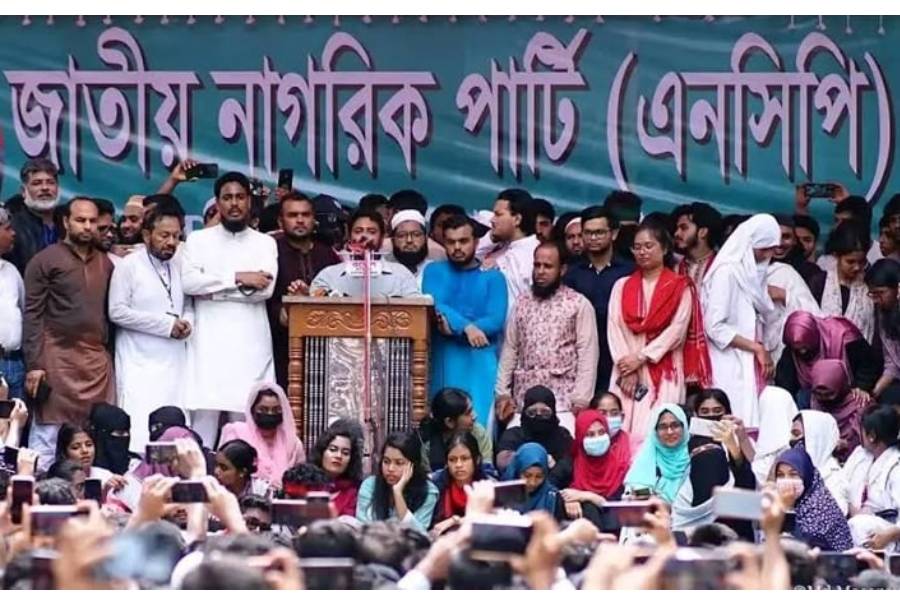
The previous day, at a press conference at the NCP’s Banglamotor office, Nahid had accused the government of “failing to uphold its duty” by not issuing the July Charter.

In that announcement, he said students and citizens would publicly read out the July Proclamation on Aug 3, regardless of the government’s position. He was unveiling a 36-day programme to commemorate the first anniversary of the July Uprising.

In Monday’s Facebook post, Nahid defined the July Proclamation as a national document that would outline the historical context of the student-led uprising, honour the martyrs and wounded, and codify its goals of political protection and security.

“Eventually, it will carry legal and constitutional force.”

“But if the government continues to do nothing, we will not sit idle. We will publish our own manifesto and invite others to do the same. If all sides produce their versions, the government will have no choice but to accept the final, consolidated document.”

He added that the July Proclamation would be read on behalf of the families of the martyrs.

Turning to the July Charter, Nahid explained that it would serve as a political consensus document outlining the structural reforms required by the state and specifying proposed amendments to the Constitution.

“All parties would sign the July Charter. The mechanism for its implementation, whether by referendum, constituent assembly, or parliamentary amendment, has yet to be finalised,” he said.

“But whichever government comes next will be bound to continue implementing reforms in line with the July Charter.”

Calling for unity, Nahid urged all parties to make compromises and support the government in delivering both the Proclamation and the Charter by Aug 5, dubbed the “36th of July.”

He concluded his post by welcoming citizens to join the NCP’s “July March,” which begins Tuesday.​
 
Analyze

Analyze Post

Add your ideas here:
Highlight Cite Fact Check Respond

The clock is ticking for the July Charter

1751330504800.webp


The pressure is mounting for the National Consensus Commission to forge an agreement by July in the context of the chief adviser's announcement that the next general election may be held as early as mid-February provided there is satisfactory progress on other key fronts.

As the commission engages in discussions with 30 political parties, the people are watching closely—hopeful that this process will chart a new course for Bangladesh's democratic future.

The commission's goal is to prepare the national charter, or July Charter, a document that will outline reform proposals agreed upon by the parties. By signing the charter, political parties will pledge to the nation that they will implement these reforms.

There is widespread hope that this charter will serve as a magna carta for Bangladesh's transition away from autocracy, kleptocracy, the criminalisation of politics, and the dominance of businessmen in parliament. It is also seen as a response to the decay of democratic institutions, the suppression of press freedom, and the unchecked accumulation of wealth by politicians and their allies through corruption and capital flight.

Citizens aspire to see the charter lay the foundation for a new state system rooted in public ownership, accountability, and welfare, and to restore genuine democracy while preventing the return of authoritarianism.

The consensus commission, is expected to finalize the July Charter by next month in consultation with the parties. However, time is running short, and the challenge is steep in a country where political consensus has historically been elusive.

In the second round of discussions, which began on June 2, the commission has so far deliberated on nine issues and reached consensus in only two. The topics included Article 70 of the constitution, nomination of standing committee chairs, tenure of the prime minister, women's representation at parliament, bicameral legislature, appointment of the Chief Justice, fundamental principles of the constitution, method of electing the president and structure of the National Constitutional Council (NCC).

So far, the parties have agreed that lawmakers will be allowed to vote against party lines, except on no-confidence motions and finance bills. Opposition MPs will chair at least four key parliamentary standing committees.

However, a closer look at the dialogues reveals a critical gap. There is no declared yardstick for how 'consensus' is determined.

This became especially apparent when 27 political parties, excluding the BNP and two others, agreed that no individual should serve as prime minister for more than 10 years. Yet, this was not officially recognised as 'consensus'. In another example, the commission needed to revise their proposal changing the structure and functions of the proposed National Constitutional Council, because the BNP and like-minded parties were against the NCC provisions as originally proposed.

The reform commission recommended that this council would oversee appointments to the positions of chief adviser, attorney general, chiefs of the three defence forces, and other constitutional posts.

Parties that supported that proposal maintained that the NCC would help curb the excessive concentration of executive power in the hands of the prime minister.

The revised proposal renames the council as the Committee for Appointments to Constitutional and Statutory Bodies. As such, it will not have the authority to appoint the chief adviser of caretaker government, which still has to be decided upon.

In the coming days, the Commission will need to address over a dozen unresolved issues, including: the formation of caretaker government and procedure for amending the constitution, declaring a state of emergency

In a deeply divided political landscape, without a clear consensus mechanism, the commission risks repeated back-and-forth and delays in finalizing the much-needed July Charter—delays the country can ill afford if the next general election is to be held in February 2026.

The commission's discussions are open-ended, meaning they have no predetermined outcome.

The consensus commission can adopt a tiered consensus framework that defines thresholds for agreement on different types of issues to ensure clarity in its decision-making. For foundational reforms—such as constitutional amendments or the structure of the caretaker government or tenure of the PM, basic principles of the constitutions and others—the commission could require unanimous or near-unanimous support to reflect national unity.

For other significant but less foundational reforms, a supermajority threshold (such as two-thirds or 75% agreement among participating parties) could be deemed sufficient. Before taking this approach, the commission will of course need to have discussions with parties to select these tiers.

The commission could also prepare a shared working draft of the charter that is regularly updated based on feedback from parties.

This way, all sides can see how proposals are evolving, which ones have support, and which ones are still disputed. Additionally, the commission could publicly list where each party stands on each issue, so that citizens can clearly see the areas of agreement and disagreement.

This would not only enhance accountability but also help the public understand the depth and breadth of political agreement.

Establishing such a yardstick would prevent delays, reduce confusion, and strengthen the July Charter as a national compact.

Still, political parties must rise above partisanship and put the country first. They must work together to find outcomes that everyone can live with—solutions that serve the nation, not just the party or personal interests.

As Ali Riaz, who is also a political scientist, wrote once, a 2014 study by Barbara Geddes, Joseph Wright, and Erica Frantz showed that only 41 percent of mass uprisings that ousted dictatorships after World War II were followed by democratisation.

Now the commission and political parties must be reasonable and work hard to make sure that Bangladesh does not fall into that 59 percent.​
 
Analyze

Analyze Post

Add your ideas here:
Highlight Cite Fact Check Respond

NCP won’t join any election without July Charter implemented
Correspondent Syedpur, Nilphamari
Published: 03 Jul 2025, 16: 57

National Citizen Party (NCP) Convener Nahid Islam has said that the NCP will not participate in any election without the implementation of the July Charter.

He made this statement today, Thursday afternoon, while speaking to journalists after visiting the grave of Sajjad Hossain, a July martyr, at Hatikhanah Cemetery in Syedpur upazila of Nilphamari.

“We have begun the July March to build the nation. This march, which started from the northern region, has been receiving overwhelming response from the people. Very soon, we will spread it across the country. Development must not be Dhaka-centric; it must focus on the entire nation. Although the fascist government fell due to the student–people’s movement, the mafia system has not ended. We must preserve the history of our struggle,” Nahid Islam said.

Others accompanying Nahid Islam included NCP’s Chief Organiser for the southern region, Hasnat Abdullah; Chief Organiser for the northern region, Sarjis Alam; Senior Joint Convener, Samanta Sharmin; Senior Joint Member Secretary, Tasnim Zara; and Sajjad Hossain’s father, Md Alamgir. Nahid offered prayer at the grave of Sajjad Hossain.

Earlier, when the July March reached Syedpur, NCP Nilphamari district convener Mohammad Abdul Majid, local leader Tanzimul Alam, and other leaders welcomed the party representatives in front of the Railway Officers’ Club. The march then proceeded from Syedpur towards Nilphamari.​
 
Analyze

Analyze Post

Add your ideas here:
Highlight Cite Fact Check Respond

NCP won’t leave street until materialization of July charter: Nahid Islam

BSS
Published :
Jul 06, 2025 23:40
Updated :
Jul 06, 2025 23:40

1751842998502.webp


National Citizen Party (NCP) Convener Nahid Islam has said they will not leave the street until July charter and July declaration is materialized.

“We are going to 64 districts for July declaration, July charter and discrimination-free Bangladesh and our journey will not stop,” he added.

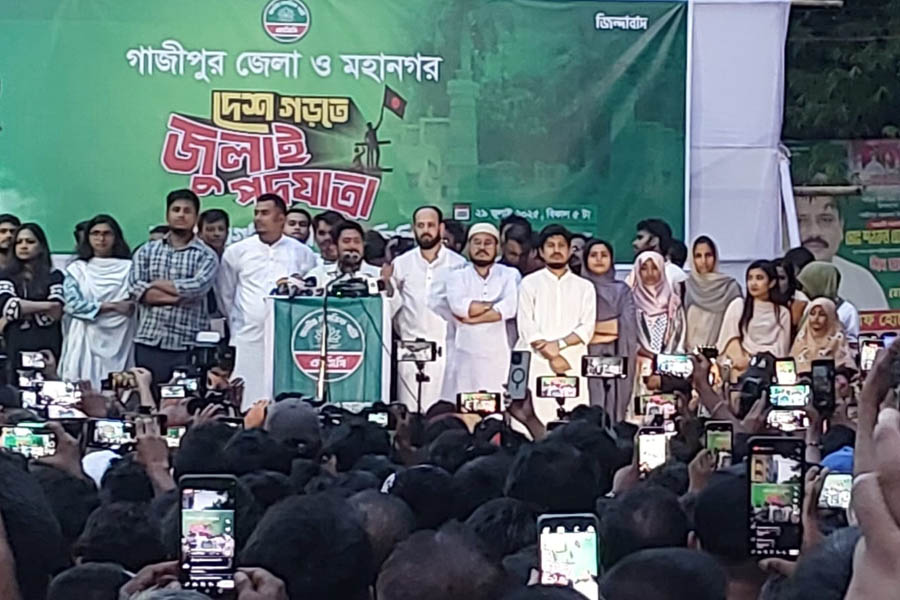
He made the remarks while taking part in a brief street corner meeting as part of their month-long July Padayatra for building the country at Godagari Upazila in the district on the way to Rajshahi from Chapainawabganj this afternoon.

Nahid Islam said they have started a walkathon to build the country. “We had got into the street in the July mass uprise with the dreams and courage and we want to give the same message we are still on the street,” he added.

Nahid Islam said revolutionaries don’t sleep and will not sleep. “We will continue our movements until our demands are fulfilled,” he continued.

Praising the Godagari’s movement he said Godagari people showed huge courage facing the bullet of police in the July mass-upsurge on August 5, 2024 that played a big role in freeing the country from fascism. “Your courage inspired the entire country,” he added.

NCP Senior Joint Convener Samanta Sharmin, member-secretary Akhter Hossain, Chief Coordinator of the northern region Sarjish Alam, Chief Coordinator of the southern region Hasnat Abdullah, Chief Coordinator Nasiruddin Patwary and Senior Joint Convener Dr Tasnim Jara were present.

Later in the evening, they also held a street-corner meeting at Shaheb Bazar Zero Point in Rajshahi city.

“We are fighting to build a new Bangladesh where there will be no more discrimination, fascism, injustice, extortion, terrorism. Students and youth must come forward to build this new country upholding the spirit of the July Uprising,” Nahid said.

He said, “Our July walkathon is basically for moulding the nation. Through the walkathon, we will go to all 64 districts across the country. We will talk to the people. We will listen to their words and aspirations.”

Nahid Islam said the NCP will remain steadfast in materializing the July Declaration and Charter and the delay that has started with the July Declaration will not be tolerated.

“To build a new Bangladesh, we must move towards a new constitution through trial, reform and a Constituent Assembly. We want to warn those who think that thousands of people who came out on the streets have returned home,” he said.​
 
Analyze

Analyze Post

Add your ideas here:
Highlight Cite Fact Check Respond

Rizvi slams move to make July Charter a core principle

UNB
Published :
Jul 11, 2025 16:39
Updated :
Jul 11, 2025 16:39

1752278812746.webp


BNP Senior Joint Secretary General Ruhul Kabir Rizvi on Friday described the call to include the July Charter in core principles of the Constitution as "misleading".

"BNP has already accepted many points from the July Charter. But why must it be made part of the fundamental principles of the Constitution?" he said.

Rizvi made the remarks while speaking as the chief guest at a prayer mat distribution programme in front of BNP's Nayapaltan Central office organised by Zia Parishad, seeking the recovery of the organisation's president and BNP Chairperson's adviser Abdul Kuddus.

The BNP leader said reforms will continue to take place across countries and through time. "Reform is not something fixed like the Thai mountain range. It is a dynamic process."

He said when needed for the sake of democracy, the state, or the people, reforms should be made and appropriate laws should be enacted.

"This is the very nature of a democratic constitution. But insisting that reforms must be done first and that it (July Charter) must be included in the fundamental principles (of the Constitution) is misleading. This is creating confusion among people. Why are you trying to mislead the public in this way?" said Rizvi.

Rizvi urged political parties to focus on returning power to people instead of confusing them by raising various demands. "That is the most important task."

He said autocratic ruler Sheikh Hasina had taken away the power of people by closing the door to democracy for 16 years. "We must now reopen that closed door and return power to people by forming a government with elected representatives."

The BNP leader said their party has never spoken against reform and, in fact, has always supported it. "Many of the issues you refer to in the name of reform are already reflected in BNP's 31-point reform outline."

He said BNP has long been fighting for a greater ideal- justice, equality, the rule of law and true democracy. "This fight is for restoring people's ownership of the state. When that ownership is denied, it opens the path to fascism."

Rizvi noted that a people's government must remain accountable to the public at every step. "That accountability is absent now. We believe the interim government has been formed with public support, as well as the backing of all political parties - except the Awami League and a few of its allies."

"We all continue to support the Dr Muhammad Yunus-led government. But it is also true that if we begin to see and hear signs of famine, the people will not spare us," Rizvi said.

Referring to the worsening economic situation, he said many garment factories are closing down, leaving people unemployed. "If people cannot afford food, that's a clear sign of famine. And if such signs appear, no one will be spared - only the fallen fascists will clap in delight."

The BNP leader said if the government wants, it can appoint administrators to manage the institutions of those Awami League cohorts who have fled the country siphoning off huge money abroad and prevent the closure of factories.

"The factories must not be shut down, especially given the dire state of the economy. This is not just a figure of speech - people are now seriously wondering whether the country might face famine by September or October," Rizvi warned.​
 
Analyze

Analyze Post

Add your ideas here:
Highlight Cite Fact Check Respond

Members Online

Latest Posts

Back
PKDefense
G
O
 
H
O
M
E