
[🇧🇩] July uprising

Afghanistan Albania Algeria Andorra Angola Antigua Austria Azerbaijan Bahamas Bahrain Bangladesh Barbados Canada China Egypt Finland Germany India Iran Israel Japan Lebanon North Macedonia Pakistan Palestine Qatar Russia Syria Turkey Ukraine United Kingdom United States Yemen
[🇧🇩] July uprising
98
3K
More threads by Saif

G Bangladesh Defense

Why Bangladesh's uprising is different from those of Sri Lanka, Nepal, and India
1785453777351.webp
 

July martyrs’ sacrifices will not go in vain: DU VC
Staff Correspondent 01 August, 2026, 02:10

1785543350525.webp

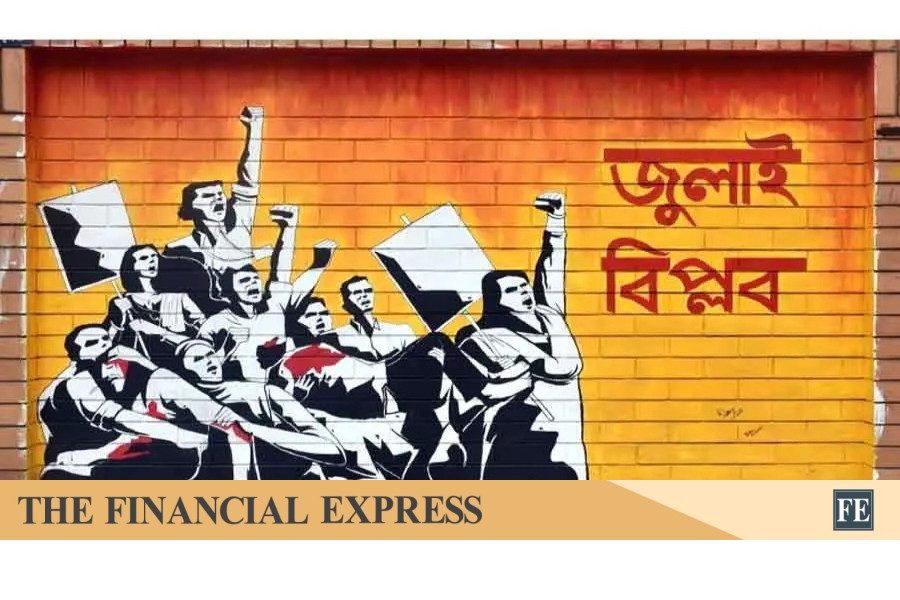
Dhaka University vice-chancellor Professor ABM Obaidul Islam, among others, looks at displayed artworks of an exhibition on July uprising on the DU campus on Thursday. | Press release photo

Dhaka University vice-chancellor Professor ABM Obaidul Islam has said that the martyrs’ supreme sacrifices during the student-led July mass uprising will not go in vain, calling upon all to unite in building an exploitation-free society reflecting the vision of the uprising.

Addressing a discussion and prize-giving ceremony organised at Fazlul Huq Muslim Hall on Wednesday, the vice-chancellor highlighted the past authoritarian misrule, stating that regimes fall when rulers oppress rather than serve the people, said a press release.

He outlined various university initiatives aimed at preserving the memory of the uprising, including establishing a July memorial, creating a July corner, releasing collections and waiving tuition fees for injured students.

The university, alongside its departments and residential halls, is observing a series of commemorative programmes to mark the second anniversary of the uprising.

Speaking at a ceremony hosted by the department of zoology on Thursday, the VC reiterated the importance of sustaining the uprising’s values.

Meanwhile, at an event organised by the faculty of earth and environmental sciences, pro-vice-chancellor, academic, Professor Abdus Salam has emphasised that achieving a discrimination-free society requires active participation from all sections of the people.

Pro-VC, administration, Professor Mohammed Almujaddade Alfasane also spoke at a seminar hosted by Kabi Jasim Uddin Hall, where tribute was paid to the families of martyrs.

Furthermore, dean of the faculty of arts, Professor Md Abul Kalam Sarkar, urged that while justice must be served regarding opposition to the uprising, innocent individuals should not face harassment.

Various other university entities, including Surja Sen Hall, Amar Ekushey Hall, the department of political science, the department of English and the Centre for Interreligious and Intercultural Dialogue, are holding discussions, cultural events, essay competitions and photo exhibitions to commemorate the struggle and keep the spirit of the uprising alive.​
 

July dream of economic justice


1785884250501.webp


As Bangladesh observes the second anniversary of the July uprising today (August 5), the nation has every reason to recall with pride the courage of the Gen Z students and ordinary people who brought down a 15-year-long authoritarian rule. But anniversaries of revolts are not meant only for commemorating sacrifices or repeating familiar slogans. They are also moments for measuring the distance travelled between the dreams for which people shed blood and the realities that followed. In that sense, the second anniversary raises an unavoidable question: how much of the July dream of a democratic, accountable and discrimination-free Bangladesh has actually been translated into reality? The most visible achievement is, of course, that the autocratic regime was removed and a parliamentary government returned through the general election held on February 12 this year. The people can again criticise those in power without the same paralysing fear, while universities, professional bodies and civic platforms have regained a public voice. The July Mass Uprising (Protection and Liability Determination) Ordinance has also accorded formal recognition and legal protection to the participants in the movement. These are no small gains. Even so, replacing one government with another was never the revolution's ultimate purpose. The deeper objective was to dismantle the political and institutional arrangements that enabled authoritarianism, corruption, enforced silence and wholesale capture of the state.

Admittedly, some work towards restoring the institutions damaged during the previous regime has begun. The Election Commission has conducted the first post-uprising national election, parliament has returned, judicial independence has received renewed attention and the Bangladesh Bank has been provided with stronger tools to address distressed banks. The July Charter has also created a framework for checks and balances, limits on executive power and greater accountability. However, enactment of laws or creation of commissions does not by itself guarantee institutional independence. The country has never suffered from a dearth of laws; what it has chronically lacked is their impartial execution. Unless appointments, investigations, prosecutions, banking decisions and public administration are freed from partisan influence, the repaired institutions might again become instruments of whichever party commands the state.

The elected government, which has been in office for less than six months, cannot reasonably be expected to reverse in so short a time the damage accumulated over one and a half decades. Yet its direction has to be judged by the condition of the common people. On that count, the picture is far from reassuring. Economic growth has remained subdued, inflation continues to erode real wages, poverty has risen and fresh graduates still find the employment market painfully narrow. At the same time, the banking system remains burdened with bad loans, weak governance and the consequences of politically-connected lending. For families struggling to buy food, pay rent and educate children, constitutional promises will have little meaning unless relief reaches them through jobs and stable prices. To a young generation that rose partly against joblessness, inequality and cronyism, democracy without economic opportunity will increasingly appear incomplete.

Under the circumstances, fulfilment of the July dream requires the government to place an economy serving ordinary people at the centre of its programme. Restoring discipline in banks, recovering stolen assets, widening the tax net without overburdening low-income people, protecting essential social expenditure and creating conditions for private investment and decent employment are therefore not merely economic tasks; they are obligations arising from the uprising. The youth, on their part, should retain their role as a vigilant democratic force rather than becoming an appendage of any political party. The blood debt of July cannot be repaid through monuments, ceremonies and official declarations alone. It can be honoured only by creating institutions that no ruler can capture and an economy in which opportunity is not reserved for the privileged few. On this second anniversary, the government would do well to remember that the July Revolution will remain unfinished until political freedom is matched by economic justice.​
 

Latest Posts

Back