
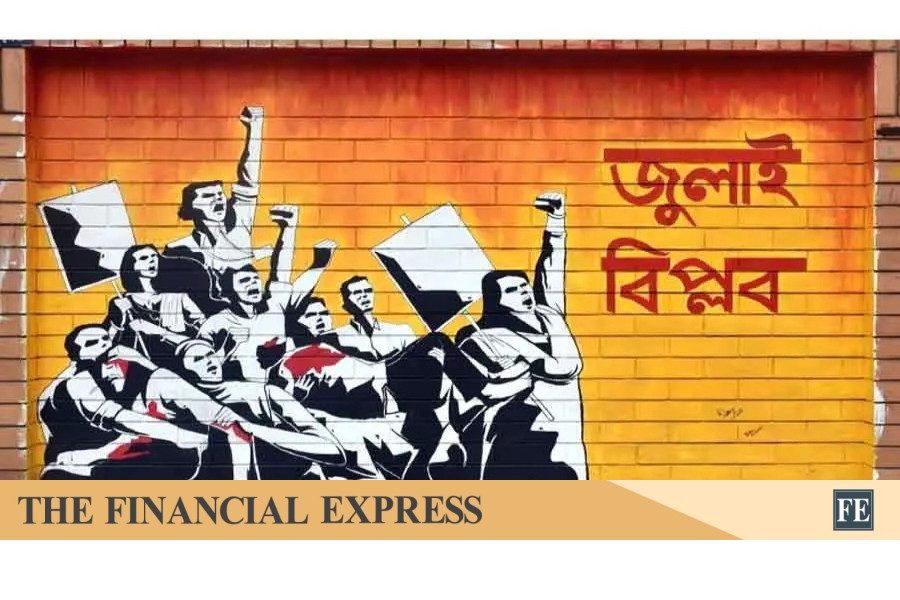
[🇧🇩] July uprising

Afghanistan Albania Algeria Andorra Angola Antigua Austria Azerbaijan Bahamas Bahrain Bangladesh Barbados Canada China Egypt Finland Germany India Iran Israel Japan Lebanon North Macedonia Pakistan Palestine Qatar Russia Syria Turkey Ukraine United Kingdom United States Yemen
[🇧🇩] July uprising
101
3K
More threads by Saif

G Bangladesh Defense

Why Bangladesh's uprising is different from those of Sri Lanka, Nepal, and India
1785453777351.webp
 

July martyrs’ sacrifices will not go in vain: DU VC
Staff Correspondent 01 August, 2026, 02:10

1785543350525.webp

Dhaka University vice-chancellor Professor ABM Obaidul Islam, among others, looks at displayed artworks of an exhibition on July uprising on the DU campus on Thursday. | Press release photo

Dhaka University vice-chancellor Professor ABM Obaidul Islam has said that the martyrs’ supreme sacrifices during the student-led July mass uprising will not go in vain, calling upon all to unite in building an exploitation-free society reflecting the vision of the uprising.

Addressing a discussion and prize-giving ceremony organised at Fazlul Huq Muslim Hall on Wednesday, the vice-chancellor highlighted the past authoritarian misrule, stating that regimes fall when rulers oppress rather than serve the people, said a press release.

He outlined various university initiatives aimed at preserving the memory of the uprising, including establishing a July memorial, creating a July corner, releasing collections and waiving tuition fees for injured students.

The university, alongside its departments and residential halls, is observing a series of commemorative programmes to mark the second anniversary of the uprising.

Speaking at a ceremony hosted by the department of zoology on Thursday, the VC reiterated the importance of sustaining the uprising’s values.

Meanwhile, at an event organised by the faculty of earth and environmental sciences, pro-vice-chancellor, academic, Professor Abdus Salam has emphasised that achieving a discrimination-free society requires active participation from all sections of the people.

Pro-VC, administration, Professor Mohammed Almujaddade Alfasane also spoke at a seminar hosted by Kabi Jasim Uddin Hall, where tribute was paid to the families of martyrs.

Furthermore, dean of the faculty of arts, Professor Md Abul Kalam Sarkar, urged that while justice must be served regarding opposition to the uprising, innocent individuals should not face harassment.

Various other university entities, including Surja Sen Hall, Amar Ekushey Hall, the department of political science, the department of English and the Centre for Interreligious and Intercultural Dialogue, are holding discussions, cultural events, essay competitions and photo exhibitions to commemorate the struggle and keep the spirit of the uprising alive.​
 

July dream of economic justice


1785884250501.webp


As Bangladesh observes the second anniversary of the July uprising today (August 5), the nation has every reason to recall with pride the courage of the Gen Z students and ordinary people who brought down a 15-year-long authoritarian rule. But anniversaries of revolts are not meant only for commemorating sacrifices or repeating familiar slogans. They are also moments for measuring the distance travelled between the dreams for which people shed blood and the realities that followed. In that sense, the second anniversary raises an unavoidable question: how much of the July dream of a democratic, accountable and discrimination-free Bangladesh has actually been translated into reality? The most visible achievement is, of course, that the autocratic regime was removed and a parliamentary government returned through the general election held on February 12 this year. The people can again criticise those in power without the same paralysing fear, while universities, professional bodies and civic platforms have regained a public voice. The July Mass Uprising (Protection and Liability Determination) Ordinance has also accorded formal recognition and legal protection to the participants in the movement. These are no small gains. Even so, replacing one government with another was never the revolution's ultimate purpose. The deeper objective was to dismantle the political and institutional arrangements that enabled authoritarianism, corruption, enforced silence and wholesale capture of the state.

Admittedly, some work towards restoring the institutions damaged during the previous regime has begun. The Election Commission has conducted the first post-uprising national election, parliament has returned, judicial independence has received renewed attention and the Bangladesh Bank has been provided with stronger tools to address distressed banks. The July Charter has also created a framework for checks and balances, limits on executive power and greater accountability. However, enactment of laws or creation of commissions does not by itself guarantee institutional independence. The country has never suffered from a dearth of laws; what it has chronically lacked is their impartial execution. Unless appointments, investigations, prosecutions, banking decisions and public administration are freed from partisan influence, the repaired institutions might again become instruments of whichever party commands the state.

The elected government, which has been in office for less than six months, cannot reasonably be expected to reverse in so short a time the damage accumulated over one and a half decades. Yet its direction has to be judged by the condition of the common people. On that count, the picture is far from reassuring. Economic growth has remained subdued, inflation continues to erode real wages, poverty has risen and fresh graduates still find the employment market painfully narrow. At the same time, the banking system remains burdened with bad loans, weak governance and the consequences of politically-connected lending. For families struggling to buy food, pay rent and educate children, constitutional promises will have little meaning unless relief reaches them through jobs and stable prices. To a young generation that rose partly against joblessness, inequality and cronyism, democracy without economic opportunity will increasingly appear incomplete.

Under the circumstances, fulfilment of the July dream requires the government to place an economy serving ordinary people at the centre of its programme. Restoring discipline in banks, recovering stolen assets, widening the tax net without overburdening low-income people, protecting essential social expenditure and creating conditions for private investment and decent employment are therefore not merely economic tasks; they are obligations arising from the uprising. The youth, on their part, should retain their role as a vigilant democratic force rather than becoming an appendage of any political party. The blood debt of July cannot be repaid through monuments, ceremonies and official declarations alone. It can be honoured only by creating institutions that no ruler can capture and an economy in which opportunity is not reserved for the privileged few. On this second anniversary, the government would do well to remember that the July Revolution will remain unfinished until political freedom is matched by economic justice.​
 

‘Political parties’ betrayal began just after July uprising’


1785887786270.webp

National Citizen Party convener and opposition chief whip Md Nahid Islam. | Sony Ramani

National Citizen Party convener and opposition chief whip in the parliament Md Nahid Islam, who announced the Students Against Discrimination’s one-point demand at the Central Shaheed Minar on August 3, 2024 that the then prime minister Sheikh Hasina must resign and the fascist system be dismantled, speaks about the July uprising, the political transition and the challenges ahead with Ahammad Foyez and Nawaz Farhin Antara in an interview with New Age

New Age: Looking back two years later, what do you consider the greatest achievement of the July uprising?

Nahid Islam:
The greatest achievement was that the people succeeded in overthrowing Sheikh Hasina and the Awami League government through the July mass uprising.

New Age: Which objectives of the July uprising remain unfulfilled? You declared the one-point demand for Sheikh Hasina’s fall and the dismantling of the fascist system. In your view, has that system truly been dismantled?

Nahid Islam:
The fascist system still exists. Only the political leadership has changed, and now the BNP is in power. We believe this reflects the incompleteness of the uprising.

State reform was meant to dismantle that system by building an accountable, democratic state, strengthening institutions and ensuring structural change. That is why the Consensus Commission was formed, the July Charter was proposed and a referendum was demanded.

However, the current BNP government has rejected the verdict of that referendum. As a result, the fundamental structural reforms that people fought for have yet to take place.

New Age: In that case, you are pursuing this change separately. You are constantly raising political demands and statements. Do you think the BNP may face a major movement because of the reluctance you describe?

Nahid Islam:
Yes, it seems to us that the BNP will not be able to handle such a movement or govern effectively. Not only may it face a major movement, but it is already showing signs of failing to govern properly. We have seen these symptoms within five months. Power is becoming more centralised than before in the hands of the prime minister and everything is being carried out with full force. If they continue to run the state in this way, this government will not be able to sustain itself, nor will it be given that opportunity. Sheikh Hasina ruled in this manner for 17 years; this government will not be given that length of time.

New Age: To what extent has the state fulfilled its responsibility towards those who were killed or injured during the July uprising?

Nahid Islam:
This responsibility can only truly be fulfilled through justice. We have discussed the trials in parliament. The tribunal has remained in operation since the interim government. If this government completes the trials and increases the tribunal’s capacity, then perhaps that responsibility will be fulfilled to some extent.

But the greater responsibility is to bring about the change for which people sacrificed their lives. Many injured people have yet to receive adequate rehabilitation or financial support, while the families of the martyrs and the injured continue to face economic hardship and socio-political insecurity. The government must address these issues.

New Age: What does the spirit of the July uprising mean to you? Critics accuse the NCP of exploiting that spirit for political gain. How do you respond?

Nahid Islam:
The biggest beneficiaries of the spirit of July are those who are in power now. Politically, the second beneficiaries are those in opposition. We are in third place and we accept that.

It is not right to equate July with the politics of exploiting the spirit of the Liberation War. We have seen that for the past 50 years: people have spoken in the name of the Liberation War without fulfilling its aspirations. We are still speaking for every commitment of July. We are still fighting for them.

When we were in government, it may be said that expectations were not fully met. But we took initiatives and carried out the work. Those making these accusations do not want a new political consciousness or a new political force to emerge from the July uprising.

New Age: The Anti-Discrimination Student Movement began with the demand for quota reform in public sector recruitment. Yet many argue that meaningful reform has still not taken place. How do you respond?

Nahid Islam:
The quota system has been reformed and it now stands at 7 per cent. But comprehensive reform of the Public Service Commission, which would ensure transparency in recruitment, has not taken place. The commission should be appointed impartially. These were our demands and they were included in the July Charter and the referendum.

Our expectation was that the government would implement these reforms after receiving a public mandate through the referendum.

This government must be held accountable because it has not done so. More broadly, employment for young people was the central issue. The crisis was not only about quotas or government jobs; it was fundamentally a crisis of employment. We are not seeing the economic reforms necessary to generate employment.

Our plan was to implement political reforms first, establish accountability and then pursue economic reforms. Without political reform, economic reform will not happen. We are now effectively stuck in achieving the goal of political reform.

New Age: At different times, you have accused various political parties of betraying the ideals of the uprising. When do you believe that betrayal began?

Nahid Islam:
That betrayal began after the uprising. There was a demand for a declaration. There was a demand for the removal of the president. The BNP was reluctant at every stage concerning the July Charter.

They held discussions at the cantonment. As a result, they did not want any change in the structure of power or any institutional reorganisation. They wanted only a change in who held power.

Through the referendum, the political deception has become increasingly clear. They now say they will accept the referendum’s verdict, whether on three points or one and a half questions, but they did not make their position clear before the election. They participated in the process, yet after winning the election they did not take the oath of the Constitutional Reform Council. By refusing to take that oath, they have exposed their deception before the people.

New Age: The July uprising brought together democratic forces and saw unprecedented participation by women. Since then, many women have stepped back, while far-right groups have become more active. How do you assess these developments?

Nahid Islam:
We are still working politically and seeking to build broader unity to implement the referendum. We are also engaging directly with people to convince them that without these reforms, none of the country’s problems will be resolved. If the government refuses to accept them, a movement will emerge.

Just as political divisions emerged after the July uprising, society has also become divided. This has created a serious crisis. Different groups have tried to exploit the situation to advance their own interests. As a result, we have fallen behind in achieving our broader goal of state reform.

However, I believe that as time passes and people become more aware of the country’s deepening crises, everyone will eventually have to return to a position of greater unity.

New Age: Many non-partisan forces that united during the July uprising became divided after some student leaders joined the government. Looking back, was it necessary for student leaders to join the government at that time?

Nahid Islam:
It was more urgent at that time. If there had been a national government, perhaps we would not have needed to join it. This crisis was created by the BNP. If there had been a national government, everyone would have had confidence in it because there would have been political participation. Then we would not have needed to join. Because we entered the government, responsibility for the government and for sustaining it fell on our shoulders. As a result, we were no longer able to organise ourselves and there was widespread propaganda and various attempts to divide us.

New Age: You are saying that the main obstacle to the formation of a national government was the BNP.

Nahid Islam:
They are admitting that themselves now.

New Age: Why did you feel it was necessary to transform the leadership of the uprising into a political party?

Nahid Islam:
No political party, especially the BNP at that time, was truly committed to our goal of dismantling the fascist system or achieving the broader aspirations of the mass uprising, including political, economic, social and cultural change. That is why we had to organise ourselves politically to achieve our demands. That is why we needed a party. We felt the need to form one because of the aspiration created by the mass uprising to build an independent, sovereign and democratic state.

New Age: Critics argue that the moral authority of the uprising has weakened since its leaders entered party politics. How do you respond to that criticism?

Nahid Islam:
We did not form a party during the first seven months, when the aspirations of the mass uprising were being ignored and suppressed. I think it is because of our political role that the mass uprising is still being discussed. Without the NCP and other political forces, perhaps the mass uprising would not have received the recognition it has.

New Age: What fundamentally distinguishes the NCP from other political parties? Why should an ordinary citizen choose to support the NCP?

Nahid Islam:
People will join the NCP for ideological reasons. The NCP embodies the aspirations of the mass uprising, advocating democratic change and defending the country’s freedom, sovereignty and civil rights. We do not see those commitments reflected in the thinking or conduct of the other parties. The aspirations of young people that emerged through the uprising are what the NCP seeks to embody in building the state. We believe a large section of the people agree with us, even if they are not politically or organisationally connected to us.

New Age: How do you evaluate the performance of the current government over the past five months?

Nahid Islam:
The government has become far more unpopular in the past five months. In particular, by rejecting the referendum result, it has lost the trust of the people. Whatever the government says now, people will not believe it. Within five months, it has completely failed to maintain public confidence.

In such a crisis, public trust is essential for governing effectively. Transparency is needed. Problems that might take other governments two or three years to create have emerged within five months. Many people are telling them that there are numerous irregularities within the government and that these amount to a form of political deception.

New Age: Do you believe the government’s promises of state reform will actually be implemented?

Nahid Islam:
They will not be implemented unless there is strong public pressure.

New Age: What changes, if any, has the July uprising brought to Bangladesh’s democratic culture?

Nahid Islam:
I think the political culture has changed. People can speak and they can sit together and engage in discussion. That space exists now, and it did not exist before.

New Age: Many young people now appear disillusioned with politics. What is your party’s plan to restore their confidence?

Nahid Islam:
There were only two or three of us in the interim government. We did not have the opportunity to demonstrate our capabilities fully. However, through our performance in parliament in a very short time and through our political activities outside parliament we have shown young people that it is possible to enter parliament at a young age through politics. It is also possible to serve in government. That has created confidence. People have begun to believe in this and to accept youth leadership. When we can demonstrate our statesmanship and our capabilities more fully, I think young people will become even more hopeful.

New Age: Do you believe post-uprising Bangladesh is on the right path? Why or why not?

Nahid Islam:
Post-uprising, and especially post-election, Bangladesh has gone off course. We are seeing political violence, attempts to suppress the opposition and worsening law and order and energy crises. This is not the direction we should take.

New Age: Looking back, is there any decision you made or position you took that you now believe should have been handled differently?

Nahid Islam:
We were part of a process that overthrew a government that no one had been able to remove for 16 years, formed a new government within three days, pursued major reforms through that government and held an election. These were extraordinary responsibilities taken on by a small group of us and by this new political force. We believe we have fulfilled our responsibilities to the best of our ability. If we had received greater cooperation from other centres of power and from other political forces, Bangladesh would have been on a better path.

New Age: Although the NCP has quickly emerged as a significant political force, critics say it remains largely urban-centred. How do you plan to strengthen the party’s grassroots presence?

Nahid Islam:
We are organising our party. During July we held programmes in 100 upazilas. Whenever we try to expand our presence at the upazila level and beyond, we face attacks. The more we move towards the grassroots, especially rural areas, the more political obstacles the established parties with entrenched power structures create. They do not want to allow us to enter. We believe that through the local government elections we will be able to overcome some of these limitations.

New Age: Although the Awami League’s top leaders fled during the July uprising, many of its leaders and most of its activists remain in the country. What do you think their political future should be?

Nahid Islam:
Awami League leaders and activists who are not involved in crimes should be free to engage in politics, but it is unlikely that the Awami League will return as a party. They can join other parties and continue their political activities.

New Age: You recently said that some groups are trying to rehabilitate the Awami League politically. Who are they and what do you believe their motives are?

Nahid Islam:
I have seen some MPs from the ruling BNP making such remarks on television talk shows. They are trying to rehabilitate the Awami League by mocking the July uprising. The Awami League was in power for 16 years and it still retains influence and privileged networks in parts of society. Since it also receives support from outside the country, particularly from India, these groups will continue trying to destabilise Bangladesh and somehow restore the Awami League’s political position.

Ahammad Foyez is managing editor of New Age; and, Nawaz Farhin Antara is seniro staff correspondent at New Age.​
 

What is the way to fulfilling July's unfinished agenda?

Fahmida Khatun


1786058670801.webp


In the history of Bangladesh, certain moments are not just the names of political events; they turn the trajectory of the nation's future course. July 2024 was such a turning point. The students' movement demanding reform of the quota system in government jobs quickly escalated into a nationwide uprising and ultimately culminated in the fall of the government. However, the most important question in historical terms lies elsewhere—why did a movement that began over the recruitment system in government jobs eventually turn into a demand for fundamental changes in the state apparatus?

To find the answer, one must look beyond just the quota reform issue; the quota was an immediate stimulus, while the real cause was the long-standing political, economic, and institutional dissatisfaction that had accumulated over time.

By mid-2024, both the country's economy and politics were under pressure. Inflation had been in double digits for a long time. Stagnant investment, slow job creation, dwindling foreign exchange reserves, weaknesses in the banking sector, and the deterioration of public services were increasing public concern. Particularly, a large section of the youth felt increasingly disconnected from both employment opportunities and the state decision-making process. As a result, the movement that began over quotas gradually turned into a broader question about justice, accountability, and legitimacy in state governance.

Energy security must be seen as one of the cornerstones of economic strategy. The recent power and gas crisis has shown that energy is not just about power generation; it is also intricately linked with industrial competitiveness, exports, employment, and investment. Thus, in the short term, it is urgent to ensure uninterrupted energy supply to productive sectors, diversify sources of imports, and settle dues with suppliers. In the long term, domestic gas exploration, expansion of renewable energy, regional power trade, and adoption of an integrated energy security plan are necessary.

This is why the July movement was not just a protest against one government; it was also against a development model where the benefits of development did not reach everyone equally, and the accountability of state institutions had weakened over time. Therefore, the expectations of July were not limited to just a change in government; its inherent aspiration was to reconstruct the relationship between the state and its citizens on a new foundation—to establish a new social contract.

Two years later, it is natural to ask—how many of those expectations have been fulfilled? The answer depends on how we define success. If a change in power is the sole criterion, then July was undoubtedly a historic success. But if judged on the basis of the reform of state institutions, economic recovery, job creation, inflation control, investment growth, or improvement of public service, it must be said—a significant part of July's agenda remains unfinished.

The real evaluation of the July movement will not be based on how many commissions were formed or how many new policies were announced. The actual assessment will be—has Bangladesh been able to create a state where political competition is peaceful, the economy is productive, institutions are independent and accountable, and citizens' rights are effectively protected. Achieving this goal requires more than short-term stability; it demands continuous and profound institutional and economic reforms.

First, there is a need to rebuild people's trust in democratic competition. July taught us that when legitimate paths for political competition are narrowed, public discontent eventually explodes on the streets. Therefore, free, fair, and participatory elections are not only prerequisites for democracy; they are also one of the foundations of economic stability. Investors want a country where there is policy continuity and changes in power occur constitutionally and peacefully. For this, it is essential to enhance the capacity of the Election Commission, build mutual trust among political parties, and improve the system for impartial dispute resolution.

Simultaneously, there must be a transition from a person-centered governance system to an institution-centered governance system. In a mature state, even if there is a change in government, institutions work with professionalism, neutrality, and continuity. Strengthening the independence, efficiency, and accountability of public administration, the judiciary, Bangladesh Bank, the Election Commission, the Anti-Corruption Commission, and other regulatory institutions is now a demand of the times. Sustainable development is not possible without strong institutions.

Employment must be at the centre of economic policy. Bangladesh's growth over the past few decades has primarily relied on the ready-made garment industry, remittances, and women's participation in the labour market. The development strategy of the future must be more multifaceted. Not just achieving high growth; establishing new industries, technology-based production, diversification of exports, the growth of small and medium entrepreneurs, and creating skilled employment should be the main goals of the development strategy to connect the aspirations of educated youth with the reality of the economy.

Reducing inequality must also be one of the central goals of the development strategy. The July movement reminded us that growth alone is not enough; the equitable distribution of growth benefits is equally important. Solving issues like regional disparity, unequal access to quality education, discrimination in women's employment, the digital divide, and limited opportunities for the youth is essential for sustainable development.

Sustainable economic development is not possible without a strong financial system. Bangladesh's banking sector has now reached a stage where piecemeal reforms are not enough. Solving problems like non-performing loans, weak governance, inadequate capital, and prolonged judicial processes requires an integrated reform programme. Without ensuring loan recovery, adequate provisioning, corporate governance, and the effective independence of Bangladesh Bank, the banking sector will not be able to support economic growth as desired.

Similarly, fundamental reform of the revenue system is needed. Bangladesh's tax-to-GDP ratio is still low compared to international standards. As a result, necessary investments in education, health, infrastructure, and social protection remain limited. Increasing revenue does not mean just raising tax rates; rather, it involves modernising tax administration, preventing tax evasion, expanding the digital tax system, and creating a simple, fair, and credible tax regime. People will spontaneously pay taxes when they are assured that the money is being spent with transparency and accountability.

Energy security must be seen as one of the cornerstones of economic strategy. The recent power and gas crisis has shown that energy is not just about power generation; it is also intricately linked with industrial competitiveness, exports, employment, and investment. Thus, in the short term, it is urgent to ensure uninterrupted energy supply to productive sectors, diversify sources of imports, and settle dues with suppliers. In the long term, domestic gas exploration, expansion of renewable energy, regional power trade, and adoption of an integrated energy security plan are necessary.

To make Bangladesh's development more inclusive, genuine decentralisation is crucial. An overly centralised administrative structure delays solving local problems and limits citizen participation. Empowering local governments with more authority and resources will improve the quality of education, health, urban management, infrastructure, and social services, making development more accountable.

Reducing inequality must also be one of the central goals of the development strategy. The July movement reminded us that growth alone is not enough; the equitable distribution of growth benefits is equally important. Solving issues like regional disparity, unequal access to quality education, discrimination in women's employment, the digital divide, and limited opportunities for the youth is essential for sustainable development.

Lastly, these reforms must be evidence-based. Effective public policy cannot solely be based on political considerations; it must be grounded in accurate data, research, and regular evaluation. Close cooperation between the government, universities, research institutions, and the private sector will not only improve policymaking but also increase public trust in the state. The real message of July was to redefine the relationship between the state and its citizens. Citizens are not just voters; they are partners in development. The duty of the state is not just to govern but to be the protector of citizens' rights, security, and potential.

#Fahmida Khatun is an economist and the Executive Director of the Centre for Policy Dialogue (CPD).​
 

Two years after July, who do we trust?

Kazi ASM Nurul Huda

1786060233832.webp

"Over the past two years, debates over constitutional reform, transitional justice, commissions of inquiry, the timing of elections, and even the 'ownership' of July have increasingly become disputes over credibility." FILE PHOTO: ORCHID CHAKMA

Two years have passed since those transformative days of the July Uprising. But even now, public debates continue to revolve around constitutional reform, transitional justice, institutional restructuring, and other reform issues. These questions, though important for the country’s democratic future, reveal a common assumption: that the significance of July can be understood primarily through changes in authority, in terms of who governs, who exercises power, and which institutions should be reformed. This assumption is understandable but incomplete, as it treats the July uprising primarily as a political event reshaping or redistributing power while overlooking its equally significant role in redistributing public credibility.

This becomes clear when we reflect on the nature of our disagreements over the past two years. People do not just disagree about reforms, elections, or the conduct of political parties. They increasingly disagree about whose account of events deserves to be believed. Student leaders, political parties, journalists, civil society organisations, victims’ families, and government officials often offer competing interpretations of what the movement demanded, where the country stands today, and where it should be heading. The disagreement, therefore, is no longer confined to political choices or policy preferences. It increasingly concerns whose interpretation deserves credibility.

Unless we understand how July transformed the relationship between political authority and public credibility—and how that transformation continues to shape Bangladesh’s democratic life—we are likely to misunderstand both the achievement of the uprising and the challenges that have followed.

During the 2024 uprising itself, official narratives competed with smartphone footage, eyewitness testimony, independent reporting, and information circulating through countless informal networks. Rather than depending exclusively on institutional explanations, citizens increasingly relied on what they themselves witnessed and on evidence documented by thousands of ordinary people. Official statements often contradicted almost immediately by visual evidence, while many claims gained public acceptance not because they came from recognised authorities but because they could be independently examined and verified.

This experience helped change, perhaps permanently, how public credibility is earned, shifting it from an outcome of an institutional environment dominated by governments, newspapers, universities, courts, and other established institutions to one in which perceived credibility could also emerge from outside those traditional structures. This transformation exposed an important distinction between political authority and public credibility. Political authority concerns the legal power to govern, whereas public credibility concerns whether citizens regard a person or institution as worthy of their trust. Perhaps one of July’s most enduring legacies is that Bangladeshis are now less willing to accept claims simply because they originate from positions of authority.

Democracies become stronger when governments recognise that official authority alone cannot secure public trust. The ability of ordinary citizens to document abuses, question official narratives, and demand justification from those exercising power represents an important expansion of democratic accountability.

However, this achievement has also created a new challenge. The decline of unquestioned authority does not automatically produce trustworthy public institutions. Instead, it creates a more demanding public sphere in which people’s credibility itself becomes the object of political contestation.

Over the past two years, debates over constitutional reform, transitional justice, commissions of inquiry, the timing of elections, and even the “ownership” of July have increasingly become disputes over credibility. Social media usage has broadened democratic participation, but it is also used to accelerate the circulation of rumours, selective evidence, and politically convenient narratives. The challenge is no longer simply to distribute political power more fairly, but to cultivate institutions capable of earning public trust in this new democratic environment.

A certain temptation naturally follows this transformation. Once citizens lose confidence in inherited authority, they begin to suspect that every institution is simply another political actor in disguise: the government may be assumed to manipulate information, political parties to exploit July for political advantage, journalists to be partisan, universities to be ideologically compromised, and courts to deliver judgment according to political loyalties rather than legal principle.

Such scepticism is understandable in a society emerging from authoritarian rule, and some of it is undoubtedly healthy. Democracies require citizens who question authority rather than submit to it uncritically. But scepticism and cynicism are not the same thing. A democracy cannot function if citizens conclude that no institution is capable of earning their credibility under any circumstances.

This is why the unfinished work of July 2024 extends beyond constitutional reform or institutional changes. Bangladesh also faces the more difficult task of restoring confidence in the judiciary, universities, the media, and public commissions, all of whose authority must rest not on inherited status or political loyalty, but on demonstrable integrity. Their credibility cannot be demanded and must instead be earned through institutional independence, professional competence, transparency, and a visible commitment to truth rather than political allegiance.

The responsibility to achieve this, however, does not belong to the institutions alone. It also belongs to citizens.

If we scrutinise only the claims of our political opponents while accepting those of our preferred leaders (without comparable examination), we have not strengthened democratic citizenship but merely redirected our political loyalties.

The spirit of July is preserved by commemorating and also by sustaining the habits of public reasoning that gave the uprising much of its moral force.

Before asking who has inherited July politically, we should ask a more fundamental question: who is building the conditions under which July’s democratic aspirations can endure? The enduring significance of July lies not only in changing who governs Bangladesh, but also in transforming the standards by which authority is evaluated. Whether that transformation ultimately strengthens democracy in Bangladesh will be contingent on whether we succeed in building a public culture in which credibility is earned through evidence, integrity, and accountability rather than assumed through office, ideology, or “historical entitlement.”

Dr Kazi ASM Nurul Huda is associate professor of philosophy at the University of Dhaka and Zuzana Simoniova Cmelikova Visiting International Scholar in Leadership and Ethics at the University of Richmond’s Jepson School of Leadership Studies.​
 

Latest Posts

Back