
 Bangladesh Defense
Saif
Senior Member
- Jan 24, 2024
- 21,704
- 9,794
- Nation

- Residence
- Axis Group


Jute farmers struggle as prices tumble
Adverse weather has reduced jute yields this year, while export restrictions have weakened demand and pushed down prices, raising fears of losses among farmers.
Jute farmers struggle as prices tumble
Adverse weather has cut yields, while export restrictions have weakened demand
Suzit Kumar Das
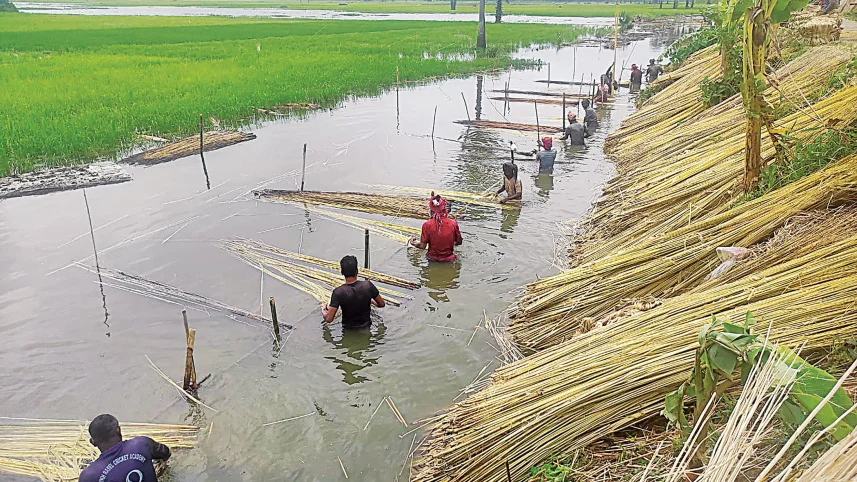
Farmers strip fibres from jute stalks after retting. Jute growers say excessive rainfall has reduced yields this season. The photo was taken recently in Khoar village under Saltha upazila of Faridpur. PHOTO: Suzit Kumar Das
Adverse weather has reduced jute yields this year, while export restrictions have weakened demand and pushed down prices, raising fears of losses among farmers.
Farmers said they expanded jute acreage after receiving good prices last year. However, excessive rainfall forced many to harvest the crop earlier than usual, resulting in lower yields.
Traditionally, lower supply supports higher prices, but farmers and traders said the suspension of raw jute exports to India had reduced demand in the local market.
Prices of good-quality raw jute have fallen by around Tk 1,200 per maund over the past one-and-a-half months. Rising production costs have further squeezed farmers.
FARMERS COUNT LOSSES
According to the Department of Agricultural Extension (DAE), the government has set a target of cultivating jute on 708,282 hectares in the 2026-27 season, with a production target of 85.21 lakh bales.
Data from the Bangladesh Bureau of Statistics (BBS) shows projected jute cultivation in FY2025-26 was 2.31 percent lower than FY2024-25, while production was expected to decline by 1.89 percent year-on-year.
Several farmers in Faridpur, Rajbari and Magura said yields per bigha had declined this season.
Sukontho Pal, a jute farmer from Boalmari upazila of Faridpur, said production costs had increased while yields had declined.
“Good-quality jute is now selling for a maximum of Tk 4,000 per maund, whereas I received around Tk 4,500 last year,” he said.
“Production costs per bigha have increased by Tk 4,000 to Tk 5,000 from last year. At the current market price, we cannot even recover our production costs.”
Md Siam Mallik, a farmer in Baliakandi upazila of Rajbari, blamed excessive rainfall for lower yields.
“Most farmers were forced to harvest jute 15 to 20 days earlier than usual due to excessive rainfall. As a result, yields fell by two to four maunds per bigha,” he said.
Naba Kumar Kundu from Magura Sadar upazila said farmers earned Tk 12,000 to Tk 15,000 per bigha last year when jute prices were high.
“The situation is completely different this year. It is difficult for farmers to make a profit unless jute prices remain above Tk 4,500 per maund,” he said.
“Good-quality jute is now selling for a maximum of Tk 4,000 per maund, whereas I received around Tk 4,500 last year,” said Sukontho Pal, a jute farmer from Faridpur
TRADERS UNDER PRESSURE
Md Mahmudur Nabi, a jute trader in Pabna Sadar upazila, said farmers and traders were both suffering due to low prices.
“It costs us more than Tk 4,200 to buy a maund of jute from the market and transport it to a jute mill. But mill owners are unwilling to buy jute at this price and want to purchase it at even lower rates,” he said.
Md Aktaruzzaman Chan, a trader at one of Faridpur’s largest jute markets, said prices had become unpredictable.
“We cannot understand the market trend this year. Jute that was selling for Tk 5,200 per maund suddenly fell to Tk 3,500. It has recovered somewhat to Tk 3,800, but we do not know whether prices will rise further as demand in the market remains low,” he said.
Moktar Molla, president of the Faridpur Jute Farmers Association, said production costs had risen by Tk 4,000 to Tk 5,000 per bigha.
He said jute prices had fallen from Tk 5,200 to Tk 4,000 per maund in one-and-a-half months, while yields declined by two to three maunds per bigha. Farmers spend Tk 3,500 to Tk 3,800 to produce a maund.
He warned that farmers could lose interest in jute cultivation if they failed to receive fair prices.
“The price of jute has fallen because exports of raw jute remain suspended,” he alleged.
EXPORT CURBS HURT DEMAND
Khandaker Alamgir Kabir, chairman of the Bangladesh Jute Association, said local demand for jute is around 60 lakh bales annually, while production is expected to exceed 80 lakh bales this year.
He said the surplus has traditionally been exported, but the then interim government had imposed conditions on raw jute exports on September 8, 2025.
“We thought the conditions would be withdrawn after a while,” Alamgir said.
The restrictions have prevented farmers from getting expected prices, he added.
“Since the conditions were imposed, we repeatedly requested the adviser to the then interim government responsible for the jute ministry, as well as the minister of the current government, to withdraw them. But no one is listening to us,” he said.
Md Rishad Abdullah, chief scientific officer at the Bangladesh Jute Research Institute, Faridpur station, said farmers usually cultivate the GRO-524 variety of jute, which is vulnerable to excessive water.
“Many farmers harvested jute before it reached full maturity,” he said, adding that it lowered quality and prices.
Mizanur Rahman, assistant director of the Department of Jute in Faridpur, said cultivation had increased this year as farmers received good prices last year.
“Jute production is also expected to be higher this year. However, the suspension of raw jute exports has reduced demand in the market, which has affected prices. If raw jute exports resume, prices could reach Tk 5,000 to Tk 5,500 per maund,” he said.
Asked whether any measures were taken to raise prices, Mizanur Rahman said their office only conveys concerns to higher authorities as it cannot make policy decisions.
Adverse weather has cut yields, while export restrictions have weakened demand
Suzit Kumar Das
Farmers strip fibres from jute stalks after retting. Jute growers say excessive rainfall has reduced yields this season. The photo was taken recently in Khoar village under Saltha upazila of Faridpur. PHOTO: Suzit Kumar Das
Adverse weather has reduced jute yields this year, while export restrictions have weakened demand and pushed down prices, raising fears of losses among farmers.
Farmers said they expanded jute acreage after receiving good prices last year. However, excessive rainfall forced many to harvest the crop earlier than usual, resulting in lower yields.
Traditionally, lower supply supports higher prices, but farmers and traders said the suspension of raw jute exports to India had reduced demand in the local market.
Prices of good-quality raw jute have fallen by around Tk 1,200 per maund over the past one-and-a-half months. Rising production costs have further squeezed farmers.
FARMERS COUNT LOSSES
According to the Department of Agricultural Extension (DAE), the government has set a target of cultivating jute on 708,282 hectares in the 2026-27 season, with a production target of 85.21 lakh bales.
Data from the Bangladesh Bureau of Statistics (BBS) shows projected jute cultivation in FY2025-26 was 2.31 percent lower than FY2024-25, while production was expected to decline by 1.89 percent year-on-year.
Several farmers in Faridpur, Rajbari and Magura said yields per bigha had declined this season.
Sukontho Pal, a jute farmer from Boalmari upazila of Faridpur, said production costs had increased while yields had declined.
“Good-quality jute is now selling for a maximum of Tk 4,000 per maund, whereas I received around Tk 4,500 last year,” he said.
“Production costs per bigha have increased by Tk 4,000 to Tk 5,000 from last year. At the current market price, we cannot even recover our production costs.”
Md Siam Mallik, a farmer in Baliakandi upazila of Rajbari, blamed excessive rainfall for lower yields.
“Most farmers were forced to harvest jute 15 to 20 days earlier than usual due to excessive rainfall. As a result, yields fell by two to four maunds per bigha,” he said.
Naba Kumar Kundu from Magura Sadar upazila said farmers earned Tk 12,000 to Tk 15,000 per bigha last year when jute prices were high.
“The situation is completely different this year. It is difficult for farmers to make a profit unless jute prices remain above Tk 4,500 per maund,” he said.
“Good-quality jute is now selling for a maximum of Tk 4,000 per maund, whereas I received around Tk 4,500 last year,” said Sukontho Pal, a jute farmer from Faridpur
TRADERS UNDER PRESSURE
Md Mahmudur Nabi, a jute trader in Pabna Sadar upazila, said farmers and traders were both suffering due to low prices.
“It costs us more than Tk 4,200 to buy a maund of jute from the market and transport it to a jute mill. But mill owners are unwilling to buy jute at this price and want to purchase it at even lower rates,” he said.
Md Aktaruzzaman Chan, a trader at one of Faridpur’s largest jute markets, said prices had become unpredictable.
“We cannot understand the market trend this year. Jute that was selling for Tk 5,200 per maund suddenly fell to Tk 3,500. It has recovered somewhat to Tk 3,800, but we do not know whether prices will rise further as demand in the market remains low,” he said.
Moktar Molla, president of the Faridpur Jute Farmers Association, said production costs had risen by Tk 4,000 to Tk 5,000 per bigha.
He said jute prices had fallen from Tk 5,200 to Tk 4,000 per maund in one-and-a-half months, while yields declined by two to three maunds per bigha. Farmers spend Tk 3,500 to Tk 3,800 to produce a maund.
He warned that farmers could lose interest in jute cultivation if they failed to receive fair prices.
“The price of jute has fallen because exports of raw jute remain suspended,” he alleged.
EXPORT CURBS HURT DEMAND
Khandaker Alamgir Kabir, chairman of the Bangladesh Jute Association, said local demand for jute is around 60 lakh bales annually, while production is expected to exceed 80 lakh bales this year.
He said the surplus has traditionally been exported, but the then interim government had imposed conditions on raw jute exports on September 8, 2025.
“We thought the conditions would be withdrawn after a while,” Alamgir said.
The restrictions have prevented farmers from getting expected prices, he added.
“Since the conditions were imposed, we repeatedly requested the adviser to the then interim government responsible for the jute ministry, as well as the minister of the current government, to withdraw them. But no one is listening to us,” he said.
Md Rishad Abdullah, chief scientific officer at the Bangladesh Jute Research Institute, Faridpur station, said farmers usually cultivate the GRO-524 variety of jute, which is vulnerable to excessive water.
“Many farmers harvested jute before it reached full maturity,” he said, adding that it lowered quality and prices.
Mizanur Rahman, assistant director of the Department of Jute in Faridpur, said cultivation had increased this year as farmers received good prices last year.
“Jute production is also expected to be higher this year. However, the suspension of raw jute exports has reduced demand in the market, which has affected prices. If raw jute exports resume, prices could reach Tk 5,000 to Tk 5,500 per maund,” he said.
Asked whether any measures were taken to raise prices, Mizanur Rahman said their office only conveys concerns to higher authorities as it cannot make policy decisions.
