Bangladesh Defense
Saif
Senior Member
- Jan 24, 2024
- 21,724
- 9,794
- Nation

- Residence
- Axis Group


5-year plan eyes trillion-dollar economy
The government has created a five-year plan that aims to turn Bangladesh into a trillion-dollar economy by 2034 and create 1 crore jobs by 2030, driven by an upsurge in investment.
5-year plan eyes trillion-dollar economy
Govt wants to create 1 crore jobs by 2030
Rejaul Karim Byron
The government has created a five-year plan that aims to turn Bangladesh into a trillion-dollar economy by 2034 and create 1 crore jobs by 2030, driven by an upsurge in investment.
The blueprint, which was prepared by the General Economic Division and will succeed the 8th five-year plan, aimed to accommodate the new government’s election manifesto and establish a realistic strategy to manage internal and global economic shocks, including the banking sector crisis.
It was approved at yesterday’s meeting of the National Economic Council chaired by Prime Minister Tarique Rahman.
“As a government elected by the people, we have incorporated those commitments into the proposed plan -- we are moving forward with strategies focused on recovery, transition, and reconstruction,” Finance Minister Amir Khosru Mahmud Chowdhury told reporters after the meeting.
The plan rests on seven pillars: economic decentralisation, deregulation and improving business climate, investment-led growth, balanced regional development, universal social protection, job creation and skills development, and good governance and institutional reforms.
In the first 12 months, the government will focus on stabilising the fragile economy.
This involves implementing a strict monetary policy to control inflation and employing prudent exchange rate management to rebuild the delicate foreign exchange reserves.
In this phase, the government would also be reducing unnecessary government expenditure while simultaneously strengthening social safety nets to protect the vulnerable from the shocks of inflation.
It would be managing the import pressures by prioritising essential commodities and facilitating easier remittance inflows.
The government would also be taking immediate steps to resolve the liquidity crisis in the banking sector and provide emergency support to the agriculture and small and medium enterprise (SME) sectors.
In the second phase, which will conclude at year three of the five-year plan, the focus would be on rebuilding systems and institutions.
Jumpstarting investment would be the main focus in this phase. Steps would be taken to remove regulatory barriers and open up financing opportunities to restore private sector confidence.
Deep reforms would be taken in the banking sector, the issue of defaulted loans would be addressed, and systemic risks would be reduced.
Trade logistics would be developed, sector-based diversification would be pursued, and youth employment programmes would be prioritised.
In this phase, strict alignment of the national budget would be ensured with strategic planning, and domestic revenue collection would be increased.
In the final phase, which will be in the last two years of the five-year plan, growth acceleration will be prioritised.
Both public and private investment would be increased in the manufacturing and high-value-added sectors, and the export base would be widened by engaging with complex global value chains.
To lower the cost of doing business, climate-resilient energy, transport, and digital infrastructure would be designed.
The government will also ensure that the benefits of economic growth play a direct role in reducing inequality through universal social protection.
In the acceleration phase, growth will be primarily driven by private investment, which includes foreign direct investment (FDI) rising to 2.5 percent of GDP.
The government has set an ambitious but realistic revenue mobilisation plan.
It has targeted increasing total revenue by 3 percent of GDP led by digitisation and full integration across all economic sectors and developing a stronger tax culture within the country.
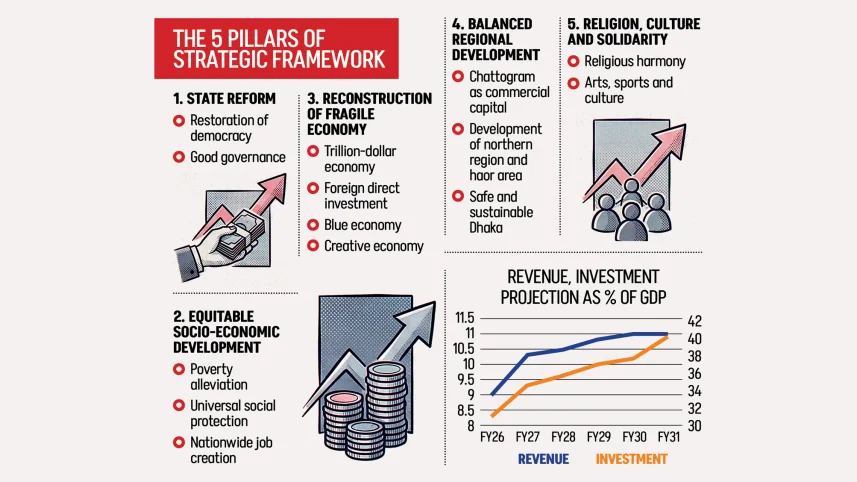
The macroeconomic framework projects that total revenue as a percentage of GDP will rise from 8 percent in fiscal 2024-25 to 11 percent by fiscal 2029-30.
There are specific plans for the agriculture sector and the youth.
The government plans to transform the agriculture sector from traditional methods to a high-tech, market-driven ecosystem.
The strategy envisions a central hub for agriculture that integrates digital innovation and agritech, smart farming, value-added processing, global value chain integration, and sustainable resource management. The government would also ensure the long-term viability of land and water.
One-stop service centres would be set up to provide all necessary agricultural support services to farmers, while steps would be taken to ensure efficient water and resource management.
Steps would be taken to establish direct connections between the agricultural sector and industrial manufacturing.
Bangladesh will be entering the critical phase of its demographic dividend, and special emphasis will be given to making the most of it.
Themain barrier to unleashing the demographic dividend has been the mismatch between educational outcomes and the actual demands of the labour market, coupled with a persistent digital divide between urban and rural areas.
A National Foundational Learning Mission would be launched that would mandate daily periods for reading and numeracy. Targeted remedial classes would be arranged that would group students by their actual competency level rather than just their age.
A national teacher competency framework would be put in place, shifting away from rote-learning methods toward continuous professional development and digital pedagogical training.
The government would bedigitising teacher attendance and the management of school grants, deploying school performance dashboards for better oversight, and gradually increasing the national education budget toward a target of 4–5 percent of GDP.
The Technical and Vocational Education and Training (TVET) would be modernised to ensure it accounts for a 25 percent share of education by 2030.
Mandatory internships and career counselling centres would be introduced, while industry advisory boards would ensure educational outcomes match market demands.
Youth and women would get special attention, and there would be equitable healthcare services to enhance the productivity of the national workforce.
The government also has a three-pronged approach to boosting the creative sector’s economic contribution.
About 200,000 youth (Gen Z/Alpha) would be upskilled in digital and creative arts, and the Bangladesh Creative Development Authority would be established with 64 district creative hubs.
A “Creative in Bangladesh” brand would be launched, and 100 Bangladeshi films/shows would be made for global streaming platforms like Netflix, Amazon, and Disney+.
As many as 46 vulnerable heritage sites would be climate-proofed, while 40 heritage tourism sites would be renovated. The government would also introduce the “Heritage Award”.
The stepswould ensure that the creative sector’s contribution to GDP would increase from the existing 0.17 percent to 1.5 percent by 2035.
Govt wants to create 1 crore jobs by 2030
Rejaul Karim Byron
The government has created a five-year plan that aims to turn Bangladesh into a trillion-dollar economy by 2034 and create 1 crore jobs by 2030, driven by an upsurge in investment.
The blueprint, which was prepared by the General Economic Division and will succeed the 8th five-year plan, aimed to accommodate the new government’s election manifesto and establish a realistic strategy to manage internal and global economic shocks, including the banking sector crisis.
It was approved at yesterday’s meeting of the National Economic Council chaired by Prime Minister Tarique Rahman.
“As a government elected by the people, we have incorporated those commitments into the proposed plan -- we are moving forward with strategies focused on recovery, transition, and reconstruction,” Finance Minister Amir Khosru Mahmud Chowdhury told reporters after the meeting.
The plan rests on seven pillars: economic decentralisation, deregulation and improving business climate, investment-led growth, balanced regional development, universal social protection, job creation and skills development, and good governance and institutional reforms.
In the first 12 months, the government will focus on stabilising the fragile economy.
This involves implementing a strict monetary policy to control inflation and employing prudent exchange rate management to rebuild the delicate foreign exchange reserves.
In this phase, the government would also be reducing unnecessary government expenditure while simultaneously strengthening social safety nets to protect the vulnerable from the shocks of inflation.
It would be managing the import pressures by prioritising essential commodities and facilitating easier remittance inflows.
The government would also be taking immediate steps to resolve the liquidity crisis in the banking sector and provide emergency support to the agriculture and small and medium enterprise (SME) sectors.
In the second phase, which will conclude at year three of the five-year plan, the focus would be on rebuilding systems and institutions.
Jumpstarting investment would be the main focus in this phase. Steps would be taken to remove regulatory barriers and open up financing opportunities to restore private sector confidence.
Deep reforms would be taken in the banking sector, the issue of defaulted loans would be addressed, and systemic risks would be reduced.
Trade logistics would be developed, sector-based diversification would be pursued, and youth employment programmes would be prioritised.
In this phase, strict alignment of the national budget would be ensured with strategic planning, and domestic revenue collection would be increased.
In the final phase, which will be in the last two years of the five-year plan, growth acceleration will be prioritised.
Both public and private investment would be increased in the manufacturing and high-value-added sectors, and the export base would be widened by engaging with complex global value chains.
To lower the cost of doing business, climate-resilient energy, transport, and digital infrastructure would be designed.
The government will also ensure that the benefits of economic growth play a direct role in reducing inequality through universal social protection.
In the acceleration phase, growth will be primarily driven by private investment, which includes foreign direct investment (FDI) rising to 2.5 percent of GDP.
The government has set an ambitious but realistic revenue mobilisation plan.
It has targeted increasing total revenue by 3 percent of GDP led by digitisation and full integration across all economic sectors and developing a stronger tax culture within the country.
The macroeconomic framework projects that total revenue as a percentage of GDP will rise from 8 percent in fiscal 2024-25 to 11 percent by fiscal 2029-30.
There are specific plans for the agriculture sector and the youth.
The government plans to transform the agriculture sector from traditional methods to a high-tech, market-driven ecosystem.
The strategy envisions a central hub for agriculture that integrates digital innovation and agritech, smart farming, value-added processing, global value chain integration, and sustainable resource management. The government would also ensure the long-term viability of land and water.
One-stop service centres would be set up to provide all necessary agricultural support services to farmers, while steps would be taken to ensure efficient water and resource management.
Steps would be taken to establish direct connections between the agricultural sector and industrial manufacturing.
Bangladesh will be entering the critical phase of its demographic dividend, and special emphasis will be given to making the most of it.
Themain barrier to unleashing the demographic dividend has been the mismatch between educational outcomes and the actual demands of the labour market, coupled with a persistent digital divide between urban and rural areas.
A National Foundational Learning Mission would be launched that would mandate daily periods for reading and numeracy. Targeted remedial classes would be arranged that would group students by their actual competency level rather than just their age.
A national teacher competency framework would be put in place, shifting away from rote-learning methods toward continuous professional development and digital pedagogical training.
The government would bedigitising teacher attendance and the management of school grants, deploying school performance dashboards for better oversight, and gradually increasing the national education budget toward a target of 4–5 percent of GDP.
The Technical and Vocational Education and Training (TVET) would be modernised to ensure it accounts for a 25 percent share of education by 2030.
Mandatory internships and career counselling centres would be introduced, while industry advisory boards would ensure educational outcomes match market demands.
Youth and women would get special attention, and there would be equitable healthcare services to enhance the productivity of the national workforce.
The government also has a three-pronged approach to boosting the creative sector’s economic contribution.
About 200,000 youth (Gen Z/Alpha) would be upskilled in digital and creative arts, and the Bangladesh Creative Development Authority would be established with 64 district creative hubs.
A “Creative in Bangladesh” brand would be launched, and 100 Bangladeshi films/shows would be made for global streaming platforms like Netflix, Amazon, and Disney+.
As many as 46 vulnerable heritage sites would be climate-proofed, while 40 heritage tourism sites would be renovated. The government would also introduce the “Heritage Award”.
The stepswould ensure that the creative sector’s contribution to GDP would increase from the existing 0.17 percent to 1.5 percent by 2035.