New Tweets

[🇧🇩] Monitoring Bangladesh's Economy

G Bangladesh Defense
[🇧🇩] Monitoring Bangladesh's Economy
1K
28K
More threads by Saif


Bangladesh faces higher inflation risk
Muhammad Mahmood
Published :
Mar 01, 2025 21:43
Updated :
Mar 01, 2025 21:43

1740877657148.webp


The interim government has been working hard over the last six months or so to guarantee political stability conducive to undertake economic repair work of macroeconomic crisis that it has inherited from the corrupt Hasina regime. This will be a difficult task to achieve in the foreseeable future given the extent of the crisis. The interim government also needs to move forward to undertake a series of necessary reform measures to create a conducive environment for an enduring democratic system to function in the country.

This will be a stupendous task for the interim government given the country's tumultuous history since independence in 1971. Bangladresh's political landscape since then has been marked by one-party rule, military coups, and a gradual erosion of democracy under civilian governments reaching the point where for 15 years and a half until early August last year, the country was ruled by a highly corrupt and repressive authoritarian regime with a democratic pretence.

Bangladesh's annual inflation rate slowed to 9.94 per cent in January 2025 from 10.89 per cent in December 2024. This marked the lowest inflation rate since September, as prices moderated in most of the sub-indices; yet according to a World Economic Forum (WEF) report released on January 15, inflation has been identified as the biggest risk to Bangladesh in 2025.

Inflation will likely remain above the central bank's target rate of 7-8 per cent which was jacked up from the previous target of 6.5 per cent in February. Raising the inflation target may allow the central bank to adopt a looser monetary policy, but that will not solve the problem.

Bangladesh Bank maintained its policy rate at 10 per cent due to persistent high inflation at its February monetary policy meeting. The upcoming national elections may contribute to political uncertainty, causing high inflation. As a result, Bangladesh Bank is expected to hold its policy rate until the end of FY2024-2025.

The way in which monetary policy affects inflation and the real economy -- output and employment -- is referred to as the monetary policy transmission mechanism. The transmission from the policy rate to inflation works its way through the financial system via many channels into economic activity, with some degree of uncertainty about the timing and size of the impacts. One important element of the transmission mechanism is the bank lending channel, where market rates transmit to lending rates making borrowing for firms and households more expensive and savings more attractive.

Inflation has put a squeeze on private consumption, and cost of living pressures are still the defining challenge for most people in Bangladesh. So, the fight against inflation must remain the highest priority of the government. Rising inflation is also contributing to the higher cost of production.

As inflation continues to hover around 10 per cent (which many consider an underestimate), real wages are falling to keep pace with inflation and millions are facing food insecurity.

The inflationary surge was largely driven by rising food and fuel prices and the depreciation of the taka. The rise in food inflation could have resulted from developments in global commodity markets. Generally, when inflation is rising, it generates conditions appropriate for further price rises, thus increasing inflation risk.

Inflationary pressures are likely to continue in 2025 in Bangladesh. This is because of supply disruptions, high exchange rate of the US dollar, balance of payment deficits and delayed pass through of higher food and energy (of which Bangladesh is a net importer) prices to the rising price pressures.

According to the IMF, global food crisis may persist with prices still elevated. Despite a slight decrease in the general inflation rate in the last four months, food inflation remains stubbornly high, exceeding 12 per cent in December, which is hitting the country's 170 million people hard. On a monthly basis, consumer prices rose 0.15 per cent, rebounding from a 1.02 per cent fall in December 2024. High inflationary pressure disproportionately affects low-income households.

While economic theory is unsatisfactory about the root causes of and cures of chronic inflation, it is also well understood that it is not a natural phenomenon. Also, inflation does not proceed equally throughout the economy. However, we do know that real or monetary factors push up specific prices, wages, or interest rates. As these specific changes spread across an economy; consumers, producers and the governments respond accordingly. Overtime, the net outcome of these differing responses is the inflation rate.

Also, the relationship between inflation and growth remains inconclusive both in theory and empirics. However, there is a consensus that growth rates and inflation rates have a long-run relationship.

The current spate of inflation in Bangladesh has largely been attributed to costs transmitted by disrupted supply chains enabling large importers and domestic businesses to jack up prices far more than the transmitted increased costs notwithstanding hoarding by domestic business syndicates adding to further supply disruptions.

The government led by Hasina during its corrupt rule borrowed heavily from the central bank as it failed to mobilise adequate revenue to pay for its grandiose projects. This also stoked inflationary pressures as it put more money into circulation. These grandiose projects were also used by her and her family members and cronies to amass massive wealth through commissions and kickbacks.

In Bangladesh as inflation surged, it led to losses of purchasing power negatively impacting production. This is generally called stagflation which is the core of the problem faced by the central bank. If the central bank raises policy rate to fight inflation, that will further slowdown the economy and may lead to a recession.

Bangladesh Bank is also faced with further dilemma with the banking sector which is on the precipice of crisis. There is a mounting liquidity crisis faced by the banking sector mostly arising from massive burden of non-performing loans. According to the Financial Express (February 27) the volume of non-performing loans hit a record level to Taka 3.45 trillion by the end of December 2024, accounting for 20.20 per cent of total loans issued by commercial banks in the country. This banking crisis has already shaken Bangladesh's standing in the global financial stage and left the country in a fragile position.

In late last August, the Bangladesh Bank governor declared that the central bank would avoid "printing money" as a solution to the liquidity crisis faced by the banking sector to curb inflation. But by late November, it backtracked on its decision and began injecting liquidity into the banking system. This additional liquidity flowing into the banking system will interfere with the central bank's policy to fight inflation.

To add a further twist to the banking crisis, the Anti-Corruption Commission (ACC) in Bangladesh on February 20 filed a case against a former central bank governor accusing him and 23 others of embezzlement. Between 2009 and 2016, during the tenure of this very governor at Bangladesh's central bank, US$81 million was stolen from the bank's account at the Federal Reserve Bank of New York in a significant cybre-heist.

This central bank governor is among several other governors and high-level officials of the central bank whose activities are being investigated for financial corruption and fraud. Some are already in detention and one former governor is on the run. Bangladesh Bank was possibly the most corruptly-run central bank in the world during the previous Hasina regime. As a result, the country's banking system is currently experiencing not only a serious liquidity crisis but also this can lead to a significant financial crisis.

The current governor of the central bank has accused the tyrannical government of Hasina engineering the massive laundering of money estimated at US$17 billion out of the country often with the help of a military intelligence agency to accumulate assets overseas illegally.

Corruption and politicisation both in the central bank and financial institutions have led to a severe trust deficit, undermining public confidence at a time when inflation and economic pressures are already on the rise. Therefore, policy makers must clearly express that the current level of inflation is standing in the way to stabilise the economy, notwithstanding the severe financial hardship being experienced by most people in the country. Therefore, they wish to reduce it. Hence. Bangladesh Bank must take concrete measures, including with regard to the policy rate to curb inflation. Addressing inflation also requires the government to implement various other measures, including providing cost-of-living relief, investing in economic capacity such as skills, energy efficiency, and infrastructure, enhancing productivity, and improving the Budget's condition.

 
Analyze

Analyze Post

Add your ideas here:
Highlight Cite Respond
  • Sad (0)
Reactions: Bilal9
Alam also spoke on the Karnaphuli tunnel project in Chattogram, which connects Patenga on the river's west bank to Anwara on the east.

Built at a cost of Tk 10,689 crore, the 3.32-kilometre tunnel was opened to traffic on October 28, 2023.

He said the tunnel was not necessary under present circumstances and the expenditure was "wasteful".

There is barely any economic activity on the other side of the river and the burden of this "wasteful" expenditure has now fallen on all citizens, he said.

I don't agree with the Chief Adviser's Press Secretary Shafiqul Alam on this subject. Typical "Mukhostho Bidya" intellect and understanding, sadly.

AL leaders and MPs did get benefitted but that was not the only benefit. The tunnel was necessary.

The port (and jetties) are on the Western bank of the Karnaphuli and the Korean EPZ (as well as the Chinese EPZ) are on the other bank (Eastern bank). There may be more EPZs necessary on that Anowara side where factories will be located.
  1. Given that jetties on that Eastern bank may not be built yet, how will the manufactured goods made in the Korean EPZ and the Chinese EPZ get to the port? The tunnel is the closest and most convenient solution.
  2. More over - how will stuff unloaded at the Matarbari deep sea port get to Chittagong (or Dhaka and the rest of the country) when container port is finally built in Matarbari? Bridges to cross the Karnaphuli are neither modern nor in enough numbers for container traffic.
  3. They are envisioning building more jetties near the Korean EPZ - connectivity is crucial.
  4. Building the tunnel now was at least 50% cheaper than waiting and trying to build it 20 years later when we would really need it. This is called advanced roadway planning using GIS.
  5. True that we have to run the tunnel at a slight loss for now, however you don't build critical infra like this every day, and the loss money will be recouped once traffic starts building, in no time flat. The tunnel's working life will be in the span of at least 50~60 years.
In my neck of the woods in Los Angeles, they can easily predict (using GIS) how many people will live in a neighborhood and what the residential and commercial traffic will be 20 years later (for road and infra planning purposes). They can even tell how many people are Muslim or Hindu or Buddhist in a specific neighborhood, what their income is and how many grocery trips they make in a month and how far (this is connected with road use, and commercial road traffic is similarly computed). The company involved is called ESRI. I am sure such a traffic feasibility study was done for the tunnel.


This Alam guy has no idea for a strategic overall view. And a long-term one.
 
Last edited:
Analyze

Analyze Post

Add your ideas here:
Highlight Cite Respond

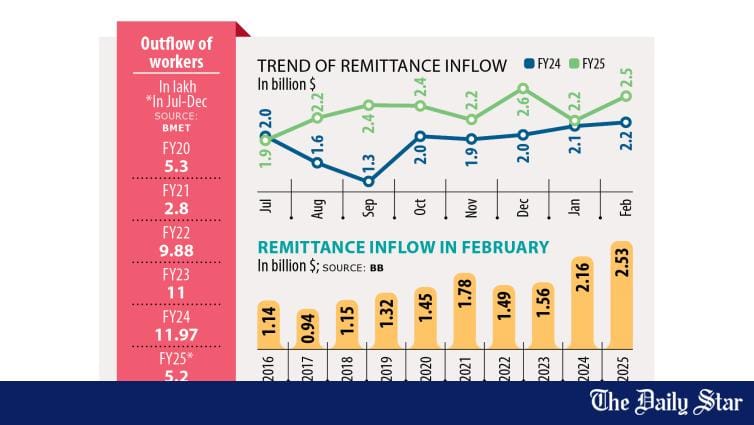
Record February: remittances climb 25% to $2.52b

1740959851831.webp


Remittances have become a much-anticipated relief for the economy reeling under macroeconomic stress, growing steadily since August last year and providing the interim government with a breather amid a rapid erosion of foreign exchange reserves.

Last month, remittance inflows to Bangladesh rose by 25 percent year-on-year to $2.52 billion, as migrant Bangladeshi workers sent larger-than-expected amounts to their families back home for Ramadan related purchases and Eid shopping.

"This is the highest-ever remittance inflow in February in Bangladesh's history," said Arief Hossain Khan, spokesperson for the central bank.

In the eight months to February this year, inward remittances recorded a 23.8 percent year-on-year growth, according to Bangladesh Bank (BB) data.

Bangladesh received a total of $18.49 billion in remittances in the eight months, up from $14.93 billion in the same period the previous year.

"The surge in remittances is positive news, as it strengthens foreign exchange reserves and helps stabilise the exchange rate," said Professor Mustafizur Rahman, a distinguished fellow at the Centre for Policy Dialogue (CPD), a leading civil society think tank in Bangladesh.

He said higher remittance inflows are also a relief for the government, as they ease the country's debt servicing burden.

When the interim government took office in early August last year, gross foreign exchange reserves were falling rapidly.

According to BB data, the country's forex reserves reached a record high of $48 billion in August 2021 but declined to $25.92 billion by July 2024.

Over the three years leading up to August 2024, local currency Taka weakened by 42 percent.

Foreign exchange reserves were so depleted that many banks struggled to open letters of credit (LCs). However, the situation has improved somewhat and the erosion of reserves has slowed, due mainly to strong remittance inflows and export growth.

As of 27 February 2025, foreign exchange reserves rose by 1.5 percent year-on-year to $26.13 billion. Under the BPM6 calculation method, reserves increased by 1.8 percent to $20.90 billion, according to BB data.

"Remittance inflows may rise next month as well," said Rahman, adding that remittances usually remain strong during Ramadan and peak before Eid.

According to central bank data, Bangladeshi migrants sent home $153 million in the last two days of February (27-28), indicating a surge in remittance inflows ahead of Ramadan.

"On the other hand, informal money transfer channels such as hundi and hawala have been disrupted since the fall of the Sheikh Hasina government, leading to more remittances being sent through formal banking channels," Rahman added.

In the last five and a half years, around 46 lakh Bangladeshis have gone abroad, contributing to the increase in remittance inflows. Initially, some struggled to find stable jobs, but many have now settled into their roles and are sending money home regularly.

According to central bank data, Bangladesh recorded its highest-ever monthly remittance inflow of $2.64 billion in December last year.

The second-highest monthly inflow was $2.59 billion in July 2020, while the third-highest was $2.54 billion in June 2024, the data showed.

To further increase remittance inflows, Professor Rahman suggested focusing on sending skilled workers abroad and ensuring they are placed in suitable jobs.

"The government needs to identify which countries require specific skills and send trained workers accordingly," he said.

For instance, Saudi Arabia is set to host the FIFA World Cup in 2034. To organise such a large event, it will make significant investments, creating job opportunities. Bangladesh should anticipate this demand, he added.

The economist also emphasised market diversification, suggesting that Bangladesh explore opportunities in countries such as South Korea and Japan.​
 
Analyze

Analyze Post

Add your ideas here:
Highlight Cite Respond
  • Love (+3)
Reactions: Bilal9

Recalibration of SEZ plan is timely
Published :
Mar 02, 2025 22:23
Updated :
Mar 02, 2025 22:23

1740962849857.webp


The interim government's decision to abandon the previous Awami League government's over-ambitious and unrealistic plan for 100 economic zones, and instead prioritise the development of five strategically selected zones, is a prudent and commendable move. The AL government's so-called 100 economic-zone project was not only impractical, but also promoted as a political agenda. The project was clearly destined to fail, had the AL even remained in power. This was because of the administration's focus on quantity over quality, coupled with a whimsical project implementation strategy, which undermined the project's potential. Notably, for well over a decade, the AL government touted the establishment of 100 SEZs by 2030, yet only a few zones showed visible progress before its tenure ended amidst a mass uprising on August 5, 2024. Moreover, the politically motivated selection of SEZ sites led to corruption and irregularities, with numerous sites selected in areas with minimal prospects for the viability of a SEZ. It also resulted in the widespread acquisition of agricultural land and river encroachment. The decision to ditch the plan, therefore, couldn't have come sooner.

In contrast, the interim government's decision to concentrate on five key economic zones - the National Special Economic Zone in Chattogram, Srihatta Economic Zone in Sylhet, Japanese Economic Zone in Narayanganj, Maheshkhali Economic Zone in Cox's Bazar, and Jamalpur Economic Zone in Jamalpur - demonstrates a more pragmatic and realistic understanding of the development of SEZs for economic purposes. By focusing on a select few of high-potential zones, the government can allocate resources more effectively for their timely development, ensuring that they are equipped with the necessary infrastructure, utilities, and support services to attract foreign investors.

However, the planned development of SEZs alone is not enough to attract a healthy flow of foreign investment. The government must also address the underlying issues hindering business operations in Bangladesh. Investors face a series of obstacles, chief among them being bureaucratic red tape, frequent policy flip-flops and political instability. The Bangladesh Economic Zones Authority (BEZA) and the Bangladesh Investment Development Authority (BIDA) have One Stop Service (OSS) platforms that cater to the needs of both local and foreign investors. While some progress has been made in enhancing systems and processes, the OSS remains far from a true "one-stop service." Investors still require access to 155 services across 44 institutions, while BIDA and BEZA can only expedite approximately 60 services from 23 institutions. For the remaining services, investors need to navigate cumbersome bureaucratic processes in various government offices, due to the lack of agreements between the regulatory bodies and all service-providing agencies. So, the government must strengthen the OSS service.

Another major challenge facing foreign investors is the frequency of policy changes in Bangladesh, which disrupts business operations. While policy adjustments can be necessary, investors often allege that the government resorts to policy flip-flops without consulting private sector partners, leading to uncertainty and reduced profitability. Furthermore, foreign investors have long demanded a consistent tax policy in Bangladesh. However, tax policy changes almost every fiscal year, further complicating investors' decision-making and affecting business confidence. Therefore, while the interim government's recalibration of SEZ projects is a timely and necessary step, it must also address the broader issues hindering foreign investment. Ultimately, the government must ensure a more attractive investment climate by implementing regulatory reforms, improving infrastructure, and ensuring political stability.​
 
Analyze

Analyze Post

Add your ideas here:
Highlight Cite Respond
  • Love (+3)
Reactions: Bilal9

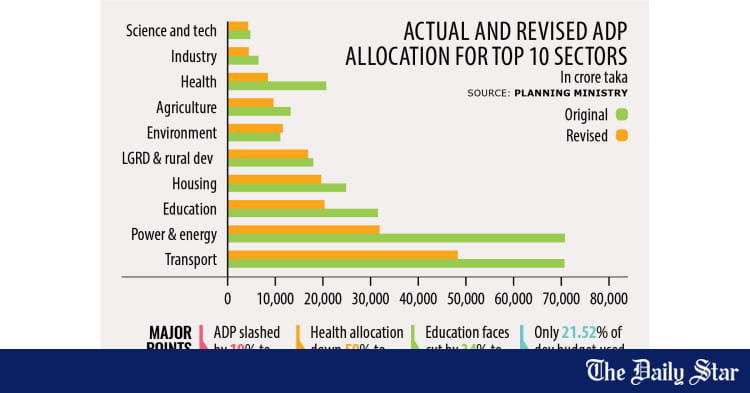
Deep cut to dev spending
Allocation trimmed by 19% to Tk 2.26 lakh crore

1741046752752.webp


The interim government yesterday approved a Tk 226,125 crore revised Annual Development Programme (ADP), while the health sector saw more than a 50 percent reduction in its original allocation despite being a priority sector.

The decision was made at a National Economic Council (NEC) meeting at its premises in the capital, with NEC Chairperson and Chief Adviser Prof Muhammad Yunus presiding.

The size of the revised ADP was reduced by 19 percent, from the original Tk 278,289 crore.

Although the health sector was among the top ten highest recipients in the original allocation, it has now faced a 59 percent cut, with its allocation slashed to Tk 8,463 crore.

Acknowledging the lower allocation in the revised ADP for health, Planning Adviser Wahiduddin Mahmud said the implementation rate of the sector was not satisfactory.

"In many areas, infrastructure and equipment remain abandoned due to a shortage of doctors, nurses and technicians," said the adviser.

"Doctors and nurses should be appointed in the health sector on a priority basis, rather than focusing solely on building infrastructure," he said.

"There are many vacant posts, and usually, doctors are reluctant to work in rural areas. This is a matter of governance," he said.

Like the health sector, the education sector saw a 34 percent cut, bringing its allocation down to Tk 20,349 crore.

Regarding this sector, Prof Mahmud noted that the performance of secondary and higher education had also remained poor.

He pointed out that several universities had set up campuses in various districts, but the number of staff recruited were more that of students and teachers.

Many of these staff members were hired based on political affiliations, he further said.

"Before increasing allocations, we must sort out these kinds of anomalies," he added.

In the revised ADP, the number of projects with allocations increased to 1,434 from 1,326 in the original ADP.

The interim government took office in August last year after a student-led mass uprising ousted the Awami League government, which formulated the FY25 budget in June.

A planning ministry official said the pace of project implementation had been slow this fiscal year because of the political turmoil.

In the first seven months of the ongoing fiscal year, only 21.52 percent of the ADP was spent, 5.59 percent less than the expenditures made during the same period last fiscal year, said the official.

Usually, when the finance and planning ministries seek demands from various ministries, they tend to request higher allocations than granted.

However, this time, the ministries demanded less than Tk 200,000 crore in total, lower than the original ADP.

According to the planning ministry official, of the 57 ministries and divisions, eight saw an increase of 0.81 percent in their revised ADP allocations, while the allocation for 48 ministries and divisions decreased by 26 percent. The rest remained unchanged.

The revised ADP allocated around 47 percent of total funds to the transport and communications, power and energy, and education sectors.

In the revised ADP, the government budget was reduced by Tk 49,000 crore to Tk 216,000 crore.

Of this, government funds were reduced by 18.18 percent to Tk 135,000 crore, while foreign funds fell by 19 percent to Tk 81,000 crore.

Besides, the ADP for state-owned enterprises was reduced by Tk 10,125 crore, from the original Tk 13,288 crore.

Among the top recipients in terms of allocation, transport and communications will receive Tk 48,253 crore (22.34 percent), power and energy Tk 31,898 crore (14.77 percent), housing and community services Tk 19,653 crore (9 percent), and local government and rural development Tk 16,909 crore (7.82 percent), according to a planning ministry official.

In terms of allocation for ministries and divisions, the Local Government and Rural Development Ministry will receive the highest allocation of Tk 36,159 crore (17 percent).

Of the total 1,434 projects with allocations in the revised ADP, 1,326 have been carried over from the original ADP as ongoing projects.

Additionally, 97 new projects have been included in the revised ADP, which were listed as unapproved in the original ADP.

Moreover, the interim government included 11 new projects in the revised ADP, which were not listed in the original ADP.

Also, in the revised ADP, 770 projects have been listed as unapproved projects without allocation.​
 
Analyze

Analyze Post

Add your ideas here:
Highlight Cite Respond

Govt approves revised ADP prioritising transport and communication
Published :
Mar 03, 2025 19:27
Updated :
Mar 03, 2025 19:27

1741050247696.webp


The National Economic Council (NEC) on Monday approved a Tk 2.16 trillion Revised Annual Development Programme (RADP) for the current fiscal year with the highest priority given to the transport and communication sector.

The approval came during a meeting at the NEC Conference Room in the city's Sher-e-Bangla Nagar, chaired by NEC Chairperson and Chief Adviser Prof Muhammad Yunus, as per a UNB report.

The original ADP outlay for FY25 was set at Tk 2.65 trillion. The revised allocation marks a reduction of Tk 490 billion - an 18.49 per cent decrease from the initial budget.

Of the approved RADP allocation, Tk 1.35 trillion will come from the government of Bangladesh's portion, while the remaining Tk 810 billion will be sourced from project loans or grants. Including an additional Tk 101.26 billion from the own funds of concerned organisations, the total RADP outlay stands at Tk 2.26 trillion.

Planning Adviser Dr Wahiduddin Mahmud briefed the reporters after the meeting.

He said that efforts would be made to accelerate the RADP implementation pace.

He noted that the chief adviser emphasised the importance of maintaining stability and expediting the implementation rate.

Dr Mahmud informed that the ADP implementation rate reached 21.52 per cent during the July-January period of FY25 - lower than the 30 per cent average seen in previous fiscal years.

He stressed that ministries, divisions, and implementing agencies must intensify their efforts to improve the execution rate.

To ensure greater efficiency, Dr Mahmud highlighted plans to make the tender process more transparent. He also called for increased investment in the health and education sectors, advocating for the appointment and training of more doctors and nurses.

Among the 57 ministries and divisions, the RADP allocation for eight saw a 17.28 per cent increase, while 49 experienced a 28.71 per cent decrease.

Of the 1,437 projects included in the RADP, 1,212 are investment projects, 28 are survey projects, 112 are technical assistance projects, and 85 are financed through own funds. Additionally, 313 projects are slated for completion within the current fiscal year.

The five sectors receiving the highest allocations are:
  • Transport and Communication: Tk 482.53 billion (22.34%)​
  • Power and Energy: Tk 318.98 billion (14.77%)​
  • Education: Tk 203.50 billion (9.42%)​
  • Housing and Community Facilities: Tk 196.53 billion (9.09%)​
  • Local Government and Rural Development: Tk 169.09 billion (7.83%)​
Among the top 10 allocated ministries and divisions, the Local Government Division received the highest share:
  • Local Government Division: Tk 361.59 billion (16.74%)​
  • Power Division: Tk 214.75 billion (9.94%)​
  • Road Transport and Highways Division: Tk 186.24 billion (8.62%)​
  • Primary and Mass Education: Tk 127.64 billion (5.91%)​
  • Science and Technology: Tk 121.29 billion (5.62%)​
  • Ministry of Railways: Tk 102.28 billion (4.74%)​
  • Ministry of Water Resources: Tk 102.12 billion (4.73%)​
  • Ministry of Shipping: Tk 71.54 billion (3.31%)​
  • Bridges Division: Tk 58.48 billion (2.71%)​
  • Health Services Division: Tk 56.69 billion (2.62%)​
The RADP also includes 78 projects under the Public-Private Partnership (PPP) initiative and 232 projects funded by the Climate Change Trust Fund.​
 
Analyze

Analyze Post

Add your ideas here:
Highlight Cite Respond

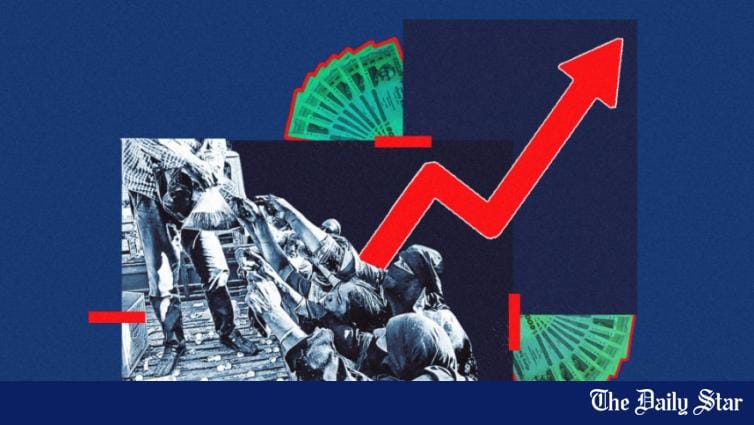
In Bangladesh, inflation control needs an iconoclastic approach

1741131510064.webp

FILE VISUAL: SHAIKH SULTANA JAHAN BADHON

Inflation is often conceptualised as the rise in aggregate price levels. These prices are consolidated across temporal intervals—usually between years—on an assemblage of commodities usually consumed daily. We often construe inflation through the narrow prism of price fluctuations. However, inflation indicates an intricate interplay of logistical, political, financial, and ethical practices that should be analysed to decipher changes in prices.

The Bangladesh Bank records consistently elevated inflation trends, rising from around 5.86 percent in January 2022 to about 11.38 percent in November 2024. In general, food inflation outpaces non-food inflation. Policy consensus suggests that exogenous shocks, such as the Covid pandemic, Russia-Ukraine conflict, and concomitant global economic slowdown, impacted Bangladesh's efforts to control price levels, leading to rising target inflation rate.

The quickest endpoint of a higher inflation rate is the reduction of purchasing power. Lower purchasing power translates into weaker local currency, which tosses a temporary lifeline to an export-orientated economy. For an import-hungry economy like Bangladesh, the sagging currency leaks more money, turbocharges the trade imbalance, and leaves a lower currency reserve.

Bangladesh's economy manifests unique idiosyncratic economic and trade characteristics, including its large population, high growth rate, and a heavy reliance on a circumscribed cohort of tradable commodities. One anomaly pertains to the entwinement of the country's principal export and import being connected to the same industry: ready-made garments. A significant portion of the country's industrial imports undergoes value-added processing before being exported to powerful foreign buyers, having a complex influence on prices, employment, government policy, currency rate, and GDP.

The most traditional method of controlling inflation is to balance a monetary instrument, notably the borrowing rates (first two panels in Figure 2). Often, these abrupt changes are moderated by an upward adjustment of direct and indirect taxes to restrain consumption.

The restrictive monetary and fiscal measures result in a deceleration in production, consumption, employment, and economic growth, which may lead to stagflation. The temporal horizon for an economy to transition out of stagflation is three to four years for a developed economy. While these traditional restrictive mechanisms work well for economies with robust financial markets, they can jeopardise overall stability in emerging nations already suffering from a systemic fragility in financial markets.

Some unconventional control mechanisms

Figure 1 delineates the metamorphosis of price transformation as goods transition from producers to consumers. Various determinants in the price formation continuum contribute to the accretion of additional costs in production pricing. Notably, many price components are superfluous and can be eliminated to attenuate the overall economic cost.

1741131625304.webp


Farmer's market
Arguably, one of the most effective methods to mitigate the repetitive price-cycle cost is to "close the gap" between producers and consumers. One such mechanism, increasingly marginalised in our society, is the traditional weekly marketplace where producers sell products directly to the consumers. Similar models are available in Malaysia and other Southeast Asian nations, exemplified by the Pasar Malam or the night markets. In England, the councils curate borough markets, facilitating direct transactions between farmers and consumers. Under these models, the government can emphasise their targeted support for the producers in the form of subsidising the cost of irrigation, seeds, labour, finance, and agricultural technologies. Effective distribution channels can be employed to distribute goods aimed at vulnerable groups at a low cost (i.e. rice and commodities at a subsidised price).

It is worth noting that sellers from the informal sector vendors (hawkers) are different from the farmer's market. Of note, with the growth of the multinational resellers, these direct exchange frameworks are declining, thereby consolidating the power of the so-called market syndicates, putting upward pressure on prices. While there are several logistical problems inherent to a farmer's market, Bangladesh can utilise its massive infrastructural growth of recent years to revitalise such models.

Use of alternative low-cost social funds

Islamic countries like Bangladesh can instrumentalise the use of social funds. Numerous examples of such instrumentation can be drawn from Indonesia and Malaysia. While the cost is low, there are obvious disadvantages of these social funds. The most prominent drawback is the trust of the general mass in the efficiency of the government managing these social funds. Nonetheless, while relying on the traditional financial sector slows down economic activities, the social fund sector can offer a viable second tier of funds (Figure 2).

1741131663442.webp


Wealth management and financial literacy

Bangladesh amassed around $23.9 billion in remittances in FY2023-24. Massive infusion of remittance-driven consumption expenditure in rural areas exerts pronounced inflationary pressure, distorting price formation at the production stage.

Bangladesh could draw examples from Malaysia, Indonesia, the Philippines, and even India, which instituted numerous foreign currency investment schemes for remittance earners. By provisioning these schemes, the government can strategically divert a portion of the funds to productive investment, thereby augmenting the capital available to the financial markets. Integrating financial technology (fintech) with judicious policy reforms could empower wealth management firms to facilitate personalised wealth management solutions. This would help build a tertiary financial sector to help diffuse instability currently concentrated within the conventional financial and banking sectors.

Finally, disproportionate escalation of inflation can have profound financial, sentimental, and political impacts. While several instruments can modulate inflationary pressure within brackets, promoting financial literacy is necessary for wider social engagement. Also, highly diversified economies exhibit greater resilience than insular economies. Therefore, strategic trade and economic partnerships may prove instrumental for Bangladesh at attenuating high inflation.

Dr Mamunur Rashid is a reader in finance at Canterbury Christ Church University, UK.​
 
Analyze

Analyze Post

Add your ideas here:
Highlight Cite Respond

We need a more self-reliant development model
Amid USAID funding cuts, government and NGOs should collaborate to keep key projects alive

1741132157631.webp

VISUAL: STAR

Like many countries, Bangladesh was caught off guard by the speed and extent of USAID funding cuts under the Trump administration. Although there is no official data on how many people have lost, or may lose, their jobs due to the freezing of funds, estimates from the development sector suggest that between 30,000 and 40,000 people may be affected. This is deeply concerning, particularly because it will put significant strain on the economy.

According to diplomatic sources, USAID provides Bangladesh with $300-400 million annually for health, nutrition, agriculture, livelihoods, labour rights, human trafficking prevention, and democratic development. These funds have been instrumental in Bangladesh's progress in areas such as maternal health, climate resilience, and rural development. However, following Donald Trump's inauguration as US president on January 20, his administration swiftly suspended most USAID funding and activities, except for emergency food aid, including assistance for Rohingya refugees in Bangladesh. This move has not only left thousands of development workers unemployed but also cast severe doubt over the future of various development projects.

Many development projects currently facing an existential crisis are similarly essential not only for their beneficiaries but also for society at large. As such, the government must not allow them to collapse. It should instead conduct a thorough evaluation to identify the most critical initiatives and explore ways to sustain them. This could include direct government funding for the high-priority projects, partnerships with international organisations, or securing alternative donor support. NGOs, too, must adapt by assessing their efficiency, optimising operational costs, and exploring sustainable funding sources.

Many of these now-unfunded projects serve the most vulnerable segments of our society. Whether providing crucial immunisations, essential medicines, affordable birth control, or income-generating opportunities for the poor, their loss will have a far-reaching impact. Some projects also focus on promoting workers' rights or supporting labour-related cases. With funding now frozen, many of these labour rights initiatives could be sidelined, leaving workers even more vulnerable to exploitation. In a country like Bangladesh, where a significant portion of the workforce is employed in the informal sector with weak labour protections, this could be devastating.

Many development projects currently facing an existential crisis are similarly essential not only for their beneficiaries but also for society at large. As such, the government must not allow them to collapse. It should instead conduct a thorough evaluation to identify the most critical initiatives and explore ways to sustain them. This could include direct government funding for the high-priority projects, partnerships with international organisations, or securing alternative donor support. NGOs, too, must adapt by assessing their efficiency, optimising operational costs, and exploring sustainable funding sources. Without compromising beneficiary support, they should implement cost-saving measures and seek collaborations with the private sector, philanthropic institutions, and public-private partnerships to reduce dependency on foreign aid.

The USAID funding cuts have posed a serious challenge, but they also underscored the need for a more self-reliant development model. A coordinated approach by the government, NGOs, and the private sector is therefore essential to ensure that crucial programmes continue to serve those who need them most.​
 
Analyze

Analyze Post

Add your ideas here:
Highlight Cite Respond
  • Love (+3)
Reactions: Bilal9

Posts you haven't read yet..

Members Online

Latest Posts

Back
PKDefense - Recommended Toggle