New Tweets

[🇧🇩] Monitoring Bangladesh's Economy

G Bangladesh Defense
[🇧🇩] Monitoring Bangladesh's Economy
1K
30K
More threads by Saif


IMF offers extra $1b for reforms
Govt pushing for at least $2b under existing loan programme

1733964703431.webp

The International Monetary Fund (IMF) headquarters building is seen in Washington, U.S., April 8, 2019. REUTERS

The International Monetary Fund (IMF) has offered an additional $1 billion to Bangladesh but the government is pushing for at least $2 billion to implement the interim government's reform agenda, narrow the deficit in the current account and shore up the dollar stockpile.

Finance Adviser Salehuddin Ahmed sought a fresh $3 billion from the Washington-based multilateral lender under the existing loan programme on the sidelines of the annual World Bank-IMF meeting in October.

Following the discussion, a 13-member IMF mission came to Bangladesh at the beginning of the month to review the country's performance and compliance with structural reform conditions for the fourth tranche of the existing loan.

The issue of extending the loan amount was discussed with the mission, which has offered about $1 billion in exchange for additional reform conditions, The Daily Star has learnt from people involved with the discussions.

But the government is holding out for at least $2 billion. In that case, $1 billion would be coming in each of the remaining four tranches under the existing loan programme.

In January last year, the multilateral lender approved a $4.7 billion loan package for Bangladesh. So far, it has disbursed $2.3 billion in three instalments.

Meanwhile, the IMF mission is set to hold talks with officials of the finance ministry and the central bank today and on December 15 to finalise various policy documents.

The policy documents are a memorandum of economic and financial policy of the government, a letter of intent, a technical memorandum of understanding and a memorandum of understanding.

While the IMF is satisfied with the interim government's various reform initiatives, it will impose specific conditions for the next loan tranches, the officials said.

This time, IMF is giving more emphasis on revenue collection, reducing the subsidy for power, energy and fertiliser sectors and banking sector governance.

In case of increasing revenue collection, the IMF wanted to know the government plans regarding tax exemption in the next fiscal budget.

Besides, the IMF may impose a condition to separate policy and administration at the National Board of Revenue and reduce the multiple VAT rates.

In the case of the central bank and banking sector, the IMF could impose various conditions for the amendments of the Bangladesh Bank Order, the Bank Company Act, and Bankruptcy.

The IMF could also give a condition for bringing down arrears in government subsidy and price adjustment.

As of June, the government's arrear was about Tk 60,000 crore. However, after taking charge, the interim government brought the amount down significantly, according to finance ministry officials.

The finance ministry is aiming to clear the arrears by half by June next year and the rest in the next fiscal year.

In case of price adjustment, the IMF has suggested raising the electricity tariffs further.

However, the interim government is unwilling to adjust the price this fiscal year because it could fuel inflation further.

The government, however, will cut expenditures of power plants in a bid to reduce subsidies, the finance ministry officials said.

A closing meeting of the IMF mission will take place on December 17 with the finance adviser.​
 
Analyze

Analyze Post

Add your ideas here:
Highlight Cite Respond

ADB approves $600m loan for structural reforms in Bangladesh
United News of Bangladesh . Manila 11 December, 2024, 17:43

1733966079726.webp

Logo of Asian Development Bank. | Collected photo

The Asian Development Bank on Wednesday said that it approved $600 million ‘policy-based loan’ to Bangladesh.

The loan will be used for bringing structural reforms supporting domestic resources mobilisation, enhance efficiency of public investment projects, developing private sector, reforming state-owned enterprises, and promoting transparency and good governance, according to a release by the Manila-based multilateral lender.

ADB’s policy-based loan promptly responds to Bangladesh’s immediate development financing needs following the political transition, said the lender’s regional lead economist Aminur Rahman.

This particular loan programme of the ADB has been developed in close collaboration with the International Monetary Fund, World Bank, and other multilateral lenders after the interim government led by Muhammad Yunus sought extra funds from them to tackle the lingering economic crisis, mostly left behind by the Awami League regime ousted on August 5 amid a student-led mass uprising.

Reportedly, the Finance Division also expects to receive another around $1.5 billion loan as budget support from the International Monetary Fund and World Bank by the next two months.

The ADB said that Bangladesh had been struggling with revenue mobilisation, as it possessed the world’s lowest tax-to-gross domestic product ratio at only 7.4 per cent.

This loan will help Bangladesh to introduce key policy actions with the aim of increasing domestic resource mobilisation, while improving transparency and accountability, according to the release.

The ADB loan programme includes digitalisation and green initiatives, rationalisation of tax incentives and exemptions, and measures to assist taxpayers to boost tax morale.

Improved transparency and efficiency of public investment projects through increased digitalisation is another key objective of the loan programme.

The loan will promote private sector development and foreign direct investment by streamlining regulatory environment and creating a level playing field.

To simplify business creation and operations, over 130 services have been made available in an online integrated platform. These are complemented by improved governance and performance monitoring of state-owned enterprises and streamlined foreign direct investment approval processes, according to the release.​
 
Analyze

Analyze Post

Add your ideas here:
Highlight Cite Respond

Consumer financing slows amid economic hardship, uncertainty

1734052355581.webp


Consumer financing has slowed as people are adopting a go-slow strategy for taking loans, considering the increasing trend of interest rates amid ongoing inflationary pressure.

Banks are also being very conservative in providing consumer credit amid the uncertainty surrounding the recent political changeover, industry insiders said.

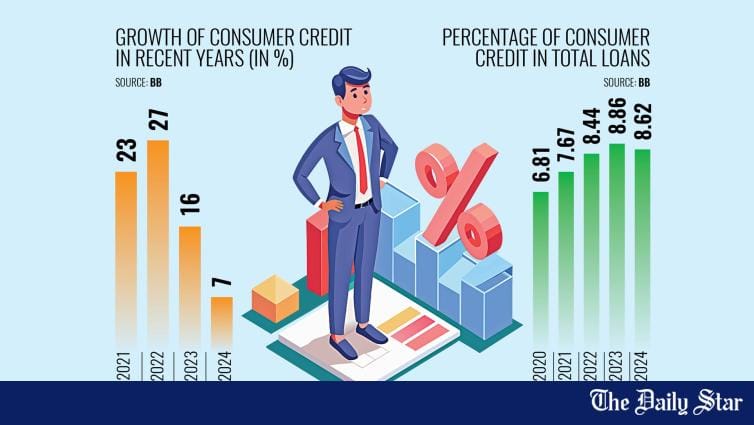
As of September this year, the percentage of consumer credit out of total loans stood at 8.62 percent, down from 8.86 percent the previous year, according to the latest data from the Bangladesh Bank.

Total outstanding loans in the banking sector stood at Tk 1,619,917 crore as of September this year, of which Tk 139,613 crore is consumer financing.

The percentage of consumer credit out of total loans was 6.81 percent in the same period of 2020, 7.67 percent in 2021 and 8.44 percent in 2022.

Consumer credit, or consumer debt, is personal debt taken on to purchase goods and services. For instance, a credit card is one type of consumer credit in finance.

Industry insiders said people take consumer credit mostly for lifestyle and luxury product purchases.

However, they have been forced to cut their spending on luxury products in the face of economic hardships. Still, some people are taking consumer loans to meet their monthly expenses, they added.

From September last year to September this year, banks disbursed Tk 9,103 crore as consumer credit, down from Tk 17,993 crore in the same period of the year prior, central bank data showed.

Bank Asia is continuing to expand its retail loans or consumer financing, said its managing director, Sohail RK Hussain.

Home loans, personal loans, automobile loans and credit cards are the major areas of retail loans.

Credit growth in the retail segment is not substantial and is still insignificant compared to the total loans in the banking sector, said the Bank Asia MD.

People of middle-income and upper middle-income are mainly taking consumer credit, he said, adding that professionals are mostly taking those types of loans.

The housing and automobile sectors were adversely impacted last year due to the exchange loss of the local currency, taka, against the US dollar, Hussain said, adding that the 100 percent letter of credit (LC) margin on luxury products impacted retail loans.

Hussain also said consumer credit or retail loans are expanding on the increased earning capacity of people and changing lifestyles.

From September last year to September this year, banks disbursed cash for purchasing consumer goods, apartment purchases, credit cards loan and salaries, central bank data showed.

Banks are also lending for educational expenses, medical treatment, marriage expenses, travel or holidays, professional loans, transport loans, loans against provident funds, personal loans against deposit premium schemes (DPS), personal loans against fixed deposit receipt (FDR) and more.

M Khurshed Alam, deputy managing director of Eastern Bank, said consumer financing has slowed because of inflationary pressure.

Inflation in Bangladesh hit a four-month-high of 11.38 percent in November this year and has stayed above 9 percent since March of last year.

Alam said Bangladesh Bank is trying to curb inflationary pressure by hiking the policy rate, which pushes up the lending rate. As a result, people are avoiding loans.

Keeping pace with the interest rate of general loans, the central bank recently increased the maximum interest rate on credit cards to 25 percent from 20 percent.

The hike in interest rate of loans against credit cards will impact the credit growth of consumer financing, Alam said.

Few banks are providing consumer credit, which is why this segment is yet to expand, said Syed Mahbubur Rahman, managing director of Mutual Trust Bank.

He said banks are allowed to lend a maximum of Tk 2 crore to each client as a home loan and a maximum of Tk 40 lakh as a personal loan.

Rahman, also the former chairman of the Association of Bankers, Bangladesh, said banks are now very conservative in giving consumer credit as defaulted loans in this segment have also increased.​
 
Analyze

Analyze Post

Add your ideas here:
Highlight Cite Respond

Revamping bond market for economic growth
FE
Published :
Dec 13, 2024 00:02
Updated :
Dec 13, 2024 00:02

1734055041594.webp


The bond market in Bangladesh, despite its immense potential, remains largely unexplored. Several factors including weak corporate governance, lack of awareness and data transparency, investor-unfriendly tax structures, and inadequate enforcement of regulations contribute to the underutilisation. The absence of a sustainable bond market has placed undue pressure on the country's banking system as the primary source of financing. This growing reliance on banks enhances the risk of non-performing assets, threatening the overall stability of the financial system. A recent roundtable jointly organised by The Financial Express (FE) and Watermark Inc. highlighted these challenges and the unutilised potential of the bond market. Experts at the event emphasised the need for comprehensive reforms to unlock the economic benefits that a vibrant bond market could offer. Their suggestions included revamping the tax structure, consolidating all regulators and market intermediaries under a single authority, and updating regulations to align with global best practices. These measures, they argued, would help attract both domestic and international investors, including global impact investors.

The bond market, a financial marketplace where buyers and sellers exchange bonds as debt securities, plays a crucial role in the economy. It provides borrowers with a mechanism to finance large-scale projects and operations, while also offering savers and investors a way to diversify their portfolios. Furthermore, bond markets act as an economic barometer, with bond prices typically moving inversely to the stock market. When equity markets rise, bond yields tend to decline, and vice versa. This counter-cyclicality makes bond markets a reliable indicator of economic trends.

In Bangladesh, however, the bond market remains quiescent, and its potential impact on the economy untapped. The keynote speaker Managing Director of UCB Investment at the roundtable pointed out that the ratio of the corporate bond market to GDP in the country is only 0.19 per cent, the lowest among peer nations. He noted that while government treasury bonds offer high yields of 12-13 per cent, the risk-adjusted returns on corporate bonds should be more attractive to investors. To realise this potential, he stressed the importance of fixing the regulatory framework and aligning it with global standards. The development of both debt and equity markets in tandem is essential for a balanced financial ecosystem. A well-disciplined debt market can complement the equity market by providing a safety net for investors, who can offset potential equity losses with stable returns from fixed-income securities. The Editor of The Financial Express observed that bonds, which typically offer reasonable yields, are considered a safe investment by informed savers. He also highlighted the urgent need for a vibrant secondary market for the transaction of both government and private bonds.

With the interim government currently focusing on restructuring the country's financial management, revitalising the bond market should be a top priority. A robust bond market can significantly enhance capital mobilisation, reduce strain on banks, and provide a stable funding source for long-term projects. The time is ripe for Bangladesh to unleash the potential of its bond market aimed at ensuring its contribution to sustained economic development.​
 
Analyze

Analyze Post

Add your ideas here:
Highlight Cite Respond

Three Cs ruined credibility of data in AL regime
Shakhawat Hossain 15 December, 2024, 00:36

Collusive behavior, capacity deficit and coordination failure have been identified as the main reason for lack of credible data on key socio-economic indicators during the Awami League regime ousted on August 5 amid a student-people uprising.

Impacts of collusive behavior of politicians and public servants to distort data have been evident in all key metrics such as gross domestic product, inflation, labour force and poverty.

The other two Cs –– capacity deficit and coordination failure –– have also led to the systemic compromise of data integrity or data-related disarray in the country over the years, according to the White Paper on the State of Bangladesh Economy.

AL policymakers hardly paid attention to the call for maintaining proper methods in calculating data through out its unbroken tenure between January 2009 and August 2024, the white paper said.

Experts and economists found it difficult to present an objective state of economy and development in absence of reliable data.

Indicating various macroeconomic data, Policy Exchange Bangladesh chairman Masroor Reaz said that they were getting many data which were not available or delayed during the AL regime.

He hoped that the availability of data in the most reliable form would increase in the coming days.

When official statistics on key metrics such as the GDP, inflation, private investment or employment are unreliable, a disconnect between economic realities and policy responses is created, said the white paper.

Appointed on August 29, a 12-member committee headed by Centre for Policy Dialogue distinguished fellow and economist Debapriya Bhattacharya submitted the white paper to the chief adviser Muhammad Yunus on December 1.

The issue of reliable data has also been highlighted in at least eight of the 23 chapters of the white paper aiming to portray the mismanagements and irregularities of the AL regime.

GDP growth rate has been the centre of attention because of apparent disjuncture with other key indicators, including private sector credit, revenue mobilisation, import payments for capital machines, energy consumption, export receipts and employment generation.

Focusing on the issue, the white paper said that in the post-2013 period, the political policymakers took a special interest in GDP figures and surely made strong influences.

A collusive group in the Bangladesh Bureau of Statistics allegedly emerged to ensure that the economic performance of the country was maintained against all odds, be it only on paper, said the white paper.

During the post-2019 period, this collusive group was largely maintaining the act. Data producers might have felt pressured to present an overly optimistic view of development characterised by accelerated economic growth, especially since past estimates were repeatedly manipulated, added the white paper.

It highlighted the collusive behavior on inflation, one of the most talked about issues over the past two years.

The unusual delay and reluctance to release the Consumer Price Index in August 2022 and only 8.4 per cent inflation for gross rent, fuel and lighting components against the price hike of fuel oil by Tk 50 with a potential domino effect pushing up prices of food, transport and utilities, among others it stated.

The distrust of inflation data increased as the BBS made a revision in estimating inflation with an expanded commodity basket having 700 more items with the latest rebasing of 2021-22 CPI, creating an opportunity for the enumerators to use arbitrary judgements, said the white paper.

Many commodities included in the new estimation method are largely unavailable at many market points of the country.

Former World Bank Dhaka office chief economist Zahid Hussain, also a writer of the white paper preparation committee, said that suppression of inflation data below double digits in the past two years was linked to collusive behavior.

Now the BSS seems to be providing actual data, he said, calculating that the double-digit inflation prevailed in August, October and November out of four months of the interim government completed on December 8.

The white paper identified that discrepancies in standards and definitions had enabled the Bangladesh Bureau of Statistics to report an inflated employment rate to appease the regime regarding the overall labour force.

Poverty rates have been reduced to 18.7 per cent in 2022 from 26.5 per cent in 2016, but the poverty reduction rate does not go in parallel with a recent BBS study on Food Security Statistics 2023 that revealed that about 22 per cent of the households perceived themselves as moderate to severe food insecure.

The sharp decline in extreme poverty surely raised the eyebrows of analysts, said the white paper.

Recognising that political influences and priorities often guide statistical manipulations is crucial. This underscores the importance of accurate data as the backbone of effective policy making, the white paper said.

Manipulated data can lead to devastating consequences, making the need for reliable data even more urgent, it added.​
 
Analyze

Analyze Post

Add your ideas here:
Highlight Cite Respond

ADP cut prompted by changed situation
Editorial
Published :
Dec 15, 2024 00:21
Updated :
Dec 15, 2024 00:21

1734223783336.webp


Adhering to the basic principles of flexibility and adjustability, the interim government is mulling over a substantial cut in the annual development budget for the current fiscal year by a big margin of Tk 500 billion from the local-resources part of the budgetary outlay. And that is thanks to the nation's appalling economic condition left behind by the immediate past government. This is no doubt a deep cut in comparison with the reductions in the ADP allocations by Tk 190b and Tk 180b in FY 23 and FY 24 respectively. A pressing financial need and the traditionally poor project implementation capability of the feeble government agencies also prompted the action. It may be mentioned here that the actual ADP implementation rate sank to less than 8 per cent during the July-October period this year. According to a report published in this paper, the budget-trimming process as part of austerity measures will bring down the ADP allocation to Tk 2.15 trillion from the original Tk 2.65 trillion. A downsized but achievable ADP is much better than a robust one far beyond the existing financial and implementation capability. However, maximum efforts must be made for the successful execution of the revised plan. At the same time, causes behind poor implementation capacity should be found out and removed.

The amount to be saved through trimming of the allocation is likely to be used to pay the dues that the government owes to the local private and foreign power generation companies as outstanding and other charges for power purchase. The cut in the ADP allocation will make a revision of the development programme and resetting priorities in the changed situation necessary. While plan for infrastructural development and budgetary allocation for projects are integral parts of a government's yearly economic programme, revision of project plans and fund allocation adjustment to cope with prevailing circumstances are also regular exercises. This is particularly true in case of deficit financing due to failure of the revenue authorities to mobilise adequate funds from domestic sources. The annual development plan adopted by the deposed regime can no longer be implemented with the present weakened financial condition, which is the outcome of ruthless plundering of the national resources by the deposed regime. Revision of development programme and budgetary allocation is nothing wrong and unusual; in fact, it is done almost every year. Not just resource constraint, inclusion of many unnecessary and politically-motivated projects, recasting of ADP is a must do job. Such a budgetary modification should rather be viewed as a pragmatic way of doing things in a changed situation. If efforts are made to execute the unmodified version of the ADP in spite of financial constraint, the government will have to depend more on bank borrowing, leading to crowding out effect.

Besides, the rate of execution of development projects by government agencies, which was less than 8.0 per cent during the first four months of the current financial year is an issue that the government can hardly ignore. The execution rate was one of the poorest in recent years. So, while asking the agencies to concentrate more on raising their project execution rate, it would be more prudent to divert unused funds to meet some pressing needs including payment of arrear bills in the power sector.​
 
Analyze

Analyze Post

Add your ideas here:
Highlight Cite Respond

Chinese investments quadrupled, India’s doubled
Shovongkor Karmakar
Dhaka
Published: 14 Dec 2024, 15: 07

1734224956031.webp


Investments from China and India significantly increased during the last fiscal under the deposed Awami League government. In the 2023-24 fiscal, Chinese investment quadrupled while Indian investments doubled as compared to the previous fiscal. Still, the overall foreign direct investment (FDI) has not improved much. The 2023-24 fiscal saw the lowest foreign investments in three years.

These figures came in a Bangladesh Bank (BB) report which states the total amount of foreign investment in the outgoing fiscal was USD 1.47 billion. The amount is 8.8 per cent less than that of 2022-23 fiscal. Bangladesh received USD 1.61 billion in foreign investment in the 2022-23 fiscal, which was USD 1.72 billion in the previous fiscal. Meanwhile, the country’s foreign investment balance stood at USD 17.54 billion by the end of the last fiscal.

Investments from China and India saw a surprising rise in the last fiscal. Investments from China rose to USD 280 million in the 2023-24 fiscal from USD 68.1 million in the previous fiscal. As such, Chinese investments in Bangladesh have quadrupled or have increased by 316 per cent in the last fiscal. However, investment from China was the highest USD 428.1 million in the 2021-22 fiscal in three years.

In the meantime, investments from India have been rising for the last two fiscals. Indian investment to the country stood at USD 130 million in the last fiscal, which was 89 per cent higher than that of in the previous fiscal. Indian investment in Bangladesh was USD 70 million in the 2021-22 fiscal.

Apart from China and India, Bangladesh saw a rise in foreign investments from several countries including Norway, Singapore, Japan, Sri Lanka, Turkey and Malaysia. Of them, an investment of USD 90 million came from Norway, which was just USD 10 million in the previous year. Investments from Singapore also rose to USD 90 million in 2023-24 fiscal from USD 50 million in the previous fiscal.

A study published by the Centre for Policy Dialogue (CPD) last month says corruption has long been the main challenge in running businesses in the country. This year too, around 17 per cent of the business owners identified corruption as the main hindrance to run a business in the country
The United Kingdom has the highest investment in the country compared to other countries. Bangladesh received investments of USD 506.5 million in the last fiscal too, the highest from any country. However, it was slightly lower than the total UK investments in Bangladesh in the previous fiscal. Bangladesh received investments of USD 507.9 million from the UK in 2022-23.

According to the BB report, the readymade garment (RMG) sector draws the highest amount of foreign investments. However, foreign investment in the sector dwindled by 18.16 per cent to USD 440 million in the last fiscal.

The RMG sector is followed by the banking sector with an investment of USD 230 million, chemical and pharmaceutical sector with USD 120 million, gas and petroleum sector with USD 120 million, USD 100 million in the telecommunication sector, agriculture and horticulture with USD 60 million and the leather industry with an investment of USD 50 million. All these sectors, except the chemical and pharmaceutical and agriculture sectors saw a decline in foreign investments as compared to the previous fiscal.

As a consequence of the fall in the FDI, new investment (equity) and reinvestment also declined. Only 45 per cent of the total USD 1.46 billion of foreign investments last year was new investment. The rate of new investment inflows has been declining for the last two fiscal years.

Meanwhile, a total of USD 610 million was reinvested in the 2023-24 fiscal, which was USD 790 million in the previous fiscal.

Local and foreign businesspersons doing business in Bangladesh say it conveys a negative impression to investors when those who have been running businesses in the country for a long time are in trouble. If the overall business is improved, then it will be easier to draw more foreign investments.

A study published by the Centre for Policy Dialogue (CPD) last month says corruption has long been the main challenge in running businesses in the country. This year too, around 17 per cent of the business owners identified corruption as the main hindrance to run a business in the country.

Apart from corruption, the study identified some 17 major challenges, including limited finance, unstable foreign currency rate, high inflation, incompetent bureaucracy, high tax rate and arbitrary policy changes, to run a business in the country.

Speaking to Prothom Alo, chairman of Research and Policy Integration for Development (RAPID) MA Razzaque said, “Investments from China are shifting due to its trade war with the US. China already has vast investments in Vietnam. So there are not that many opportunities there. At the same time, due to geopolitical reasons, there won't be much Chinese investments in India. Even the Indian government won’t show much interest. So, considering everything, there is a good opportunity to increase Chinese investments in Bangladesh.”

MA Razzaque said, “Foreign investments will increase in the next two or three years if four or five things are done sincerely. First, the forex reserve must not decline any further. Second, an uninterrupted gas and electricity supply must be ensured. Third, instead of 100 economic zones, we should focus on the reform of one or two zones to convey a message to the investors that we are ready. Besides, a one-stop-service should be introduced to settle business related disputes.”

*This report appeared on the print and online versions of Prothom Alo and has been rewritten in English by Ashish Basu.​
 
Analyze

Analyze Post

Add your ideas here:
Highlight Cite Respond

Boosting trade efficiency through automation
FE
Published :
Dec 17, 2024 00:41
Updated :
Dec 17, 2024 00:41

1734396217235.webp


In today's fast-paced global economy, automation and innovation are two major forces driving transformative changes in international trade and commerce. Regrettably, Bangladesh's trade ecosystem remains hamstrung by a lack of automation and bureaucratic inefficiencies, as highlighted in a recent study by the Bangladesh Institute of Bank Management (BIBM). The study conducted on banks involved in trade facilitation reveals that heavy dependence on physical documents (reported by 70 per cent of respondents) and a lack of automation (highlighted by 80 per cent) create significant obstacles for export-import trades from Bangladesh. The study underscores that the lack of digitalisation in trade services not only hampers efficiency but also increases the likelihood of errors and delays. Furthermore, manual operations provide opportunities for misuse and reduce the transparency necessary to attract and retain global trade partners. Other concerns include price verification for letters of credit (LC), complex regulatory frameworks, and restricted access to global trade finance networks - all of which erode confidence in the system and impede progress.

For example, one of the pressing challenges for exporters is navigating the complexities of the Harmonized System (HS) Code, a standardised classification system for traded goods. The lack of clarity in HS Code allocation has become a significant hurdle, often leading to unnecessary delays, financial burdens, and even harassment. Exporters allege that they often face demands for bribes from customs and tax officials under the pretext of HS Code compliance and document verification. These unethical practices not only create procedural bottlenecks for exporters but also tarnish the credibility of public institutions. The BIBM study pointed out that the taxation issues could be resolved by simplifying and harmonising tax codes and adopting automation. By integrating advanced technologies into customs and taxation systems, procedural complexities can be reduced significantly. For instance, an automated system could efficiently allocate HS Codes based on predefined parameters, minimising human intervention and the scope for corruption. Such systems could also ensure faster processing of export documentation, enabling businesses to meet tight deadlines and reduce costs associated with delays.

To this end, it is essential for the National Board of Revenue (NBR) and customs authorities to prioritise digital transformation. Simplified and automated processes can foster greater transparency and accountability, ensuring that traders are not subjected to undue harassment. Moreover, automation would align with global best practices, enhancing Bangladesh's competitiveness in the international market. However, automation alone cannot solve the problem. It must be accompanied by policy reforms that eliminate bureaucratic red tape and establish clear, unambiguous procedures. Stakeholders, including exporters, industry associations, and government agencies, must collaborate to design systems that address their specific needs while promoting fairness and efficiency. It will not only alleviate the burdens faced by traders but also pave the way for a more robust and business-friendly environment that benefits the nation as a whole.

Another critical takeaway from the BIBM study is the need to build capacity among stakeholders. Enhancing skills and knowledge is vital for effectively integrating technology and navigating evolving global trade dynamics. Small and medium enterprises (SMEs), in particular, stand to benefit significantly from improved access to trade finance through technological innovations, contributing to inclusive economic growth. Additionally, by fostering inter-agency cooperation and creating incentives to promote professionalism in trade services have been identified by the study as pivotal steps. Stakeholders, including financial institutions, regulatory bodies, and policymakers, would do well in coming forward to implement these reforms.
 
Analyze

Analyze Post

Add your ideas here:
Highlight Cite Respond

Latest Posts

Back
PKDefense - Recommended Toggle