New Tweets

[🇧🇩] Monitoring Bangladesh's Economy

G Bangladesh Defense
[🇧🇩] Monitoring Bangladesh's Economy
1K
30K
More threads by Saif


Hasina administration did not heed warnings on economy: Farashuddin

1734478366301.webp

Mohammed Farashuddin, a former governor of Bangladesh Bank, speaks at a discussion on “World Trade and Bangladesh” organised by East West University in the capital today. Photo: Collected

The previous government, led by Sheikh Hasina, ignored repeated warnings from experts on various economic issues in Bangladesh, according to Mohammed Farashuddin, a former governor of the country's central bank.

"The Hasina administration did not heed warnings from economists on the lack of good governance in the banking sector or rampant money laundering and tax evasion in Bangladesh," he said.

"Rather, the people who brought up such issues became victims of rudeness," he said during a public lecture on "World Trade and Bangladesh" organised by East West University (EWU) at its auditorium in Dhaka today.

The former central bank governor informed that he was prohibited from entering Hasina's residence at Gono Bhaban for six years while he was also banned from Bangabhaban for four years for raising these concerns.

Farashuddin, also chief adviser of EWU, said he wrote to the Hasina administration several times, urging it to address corruption and other economic anomalies, but was ultimately ignored and banned.

Farashuddin further said that he was once one of the closest financial policy advisers to Sheikh Hasina's Awami League government.

Construction costs increased manifold because of corruption and nepotism within the previous administration, he said while demanding punishment for those responsible for cost-overruns in development projects.

He said he fell out of love with the last government because it created discrimination and anarchism.

Farashuddin, also a former vice chancellor of EWU, added that only 10 percent of the country's population controls 85 percent of its wealth, indicating serious discrimination in asset distribution.

He suggested that Bangladesh should develop its cheap labour-based garments industry and go for diversification of exportable goods and the highest level of value addition in the sector.

He said Bangladesh was facing problems with some big conglomerates like Grameenphone and Korean EPZ, but these challenges are being resolved now.

Moreover, foreign direct investment should be attracted with the right policies and strategies, he added.

Farashuddin pointed out that political and social stability are essential to attract foreign investments. He also stressed the need for fair competition in business policies and tax exemptions to create an equitable business climate in Bangladesh.

"Staying in power for 15 years does not mean political stability, which can only happen when all political parties reach a consensus on at least some vital issues," he said.

Addressing the lecture, renowned economist and former professor at Morgan State University in the US MG Quibria emphasised the need for Bangladesh to diversify its export markets beyond Europe and the USA, focusing on neighbouring countries like China and India.

He highlighted the importance of investing in health and education to develop skilled human resources and urged the government to address critical issues like oil, gas and electricity shortages.

Quibria said increased trade restrictions are leading to disrupted supply chains and fragmentation of global trade into US-leaning and China- leaning blocs.

An analysis by the International Monetary Fund suggests that global economies have virtually become separated in three blocs -- the west-leaning bloc, the China-leaning bloc and a tiny non-aligned bloc.

Pointing to how trade between two of these major blocs has fallen significantly, he said the non-aligned countries like Mexico and Vietnam, which are also called "connector countries", have stabilised global trade from falling precipitously.

"These developments may create a very vulnerable position for a small, trade-dependent country like Bangladesh, which has very little say in international discourse," he said.

"All the discussions are taking place between feuding parties outside the UN or WTO," Quibria added.

Shams Rahman, vice chancellor of EWU, also spoke at the lecture.​
 
Analyze

Analyze Post

Add your ideas here:
Highlight Cite Respond

Taskforce readies strategies to fix economic fault lines
Draft contains 16 chapters with sector-wise proposals

The planning ministry's taskforce for sustainable development has drafted a report with proposals to fix the economic fault lines identified by the white paper on the economic state of the country and achieve moderate economic growth.

The 12-member body, formed to help reshape the economic landscape by stabilising the macroeconomic turbulence, has identified 16 key sectors, including macroeconomic strategy.

The team is set to present short and mid-term recommendations to the interim government this month, according to its members.

The taskforce will also emphasise how the government can curb the existing elevated inflation to alleviate the excessive inflationary pressure on low and fixed-income households.

Led by KAS Murshid, former director general of the Bangladesh Institute of Development Studies (BIDS), the team was announced on September 11 to devise strategies for "re-strategizing the economy and mobilising resources for equitable and sustainable development".

The taskforce was given a three-month deadline to produce its report.

Recently, its members said they have completed their sectoral analysis.

These measures are seen as crucial in light of recent economic downturns complicated by political instability, industrial unrest and natural calamities following the August 5 political changeover.

Besides, the recommendations will come at a critical time for the country as the interim government has suspended the completion of the Eighth Five-Year Plan, scheduled to conclude in June 2025, and halted the preparation of the Ninth Five-Year Plan.

"We won't form any five-year plan. We will just propose a strategic plan for the future economy," said one of the taskforce members, who preferred to remain anonymous.

"The recently published white paper was backward-looking, mainly elaborating on economic mismanagement by the previous government. We, however, are focused on future strategies," the member added.

While the white paper assessed the previous government's actions, the taskforce's mandate is to lay out an economic roadmap for the short and mid-term future.

CHAPTERS IN THE DRAFT

The taskforce's first sector, titled "Rebuilding Economic Foundations: A Strategy for Macroeconomic Stability", outlines how the interim government can restore economic growth and stabilise the economy, which has been struggling with slow growth in recent years.

This chapter addresses pressing macroeconomic challenges, including the country's rising debt burden, which has put additional strain on the national economy.

In October, the World Bank (WB) slashed its forecast for Bangladesh's economic growth by 1.7 percentage points to 4 percent for fiscal year 2024-25 due to "significant uncertainties following recent political turmoil" and "data unavailability".

Similarly, the International Monetary Fund (IMF) also lowered Bangladesh's growth forecast to 4.5 percent by slashing it by 2.1 percentage points.

The multilateral lenders linked the lower growth forecast to political uncertainty, industrial unrest and floods, which have weighed heavily on economic activities.

This figure is the lowest since fiscal 2019-20, when the coronavirus pandemic began. In fiscal 2019-20, GDP growth was 3.4 percent.

The white paper, which was submitted to Chief Adviser Prof Muhammad Yunus on December 1, suggested that Bangladesh's growth figures have been inflated over the years.

The rebuilding economic foundations chapter analyses the debt burden as the country is reeling under pressure from debt servicing.

According to the finance ministry, Bangladesh's foreign debt servicing surged by nearly 31 percent year-on-year during the first four months of fiscal year 2024-25, reaching $1.44 billion in repayments.

The white paper predicted that debt servicing costs will double in the next three years.

Another chapter of the draft report, titled "Infrastructure and Connectivity: A Pathway to Economic Prosperity", evaluates the progress and future viability of mega infrastructure projects that have been central to the previous government's development narrative over the past 15 years.

With the interim government now reviewing whether to continue these projects, the taskforce is expected to recommend policies that can ensure that infrastructure investments contribute effectively to long-term economic prosperity.

The taskforce will also emphasise targeted policy reforms in the health and education sectors, areas identified as key to harnessing the country's demographic dividend.

"Recommendations will be made for both public and private sector improvements to these critical services," the taskforce member said.

The team will also address other issues sector-by-sector, such as trade potential, agriculture, industrial strategy, the potential of state-owned enterprises, climate policy and mitigation, energy policy, financial sector, structural inequality, poverty, vulnerability, social protection, youth, economic governance and digital economy.

The team comprises prominent economists and experts, including Akhtar Mahmood, a former WB official; Prof Selim Raihan of the University of Dhaka; Abdur Razzak, former head of research at the Commonwealth Secretariat; Prof Mushfiq Mobarak of Yale University; and Prof Shamsul Haque of the Bangladesh University of Engineering and Technology.

The other members are Prof Rumana Huque of the University of Dhaka; Nasim Manzoor, former president of the Metropolitan Chamber of Commerce and Industry; Monzur Hossain, research director at BIDS; Fahmida Khatun, executive director of the Centre for Policy Dialogue; AKM Fahim Mashrur, CEO of BDjobs; and Md Kawser Ahmed, member secretary of the General Economics Division of the Planning Commission.​
 
Analyze

Analyze Post

Add your ideas here:
Highlight Cite Respond

Bangladeshi card spending falls in India, rises in Thailand, Singapore

1734480074381.webp


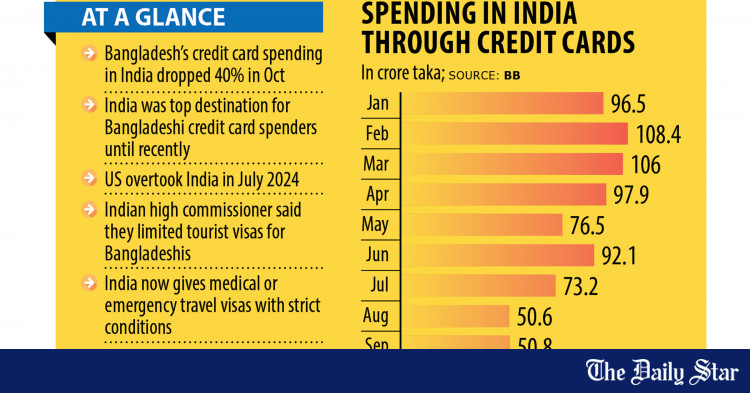
Credit card spending by Bangladeshi citizens in India has plummeted in recent months while it is rising in Thailand and Singapore, according to central bank data.

This trend, according to industry people, is linked to India's limited visa issuance, which has reduced the number of Bangladeshi patients and tourists visiting the neighbouring country.

In October this year, credit card spending by Bangladeshis in India declined by over 40 percent year-over-year, dropping from Tk 90.2 crore to Tk 53.8 crore, as per the latest data of the Bangladesh Bank.

India's share of total overseas credit card spending by Bangladeshis fell from 16.50 percent in October 2023 to 10.78 percent in the same month this year.

Meanwhile, credit card usage by Bangladeshis in Thailand and Singapore has increased.

Historically, India has been the top destination for Bangladeshi credit card spending abroad. From March 2023 to June 2024, India consistently held the top spot. However, in July this year, the United States surpassed India.

After the political changeover in August and the formation of the interim government, Indian High Commissioner to Bangladesh Pranay Verma in October clarified that India would not resume tourist visas for Bangladeshis anytime soon.

The envoy said that the Indian High Commission in Dhaka was issuing visas only for emergency cases.

In that month, Randhir Jaiswal, spokesperson for India's external affairs ministry, confirmed at a briefing that the country had limited visa operations in Bangladesh and was only issuing visas for medical and emergency reasons.

Consequently, credit card usage by Bangladeshis in India has declined. Instead of India, Bangladeshis are now opting for Thailand, Malaysia and Singapore for medical and travel purposes.

Thailand has now become the second-largest destination for Bangladeshi credit card spending abroad, according to central bank data.

In September, Bangladeshis spent Tk 42 crore through credit cards in Thailand while the amount surged to Tk 57 crore in October, elevating Thailand to the second position and pushing India to third.

Following Thailand, Singapore has seen significant growth in credit card spending by Bangladeshis. In October, Bangladeshis spent Tk 43 crore in Singapore, up from Tk 30 crore in September.

Syed Mohammad Kamal, country manager for Bangladesh at Mastercard, said that visits from Bangladesh to India have dropped by nearly 90 percent due to visa restrictions.

He said very few people are now able to travel to India for medical treatment as patients must obtain written permission from doctors under strict conditions.

Kamal said tourists who previously chose Kolkata are now heading to Cox's Bazar while those who used to visit Mumbai or other Indian cities are now opting for Thailand, Singapore and Nepal.

The Bangladesh Bank report, titled "An Overview of Credit Cards Usage Pattern Within and Outside Bangladesh", collected extensive data on credit card transactions from 44 scheduled banks and 1 non-bank financial institution in the country.

It showed that domestic credit card transactions increased by 7.41 percent in October, amounting to Tk 28.66 crore compared to Tk 26.68 crore in September.

Similarly, international transactions outside the country totalled Tk 498 crore in October, showing an increase of 18.56 percent from Tk 420 crore in September.

Concurrently, transactions made using credit cards issued by foreign entities but utilised within Bangladesh increased to Tk 129 crore in October from Tk 111 crore in September, indicating a considerable increase of 15.89 percent.​
 
Analyze

Analyze Post

Add your ideas here:
Highlight Cite Respond

White Paper on the state of Bangladesh economy: some insights & reflections
Golam Rasul
Published :
Dec 18, 2024 00:06
Updated :
Dec 18, 2024 00:06

1734483150178.webp


The interim government formed a 12-member committee led by Dr. Debapriya Bhattacharya to prepare a white paper on the state of Bangladesh's economy. The purpose is to provide a clear assessment of the current state of the economy, reflecting on what happened in the last 15 years and why. The committee submitted its report to the Chief Advisor on December 1, 2024. This report is very timely and relevant for future economic policies and planning and as such it deserves a closer examination.

STRENGTHS OF THE REPORT

A key strength of the report is its comprehensive data collection from various sources, including primary and secondary data, gray literature, and stakeholder consultations. Despite the complexity of analysing the economic situation and data limitations, the authors completed the report within the 90-day timeframe.

The report covers various critical aspects, structured into 23 chapters under five major headings: macroeconomic issues, structural challenges, social issues, institutional aspects, and policy outlook. Each chapter is authored by professional economists and social scientists.

This report highlights several critical issues that demand the interim government's immediate attention. It illustrates on how the economy has been severely damaged by financial mismanagement, poor macroeconomic policies, corruption, and ill-conceived policies. Furthermore, it identifies various channels of widespread corruption, including the misappropriation of bank loans, illicit financial outflows, money laundering, politically motivated non-viable projects, poorly designed projects, inflated project costs, non-competitive tender processes, cronyism, favouritism, and the misuse of power. The report effectively underscores the erosion of institutional integrity and the nexus between politicians, businessmen, and bureaucrats, which is particularly evident in the banking, energy, and infrastructure sectors. This nexus has contributed to the rise of crony capitalism and oligarchy.

WEAKNESS OF THE REPORT

a. Selective use of data and information: While the report is comprehensive and that the authors have assembled a large amount of data, limited information is provided about how they collected it, what methodology they used, how they selected the data, what inclusion and exclusion criteria were used, and how they validated the information and data that they gathered. Many reports from international organisations such as the International Monetary Fund (IMF), the United States Department of Agriculture (USDA), the Food and Agriculture Organisation of the United Nations (FAO), the International Food Policy Research Institute (IFPRI), the World Economic Forum, and the International Finance Corporation (IFC) highlighted the social and economic progress of Bangladesh but were either ignored or interpreted differently by the authors. For instance, several World Bank reports recognised Bangladesh as an "outstanding" economic performer and referred to it as "an inspiring story of growth and development."

b. Overlooks social progress: Despite the report's breadth, it overlooks numerous literatures, which highlighted Bangladesh's progress in social development, including food production, calorie intake, infant and child mortality rates, gender parity, life expectancy, and disaster risk management. The selective use of data and findings may cast doubt on the reliability and validity of the report's conclusions. A balanced analysis of both positive and negative aspects of the economy is essential for a genuine assessment of the past regime. Despite being less than potential, Bangladesh has achieved reasonably good progress in many areas that warrants recognition and discussion.

c. Ignores external challenges: Bangladesh's economic downturn began during COVID-19 and worsened after the Russia-Ukraine war in 2022. While poor governance and economic mismanagement are partly responsible for macroeconomic instability, global factors such as high fuel, food, and fertiliser prices, supply chain disruptions, and high interest rates of US dollar have significantly affected Bangladesh's economy. For example, the price of urea rose from USD 238 per metric ton in 2021 to USD 599 in 2023, negatively impacted the terms of trade. The report seems to ignore or undermine such external challenges and their cascading effects on Bangladesh's macroeconomic stability, resulting in a one-sided analysis.

d. Validation of data: Another important aspect is the reliability of data sources. The report heavily relies on gray literature, including newspaper articles that have not been scientifically reviewed, raising concerns about the reliability of the data, thus leaving it unclear on how they evaluated the reliability and validity of data and information presented.

e. Estimation of social protection misallocation: Although the white paper aims to provide a transparent assessment of the current economic state, in many instances, the authors' opinions overshadowed the factual analysis. For example, Chapter 1 reports that 73 per cent of social safety net benefits are misallocated, meaning that they are received by non-poor beneficiaries. However, it is unclear what the basis for this information is, as the relevant chapter on poverty and social protection (chapter 13) lacks primary data to support this claim, and such a claim is not made elsewhere in the document.

f. Estimation of illicit outflows of money: This report estimates that between 2009 and 2023, Bangladesh experienced approximately USD 234 billion in illicit outflows, averaging about USD 16 billion per year. This estimate is based on the Global Financial Integrity (GFI) reports. Over 70 per cent of illicit money outflows occur through trade, primarily due to over- and under-invoicing. According to GFI, Bangladesh lost an average of USD 8.27 billion annually from 2009 to 2018 due to trade mis-invoicing, and the authors have extrapolated this data to 2023. Illicit money outflows are a common problem in developing countries worldwide. According to another GFI report, illicit outflows of money from developing countries range from 14.4 per cent of total international trade in Swaziland to 51.9 per cent in Gambia. As per this report, illicit outflows from Bangladesh are among the lowest in the world at 17.3 per cent of total international trade, and also compared to neighbouring countries, e.g., China (21.5 per cent), India (19.8 per cent), Malaysia (20.8 per cent), and Pakistan (18.7). Although even a single dollar of illicit outflow of money is unacceptable, estimating these outflows based solely on the GFIR coefficient is an oversimplification and may not yield accurate results. This is a serious issue for Bangladesh's economy and warrants a deeper analysis, including identifying loopholes in regulatory frameworks and institutional mechanisms that facilitate the generation and outflow of illicit money. Additionally, it is essential to examine the business, investment, and political environments that foster these illicit outflows of money from Bangladesh.

g. Estimation of magnitude of corruption: This report estimates the magnitude of corruption -- ranging from USD 14 billion to 24 billion (1.61 to 2.80 lakh crore BDT) out of the USD 60 billion invested in various development projects over the past 15 years. The authors arrived at this estimate based on a report by Transparency International, Bangladesh (TIB), which conducted a study on corruption in development projects implemented by the Roads and Highways Department. Notably, projects below BDT 1,000 crore were included, while large and mega projects were excluded from this study. Since the TIB study focused only on particular types of projects, when generalising the same rate of corruption to different sectors and project sizes, the authors should have provided their expert judgment regarding how confident they are in this estimate. Different sectors may have varying modalities of implementation, decision-making, and policy-making processes, which could affect the prevalence, volume and nature of corruption.

h. Mismatch between analysis and recommendations: There is also a gap between analysis and recommendations. Many chapters present extensive lists of generic recommendations without systematically analysing the issues at hand, rendering these recommendations somewhat subjective. For instance, the suggestions to "promote evidence-based policymaking and facilitate the development of targeted adaptation strategies" and to "integrate climate change considerations into national agricultural policies and development plans" lack thorough examination of existing policies and plans regarding climate change adaptation. Similarly, in the final chapter, the authors presented an interesting set of recommendations, including Mid-Term Planning, a Strategy for LDC Graduation, and Hosting a Forum for Inclusive and Sustainable Development. While these suggestions are important for the interim government, questions arise as to the origins of these recommendations. As this is a concluding chapter, the recommendations should be grounded in an analysis of the main chapters presented earlier. As these issues were not discussed previously, making the recommendations here would be considered more as reflections of the authors' subjective opinions rather than conclusions drawn from the report itself.

i. Lack of clarity: The report could benefit by including an executive summary that distills the key messages from each chapter. While the Foreword attempts to provide a summary, it does not encompass all the important points from every chapter. To enhance readability, the authors may consider eliminating jargons such as "A Development Promise in Flux," "statistical artifact," and "foggy visibility."

Despite the good efforts of authors and comprehensive coverage of the subject, this report may not hold scientifically robust. Integrating diverse perspectives on development strategies and analysing the pros and cons of various development strategies and approaches-what works and what does not-will make the findings of the report more relevant and useful for the government, development partners and other stakeholders. Despite these shortcomings, the report remains a vital document for understanding the economic challenges that Bangladesh is facing now.

Golam Rasul, PhD is Professor, Department of Economics, International University of Business Agriculture and Technology (IUBAT), Dhaka, Bangladesh.​
 
Analyze

Analyze Post

Add your ideas here:
Highlight Cite Respond

Economic problems need attention: What are the people thinking?
Pay attention to the economic crisis
Editorial Desk
Published: 17 Dec 2024, 14: 12

It cannot be claimed with certainty that a public opinion poll will reveal the correct picture of the country. No survey is 100 per cent accurate. However, the thoughts and opinions of the respondents, meaning the public, can be predicted from a survey to a great extant.

What’s more important is that, it gives the government or the concerned authorities a proper idea in adopting policies and plans as well as the effectiveness and results of these.

The results of the BRAC Institute of Governance and Development (BIGD) pulse survey phase 2 are significant for policy makers of the government, we believe. The title of the survey was ‘Post-Uprising Bangladesh: What are people thinking’.

This is the second survey done by BIGD while the first one was carried out in August. Though the survey addressed several issues including elections, new parties, efficiency of the interim government, women’s safety, the law and order situation, etc. the issue of economy was prioritised.

One of the notable questions in the survey was, “What is the country's biggest problem now?” In response, 67 per cent of the people talked about the economic crisis (price hike, economic or business downturn). As much as 9 per cent of the respondents mentioned political unrest and intolerance, 4 per cent of them spoke of deterioration of law and order, 3 per cent voted for lack of democracy and 2 per cent talked about lack of safety.

From the survey results, we can realise that people are not as much worried about the law and order situation as they are about the prices of daily commodities. It doesn’t seem the government has any control over the market.

Economist Debapriya Bhattacharya said that if the government fails to provide economic relief and to improve law and order situation, the public will lose patience. Finance adviser Salehuddin Ahmed has blamed the price hike on extortion. No matter if it’s extortion or stockpiling behind the price hike of daily essentials, it is the government that has to take action.

Chief adviser Dr Muhammad Yunus while addressing the nation talked about launching an alternative agricultural market. However, how that will happen and how long that will take is a concern as well. People will get some relief if the government increases the supply of essentials at discounted prices through TCB until there’s an alternative market.

In response to the question, “Considering the economic situation of last month, do you think Bangladesh is going in the right direction, or in the wrong direction?” 43 per cent people said that the country is going on the right direction. Meanwhile, 52 per cent of the people think the country is moving on the wrong direction.

On the same question during the first survey carried out by BIGD in last August, 60 per cent of the people had said that the country was going in the right direction, while 27 per cent said it was going in the wrong direction.

This means people’s trust in the government is declining. The people will grow even more frustrated if the law and order situation does not improve or the prices of daily necessities do not come down.

Though the BIGD survey has been revealed now, it was carried out in September. The prices of daily commodities have soared even higher in the last two months.

People from all walks of life do support the commissions the government has formed to reform the constitution, election commission, anti-corruption commission and so on. However, the government must keep in mind that no reform will come to any use if the market cannot be brought under control.

The support of the public is a great source of strength for this government, which came to power through the student-people uprising. If that very source becomes unstable, then their moral stance will grow feeble as well.​
 
Analyze

Analyze Post

Add your ideas here:
Highlight Cite Respond

IMF to give $645m in fourth tranche
Govt seeks $750m of additional funds

1734564175826.webp


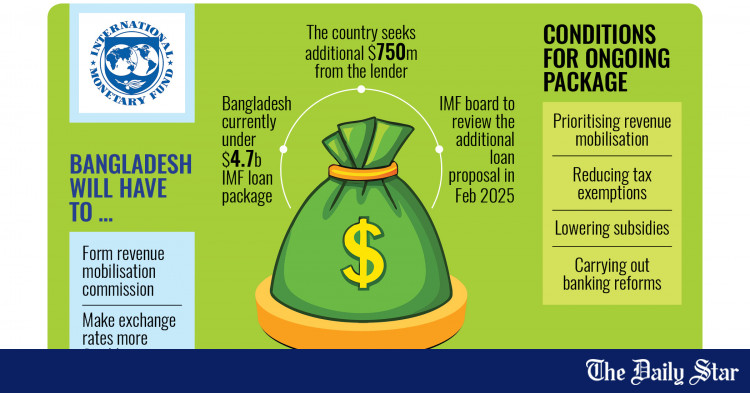
The International Monetary Fund will give Bangladesh $645 million in the fourth tranche under the $4.7 billion loan programme, taking the total disbursement to $2.31 billion.

However, no decision has been made yet on Bangladesh's request for additional funds under the existing programme, as the visiting IMF staff team concluded its third loan review yesterday.

After assuming office, the interim government verbally requested the IMF to provide $3 billion in fresh loans for replenishing foreign currency reserves.

The government ultimately sought $750 million, the IMF staff team said in a statement at the conclusion of its 16-day visit to Dhaka.

"Amid significant macroeconomic challenges, the authorities requested an augmentation of SDR 567.2 million (approximately $750 million) in IMF financial support to Bangladesh," said the IMF staff team led by Chris Papageorgiou.

The SDR (Special Drawing Rights) is an international reserve asset created by the IMF to supplement the official reserves of its member countries.

If the IMF executive board approves the request for additional funds, its total loan package for Bangladesh will reach $5.3 billion from the existing $4.7 billion.

The formation of an interim government has "fostered a gradual return" to economic normalcy in Bangladesh, the statement said.

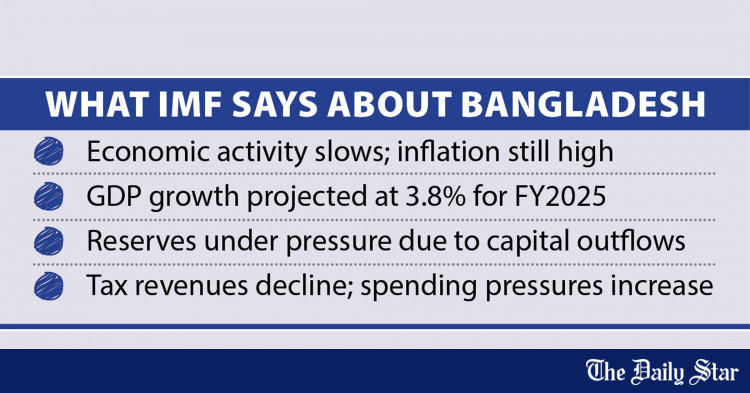
Economic activity in Bangladesh has slowed significantly and inflation remains elevated. Capital outflows, particularly from the banking sector, have put pressure on foreign exchange reserves.

Additionally, tax revenues have declined, while spending pressures have increased, it pointed out.

"These challenges are further exacerbated by stress in parts of the financial sector."

Real GDP growth is projected to slow to 3.8 percent in fiscal 2024-25 due to output losses caused by the public uprising, floods and tighter policies but is expected to rebound to 6.7 percent in fiscal 2025-26 as policies relax.

Inflation is anticipated to hover around 11 percent (annual average year-on-year) this fiscal year before declining to 5 percent next fiscal year, supported by tighter policies and easing supply pressures.

"However, the outlook remains highly uncertain, with risks skewed to the downside. To address the emerging external financing gap and persistently high inflation, near-term policy tightening is crucial."

Fiscal consolidation should prioritise the swift implementation of additional revenue measures, such as removing tax exemptions while restraining non-essential spending.

Coupled with monetary tightening, greater exchange rate flexibility and safeguarding foreign exchange reserve buffers will strengthen the economy's resilience to external shocks.

Bangladesh's low tax-to-GDP ratio calls for urgent tax reforms to establish a fairer, more transparent system, focusing on rationalising exemptions, improving compliance and separating tax policy from administration.

A comprehensive strategy is also needed to curb subsidy spending and address arrears in the electricity and fertiliser sectors, the statement said.

"Addressing vulnerabilities in the banking sector is essential."

Immediate priorities include accurately assessing defaulted loans, ensuring the effective implementation of existing regulations and formulating a roadmap for financial sector restructuring, it said.

Key actions involve conducting an asset quality review and adopting a recovery and resolution framework aligned with global standards.

Simultaneously, the authorities should advance risk-based supervision, while legal reforms are needed to strengthen corporate governance and regulatory frameworks.

"Institutional reforms to enhance the Bangladesh Bank's independence and governance will be critical for the successful implementation of financial sector reforms."

Enhancing governance, along with greater transparency, is critical to improving the investment climate, attracting foreign direct investment and diversifying exports beyond the garment sector, the statement said.

Furthermore, building resilience to climate change is vital to reduce macroeconomic and fiscal vulnerabilities.

Strengthening institutional capacity and optimising spending efficiency will aid in achieving climate goals.

The government should focus on implementing climate-sensitive fiscal reforms and investing in sustainable, resilient infrastructure.

Furthermore, robust management of climate-related risks will reinforce the stability of the financial sector, it added.​
 
Analyze

Analyze Post

Add your ideas here:
Highlight Cite Respond

IMF sees brighter days for Bangladesh from FY26

1734651942715.webp


The International Monetary Fund (IMF) yesterday said that the country's economic scenario may turn positive in fiscal year 2025-26 with the inflationary pressure easing and economic growth picking up.

The multilateral lender attributed several government measures to their forecast of the positive outlook.

"We've seen this in many other countries with corrective measures in place… we expect a rebound," said IMF official Chris Papageorgiou at a press briefing at the finance ministry.

He led a recent two-week mission to Dhaka.

"We are expecting that we would see the inflation decline finally in the next year," he said.

Earlier on Wednesday, the IMF cut Bangladesh's growth outlook to 3.8 percent for FY25, which may rebound to 6.7 percent in FY26

Earlier on Wednesday, the IMF cut Bangladesh's growth outlook to 3.8 percent for FY25, which may rebound to 6.7 percent in FY26.

It also said that inflation is anticipated to remain around 11 percent in FY25 before declining to 5 percent in FY26.

"This is a very important point, when we start seeing inflation coming down to single digits, hitting the target rate of five to six percent, then we'll see growth start to pick up," Papageorgiou said.

He said disruptions caused by floods in the northeastern region in August and September, and other disruptions earlier slowed growth this year.

"Frankly, a lot of the growth reduction we see is because of the disruptions in the months of July and August, and also flooding, unprecedented flooding that we've seen."

"From next fiscal year, we expect everything, the growth momentum, to start transitioning, rebounding to better days Bangladesh used to have in the past," he added.

"We do not see inflation coming down to rates we were expecting," he said. "Inflation remains in double digits. We have numbers [inflation] as of November, and the price pressures remaining very high comes from two parts," he added.

He said that high inflation is driven by both supply-side and demand-side factors.

On the supply side, structural issues contribute to persistent food inflation. On the demand side, strong aggregate demand has also contributed to inflationary pressures.

"So inflation remains much higher than our expectations," he said.

He said this combination of low growth and high inflation has put additional strain on the balance of payments and foreign exchange reserves.

The IMF has long been vocal about the non-performing loans (NPLs) in the banking sector.

Papageorgiou said that historical NPL measures have been biased and that the actual level of NPLs is likely much higher.

The IMF appreciated the interim government's efforts to prioritise the banking sector. "We applaud them for that. But with that, we see that the banking sector is still in distress," he said.

He said the country has transitioned from a period of 7 percent growth with low inflation to a period of 3.8 percent growth with high inflation, putting pressure on reserves and the banking sector.

Regarding the IMF's programme evaluation, the mission chief said they started the programme with a clear request for stopping the decline in foreign exchange reserves.

The reserves have decreased dramatically, from around $50 billion three years ago to mere $20 billion now, he said.

Papageorgiou said the IMF programme has coincided with a series of global shocks. When the programme began, the impact of the Russia-Ukraine war and subsequent commodity price increases was not fully anticipated.

He said these shocks, coupled with domestic challenges such as the July-August unrest, have further complicated Bangladesh's economic situation.

The mission chief said the main objective of the IMF programme is to stabilise the economy and restore sustainable growth.

"That is number one goal," he said, adding that Bangladesh would return to a path of healthy growth and low inflation.​
 
Analyze

Analyze Post

Add your ideas here:
Highlight Cite Respond

IMF pushes for more reforms to unlock additional $750m

1734653413888.webp


The International Monetary Fund (IMF) has proposed more reforms, including the separation of tax administration and tax policy and greater exchange rate flexibility, as conditions for an additional $750 million loan to Bangladesh.

The multilateral lender will present the proposal for the additional loan, along with the next instalment of the ongoing $4.7 billion package, to its executive board meeting in February 2025.

Before the board meeting, Bangladesh will have to implement the revenue mobilisation commission and adopt more flexible exchange rate policies, according to IMF official Chris Papageorgiou, who led a two-week mission to Dhaka.

At a press conference at the finance ministry yesterday, Papageorgiou said the formation of the revenue commission fulfils one of the conditions. Once the second condition is fulfilled, the proposal will be submitted to the IMF board meeting on February 5 next year.

The meeting will finalise the fourth tranche of the ongoing programme, totalling $645 million including $80 million from the additional loan.

In a statement on Wednesday, the IMF confirmed that the government had requested an additional $750 million from the fund, separate from the ongoing $4.7 billion programme approved in January 2023.

The mission chief also said that the IMF has already committed to the additional amount and will release $80 million of it with the regular fourth tranche.

The IMF determined the additional amount in consultation with the Asian Development Bank (ADB) and the World Bank (WB).

After the IMF press conference, Finance Adviser Salehuddin Ahmed and Power and Energy Adviser Fouzul Kabir Khan spoke to journalists.

Salehuddin said that the IMF has prioritised revenue mobilisation to increase the country's tax-to-GDP ratio -- one of the lowest globally.

Another condition is about reducing tax exemptions. According to Salehuddin, the government has already taken steps to limit exemptions and will continue to scrutinise them further.

Regarding the separation of tax policy and administration, the adviser said they would place it before the Advisory Council meeting.

"Placing the proposal to the council is good enough," Salehuddin said, referring to the IMF.

Another IMF condition was to increase electricity prices to reduce subsidies.

However, Energy Adviser Fouzul Kabir Khan said that the government would not increase electricity prices this year due to high inflation.

Khan added that the IMF agreed to this and that the government would reduce power subsidies by lowering generation costs and increasing revenue.

REVENUE BOOSTING EFFORTS SLOWING DOWN

At the press conference, Papageorgiou said revenue mobilisation efforts of Bangladesh are slowing down instead of progressing.

He said the IMF supports structural changes at the National Board of Revenue (NBR), including the separation of tax policy and administration, which he described as a "big reform."

"It is going to bring very good things to the country, because, like many other countries, this should be the case, policy should be separated from administration," Papageorgiou said.

The IMF has also identified specific measures to increase revenue, specially addressing tax exemptions.

Papageorgiou said these exemptions have become a long-standing cultural issue, which needs massive effort and political will to change.

Another key area of focus for the IMF is exchange rate flexibility. While the central bank governor has made significant strides, the IMF is advocating for a more transitional system to reduce reliance on reserve sales to support exchange rate reform.

The final major issue is the banking sector, according to Papageorgiou as he said the IMF is working closely with authorities, the taskforce and bilateral development partners.

He said they have developed a matrix to assist authorities in addressing banking sector challenges.

The immediate focus will be on the 10-12 banks identified as the most distressed. The mission chief talked about a roadmap that includes legislative measures, human resource adjustments and administrative changes.

While the process is not expected to be completed by the end of 2025, said the mission chief, the IMF expects the implementation of key measures to ensure notable progress.​
 
Analyze

Analyze Post

Add your ideas here:
Highlight Cite Respond

Latest Posts

Back
PKDefense - Recommended Toggle