Bangladesh Defense
Saif
Senior Member
- Jan 24, 2024
- 21,561
- 9,760
- Nation

- Residence
- Axis Group


The human cost of wasting Rohingya aid funds
The Rohingya refugee crisis remains one of the world’s largest and most protracted humanitarian emergencies.
The human cost of wasting Rohingya aid funds
Kallol Mustafa
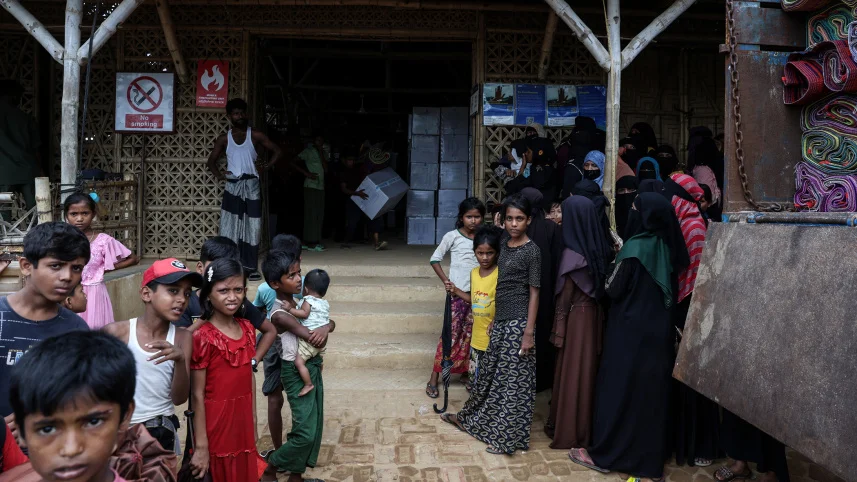
People queue to collect aid boxes at a Rohingya refugee camp in Cox's Bazar, Bangladesh on May 27, 2025. FILE PHOTO: REUTERS
The Rohingya refugee crisis remains one of the world’s largest and most protracted humanitarian emergencies. Since more than 10 lakh Rohingya fled violence in Myanmar and sought refuge in Bangladesh, the international humanitarian response has relied heavily on the leadership of the United Nations High Commission for Refugees (UNHCR). Working alongside the Bangladesh government, other UN agencies, and numerous national and international partners, UNHCR has played a central role in providing shelter, protection, healthcare, education, and other essential services to one of the world’s most vulnerable populations.
It is precisely because of this critical role that the findings of a UN internal audit recently reported by New Age deserve serious attention. The audit, conducted by the Office of Internal Oversight Services (OIOS) at the UN headquarters for the period of January 2023 to December 2024 found serious mismanagement, irregularities, and misuse of aid in UNHCR-run Rohingya relief projects in Bangladesh.
First, many relief items were purchased even though the refugees did not need them. For instance, they preferred water pitchers to jerrycans ($87,875) and had no use for cutlery ($182,028) since they eat with their hands. Despite complaints, non-food item (NFI) kits were not adjusted, leading to stockpiles of unused items, including 62,100 kitchen sets worth $1.32 million.
Second, 99 elephant watchtowers were constructed for $2.2 million. Subsequent evaluations found them to be ineffective. A further $56,025 was lost in materials, and $367,759 was spent on unsuccessful improvements. Although a 2025 evaluation recommended reducing the number of towers, only 12 had been removed by the time the audit was conducted. The removal of the remaining 37 would save a further $180,000.
Third, similar to many public development projects, UNHCR purchased unnecessary vehicles but failed to justify the need for 52 programme vehicles for 16 refugee camps and 48 administrative vehicles for which it had only 29 drivers. Also, at the time of the audit, 10 of the 104 vehicles had not been operational for an extended period, but over $80,000 was paid in rental fees for them.
Fourth, UNHCR purchased $24.2 million worth of LPG refills even though the actual requirement was worth $18.7 million.
Fifth, a new office in Cox’s Bazar was built for $240,000 without obtaining formal permission from the landowner. The project’s cost increased after a third floor was added. Upon completion, the landowner announced a rent increase despite the absence of any formal lease agreement. The new office remained vacant for five months while UNHCR continued paying $11,000 rent per month.
Moreover, some of the facilities constructed and equipment procured were not used, such as: i) a $1.5 million specialised hospital in Ukhiya; ii) a 20-bed inpatient facility in Bhasan Char after refurbishment and installation of solar equipment totalling $140,000; and ii) an X-ray machine totalling $74,301.
Sixth, between 2021 and June 2025, construction works and procurement worth $25 million were awarded to a single contractor whose prices were 26 percent higher than market rates, resulting in an estimated loss of $6.5 million.
The shelter construction programme also relied on a single contractor, even though four other prequalified firms had submitted bids at 33-43 percent lower. Contracts worth $30 million for LPG refills, stoves, igniters, pressure cookers, and training were awarded to a single supplier who was not the lowest bidder. Although LPG depot costs were contractually the responsibility of the contractor, UNHCR itself paid $1.66 million. And while accessories like spark lighters were covered under pressure cooker warranties, additional spark lighters worth $65,367 were purchased.
Seventh, the $3.9 million energy and environmental programme was implemented at rates significantly above prevailing market prices. In the 2021 solar project, contractor rates were up to 36 percent higher than market prices and comparable sector costs. In 2023, contract rates were increased by 19-25 percent without clear justification, resulting in additional expenditure of $294,840. The electrical works under the construction framework exceeded market rates by about 10 percent, resulting in a loss of $1.5 million. The same company was hired to conduct the feasibility study, prepare the design, and implement the electrical installations, despite a clear conflict of interest.
The significance of these findings extends far beyond accounting practices. Rohingya humanitarian response is going through a period of severe financial strain. International donor contributions have steadily declined over recent years; food assistance has faced reductions, healthcare services are at risk, the education of refugee children is under threat, and agencies continue to struggle to maintain even basic services inside the camps.
In such circumstances, every unnecessary expenditure represents resources that could otherwise have provided food, healthcare, education, shelter, or protection to refugee families. Waste in humanitarian operations directly affects the well-being of vulnerable people.
There is another important consequence. Humanitarian assistance ultimately depends on public trust. Governments allocate taxpayer resources to international relief efforts because they believe those funds will be used responsibly and transparently. Audit findings suggesting weak financial controls, procurement irregularities, or ineffective project management risk undermining that confidence. If international donors become less willing to finance Rohingya operations, the consequences will not be borne primarily by international organisations. They will be felt first by the Rohingya refugees, and increasingly by Bangladesh, in terms of critical gaps in food assistance, healthcare, and essential services, at a time when the country is already confronting its own economic and fiscal constraints.
Sustaining international solidarity requires maintaining the highest standards of accountability. Humanitarian organisations are rightly expected to meet standards that often exceed those applied elsewhere because they operate with public funds intended to alleviate human suffering.
UNHCR has acknowledged many of the audit observations and has committed to implementing corrective measures. That process must continue with transparency. The organisation should publicly demonstrate how procurement systems are being strengthened, how project planning is being improved, and how recommendations are being implemented.
With humanitarian funding shrinking while refugee needs remain immense, the objective should be clear: every donated dollar must reach those for whom it was intended. The people who ultimately bear the cost of wasteful spending, irregularities, and mismanagement are not donors or institutions. They are the Rohingya families whose survival depends on an international community struggling to sustain its commitment.
Kallol Mustafa is an engineer and writer who focuses on power, energy, environment, and development economics.
Kallol Mustafa
People queue to collect aid boxes at a Rohingya refugee camp in Cox's Bazar, Bangladesh on May 27, 2025. FILE PHOTO: REUTERS
The Rohingya refugee crisis remains one of the world’s largest and most protracted humanitarian emergencies. Since more than 10 lakh Rohingya fled violence in Myanmar and sought refuge in Bangladesh, the international humanitarian response has relied heavily on the leadership of the United Nations High Commission for Refugees (UNHCR). Working alongside the Bangladesh government, other UN agencies, and numerous national and international partners, UNHCR has played a central role in providing shelter, protection, healthcare, education, and other essential services to one of the world’s most vulnerable populations.
It is precisely because of this critical role that the findings of a UN internal audit recently reported by New Age deserve serious attention. The audit, conducted by the Office of Internal Oversight Services (OIOS) at the UN headquarters for the period of January 2023 to December 2024 found serious mismanagement, irregularities, and misuse of aid in UNHCR-run Rohingya relief projects in Bangladesh.
First, many relief items were purchased even though the refugees did not need them. For instance, they preferred water pitchers to jerrycans ($87,875) and had no use for cutlery ($182,028) since they eat with their hands. Despite complaints, non-food item (NFI) kits were not adjusted, leading to stockpiles of unused items, including 62,100 kitchen sets worth $1.32 million.
Second, 99 elephant watchtowers were constructed for $2.2 million. Subsequent evaluations found them to be ineffective. A further $56,025 was lost in materials, and $367,759 was spent on unsuccessful improvements. Although a 2025 evaluation recommended reducing the number of towers, only 12 had been removed by the time the audit was conducted. The removal of the remaining 37 would save a further $180,000.
Third, similar to many public development projects, UNHCR purchased unnecessary vehicles but failed to justify the need for 52 programme vehicles for 16 refugee camps and 48 administrative vehicles for which it had only 29 drivers. Also, at the time of the audit, 10 of the 104 vehicles had not been operational for an extended period, but over $80,000 was paid in rental fees for them.
Fourth, UNHCR purchased $24.2 million worth of LPG refills even though the actual requirement was worth $18.7 million.
Fifth, a new office in Cox’s Bazar was built for $240,000 without obtaining formal permission from the landowner. The project’s cost increased after a third floor was added. Upon completion, the landowner announced a rent increase despite the absence of any formal lease agreement. The new office remained vacant for five months while UNHCR continued paying $11,000 rent per month.
Moreover, some of the facilities constructed and equipment procured were not used, such as: i) a $1.5 million specialised hospital in Ukhiya; ii) a 20-bed inpatient facility in Bhasan Char after refurbishment and installation of solar equipment totalling $140,000; and ii) an X-ray machine totalling $74,301.
Sixth, between 2021 and June 2025, construction works and procurement worth $25 million were awarded to a single contractor whose prices were 26 percent higher than market rates, resulting in an estimated loss of $6.5 million.
The shelter construction programme also relied on a single contractor, even though four other prequalified firms had submitted bids at 33-43 percent lower. Contracts worth $30 million for LPG refills, stoves, igniters, pressure cookers, and training were awarded to a single supplier who was not the lowest bidder. Although LPG depot costs were contractually the responsibility of the contractor, UNHCR itself paid $1.66 million. And while accessories like spark lighters were covered under pressure cooker warranties, additional spark lighters worth $65,367 were purchased.
Seventh, the $3.9 million energy and environmental programme was implemented at rates significantly above prevailing market prices. In the 2021 solar project, contractor rates were up to 36 percent higher than market prices and comparable sector costs. In 2023, contract rates were increased by 19-25 percent without clear justification, resulting in additional expenditure of $294,840. The electrical works under the construction framework exceeded market rates by about 10 percent, resulting in a loss of $1.5 million. The same company was hired to conduct the feasibility study, prepare the design, and implement the electrical installations, despite a clear conflict of interest.
The significance of these findings extends far beyond accounting practices. Rohingya humanitarian response is going through a period of severe financial strain. International donor contributions have steadily declined over recent years; food assistance has faced reductions, healthcare services are at risk, the education of refugee children is under threat, and agencies continue to struggle to maintain even basic services inside the camps.
In such circumstances, every unnecessary expenditure represents resources that could otherwise have provided food, healthcare, education, shelter, or protection to refugee families. Waste in humanitarian operations directly affects the well-being of vulnerable people.
There is another important consequence. Humanitarian assistance ultimately depends on public trust. Governments allocate taxpayer resources to international relief efforts because they believe those funds will be used responsibly and transparently. Audit findings suggesting weak financial controls, procurement irregularities, or ineffective project management risk undermining that confidence. If international donors become less willing to finance Rohingya operations, the consequences will not be borne primarily by international organisations. They will be felt first by the Rohingya refugees, and increasingly by Bangladesh, in terms of critical gaps in food assistance, healthcare, and essential services, at a time when the country is already confronting its own economic and fiscal constraints.
Sustaining international solidarity requires maintaining the highest standards of accountability. Humanitarian organisations are rightly expected to meet standards that often exceed those applied elsewhere because they operate with public funds intended to alleviate human suffering.
UNHCR has acknowledged many of the audit observations and has committed to implementing corrective measures. That process must continue with transparency. The organisation should publicly demonstrate how procurement systems are being strengthened, how project planning is being improved, and how recommendations are being implemented.
With humanitarian funding shrinking while refugee needs remain immense, the objective should be clear: every donated dollar must reach those for whom it was intended. The people who ultimately bear the cost of wasteful spending, irregularities, and mismanagement are not donors or institutions. They are the Rohingya families whose survival depends on an international community struggling to sustain its commitment.
Kallol Mustafa is an engineer and writer who focuses on power, energy, environment, and development economics.