Donate ☕
201 Military Defense Forums
[🇧🇩] - Monitoring Bangladesh's Economy | Page 7 | PKDefense
Home Login Forums Wars Movies Watch Videos
Serious discussion on defense, geopolitics, and global security.

[🇧🇩] Monitoring Bangladesh's Economy

Reply (Scroll)
Press space to scroll through posts
G Bangladesh Defense
[🇧🇩] Monitoring Bangladesh's Economy
948
25K
More threads by Saif

Challenges on the road to becoming the 28th largest economy​


1707959861055.webp

Investment, both domestic and foreign, plays a pivotal role in fostering economic growth. PHOTO: REUTERS

Bangladesh undeniably stands out as one of the most promising economies in the region. Despite facing resource constraints, the country has made commendable economic and social progress since independence. This success is a testament to the indomitable spirit of the Bangladeshi people, their relentless struggle for survival, and their remarkable commitment, determination, and entrepreneurial spirit. With an average annual GDP growth of six percent since the 2000s, Bangladesh currently holds the 35th position among global economies, and it is projected to become the 28th largest economy by 2030. However, this ambitious journey toward economic advancement is not without its challenges. The critical hurdles on our path include tackling poverty, addressing income inequality, managing high inflation and external debt burden, attracting foreign investment, improving resource mobilisation, addressing foreign exchange shortages, curbing corruption, ensuring the stability of the financial sector, and others.

In recent years, Bangladesh has borrowed heavily to finance various mega projects. Consequently, annual debt servicing has been on the rise, which now constitutes a substantial share of the government's expenditures. According to data from the Bangladesh Bank, the total government debt, comprising both domestic and foreign, reached around the $100-billion mark at the end of June 2023. While some of these projects may yield long-term benefits, the immediate requirements for debt servicing pose a challenge for the government's financial capacity. Currently, Bangladesh has to repay foreign loans ranging from $2-2.76 billion annually, and this amount is expected to rise in the coming years. According to a finance ministry projection, foreign debt repayments, including interests, will reach $4.5 billion in 2025-2026. The increasing external debt service payments are straining the country's foreign exchange reserves.​

1707959897795.webp

With an average annual GDP growth of six percent since the 2000s, Bangladesh currently holds the 35th position among global economies. VISUAL: TEENI AND TUNI

Concurrently, debt-service payments are diverting already scarce fiscal resources from critical sectors such as healthcare, education, social assistance, and infrastructure development. While experts argue that Bangladesh's current debt-GDP ratio is not a cause for concern, it shouldn't be seen as a green light for indiscriminate loan accumulation. To secure the nation's economic future, it is crucial for policymakers to prioritise projects by carefully assessing payback periods, thus preventing potential debt traps. Ensuring the efficient utilisation of borrowed funds is paramount to sustaining the economic cycle in the face of challenges.

Investment, both domestic and foreign, plays a pivotal role in fostering economic growth, improving the skills of the local workforce through the transfer of technology, leading to job creation, higher incomes, and improved standards of living. Research shows that to transform Bangladesh into a high-income country, it would need to raise its investment-to-GDP ratio to around 40-44 percent of GDP. Regrettably, private investment has shown little growth, hovering at around 23-24 percent of GDP for the past decade, as reported by the Bangladesh Bureau of Statistics (BBS). We are also lagging behind in attracting foreign direct investment (FDI). While even during the pandemic (2020) FDI flow to developing countries in Asia increased by four percent to $535 billion, according to figures from the UN Conference on Trade and Development (UNCTAD), Bangladesh could not achieve the expected FDI. As per Bangladesh Bank's data for the fiscal year 2023, the nation attracted approximately $3.2 billion in foreign direct investment. The rate of FDI inflow in Bangladesh is only around one percent of GDP, one of the lowest in Asia.

1707959948717.webp

ILLUSTRATION: Salman Sakib Shahryar

It's crucial to recognise that the level of convenience in doing business holds significant importance for foreign investors when deciding where to invest. The ease of doing business and global competitiveness are key factors influencing their investment choices. Investors assess various aspects, including the clarity of existing policies, reliability of government officials, taxation policies, adherence to rules and regulations and, most importantly, the security provided for their investments.

Regrettably, in the case of Bangladesh, investors often express frustration due to bureaucratic hurdles that impede smooth business operations. These challenges include bureaucratic red tape, inadequate socio-economic and physical infrastructure, inconsistent energy supply, corruption, underdeveloped money and capital markets, a complicated tax system, along with delays in decision-making processes. Furthermore, hidden costs related to procedures, policies, laws, and infrastructure significantly impact the overall cost of doing business.

Therefore, in light of the current economic challenges, it is essential to boost investment inflow by making timely adjustments to policies. The government should remove the impediments that are responsible for the high cost of investment and promptly take measures to improve public goods and services, including roads, electricity, gas, water, and sewerage. Additionally, the government should implement business-friendly policies safeguarding the rights of enterprises, workers, consumers, the environment and, most importantly, ensure a stable political environment to attract both domestic and foreign investments.

1707959994813.webp

Bangladesh undeniably stands out as one of the most promising economies in the region. VISUAL: REHNUMA PROSHOON

Bangladesh's export portfolio is primarily dominated by its ready-made garments (RMG) sector. In the fiscal year 2022-2023, the total export from Bangladesh amounted to $55.56 billion, with RMG exports contributing $46.99 billion. Currently, the RMG sector accounts for 85 percent of the country's total exports, with primary destinations being the European Union and the United States. The RMG sector has played a transformative role in shaping our economy, job market, and income, but due to ongoing global geopolitical conflicts, energy price hike, domestic political unrests, currently, the RMG sector is in a sluggish state. Hence, for Bangladesh to sustain its growth trajectory, diversification of the export basket and tapping into new markets is imperative.

Industry insiders say that there are promising export sectors such as pharmaceuticals, bicycles, shipbuilding, leather and leather goods, frozen and live fish, terry towels, furniture, and agricultural products, if the government provides adequate policy support, similar to what is offered to the RMG sector.
1707960028547.webp

According to a finance ministry projection, foreign debt repayments, including interests, will reach $4.5 billion in 2025-2026. VISUAL: TEENI AND TUNI

Foreign remittance is Bangladesh's lifeline. Despite an increasing number of Bangladeshis leaving for jobs abroad, in recent times, the remittance inflow has been decreasing at an alarming rate. In September 2023, migrant workers sent home $1.34 billion—the lowest since April 2020, according to data from Bangladesh Bank. Large remittances are sent through informal channels like hundi despite a 2.5 percent incentive for the remitters through the banking channel. Many argue that the widening gap between official and unofficial exchange rates, lack of motivation, and institutional barriers such as high transaction costs and formalities for sending remittances through formal channels hinder remitter's use of banking services. Currently, Bangladesh is struggling with a prolonged dollar crisis and is compelled to restrict imports due to falling reserves. Remittances play a vital role in growing foreign exchange reserves and economic growth. Hence, an urgent policy focus is required to shift remittances from informal to formal channels.

One of the biggest concerns for the economy is our ailing banking sector, which has, on numerous occasions, been tarnished by unwanted malpractices. It is now an open secret that the country's banking sector has been entangled in a series of scams and irregularities, such as the funnelling of loans worth billions of taka by violating banking rules and procedures to influential people known for lax repayments. Unfortunately, violators of banking norms and regulations are hardly ever punished, and they are allowed to continue to default on loans with impunity. As a result, at the end of FY 2022-23, defaulted loans in the banking sector stood at a record Tk 156,040 crore.

Banks are the lifeblood of the economy; therefore, regulators should take pre-emptive measures to control the current situation before it worsens and gets out of control. A combination of strong policy reforms and good governance in the banking sector is the need of the hour. Measures should include legal action against wilful loan defaulters, enhanced banking regulation and supervision, addressing banking sector weaknesses, tighter criteria for loan rescheduling/restructuring, and improved legal systems to accelerate loan recovery. If enforcement authorities take these measures with the right intentions, Bangladesh will embark on a path to creating a stronger economy.
1707960065757.webp

A vendor sells fish at a market in Dhaka. PHOTO: REUTERS

Over the past decade, Bangladesh has consistently demonstrated impressive economic growth. However, one may ask: has everyone been able to share its benefits equally? The answer, sadly, is "no." The growth has, unfortunately, bypassed the majority of the population while higher-income groups have been its main beneficiaries. The country has experienced a rapid increase in income inequality, with 10 percent of the population owning 40 percent of the national income, while the bottom 50 percent possess only 19.05 percent of GDP. The primary factors which deprive poor and vulnerable people of their most elementary rights—and which lead to greater income inequality—are unequal access to education and employment opportunities, low-wage jobs, unchecked corruption and systemic irregularities (such as those enabling the various scams in the banking sector), tax evasion, money laundering, and so on.

The growing gap between the rich and poor not only hinders sustainable growth but also increases the risk of social and political unrest. As such, it's essential for our policymakers to stop favouring the wealthy and start focusing on fair treatment for everyone. The main goal should be to achieve inclusive growth. We need to address issues like wealth sharing, good governance, and social policies that promote fairness and equality. It may be noted that a society that is happy, equal, and just will always experience peace and prosperity.

Inflation has been adversely affecting the common people in Bangladesh. Prices of daily essentials, including eggs, chicken, onions, potatoes, sugar, and oil, have consistently increased, contrasting with the global trend of decreasing prices. Purchasing daily necessities has become increasingly challenging, as highlighted in a recent report by the World Bank. According to the report, 71 percent of families are being affected by rising food prices. This alarming statistic implies that out of the 4.10 crore families, almost 2.91 crore are facing food insecurity, a matter of grave concern. If the current trajectory of inflation and escalating living costs persists, there is a significant risk of more families falling into poverty.

1707960125820.webp

VISUAL: STAR

Experts say that soaring food inflation rates in the country are linked to flawed government policies, poor market management and the profit-seeking behaviours of certain businessmen involved in syndicates. Moreover, the control of essential commodity imports by powerful businesses has resulted in market monopoly. The government has to address all the underlying reasons behind food inflation through a well-formulated action plan.

The need for continued investment in education and skill development is another challenge that Bangladesh must address. Over the past few years, numerous experiments have been carried out in the name of modernising and updating our primary, secondary, and higher secondary education. Yet, the existing education curriculum is not aligned with industry needs. While educational institutions worldwide emphasise soft skills like team-building, problem-solving, critical thinking, communication, negotiation, and decision-making, our education system is still stuck in the past.

So, often, we hear complaints from the business community about their inability to find skilled workers, leading them to hire foreign professionals due to a lack of efficient local human resources. This not only hampers the country's job market but also increases the strain on Bangladesh's depleting foreign-currency reserves.

Regrettably, our education budget doesn't reflect the urgency of developing human resources. The country spends around two percent of its GDP on education, which is the lowest among South Asian countries. It is high time for Bangladesh to focus on enhancing its education system, ensuring that the workforce is equipped with the skills necessary for the evolving job market. A well-educated and skilled population is not only vital for fostering innovation but also for attracting high-value industries and investments.

It's unfortunate that, even after 52 years of independence, the country's healthcare sector is in shambles. It is shameful that a nation on the path to becoming the 28th largest economy in the world still witnesses a substantial number of its citizens, including politicians, businessmen, and ordinary people, seeking medical treatment abroad each year. This trend reflects a lack of confidence in our own healthcare system. While individuals choosing overseas medical care may argue that they owe no public explanation, the scenario takes a more alarming turn when Bangladeshi leaders and politicians follow suit. Their decision to seek medical treatment abroad is not just a personal matter but a cause for concern, as they bear the responsibility for the development of a robust healthcare system for their fellow citizens.

This prevailing culture needs to be transformed urgently, given its detrimental impact on our hard-earned foreign currency reserves and the nation's image. The government should prioritise and guarantee equitable access to high-quality health services for all citizens. Failing to improve our health sector not only jeopardises the well-being of our population but also threatens to erode the significant economic gains Bangladesh has achieved over the years. Therefore, concerted efforts are imperative to instigate a paradigm shift and ensure that the healthcare system becomes a source of pride and reliability for every citizen, discouraging the need for seeking medical treatment abroad.

Corruption is a global problem, and Bangladesh is no exception to this pervasive issue. While the country holds the 147th position out of 180 countries in the Corruption Perceptions Index (CPI) for 2022, according to Transparency International, it is important to recognise that this ranking does not implicate every citizen in the web of corruption. I firmly believe that the majority of Bangladeshis are honest and possess integrity. Nevertheless, the harsh reality persists that a handful of people within key sectors such as government offices, businesses, healthcare, education, and political institutions are involved in corrupt practices such as bribery, embezzlement of public funds, bank loan scams, money laundering, under/over invoicing, adulteration of food and drugs, and various forms of cheating.

It is unfortunate that despite governmental claims of zero tolerance for corruption, there is a disconcerting trend where powerful individuals often escape accountability. It should be noted that instances of overlooking or condoning corrupt practices among associates, friends, and political supporters erode public trust, perpetuating a culture where dishonesty might be perceived as justifiable. The need to break free from this complacency is urgent. Holding wrongdoers accountable and instituting stringent measures against corruption are imperative. Currently, the absence of severe consequences for influential figures engaged in corrupt activities not only perpetuates a cycle of impunity but also undermines public confidence in the democratic process. It is time to revisit and reinforce our commitment to eradicating corruption.

Effective law enforcement is a critical pillar in ensuring that the corrupt face justice and that the culture of impunity is dismantled. However, punitive measures alone are insufficient, a comprehensive approach that includes legal reforms, institutional strengthening, and increased societal awareness is indispensable to combatting corruption. These measures are not only vital for sustained economic growth but are also fundamental for elevating Bangladesh's standing on the international stage.​
 

Analyze Post

Add your ideas here:
Highlight Cite Respond

Reaching high-Income status​

M ROKONUZZAMAN
Published :​
Feb 23, 2024 21:47
Updated :​
Feb 23, 2024 21:47

1708738627329.webp


Upon reaching the low middle-income status, a natural resource-poor populous country aspires to reach high-income status. As the low-cost labour advantage has already been exhausted, development professionals are of the opinion that the past path of labour export would not scale up to meet the aspiration. Hence, opinion has favoured an alternative--a knowledge economy. Therefore, advice has been to pursue service export out of knowledge. Upon citing India's large information technology (IT) and service export success, experts strongly believe in following India's footprint. However, how far is India's service export scalable, and how far can it empower an aspiring less developed country to reach high-income status? If not, what is the alternative left?

According to some popular indicators, per capita income should go above $12,000 to reach high-income status. Let's look at India's success in generating export income from IT service. One of the prominent sectors of service export in India has been microchip design services. Almost 100 multinational semiconductor companies have set up design centres to source design services from Indian graduates. So far, India has succeeded in creating a little more than 20,000 microchip designer jobs in serving these multinational companies. On average, each of the microchip designers earns around $14,000 per year.

Let's assume that each chip designer needs to support a family of four. Hence, the per capita income of a typical chip designer family reaches $3,500--far less than required for high-income status. Therefore, it is not unfair to state that if a naturally resource-poor populous country turns all of its students into high-end knowledge-based service exporters, it would not be able to reach high-income status. Besides, because of high-amenability of automation of knowledge, service export is not scalable either. Therefore, a plain vanilla suggestion of investing in education and creating an export-oriented service economy for getting high-income status runs short of merit.

The obvious question is about the alternative. In pursuit of finding an answer to this vital question, in 2006, the World Bank formed the Growth Commission-headed by a Nobel laureate economist. Upon hosting many seminars and dialogues at the expense of few million dollars, the commission came up with no clear pathway. Despite the common belief that innovation could be an answer, there has not been a well-articulated demonstration. However, Paul Romer got the Nobel Prize to increase the emphasis on exploiting ideas in driving economic growth. Unfortunately, his articulation of endogenous growth theory lacks clarity in finding implementable development solutions.

To compare service and idea export out of knowledge of science, technology, engineering, and mathematics (STEM) competence, let's draw an example from Taiwan's track record in microchip design. Compared to India's success in generating $14,000 per designer per year in revenue, Taiwan has generated $700,000 per designer per year in revenue. Such a per microchip designer revenue is sufficient to propel as many as 60 people to a $12,000 high-income status. Hence, for a country with a population of 170 million, the challenge is to empower as little as 3 million people to produce and export such a level of value to make such a country reach high-income status. The obvious question is how Taiwan has succeeded in doing so.

Instead of exporting microchip design services, Taiwanese home-grown firms like MediaTek turn microchip design expertise into ideas, implement them into finished microchips, and export them. But how does it make such a difference? Let's take an example of a hypothetical scenario. For example, ten microchip designers of MediaTek work a year to develop an idea to generate an additional $1 net profit from a microchip as a system-on-chip (SoC) for smartphones. Let's assume that if MediaTek succeeded in selling 10 million units of this SoC, net earnings from the work of those ten designers over a year would be $10 million. Yes, MediaTek has created such a success by capturing a 30 per cent market share of the smartphone SoC market in the second of 2023. In the first quarter of 2021, MediaTek exported 30.7 million smartphone SoC to the Chinese market alone. Taiwan's success shows enough logic to believe that STEM-based idea production and trading offers a prospect to a natural resource-poor populous country to reach high-income status.

The next question is how to reach such revenue from STEM-based idea production. Does it mean that upon getting inspired by Taiwan's success and Paul Romer's idea and object theory, should we ramp up STEM education and R&D-producing graduates, publications, and patents? Of course not. Unfortunately, there has been no natural correlation. For example, on the backdrop of the rising profit and hiring of engineers by Taiwan's MediaTek and TSMC, the USA's Intel recently reported loss and laid off high-caliber experienced engineers. It's worth noting that Intel has a history of filing more patents and recruiting graduates from more reputed institutions than TSMC. Besides, Intel has a track record of profiting from microchip design ideas. Despite the past success, high-quality engineers, and strong R&D investment and patent filing record, why Intel has been reporting such a reality is the subject of investigation to draw lessons from leveraging STEM ideas for growth.

The production of ideas alone creates little or no economic value for a firm or nation. At the outset, it costs money. The challenge is to predict, detect, and catch the new wave to generate revenue. The next challenge is to create a flow of ideas, forming a cumulative effect. For example, MediaTek's parent company, UMC, did not make money during the initial years.

Upon catching the smartphone wave and winning the competition of the idea race, MediaTek has succeeded in showing such an impressive financial performance from microchip design competence. However, this wave of profiting from ideas of advancing smartphone chips will not last for a never-ending period. For example, one of the reasons for Intel's poor performance has been the maturity of the personal computer market and its failure to catch up with the next wave.

The first challenge for crafting the path to reaching high-income status is understanding the wealth-creation dynamics of STEM ideas in a globally competitive market. It has been changing as waves unfold-creating new opportunities and destroying proven ones. Such an understanding must form the base of the education system for changing the beliefs, values, and culture of development of aspiring less developed countries. Along with it, unfolding waves of innovation should be kept monitoring. Upon detecting prospective waves offering the opportunity to create large-scale wealth from a flow of ideas, appropriate changes need to be made in economic policies, education, R&D, and investment to leverage them for driving economic growth. It's worth noting that a single idea like automobile or semiconductor has propelled few countries to high-income state. Yes, it is a long-term process. We must stay in course. Unfortunately, there has been no alternative--shortcut or leapfrogging.

Rokonuzzaman, Ph.D is academic and researcher on technology, innovation and policy.
 
Analyze

Analyze Post

Add your ideas here:
Highlight Cite Fact Check Respond

Rising debt burden threatens our future​


1708817608661.webp

Government must ensure that the rich duly pay their taxes VISUAL: STAR

The continued increase in the government's debt burden amid insufficient revenue collection has emerged as a big concern. Despite public expenditure on development rising every year, the National Board of Revenue (NBR) has not been able to ramp up tax collection as much as the government had hoped for. Consequently, Bangladesh's tax-GDP ratio still stands below 10 percent, one of the worst in the world.

The ratio has not been good for the past two decades, which indicates how deeply rooted this problem is. Data from NBR and the finance ministry show that in the last 10 years, the amount of domestic and foreign loans has increased by 9 percentage points in proportion to the revenue collection of NBR. In other words, government borrowing has increased every year. In FY2013-14, the government reportedly had to borrow 44 percent of the amount that was the NBR's income. In FY2022-23, compared to the amount of money that NBR was able to collect, it was forced to borrow 53 percent more money to meet expenses. According to an IMF report, the amount of money Bangladesh has to spend on domestic and foreign debt interest payments is equal to 71.8 percent of revenue collection and grants. In the current fiscal year, that amount may increase to 101 percent, it said.

If a country has to spend the same amount (or more) that it earns as revenue to pay interest on debt, then it will have to borrow constantly to meet development and other expenses. Therefore, the government now finds itself in a tight spot. If it borrows from domestic sources, it will slow down investment (due to the crowding-out effect). But if it continues to borrow heavily from foreign sources, then it will lose foreign currency while paying interest. In FY2022-23, foreign loan repayment stood at $4.78 billion, up 32.8 percent year-on-year, according to the Economic Relations Division. And going forward, the repayments are expected to increase further.


So the only way out of this trap is to increase revenue collection. That should be more than possible if we can make the rich pay their taxes. Currently, an estimated 87 percent of rich and upper-middle-class people do not pay taxes, heavily contributing to the revenue and debt management problems. Therefore, it is high time the government reformed its tax collection system and ensured that the wealthy cannot continue avoiding taxes. Going forward, it should also think long-term about taking foreign debt.​
 
Analyze

Analyze Post

Add your ideas here:
Highlight Cite Fact Check Respond

$7b pledged in foreign funds​

24 projects to be implemented in health, education, transport, energy; fund commitment may cross $10b this fiscal year

1708990072501.webp


When Bangladesh is facing a reserve squeeze, it has received fresh commitments for $7.2 billion in loans from global lenders in the first seven months of fiscal 2023-24, a fourfold increase from a year earlier.

That means the new commitments crossed the foreign loan target of $6 billion for this fiscal year.​

Finance ministry officials hoped that the fund commitments would exceed $10 billion this fiscal year and provide some cushion to the economy, subject to quick utilisation.

The utilisation of the funds remains a cause for concern as Bangladesh could use only $4.4 billion in seven months against a target of $11.24 billion for this fiscal year.

To achieve the target, the government would have to spend $6.84 billion over five months, which could be difficult,given its poor record of timely project implementation.

Unused foreign funds stood at $47 billion as of January this year. It was $43.76 billion on June 30 last year, according to the finance ministry documents.

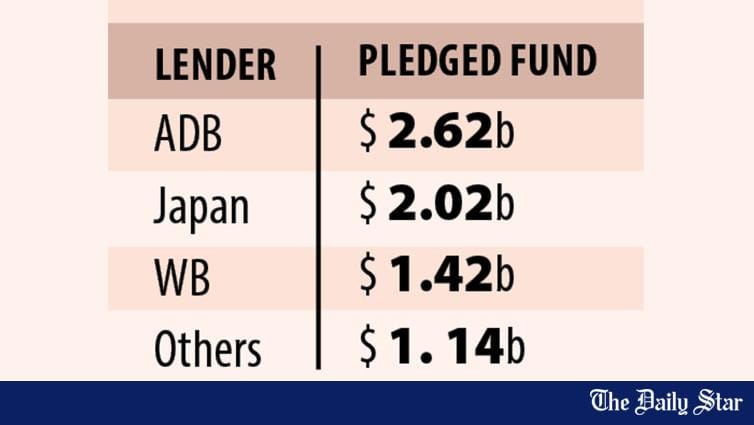
Of the $7.2 billion committed, the highest $2.62 billion was committed by the Asian Development Bank (ADB), followed by Japan $2.02 billion and the World Bank $1.42 billion. The rest $1.14 billion fund commitment came from other lenders.

Between July and January of 2022-23, Bangladesh received commitments for just $1.76 billion in foreign loans.

FUND FOR PROJECTS

As per the fresh commitments, ADB will finance 10 projects in health, education, transport, and energy sectors and for the local government and the Chittagong Hill Tracts.

The ADB has offered to finance a $336.47 million project to establish an international standard laboratory for vaccine research and production of high-quality vaccines.

It will provide $300 million for implementing a project to improve sub-regional transport and trade and 190km of Dhaka-Northwest corridor.

The ADB will also provide $200 million for the "Smart Metering Energy Efficiency Improvement Project" to prevent the waste of natural gas at home.

It will give $100 million to three public universities and the University Grants Commission to create skilled manpower in the manufacturing sector and to create jobs in the industrial sector.

About $90 million will be given to the Local Government Division's project for safe water supply and waste management in Rangamati, Bandarban, and Lama municipalities.

The Local Government Division will also get $490 million for two projects to improve rural connectivity, urban governance, and infrastructure.

Japan's $2.02 billion will go to two ongoing projects. One is the 1,200-megawatt coal power plant at Matarbari. The other project is for building the third terminal of the Hazrat Shahjalal International Airport.

The World Bank will provide $300 million for the economic inclusion of the youth through support for skill development, employment, self-employment, and entrepreneurship.

SLOW IMPLEMENTATION

The authorities have utilised $4.4 billion of foreign funds between July and January this fiscal year.

Of the amount, the ADB disbursed $1.24 billion, Japan $884 million, the World Bank $763 million, Russia $588 million, China $361 million, and India $169 million. Other lenders disbursed the rest.

Shahriar Kader Siddiky, secretary to the Economic Relations Division, said disbursement of foreign funds depends on project implementation.

"We are working in a coordinated way with the relevant ministries, development partners and their headquarters to increase the utilisation of the committed funds. Disbursement is increasing gradually," he told reporters on Sunday after a meeting between Finance Minister Abul Hassan Mahmood Ali and visiting World Bank Managing Director Anna Bjerde.
An ERD official, seeking anonymity, said they have utilised more than $10 billion in foreign funds during each of the last two fiscal years. The official said they used to spend $7 billion a year before that.

Replying to a question, the official said they were expecting commitments for $3 billion to $4 billion more during the last five months of this fiscal year.

LOAN REPAYMENT TO RISE TOO

The government's foreign debt repayment saw a rise of 44.54 percent over the first seven months of this fiscal year.

The government repaid $1.85 billion, which was $1.28 billion during the same period in the last fiscal year.

The surge in disbursement of foreign loans and interest payments against them is pushing up the debt servicing requirement, the ERD official said.​
 
Analyze

Analyze Post

Add your ideas here:
Highlight Cite Fact Check Respond

Inconsistent policies, rules barriers to export diversification​


1708990390771.webp


Inconsistent policies and regulations create uncertainty for exporters and make it difficult for them to plan and invest for the long term, standing in the way of export diversification for Bangladesh, according to experts.

"Bangladesh needs a broad base export policy, addressing all bottlenecks and high tariff issues for export diversification," said Selim Raihan, executive director of the South Asian Network on Economic Modeling (Sanem).

He made the observation at a session on "Challenges of export diversification and structural transformation in Bangladesh" at the 7th edition of the Sanem Annual Economists' Conference (SAEC) at the BRAC Centre Inn in the capital on Sunday.

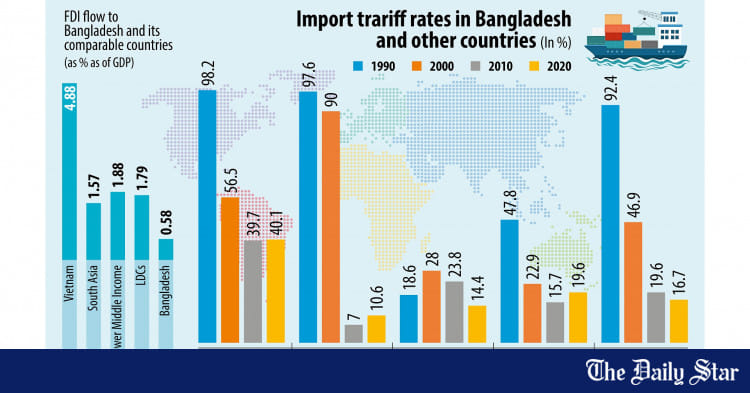
According to Raihan, the overall import tariff line in Bangladesh is 40 percent, which is much higher than in India, Malaysia, and Vietnam.

"Besides, volatile and artificially maintained exchange rates created a bottleneck for export diversification during the last few years."

Syed Akhtar Mahmood, a former lead private sector specialist at the World Bank Group, said in 1995 the economy and the export volume of Bangladesh and Vietnam were almost the same, and in some cases, Bangladesh was ahead of Vietnam.

"But, during the last 30 years, Vietnam has improved a lot while Bangladesh has remained almost the same."

Vietnam has performed well thanks to its policies and support conducive to foreign direct investments, he said, blaming a lack of necessary policy reforms for Bangladesh's failure to attract an expected level of FDIs.

According to him, around $100 billion of Vietnam's exports come from the electronics sector, which almost accounts for 70 percent of the country's total earnings from the external sector.

"Bangladesh had the same potential. But it did not happen due to a lack of timely policy support."

Bangladeshi exporters shipped goods worth $55.56 billion in the last fiscal year of 2022-23, which ended in June.

Mahmood also blamed a lack of timely rules and regulatory reforms for Bangladesh's failure to diversify exports, which are dominated by garments.

Syed Nasim Manzur, managing director of Apex Footwear Limited, said the leather and agriculture sectors have the same potential like the ready-made garments to increase the export volume if the former is granted an identical facility and importance.

He said export diversification is developed through relations, connectivity, and value-chain management.

"We need supply chain management and innovative ideas with proper implementation in order to increase product diversification for the export market. It will happen only if policy reforms are put in place."

Zaidi Sattar, chairman of the Policy Research Institute, alleged the anti-export policy and the high tariff on the import of raw materials are preventing the export sector from tapping its true potential.

There are about 1,500 non-garment products in Bangladesh that are not getting facilities like the garment sector despite having an immense potential to contribute to the export sector, he said.

Sattar said the government is keen to diversify exports but there is no particular policy support.

Zahid Hussain, a former lead economist of the World Bank's Dhaka Office, who chaired the session, said exporters face various trade barriers and protectionist measures in international markets, which limit their access to new markets and increase the cost of doing business.

"Export diversification is needed for poverty reduction and employment generation and the government can play the due role to this effect."​
 
Analyze

Analyze Post

Add your ideas here:
Highlight Cite Fact Check Respond

LDC Graduation: Implications for Bangladesh beyond 2026​


1709159911348.webp

Photo: Prabir Das

It is now more or less recognized that Bangladesh is one of the world's fastest-growing and relatively more resilient economies. The country's macroeconomic performance during the pandemic-induced economic slowdown and the ongoing global supply chain disruptions caused by the Russo-Ukrainian war bear testimony to such an inference. Bangladesh's commendable successes in terms of reducing poverty, coupled with its consistent achievements in human development indicators such as the hunger index, average life span, and maternal and child mortality rates, also prove that gains from positive macroeconomic performances have been able to improve the 'quality of life' for those belonging to the bottom of the social pyramid. Yet, it must also be acknowledged that Bangladesh has faced unprecedented challenges related to the external economy and some internal structural issues. The new government faces critical challenges associated with managing persistent inflationary pressures, making the exchange rates market-friendly, managing the financial deficit, bolstering the forex reserve, creating further employment opportunities, improving the investment climate, and enhancing capacities to mobilize revenue.

Bangladeshi policymakers must make quick, potent, and prudent moves to address the above-mentioned macroeconomic challenges to further realize the country's economic potential (e.g., becoming the ninth largest consumer economy by 2030, a trillion-dollar economy by 2035 or 2040, etc.). It must also be remembered that these challenges, though critical, are only immediate ones. Policymakers must not lose focus on the bigger picture as Bangladesh is to become a 'developing country' within another couple of years (by November 2026). This graduation from the 'LDC category' will create an additional set of macroeconomic challenges for Bangladesh that must also be flagged now.

Given this context, analyzing the challenges likely to emerge due to LDC graduation and looking into the possible ways forward are very relevant. The UN General Assembly has rightly set Bangladesh to graduate from the LDC status and officially become a 'Developing Country' by the end of 2026. In 2021, when this decision was made, Bangladesh's GNI per capita stood at USD 1,827 (graduation threshold is USD 1,222). Bangladesh's scores in the other two indicators, i.e., the Economic Vulnerability Index (EVI) and the Human Assets Index (HAI), were also significantly above the graduation thresholds. The country's EVI score stood at 27 whereas the graduation threshold is 32 or below. Bangladesh's HAI score stood at 75 whereas the graduation threshold is 66 or above. These certainly proved that Bangladesh's journey of inclusive and sustainable development over the previous 10-12 years had yielded the desired results. However, this brought up burning questions about the challenges associated with this graduation.

What are these challenges? As an LDC, Bangladesh has enjoyed preferential access for its exports to many countries. This has particularly contributed to the rapid growth of the RMG exports (which have reached almost USD 50 billion annually by now). Graduating may result in Bangladesh losing such preferential treatment. Secondly, as an LDC, the country has remained flexible in implementing intellectual property rights (IPRs). This has significantly benefitted Bangladesh's pharmaceutical and software industries, which have significant growth potential as export-oriented sectors. However, after graduation, Bangladesh must be further stringent in implementing the IPRs. In other words, these industries will then face increased competition in the global marketplace. Finally, Bangladesh has leveraged long-term soft loans from international development partners as an emerging economy. After graduating from LDC status, Bangladesh will have to pay higher interest rates and deal with shorter grace periods for these International Support Measures (ISMs).

All these make it obvious that without revamping the policies and practices related to international trade, Bangladesh may lose its competitive edge to a significant extent once it becomes a 'developing country.' A UNCTAD projection from 2023 shows that the potential loss of export earnings due to losing Most Favored Nation (MFN) tariffs and withdrawal of the Duty-free Quota-free (DFQF) facilities may range from 7 to 14 percent. It must be noted that this will happen if Bangladesh follows a 'business as usual' course even after graduation from LDC status. Commentators and experts remain optimistic that Bangladesh will live up to its reputation as an ever-evolving and resilient economic engine and cope with this new set of challenges. Yet, the question remains: how to deal with these new challenges most effectively? The country, i.e., its policymakers, will have to combat these challenges in two frontiers: negotiations (mainly more brilliant economic diplomacy) at the international level and bolstering capacities at the domestic/internal levels.

Fortunately for Bangladesh and other economies in transition (e.g., Nepal and Lao PDR), the global bodies appear to be sensitized (at least to a significant extent) to these newly emerging economic challenges. The formal statement from the 12th Ministerial Conference of the WTO (publicized in June 2022) states, "We acknowledge the challenges that graduation presents … We recognize the role that certain measures in the WTO can play in facilitating the smooth and sustainable transition for these Members after graduation from the LDC category." Given this backdrop, now seems to be the high time for Bangladesh to go for a three-pronged approach to economic diplomacy in the international arena.

Firstly, Bangladesh needs to collaborate with other LDC countries to ensure that WTO's previously committed LDC-friendly initiatives (e.g., DFQF market access, LDC-friendly rules of origin, etc.) are materialized as soon as possible so that the country may enjoy the full benefits until it formally graduates.

Secondly, policymakers from Bangladesh should focus on forming and leading a coalition of soon-to-graduate LDCs to push for a new set of support measures to meet the demand for countries in transition (especially in the context of currently prevailing geopolitical turmoil).

Finally, looking beyond 2026, Bangladesh's economic diplomacy should focus on expediting negotiations with the WTO related to new/emerging sectors such as fisheries subsidies, e-commerce, investment facilitation, and promoting MSMEs.

Along with economic diplomacy, Bangladesh must prioritize domestic preparedness for smooth and sustainable graduation. The country needs to diversify its export basket (over 80 percent from one sector- RMG) and diversify its export destinations (an overwhelming share of exports going to 9 to 10 countries only). Structural transformation of the export sector will also be pivotal as 93 percent of Bangladesh's exporters are low-tech manufacturers (the ratio is 33 and 21 for Vietnam and India, respectively). While Bangladesh has made excellent strives to develop hard infrastructure, this trend needs further bolstering. A Bangladesh exporter still requires 28 days to complete an export process, whereas the average for Asia is 18 days. Private sector investment in infrastructure development must grow significantly (currently, private sector participation is only 1.1 percent of GDP). To reduce reliance on international development support/assistance, Bangladesh must also significantly improve its capacity to mobilize revenue domestically. Tax-GDP ratio for Bangladesh has been hovering below 10 percent for many years now, whereas an economy of such size and potential should have a ratio over 15 percent. This calls for fast digitization of resource mobilization and improving the governance of revenue management. Also, special attention is needed to ease the tax administration to attract more foreign direct investors.

In conclusion, it may be safely said that Bangladesh, with its extraordinary resilience and entrepreneurial zeal, has done very well in laying the foundation for a vibrant, developing country. However, the challenges remain, particularly in skilling and reskilling human resources to make the production process more efficient. In addition, the geopolitical challenges, including the latest tension in the Red Sea on the movement of ships and the threat of deglobalization or truncated trade cooperation, may constrain the potential gains from the graduation. The country may have to focus more on regional and subregional economic cooperation and greater emphasis on domestic production. The financial sector will have to reorient itself with more cooperation in the regional payment system to cope with the new landscape of trade cooperation in the new context.​
 
Analyze

Analyze Post

Add your ideas here:
Highlight Cite Fact Check Respond

Members Online

⤵︎

Latest Posts

Latest Posts