[🇧🇩] Monitoring Bangladesh's Economy

[🇧🇩] Monitoring Bangladesh's Economy
948
25K
More threads by Saif

G Bangladesh Defense

Challenges on the road to becoming the 28th largest economy​


1707959861055.webp

Investment, both domestic and foreign, plays a pivotal role in fostering economic growth. PHOTO: REUTERS

Bangladesh undeniably stands out as one of the most promising economies in the region. Despite facing resource constraints, the country has made commendable economic and social progress since independence. This success is a testament to the indomitable spirit of the Bangladeshi people, their relentless struggle for survival, and their remarkable commitment, determination, and entrepreneurial spirit. With an average annual GDP growth of six percent since the 2000s, Bangladesh currently holds the 35th position among global economies, and it is projected to become the 28th largest economy by 2030. However, this ambitious journey toward economic advancement is not without its challenges. The critical hurdles on our path include tackling poverty, addressing income inequality, managing high inflation and external debt burden, attracting foreign investment, improving resource mobilisation, addressing foreign exchange shortages, curbing corruption, ensuring the stability of the financial sector, and others.

In recent years, Bangladesh has borrowed heavily to finance various mega projects. Consequently, annual debt servicing has been on the rise, which now constitutes a substantial share of the government's expenditures. According to data from the Bangladesh Bank, the total government debt, comprising both domestic and foreign, reached around the $100-billion mark at the end of June 2023. While some of these projects may yield long-term benefits, the immediate requirements for debt servicing pose a challenge for the government's financial capacity. Currently, Bangladesh has to repay foreign loans ranging from $2-2.76 billion annually, and this amount is expected to rise in the coming years. According to a finance ministry projection, foreign debt repayments, including interests, will reach $4.5 billion in 2025-2026. The increasing external debt service payments are straining the country's foreign exchange reserves.​

1707959897795.webp

With an average annual GDP growth of six percent since the 2000s, Bangladesh currently holds the 35th position among global economies. VISUAL: TEENI AND TUNI

Concurrently, debt-service payments are diverting already scarce fiscal resources from critical sectors such as healthcare, education, social assistance, and infrastructure development. While experts argue that Bangladesh's current debt-GDP ratio is not a cause for concern, it shouldn't be seen as a green light for indiscriminate loan accumulation. To secure the nation's economic future, it is crucial for policymakers to prioritise projects by carefully assessing payback periods, thus preventing potential debt traps. Ensuring the efficient utilisation of borrowed funds is paramount to sustaining the economic cycle in the face of challenges.

Investment, both domestic and foreign, plays a pivotal role in fostering economic growth, improving the skills of the local workforce through the transfer of technology, leading to job creation, higher incomes, and improved standards of living. Research shows that to transform Bangladesh into a high-income country, it would need to raise its investment-to-GDP ratio to around 40-44 percent of GDP. Regrettably, private investment has shown little growth, hovering at around 23-24 percent of GDP for the past decade, as reported by the Bangladesh Bureau of Statistics (BBS). We are also lagging behind in attracting foreign direct investment (FDI). While even during the pandemic (2020) FDI flow to developing countries in Asia increased by four percent to $535 billion, according to figures from the UN Conference on Trade and Development (UNCTAD), Bangladesh could not achieve the expected FDI. As per Bangladesh Bank's data for the fiscal year 2023, the nation attracted approximately $3.2 billion in foreign direct investment. The rate of FDI inflow in Bangladesh is only around one percent of GDP, one of the lowest in Asia.

1707959948717.webp

ILLUSTRATION: Salman Sakib Shahryar

It's crucial to recognise that the level of convenience in doing business holds significant importance for foreign investors when deciding where to invest. The ease of doing business and global competitiveness are key factors influencing their investment choices. Investors assess various aspects, including the clarity of existing policies, reliability of government officials, taxation policies, adherence to rules and regulations and, most importantly, the security provided for their investments.

Regrettably, in the case of Bangladesh, investors often express frustration due to bureaucratic hurdles that impede smooth business operations. These challenges include bureaucratic red tape, inadequate socio-economic and physical infrastructure, inconsistent energy supply, corruption, underdeveloped money and capital markets, a complicated tax system, along with delays in decision-making processes. Furthermore, hidden costs related to procedures, policies, laws, and infrastructure significantly impact the overall cost of doing business.

Therefore, in light of the current economic challenges, it is essential to boost investment inflow by making timely adjustments to policies. The government should remove the impediments that are responsible for the high cost of investment and promptly take measures to improve public goods and services, including roads, electricity, gas, water, and sewerage. Additionally, the government should implement business-friendly policies safeguarding the rights of enterprises, workers, consumers, the environment and, most importantly, ensure a stable political environment to attract both domestic and foreign investments.

1707959994813.webp

Bangladesh undeniably stands out as one of the most promising economies in the region. VISUAL: REHNUMA PROSHOON

Bangladesh's export portfolio is primarily dominated by its ready-made garments (RMG) sector. In the fiscal year 2022-2023, the total export from Bangladesh amounted to $55.56 billion, with RMG exports contributing $46.99 billion. Currently, the RMG sector accounts for 85 percent of the country's total exports, with primary destinations being the European Union and the United States. The RMG sector has played a transformative role in shaping our economy, job market, and income, but due to ongoing global geopolitical conflicts, energy price hike, domestic political unrests, currently, the RMG sector is in a sluggish state. Hence, for Bangladesh to sustain its growth trajectory, diversification of the export basket and tapping into new markets is imperative.

Industry insiders say that there are promising export sectors such as pharmaceuticals, bicycles, shipbuilding, leather and leather goods, frozen and live fish, terry towels, furniture, and agricultural products, if the government provides adequate policy support, similar to what is offered to the RMG sector.
1707960028547.webp

According to a finance ministry projection, foreign debt repayments, including interests, will reach $4.5 billion in 2025-2026. VISUAL: TEENI AND TUNI

Foreign remittance is Bangladesh's lifeline. Despite an increasing number of Bangladeshis leaving for jobs abroad, in recent times, the remittance inflow has been decreasing at an alarming rate. In September 2023, migrant workers sent home $1.34 billion—the lowest since April 2020, according to data from Bangladesh Bank. Large remittances are sent through informal channels like hundi despite a 2.5 percent incentive for the remitters through the banking channel. Many argue that the widening gap between official and unofficial exchange rates, lack of motivation, and institutional barriers such as high transaction costs and formalities for sending remittances through formal channels hinder remitter's use of banking services. Currently, Bangladesh is struggling with a prolonged dollar crisis and is compelled to restrict imports due to falling reserves. Remittances play a vital role in growing foreign exchange reserves and economic growth. Hence, an urgent policy focus is required to shift remittances from informal to formal channels.

One of the biggest concerns for the economy is our ailing banking sector, which has, on numerous occasions, been tarnished by unwanted malpractices. It is now an open secret that the country's banking sector has been entangled in a series of scams and irregularities, such as the funnelling of loans worth billions of taka by violating banking rules and procedures to influential people known for lax repayments. Unfortunately, violators of banking norms and regulations are hardly ever punished, and they are allowed to continue to default on loans with impunity. As a result, at the end of FY 2022-23, defaulted loans in the banking sector stood at a record Tk 156,040 crore.

Banks are the lifeblood of the economy; therefore, regulators should take pre-emptive measures to control the current situation before it worsens and gets out of control. A combination of strong policy reforms and good governance in the banking sector is the need of the hour. Measures should include legal action against wilful loan defaulters, enhanced banking regulation and supervision, addressing banking sector weaknesses, tighter criteria for loan rescheduling/restructuring, and improved legal systems to accelerate loan recovery. If enforcement authorities take these measures with the right intentions, Bangladesh will embark on a path to creating a stronger economy.
1707960065757.webp

A vendor sells fish at a market in Dhaka. PHOTO: REUTERS

Over the past decade, Bangladesh has consistently demonstrated impressive economic growth. However, one may ask: has everyone been able to share its benefits equally? The answer, sadly, is "no." The growth has, unfortunately, bypassed the majority of the population while higher-income groups have been its main beneficiaries. The country has experienced a rapid increase in income inequality, with 10 percent of the population owning 40 percent of the national income, while the bottom 50 percent possess only 19.05 percent of GDP. The primary factors which deprive poor and vulnerable people of their most elementary rights—and which lead to greater income inequality—are unequal access to education and employment opportunities, low-wage jobs, unchecked corruption and systemic irregularities (such as those enabling the various scams in the banking sector), tax evasion, money laundering, and so on.

The growing gap between the rich and poor not only hinders sustainable growth but also increases the risk of social and political unrest. As such, it's essential for our policymakers to stop favouring the wealthy and start focusing on fair treatment for everyone. The main goal should be to achieve inclusive growth. We need to address issues like wealth sharing, good governance, and social policies that promote fairness and equality. It may be noted that a society that is happy, equal, and just will always experience peace and prosperity.

Inflation has been adversely affecting the common people in Bangladesh. Prices of daily essentials, including eggs, chicken, onions, potatoes, sugar, and oil, have consistently increased, contrasting with the global trend of decreasing prices. Purchasing daily necessities has become increasingly challenging, as highlighted in a recent report by the World Bank. According to the report, 71 percent of families are being affected by rising food prices. This alarming statistic implies that out of the 4.10 crore families, almost 2.91 crore are facing food insecurity, a matter of grave concern. If the current trajectory of inflation and escalating living costs persists, there is a significant risk of more families falling into poverty.

1707960125820.webp

VISUAL: STAR

Experts say that soaring food inflation rates in the country are linked to flawed government policies, poor market management and the profit-seeking behaviours of certain businessmen involved in syndicates. Moreover, the control of essential commodity imports by powerful businesses has resulted in market monopoly. The government has to address all the underlying reasons behind food inflation through a well-formulated action plan.

The need for continued investment in education and skill development is another challenge that Bangladesh must address. Over the past few years, numerous experiments have been carried out in the name of modernising and updating our primary, secondary, and higher secondary education. Yet, the existing education curriculum is not aligned with industry needs. While educational institutions worldwide emphasise soft skills like team-building, problem-solving, critical thinking, communication, negotiation, and decision-making, our education system is still stuck in the past.

So, often, we hear complaints from the business community about their inability to find skilled workers, leading them to hire foreign professionals due to a lack of efficient local human resources. This not only hampers the country's job market but also increases the strain on Bangladesh's depleting foreign-currency reserves.

Regrettably, our education budget doesn't reflect the urgency of developing human resources. The country spends around two percent of its GDP on education, which is the lowest among South Asian countries. It is high time for Bangladesh to focus on enhancing its education system, ensuring that the workforce is equipped with the skills necessary for the evolving job market. A well-educated and skilled population is not only vital for fostering innovation but also for attracting high-value industries and investments.

It's unfortunate that, even after 52 years of independence, the country's healthcare sector is in shambles. It is shameful that a nation on the path to becoming the 28th largest economy in the world still witnesses a substantial number of its citizens, including politicians, businessmen, and ordinary people, seeking medical treatment abroad each year. This trend reflects a lack of confidence in our own healthcare system. While individuals choosing overseas medical care may argue that they owe no public explanation, the scenario takes a more alarming turn when Bangladeshi leaders and politicians follow suit. Their decision to seek medical treatment abroad is not just a personal matter but a cause for concern, as they bear the responsibility for the development of a robust healthcare system for their fellow citizens.

This prevailing culture needs to be transformed urgently, given its detrimental impact on our hard-earned foreign currency reserves and the nation's image. The government should prioritise and guarantee equitable access to high-quality health services for all citizens. Failing to improve our health sector not only jeopardises the well-being of our population but also threatens to erode the significant economic gains Bangladesh has achieved over the years. Therefore, concerted efforts are imperative to instigate a paradigm shift and ensure that the healthcare system becomes a source of pride and reliability for every citizen, discouraging the need for seeking medical treatment abroad.

Corruption is a global problem, and Bangladesh is no exception to this pervasive issue. While the country holds the 147th position out of 180 countries in the Corruption Perceptions Index (CPI) for 2022, according to Transparency International, it is important to recognise that this ranking does not implicate every citizen in the web of corruption. I firmly believe that the majority of Bangladeshis are honest and possess integrity. Nevertheless, the harsh reality persists that a handful of people within key sectors such as government offices, businesses, healthcare, education, and political institutions are involved in corrupt practices such as bribery, embezzlement of public funds, bank loan scams, money laundering, under/over invoicing, adulteration of food and drugs, and various forms of cheating.

It is unfortunate that despite governmental claims of zero tolerance for corruption, there is a disconcerting trend where powerful individuals often escape accountability. It should be noted that instances of overlooking or condoning corrupt practices among associates, friends, and political supporters erode public trust, perpetuating a culture where dishonesty might be perceived as justifiable. The need to break free from this complacency is urgent. Holding wrongdoers accountable and instituting stringent measures against corruption are imperative. Currently, the absence of severe consequences for influential figures engaged in corrupt activities not only perpetuates a cycle of impunity but also undermines public confidence in the democratic process. It is time to revisit and reinforce our commitment to eradicating corruption.

Effective law enforcement is a critical pillar in ensuring that the corrupt face justice and that the culture of impunity is dismantled. However, punitive measures alone are insufficient, a comprehensive approach that includes legal reforms, institutional strengthening, and increased societal awareness is indispensable to combatting corruption. These measures are not only vital for sustained economic growth but are also fundamental for elevating Bangladesh's standing on the international stage.​
 

Analyze Post

Add your ideas here:
Highlight Cite Respond

Govt must address inflation, banking sector irregularities
Published: 00:00, Mar 19,2024

A CONSISTENT upward trend in the volume of currency held outside the banks over the past few months brings forth a number of issues that warrant attention. The amount of cash held outside the country’s banks increased in January to reach Tk 2,57,295 crore from Tk 2,54,860 crore in December, Tk 2,48,441 crore in November and Tk 2,45,943 crore in October. The figure was Tk 2,05,895 crore in October 2021. The increase in the volume of cash held outside the banks is blamed on consistent high inflation, people’s declining purchasing power, an erosion of trust in banks and a rise in informal economic activity. The overall inflation rate reached 9.67 per cent in February, while the rate, according to even the conservative estimate of the Bangladesh Bureau of Statistics, remained over 9 per cent for the past 12 consecutive months. Food inflation, meanwhile, has remained higher than non-food inflation. The high inflationary pressure have devalued the taka and negatively impacted people’s purchasing power. Depositors have, as a result, continued to withdraw their deposits to meet the rising costs of living. Widespread irregularities in the banking sector have, moreover, caused an erosion of trust in banks, causing declining deposits in the banks. What is worrying is that the government and the central bank have failed to address both the issues.

When most countries that experienced inflationary pressures since early 2022 in the wake of the Russia-Ukraine war have largely succeeded to contain inflation with effective monetary and fiscal policies, Bangladesh appears to have lamentably failed to address the issue. The mismatch between the expansionary fiscal policy of the government and the contractionary monetary policy of the central bank has rendered all initiatives aiming at containing inflation ineffective. And, with a rise in cash outside the banks the central bank is hardly at a position to control money supply, which is crucial to managing inflation and ensuring economic stability. The authorities have also failed to address the irregularities in the banking sector that has caused a trust deficit, resulting in a decline in deposit. Two-thirds of the banks are, according to the Bangladesh Bank, in a bad shape. In the recent Banks’ Health Index and HEAT Map, the central bank has categorised banks into three zones: green, yellow, and red. The index finds the health of only eight local banks in a good shape and finds 12 banks in a critical condition, among which nine are put in the red zone. Twenty-nine banks are in the yellow zone, suggesting weak and fragile condition and requiring special supervisory attention. The banking sector has for long been plagued by a sharp rise in defaulted loans, scams, irregularities, mismanagement and a lack of good governance. Such a sorry state of the banking sector has not only caused a decline in deposit but also encouraged significant economic activity outside the banks.

The consistent increase in cash held outside the banks has implications for monetary policy, liquidity management and overall economic stability. The authorities must, therefore, devise potential policy interventions to address the underlying issues and to achieve economic stability.​
 
Analyze

Analyze Post

Add your ideas here:
Highlight Cite Fact Check Respond

Bangladesh’s exports to keep boosting economic growth: BMI​


1710888430837.webp


Bangladesh's exports will continue to contribute to its economic growth in the short term although high inflation, a weaker taka, and restrictions on imports will weigh down consumption and private investment, according to a new report.

The report, prepared by BMI, a provider of insights, data and analytics owned by Fitch Solutions, said a weak macroeconomic environment and lower purchasing power had caused consumers to shift spending away from mid-priced clothing towards low-priced items, benefitting low-wage producers such as Bangladesh. The report was released last week.​

"We expect that Bangladesh's exports will be bolstered by the growth of low-priced clothing sales across key destinations."

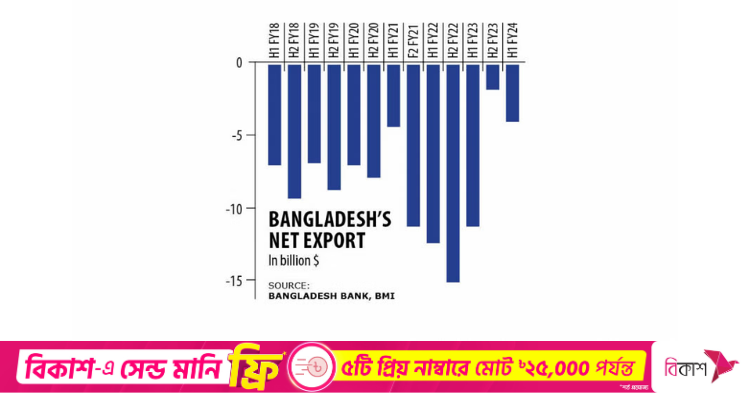
According to BMI, Bangladesh's net exports, which have historically been in the negative, improved to $3.9 billion in the negative, significantly higher than the average net exports of negative $8.1 billion since FY2017-18.

"Net exports are a bright spot as Bangladesh's trade deficit has decreased over recent months and stands at a low, even compared to pre-pandemic levels."

Net exports bottomed out at negative $15.1 billion in the second half of 2021-22, it said.

"The devaluation of the Bangladeshi taka will sustain the country's export competitiveness and keep net export growth elevated."

BMI said Bangladesh's economy is projected to grow 5.4 percent year on year in 2023-24, which is lower than the Bangladesh Bureau of Statistics (BBS) estimate of 5.78 percent.

BMI's prediction is also lower than the forecasts made by the World Bank and the International Monetary Fund.

In January, the World Bank projected that Bangladesh's gross domestic product would slow to 5.6 percent in FY24. The IMF forecast a GDP growth of 6 percent.

This ranges below the robust pre-Covid growth rates, which averaged 6.6 percent in the decade to the pandemic, BMI added.

According to the data service provider, higher inflation and interest rates, capital goods import restrictions, a weaker taka and the ongoing shortage of foreign currency will weigh heavily on private sector investment.

"Although we do not currently forecast the taka to undergo significant further depreciation in the short term, the strong devaluation of the currency in 2022 will continue to weigh on household purchasing power."

Inflation is forecast to average 9.4 percent in FY24, up from 8.9 percent the previous year and considerably above the historical five-year average of 6.3 percent from 2018-19 to 2022-23.

"We forecast private consumption to continue under-performing as high inflation undermines household purchasing power."

It also forecast that private consumption would expand by 6 percent year on year in FY24. But the growth is lower than the stronger growth rates of 8 percent and 7.5 percent recorded in 2020-21 and 2021-22, respectively.

However, it said, robust remittance inflows will provide some upside pressure to consumption.

Remittances inflows, which amount to roughly 5 percent of Bangladesh's GDP, have grown at an average of 22.8 percent per month since October 2023, it said.

"We expect inflows to remain strong, supported by a positive economic outlook for the Gulf Cooperation Council economies," said BMI, forecasting the bloc's economic growth would accelerate from 0.7 percent in 2023 to 2.6 percent in 2024.

An increase in energy prices due to a regionalisation of the Israel-Hamas war poses a key downside risk to the outlook, it said.

BMI added that although energy prices have declined since their rise in response to Russia's invasion of Ukraine, they are expected to remain comparatively high.​
 
Analyze

Analyze Post

Add your ideas here:
Highlight Cite Fact Check Respond

Taming Inflation: Let the orthodox monetary policy work​


1710973293608.webp


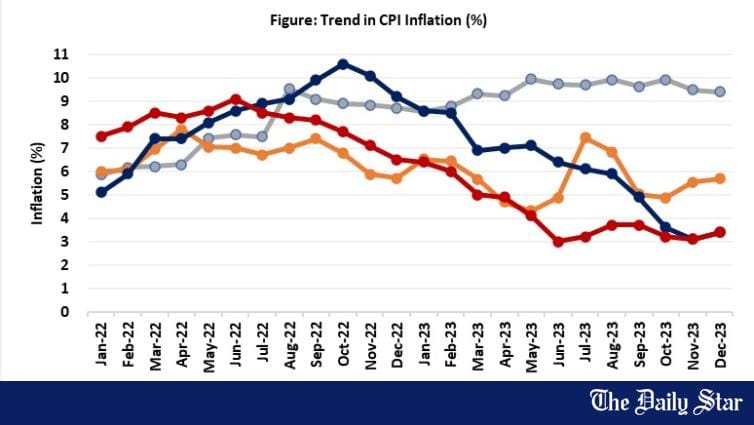
Bangladesh has been experiencing rising inflationary pressure for at least 18 months. In fact, monthly inflation reached as high as 9.94 percent in May 2023 and still remains stubbornly high at 9.67 percent in February 2024. Uncontrolled inflationary pressure is one of the most problematic phenomena in the country. Lessons from economic history vividly demonstrate that high inflation can hinder macroeconomic stability, erode competitiveness of local entrepreneurs, demotivate investment decisions, and accentuate income inequality by substantially reducing the purchasing power of fixed-income and financially weak households.

Thus, it is not surprising that mature monetary regimes across advanced economies commit to an inflation targeting framework where the primary agenda is to keep inflation at about two percent annually. This also explains why, recently, central banks across advanced economies have responded aggressively to tighten money supply and raise interest rates, which translated into lowering inflationary pressure in their respective economies. Interestingly, this also creates a useful context for evaluating the effectiveness of our monetary policy, which has largely been ineffective in controlling inflation.

More simply, given that global inflation has been coming down over the last 18 months, why has inflation in Bangladesh maintained an upward trend since mid-2022? In other words, why is inflation in countries like India and Sri Lanka less than six percent while it remains above 9.6 percent in Bangladesh? What explains this divergence?

To decode this heterogeneity in monetary performance, this analysis will offer insights on three core issues: (i) the set of factors that has driven the global inflationary pressure and how it has been addressed by central banks across the world. In particular, we try to distil the broad lessons that emerge from the international experience; (ii) the set of factors that has driven the inflationary pressure in Bangladesh, and why Bangladesh Bank has failed to tame the inflationary pressure; and (iii) the exact policy decisions that might help bring the current inflationary pressure under control.

Drivers of global inflation and lessons for monetary policy


There is now a consensus among experts that excessive fiscal and monetary stimulus in response to Covid, along with the supply chain disruptions stemming from the aftershocks of the pandemic and Russia-Ukraine war, fuelled this spike in inflation across countries. The initial expectation that the inflationary spike is a transient phenomenon did not come true, and advanced economies started preparing for the worst-case scenario—stagflation—where it was expected that inflation and unemployment rate would rise and remain high simultaneously. This prompted central banks in advanced countries to raise their respective interest rates and commit to contractionary monetary policies, given from the standpoint of macroeconomic management; inflation is seen as a more dangerous problem than unemployment.

For instance, inflation in the United States reached as high as 9.1 percent in June 2022—the highest in 40 years. Responding to this growing crisis, the Fed increased its policy rate eleven times to a range of 5.25 to 5.5 percent—the highest policy rate in 23 years. Consequently, inflation since then decreased substantially, coming down to 3.1 percent in January 2024. Even in India, over the same time span, inflation came down from 7.7 percent to 5.1 percent—responding to the Reserve Bank of India's (RBI) decision to increase the policy rate to 6.5 percent. A similar phenomenon was also observed for the European Union where a contractionary monetary policy brought down inflation from 11.50 percent in October 2022 to 3.1 percent in January 2024.

It is also interesting to underscore that in the US, EU and India, inflation management through contractionary monetary policies did not result in any serious spike in unemployment or nosedive in economic growth. The noted regions have achieved an economic "soft landing," a phenomenon that has pleasantly surprised policymakers who expected costly growth implications of a sustained contractionary monetary policy stance.

Of course, not every nation-state crafted a similar response for inflation management. Türkiye boldly and quite foolishly did what no one expected: its central bank, under pressure from President Tayyip Erdogan, decided to lower interest rates despite an inflation rate of 20 percent, arguing that such measures would help increase investments and smoothen supply-side constraints. But this unorthodox monetary policy experiment did not work and inflation increased to 80 percent in 2022. Subsequently, Türkiye has corrected its earlier devastating monetary policy blunder by increasing its interest rate to 40 percent, which has triggered a downward trend in its inflation rate (standing currently at 65 percent).

On the whole, the global downward trend in inflation validated the effectiveness of an orthodox monetary policy, which views inflation as a largely monetary phenomenon and supports inflation management through contractionary monetary policy stance.

Drivers of inflation in Bangladesh and BB response


As the inflationary pressure in Bangladesh remains sturdy, it is essential to pinpoint its possible drivers. According to the latest monetary policy statement published by the Bangladesh Bank, our inflationary pressure is fuelled by three key factors: (i) supply chain disruptions stemming from post-Covid demand spike and Ukraine-Russian war; (ii) exchange rate depreciation due to higher import bills in FY2022 (which could have been due to money laundering through over-invoicing of imports); and (iii) a sharp energy prices adjustments after the Ukraine-Russia war.

This we believe is an accurate but an incomplete assessment as it ignores a number of key additional issues that have seriously compromised the authorities' efforts to contain inflation. These are: (i) keeping the interest rate structure administratively fixed in the range of six to nine percent for a long time, ignoring the global developments and the post-Covid surge in domestic inflation; (ii) keeping the exchange rate virtually fixed against the US dollar for almost 12 years, contributing to a massive balance-of-payment imbalance and a sharp depreciation of the taka; (iii) injection of substantial monetary stimulus to navigate the economic effects of Covid, which was necessary at that time but was not sterilised subsequently; (iv) printing of high-powered money by the Bangladesh Bank for lending to the government to compensate for revenue shortfall in FY2023; and (v) injection of emergency funds through promissory notes into troubled Islamic banks in December 2022 and December 2023, partially offsetting the efficacy of the central bank's contractionary monetary policy stance. Collectively, these issues need serious recognition in policy formulation.

It is also essential to underscore that the Bangladesh Bank's initial narrative that the inflation was transitory due to external supply shocks and would unwind with supply situation improving was wrong. Thus, its earlier reluctance to remove the six to nine percent interest rate band undermined its fight against inflation. The unchanged interest rate policy also widened the interest rate differential in favour of the US dollar, thereby undermining the authorities' efforts to limit the depreciation of taka by making the taka less attractive against the dollar. The unfavourable return on taka assets coupled with the exchange rate depreciation turned the financial account of the balance of payments significantly negative for the first time in many decades, accentuating pressure on foreign exchange reserves and the exchange rate as short-term capital inflows dried up. Since up to 40 percent of inflation could be attributed to the 30-35 percent depreciation of the taka, an aggressive interest rate policy could have a dampening impact on the inflationary pressure.

Going forward, it is encouraging to note that Bangladesh Bank has moved away from its earlier narrative and has announced the adoption of a tighter monetary stance in its latest Monetary Policy Statement. The authorities have already abandoned the six to nine percent interest policy band, have announced that there would be no recourse to central bank borrowing for budget financing, and the resulting bank financing of the budget deficit has contributed to a significant increase in the interest rates on treasury bills and bonds.

The green shoots of macroeconomic stabilisation is already visible in the form of: (i) external current account being in surplus due to import compression; (ii) stabilisation of the official foreign exchange reserves at around $18-20 billion level; (iii) an apparent stabilisation of the exchange rate around Tk 120-124 per dollar for the last three months; and (iv) an upgradation of the outlook for the banking sector by Moody's due to increased profitability, some recovery in bank deposits and improved liquidity situation, all resulting from the abandoning of the fixed interest rate band.

Given the gains already visible, the Bangladesh Bank needs to go further to consolidate the gains. The post-election hike in the policy rate by 25 basis points was too little too late. The policy rate should be increased in steps of 50 basis points per month for the next four months before considering a pause in the policy rate increase. The basic principle should be to "continue increasing the interest rate until the inflation rate comes down close to the target range." We are still very far from that.

The agenda for restoring macroeconomic stability including price stability—in addition to interest rate hikes—will require (i) unification of the exchange rate in the interbank market; (ii) a sizable cut in non-essential fiscal spending (which we believe is underway); and (iii) refraining from central bank financing of the budget deficit despite the expected pickup in budgetary spending in the final quarter of FY2024. Notwithstanding the initial hesitations and delays, the authorities' current policies are in the right direction and working. What is needed is to strengthen the orthodox policy measures further along the lines described above, and allow for six to nine months of time for the policies to deliver the desired results.​

Dr Ahsan H Mansur and Dr Ashikur Rahman are executive director and senior economist, respectively, at the Policy Research Institute (PRI).
 
Analyze

Analyze Post

Add your ideas here:
Highlight Cite Fact Check Respond

External debt crosses $100b for first time​


1711059551119.webp


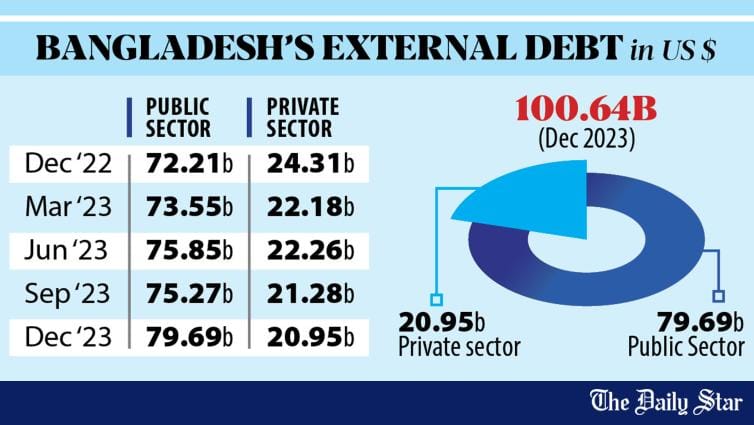
Bangladesh's external debt has crossed the $100 billion mark for the first time, indicating a challenging future amid foreign exchange shortage.

At the end of 2023, the overall external debt stood at $100.6 billion, up from $96.5 billion a year earlier, as per the latest data from the Bangladesh Bank.

Of the external debt, $79.69 billion was taken by the public sector and the rest by the private sector. About 85 percent of the loans are long-term and the rest are short-term.

The debt buildup, which is still within the threshold recommended by the International Monetary Fund (IMF), is becoming a headache for the country given the unfavorable developments on various economic fronts.

"This is concerning that the external debt is increasing," said Ahsan H Mansur, executive director of the Policy Research Institute of Bangladesh.

To tackle the situation, the supplier credit that is being taken from China and Russia must be stopped now, he said.

Supplier credit is an agreement in a commercial contract under which an exporter will supply goods or services to a foreign buyer on credit terms.

If external debt continues to rise, with it the repayment challenges will mount as the country's earning capacity is slowing, both in terms of revenue and foreign exchange, said Mansur, a former economist of the IMF.

Both external debt and debt servicing are growing, said Mustafizur Rahman, a distinguished fellow of the Centre for Policy Dialogue.

In the first five months of the fiscal year, the government's spending on interest payments for foreign debt surged 136.7 percent year-on-year to $562 million.

"The latest batch of external debt is costly, so we have to be alert that there is no problem in debt servicing," Rahman said.

The returns against the foreign loans are coming in local currency and because of the devaluation of the local currency against the dollar, the cost of foreign debt will increase, he said.

The foreign loans that are piled up in the pipeline for projects will have to be used soon to avoid increasing the servicing costs, he added.

Meanwhile, the private sector's foreign loans have dropped about 14 percent to $20.95 billion.

Previously, the interest rate for foreign loans was 1 percent to 2 percent but it has now jumped to 8 percent to 9 percent, said a top official of the central bank.

"This is the main reason for the declining trend of private sector foreign loans," he added.​
 
Analyze

Analyze Post

Add your ideas here:
Highlight Cite Fact Check Respond

Gross forex reserves dip below $20b again
Staff Correspondent | Published: 23:09, Mar 21,2024

1711147014772.webp


A file photo shows a man counting dollar notes in the capital Dhaka. The gross foreign exchange reserves in Bangladesh, according to the International Monetary Fund guidelines, dropped to $19.98 billion on Wednesday. — New Age photo

The gross foreign exchange reserves in Bangladesh, according to the International Monetary Fund guidelines, dropped to $19.98 billion on Wednesday.

According to Bangladesh Bank data, the foreign exchange reserves reached the current level on the day from $20.78 billion at the end of January 2024 and $21.86 billion at the end of December 2023.


However, based on the Bangladesh Bank’s conventional valuation, the foreign exchange reserves were reported as $25.24 billion on that day.

The reserves did not fall significantly as the central bank received more than $1 billion from banks under recently launched swap arrangements, bankers said.

As the banks are facing serious liquidity crisis, they are searching for options for local currency under the arrangements, they said.

So, the dollar rate declined by Tk 4-6 each on the open market to Tk 117 each.

The foreign exchange reserves had previously dropped to $19.13 billion on December 6, 2023, but recovered to $21.74 billion on January 4 after receiving $689 million in loans from the International Monetary Fund and $400 million from the Asian Development Bank.

The Bangladesh Bank follows the IMF’s BPM6 for calculating gross and net international reserves.

The decline in the country’s foreign exchange reserves continued due mainly to a significant dollar shortage on the market, which has compelled the central bank to continue selling dollars to the banks from its reserves, BB officials said.

Due to payments made to the Asian Clearing Union, the reserves also declined.

The Asian Clearing Union is a payment settlement forum whereby the participants settle payments for intra-regional transactions through participating central banks on a net multilateral basis.

Payment obligations of transactions among Bangladesh, Bhutan, India, Iran, the Maldives, Myanmar, Nepal, Pakistan and Sri Lanka are settled through the ACU payment system.

Apart from the payment obligations to ACU, the ongoing sales of foreign currency to the country’s banks by the central bank contributed to the reduction in the country’s foreign exchange reserves.

The central bank has been selling dollars to commercial banks, with more than $30 billion sold over the past 32 months.

This included $9 billion allocated to banks in July-February of the financial year 2023-24, $13.5 billion in FY23 and $7.62 billion in FY22.​
 
Analyze

Analyze Post

Add your ideas here:
Highlight Cite Fact Check Respond

Members Online

Latest Posts

Back
Top
PKDefense
G
O
 
H
O
M
E