[🇧🇩] Monitoring Bangladesh's Economy

[🇧🇩] Monitoring Bangladesh's Economy
1K
51K
More threads by Saif

G Bangladesh Defense

Enabling inflow of fresh FDI


1792537720446.webp


For an economy struggling to stimulate private investment and generate employment, the persistent failure to attract foreign direct investment (FDI) is indeed troubling. And that is despite the generous fiscal incentives and tax holidays being offered to foreign investors. According to the latest Bangladesh Bank (BB) figures, net FDI inflows during the first half of 2026 dropped by about 28 per cent to USD794 million from over USD1.1 billion in the corresponding period last year. More concerning is the fall in fresh equity capital from USD345 million to just USD156 million. Meanwhile, reinvested earnings of multinational companies (MNCs) increased markedly.

Admittedly, their retaining profits is a positive sign. But reinvestment reflected in company accounts should not be confused with new capital being brought from abroad to set up industries or expand businesses. Evidently, potential investors are taking a wait-and-see approach. So, what is holding them back? In fact, foreign investors, who have the option of choosing among competing destinations, look beyond the tax concessions on offer. They also take into cognizance the chronic shortages of gas and electricity, inadequate logistics and port facilities, rising production costs and the bureaucratic hassles involved in obtaining permissions. In addition, there are macroeconomic challenges such as high inflation, volatility in the exchange rate regime and uncertainties arising from global trade disputes and geopolitical tensions. Understandably, investors are reluctant to undertake long-term projects under such conditions. Worse still, the country's financial sector, already weakened by massive non-performing loans (NPLs), poor governance and shortages of credit for productive industries, hardly inspires confidence. The NPL ratio, reportedly, reached 33.2 per cent last June. And international credit-rating agencies' adverse assessments of Bangladesh's sovereign risk do not help matters either. Clearly, fiscal baits cannot compensate for such structural weaknesses in an economy.

However, what is particularly disconcerting is that the government is failing to make the best of the reforms it has already introduced. According to the foreign investors' chambers, as reported in last Monday's exclusive carried by this paper, NBR's field-level officials often interpret tax regulations differently or are insufficiently informed of the changes made at the policy level. The outcome is procedural complexity, uncertain assessments, delayed refunds and sometimes multiple audits of compliant companies. But the revenue authority, rather than widening the tax net, appears more inclined to squeeze additional revenue from those who already pay taxes. In this connection, the Finance Act 2026's withdrawal of the minimum tax provision and announcement of a roadmap for tax rates deserve appreciation. But the increase in turnover tax to 1.0 per cent and reintroduction of monthly VAT returns have raised fresh concerns among businesses. Worse yet, limited understanding of international accounting standards and multinational companies' enterprise resource planning systems often leads to assessments divorced from actual transactions. Can an investor plan confidently when the rules are applied so unpredictably?

In that case, the government's task is not simply to announce another package of tax holidays or hold investment promotion events. It needs to restore discipline in the banking sector, ensure dependable energy supply, upgrade infrastructure and remove layers of official approval. Equally urgent is reforming the tax administration through digitisation, automated refunds, consistent interpretation of regulations and rationalisation of sector-specific taxes. The operational circulars issued on fiscal reforms must reach the field offices and be followed in letter and spirit, not stymied by bureaucratic sloth. In a similar vein, dialogue with foreign investors and domestic businesses should help identify and settle issues before they turn into disputes. Perhaps, the experiences of those already operating here generate the most credible publicity for the country's investment climate. Therefore, until the government translates its declared investor-friendly policies into a predictable and workable business environment, generous incentives alone will not bring the much-needed fresh foreign capital.​
 

Bangladeshis spending nearly four times abroad what foreigners spend here using cards


1792626605162.webp


Bangladeshis continue to spend significantly more using cards abroad than foreign nationals spend within Bangladesh, with outbound card transactions outpacing inbound spending by nearly fourfold, according to the latest central bank data.

In August, transactions made by Bangladeshis using cards abroad reached approximately Tk 987 crore, a slight increase from Tk 985 crore in July. In contrast, foreign nationals spent about Tk 249 crore using cards inside Bangladesh in August, reflecting a 6.27 percent increase from Tk 234 crore the previous month.

The wide gap between the two figures highlights the growing scale of international card-based expenditures by domestic users.

According to Bangladesh Bank data, outbound expenditures in August comprised Tk 504.60 crore through credit cards, Tk 422.10 crore via debit cards, and Tk 60.10 crore using prepaid cards.

When using credit cards abroad, the United States remained the top destination for Bangladeshis, accounting for 17.16 percent of total foreign credit card transactions. The US was followed by Thailand, the United Kingdom, India, and Singapore.

For debit cards, the UK topped the list with 14.19 percent of total transactions, while India accounted for the highest share of prepaid card usage at 18.71 percent.

Domestic Credit Card Spending Dips:

While spending abroad increased, domestic credit card transactions within the country experienced a decline. Domestic transactions dropped by 5.44 percent, falling from Tk 4,324.80 crore in July to Tk 4,089.30 crore in August.

Department stores accounted for the largest share of domestic credit card transactions at 48.14 percent. This was followed by retail outlets at 12.67 percent, utility bill payments at 10.80 percent, pharmacies and drug stores at 6.94 percent, and cash withdrawals at 6.43 percent.

Despite the overall dip in domestic credit card turnover, spending in specific categories saw growth; transactions at retail outlets rose from Tk 477.90 crore to Tk 518.30 crore, alongside increases in utility payments, pharmaceuticals, clothing, and transportation sectors.

Data from the central bank reveals a substantial surge in plastic money adoption over the past five years. At the end of September 2021, the country had 2.42 crore debit cards, 17.63 lakh credit cards, and 10.27 lakh prepaid cards.

By August 2026, those numbers expanded to roughly 4 crore debit cards, 28.05 lakh credit cards, and 92.71 lakh prepaid cards. Overall, the total number of cards surged by 96 percent over five years, while transaction volumes grew by 103 percent, with prepaid cards witnessing the fastest growth rate.

By the end of August, the total approved credit limit against credit cards stood at Tk 43,108 crore, with outstanding loans amounting to Tk 14,482 crore.

Commenting on the trends, Bangladesh Bank Executive Director and Spokesperson Arif Hossain Khan told the press that the central bank has been implementing various initiatives to discourage cash transactions and promote digital payments. Alongside card usage, ongoing efforts include expanding interoperable digital payment methods such as the Bangla QR code system.​
 

Money supply beating output growth pace fuels inflation
WB finds broad money circulation in economy double in a year to last May, adding fuel to inflation flames


1792711337791.webp


Money supply outpacing production growth in the economy ignites inflation in Bangladesh as government borrowing creates liquidity splurge while private-sector-credit flow slows amid production deceleration.

Such is the latest evaluation of the country's macroeconomic main features by the World Bank, as inflationary pressures remain waywardly high, pushed by broad money supply in excess.

The monetary expansion is becoming more closely associated with the inflationary pressures following the increased supply of broad money, it says.

Broad money, encapsulated M2, growth accelerated from 6.5 per cent in June 2025 to 12.4 per cent in May 2026, while inflation remained elevated through FY2025-26, the latest World Bank (WB) report on Bangladesh has said.

The development financier has predicted that the link (between broad money and inflation) may be strengthening, as monetary expansion increasingly coincides with persistent price pressures.

Broad money or M2 consists of M1 or all currency plus checkable deposits plus small-time and-savings deposits.

It is believed that if the total money supply grows faster than the actual production of goods and services, inflation goes up.

The Bank report says the recent trend suggests that monetary expansion may be contributing more directly to price pressures than in previous years, when the relationship between money-supply growth and inflation was "less pronounced", the report reads.

The moderation in money-supply growth in earlier periods was partly driven by substantial foreign-exchange sales by Bangladesh Bank (BB).

Recent developments, however, point to a shift in the relationship between liquidity and prices.

Understanding the change requires examining the composition of broad- money expansion.

Growth in M2 has been driven by increases in both net domestic assets (NDA) and net foreign assets (NFA), according to the World Bank.

On the domestic front, the expansion was concentrated in public-sector borrowing, which grew more than 20 per cent.

"Much of the borrowing financed current expenditure, including subsidies and interest payments, rather than productive investment."

At the same time, private-sector credit growth fell to a multi-decade low, limiting the flow of funds into businesses and constraining economic activity.

On the external side, rising remittance inflows and associated foreign- exchange purchases by the central bank provided an additional source of monetary stimulus.

Consequently, monetary expansion became increasingly detached from productive activity, contributing relatively little to real gross domestic product (GDP) growth.

In earlier periods, money-supply growth was supported by investment capable of expanding production as the private-sector credit growth that period was good.

But the recent increases in M2 have largely reflected fiscal deficits and central bank operations.

With structural bottlenecks constraining output, additional liquidity has increasingly fed into price pressures rather than generating a commensurate increase in production. The relationship between money-supply growth and inflation has also evolved over time.

During FY2017-FY2021, the two variables showed little consistent association.

In FY2022-FY2025, however, inflation surged above 9.0 per cent and remained persistently elevated, even as M2 growth moderated.

The World Bank has attributed much of the inflation surge, however, to supply-side shocks, particularly sharp increases in fuel prices and a significant depreciation of the local currency.​
 

Govt moves to ease capital repatriation to boost investor confidence


1792712527248.webp


The government has planned to introduce a 30-day deadline for processing applications to repatriate profits from lawful foreign investments, alongside a series of financial reforms aimed at reducing business costs and strengthening investor confidence.

The proposed measures, outlined in a budget document, seek to address administrative bottlenecks affecting foreign investors while making banking services, foreign trade transactions and access to financing more efficient.

The document says coordination among banking verification, tax-related documents and approval processes will be strengthened to ensure timely processing of profit repatriation applications.

The government has also simplified the repatriation and reinvestment of proceeds from shares or securities purchased through a Non-Resident Investors’ Taka Account (NITA).

The requirement for an auditor’s certificate has been withdrawn, allowing such proceeds to be credited directly to the relevant NITA. This will enable repatriation and reinvestment within one working day and reduce compliance costs.

Share transfers and capital repatriation involving unlisted companies will also become easier. No valuation report will be required for transactions worth up to Tk 10 million (Tk 1 crore), while repatriation of transaction proceeds of up to Tk 1.0 billion (Tk 100 crore) will be allowed without prior approval from Bangladesh Bank.

For larger transactions, licensed valuation firms will be introduced to ensure more neutral and acceptable share valuations.

The government is also considering a certification board comprising representatives from Bangladesh Bank, the Bangladesh Investment Development Authority (BIDA), the Bangladesh Securities and Exchange Commission (BSEC), the National Board of Revenue and the private sector.

Acceptance of reports from approved valuation firms could reduce repeated verification and delays in capital repatriation.

To cut the time and cost of foreign trade, the government will consider gradually relaxing the mandatory use of letters of credit for reliable importers and low-risk goods. The use of Documents against Payment (D/P) and Telegraphic Transfer (TT) will be expanded where appropriate.

Companies registered in Bangladesh will also be able to obtain loans in taka against foreign bank guarantees or Standby Letters of Credit (SBLC), regardless of their ownership or control structure, subject to applicable rules.

The requirement for separate prior approval for each loan from an Offshore Banking Unit (OBU) will be reviewed. However, existing provisions on Credit Information Bureau reporting, single-borrower limits, loan classification and provisioning will remain in force.

The approval process for renting, leasing, renewing and relocating bank branches and business centres has also been simplified. Within prescribed region-wise rent ceilings, banks may take such decisions with approval from their boards of directors.

The government has further simplified the process of obtaining a Sukuk Investor ID (SIID) for investment in government Sukuk by determining the required application forms, documents and fee structures.

To expand digital financial services, Real Time Gross Settlement (RTGS) will be made more effective, with faster payment and settlement arrangements among banks, mobile financial service providers and other payment platforms.

The document says the introduction of digital small loans, or e-Loans, has been permitted. Loans of up to Tk 500,000 (Tk 5 lakh) may be provided for 12 months through a fully digital process to improve access to credit and reduce customers’ time and operational costs.

Pre-suit mediation has also been encouraged for recovering defaulted loans to reduce court-related delays and expenses and improve recovery efficiency.

The government has relaxed lending rules for environment-friendly vehicles and personal financing.

The maximum auto loan for electric and hybrid vehicles has been increased from Tk 6.0 million (Tk 60 lakh) to Tk 8.0 million (Tk 80 lakh), while the debt-equity ratio has been raised from 60:40 to 80:20.

The ceiling for unsecured personal loans has been doubled from Tk 500,000 (Tk 5 lakh) to Tk 1.0 million (Tk 10 lakh), while secured personal loans may now be provided up to Tk 4.0 million (Tk 40 lakh).

Credit card limits have also been increased. The maximum limit for unsecured credit cards has risen from Tk 1.0 million (Tk 10 lakh) to Tk 2.0 million (Tk 20 lakh), while the limit against securities has increased from Tk 2.0 million (Tk 20 lakh) to Tk 4.0 million (Tk 40 lakh).

Banks may introduce new credit cards with approval from their boards of directors without obtaining prior approval from Bangladesh Bank.

The document says the measures are intended to reduce administrative complexity and costs across investment, foreign trade, banking and lending, while strengthening investor confidence, financial inclusion and the growth of the digital economy.​
 

Muted optimism about FDI

The world is passing through a dangerous time as conflicts in different regions have intensified. Besides, the prolonged Iran war launched by the United States (US) and Israel has turned the Middle East into a region of violent clashes, human casualties, and civil destruction. The global energy market has become volatile, supply chains have been disrupted, and shipping costs have increased. As a result, uncertainty in international trade has increased, putting economies like Bangladesh in serious trouble. There is already apprehension that further intensification of conflicts may lead to a Third World War. Many argue that Donald Trump's trade and foreign policies are spreading conflict and global uncertainty.

Against this backdrop, the three-day World Investment Forum 2026 is set to begin today in Doha, Qatar's capital. It is the 9th edition of the forum, organised by the United Nations Trade and Development (UNCTAD) to review the global investment situation and explore the future path in a world marked by geopolitical shifts, financial tightening, climate risks and rapid technological change. In the three-day gathering, 'policy, capital and enterprise' will meet to 'shape the next generation of sustainable, resilient and inclusive investment.' The forum's core theme is 'investing in the future', meaning attracting investment in tomorrow's industries that span from digital technologies to clean energy.

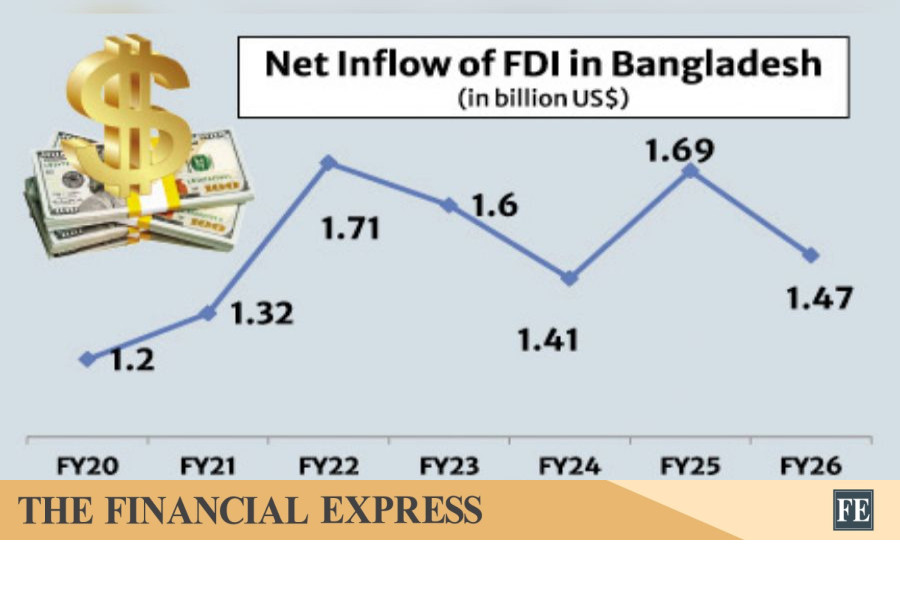
When the global investment forum explores future sectors and destinations for FDI, Bangladesh is struggling to improve its investment climate to attract foreign investment the inflow of which lately has become thin. The declining curve of FDI has become a major concern. Net FDI inflows dropped 13 per cent in the last fiscal year (FY26), according to the latest statistics available with the Bangladesh Bank.

Net FDI inflow fell to $1.47 billion in FY26, down from $1.69 billion in the previous fiscal year (FY25). Thus, net FDI inflow declined again after a 20 per cent surge in FY25. Earlier, in FY24, net FDI inflows declined by around 12 per cent to $1.41 billion from $1.60 billion in FY23.

Bangladesh Bank statistics also showed that last fiscal year, only $365.14 million came as equity capital or fresh foreign direct investment, whereas it was $ 554.77 million in FY25. In FY26, $ 1,026 million came as reinvested earnings by existing multinational entities in Bangladesh, up from $758.11 million in FY25. Only $85.88 million was injected into the net FDI portfolio as intra-company loans in FY26, down from $386 million.

Both domestic and existing foreign investors have already expressed their concerns regarding the poor investment climate and urged the government to take necessary steps to improve it. The investment climate generally refers to the socio-economic and political landscape of a country or region that affects investment attractiveness. Acknowledging the investment gap, the government has already initiated several measures to reduce the cost of doing business.

Two months ago, the government formally launched Invest Bangladesh, Bangladesh's apex investment promotion agency under the Prime Minister's Office. The new entity was created by merging the Bangladesh Investment Development Authority (BIDA), the Bangladesh Economic Zones Authority (BEZA), and the Public-Private Partnership Authority (PPPA). The new agency also operates BanglaBiz, the country's single digital platform for investment services. Investors are expected to access business licences and permits online through the digital platform on a time-bound basis.

More than a decade ago, UNCTAD prepared and published Bangladesh's Investment Policy Review (IPR). The document outlined recommendations to improve the investment climate and attract FDI. Last year, BIDA requested the UN agency to assess the implementation of the IPR recommendations. In response, UNCTAD prepared a report on the implementation of the country's investment policy review. It was unveiled in June last year, and the country's graduation from the Least Developed Country (LDC) category also received attention.

The report's core findings showed that since the IPR's release in 2013, the country has advanced in many areas by improving relevant rules, reducing regulatory complexity, and streamlining procedures to improve the investment climate. For instance, BIDA was created in 2016 by merging the Board of Investment (BoI) and the Privatisation Commission. It also introduced a one-stop service to facilitate investors. Regulatory and institutional reforms were also implemented over the last decade, including labour, taxation, and intellectual property.

Nevertheless, the report pointed out several challenges that continue to limit the country's ability to capitalise on its investment potential fully. UNCTAD thus stressed that the investment-specific legal and institutional framework needs further strengthening. In this connection, it noted a lack of coordination and coherence in formulating and implementing investment, industrial, and trade policies. It also outlines other aspects of the investment environment that still require strengthening. Land-related complexity is underscored there. The UNCTAD report further noted that infrastructure development still requires more integrated planning and stronger institutions.

To improve the investment climate, the report set five priorities for Bangladesh, most of which were also recommended in 2013. The country now needs a national investment policy and a consolidated investment law. Strengthening investment promotion and facilitation activities is essential. It is necessary to focus targeted measures on priority sectors. To mitigate the impact of the erosion of LDC status, engagement with key investment and trade partners needs to be accelerated. Finally, addressing critical investment bottlenecks by improving access to land and infrastructure is essential.

In fact, the barriers to improving the investment climate are well known to all. Although the UN agency does not explicitly mention the deterioration of civic law and order, it is a key barrier to making the investment climate favourable. The business community expected that once an elected government assumed power, the situation would improve gradually. Eight months have already passed since the BNP government assumed power, and concerns about law and order are increasing. Corruption and irregularities on various fronts have also not subsided. These factors are weakening the implementation of policies aimed at creating pro-business environment. A few existing foreign investors have also hinted at winding up their commercial operations. Coupled with the energy crisis and poor governance, it is difficult to be optimistic about attracting more FDI in the coming days.​
 

Bangladesh's four man-made traps
Together they generate the fifth, the poverty trap


1792883509675.webp

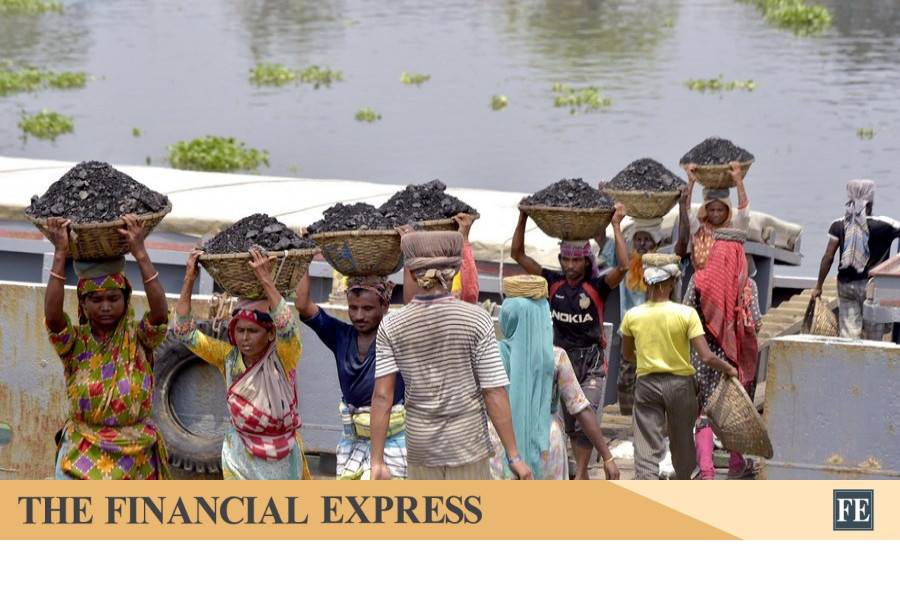
Labourers unload coal from a ship at a riverbank in Dhaka, Bangladesh, on April 30, 2023. Acute poverty forces millions of people in the country to go for low-paid hard work —Xinhua Photo

Bangladesh's economy has long been constrained by four man-made, mutually reinforcing traps: political confrontation, corruption, extortion, and capital flight. Together they generate the fifth or the poverty trap, which in turn sustains the other four. These are not isolated problems but interconnected forces operating within a single matrix. Governments change, development plans multiply, and reform promises are renewed, yet the underlying mechanisms persist.

HOW THE FOUR TRAPS REINFORCE ONE ANOTHER: Political confrontation is the first trap. Democracy requires disagreement and accountability, but rivalry becomes economically destructive when it degenerates into institutional paralysis, intimidation, and retaliation. Political disruptions interrupt transportation, supply chains, and commercial activity, imposing costs on businesses and wage earners. During the hartals and blockades of late October to November 2023, the president of the Federation of Bangladesh Chambers of Commerce and Industry (FBCCI) put the economy's losses at Tk 65 billion per day. The estimate of the business-association has not been independently verified. Businesses postpone investment, policymakers prioritise political survival, and public institutions lose their independence. That uncertainty is the environment in which the other three traps flourish.

Corruption, the second trap, arises from collusion between bureaucrats and politicians, a nexus I have elsewhere termed "bureaupolitigraft," a portmanteau that gives this phenomenon its more precise name: the bureaupolitigraft trap. It converts public authority into private enrichment. Contracts, licenses, loans, and approvals become instruments of favouritism rather than efficiency. Politically connected borrowers secure credit while productive enterprises struggle for financing, and when loans go unpaid, the costs fall on depositors, taxpayers, and the wider economy. According to the World Bank's October 2026 Bangladesh Development Update, non-performing loans reached 33.2 per cent of total loans in June 2026, while private-sector credit growth fell to 4.5 per cent, its lowest level in 33 years. Meanwhile, unsecured liquidity support from Bangladesh Bank to weak banks reached Tk 760 billion, exposing public resources to the consequences of reckless lending. Credit misallocated or lost cannot finance new enterprises, and enterprises deprived of financing cannot create jobs.

Extortion, the third trap, carries institutional abuse into everyday transactions. From highways and transport terminals to markets and footpaths, unauthorized payments raise production, transportation, and distribution costs. Transparency International Bangladesh (TIB) estimated that private buses and minibuses alone pay approximately Tk 10.59 billion annually. The Bangladesh Hawkers Federation has claimed that Dhaka's footpath vendors pay roughly Tk 30 billion annually, although that figure is not independently audited. These payments operate as an unofficial tax with no public accountability and no public benefit. Businesses pass part of the cost to consumers, small enterprises absorb the rest through lower earnings and investment, and the poor bear the heaviest burden.

Capital flight, the fourth trap, is the exit route for illicit wealth. Global Financial Integrity (GFI) estimated approximately $68 billion in trade misinvoicing involving Bangladesh between 2013 and 2022, and a 2024 government-appointed white paper committee estimated annual trade-related outflows at approximately $16 billion. These estimates rest on different indirect methods and should not be read as precise measurements. The World Bank reports that net foreign direct investment (FDI) in FY2026 fell 15 percent to about $1.5 billion, only 0.3 per cent of GDP. Estimated annual trade-related outflows of about $16 billion and net FDI of about $1.5 billion are not directly comparable, since one is a gross estimate and the other a net flow. The gap in their scale nonetheless illustrates Bangladesh's capital-retention problem. Resources that could finance domestic investment and employment leave the economy instead.

POVERTY IS THE FIFTH TRAP: The economic consequences of the four traps ultimately converge on households. Corruption and capital flight shrink the supply of productive credit and investment, so fewer jobs are created. Extortion raises the cost of doing business and daily living. Political confrontation weakens the institutions that might protect either. The result is that income growth slows and economic mobility stalls.

Poverty then feeds back into the traps. A household with no savings, secure employment, or effective legal recourse cannot easily refuse an extortion payment when the alternative is losing its stall or livelihood. Dependence on local patronage for services and employment weakens its bargaining power and makes political manipulation easier. The reported payments by footpath vendors show the cost side of this loop: those least able to absorb the payments are the ones asked to make them, and each payment leaves them poorer and less able to refuse the next. Children from disadvantaged households also face barriers to education, health care, and productive employment, allowing vulnerability to persist across generations. Poverty is therefore both an outcome of the first four traps and a condition that helps preserve them.

Bangladesh's experience also reveals a troubling divergence between economic growth and poverty reduction. According to the World Bank, the poverty-reducing effectiveness of growth began weakening after 2016, as productive employment stagnated and the benefits of expansion became increasingly unequal. The four traps help explain why economic growth, even when sustained, may fail to translate proportionately into employment, household security, and lasting reductions in poverty.

The World Bank estimated that approximately 62 million Bangladeshis were vulnerable to falling into poverty in 2022. This enormous reservoir of economic insecurity illustrates why escaping poverty does not necessarily mean escaping the poverty trap. Households without adequate savings, secure employment, or protection against economic shocks remain vulnerable to the institutional failures that the four traps perpetuate.

The fragility of progress is evident in the World Bank's October 2026 assessment, which estimated that approximately 2.1 million additional Bangladeshis fell into poverty during FY2026. The traps are not the only possible cause of that increase. Nevertheless, a banking system with a 33.2 per cent NPL ratio, exceptionally weak private-sector credit growth, and foreign investment of just 0.3 per cent of GDP provides little foundation for sustained employment expansion. For households with limited savings and insecure earnings, each economic shock increases vulnerability and makes escape from the poverty trap more difficult.

BREAKING THE INTERLOCKING MATRIX: Because the traps are interconnected, isolated reforms are unlikely to produce lasting results. Recapitalising troubled banks without confronting politically connected lending may restore liquidity without accountability. Campaigns against extortion provide temporary relief when the networks responsible remain politically protected. Measures against capital flight require credible financial supervision, transparent trade transactions, and effective enforcement.

The most immediate opportunities lie where these destructive forces intersect. Strengthening banking supervision, resolving failed institutions, recovering misappropriated assets, and scrutinising suspicious trade transactions would weaken the connection between corruption and capital flight. Transparent fee schedules, accountable local administration, and protection against coercive payments would help transport operators, traders, and small entrepreneurs.

Breaking the poverty feedback loop requires complementary measures, designed so that the traps cannot capture them. Social protection delivered through local patronage networks would deepen the dependence it is meant to relieve, so benefits should reach households through direct transfers under published, rules-based eligibility rather than discretionary local channels. The same discipline applies to credit. Lending to small businesses and vulnerable households must not repeat the politically directed allocation that produced today's NPLs, which means transparent criteria, independent appraisal, and public reporting of who receives it. Affordable legal recourse would complete the set, giving households a way to resist coercive payments without relying on a patron. Together these measures would reduce the dependence of vulnerable households and small businesses on political patrons and extortion networks, while improving their prospects for economic mobility.

The most difficult challenge remains political confrontation. Without agreement among competing political forces to protect the independence of the judiciary, central bank, anti-corruption institutions, and regulatory authorities, reforms risk becoming instruments of partisan advantage. Institutional accountability must survive electoral transitions rather than depend on whichever party controls the government.

Bangladesh's transition toward higher-income status requires more than economic growth or changes in political leadership. It requires dismantling the institutional mechanisms of confrontation, corruption, extortion, and capital flight while simultaneously reducing the poverty and vulnerability that allow those mechanisms to reproduce themselves. Unless both sides of this mutually reinforcing matrix are addressed, political transitions may change the beneficiaries of the system without changing the system itself.

The writer is a former physicist and nuclear engineer at the BAEC and professor emeritus of economics at Eastern Michigan University, USA.​
 

Govt wants to establish creative industries as mainstream economy: Finance minister


1792884462874.webp


Finance Minister Amir Khosru Mahmud Chowdhury on Saturday said the government wants to establish creative industries as a mainstream economic sector and a source of Bangladesh's soft power on the global stage.

"Arts and culture, rural handicrafts, music, films and theatre must be integrated into mainstream economic activities to become key drivers of the country's future GDP growth and strengthen Bangladesh's soft power internationally," he said.

The finance minister made the remarks while speaking as the chief guest at the unveiling ceremony of the book Creative Footprints, jointly organised by Standard Chartered Bank and Bengal Foundation at a city hotel.

He said traditional economic thinking had consistently placed arts and culture behind other economic activities. The present government has decided to move beyond that approach and incorporate the creative economy as a new driver of the country's economic aspirations and growth, said a Finance Ministry press release.

The minister said the government alone could not implement all the initiatives required to develop the sector. Strong partnerships with the private sector and non-governmental organisations (NGOs), alongside appropriate policies and financing, would therefore play a crucial role in advancing creative industries.

He said the government had already allocated necessary funds for the sector in the national budget, while private-sector organisations had also shown interest in making substantial investments.

Outlining the government's plans, Amir Khosru said it would provide financial assistance to local artisans, painters and cultural workers, alongside support for skills development, design, branding and marketing through international e-commerce platforms such as Amazon, eBay and Alibaba.

"These initiatives would help marginalised artists and artisans secure fair prices for their products and convert their creative work into sustainable income," he said.

The measures would also improve their living standards, create employment opportunities and contribute to foreign exchange earnings, the minister added.

Emphasising the international significance of Bangladesh's cultural heritage, he said creative industries represented more than art, handicrafts or business; they also served as an important source of the country's soft power.

"Through music, theatre, films and handicrafts, we want to strengthen Bangladesh's position on the global stage," he said.

The finance minister thanked Standard Chartered Bank and Bengal Foundation for their initiative and expressed optimism that joint efforts by the government and private sector would bring about a cultural and economic transformation in the country.

British High Commissioner to Bangladesh Sarah Cooke attended the event as a special guest.

Bengal Foundation Chairman Abul Khair Litu and Standard Chartered Bank Chief Executive Officer Enamul Haque were also present.​
 
Back
Top