
 Bangladesh Defense
Saif
Senior Member
- Jan 24, 2024
- 21,435
- 9,743
- Nation

- Residence
- Axis Group

India fortifies Chicken’s Neck: 3 new garrisons set up on Bangladesh border
India has fortified its eastern border by establishing three new military garrisons along the Indo-Bangladesh frontier to secure the strategic Siliguri Corridor amid shifting regional alliances. This move aims to enhance surveillance and rapid response capabilities in a sensitive area connecting...
India fortifies Chicken's Neck: 3 new garrisons set up on Bangladesh border
India has fortified its eastern border by establishing three new military garrisons along the Indo-Bangladesh frontier to secure the strategic Siliguri Corridor amid shifting regional alliances. This move aims to enhance surveillance and rapid response capabilities in a sensitive area connecting mainland India to its northeast states.

India sets up three new garrisons on Bangladesh border, bolstering chicken’s neck.
India has strengthened its eastern frontier by setting up three new fully operational military garrisons along the Indo-Bangladesh border, at Bamuni (near Dhubri), Kishanganj, and Chopra, to secure the strategic Siliguri Corridor, commonly known as the “Chicken’s Neck”.
According to top intelligence sources, the move is part of a broader plan to plug tactical gaps, enhance surveillance, and boost rapid-response capabilities in one of India’s most sensitive regions.
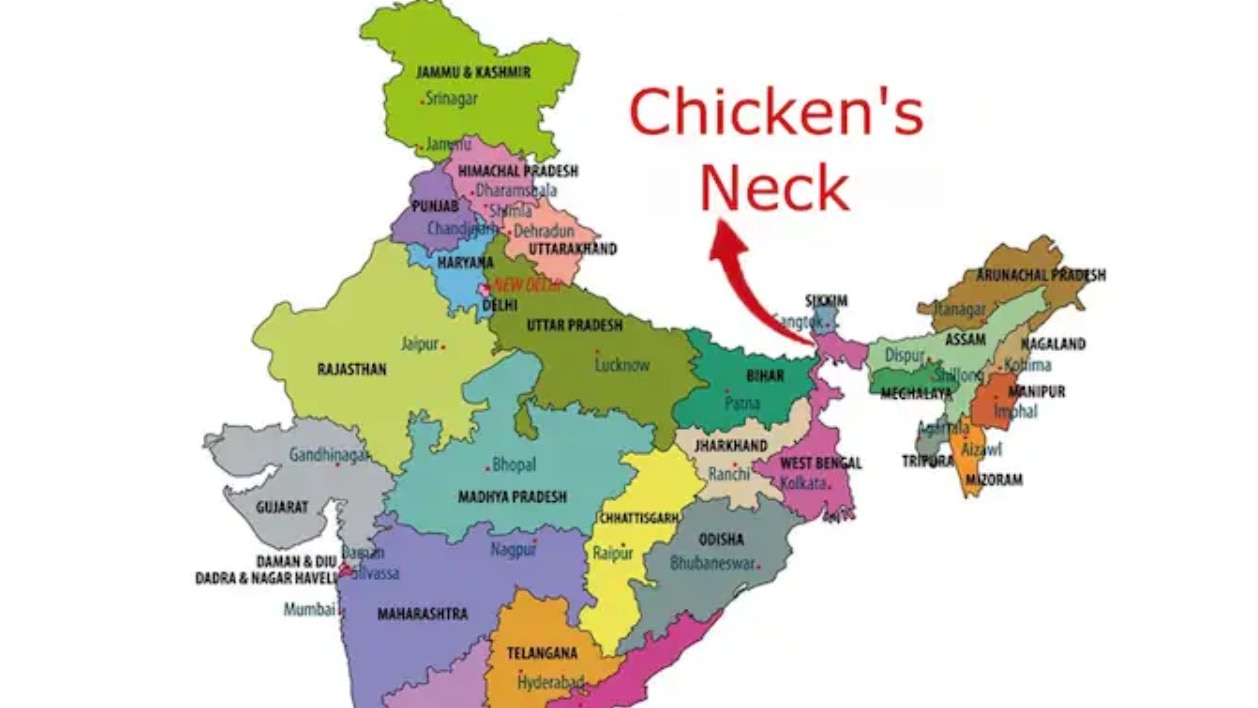
The Siliguri Corridor, a 22-kilometre-wide strip in North Bengal, connects the rest of India with its seven northeastern states and lies sandwiched between Nepal, Bhutan, Bangladesh, and China.
INDIA ON GUARD AS DHAKA REORIENTS POLICY
The development comes amid reports of increased engagement between Bangladesh’s interim Chief Adviser Muhammad Yunus and Pakistan’s military establishment, including a recent meeting with Pakistan’s Joint Chiefs of Staff Chairman General Sahir Shamshad Mirza, reportedly to discuss connectivity and defence cooperation.
Since Yunus took charge following former Prime Minister Sheikh Hasina’s ouster, Bangladesh’s policy direction has undergone a marked shift, with overtures to China for investments and a reset of ties with Pakistan. Intelligence assessments describe this as part of a strategic attempt to “reshape the power balance” in the eastern neighbourhood, potentially affecting the security of the Siliguri Corridor.
‘CHICKEN’S NECK IS OUR STRONGEST LINK’
Contrary to perceptions of vulnerability, senior Indian military officials have emphasised that the region is India’s “strongest defence corridor.”
An Army source said, “The Siliguri corridor is under multi-layered security cover. The new garrisons will enhance our quick mobility, logistics, and real-time intelligence integration.”
Earlier, the Indian Army Chief had remarked, “As far as the Chicken’s Neck is concerned, I see it from a different perspective. It is our strongest region because our entire force deployed in West Bengal, Sikkim and the Northeast can be mobilised there together.”
TRISHAKTI CORPS LEADS SECURITY OF THE CORRIDOR
The Trishakti Corps (33 Corps), headquartered at Sukna near Siliguri, oversees the corridor’s defence. The formation routinely conducts combat and live-fire exercises, including with T-90 tanks, to maintain readiness in high-altitude and riverine terrain.
The corridor’s aerial security is bolstered by the Rafale fighter jets deployed at the Hashimara Airbase in West Bengal, alongside MiG variants and a BrahMos missile regiment, ensuring both offensive and deterrence capability.
LAYERED AIR DEFENCE NETWORK
India has also deployed an advanced triad of air defence systems in the region, the S-400 surface-to-air missiles sourced from Russia, the MRSAM system developed jointly by DRDO and Israel, and the indigenous Aakash missile system. Together, they provide overlapping coverage against aerial and missile threats from the east and northeast.
The S-400 system in the region is specifically meant to deter incursions by Chinese or hostile aircraft into Indian airspace. The Defence Ministry has also recently approved Rs 8,160 crore for two additional regiments of the Akash-Advanced system, featuring new seeker technology and 360-degree engagement capability.
BHAIRAV BATTALIONS AND ASHNI PLATOONS
Following Operation Sindoor, the Indian Army has enhanced its drone warfare capability, creating Ashni platoons with FPV and kamikaze drones, and Bhairav battalions equipped for precision strikes.
Officials said these units are designed for rapid deployment and close integration with ground combat teams.
INDIA’S EVOLVING STRATEGY
With China’s growing footprint in Bangladesh through the Belt and Road Initiative (BRI) and Dhaka’s new overtures to Beijing and Islamabad, Indian agencies view the developments as a potential challenge to regional stability.
“India is alert and has factored in every emerging dynamic,” said a senior military planner. “We are not reacting; we are reinforcing.”
The government’s recent infrastructure and deployment drive, from Rafale squadrons to BrahMos regiments, reflects a deliberate shift from deterrence to dominance in the east.
India has fortified its eastern border by establishing three new military garrisons along the Indo-Bangladesh frontier to secure the strategic Siliguri Corridor amid shifting regional alliances. This move aims to enhance surveillance and rapid response capabilities in a sensitive area connecting mainland India to its northeast states.
India sets up three new garrisons on Bangladesh border, bolstering chicken’s neck.
India has strengthened its eastern frontier by setting up three new fully operational military garrisons along the Indo-Bangladesh border, at Bamuni (near Dhubri), Kishanganj, and Chopra, to secure the strategic Siliguri Corridor, commonly known as the “Chicken’s Neck”.
According to top intelligence sources, the move is part of a broader plan to plug tactical gaps, enhance surveillance, and boost rapid-response capabilities in one of India’s most sensitive regions.
The Siliguri Corridor, a 22-kilometre-wide strip in North Bengal, connects the rest of India with its seven northeastern states and lies sandwiched between Nepal, Bhutan, Bangladesh, and China.
INDIA ON GUARD AS DHAKA REORIENTS POLICY
The development comes amid reports of increased engagement between Bangladesh’s interim Chief Adviser Muhammad Yunus and Pakistan’s military establishment, including a recent meeting with Pakistan’s Joint Chiefs of Staff Chairman General Sahir Shamshad Mirza, reportedly to discuss connectivity and defence cooperation.
Since Yunus took charge following former Prime Minister Sheikh Hasina’s ouster, Bangladesh’s policy direction has undergone a marked shift, with overtures to China for investments and a reset of ties with Pakistan. Intelligence assessments describe this as part of a strategic attempt to “reshape the power balance” in the eastern neighbourhood, potentially affecting the security of the Siliguri Corridor.
‘CHICKEN’S NECK IS OUR STRONGEST LINK’
Contrary to perceptions of vulnerability, senior Indian military officials have emphasised that the region is India’s “strongest defence corridor.”
An Army source said, “The Siliguri corridor is under multi-layered security cover. The new garrisons will enhance our quick mobility, logistics, and real-time intelligence integration.”
Earlier, the Indian Army Chief had remarked, “As far as the Chicken’s Neck is concerned, I see it from a different perspective. It is our strongest region because our entire force deployed in West Bengal, Sikkim and the Northeast can be mobilised there together.”
TRISHAKTI CORPS LEADS SECURITY OF THE CORRIDOR
The Trishakti Corps (33 Corps), headquartered at Sukna near Siliguri, oversees the corridor’s defence. The formation routinely conducts combat and live-fire exercises, including with T-90 tanks, to maintain readiness in high-altitude and riverine terrain.
The corridor’s aerial security is bolstered by the Rafale fighter jets deployed at the Hashimara Airbase in West Bengal, alongside MiG variants and a BrahMos missile regiment, ensuring both offensive and deterrence capability.
LAYERED AIR DEFENCE NETWORK
India has also deployed an advanced triad of air defence systems in the region, the S-400 surface-to-air missiles sourced from Russia, the MRSAM system developed jointly by DRDO and Israel, and the indigenous Aakash missile system. Together, they provide overlapping coverage against aerial and missile threats from the east and northeast.
The S-400 system in the region is specifically meant to deter incursions by Chinese or hostile aircraft into Indian airspace. The Defence Ministry has also recently approved Rs 8,160 crore for two additional regiments of the Akash-Advanced system, featuring new seeker technology and 360-degree engagement capability.
BHAIRAV BATTALIONS AND ASHNI PLATOONS
Following Operation Sindoor, the Indian Army has enhanced its drone warfare capability, creating Ashni platoons with FPV and kamikaze drones, and Bhairav battalions equipped for precision strikes.
Officials said these units are designed for rapid deployment and close integration with ground combat teams.
INDIA’S EVOLVING STRATEGY
With China’s growing footprint in Bangladesh through the Belt and Road Initiative (BRI) and Dhaka’s new overtures to Beijing and Islamabad, Indian agencies view the developments as a potential challenge to regional stability.
“India is alert and has factored in every emerging dynamic,” said a senior military planner. “We are not reacting; we are reinforcing.”
The government’s recent infrastructure and deployment drive, from Rafale squadrons to BrahMos regiments, reflects a deliberate shift from deterrence to dominance in the east.


